


ISO 8124-11:2019
(Main)Safety of toys — Part 11: Chemical toys (sets) other than experimental sets
Safety of toys — Part 11: Chemical toys (sets) other than experimental sets
This document specifies requirements and test methods for the substances and materials used in chemical toys (sets) other than experimental sets. These substances and mixtures are: — those classified as dangerous by the Globally Harmonized System of Classification and Labelling of Chemicals (GHS)[1]; — substances and mixtures which in excessive amounts could harm the health of the children using them and which are not classified as dangerous by the GHS; and — any other chemical substance(s) and mixture(s) delivered with the chemical toy. Additionally, requirements are specified for markings, warnings, safety rules, contents lists, instructions for use and first aid information. This document applies to: — plaster of Paris (gypsum) moulding sets; — oven-hardening plasticised PVC modelling clay sets; — polystyrene granules sets; — embedding sets; — adhesives, paints, lacquers, varnishes, thinners and cleaning agents (solvents) supplied or recommended in model sets.
Sécurité des jouets — Partie 11: Jouets chimiques (coffrets) autres que les coffrets d'expériences
General Information
- Status
- Published
- Publication Date
- 02-May-2019
- Technical Committee
- ISO/TC 181 - Safety of toys
- Drafting Committee
- ISO/TC 181/WG 9 - Chemical toys
- Current Stage
- 9093 - International Standard confirmed
- Start Date
- 21-Jan-2026
- Completion Date
- 12-Feb-2026
Overview
ISO 8124-11:2019 - Safety of toys - Part 11: Chemical toys (sets) other than experimental sets specifies safety requirements and test methods for chemical toys and kits intended for children. The standard covers hazardous substances as classified by the Globally Harmonized System (GHS), chemicals that may be harmful in excessive amounts but not GHS-classified, and any other chemicals supplied with the toy. It also sets requirements for marking, warnings, instructions for use, contents lists and first aid information.
Keywords: ISO 8124-11:2019, safety of toys, chemical toys, GHS, test methods, marking, instructions.
Key Topics and Requirements
- Scope of products: plaster of Paris (gypsum) moulding sets; oven‑hardening plasticised PVC modelling clay sets; polystyrene granules sets; embedding sets; adhesives, paints, lacquers, varnishes, thinners and cleaning agents supplied or recommended in model sets.
- Chemical hazards: addresses substances and mixtures classified as dangerous under GHS, as well as non‑GHS chemicals that can be harmful in excessive amounts.
- Marking and labelling: mandatory information on primary and individual packaging including manufacturer identification and prescribed warning phrases.
- Instructions and warnings: required contents lists, safety rules, adult supervision advice, instructions for safe use, spill handling, disposal and first aid information.
- Packaging and safety: provisions relating to packaging, containment and child safety measures for specific set types (e.g., embedding, polystyrene granules).
- Test methods: standardized analytical procedures are included for laboratory testing, for example:
- determination of plasticisers in oven‑hardening PVC modelling clay,
- measurement of emissions of benzene, toluene and xylenes (BTX) from PVC clay and polystyrene granules,
- determination of styrene content in polystyrene granules,
- determination of organic solvents in adhesives, paints and cleaning agents.
- Documentation: requirements for test reports and critical control points for laboratory verification.
Keywords: plasticised PVC, polystyrene, styrene, benzene toluene xylenes, plasticisers, organic solvents.
Applications and Users
ISO 8124-11:2019 is used by:
- Toy manufacturers and product designers to design safer chemical toy sets and specify compliant components.
- Testing and certification laboratories to perform the standard test methods and prepare compliance reports.
- Regulatory bodies and market surveillance to assess product conformity with toy safety regulations.
- Importers, retailers and quality managers to verify labeling, instructions and packaging meet safety requirements.
- Safety consultants and standards professionals involved in risk assessment, labeling and instructions for use.
Practical uses include product development, pre‑market testing, labeling and packaging review, and regulatory compliance checks.
Related Standards
- Other parts of the ISO 8124 series (general mechanical, flammability, etc.) complement Part 11.
- The Globally Harmonized System (GHS) is referenced for chemical classification and labelling criteria.
Keywords: ISO 8124 series, toy safety standards, GHS compliance.

Frequently Asked Questions
ISO 8124-11:2019 is a standard published by the International Organization for Standardization (ISO). Its full title is "Safety of toys — Part 11: Chemical toys (sets) other than experimental sets". This standard covers: This document specifies requirements and test methods for the substances and materials used in chemical toys (sets) other than experimental sets. These substances and mixtures are: — those classified as dangerous by the Globally Harmonized System of Classification and Labelling of Chemicals (GHS)[1]; — substances and mixtures which in excessive amounts could harm the health of the children using them and which are not classified as dangerous by the GHS; and — any other chemical substance(s) and mixture(s) delivered with the chemical toy. Additionally, requirements are specified for markings, warnings, safety rules, contents lists, instructions for use and first aid information. This document applies to: — plaster of Paris (gypsum) moulding sets; — oven-hardening plasticised PVC modelling clay sets; — polystyrene granules sets; — embedding sets; — adhesives, paints, lacquers, varnishes, thinners and cleaning agents (solvents) supplied or recommended in model sets.
This document specifies requirements and test methods for the substances and materials used in chemical toys (sets) other than experimental sets. These substances and mixtures are: — those classified as dangerous by the Globally Harmonized System of Classification and Labelling of Chemicals (GHS)[1]; — substances and mixtures which in excessive amounts could harm the health of the children using them and which are not classified as dangerous by the GHS; and — any other chemical substance(s) and mixture(s) delivered with the chemical toy. Additionally, requirements are specified for markings, warnings, safety rules, contents lists, instructions for use and first aid information. This document applies to: — plaster of Paris (gypsum) moulding sets; — oven-hardening plasticised PVC modelling clay sets; — polystyrene granules sets; — embedding sets; — adhesives, paints, lacquers, varnishes, thinners and cleaning agents (solvents) supplied or recommended in model sets.
ISO 8124-11:2019 is classified under the following ICS (International Classification for Standards) categories: 97.200.50 - Toys. The ICS classification helps identify the subject area and facilitates finding related standards.
ISO 8124-11:2019 is available in PDF format for immediate download after purchase. The document can be added to your cart and obtained through the secure checkout process. Digital delivery ensures instant access to the complete standard document.
Standards Content (Sample)
INTERNATIONAL ISO
STANDARD 8124-11
First edition
2019-05
Safety of toys —
Part 11:
Chemical toys (sets) other than
experimental sets
Sécurité des jouets —
Partie 11: Jouets chimiques (coffrets) autres que les coffrets
d'expériences
Reference number
©
ISO 2019
© ISO 2019
All rights reserved. Unless otherwise specified, or required in the context of its implementation, no part of this publication may
be reproduced or utilized otherwise in any form or by any means, electronic or mechanical, including photocopying, or posting
on the internet or an intranet, without prior written permission. Permission can be requested from either ISO at the address
below or ISO’s member body in the country of the requester.
ISO copyright office
CP 401 • Ch. de Blandonnet 8
CH-1214 Vernier, Geneva
Phone: +41 22 749 01 11
Fax: +41 22 749 09 47
Email: copyright@iso.org
Website: www.iso.org
Published in Switzerland
ii © ISO 2019 – All rights reserved
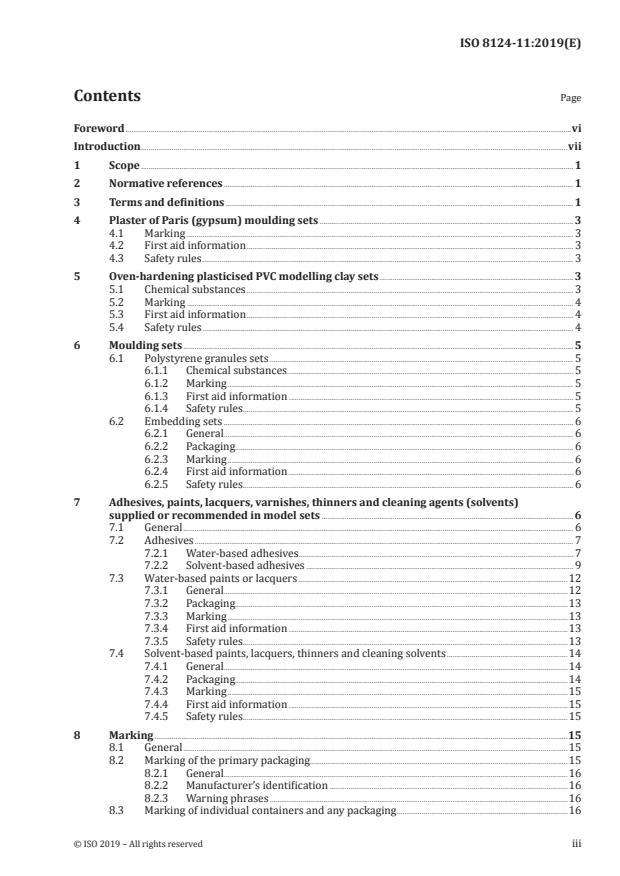
Contents Page
Foreword .vi
Introduction .vii
1 Scope . 1
2 Normative references . 1
3 Terms and definitions . 1
4 Plaster of Paris (gypsum) moulding sets . 3
4.1 Marking . 3
4.2 First aid information . 3
4.3 Safety rules . 3
5 Oven-hardening plasticised PVC modelling clay sets . 3
5.1 Chemical substances . 3
5.2 Marking . 4
5.3 First aid information . 4
5.4 Safety rules . 4
6 Moulding sets . 5
6.1 Polystyrene granules sets . 5
6.1.1 Chemical substances. 5
6.1.2 Marking . 5
6.1.3 First aid information . 5
6.1.4 Safety rules. 5
6.2 Embedding sets . 6
6.2.1 General. 6
6.2.2 Packaging. 6
6.2.3 Marking . 6
6.2.4 First aid information . 6
6.2.5 Safety rules. 6
7 Adhesives, paints, lacquers, varnishes, thinners and cleaning agents (solvents)
supplied or recommended in model sets . 6
7.1 General . 6
7.2 Adhesives . 7
7.2.1 Water-based adhesives . . 7
7.2.2 Solvent-based adhesives . 9
7.3 Water-based paints or lacquers .12
7.3.1 General.12
7.3.2 Packaging.13
7.3.3 Marking .13
7.3.4 First aid information .13
7.3.5 Safety rules.13
7.4 Solvent-based paints, lacquers, thinners and cleaning solvents .14
7.4.1 General.14
7.4.2 Packaging.14
7.4.3 Marking .15
7.4.4 First aid information .15
7.4.5 Safety rules.15
8 Marking .15
8.1 General .15
8.2 Marking of the primary packaging.15
8.2.1 General.16
8.2.2 Manufacturer’s identification .16
8.2.3 Warning phrases .16
8.3 Marking of individual containers and any packaging .16
9 Instructions for use .16
9.1 General .16
9.2 Contents list .16
9.3 Advice for adult supervision .17
9.4 Safety rules .17
9.5 Instructions for carrying out the activities .17
9.6 Spills and disposal of chemicals .18
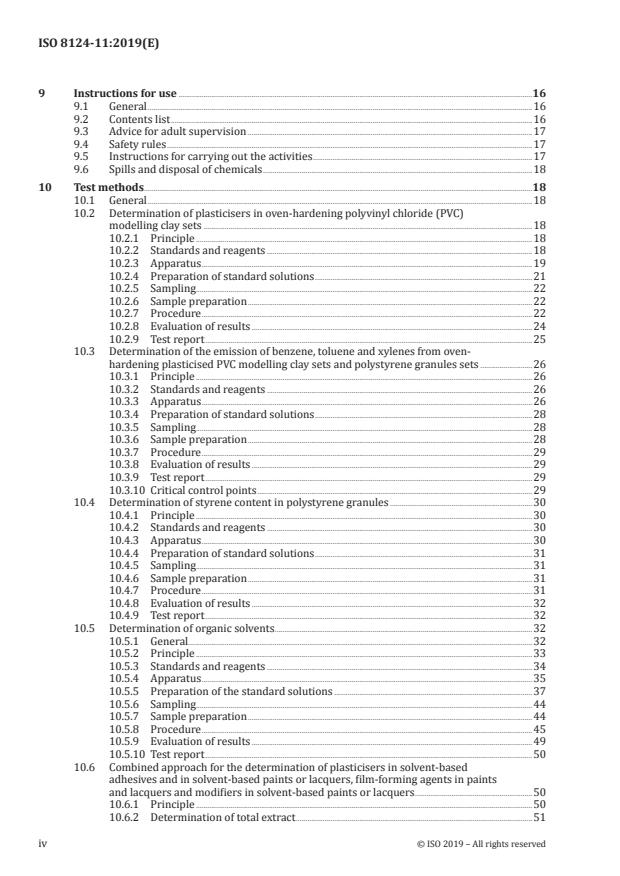
10 Test methods .18
10.1 General .18
10.2 Determination of plasticisers in oven-hardening polyvinyl chloride (PVC)
modelling clay sets .18
10.2.1 Principle .18
10.2.2 Standards and reagents .18
10.2.3 Apparatus .19
10.2.4 Preparation of standard solutions .21
10.2.5 Sampling.22
10.2.6 Sample preparation .22
10.2.7 Procedure .22
10.2.8 Evaluation of results .24
10.2.9 Test report .25
10.3 Determination of the emission of benzene, toluene and xylenes from oven-
hardening plasticised PVC modelling clay sets and polystyrene granules sets .26
10.3.1 Principle .26
10.3.2 Standards and reagents .26
10.3.3 Apparatus .26
10.3.4 Preparation of standard solutions .28
10.3.5 Sampling.28
10.3.6 Sample preparation .28
10.3.7 Procedure .29
10.3.8 Evaluation of results .29
10.3.9 Test report .29
10.3.10 Critical control points .29
10.4 Determination of styrene content in polystyrene granules .30
10.4.1 Principle .30
10.4.2 Standards and reagents .30
10.4.3 Apparatus .30
10.4.4 Preparation of standard solutions .31
10.4.5 Sampling.31
10.4.6 Sample preparation .31
10.4.7 Procedure .31
10.4.8 Evaluation of results .32
10.4.9 Test report .32
10.5 Determination of organic solvents .32
10.5.1 General.32
10.5.2 Principle .33
10.5.3 Standards and reagents .34
10.5.4 Apparatus .35
10.5.5 Preparation of the standard solutions .37
10.5.6 Sampling.44
10.5.7 Sample preparation .44
10.5.8 Procedure .45
10.5.9 Evaluation of results .49
10.5.10 Test report .50
10.6 Combined approach for the determination of plasticisers in solvent-based
adhesives and in solvent-based paints or lacquers, film-forming agents in paints
and lacquers and modifiers in solvent-based paints or lacquers .50
10.6.1 Principle .50
10.6.2 Determination of total extract .51
iv © ISO 2019 – All rights reserved
10.6.3 Identification of nitrocellulose .52
10.6.4 Determination of plasticisers.54
10.6.5 Determination of film-forming agents .54
10.6.6 Determination of the modifiers .59
10.6.7 Test report .60
Annex A (normative) Environmental, health and safety precautions for using the methods
of analysis .61
Annex B (informative) Organic solvents .62
Annex C (informative) Validation of test methods .64
Annex D (informative) Rationale .65
Bibliography .67
Foreword
ISO (the International Organization for Standardization) is a worldwide federation of national standards
bodies (ISO member bodies). The work of preparing International Standards is normally carried out
through ISO technical committees. Each member body interested in a subject for which a technical
committee has been established has the right to be represented on that committee. International
organizations, governmental and non-governmental, in liaison with ISO, also take part in the work.
ISO collaborates closely with the International Electrotechnical Commission (IEC) on all matters of
electrotechnical standardization.
The procedures used to develop this document and those intended for its further maintenance are
described in the ISO/IEC Directives, Part 1. In particular, the different approval criteria needed for the
different types of ISO documents should be noted. This document was drafted in accordance with the
editorial rules of the ISO/IEC Directives, Part 2 (see www .iso .org/directives).
Attention is drawn to the possibility that some of the elements of this document may be the subject of
patent rights. ISO shall not be held responsible for identifying any or all such patent rights. Details of
any patent rights identified during the development of the document will be in the Introduction and/or
on the ISO list of patent declarations received (see www .iso .org/patents).
Any trade name used in this document is information given for the convenience of users and does not
constitute an endorsement.
For an explanation of the voluntary nature of standards, the meaning of ISO specific terms and
expressions related to conformity assessment, as well as information about ISO's adherence to the
World Trade Organization (WTO) principles in the Technical Barriers to Trade (TBT) see www .iso
.org/iso/foreword .html.
This document was prepared by Technical Committee ISO/TC 181, Safety of toys.
A list of all parts in the ISO 8124 series can be found on the ISO website.
Any feedback or questions on this document should be directed to the user’s national standards body. A
complete listing of these bodies can be found at www .iso .org/members .html.
vi © ISO 2019 – All rights reserved
Introduction
This document is intended to reduce the risks and health hazards to children when chemical toys are
used as intended or in a foreseeable way, bearing in mind the behaviour of children.
When using these chemical toys, potential risks should be kept to a minimum by the inclusion of
appropriate information drawing attention to possible hazards, risks and other problems.
The Chemical Abstract Service Registry Numbers (CAS) and European Inventory of Existing Chemical
Substances Numbers (EINECS) given in various tables are provided for information purposes only.
Products covered by this document may be subject to legal requirements specific to the jurisdiction
in which they are sold and conformity with the requirements in this document cannot be relied on to
ensure compliance with those requirements.
INTERNATIONAL STANDARD ISO 8124-11:2019(E)
Safety of toys —
Part 11:
Chemical toys (sets) other than experimental sets
1 Scope
This document specifies requirements and test methods for the substances and materials used in
chemical toys (sets) other than experimental sets. These substances and mixtures are:
— those classified as dangerous by the Globally Harmonized System of Classification and Labelling of
[1]
Chemicals (GHS) ;
— substances and mixtures which in excessive amounts could harm the health of the children using
them and which are not classified as dangerous by the GHS; and
— any other chemical substance(s) and mixture(s) delivered with the chemical toy.
Additionally, requirements are specified for markings, warnings, safety rules, contents lists,
instructions for use and first aid information.
This document applies to:
— plaster of Paris (gypsum) moulding sets;
— oven-hardening plasticised PVC modelling clay sets;
— polystyrene granules sets;
— embedding sets;
— adhesives, paints, lacquers, varnishes, thinners and cleaning agents (solvents) supplied or
recommended in model sets.
2 Normative references
The following documents are referred to in the text in such a way that some or all of their content
constitutes requirements of this document. For dated references, only the edition cited applies. For
undated references, the latest edition of the referenced document (including any amendments) applies.
ISO 3104, Petroleum products — Transparent and opaque liquids — Determination of kinematic viscosity
and calculation of dynamic viscosity
ISO 3219, Plastics — Polymers/resins in the liquid state or as emulsions or dispersions — Determination of
viscosity using a rotational viscometer with defined shear rate
ISO 3696, Water for analytical laboratory use — Specification and test methods
ISO 22854, Liquid petroleum products — Determination of hydrocarbon types and oxygenates in automotive-
motor gasoline and in ethanol (E85) automotive fuel — Multidimensional gas chromatography method
3 Terms and definitions
For the purposes of this document, the following terms and definitions apply.
ISO and IEC maintain terminological databases for use in standardization at the following addresses:
— ISO Online browsing platform: available at https: //www .iso .org/obp
— IEC Electropedia: available at http: //www .electropedia .org/
3.1
chemical toy
toy intended for the direct handling of chemical substances and mixtures and which is used in a manner
appropriate to a given age-group and under the supervision of an adult
[SOURCE: ISO 8124-2:2014, 3.1]
3.2
experimental set
chemical toy (3.1) in which the experimental and explorative character in playing with single chemical
substances and mixtures is guided by strict instructions that dominate over the creative ideas of the user
3.3
plaster of Paris (gypsum) moulding set
toy containing moulds into which a mixture of water and gypsum is poured and allowed to harden
Note 1 to entry: The gypsum consists predominantly of calcium sulfate hemihydrate CaSO4 · 0,5 H O.
Note 2 to entry: Plaster of Paris (gypsum) moulding sets are used, for example, for preparing figures and plates.
3.4
oven-hardening plasticised PVC modelling clay set
toy to be used for creating all kinds of figures, brooches and fashion jewellery, prepared by hardening
in the oven at temperatures of 100 °C to 130 °C
3.5
polystyrene granules set
toy to be used in substitution of ceramic materials to create decorative articles or models by fusion of a
polymer by heating in an oven up to a maximum of 180 °C
3.6
embedding set
toy to be used to preserve certain products in a transparent material
3.7
model set
product used to assemble and coat models which are supplied with or recommend adhesives (3.8),
paints or lacquers (3.9 and 3.10), varnishes (3.11), thinners and cleaning agents (3.12)
Note 1 to entry: Examples for these models include motorcars, aeroplanes, houses and ships.
3.8
adhesive
non-metallic substance capable of joining materials by surface bonding (adhesion) and the bond
possessing adequate internal strength (cohesion)
3.9
water-based paint or lacquer
water-based pigmented material which, when applied in a liquid form to a surface, eventually forms a
dry adherent film or coating
3.10
solvent-based paint or lacquer
solvent-based pigmented material which, when applied in a liquid form to a surface, eventually forms a
dry adherent film or coating
2 © ISO 2019 – All rights reserved
3.11
varnish
low-viscosity lacquer
3.12
thinners and cleaning agents
solvents
products which are intended to obtain the required viscosity of paints and lacquers and to clean tools
and brushes
4 Plaster of Paris (gypsum) moulding sets
4.1 Marking
See D.2 and D.3.
The primary packaging shall, in addition to the marking required in Clause 9, bear the following:
“Warning! Not suitable for children under (*) years. For use under adult supervision. Read the
instructions before use, follow them and keep them for reference.”
(*) The age is to be specified by the manufacturer, authorized representative or importer. It shall not be
below 5 years.
4.2 First aid information
The instructions for use shall, in addition to the general first aid information in 9.2 d), contain the
following:
— “In case of eye contact: Wash out eye with plenty of water, holding eye open. Seek immediate medical
advice.”
— “If swallowed: Wash out mouth with water, drink some fresh water. Do not induce vomiting. Seek
immediate medical advice.”
4.3 Safety rules
The instructions for use shall, in addition to the rules required in 9.4, contain the following safety rules:
— “Do not place the material in the mouth.”
— “Do not inhale dust or powder.”
— “Do not apply to the body.”
5 Oven-hardening plasticised PVC modelling clay sets
5.1 Chemical substances
See D.4.
These modelling clay sets shall consist of PVC (polyvinylchloride) and plasticisers and may contain
modifiers, fillers (e.g. China clay) and colourants. Only plasticisers given in Table 1 shall be used.
The mass fraction of plasticisers in the mixture shall not exceed 30 %.
The vinyl chloride monomer content shall be below 1 mg/kg.
Table 1 — Plasticisers in oven-hardening plasticised PVC modelling clay sets
Chemical substance CAS number
Adipic acid polyesters various
Alkylsulfonic acid esters (C to C ) of phenol 91082–17–6
12 20
Di(isononyl) cyclohexane-1,2-dicarboxylate (DINCH) 166412–78–8
Tributyl acetylcitrate 77–90–7
Tris(2-ethylhexyl) acetylcitrate 144–15–0
During heating of these materials at the maximum permitted temperature and duration, the limits
given in Table 2 shall not be exceeded for the emission of the listed toxic substances when tested
according to 10.3.
Table 2 — Limits for the emission of substances from oven-hardening plasticised PVC modelling
clay sets and polystyrene granules sets during heating
Limit
Substance
mg/kg
Benzene 5
Toluene 15
Xylenes 25
5.2 Marking
See D.2 and D.3.
The primary packaging shall, in addition to the marking required in Clause 9, bear the following
warning:
“Warning! Not suitable for children under (*) years. For use under adult supervision. Read the
instructions before use, follow them and keep them for reference.”
(*) The age is to be specified by the manufacturer, authorized representative or importer. It shall not be
below 8 years.
5.3 First aid information
The instructions for use shall, in addition to the general first aid information in 9.2 d), contain the
following:
— “In case of accidental overheating and inhalation of poisonous gases: Remove person to fresh air and
seek immediate medical advice.”
5.4 Safety rules
The instructions for use shall, in addition to the rules required in 9.4, contain the following safety rules:
— “Do not place the material in the mouth.”
— “Do not exceed a hardening temperature of 130 °C or harmful gases may be produced.”
— “Do not exceed a hardening time of 30 minutes.”
— “The hardening process is not part of the function of the toy and should be carried out by the
supervising adult.”
— “Use a domestic oven thermometer, e.g. bimetal, to measure the temperature.”
4 © ISO 2019 – All rights reserved
— “Do not use a glass thermometer.”
— “Do not heat the material and cook food at the same time in a domestic oven.”
— “Do not use a microwave oven.”
6 Moulding sets
6.1 Polystyrene granules sets
6.1.1 Chemical substances
These sets shall contain uncoloured and coloured polystyrene granules in accordance with Table 3.
Table 3 — Polystyrene
Chemical substance CAS number EINECS number
Polystyrene with monomer content of styrene ≤ 500 mg/kg 9003–53–6 —
6.1.2 Marking
See D.2 and D.3.
The primary packaging shall, in addition to the marking required in Clause 9, bear the following
warnings:
“Warning! Not suitable for children under (*) years. For use under adult supervision. Read the
instructions before use, follow them and keep them for reference.”
(*) The age is to be specified by the manufacturer, authorized representative or importer. It shall not be
below 10 years.
6.1.3 First aid information
The instructions for use shall, in addition to the general first aid information in 9.2 d), contain the
following:
— “In case of accidental overheating and inhalation of poisonous gases: Remove person to fresh air and
seek immediate medical advice.”
6.1.4 Safety rules
The instructions for use shall, in addition to the rules required in 9.4, contain the following safety rules:
— “Do not exceed a melting temperature of 180 °C.”
— “The melting process is not part of the function of the toy and should be carried out by the
supervising adult.”
— “Use a domestic oven thermometer, e.g. bimetal, to measure the temperature.”
— “Do not swallow material.”
— “Do not heat the material and cook food at the same time in a domestic oven.”
— “Do not use a glass thermometer.”
— “Do not exceed the maximum recommended processing period.”
— “Do not use a microwave oven.”
6.2 Embedding sets
6.2.1 General
See D.5.
Only preservatives permitted in foodstuffs and/or cosmetics, except those preservatives which are
only allowed in cosmetic products that are rinsed off after use, shall be used.
NOTE 1 Examples of information on preservatives permitted in cosmetics in Europe and the United States are
provided in References [4] and [5].
Other substances classified as dangerous substances (see Reference [1]) shall not be used in
embedding sets.
NOTE 2 Substances such as gelatine or agar could be utilized with suitable preservation.
6.2.2 Packaging
See D.2.
The name(s) of any preservative(s) used shall be indicated on the primary packaging.
6.2.3 Marking
See D.3.
The packaging shall, in addition to the marking required in Clause 9, bear the following warnings:
“Warning! Not suitable for children under (*) years. For use under adult supervision. Read the
instructions before use, follow them and keep them for reference.”
(*) The age is to be specified by the manufacturer, authorized representative or importer. It shall not be
below 5 years.
6.2.4 First aid information
The instructions for use shall, in addition to the general first aid information in 9.2 d), contain the
following:
— “If swallowed: Wash out mouth with water, drink some fresh water. Do not induce vomiting. Seek
immediate medical advice.”
6.2.5 Safety rules
The instructions for use shall, in addition to the rules required in 9.4, contain the following safety rule:
— “Do not place the preserved material in the mouth.”
7 Adhesives, paints, lacquers, varnishes, thinners and cleaning agents (solvents)
supplied or recommended in model sets
7.1 General
Adhesives, paints, lacquers, varnishes, thinners and cleaning agents (solvents) supplied in model sets
shall conform with the requirements in Clause 7. The instructions included in the set shall mention only
adhesives, paints, lacquers, varnishes, thinners and cleaning agents (solvents) that conform with the
requirements in Clause 7.
6 © ISO 2019 – All rights reserved
7.2 Adhesives
7.2.1 Water-based adhesives
7.2.1.1 General
See D.5.
Water-based adhesives shall consist of water and basic materials. Only basic materials given in Table 4
shall be used. Additionally, water-based adhesives may contain special materials given in Table 5 or
Table 7, preservatives, fillers and modifiers.
Only preservatives permitted in foodstuffs and/or cosmetics, except those preservatives which are
only allowed in cosmetic products that are rinsed off after use, shall be used.
NOTE Examples of information on preservatives permitted in cosmetics in Europe and the United States are
provided in References [4] and [5].
Table 4 — Basic materials for water-based adhesives and water-based paints or lacquers
Chemical substance CAS number EINECS number
Acrylic homo and copolymers — —
Hydrophilic polyurethane containing neither free isocyanate
— —
groups nor aromatic amino-compounds
Polymers and copolymers of monomers permitted for materials
— —
intended to come into contact with foodstuffs
Polyvinyl homo and copolymers — —
Poly(vinyl alcohol) 9002–89–5 209–183–3
Polyvinylpyrrolidone homo and copolymers — —
The basic materials shall be appropriate for food contact. The migration solvent shall be water, grade 3
according to ISO 3696. The contact time shall be approximately 60 min at approximately 40 °C.
7.2.1.2 Liquid adhesives for paper and wood
7.2.1.2.1 General
Special materials for adhesives for paper and wood shall be in accordance with Table 5.
Table 5 — Special materials for adhesives for paper and wood and water-based paints and
lacquers
Chemical substance CAS number EINECS number
Cellulose ethers (e.g. carboxymethylcellulose, methylcellulose) 9004–67–5 —
Dextrin 9004–53–9 232–675–4
Gum arabic 9000–01–5 232–519–5
Starch or modified starch 9005–25–8 232–679–6
Special additives for adhesives for paper and wood shall be in accordance with Table 6.
Table 6 — Special additives for liquid adhesives for paper and wood
Chemical substance CAS number EINECS number
a
Butyl glycolate (Butyl hydroxyacetate) 7397–62–8 230–991–7
b
Caprolactam 105–60–2 203–313–2
Glycerol 56–81–5 200–289–5
Polyacrylamide 9003–05–8 —
Poly(acrylic acid) 9003–01–4 —
Polyethylene glycol 25322–68–3 —
Poly(methacrylic acid) 25087–27–7 —
Polypropylene glycol 25322–69–4 —
Sodium salts of fatty acids (C upwards) — —
Sorbitol 50–70–4 200–061–5
c
2-(2-Butoxyethoxy)ethyl acetate 124–17–4 204–685–9
Xylitol 87–99–0 201–788–0
a
The mass fraction of butyl glycolate shall not exceed 3 %.
b
The mass fraction of caprolactam shall not exceed 5 %.
c
The mass fraction of 2-(2-butoxyethoxy)ethyl acetate shall not exceed 3 %.
The polymers given in Table 6 shall be appropriate for food contact. The migration solvent shall be water
grade 3 according to ISO 3696. The contact time shall be approximately 60 min at approximately 40 °C.
7.2.1.2.2 Packaging
See D.2.
The capacity of the containers for water-based adhesives in a set shall not be more than 100 ml. The
name(s) of any preservative(s) used shall be indicated on the primary packaging.
7.2.1.2.3 Marking
See D.3.
The adhesive container shall, in addition to the marking required in Clause 9, bear the following
warnings:
“Warning! Not suitable for children under (*) years. For use under adult supervision.”
(*) The age is to be specified by the manufacturer, authorized representative or importer. It shall not be
below 5 years.
7.2.1.2.4 First aid information
The instructions for use shall, in addition to the general first aid information in 9.2 d), contain the
following:
— “In case of skin contact: Wash affected area with plenty of water.”;
— “In case of eye contact: Wash out eye with plenty of water, holding eye open. Seek immediate medical
advice.”
7.2.1.3 Adhesive sticks and pastes for paper
7.2.1.3.1 General
Special materials for adhesive sticks and pastes for paper shall be in accordance with Tables 5, 6 and 7.
8 © ISO 2019 – All rights reserved
Table 7 — Special material for adhesive sticks and pastes for paper
Chemical substance CAS number EINECS number
Acrylic homo and copolymers — —
Hydrophilic polyurethane containing neither free isocyanate
— —
groups nor aromatic amino-compounds
Polymers and copolymers of monomers permitted for materials
— —
intended to come into contact with foodstuffs
Polyvinyl homo and copolymers — —
Poly(vinyl alcohol) 9002–89–5 209–183–3
Polyvinylpyrrolidone homo and copolymers — —
Dextrin 9004–53–9 232–675–4
Starch or modified starch 9005–25–8 232–679–6
The special materials shall be appropriate for food contact. The migration solvent shall be water grade 3
according to ISO 3696. The contact time shall be approximately 60 min at approximately 40 °C.
7.2.1.3.2 Packaging
The mass of the adhesive stick in a set shall not exceed 50 g.
7.2.1.3.3 Marking
See D.3.
The packaging, if any, or the adhesive stick container shall, in addition to the marking in Clause 9, bear
the following warning:
“Warning! Not suitable for children under (*) years. For use under adult supervision.”
(*) The age is to be specified by the manufacturer, authorized representative or importer. It shall not be
below 3 years.
7.2.1.3.4 First aid information
The instructions for use shall, in addition to the general first aid information in 9.2 d), contain the
following:
— “In case of skin contact: Wash affected area with plenty of water.”;
— “In case of eye contact: Wash out eye with plenty of water, holding eye open. Seek immediate medical
advice.”
7.2.2 Solvent-based adhesives
7.2.2.1 General
...
Questions, Comments and Discussion
Ask us and Technical Secretary will try to provide an answer. You can facilitate discussion about the standard in here.
Loading comments...