


ISO 10651-1:1993
(Main)Lung ventilators for medical use — Part 1: Requirements
Lung ventilators for medical use — Part 1: Requirements
Is to be used in conjunction with IEC 601-1:1988. Specifies relevant requirements (general requirements, environmental conditions, protection against electric shock hazards, protection against excessive temperatures and other safety hazards, accuracy of operating data and protection against hazardous output, constructional requirements, additional requirements) for lung ventilators, excluding ventilators primarily intended for anaesthesia, home care, transport, and other devices such as jet and high-frequency ventilators. The requirements of this standard take precedence over those of IEC 601-1.
Ventilateurs pulmonaires à usage médical — Partie 1: Prescriptions
General Information
- Status
- Withdrawn
- Publication Date
- 02-Jun-1993
- Withdrawal Date
- 02-Jun-1993
- Current Stage
- 9599 - Withdrawal of International Standard
- Start Date
- 06-Dec-2001
- Completion Date
- 12-Feb-2026
Relations
- Effective Date
- 15-Apr-2008
- Effective Date
- 15-Apr-2008
Get Certified
Connect with accredited certification bodies for this standard

BSI Group
BSI (British Standards Institution) is the business standards company that helps organizations make excellence a habit.

TÜV Rheinland
TÜV Rheinland is a leading international provider of technical services.

TÜV SÜD
TÜV SÜD is a trusted partner of choice for safety, security and sustainability solutions.
Sponsored listings
Frequently Asked Questions
ISO 10651-1:1993 is a standard published by the International Organization for Standardization (ISO). Its full title is "Lung ventilators for medical use — Part 1: Requirements". This standard covers: Is to be used in conjunction with IEC 601-1:1988. Specifies relevant requirements (general requirements, environmental conditions, protection against electric shock hazards, protection against excessive temperatures and other safety hazards, accuracy of operating data and protection against hazardous output, constructional requirements, additional requirements) for lung ventilators, excluding ventilators primarily intended for anaesthesia, home care, transport, and other devices such as jet and high-frequency ventilators. The requirements of this standard take precedence over those of IEC 601-1.
Is to be used in conjunction with IEC 601-1:1988. Specifies relevant requirements (general requirements, environmental conditions, protection against electric shock hazards, protection against excessive temperatures and other safety hazards, accuracy of operating data and protection against hazardous output, constructional requirements, additional requirements) for lung ventilators, excluding ventilators primarily intended for anaesthesia, home care, transport, and other devices such as jet and high-frequency ventilators. The requirements of this standard take precedence over those of IEC 601-1.
ISO 10651-1:1993 is classified under the following ICS (International Classification for Standards) categories: 11.040.10 - Anaesthetic, respiratory and reanimation equipment. The ICS classification helps identify the subject area and facilitates finding related standards.
ISO 10651-1:1993 has the following relationships with other standards: It is inter standard links to ISO 5369:1987, IEC 60601-2-12:2001. Understanding these relationships helps ensure you are using the most current and applicable version of the standard.
ISO 10651-1:1993 is available in PDF format for immediate download after purchase. The document can be added to your cart and obtained through the secure checkout process. Digital delivery ensures instant access to the complete standard document.
Standards Content (Sample)
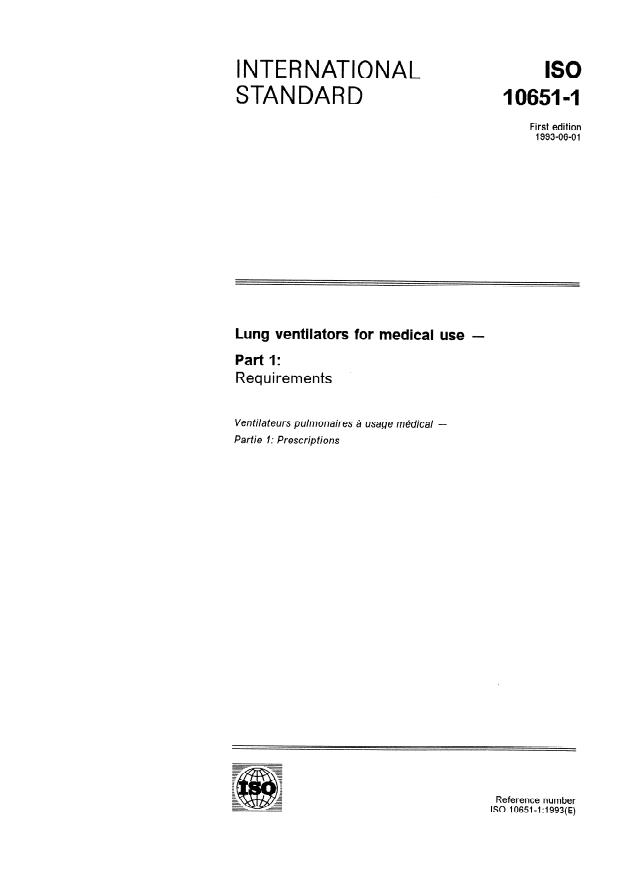
INTERNATIONAL
STANDARD
10651-1
First edi tion
1993-06-0 1
Lung ventilators for medical use -
Part 1:
Requirements .
Ventilateurs pulmonaires a wage medical -
Partie Ir Prescrip tions
Reference number
ISO 10651~1:1993(E)
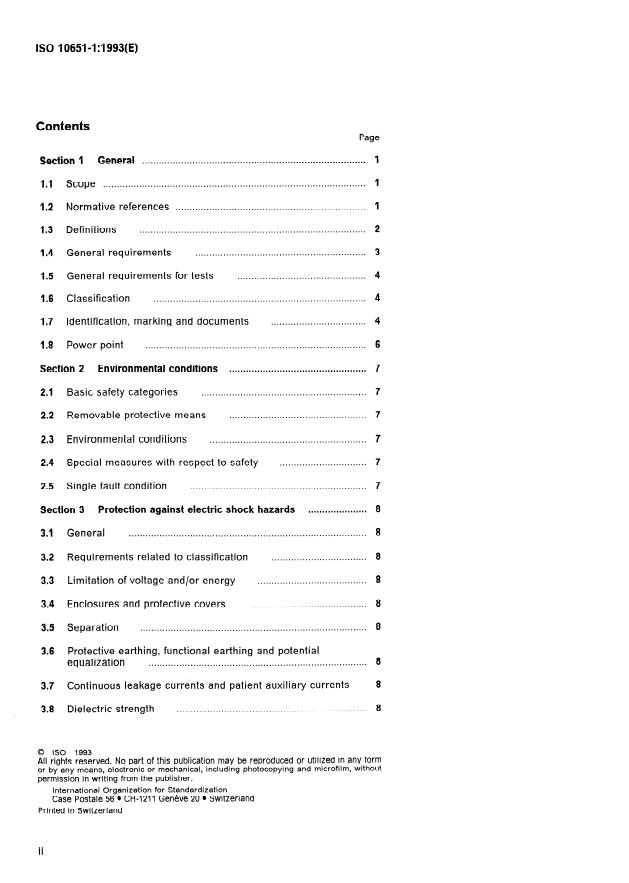
Contents
Page
General . . . . . . . . . . . . . . . . .I.
Section 1
..,............,...............................,..............................................
1.1 Scope
. . . . . . . . . . . . . . . . . . . . . . . . . . . . . . . . . . . . . . . . . . . . . . . . . . . . . . . . . . . . . . . . . . . .
1.2 Normative references
. . . . . . . . . . . . . . . . . . . . . . . . . . . . . . . . . . . . . . . . . . . . . . . . . . . . . . . . . . . . . . . . . . . . . . . . . . . . . . . . .
1.3 Definitions
1.4 General requirements . . . . . . . . . . . . . . . . . . . . . . . . . . . . . . . . . . . . . . . . . . . . . . . . . . . . . . . . . . . . .
1.5 General requirements for tests . . . . . . . . . . . . . . . . . . . . . . . . . . . . . . . . . . . . . . . . . . . . . .
1.6 Classification . . . . . . . . . . . . . . . . . . . . . . . . . . . . . . . . . . . . . . . . . . . . . . . . . . . . . . . . . . . . . . . . . . . . . . . .-.
. . . . . . . . . . . . . . . . .*. 4
1.7 Identification, marking and documents
1.8 Power Point . . . . . . . . . . . . . . . . . . . . . . . . . . . . . . . . . . . . . . . . . . . . . . . . . . . . . . . . . . . . . . . . . . . . . . . . . . . . . . .
Section 2 Environmental conditions . . . . . . . . . . . . . . . . . . . . . . . . . . . . . . . . . . . . . . . . . . . . .~.
. . . . . . . . . . . . . . . . . . . . . . . . . . . . . . . . . . . . . . . . . . . . . . . . . . . . . . . . . . . 7
2.1 Basic safety categories
..,...........~.................................. 7
2.2 Removable protective means
2.3 Environmental conditions . . . . . . . . . . . . . . . . . . . . . . . . . . . . . . . . . . . . . . . . . . . . . . . . . . . . . . . .
. . . . . . . . . . . . . . . . . . . . . . . . . . . . . . . 7
2.4 Special measures with respect to safety
. . . . . . . . . . . . . . . . . . . . . . . . . . . . . . . . . . . . . . . . . . . . . .~.
2.5 Single fault condition
,,.,.,.1.1. 8
Section 3 Protection against electric shock hazards
. . . . . . . . . . . . . . . . . . . . . . . . . . . . . . . . . . . . . . . . . . . . . . . . . . . . . . . . . . . . . . . . . . . . . . . . . . . . . . . . . . . . .
3.1 General
. . . . . . . . . . . . . . . . . . . . . . . . . . . .s. 8
3.2 Requirements related to classification
. . . . . . . . . . . . . . . . . . . . . . . . . . . . . . . . . . . . . . .
3.3 Limitation of voltage and/or energy
3.4 Enclosures and protective covers ,.,.,.
. . . .-.
3.5 Separation
3.6 Protective earthing, functional earthing and potential
. . . . . . . . . . . . . . . . . . . . . . . . . . . . . . . . . . . . . . . . . . . . . . . . . . . . . . . . . . . . . . . . . . . . . . . . . . . . . .
equalization
3.7 Continuous leakage currents and Patient auxiliary currents
. . . . . . . . . . . .m.m. 8
. . . . . . . . . . . . . . . . . . . . . . . . . . . . . . . . . . . . . . .
3.8 Dielectric strength
0 ISO 1993
All rights reserved. No part of this publication may be reproduced or utilized in any form
or by any means, electronie or mechanical, including photocopying and microfilm, without
Permission in writing from the publisher.
International Organization for Standardization
Case Postale 56 l CH-1211 Geneve 20 0 Switzerland
Printed in Switzerland
ii
ISO 106514:1993(E)
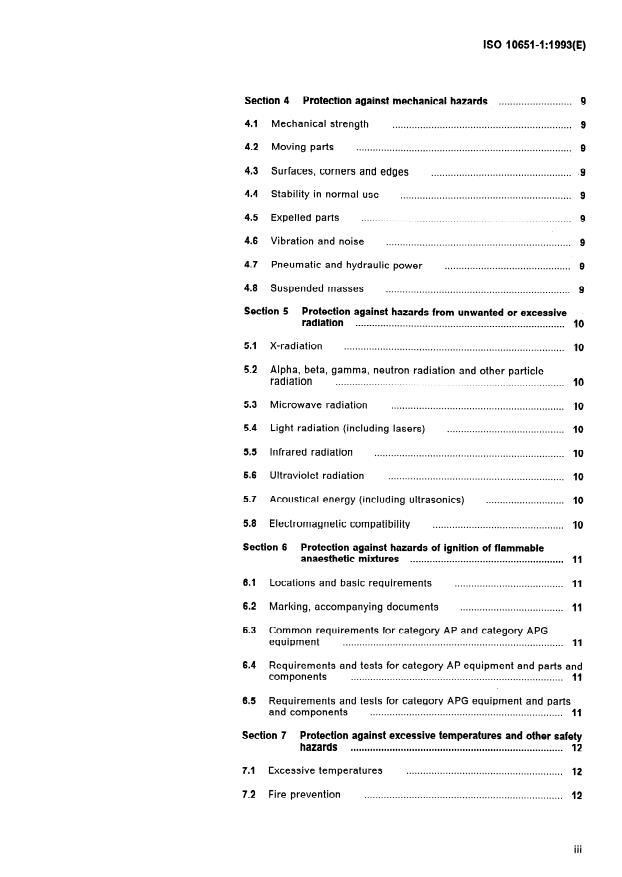
Section 4 Protection against mechanical hazards . . . . . . . . .*.“. 9
4.1 Mechanical strength . . . . . . . .*. 9
4.2 Moving Parts
. . . . . . . . . . . . . . . . . . . . . . . . . . . . . . . . . . . . . . . . . . . . . . . . . . . . . . . . . . . . . . . . . . . . . . . . . . . . . 9
4.3 Surfaces, corners and edges . ,9
4.4 Stability in normal use
............................................................. 9
4.5 Expelled Parts
........................................................................... 9
4.6 Vibration and noise . . . . . . . . . . . . . . . . . . . . . . . . . . . . . . . . . . . . . . . . . . . . . . . . . . . . . . . . . . . . . . . . . .
4.7 Pneumatic and hydraulic power
. . . . . . . . . . . . . . . . . . . . . . . . . . . . . . . . . . . . . . . . . . . . . 9
4.8 Suspended masses . . . . . . . . . . . . . . . . . . . . . . . . . . . . . . . . . . . . . . . . . . . . . . . . . . . . . . . . . . . .*. 9
Section 5 Protection against hazards from unwanted or excessive
radiation . . . . . . . . . . . . . . . . . . . . . . . . . . . . . . . . . . . . . . . . . . . . . . . . . . . . . . . . . . . . . . . . . . . . . . . . . . .
5.1 X-radiation . . . . . . . . . . . . . . . . . . . . . . . . . . . . . . . . . . . . . . . . . . . . . . . . . . . . . . . . . . . . . . . . . . . . . . . . . . . . . . .
Alpha, beta, gamma, neutron radiation and other particle
5.2
radiation . . . . . . . . . . . . . . . . . . . . . . . . . . . . . . . . . . . . . . . . . . . . . . . . . . . . . . . . . . . . . . . . . . . . . . . . . . . . . . . . . .
5.3 Microwave radiation . . . . . . . . . . . . . . . . . . . . . . . . . . . . . . . . . . . . . . . . . . . . . . . . . . . . . . . . . . . . . .
IO
5.4 Light radiation (including lasers) . . . . . . . . . . . . . . . . . . . . . . . . . . . . . . . . . . . . . . . . . . 10
5.5 Infrared radiation . . . . . . . . . . . . . . . . . . . . . . . . . . . . . . . . . . . . . . . . . . . . . . . . . . . . . . . . . . . . . . . . . . . . 10
5.6 Ultraviolet radiation . . . . . . . . . . . . . . . . . . . . . . . . . . . . . . . . . . . . . . . . . . . . . . . . . . . . . . . . . . . . . . . 10
5.7 Acoustical energy (including ultrasonics) . . . . . . . . . . . . . . . . . . . . . . . . . . . . 10
5.8 Electromagnetit compatibility . . . . . . . . . . . . . . . .*.
Section 6 Protection against hazards of ignition of fiammable
anaesthetic mixtures .,.,.,~.~., 11
6.1 Locations and basic requirements . . . . . . . . . . . . . . . . . . . . . . . . . . . . . . . . . . . . . . . 11
6.2 Marking, accompanying documents . . . . . . . . . . . . . . . . . . . . . . . . . . . . . . . . . . . . . 11
Common requirements for category AP and category APG
6.3
equipment . . . . . . . . . . . . . . . . . . . . . . . . . . . . . . . . . . . . . . . . . . . . . . . . . . . . . . . . . . . . . . . . . . . . . . . . . . . . . . . 11
6.4 Requirements and tests for category AP equipment and Parts and
. . . . . . . . . . . . . . . . . . . . . . . . . . . . . . . . . . . . . . . . . . . . . . . . . . . . . . . . . . . . . . . . . . . . . . . . . . . .
components 11
6.5 Requirements and tests for category APG equipment and Parts
and components . . . . . . . . . . . . . . . . . . . . . . . . . . . . . . . . . . . . . . . . . . . . . . . . . . . . . . . . . . . . . . . . . . . . . 11
Section 7 Protection against excessive temperatures and other safety
,,,,,,.,.,,.~.,.,,,.
hazards 12
7.1 Excessive temperatures . . . . . . . . . . . . . . . . . . . . . . . . . . . . . . . . . . . . . . . . . . . . . . . . . . . . . . . .
7.2 Fire prevention . . . . . . . . . . . . . . . . . . . . . . . . . . . . . . . . . . . . . . . . . . . . . . . . . . . . . . . . . . . . . . . . . . . . . . . 12
. . .
Ill
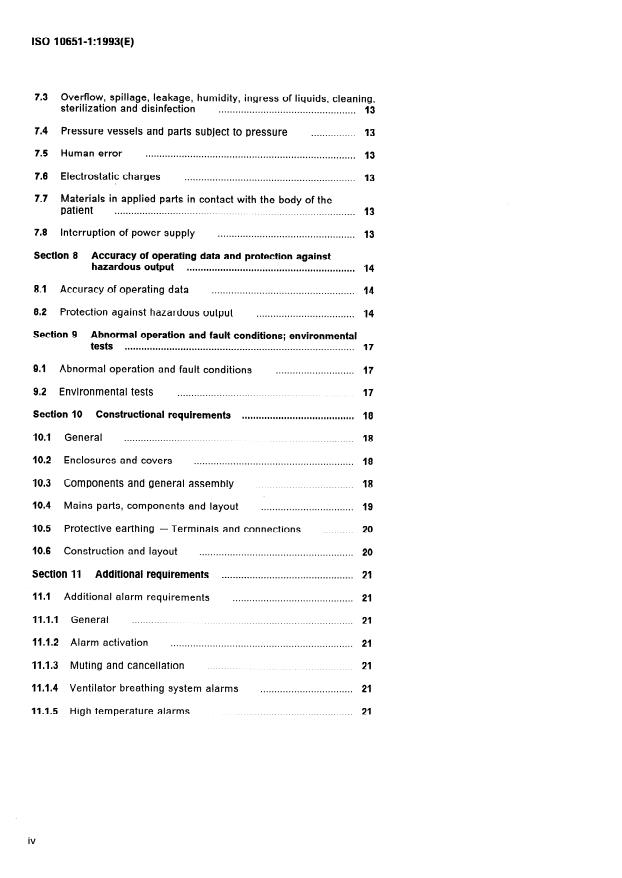
7.3 Overflow, spillage, leakage, humidity, ingress of liquids, cleaning,
sterilization and disinfection . . . . . . . . . . . . . . . . . . . . . . . . . . . . . . . . . . . . . . . . . . . . . . . . .
7.4 Pressure vessels and Parts subject to pressure
. . . . . . . . . . . . . . . . 13
7.5 Human error . . . . . . . . . . . . . . . . . . . . . . . . . . . . . . . . . . . . . . . . . . . . . . . . . . . . . . . . . . . . . . . . . . . . . . . . . . .
7.6 Electrostatic charges . . . . . . . . . . . . . . . . . . . . . . . . . . . . . . . . . . . . . . . . . . . . . . . . . . . . . . . . . . . . .
7.7 Materials in applied Parts in contact with the body of the
Patient . . . . . . . . . . . . . . . . . . . . . . . . . . . . . . . . . . . . . . . . . . . . . . . . . . . . . . . . . . . . . . . . . . . . . . . . . . . . . .*.
7.8 Interruption of power supply
. . . . . . . . . . . . . . . . . . . . . . . . . . . . . . . . . . . . . . . . . . . .~. 13
Section 8 Accuracy of operating data and protection against
hazardous output .1.*.,.,. 14
8.1 Accuracy of operating data . . . . . . . . . . . . . . . . . . . . . . . . . . . . . . . . . . . . . . . . . . . . . . . . . . . 14
8.2 Protection against hazardous output
. . . . . . . . . . . . . . . . . . . . . . . . . . . . . . . . . . . 14
Section 9 Abnormal Operation and fault conditions; environmental
tests . . . . . . . . . . . . . . . . . . . . . . . . . . . . . . . . . . . . . . . . . . . . . . . . . . . . . . . . .*.
9.1 Abnormal Operation and fault conditions . . . . . . . . . . . . . . . . . . . . . . . . . . . . 17
9.2 Environmental tests . . . . . . . . . . . . . . . . . . . . . . . . . . . . . . . . . . . . . . . . . . . . . . . . . . . . . . . . . . . . . . . 17
Section 10 Constructional requirements . . . . . . . . . . . . . . . . . .1. 18
10.1 General . . . . . . . . . . . . . . . . . . . . . . . . . . . . . . . . . . . . . . . . . . . . . . . . . . . . . . . . . . . . . . . . . . . . . . . . . . . . . . . . . . 18
10.2 Enclosures and covers
. . . . . . . . . . . . . . . . . . . . . . . . . . . . . . . . . . . . . . . . . . . . . . . . . . . . . . . . . 18
10.3 Components and general assembly . . . . . . . . . . . . . . . . . . . . . . . . . . . . . . . . . . . 18
10.4 Mains park, components and layout 19
. . . . . . . . . . . . . . . . . . . . . . . . . . . . . . . . .
10.5 Protective earthing - Terminals and connections . . . . . . . . . . , 20
10.6 Construction and layout . . . . . . . . . . . . . . . . . . . . . . . . . . . . . . . . . . . . . . . . . . . . . . . . . . . . . . . 20
Section 11 Additional requirements .1.11,.11.,,.1.~. 21
11.1 Additional alarm requirements . . . . . . . . . . . . . . . . . . . . . . . . . . . . . . . . . . . . . . . . . . . 21
11.1.1 General . . . . . . . . . . . . . . . . . . . . . . . . . . . . . . . . . . . . . . . . . . . . . . . . . . . . . . . . . . . . . . . . . . . . . . . . . . . . . . . 21
11.1.2 Alarm activation . . . . . . . . . . . . . . . . . . . . . . . . . . . . . . . . . . . . . . . . . . . . . . . . . . . . . . . . . . . . . . . . .
11.1.3 Muting and cancellation . . . . . . . . . . . . . . . . . . . . . . . . . . . . . . . . .~.
. . . . . . . . . . . . . . . . . . . . . . . . . . . . . . . . . 21
11.1.4 Ventilator breathing System alarms
11.1.5 High temperature alarms . . . . . . . . . . . . . . . . . . . . . . . . . . . . . . . . . . . . . . . . . . . . . . . . . .
iv
ISO 106!51=1:1993(E)
Foreword
ISO (the International Organization for Standardization) is a worldwide
federation of national Standards bodies (ISO member bodies). The work
of preparing International Standards is normally carried out through ISO
technical committees. Esch member body interested in a subject for
which a technical committee has been established has the right to be
represented on that committee. International organizations, govern-
mental and non-governmental, in liaison with ISO, also take patt in the
work. ISO collaborates closely with the International Electrotechnical
Commission (IEC) on all matters of electrotechnical standardization.
Draft International Standards adopted by the technical committees are
circulated to the member bodies for voting. Publication as an Inter-
national Standard requires approval by at least 75 % of the member
bodies casting a vote.
International Standard ISO 106514 was prepared by Technical Commit-
tee ISO/TC 121, Anaesthetic and respiratory equipment, Sub-Committee
SC 3, Lung ventiiators and related equipment.
This fit-st edition of ISO 10651-1 cancels and replaces the first edition of
of ISO 5369, published in 1988, and IEC 601-2-12:1988, of both of which
it constitutes a technical revision and amplification.
ISO 10651 consists of the following Parts, under the general title Lung
ventilators for medical use:
- Part 1: Requirements
- Part 2: Particular requirements for home care ventilators
transport
- Part 3: Particular requiremen ts for emergency
ven tila tors
V
This page intentionally leff blank
~--~- -
ISO 106514:1993(E)
INTERNATIONAL STANDARD
Lung ventilators for medical use -
Part 1:
Requirements
Section 1: General
IEC and ISO maintain registers of currently valid
1.1 Scope
International Standards.
ISO 10651 is one of a series of International Stan-
ISO 32:1977, Gas cylinders for medical use - Mark-
dards based on IEC 601-1:1988. In IEC 601-1:1988
ing for identification of content.
(the “General Standard”), this type of International
Standard is referred to as a “Particular Standard”.
ISO 4135:1979, Anaesthesiology - Vocabulary.
As stated in 1.3 of IEC 601-1:1988, the requirements
of this International Standard take precedence over
ISO 5356-1 :1987, Anaesthetic and respiratory equip-
those of IEC 60%1:1988.
ment - Conical connectors - Part 1: Cones and
sockets.
This International Standard is a revision and ampli-
fication of IEC 60%2-12:1988, Medical electrical
equipmen t - Part 2: Particular requirements for the ISO 5356-2: 1987, Anaesthetic and respiratory equip-
safety of lung ventilators for medical use. lt includes ment - Conical connectors - Part 2: Screw-
requirements from ISO 5369:1988 and replaces both threaded weight-bearing connectors.
documents.
ISO 5359:1989, Low-pressure f7exible connecting as-
The scope and Object given in clause 1 of
semblies Chose assemblies) for use with medical gas
IEC 60%1:1988 applies except that 1.1 shall be re-
Systems.
placed by the following:
ISO 5362:1986, Anaesthetic reservoir bags.
This part of ISO 10651 specifies requirements for
lung Ventilators intended for medical use, excluding
ISO 5367:1991, Breathing tubes intended for use with
Ventilators primarily intended for anaesthesia, home
anaesthetic apparatus and ventilators.
care, transport, and other devices such as jet and
high-frequency Ventilators.
ISO 7767:1988, Oxygen analyzers for moniforing pa-
tient breathing mixtures - Safety requirements.
1.2 Normative references
ISO 8185:1988, Humidifiers for medical use - Safety
requirements.
The following Standards contain provisions which,
through reference in this text, constitute provisions
ISO 9360:1992, Anaesthetic and respiratory equip-
of this part of ISO 10651. At the time of publication,
ment - Heat and moisture exchangers for use in
the editions indicated were valid. All Standards are
humidifying respired gases in humans.
subject to revision, and Parties to agreements based
on this part of ISO 10651 are encouraged to investi-
ISO 9703~1:1992, Anaesthesia and respiratory care
gate the possibility of applying the most recent edi-
alarm Signals - Part 1: Visuai alarm Signals.
tions of the Standards indicated below. Members of
ISO 106514:1993(E)
IEC 65:1985, Safety requirements for mains operated
1.3.9 expiratory Phase: Interval from the Start of
elecfronic and related apparatus for household and
expiratory flow to the Start of inspiratory flow.
similar general use.
1.3.10 flow-direction-sensitive component: Com-
IEC 6014 3988, Medical electrical equipment -
ponent through which the gas flow has to be in one
Part 1: General requiremen ts.
direction only for its proper functioning and/or pa-
tient safety.
IEC 80%2:1991, Elecfromagnetic compatibility for
industrial-process measurement and control equip-
1.3.11 fresh gas: Gas supplied to the lung Ventilator
ment - Part 2: Elec tros ta tic discharge requiremen ts.
breathing System. lt excludes the following:
a) air drawn through the emergency air intake port;
1.3 Definitions
b) air drawn through leaks in the Ventilator breath-
ing System;
For the purposes of this part of ISO 10651, the defi-
nitions given in clause 2 of IEC 601-1:1988 apply ex-
c) expired gas from the Patient.
cept that the definition given in 2.1.5 shall be
replaced by the following?
1.3.12 fresh gas Input port: Gas input port to which
[2.1.5] applied Part:‘) All Parts of the Ventilator in- fresh gas is supplied.
tended to be connected to the Patient or to the
NOTE 1 There may be more than one fresh gas input
breathing System.
port.
For the purposes of this part of ISO 10651, the fol-
lowing additional definitions also apply. 1.3.13 fresh gas intake port: Gas intake port, other
than the emergency air intake port, through which
fresh gas may be drawn into the Ventilator breathing
1.3.1 bacterial filter: Device intended to reduce
System by the lung Ventilator or the Patient.
bacteria content and particulate matter content of
the gas stream.
1.3.14 gas exhaust port: Port of the lung Ventilator
from which gas is discharged to the atmosphere ei-
1.3.2 calibrated control: Control with numbered
ther directly or via an anaesthetic gas scavenging
marks in which the numbers purport to indicate the
System.
value of the Parameter being controlled, whether or
not the control has been individually calibrated.
1.3.15 gas input port: Port to which gas is supplied
under positive pressure and through which the gas
1.3.3 clearly legible: Visual attribute of informat’ion
is driven by this pressure.
displayed by the equipment that allows the Operator
to discern (or identify) qualitative or quantitative
NOTES
values or functions under a specific set of environ-
mental conditions.
2 The gas may be supplied either at a controlled pres S-
ure and/or at a controlled flow.
1.3.4 cycling pressure: Pressure in the Ventilator
3 c.f. gas intake Port.
breathing System which initiates an inspiratory or
expiratory Phase.
1.3.16 gas lntake port: The port through which gas
is drawn into the Ventilator breathing System by the
1.3.5 driving gas:
Gas which powers the lung
lung Ventilator or the Patient.
Ventilator but is not necessarily delivered to the pa-
tient.
NOTES
1.3.6 driving gas input po& Gas input port to which
4 Gas may be supplied to the port at or about ambient
driving gas is supplied.
atmosphere or end-expiratory pressure, or the port may
simply be left open to the atmosphere.
1.3.7 emergency air lntake port: Dedicated gas in-
5 In a Ventilator breathing System, energy is required to
take port through which ambient air may be drawn
reduce the pressure below that of the atmosphere.
when the supply of fresh and/or inflating gas is in-
Therefore, when gas is supplied at or about atmospheric
sufficient.
pressure to a gas intake Port, work has to be done, either
by the lung Ventilator (using energy from, for example, an
1.3.8 expired tidal volume: Volume of gas leaving
electrical supply or a driving gas supply) or by the Patient
the patient’s lungs during an expiratory Phase. in Order to lower the breathing System pressure suf-
1) See also annex L in this part of ISO 10651.
ISO 10651=1:1993(E)
ficiently for gas to flow in through the gas intake Port. In NOTE 7 Even if not adjustable, this maximum may be
this sense, gas is “drawn” into the breathing System. A less than the maximum limited pressure.
similar argument applies, even if gas is supplied to the
gas intake port at a small positive pressure to compen-
1.3.28 minimum limlted pressure, Piim min: Lowest
sate for the use of positive end-expiratory pressure.
(most negative) pressure measured at’ the Patient
connection port, which tan be attained in the
1.3.17 gas output Port: Port of a lung Ventilator
Ventilator breathing System during malfunction of
through which gas is delivered through a tube to the
the Ventilator but with a functioning safety mech-
Patient connection Port.
anism.
See note 6.
NOTE 8
1.3.18 gas return port: Port of the lung Ventilator
through which gas is returned at respiratory press-
1.3.29 minimum working pressure, Pw min: Lowest
ures through a tube from the Patient connection
(most negative) pressure which tan be’ attained at
.
Port
the Patient connection port during the expiratory
Phase, irrespective of the setting of controls other
1.3.19 high pressure gas input port: Gas input port
than any control intended to adjust this pressure,
to which gas is supplied at a pressure greater than
with the Ventilator working normally.
100 kPa.
1.3.30 operator’s Position: Intended orientation of
1.3.20 inflating gas: Fresh gas which powers the
the Operator with respect to the equipment for
lung Ventilator and is supplied to the Patient.
normal use according to the instructions for use.
1.3.21 inflating gas input port: Gas input port to
1.3.31 Patient connectlon port (of the Ventilator
which inflating gas is supplied.
breathing System): Port of the Ventilator breathing
System to which the Patient may be connected.
1.3.22 inspiratory Phase: Interval from the Start of
inspiratory flow to the statt of expiratory flow.
1.3.32 triggering: Initiation of the inspiratory Phase
of the lung Ventilator by the inspiratory effort of the
Patient.
1.3.23 low pressure gas input port: Gas input port
to which gas is supplied at a pressure not exceeding
1.3.33 Ventilation, R Volume of gas per minute en-
100 kPa.
tering or leaving the patient’s lungs.
1.3.24 lung Ventilator: Any device which is intended
1.3.34 Ventilator breathing System (VBS): Breathing
to augment automatically or provide Ventilation of
System bounded by the low pressure gas input
the patient’s lungs when connected to the patient’s
port(s), the gas intake port(s) and the Patient con-
airway, referred to as a Ventilator throughout this
nection port together with the fresh gas inlet and
document.
exhaust port(s), if these are provided.
1.3.25 manual ventilation port: Port of the Ventilator
NOTES
to which a device may be connected for manual in-
flation of the lungs.
9 Attention is drawn to the definition of a breathing sys-
tem in ISO 4135.
1.3.26 maxlmum limited pressure, I’lim max: Highest
10 Gas supplied to the Ventilator at any gas input port
pressure measured at the Patient connection port
enter the Ventilator breathing System at any Point.
maY
which tan be attained in the Ventilation breathing
System during malfunction of the Ventilator but with
Valves may be placed anywhere in relation to ports
a functioning safety mechanism.
and, indeed, anywhere in the Ventilator breathing System,
provided the requirements of this part of ISO 10651 are
met.
NOTE 6 Components of a Ventilator are operating
normally when individually they operate as the manufac-
turer intended, even though particular combinations of
settings of controls and of the compliance and resistance 1.4 General requirements
of the patient’s respiratory tract may lead to an inappro-
priate Pattern of Ventilation.
The general requirements given in clause 3 of
IEC 60%1:1988 apply with the following addition:
1.3.27 maximum worklng pressure, Pw max: Highest
pressure which tan be attained at the ‘Patient con- 3.6j) Applicable Single fault conditions are short-
nection port during the inspiratory Phase, irrespec- and open-circuits of components of wiring which
tive of the setting of controls other than any control tan
intended to adjust this pressure, with the Ventilator
working normally.
- Cause Sparks to occur, or
ISO 10651~1:1993(E)
ab) Any high pressure gas input port shall be
- increase the energy of Sparks, or
marked in accordance with ISO 5359.
- increase temperatures.
ac) If Parts are marked, the following terms shall
be used at least in the national language or
A Single fault condition shall not Cause a moni-
English. Alternatively, Symbols may be used
toring and/or alarm device as in 8.2 and 11.1, and
and explained in the instructions for use:
the corresponding Ventilation control function
shall not fail in such a way that the monitoring
1 Driving gas input port: “driving gas in-
function becomes simultaneously ineffective, and
Jl
Put
thus fails to detect the loss of the monitored
Ventilator function.
2 Inflating gas input Port: “inflating gas
input” or “driving and fresh gas input”,
Test for compliance by Simulation of a Single
as appropriate
fault condition or by visual inspection.
3 Fresh gas input port: “fresh gas”
1.5 General requirements for tests
4 Fresh gas intake port: “fresh gas
intake”
The requirements given in clause 4 of IEC 601-1:1988
5 Emergency air intake port: “WARNING:
aPPlY l
emergency air intake - do not
obstruct”
1.6 Classification
6 Manual Ventilation port: “bag”
The classification given in clause 5 of IEC 601-1:1988
7 Gas output port: “gas output”
applies.
8 Gas return port: “gas return”
NOTE 12 A Ventilator may have applied Parts of differ-
ent types.
9 Gas exhaust port: “exhaust”. If the vol-
ume of gas discharged from the exhaust
port is either more or less than the ex-
1.7 Identification, marking and documents
pired volume, additionally: “not for
spirometer”
The requirements given in clause 6 of IEC 601-1:1988
apply except for the following additions and modifi-
ad) A Checklist indicating the procedures to be
cations.
carried out by the user immediately before
use shall be permanently attached to the
a) Amend 6.1 e) as follows:
Ventilator. The use of electronie displays,
e.g. a CRT, is permitted.
The address of the manufacturer and/or author-
ized representative, as applicable, shall also be
ae) If auxiliary mains socket outlet(s) tan accept
marked.
a mains plug, the auxiliary mains socket
outlet(s) shall be marked with Symbol 14
b) Amend 6.1 j) as follows:
given in table Dl in Appendix D of
IEC 601-1:1988.
The power input marking shall be given in am-
peres for the Ventilator and for the sum of the
af) If gas-specific colour coding of flow controls
current ratings for the Ventilator and auxiliary
and flexible hoses is provided, it shall be in
mains socket outlets.
accordance with ISO 32.
c) Amend 6.1 k) as follows:
ag) Packages containing breathing attachments
intended for Single use shall be clearly
The requirement for marking of auxiliary mains
marked with the following:
socket outlets shall apply to each auxiliary mains
socket outlet and the maximum allowed output a description of the contents;
a)
shall be marked in amperes.
b) the words “Single Patient use”;
d) In 6.1, add the following items:
given in
NOTE 13 Symbol No. 1051
ISO 7000 may additionally be used.
aa) All operator-accessible flow-direction-
sensitive components, unless non-
c) the words “sterile” or “non-sterile”, as
interchangeable, shall be permanently
applicable;
marked with a clearly legible arrow indicat-
ing the direction of flow.
ISO 10651=1:1993(E)
d) the name and/or trademark of the 5 if auxiliary mains socket outlet(s) accept a
manufacturer and/or supplier; Standard mains plug, a warning related to
the Symbol required in item ac) of 6.1 to the
an identification reference to the type,
e)
effect that the connection of equipment to
batch, serial number or date of manu-
the auxiliary mains socket outlet(s) may in-
facture.
crease the Patient leakage currents to val-
ues exceeding the allowable limits in the
Packages containing breathing attachments
ah)
event of a defective ear-th conductor,
intended for re-use shall be clearly marked
with the following:
6 the intended use of the Ventilator (e.g. in-
tensive therapy, adult, paediatric, neonatal),
a description of the contents;
a)
7 if the lung Ventilator is fitted with a gas mix-
b) the name and/or trademark of the
ing System, the manufacturer shall disclose
manufacturer and/or supplier;
the following:
recommended methods of cleaning,
Cl
a) the recommended range of flows from
disinfection and sterilization;
the mixing System,
NOTE 14 Some breathing attachments
the leakage from one gas System to the
W
may contain these recommended methods
other,
in the instructions for use.
c) the design pressure and any pressure
ai) Packages containing breathing attachments
differential,
made of conductive materials shall be
clearly marked with the word “conductive”
f) .In 6.8.3, add the following to item a):
or “antistatic”.
The technical description shall additionally in-
e) In 6.8.2a), add the following:
clude disclosure of all information necessary to
check that the lung Ventilator is installed cor-
1 a Statement to the effect that antistatic
rectly and is in safe and correct working Order,
(conductive) hoses or tubing should not be
and on the nature and frequency of maintenance
used ,*)
continuing
operations necessary to ensure
safety and correct Operation, as listed below, as
if the Ventilator has an internal electrical
far as applicable.
power Source, a specification of the operat-
ing time under conditions stated by the
1 a listing of the following pressures:
manufacturer,
maximum limited pressure, p,im,max,
3 the manufacturer shall disclose what elec-
tromagnetic compatibility Standard or test
-
range of values to which the maximum
method the Ventilator was tested to at the
working pressure tan be set and the
time the accompanying documents were
means by which the maximum is en-
prepared,
sured (e.g. pressure cycling, pressure
limiting, pressure generation) and a
4 a method of testing the following alarms
Statement whether negative pressure is
Prior to connection of the breathing System
available in the expiratory Phase,
to the Patient:
- minimum (most negative) limited press-
high pressure alarm,
a)
Ure,
low volume alarm,
W
- range of values to which the minimum
(most negative) working pressure tan
high and Oxygen concentration
Cl
be set and the means by which the
alarm,
minimum is ensured;
breathing circuit integrity alarm,
d)
2 a listing of the ranges of the following par-
ameters, if applicable:
NOTE 15 Examples may be leaks or dis-
connects of breathing System components.
-
cycling pressure,
e) power failure alarm;
end-expiratory pressure,
2) See also annex L in this part of ISO 10651.
ISO 106514:1993(E)
- delivered concentration of Oxygen, if
Inspiratory and expiratory resistances shall
adjustable by controls on the Ventilator. be disclosed for flows of 60 I/min for adult
use, 30 I/min for paediatric use and 5 I/min
If there is a facility for negative pressure in
for neonatal use.
the expiratory Phase, the limiting pressure
and generated pressure, if applicable, shall
The instructions for use shall state that the
be listed for the expiratoty Phase and the
Operator will have to ensure (as stated in
inspiratory Phase.
56.16) that these values are not exceeded
when adding attachments or other com-
a technical description of the means of trig-
ponents or sub-assemblies to the breathing
gering shall be provided, if applicable;
System.
the purpose, type, range and sensing pos-
IO a pneumatic diagram of the Ventilator and a
ition of all measuring and display devices
diagram for each Ventilator breathing sys-
either incorporated into the Ventilator or
tem either supplied or recommended by the
recommended by the manufacturer for use
manufacturer;
with the Ventilator;
11 details of any restrictions on the sequence
the conditions under which any measured
of components within the Ventilator breath-
or displayed flow, volume or Ventilation is to
ing System, e.g. where such components are
be expressed (e.g. ATPD, BTPS) and the
flow-direction-sensitive;
condition and composition of gas in the cor-
responding Sensor so that the display com-
12 interdependente of controls, if applicable.3)
plies with the accuracy requirements
specified in 51.10;
If a display, or a calibrated scale or control,
measures or controls a Parameter within the
6 for alarms either supplied with or fitted to
Ventilator, either
the Ventilator or recommended for use with
the Ventilator, a Statement of their type,
1 the display or scale shall be marked to
capabilities, principle of the alarm detection
indicate that it refers to a machine par-
and, if appropriate, suppression or delay of
ameter and not a Patient Parameter, or
annunciation,
estimated battery life and
2 if the indicated value agrees with the
suitable replacement batteries;
value of a Patient Parameter to within
size and type of the battery and criteria for
the accuracy specified in 10.2.4 and un-
the need for replacement and any special
der the conditions specified in those
precautions;
clauses, the display or scale shall be
marked to indicate that it refers to a
the internal volume of any breathing attach-
machine Parameter or Patient par-
ments or other components or
sub-
ameter.
assemblies recommended by
the
manufacturer to be placed between the pa-
Compliance shall be determined by in-
tient connection port and the Patient. The
spection of marking and instructions for use.
manufacturer shall disclose the test method
on request;
the resistance and compliance of the com-
plete Ventilator breathing System and/or any
breathing attachment or other components
or sub-assemblies, e.g. humidifier or bac-
1.8 Power Point
terial filter recommended by the manufac-
turer for inclusion in the Ventilator breathing
System shall be disclosed in the instructions The requirements given in clause 7 of IEC 60%.1:1988
for use.
aPPlY l
3) See also annex L in this part of ISO 10651.
ISO 106514:1993(E)
Section 2: Environmental conditions
and/or external power variations stated by the
2.1 Basic safety categories
manufacturer.
The requirements given in clause 8 of IEC 60%1:1988
10.2.3 The Ventilator shall continue to function
n
aPPlY
within the specified tolerantes throughout the
range of pressure Variation of pneumatic power
2.2 Removable protective means
stated by the manufacturer.
Not used [replaced by subclause 6.1 z) in
2.4 Special measures with respect to
IEC 601-1:1988].
safety
2.3 Environmental conditions
Not used.
The requirements given in clause 10 of
IEC 601-1:1988 apply with the following addition: 2.5 Single fault condition
Not used (transferred to subclause 3.6 in
10.2.2 The Ventilator shall comply with this part
of ISO 10651 throughout the range of internal IEC 60%1:1988).
ISO 10651=1:1993(E)
Section 3: Protection against electric shock hazards
3.1 General 3.6 Protective earthing, functional
earthing and potential equalization
requirements given in clause 13 of
The
IEC 601-1:1988 apply.
The requirements given in clause 18 of
IEC 60%1:1988 apply.
3.2 Requirements related to classification
3.7 Continuous leakage currents and
The requirements given in clause Patient auxiliary currents
14 of
IEC 601-1:1988 apply.
The in clause 19 of
requirements given
IEC 601-1:1988 apply except as follows:
3.3 Limitation of voltage and/or energy
In 19.4, add the following to item h):4)
The requirements given in clause 15 of
The Patient leakage current shall be measured
IEC 601-1: 1988 apply.
from the machine outlet(s) and other Parts which
are defined as applied Parts for the purposes of
this part of ISO 10651. All Parts of the Same type
3.4 Enclosures and protective covers
shall be connected together electrically with the
exception of Parts connected to the protective
The requirements given in clause
16 of
earth terminal which shall be tested separately
IEC 601-1:1988 apply.
from Parts not so connected.
3.5 Separation
3.8 Dielectric strength
The requirements given in clause The requirements given in clause 20 of
17 of
IEC 601-1:1988 apply. IEC 601-1 :1988 apply.
4) See also annex L in this part of ISO 10651.
Protection against mechanical hazards
Section 4:
4.5 Expelled park
4.1 Mechanical strength
given in clause 25 of
in clause 21 of The requirements
The requirements given
IEC 60%1:1988 apply.
IEC 60%1:1988 apply.
4.6 Vibration and noise
4.2 Moving park
in clause 26 of
given in clause 22 of The requirements given
The requirements
IEC 601-1 :1988 apply.
IEC 60%1:1988 apply.
4.7 Pneumatic and hydraulic power
4.3 Surfaces, corners and edges
requirements given in clause 27 of
requirements given in clause 23 of The
The
IEC 601-1:1988 apply.
IEC 60%1:1988 apply.
4.8 Suspended masses
4.4 Stability in normal use
The requirements given in clause 28 of
clause 24 of
The requirements given in
IEC 601-1:1988 apply.
IEC 601-1:1988 apply.
ISO 10651=1:1993(E)
Protection against hazards from unwanted or excessive radiation
Section 5:
5.5 Infrared radiation
5.1 X-radiation
33 of
given in clause
requirements given in clause 29 of The requirements
The
IEC 601-1:1988 apply.
IEC 601-1:1988 apply.
5.6 Ultraviolet radiation
5.2 Alpha, beta, gamma, neutron radiation
and other particle radiation
in clause 34 of
The requirements given
IEC 601-1:1988 apply.
The requirements given in clause 30 0
IEC 601-1:1988 apply.
5.7 Acoustical energy (including
ultrasonics)
5.3 Microwave radiation
in clause 35 of
31 0 The requirements given
The requirements given in clause
IEC 601-1:1988 apply.
IEC 601-1: 1988 apply.
5.8 Electromagnetit compatibility
5.4 Light radiation (including lasers)
in clause 36 of
given clause 32 of The requirements given
The requirements in
IEC 601-1:1988 apply.
IEC 601-1:1988 apply.
IO
ISO 10651=1:1993(E)
Protection against hazards of ignition of flammable anaesthetic mixtures
Section 6:
6.4 Requirements and tests for category
6.1 Locations and basic requirements
AP equipment and Parts and components
in clause 37 of
The requirements given
IEC 601-1: 1988 apply.
The requirements given in clause 40 of
IEC 601-1:1988 apply.
6.2 Marking, accompanying documents
clause 38 of
The requirements given in
IEC 601-1:1988 apply.
6.5 Requirements and tests for category
6.3 Common requirements for category
APG equipment and pah and components
AP and category APG equipment
clause 41 of
39 of The requirements given in
The requirements given in clause
IEC 601-1:1988 apply.
IEC 601-1: 1988 apply.
ISO 10651=1:1993(E)
Section 7: Protection against excessive temperatures and other safety hazards
43.4 Oxygen concentrations in enclosed com-
7.1 Excessive temperatures
partments shall be measured under the following
conditions and for such a period that the highest
The requirements given in clause 42 of
possible concentration of Oxygen occurs.
IEC 601.1:1988 apply.
Single fault condition:
- Oxygen flow equal to the maximum set-Point
7.2 Fire prevention
value in normal us
e;
The requirements given in clause 43 of
- selection of the least favourable control set-
IEC 601.1:1988 apply together with the following ad-
tings;
ditional requirements:
- mains supply voltage deviation of + 10 %;
-
43.15) In Order to eliminate the risk of fires caused
by electrical components which may be a Source
- measurements repeated after 18 h during
of ignition in Oxygen-enriched atmospheres, at
which time the supply voltage shall have
least one of the following requirements shall be
been switched off and the gas supply shall
met in enclosed compartments of Ventilators
have remained on;
containing such atmospheres.
- rate of air exchange in the test room between
a) Electrical components shall be separated
3 and 10 per hour.
from compartments in which accumulations
of such gases tan occur by a barrier comply-
435) Electrical circuits which tan produce
ing with the requirements given in 43.2.
Sparks or generate increased surface tempera-
tures and which might otherwise be a Source of
b) Compartments containing electrical com-
ignition shall be so designed that no ignition oc-
ponents shall be ventilated according to the
curs. At least the following requirements shall be
requirements given in 43.3.
satisfied in normal conditions and Single fault
conditions.
c) Electrical components which in normal use
and Single fault condition tan be a Source of
- The product of the value of the r.m.s. no-load
ignition shall comply with the requirements
voltage and the r.m.s. value of the short-
given in 43.5.
circuit current shall not exceed 10 VA.
43.2 Any barrier required under the provisions
- The surface temperature of components shall
of 43.1 shall be sealed at all joints and at any
not exceed 300 *C.
holes or cables, shafts or other purpose holes.
Compliance shall be checked by inspection and,
Compliance shall be checked by measuring or
if applicable, by the compliance test for enclos-
calculating voltages and currents in steady-state
Ures with restricted breathing given in 43.102 of
condition and measuring surface temperatures
IEC 60%l-12:1988. The internal overpressure of
in normal conditions and Single fault conditions.
0,4 kPa specified in 43.102 of IEC 601-l-12:1988 is
Short- and open-circuiting of resistors, capaci-
not applicable when, in normal conditions, a
tors and inductances complying with the re-
pressure differente exists between the spaces
quirements given in clause 14 of IEC 65:1985
separated by the barrier. In such cases the test
shall not be considered as Single fault conditions.
method given in 43.3 applies.
NOTE 16 If it tan be verified that the component
43.35) The ventilation required in 43.3 b) shall be
burns when subjected to overheating in 100 % oxy-
such that when tested by the method described
gen, but does not propagate the fire, this component
in 43.4, the Oxygen concentration in the enclosed may have a surface temperature which exceeds
300 “C.
compartment containing electrical components
shall not exceed 4 % above the ambient Oxygen
43.65) External exhaust gas outlets shall be lo-
level; if this requirement is met by forced venti-
cated at least 20 cm from any electrical com-
lation, an alarm shall be provided to warn of
ponent mounted on the outside of the Ventilator
failure of the Ventilation.
5) See also annex L in this part of ISO 10651.
ISO 106514:1993(E)
which tan spark in normal condition or Single When subjected to the test, the lung Ventilator shall
fault condition. either continue to function and meet the require-
ments of this patt of ISO 10651, or it shall fail without
43.7 The Operation of the mains on/off switch causing a safety hazard. If an anomaly occurs, such
shall require a sequence of controlled actions on as display interrupt, alarm activation, etc., it shall
the patt of the Operator. be possible to restore normal Operation within 30 s
after the electrostatic discharge has been applied.
Silencing of an activated alarm shall not be con-
7.3 Overflow, spillage, leakage, humidity, sidered a failure.
Ingress of liquids, cleaning, sterilization
7.7 Materials in applied Parts in contact
and disinfection
with the body of the Patient
The requirements given in clause 44 of
IEC 601-1:1988 apply except as follows:
The requirements given in clause 48 of
IEC 601-1:1988 apply.
In 44.7, add the follow
...
Questions, Comments and Discussion
Ask us and Technical Secretary will try to provide an answer. You can facilitate discussion about the standard in here.
Loading comments...