


IEC 60601-2-12:2001
(Main)Medical electrical equipment — Part 2-12: Particular requirements for the safety of lung ventilators — Critical care ventilators
Medical electrical equipment — Part 2-12: Particular requirements for the safety of lung ventilators — Critical care ventilators
Appareils électromédicaux — Partie 2-12: Règles particulières de sécurité pour ventilateurs pulmonaires — Ventilateurs pour utilisation en soins intensifs
General Information
- Status
- Withdrawn
- Publication Date
- 05-Dec-2001
- Withdrawal Date
- 05-Dec-2001
- Current Stage
- 9599 - Withdrawal of International Standard
- Start Date
- 18-Jul-2013
- Completion Date
- 12-Feb-2026
Relations
- Effective Date
- 27-Jul-2013
- Effective Date
- 15-Apr-2008
Get Certified
Connect with accredited certification bodies for this standard

BSI Group
BSI (British Standards Institution) is the business standards company that helps organizations make excellence a habit.

TÜV Rheinland
TÜV Rheinland is a leading international provider of technical services.

TÜV SÜD
TÜV SÜD is a trusted partner of choice for safety, security and sustainability solutions.
Sponsored listings
Frequently Asked Questions
IEC 60601-2-12:2001 is a standard published by the International Organization for Standardization (ISO). Its full title is "Medical electrical equipment — Part 2-12: Particular requirements for the safety of lung ventilators — Critical care ventilators". This standard covers: Medical electrical equipment — Part 2-12: Particular requirements for the safety of lung ventilators — Critical care ventilators
Medical electrical equipment — Part 2-12: Particular requirements for the safety of lung ventilators — Critical care ventilators
IEC 60601-2-12:2001 is classified under the following ICS (International Classification for Standards) categories: 11.040.10 - Anaesthetic, respiratory and reanimation equipment. The ICS classification helps identify the subject area and facilitates finding related standards.
IEC 60601-2-12:2001 has the following relationships with other standards: It is inter standard links to ISO 80601-2-12:2011, ISO 10651-1:1993. Understanding these relationships helps ensure you are using the most current and applicable version of the standard.
IEC 60601-2-12:2001 is available in PDF format for immediate download after purchase. The document can be added to your cart and obtained through the secure checkout process. Digital delivery ensures instant access to the complete standard document.
Standards Content (Sample)
INTERNATIONAL IEC
STANDARD
60601-2-12
[ISO 10651-1]
Second edition
2001-10
Medical electrical equipment –
Part 2-12:
Particular requirements for the safety of lung
ventilators – Critical care ventilators
Appareils électromédicaux –
Partie 2-12:
Règles particulières de sécurité pour ventilateurs
pulmonaires – Ventilateurs pour utilisation en soins intensifs
Reference number
Publication numbering
As from 1 January 1997 all IEC publications are issued with a designation in the
60000 series. For example, IEC 34-1 is now referred to as IEC 60034-1.
Consolidated editions
The IEC is now publishing consolidated versions of its publications. For example,
edition numbers 1.0, 1.1 and 1.2 refer, respectively, to the base publication, the
base publication incorporating amendment 1 and the base publication incorporating
amendments 1 and 2.
Further information on IEC publications
The technical content of IEC publications is kept under constant review by the IEC,
thus ensuring that the content reflects current technology. Information relating to
this publication, including its validity, is available in the IEC Catalogue of
publications (see below) in addition to new editions, amendments and corrigenda.
Information on the subjects under consideration and work in progress undertaken
by the technical committee which has prepared this publication, as well as the list
of publications issued, is also available from the following:
IEC Web Site (www.iec.ch)
•
• Catalogue of IEC publications
The on-line catalogue on the IEC web site (www.iec.ch/catlg-e.htm) enables
you to search by a variety of criteria including text searches, technical
committees and date of publication. On-line information is also available on
recently issued publications, withdrawn and replaced publications, as well as
corrigenda.
• IEC Just Published
This summary of recently issued publications (www.iec.ch/JP.htm) is also
available by email. Please contact the Customer Service Centre (see below) for
further information.
• Customer Service Centre
If you have any questions regarding this publication or need further assistance,
please contact the Customer Service Centre:
Email: custserv@iec.ch
Tel: +41 22 919 02 11
Fax: +41 22 919 03 00
INTERNATIONAL IEC
STANDARD
60601-2-12
[ISO 10651-1]
Second edition
2001-10
Medical electrical equipment –
Part 2-12:
Particular requirements for the safety of lung
ventilators – Critical care ventilators
Appareils électromédicaux –
Partie 2-12:
Règles particulières de sécurité pour ventilateurs
pulmonaires – Ventilateurs pour utilisation en soins intensifs
IEC 2001 Copyright - all rights reserved
No part of this publication may be reproduced or utilized in any form or by any means, electronic or
mechanical, including photocopying and microfilm, without permission in writing from the publisher.
International Electrotechnical Commission 3, rue de Varembé Geneva, Switzerland
Telefax: +41 22 919 0300 e-mail: inmail@iec.ch IEC web site http://www.iec.ch
PRICE CODE
S
For price, see current catalogue
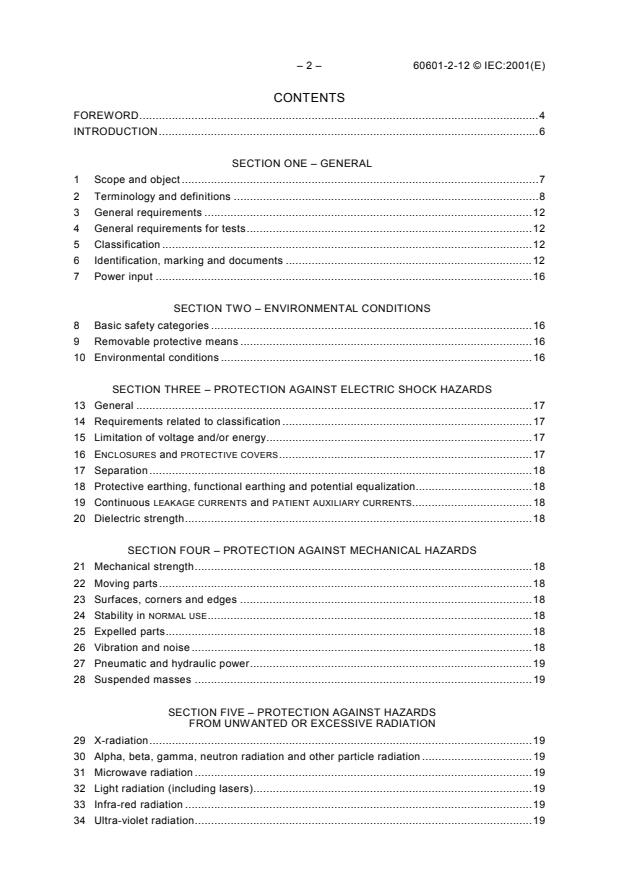
– 2 – 60601-2-12 © IEC:2001(E)
CONTENTS
FOREWORD.4
INTRODUCTION.6
SECTION ONE – GENERAL
1 Scope and object .7
2 Terminology and definitions .8
3 General requirements .12
4 General requirements for tests.12
5 Classification .12
6 Identification, marking and documents .12
7 Power input .16
SECTION TWO – ENVIRONMENTAL CONDITIONS
8 Basic safety categories .16
9 Removable protective means .16
10 Environmental conditions .16
SECTION THREE – PROTECTION AGAINST ELECTRIC SHOCK HAZARDS
13 General .17
14 Requirements related to classification .17
15 Limitation of voltage and/or energy.17
16 ENCLOSURES and PROTECTIVE COVERS.17
17 Separation.18
18 Protective earthing, functional earthing and potential equalization.18
19 Continuous LEAKAGE CURRENTS and PATIENT AUXILIARY CURRENTS.18
20 Dielectric strength.18
SECTION FOUR – PROTECTION AGAINST MECHANICAL HAZARDS
21 Mechanical strength.18
22 Moving parts.18
23 Surfaces, corners and edges .18
24 Stability in NORMAL USE.18
25 Expelled parts.18
26 Vibration and noise .18
27 Pneumatic and hydraulic power.19
28 Suspended masses .19
SECTION FIVE – PROTECTION AGAINST HAZARDS
FROM UNWANTED OR EXCESSIVE RADIATION
29 X-radiation.19
30 Alpha, beta, gamma, neutron radiation and other particle radiation .19
31 Microwave radiation .19
32 Light radiation (including lasers).19
33 Infra-red radiation .19
34 Ultra-violet radiation.19
60601-2-12 © IEC:2001(E) – 3 –
35 Acoustical energy (including ultrasonics) .19
36 Electromagnetic compatibility.19
SECTION SIX – PROTECTION AGAINST HAZARDS OF IGNITION
OF FLAMMABLE ANAESTHETIC MIXTURES
37 Locations and basic requirements .20
38 Marking, ACCOMPANYING DOCUMENTS .20
39 Common requirements for CATEGORY AP and CATEGORY APG EQUIPMENT .20
40 Requirements and tests for CATEGORY AP EQUIPMENT, parts and components thereof.20
41 Requirements and tests for CATEGORY APG EQUIPMENT, parts and components thereof .20
SECTION SEVEN – PROTECTION AGAINST EXCESSIVE TEMPERATURES
AND OTHER SAFETY HAZARDS
42 Excessive temperatures.20
43 * Fire prevention .20
44 Overflow, spillage, leakage, humidity, ingress of liquids, cleaning, sterilization,
disinfection and compatibility .21
45 Pressure vessels and parts subject to pressure.21
46 Human errors .22
47 Electrostatic charges .22
48 Biocompatibility.22
49 Interruption of the power supply .22
SECTION EIGHT – ACCURACY OF OPERATING DATA
AND PROTECTION AGAINST HAZARDOUS OUTPUT
50 Accuracy of operating data.23
51 Protection against hazardous output .24
SECTION NINE – ABNORMAL OPERATION AND FAULT CONDITIONS;
ENVIRONMENTAL TESTS
52 Abnormal operation and fault conditions.26
53 Environmental tests .26
SECTION TEN – CONSTRUCTIONAL REQUIREMENTS
54 General .27
55 ENCLOSURES and covers .27
56 Components and general assembly.27
57 MAINS PARTS, components and layout.29
58 Protective earthing – Terminals and connections.30
59 Construction and layout .30
Appendix L References – Publications mentioned in this standard .31
Annex AA (informative) Rationale .34
Annex BB (normative) Legibility and visibility of visual indications .39
Annex CC (informative) Intelligent alarm systems .40
Bibliography .41
Terminology – Index of defined terms.42
– 4 – 60601-2-12 © IEC:2001(E)
INTERNATIONAL ELECTROTECHNICAL COMMISSION
___________
MEDICAL ELECTRICAL EQUIPMENT –
Part 2-12: Particular requirements for the safety of lung ventilators –
Critical care ventilators
FOREWORD
1) The IEC (International Electrotechnical Commission) is a worldwide organization for standardization, comprising
all national electrotechnical committees (IEC National Committees). The object of the IEC is to promote
international cooperation on all questions concerning standardization in the electrical and electronic fields. To
this end and in addition to other activities, the IEC publishes International Standards. Their preparation is
entrusted to technical committees; any IEC National Committee interested in the subject dealt with may
participate in this preparatory work. International, governmental and non-governmental organizations liaising
with the IEC also participate in this preparation. The IEC collaborates closely with the International Organization
for Standardization (ISO) in accordance with conditions determined by agreement between the two
organizations.
2) The formal decisions or agreements of the IEC on technical matters, express as nearly as possible, an
international consensus of opinion on the relevant subjects since each technical committee has representation
from all interested National Committees.
3) The documents produced have the form of recommendations for international use and are published in the form
of standards, technical specifications, technical reports or guides, and they are accepted by the National
Committees in that sense.
4) In order to promote international unification, IEC National Committees undertake to apply IEC International
Standards transparently to the maximum extent possible in their national and regional standards. Any
divergence between the IEC Standard and the corresponding national standard shall be clearly indicated in the
latter.
5) The IEC provides no marking procedure to indicate its approval and cannot be rendered responsible for any
equipment declared to be in conformity with one of its standards.
6) Attention is drawn to the possibility that some of the elements of this International Standard may be the subject
of patent rights. IEC shall not be held responsible for identifying any such patent rights.
International Standard IEC 60601-2-12 has been prepared by subcommittee 62D: Electro-
medical equipment, of IEC technical committee 62: Electrical equipment in medical practice.
ISO TC 121/SC 3, Lung ventilators and related equipment, also participated in the preparation
of this standard.
This second edition replaces the first edition of IEC 60601-2-12:1988, Medical electrical
equipment – Part 2: Particular requirements for the safety of lung ventilators for medical use,
and ISO 10651-1:1993, Lung ventilators for medical use – Part 1: Requirements.
The text of this Particular Standard is based on the following documents:
FDIS Report on voting
62D/414/FDIS 62D/440/RVD
Full information on the voting for the approval of this standard can be found in the report on
voting indicated in the above table.
Annex BB forms an integral part of this standard.
Annexes AA and CC are for information only.
60601-2-12 © IEC:2001(E) – 5 –
In this Particular Standard, the following print types are used:
– requirements, compliance with which can be tested, and definitions: roman type;
– notes, explanations, advice, introductions, general statements and references: smaller roman type;
– test specifications: italic type;
– TERMS DEFINED IN CLAUSE 2 OF THE GENERAL STANDARD IEC 60601-1 OR IN THIS PARTICULAR
STANDARD: SMALL CAPITALS.
The committee has decided that the contents of this publication will remain unchanged until
2004. At this date, the publication will be:
• reconfirmed;
• withdrawn;
• replaced by a revised edition, or
• amended.
NOTE IEC 60601-1-8, Medical electrical equipment – Part 1-8: General requirements for safety – Collateral
Standard: General requirements and guidelines for the application of alarms in medical electrical equipment is
currently under development. This Standard will require maintenance to conform to that Collateral Standard.
– 6 – 60601-2-12 © IEC:2001(E)
INTRODUCTION
Critical care VENTILATORS are an essential medical device in every intensive care unit (ICU).
Approximately half of all PATIENTS in ICUs receive partial to full ventilatory support with this
EQUIPMENT. Given the vulnerable status of these PATIENTS, EQUIPMENT safety is of fundamental
importance. Accordingly, this Particular Standard, by building on other standards and
specifically on IEC 60601-1: Medical electrical equipment – Part 1: General requirements for
safety, herein referred to as the “General Standard”, sets the minimum requirements that
should be met by every critical care VENTILATOR that is designed after the publication of this
Particular Standard.
A rationale for the most important requirements is given in Annex AA.
Continuous positive airway pressure (CPAP) devices, sleep apnea therapy devices, support-
care VENTILATORs, anaesthesia, emergency and transport VENTILATORs, jet and high frequency
VENTILATOR and oscillators are not covered by this Particular Standard, nor are devices that
may be used within hospitals, intended solely to augment the ventilation of spontaneously
breathing PATIENTS.
60601-2-12 © IEC:2001(E) – 7 –
MEDICAL ELECTRICAL EQUIPMENT –
Part 2-12: Particular requirements for the safety of lung ventilators –
Critical care ventilators
SECTION ONE – GENERAL
The clauses and subclauses of this section of the General Standard apply except as follows:
1 Scope and object
This clause of the General Standard applies, except as follows:
1.1 Scope
Addition:
This Particular Standard specifies the safety requirements for VENTILATORS, as defined in
2.1.125, intended for use in critical care settings.
Continuous positive airway pressure (CPAP) devices, sleep apnea therapy devices, support-
care VENTILATORs, emergency and transport VENTILATORs, jet and high frequency VENTILATORs
and oscillators are outside the scope of this Particular Standard, nor are devices that may be
used within hospitals, intended solely to augment the ventilation of spontaneously breathing
PATIENTS. Standards for other types of VENTILATORs, e.g. high frequency jet and oscillation
ventilators, are under consideration.
Requirements for VENTILATORs intended for anaesthetic applications are given in IEC 60601-2-13.
1.2 Object
Addition:
The object of this standard is to specify particular safety requirements for VENTILATORS
intended for use in critical care settings.
1.3 Particular standards
Addition:
This Particular Standard refers to IEC 60601-1:1988, Medical electrical equipment – Part 1:
General requirements for safety, as amended by its amendment 1 (1991) and its amendment 2
(1995), herein referred to as the “General Standard”.
The General Standard takes into account a set of Collateral Standards:
IEC 60601-1-1:2000, Medical electrical equipment – Part 1-1: General requirements for safety,
Collateral standard: Safety requirements for medical electrical systems
IEC 60601-1-2:2001, Medical electrical equipment – Part 1-2: General requirements for safety
– Collateral standard: Electromagnetic compatibility – Requirements and tests
– 8 – 60601-2-12 © IEC:2001(E)
IEC 60601-1-4:1996, Medical electrical equipment – Part 1: General requirements for safety, 4.
Collateral standard: Programmable electrical medical systems
Amendment 1
The term “this Standard” covers this Particular Standard, used together with the General
Standard and the Collateral Standards.
The numbering of sections, clauses, and subclauses of this Particular Standard corresponds
with that of the General Standard. The changes to the text of the General Standard are
specified by the use of the following words:
– “Replacement” means that the clause or subclause of the General Standard is replaced
completely by the text of this Particular Standard.
– “Addition” means that the text of this Particular Standard is additional to the requirements of
the General Standard.
– “Amendment” means that the clause or subclause of the General Standard is amended as
indicated by the text of this Particular Standard.
Subclauses or figures that are additional to those of the General Standard are numbered
starting from 101, additional annexes are lettered AA, BB, etc., and additional items aa), bb),
etc.
Clauses and subclauses to which there is a rationale are marked with an asterisk *. These
rationales can be found in an informative Annex AA.
Annexes AA and CC are not normative parts of this Particular Standard and only provide
additional information; they can never be the subjects of testing.
Where there is no corresponding section, clause or subclause in this Particular Standard, the
section, clause or subclause of the General Standard or specified Collateral Standard applies
without modification.
Where it is intended that any part of the General Standard or Collateral Standard, although
possibly relevant, is not to be applied, a statement to that effect is given in this Particular
Standard.
A requirement of this Particular Standard replacing or modifying requirements of the General
Standard or a Collateral Standard takes precedence over the corresponding general
requirement(s).
2 Terminology and definitions
This clause of the General Standard applies, except as follows:
* 2.1.5
applied part
Addition:
or any part of the VENTILATOR intended to be connected to the breathing system
___________
There exists a consolidated edition 1.1 (2000) that includes IEC 60601-1-4 (1996) and its amendment 1 (1999).
60601-2-12 © IEC:2001(E) – 9 –
Additional definitions:
2.1.101
bacterial filter
device that removes bacteria and particulate matter from the gas stream
[ISO 4135:1995, definition 4.1.7 modified]
2.1.102
clearly legible
visual attribute of information displayed by the EQUIPMENT that allows the OPERATOR to discern
(or identify) qualitative or quantitative values or functions under a specific set of environmental
conditions
2.1.103
emergency air intake port
dedicated intake port through which ambient air may be drawn when the supply of FRESH GAS is
insufficient or absent
[ISO 4135:1995, definition 4.2.2 modified]
2.1.104
flow-direction-sensitive component
VENTILATOR component through which the gas flow has to be in one direction only for its proper
functioning and/or PATIENT safety
[ISO 4135:1995, definition 4.1.13]
2.1.105
fresh gas
gas supplied to the VENTILATOR BREATHING SYSTEM. It excludes the following:
– air drawn through the EMERGENCY AIR INTAKE PORT;
– air drawn through leaks in the VENTILATOR BREATHING SYSTEM;
– expired gas from the PATIENT
2.1.106
fresh gas intake port
intake port, other than the EMERGENCY AIR INTAKE PORT, through which FRESH GAS may be
drawn into the VENTILATOR BREATHING SYSTEM
[ISO 4135:1995, definition 4.2.6 modified]
2.1.107
gas exhaust port
that port of a VENTILATOR from which gas is discharged to the atmosphere either directly or via
a gas scavenging system
[ISO 4135:1995, definition 4.2.7]
2.1.108
gas intake port
port through which gas is drawn into the VENTILATOR BREATHING SYSTEM
– 10 – 60601-2-12 © IEC:2001(E)
2.1.109
gas output port
port through which gas is delivered at RESPIRATORY PRESSURES via the inspiratory limb to the
PATIENT CONNECTION PORT
[ISO 4135:1995, definition 4.2.8 modified]
2.1.110
gas return port
port through which gas is returned at RESPIRATORY PRESSURES via the expiratory limb from the
PATIENT CONNECTION PORT
[ISO 4135:1995, definition 4.2.9 modified]
2.1.111
high pressure gas input port
input port to which gas may be supplied at a pressure greater than 100 kPa
[ISO 4135:1995, definition 4.2.10 modified]
2.1.112
inflating gas
FRESH GAS that may also power the VENTILATOR
2.1.113
inflating gas input port
input port to which INFLATING GAS is supplied
[ISO 4135:1995, definition 4.2.11]
NOTE An input port is a port to which gas is supplied under positive pressure and through which the gas is driven
by this pressure. The gas may be supplied either at a controlled pressure or at a controlled flow.
2.1.114
inhibition
(disabled)
state in which an alarm system or part of an alarm system can not annunciate alarm signals
NOTE 1 INHIBITION may apply to an individual alarm condition, to a group of alarm conditions, or to the entire alarm
system of the EQUIPMENT.
NOTE 2 INHIBITION may be invoked by the OPERATOR or by the EQUIPMENT (for instance, in a warm-up mode or
when no PATIENT is connected).
NOTE 3 The duration of INHIBITION is always indefinite. Only direct action by the OPERATOR or a change in the
EQUIPMENT caused by the OPERATOR (for instance, the end of a warm-up mode or when a PATIENT is connected) will
revoke INHIBITION.
2.1.115
low-pressure gas input port
input port to which gas is supplied at a pressure not exceeding 100 kPa
[ISO 4135:1995, definition 4.2.14]
2.1.116
manual ventilation port
port to which a device may be connected for manual inflation of the lungs
[ISO 4135:1995, definition 4.2.15 modified]
2.1.117
maximum limited pressure (P max)
LIM
Highest pressure at the PATIENT CONNECTION PORT during NORMAL USE and under a SINGLE
FAULT CONDITION
60601-2-12 © IEC:2001(E) – 11 –
2.1.118
maximum working pressure (P max)
W
highest pressure at the PATIENT CONNECTION PORT during NORMAL USE, irrespective of the
setting of controls, other than the control intended to adjust this pressure
NOTE Even if not adjustable, this maximum is equal to or less than the MAXIMUM LIMITED PRESSURE.
2.1.119
minimum limited pressure (P min)
LIM
lowest pressure at the PATIENT CONNECTION PORT during NORMAL USE and under a SINGLE FAULT
CONDITION
NOTE This pressure may be sub-atmospheric.
2.1.120
&
minute volume (V )
volume of gas per minute entering or leaving the lungs of the PATIENT
2.1.121
operator’s position
intended location and orientation of the OPERATOR with respect to the EQUIPMENT for NORMAL
USE according to the instructions for use
2.1.122
patient connection port (of the VENTILATOR BREATHING SYSTEM)
port of the VENTILATOR BREATHING SYSTEM to which the PATIENT can be connected
[ISO 4135:1995, definition 4.2.16]
NOTE Interface between the VENTILATOR BREATHING SYSTEM and the PATIENT.
2.1.123
respiratory pressure
pressure at the PATIENT CONNECTION PORT
2.1.124
suspended
state of an alarm system where OPERATOR action has temporarily caused an otherwise enabled
alarm system to disable all auditory or all auditory and visual alarm signals for a fixed interval
2.1.125
ventilator
automatic EQUIPMENT that is intended to augment or provide ventilation of the lungs of the
PATIENT when connected to the airway of the PATIENT
2.1.126
ventilator breathing system (VBS)
breathing system bounded by the LOW PRESSURE GAS INPUT PORT(S), the GAS INTAKE PORT(S)
and the PATIENT CONNECTION PORT, together with the FRESH GAS INTAKE and EXHAUST PORT(S), if
these are provided
[ISO 4135:1995, definition 4.1.6 modified]
– 12 – 60601-2-12 © IEC:2001(E)
3 General requirements
This clause of the General Standard applies, except as follows:
* 3.1
Addition:
Any fault that can lead to a hazard and that is not detected by intrinsic means or by periodic
inspection (e.g. an oxidant leak, software defect) shall be regarded as a NORMAL CONDITION and
not a SINGLE FAULT CONDITION.
3.4
Addition:
An equivalent degree of safety may be demonstrated by means of a risk analysis, in
accordance with ISO 14971.
4 General requirements for tests
This clause of the General Standard applies.
5 Classification
This clause of the General Standard applies, except as follows:
5.2
Addition:
NOTE A VENTILATOR may have APPLIED PARTS of different types.
6 Identification, marking and documents
This clause of the General Standard applies, except as follows:
6.1 Marking on the outside of EQUIPMENT or EQUIPMENT parts
e) Indication of origin
Addition (after the existing sentence):
The name and address of the manufacturer or authorized representative, as applicable,
shall also be marked.
k) Mains power output
Replacement:
If provided, AUXILIARY MAINS SOCKET OUTLET(S) of EQUIPMENT shall be marked with the
maximum allowed output in amperes or volt-amperes.
q) Physiological effects
Addition (between the first and second paragraphs)
If applicable, a warning that latex is used.
60601-2-12 © IEC:2001(E) – 13 –
Addition:
aa) Any HIGH PRESSURE GAS INPUT PORT shall be marked with the name or symbol of gas in
accordance with ISO 5359 and with the supply pressure range and the nominal maximum
flow requirements. If gas-specific color-coding of flow control or flexible hoses is
provided, it shall be in accordance with ISO 32.
bb) If OPERATOR accessible ports are provided, they shall be marked. The following terms
should be used.
− INFLATING GAS INPUT PORT: 'Inflating Gas Input'
− MANUAL VENTILATION PORT: 'Bag'
− GAS OUTPUT PORT: 'Gas Output'
− GAS RETURN PORT: 'Gas Return'
− GAS EXHAUST PORT: 'Exhaust'
Alternatively, other terms or symbols may be used in the above and explained in the
instructions for use.
− EMERGENCY AIR INTAKE PORT: 'WARNING: Emergency Air Intake – Do Not Obstruct'
cc) Any particular storage and/or handling instructions.
dd) Any particular warnings and/or precautions relevant to the immediate operation of the
VENTILATOR.
ee) Where appropriate, an indication of the date by which the EQUIPMENT or ACCESSORY shall
be used expressed as the year and month.
NOTE Symbol 3.12 from ISO 15223:2000 may be used.
ff) Packages containing breathing attachments intended for single use shall be clearly
marked with the following, as far as applicable:
− A description of the contents.
− The words "SINGLE USE", “DO NOT REUSE”, Symbol 1051 from ISO 7000:1989 or
Symbol 3.2 from ISO 15223:2000.
− The word "STERILE," if applicable”, or one of Symbols 3.20 to 3.24 from ISO
15223:2000.
− The name or trademark and address of the manufacturer, supplier, or authorized
representative.
− An identification reference to the type, or Symbol 3.15 from ISO 15223:2000.
− An identification reference to the batch or serial number or Symbol 3.14 or 3.16 from
ISO 15223:2000.
− Packages containing latex shall be clearly marked with the word ‘LATEX’.
gg) Packages containing breathing attachments intended for reuse shall be clearly marked
with the following:
− A description of the contents.
− The name or trademark and address of the manufacturer, supplier, or authorized
representative.
− An identification reference to the type, or Symbol 3.13 from ISO 15223:2000.
− An identification reference to the batch or serial number or Symbols 3.14 or 3.16 from
ISO 15223:2000.
− Recommended methods of cleaning, disinfection and sterilization.
NOTE Some breathing attachments may contain recommended methods for cleaning, disinfection and
sterilization in the instructions for use. See also 6.8.2 d).
− Packages containing latex shall be clearly marked with the word ‘LATEX’.
– 14 – 60601-2-12 © IEC:2001(E)
hh ) All FLOW-DIRECTION-SENSITIVE COMPONENTS that are OPERATOR-removable without the use
of a tool shall be durably marked with a CLEARLY LEGIBLE arrow indicating the direction of
the flow.
6.3 g)
Addition:
− Pressure:
• cm H O
6.6 Identification of medical gas cylinders and connections
Replacement:
a) If gas-specific color-coding is used (e.g., for flow controls, flexible hoses, gas cylinders,
etc.) it shall be in accordance with ISO 32. See also 56.3 a).
6.8.2 Instructions for use
6.8.2 d) Cleaning, disinfection and sterilization of parts in contact with the
PATIENT
Addition (as a second paragraph):
If applicable, the instructions for use shall contain:
• information about cleaning and sterilization prior to first use;
• information about cleaning, disinfection and sterilization and any restriction
concerning re-use;
• instructions which indicate the maximum number of processes for each reusable
component or visual functional pass/fail criteria to be used in determining when a
component needs replacement.
Device packaging and/or labelling shall differentiate between the same or similar products
placed on the market by the same manufacturer, both sterile and non-sterile. See also 6.1 ff) 3.
Addition:
aa) Additional general information
The instructions for use shall include the following:
1. * A statement to the effect that antistatic or electrically conductive hoses or tubing
shall not be used.
2. * If the VENTILATOR has provisions for an INTERNAL and/or external reserve
ELECTRICAL POWER SOURCE, the manufacturer shall disclose in the appropriate
documentation at least the following data (see also 49.101 and 49.102):
• the ampere-hour rating;
• the voltage requirement;
• the current requirement;
• the operational time from the power source after it has become fully charged;
• the means for determining the status of the reserve power source; and
• the means by which the reserve power source can be tested.
3. If the VENTILATOR is provided with a reserve power supply, the functioning after a
switchover to the reserve power supply shall be described.
4. If the VENTILATOR is designed to operate with high-pressure gas(es), the supply
pressure and flow range(s) shall be stated.
60601-2-12 © IEC:2001(E) – 15 –
5. A statement as to whether any portion of the gas supplied to a HIGH PRESSURE GAS
INPUT PORT is used as FRESH GAS.
6. A method for testing the function of the ALARM SYSTEM for each of the ALARM
CONDITIONS specified in this Standard.
7. The intended use of the VENTILATOR.
8. A statement to the effect that, while the VENTILATOR is in use, an alternative means
of ventilation should always be available.
9. If ports are non-conical, this information shall be given with the instructions for use,
or a marking shall be made. See also 56.3 dd) 2 ii).
10. Instructions and information necessary to ensure that the VENTILATOR is installed
correctly and is in safe and correct working order.
11. Specifications about the nature and frequency of maintenance operations necessary
to ensure continuing safe and correct operation. This requirement also applies to
ACCESSORY components.
12. For each control and measured variable provided on the VENTILATOR, a listing of the
applicable range, resolution and accuracy. See also 51.107.
NOTE The accuracy should be expressed in the form of maximum zero error quoted in appropriate units, plus a
sensitivity error quoted, e.g., as a percentage of reading.
13. * If the VENTILATOR is specified to be used in environmental conditions which extend
beyond those specified in 10.2.1 of this Standard and performance is affected by
this, the manufacturer shall disclose the extended limits and how the VENTILATOR will
respond.
NOTE Critical care VENTILATORS are intended for hospital use and no such specification is expected.
14. The means of accomplishing automatic record keeping or, if applicable, that
automatic record keeping is not supported.
15. The ranges of any supply that is required for NORMAL USE of the VENTILATOR. See
also 49.101.
16. Warning statement to the effect that the VENTILATOR shall not be covered or
positioned in such a way that the operation or performance of the VENTILATOR is
adversely affected (e.g., positioned next to a curtain that blocks the flow of cooling
air, thereby causing the EQUIPMENT to overheat).
17. If an alarm limit is set automatically, the alarm limit(s) algorithm or default value(s)
shall be disclosed.
18. The inspiratory and expiratory pressure drop measured at the PATIENT CONNECTION
PORT at 60 l/min for VENTILATORS intended for providing tidal volumes greater than
300 ml, or 30 l/min for tidal volumes between 300 ml and 30 ml, or 5 l/min for tidal
volumes less than 30 ml, when the recommended breathing system is in use and
normal ventilation is compromised by the total or partial loss of power supply. See
49.103.
19. A statement to the effect that when adding attachments or other components or sub-
assemblies to the VENTILATOR BREATHING SYSTEM, the pressure gradient across the
VENTILATOR BREATHING SYSTEM, measured with respect to the PATIENT CONNECTION
PORT, may increase.
6.8.3 Technical description
a) * General
Addition:
− for all measured and/or computed variables that are displayed or used for control, a
general description of the filtering and/or smoothing techniques, as applicable;
− if there is a facility for sub-atmospheric pressure in the expiratory phase, the limiting
pressure and generated pressure, if applicable, shall be listed for the inspiratory and
expiratory phase;
– 16 – 60601-2-12 © IEC:2001(E)
− a technical description of the means of triggering shall be provided if applicable;
− the conditions under which any measured or displayed flow, volume or ventilation is to be
expressed, e.g., Ambient Temperature and Pressure Dry (ATPD), Body Temperature and
Pressure Saturated (BTPS) etc.;
− the principle by which each VENTILATOR alarm condition, essential for the safe operation of
the VENTILATOR, is detected, their priority level(s), and the algorithms that cause the
annunciation of a given priority level. If priority levels escalate and de-escalate, those
algorithms shall also be disclosed. See 49.101, 49.102, 50.101.2, 51.106, 51.107, 51.108,
and 56.104;
− the performance characteristics necessary for safe operation of the VENTILATOR with
VENTILATOR BREATHING SYSTEM(S), breathing attachments, and other components or sub-
assemblies (e.g., breathing tubes, humidifier, filter, etc.) recommended by the
manufacturer for inclusion in the VENTILATOR BREATHING SYSTEM;
NOTE Such characteristics may include pressure-flow relationships, compliance and internal volume.
− if provided, disclosure of the characteristics of the bacterial filter;
− a pneumatic diagram of the VENTILATOR including a diagram for each VENTILATOR
BREATHING SYSTEM either supplied or recommended by the manufacturer;
− disclosure of any restrictions on the sequence of components placed within the VENTILATOR
BREATHING SYSTEM, e.g., where such components are FLOW-DIRECTION SENSITIVE;
− interdependence of controls, if applicable;
− a listing of the following pressures:
• MAXIMUM LIMITED PRESSURE (P max);
lim
• range of values to which the MAXIMUM WORKING PRESSURE (P max)can be set and the
W
means by which the maximum is assured (e.g., pressure cycling, pressure limiting,
pressure generation);
• a statement whether negative (sub-atmospheric) pressure is available in the expiratory
phase.
7 Power input
This clause of the General Standard applies.
SECTION TWO – ENVIRONMENTAL CONDITIONS
8 Basic safety categories
This clause of the General Standard applies.
9 Removable protective means
This clause of the General Standard applies.
10 Environmental conditions
This clause of the General Standard applies, except as follows:
60601-2-12 © IEC:2001(E) – 17 –
10.2 Operation
Addition (add before the semicolon):
or any extension of these conditions as specified by the manufacturer in the ACCOMPANYING
DOCUMENTS. See also 6.8.2 aa) 13.
10.2.2 Power Supply
Addition:
aa) The VENTILATOR shall comply with this standard throughout the range of INTERNAL or
external ELECTRICAL POWER SOURCE variation stated by the manufacturer.
10.101 Pneumatic driving power supplies
If the VENTILATOR is intended to be connected to a medical gas pipeline system complying with
ISO 7396, it shall operate and meet the requirements of this standard throughout a range of
280 kPa to 600 kPa and shall cause no safety hazard with inlet pressures up to 1 000 kPa. The
gas flow measured at the VENTILATOR’S HIGH PRESSURE GAS INPUT PORT shall not exceed 60
l/min (time weighted average over 10 s) at a pressure of 280 kPa under NORMAL CONDITIONS.
Further, the transient flow requirement shall not exceed the equivalent of 200 l/min for 3 s.
NOTE Flow values are expressed under ATPD conditions.
Not used.
Not used.
SECTION THREE – PROTECTION AGAINST ELECTRIC SHOCK HAZARDS
13 General
This clause of the General Standard applies.
14 Requirements related to classification
This clause of the General Standard applies.
15 Limitation of voltage and/or energy
This clause of the General Standard applies.
16 ENCLOSURES and PROTECTIVE COVERS
This clause of the General Standard applies.
– 18 – 60601-2-12 © IEC:2001(E)
17 Separation
This clause of the General Standard applies.
18 Protective earthing, functional earthing and potential equalization
This clause of the General Standard applies.
19 Continuous LEAKAGE CURRENTS and PATIENT AUXILIARY CURRENTS
This clause of the General Standard applies
19.4 * Tests
h) Measurement of the PATIENT LEAKAGE CURRENT
Addition:
101) The PATIENT LEAKAGE CURRENT shall be measured from all parts that are defined as
APPLIED PARTS for the purpose of this Particular Standard. All parts of the same type
shall be connected together electrically with the exception of parts connected to the
protective earth terminal that shall be tested separately from parts not so connected.
20 Dielectric strength
This clause of the General Standard applies.
SECTION FOUR – PROTECTION AGAINST MECHANICAL HAZARDS
21 Mechanical strength
This clause of the General Standard applies.
22 Moving parts
This clause of the General Standard applies.
23 Surfaces, corners and edges
This clause of the General Standard applies.
24 Stability in NORMAL USE
This clause of the General Standard applies.
25 Expelled parts
This clause of the General Standard applies.
26 Vibration and noise
This clause of the General Standard applies.
60601-2-12 © IEC:2001(E) – 19 –
27 Pneumatic and hydraulic power
This clause of the General Standard applies.
28 Suspended masses
This clause of the General Standard applies.
SECTION FIVE – PROTECTION AGAINST HAZARDS FROM UNWANTED OR
EXCESSIVE RADIATION
29 X-radiation
This clause of the General Standard applies.
30 Alpha, beta, gamma, neutron radiation and other particle radiation
This clause of the General Standard applies.
31 Microwave radiation
This clause of the General Standard applies.
32 Light radiation (including lasers)
This clause of the General Standard applies.
33 Infra-red radiation
This clause of the General Standard applies.
34 Ultra-violet radiation
This clause of the General Standard applies.
35 Acoustical energy (including ultrasonics)
This clause of the General Standard applies.
36 Electromagnetic compatibility
This clause of the General Standard applies.
– 20 – 60601-2-12 © IEC:2001(E)
SECTION SIX – PROTECTION AGAINST HAZARDS OF IGNITION OF
FLAMMABLE ANAESTHETIC MIXTURES
37 Locations and basic requirements
This clause of the General Standard applies.
38 Marking, ACCOMPANYING DOCUMENTS
This clause of the General Standard applies.
39 Common requirements for CATEGORY AP and CATEGORY APG EQUIPMENT
This clause of the General Standard applies.
40 Requirements and tests for CATEGORY AP EQUIPMENT, parts and
components thereof
This clause of the General Standard applies.
41 Requirements and tests for CATEGORY APG EQUIPMENT, parts and components
thereof
This clause of the General Standard applies.
SECTION SEVEN – PROTECTION AGAINST EXCESSIVE TEMPERATURES AND
OTHER SAFETY HAZARDS
42 Excessive temperatures
This clause of the General Standard applies.
43 * Fire prevention
This clause of the General Standard applies, except as follows.
Addition:
In order to reduce the risk to PATIENTS, to other persons or to the surroundings due to fire,
ignitable material, under NORMAL and SINGLE FAULT CONDITIONS, shall not at the same time be
subjected to conditions in which:
• the temperature of the material is raised to its minimum ignition temperature, and
• an oxidant is present.
NOTE Air mixtures with a volume fraction of less than 25 % oxygen are not considered to be an oxidant.
The minimum ignition temperature is determined in accordance with IEC 60079-4 using the
oxidizing conditions present under NORMAL and SINGLE FAULT CONDITIONS.
60601-2-12 © IEC:200
...
Questions, Comments and Discussion
Ask us and Technical Secretary will try to provide an answer. You can facilitate discussion about the standard in here.
Loading comments...