

ISO 10893-5:2011
(Main)Non-destructive testing of steel tubes — Part 5: Magnetic particle inspection of seamless and welded ferromagnetic steel tubes for the detection of surface imperfections
General Information
- Abstract
ISO 10893-5:2011 specifies requirements for magnetic particle inspection of seamless and welded ferromagnetic steel tubes for the detection of surface imperfections on the tube body and the end/bevel face at the ends. For the tube body, it specifies requirements for the detection of surface imperfections on all or part of the outside surface of tubes. However, by agreement between the purchaser and manufacturer, it can be applicable to the inside surface over a limited length from the ends of tubes, dependent on the tube diameter. In addition, ISO 10893-5:2011 can be used, as appropriate, to locate the position of external surface imperfections detected by another non-destructive testing method (e.g. ultrasonic) prior to dressing of the tube surface, and to ensure complete removal of the imperfection after dressing is complete. For the end/bevel face at the ends of plain-end and beveled-end tubes, ISO 10893-5:2010 specifies requirements for the detection of laminar imperfections which can interfere with subsequent fabrication and inspection operations (e.g. welding and ultrasonic inspection of the welds). ISO 10893-5:2011 is applicable to the detection of imperfections, other than laminar imperfections, on the end/bevel face. In this case, magnetization is applied in the direction essentially perpendicular to the orientation of the particular imperfections being detected. It can also be applicable to the testing of hollow sections.
- Status
- Published
- Publication Date
- 23-Mar-2011
- Technical Committee
- ISO/TC 17/SC 19 - Technical delivery conditions for steel tubes for pressure purposes
- Drafting Committee
- ISO/TC 17/SC 19/WG 1 - Non-destructive testing
- Current Stage
- 9060 - Close of review
- Completion Date
- 04-Jun-2027
Buy Documents
ISO 10893-5:2011 - Non-destructive testing of steel tubes — Part 5: Magnetic particle inspection of seamless and welded ferromagnetic steel tubes for the detection of surface imperfections Released:3/24/2011
ISO 10893-5:2011 - Essais non destructifs des tubes en acier — Partie 5: Contrôle par magnétoscopie des tubes en acier ferromagnétique sans soudure et soudés pour la détection des imperfections de surface Released:3/24/2011
Overview - ISO 10893-5:2011 (magnetic particle inspection)
ISO 10893-5:2011 defines requirements for magnetic particle inspection (MPI) of seamless and welded ferromagnetic steel tubes to detect surface imperfections on the tube body and end/bevel faces. It applies to external (and, by agreement, limited internal) surface inspection, can be used to localize indications found by other NDT methods, and is suitable for plain-end, beveled-end tubes and some hollow sections. The standard integrates MPI technique, personnel qualification, test conditions and reporting to ensure reliable non-destructive testing (NDT) of steel tubes.
Key topics and technical requirements
- Scope: Inspection of tube body and end/bevel face for surface defects; detection of laminar and non-laminar imperfections where applicable.
- Timing: MPI normally performed after completion of primary production processes (rolling, heat treatment, sizing, straightening).
- Surface preparation: Tubes must be clean and free of oil, grease, scale or other contaminants that may mask indications.
- Personnel qualification: Operators must be trained and certified per ISO 9712, ISO 11484 or equivalent; NDT operations supervised by competent personnel.
- Detection media & lighting: Detecting media applied with magnetization; minimum illumination 500 lux. For fluorescent inspection use a darkened area (white light ≤ 20 lux) with UV-A (black light) intensity specified.
- Magnetization direction & sensitivity:
- Circumferential magnetization to reveal longitudinal imperfections; axial magnetization to reveal transverse imperfections.
- Magnetization levels themselves are not prescribed by this part, but ISO 9934 series requirements apply for media, equipment and general MPI principles.
- Magnetization methods for tube body:
- Method A - current flow (surface contacts)
- Method B - internal bar/cable current
- Method C - encircling coil (favors transverse defects)
- Method D - magnetic flow (tube as part of electromagnet circuit)
- Other techniques or combinations allowed if field strength/direction requirements are met.
- Quality controls: Field strength checks at regular intervals (e.g., not exceeding 4 hours) or use of reference pieces for end/bevel testing.
- Test reporting and acceptance: Requirements for evaluation of indications and reporting are specified to support acceptance decisions.
Applications - who uses this standard
- Tube manufacturers and mills to validate production quality of seamless and welded steel tubes.
- NDT service providers and inspection labs performing magnetic particle inspection on ferromagnetic tubing.
- Quality managers, purchasers and fabricators (welders, pipeline assemblers) who need assurance that tube surfaces and ends are free of defects that could affect welding or further inspection.
- Engineering and procurement teams specifying NDT acceptance criteria in contracts.
Related standards
- ISO 9934-1/2/3 (Magnetic particle testing - principles, media, equipment)
- ISO 9712 and ISO 11484 (NDT personnel qualification)
- ISO 10893 series (other NDT methods for steel tubes, e.g., ultrasonic, radiographic)
Keywords: ISO 10893-5:2011, magnetic particle inspection, MPI, non-destructive testing, NDT, ferromagnetic steel tubes, seamless and welded tubes, surface imperfections, tube inspection, end/bevel testing.
Relations
- Effective Date
- 09-Feb-2026
- Effective Date
- 09-Feb-2026
- Effective Date
- 09-Feb-2026
- Effective Date
- 09-Feb-2026
- Effective Date
- 09-Feb-2026
- Effective Date
- 09-Feb-2026
- Referred By
EN ISO 11961:2018 - Petroleum and natural gas industries - Steel drill pipe (ISO 11961:2018) - Effective Date
- 09-Feb-2026
- Effective Date
- 09-Feb-2026
- Effective Date
- 12-Feb-2026
- Effective Date
- 06-Jun-2022
- Effective Date
- 15-Apr-2008
- Effective Date
- 15-Apr-2008
Buy Documents
ISO 10893-5:2011 - Non-destructive testing of steel tubes — Part 5: Magnetic particle inspection of seamless and welded ferromagnetic steel tubes for the detection of surface imperfections Released:3/24/2011
ISO 10893-5:2011 - Essais non destructifs des tubes en acier — Partie 5: Contrôle par magnétoscopie des tubes en acier ferromagnétique sans soudure et soudés pour la détection des imperfections de surface Released:3/24/2011
Get Certified
Connect with accredited certification bodies for this standard

Element Materials Technology
Materials testing and product certification.

Inštitut za kovinske materiale in tehnologije
Institute of Metals and Technology. Materials testing, metallurgical analysis, NDT.
Institut za varilstvo d.o.o. (Welding Institute)
Slovenia's leading welding institute since 1952. ISO 3834, EN 1090, pressure equipment certification, NDT personnel, welder qualification. Only IIW Au
Sponsored listings
Frequently Asked Questions
ISO 10893-5:2011 is a standard published by the International Organization for Standardization (ISO). Its full title is "Non-destructive testing of steel tubes — Part 5: Magnetic particle inspection of seamless and welded ferromagnetic steel tubes for the detection of surface imperfections". This standard covers: ISO 10893-5:2011 specifies requirements for magnetic particle inspection of seamless and welded ferromagnetic steel tubes for the detection of surface imperfections on the tube body and the end/bevel face at the ends. For the tube body, it specifies requirements for the detection of surface imperfections on all or part of the outside surface of tubes. However, by agreement between the purchaser and manufacturer, it can be applicable to the inside surface over a limited length from the ends of tubes, dependent on the tube diameter. In addition, ISO 10893-5:2011 can be used, as appropriate, to locate the position of external surface imperfections detected by another non-destructive testing method (e.g. ultrasonic) prior to dressing of the tube surface, and to ensure complete removal of the imperfection after dressing is complete. For the end/bevel face at the ends of plain-end and beveled-end tubes, ISO 10893-5:2010 specifies requirements for the detection of laminar imperfections which can interfere with subsequent fabrication and inspection operations (e.g. welding and ultrasonic inspection of the welds). ISO 10893-5:2011 is applicable to the detection of imperfections, other than laminar imperfections, on the end/bevel face. In this case, magnetization is applied in the direction essentially perpendicular to the orientation of the particular imperfections being detected. It can also be applicable to the testing of hollow sections.
ISO 10893-5:2011 specifies requirements for magnetic particle inspection of seamless and welded ferromagnetic steel tubes for the detection of surface imperfections on the tube body and the end/bevel face at the ends. For the tube body, it specifies requirements for the detection of surface imperfections on all or part of the outside surface of tubes. However, by agreement between the purchaser and manufacturer, it can be applicable to the inside surface over a limited length from the ends of tubes, dependent on the tube diameter. In addition, ISO 10893-5:2011 can be used, as appropriate, to locate the position of external surface imperfections detected by another non-destructive testing method (e.g. ultrasonic) prior to dressing of the tube surface, and to ensure complete removal of the imperfection after dressing is complete. For the end/bevel face at the ends of plain-end and beveled-end tubes, ISO 10893-5:2010 specifies requirements for the detection of laminar imperfections which can interfere with subsequent fabrication and inspection operations (e.g. welding and ultrasonic inspection of the welds). ISO 10893-5:2011 is applicable to the detection of imperfections, other than laminar imperfections, on the end/bevel face. In this case, magnetization is applied in the direction essentially perpendicular to the orientation of the particular imperfections being detected. It can also be applicable to the testing of hollow sections.
ISO 10893-5:2011 is classified under the following ICS (International Classification for Standards) categories: 23.040.10 - Iron and steel pipes; 77.040.20 - Non-destructive testing of metals; 77.140.75 - Steel pipes and tubes for specific use. The ICS classification helps identify the subject area and facilitates finding related standards.
ISO 10893-5:2011 has the following relationships with other standards: It is inter standard links to EN ISO 13680:2025, EN ISO 11960:2014, EN ISO 13680:2020, EN ISO 3183:2012, EN 14870-4:2023, EN 14870-1:2023, EN ISO 11961:2018, EN ISO 11960:2021, EN ISO 10893-5:2011, ISO 15865:2005, ISO 13664:1997, ISO 13665:1997. Understanding these relationships helps ensure you are using the most current and applicable version of the standard.
ISO 10893-5:2011 is available in PDF format for immediate download after purchase. The document can be added to your cart and obtained through the secure checkout process. Digital delivery ensures instant access to the complete standard document.
Standards Content (Sample)
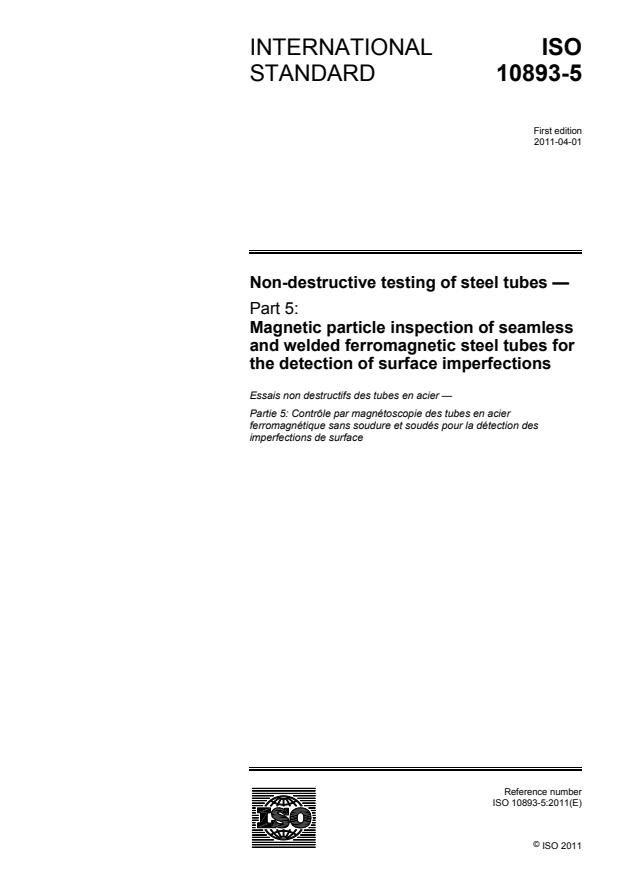
INTERNATIONAL ISO
STANDARD 10893-5
First edition
2011-04-01
Non-destructive testing of steel tubes —
Part 5:
Magnetic particle inspection of seamless
and welded ferromagnetic steel tubes for
the detection of surface imperfections
Essais non destructifs des tubes en acier —
Partie 5: Contrôle par magnétoscopie des tubes en acier
ferromagnétique sans soudure et soudés pour la détection des
imperfections de surface
Reference number
©
ISO 2011
PDF disclaimer
This PDF file may contain embedded typefaces. In accordance with Adobe's licensing policy, this file may be printed or viewed but
shall not be edited unless the typefaces which are embedded are licensed to and installed on the computer performing the editing. In
downloading this file, parties accept therein the responsibility of not infringing Adobe's licensing policy. The ISO Central Secretariat
accepts no liability in this area.
Adobe is a trademark of Adobe Systems Incorporated.
Details of the software products used to create this PDF file can be found in the General Info relative to the file; the PDF-creation
parameters were optimized for printing. Every care has been taken to ensure that the file is suitable for use by ISO member bodies. In
the unlikely event that a problem relating to it is found, please inform the Central Secretariat at the address given below.
© ISO 2011
All rights reserved. Unless otherwise specified, no part of this publication may be reproduced or utilized in any form or by any means,
electronic or mechanical, including photocopying and microfilm, without permission in writing from either ISO at the address below or
ISO's member body in the country of the requester.
ISO copyright office
Case postale 56 • CH-1211 Geneva 20
Tel. + 41 22 749 01 11
Fax + 41 22 749 09 47
E-mail copyright@iso.org
Web www.iso.org
Published in Switzerland
ii © ISO 2011 – All rights reserved
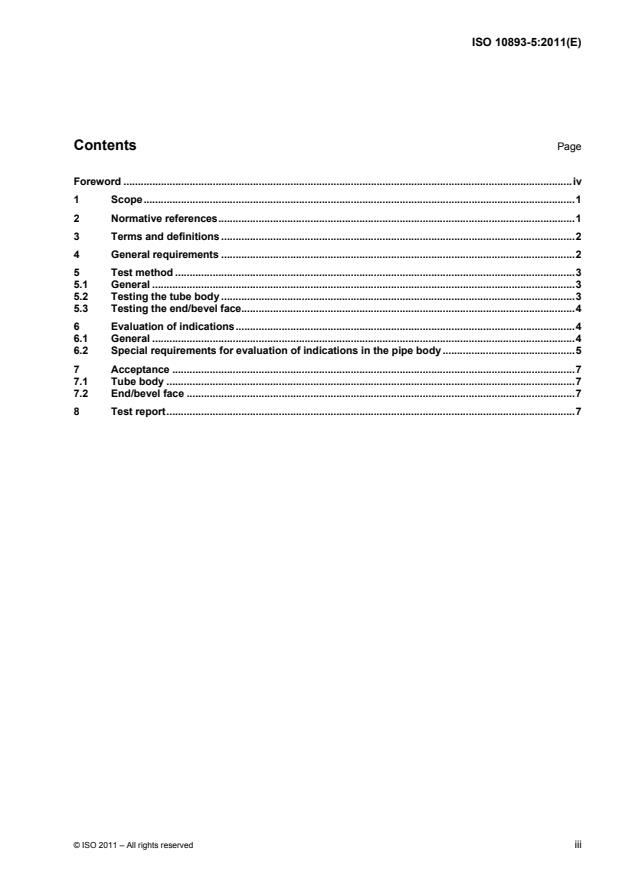
Contents Page
Foreword .iv
1 Scope.1
2 Normative references.1
3 Terms and definitions .2
4 General requirements .2
5 Test method .3
5.1 General .3
5.2 Testing the tube body .3
5.3 Testing the end/bevel face.4
6 Evaluation of indications.4
6.1 General .4
6.2 Special requirements for evaluation of indications in the pipe body .5
7 Acceptance .7
7.1 Tube body .7
7.2 End/bevel face .7
8 Test report.7
Foreword
ISO (the International Organization for Standardization) is a worldwide federation of national standards bodies
(ISO member bodies). The work of preparing International Standards is normally carried out through ISO
technical committees. Each member body interested in a subject for which a technical committee has been
established has the right to be represented on that committee. International organizations, governmental and
non-governmental, in liaison with ISO, also take part in the work. ISO collaborates closely with the
International Electrotechnical Commission (IEC) on all matters of electrotechnical standardization.
International Standards are drafted in accordance with the rules given in the ISO/IEC Directives, Part 2.
The main task of technical committees is to prepare International Standards. Draft International Standards
adopted by the technical committees are circulated to the member bodies for voting. Publication as an
International Standard requires approval by at least 75 % of the member bodies casting a vote.
Attention is drawn to the possibility that some of the elements of this document may be the subject of patent
rights. ISO shall not be held responsible for identifying any or all such patent rights.
ISO 10893-5 was prepared by Technical Committee ISO/TC 17, Steel, Subcommittee SC 19, Technical
delivery conditions for steel tubes for pressure purposes.
This first edition cancels and replaces ISO 13664:1997 and ISO 13665:1997, which have been technically
revised.
ISO 10893 consists of the following parts, under the general title Non-destructive testing of steel tubes:
⎯ Part 1: Automated electromagnetic testing of seamless and welded (except submerged arc-welded) steel
tubes for the verification of hydraulic leaktightness
⎯ Part 2: Automated eddy current testing of seamless and welded (except submerged arc-welded) steel
tubes for the detection of imperfections
⎯ Part 3: Automated full peripheral flux leakage testing of seamless and welded (except submerged arc-
welded) ferromagnetic steel tubes for the detection of longitudinal and/or transverse imperfections
⎯ Part 4: Liquid penetrant inspection of seamless and welded steel tubes for the detection of surface
imperfections
⎯ Part 5: Magnetic particle inspection of seamless and welded ferromagnetic steel tubes for the detection of
surface imperfections
⎯ Part 6: Radiographic testing of the weld seam of welded steel tubes for the detection of imperfections
⎯ Part 7: Digital radiographic testing of the weld seam of welded steel tubes for the detection of
imperfections
⎯ Part 8: Automated ultrasonic testing of seamless and welded steel tubes for the detection of laminar
imperfections
⎯ Part 9: Automated ultrasonic testing for the detection of laminar imperfections in strip/plate used for the
manufacture of welded steel tubes
⎯ Part 10: Automated full peripheral ultrasonic testing of seamless and welded (except submerged
arc-welded) steel tubes for the detection of longitudinal and/or transverse imperfections
iv © ISO 2011 – All rights reserved
⎯ Part 11: Automated ultrasonic testing of the weld seam of welded steel tubes for the detection of
longitudinal and/or transverse imperfections
⎯ Part 12: Automated full peripheral ultrasonic thickness testing of seamless and welded (except
submerged arc-welded) steel tubes
INTERNATIONAL STANDARD ISO 10893-5:2011(E)
Non-destructive testing of steel tubes —
Part 5:
Magnetic particle inspection of seamless and welded
ferromagnetic steel tubes for the detection of surface
imperfections
1 Scope
This part of ISO 10893 specifies requirements for magnetic particle inspection of seamless and welded
ferromagnetic steel tubes for the detection of surface imperfections on the tube body and the end/bevel face
at the ends.
For the tube body, it specifies requirements for the detection of surface imperfections on all or part of the
outside surface of tubes. However, by agreement between the purchaser and manufacturer, it can be
applicable to the inside surface over a limited length from the ends of tubes, dependent on the tube diameter.
In addition, this part of ISO 10893 can be used, as appropriate, to locate the position of external surface
imperfections detected by another non-destructive testing method (e.g. ultrasonic) prior to dressing of the tube
surface, and to ensure complete removal of the imperfection after dressing is complete.
For the end/bevel face at the ends of plain-end and beveled-end tubes, this part of ISO 10893 specifies
requirements for the detection of laminar imperfections which can interfere with subsequent fabrication and
inspection operations (e.g. welding and ultrasonic inspection of the welds).
This part of ISO 10893 is applicable to the detection of imperfections, other than laminar imperfections, on the
end/bevel face. In this case, magnetization is applied in the direction essentially perpendicular to the
orientation of the particular imperfections being detected.
It can also be applicable to the testing of hollow sections.
2 Normative references
The following referenced documents are indispensable for the application of this document. For dated
references, only the edition cited applies. For undated references, the latest edition of the referenced
document (including any amendments) applies.
ISO 9712, Non-destructive testing — Qualification and certification of personnel
ISO 9934-1, Non-destructive testing — Magnetic particle testing — Part 1: General principles
ISO 9934-2, Non-destructive testing — Magnetic particle testing — Part 2: Detection media
ISO 9934-3, Non-destructive testing — Magnetic particle testing — Part 3: Equipment
ISO 10893-8, Non-destructive testing of steel tubes — Part 8: Automated ultrasonic testing of seamless and
welded steel tubes for the detection of laminar imperfections
ISO 11484, Steel products — Employer's qualification system for non-destructive testing (NDT) personnel
3 Terms and definitions
For the purposes of this document, the terms and definitions given in ISO 9934-1 and ISO 11484 and the
following apply.
3.1
tube
hollow long product open at both ends, of any cross-sectional shape
3.2
seamless tube
tube made by piercing a solid product to obtain a tube hollow, which is further processed, either hot or cold,
into its final dimensions
3.3
welded tube
tube, made by forming a hollow profile from a flat product and welding adjacent edges together, and which
after welding can be further processed, either hot or cold, into its final dimensions
3.4
manufacturer
organization that manufactures products in accordance with the relevant standard(s) and declares the
compliance of the delivered products with all applicable provisions of the relevant standard(s)
3.5
agreement
contractual arrangement between the manufacturer and purchaser at the time of enquiry and order
4 General requirements
4.1 Unless otherwise specified by the product standard or agreed on by the purchaser and manufacturer, a
magnetic particle inspection shall be carried out on tubes after completion of all the primary production
process operations (rolling, heat treating, cold and hot working, sizing, primary straightening, etc.).
4.2 The surface of the tube and of the end/bevel face at both tube ends being tested shall be sufficiently
clean and free of oil, grease, sand or scale or any other foreign matter which can interfere with the correct
interpretation of the indications obtained from the magnetic particle inspection. The type of indications, as well
as the minimum dimension of the surface imperfections being detected, depends on the specific tube
manufacturing process and the surface finish.
4.3 This inspection shall be carried out by trained operators qualified in accordance with ISO 9712,
ISO 11484 or equivalent, and supervised by competent personnel nominated by the manufacturer. In the case
of third-party inspection, this shall be agreed on between the purchaser and manufacturer.
The operating authorization issued by the employer shall be according to a written procedure. NDT operations
shall be authorized by a level 3 NDT individual approved by the employer.
NOTE The definition of levels 1, 2 and 3 can be found in appropriate International Standards, e.g. ISO 9712 and
ISO 11484.
2 © ISO 2011 – All rights reserved
5 Test method
5.1 General
5.1.1 Inspection area (the tube body or end/bevel face) and inspection direction (longitudinal or transverse)
shall be as specified in the product standards or purchaser order.
5.1.2 The entire outside surface of each tube or part of it, as required, shall be inspected using the
magnetic particle method, for the detection of longitudinal and/or transverse surface imperfections, using a.c.
or d.c. magnetization, as appropriate to the magnetic particle technique adopted. In the case of end/bevel
testing, the use of dry magnetic powder is only permitted by prior agreement between the purchaser and
manufacturer. Otherwise, the requirements given in ISO 9934-1,
...
NORME ISO
INTERNATIONALE 10893-5
Première édition
2011-04-01
Essais non destructifs des tubes
en acier —
Partie 5:
Contrôle par magnétoscopie des tubes en
acier ferromagnétique sans soudure et
soudés pour la détection des
imperfections de surface
Non-destructive testing of steel tubes —
Part 5: Magnetic particle inspection of seamless and welded
ferromagnetic steel tubes for the detection of surface imperfections
Numéro de référence
©
ISO 2011
PDF – Exonération de responsabilité
Le présent fichier PDF peut contenir des polices de caractères intégrées. Conformément aux conditions de licence d'Adobe, ce fichier
peut être imprimé ou visualisé, mais ne doit pas être modifié à moins que l'ordinateur employé à cet effet ne bénéficie d'une licence
autorisant l'utilisation de ces polices et que celles-ci y soient installées. Lors du téléchargement de ce fichier, les parties concernées
acceptent de fait la responsabilité de ne pas enfreindre les conditions de licence d'Adobe. Le Secrétariat central de l'ISO décline toute
responsabilité en la matière.
Adobe est une marque déposée d'Adobe Systems Incorporated.
Les détails relatifs aux produits logiciels utilisés pour la création du présent fichier PDF sont disponibles dans la rubrique General Info
du fichier; les paramètres de création PDF ont été optimisés pour l'impression. Toutes les mesures ont été prises pour garantir
l'exploitation de ce fichier par les comités membres de l'ISO. Dans le cas peu probable où surviendrait un problème d'utilisation,
veuillez en informer le Secrétariat central à l'adresse donnée ci-dessous.
DOCUMENT PROTÉGÉ PAR COPYRIGHT
© ISO 2011
Droits de reproduction réservés. Sauf prescription différente, aucune partie de cette publication ne peut être reproduite ni utilisée sous
quelque forme que ce soit et par aucun procédé, électronique ou mécanique, y compris la photocopie et les microfilms, sans l'accord écrit
de l'ISO à l'adresse ci-après ou du comité membre de l'ISO dans le pays du demandeur.
ISO copyright office
Case postale 56 • CH-1211 Geneva 20
Tel. + 41 22 749 01 11
Fax + 41 22 749 09 47
E-mail copyright@iso.org
Web www.iso.org
Publié en Suisse
ii © ISO 2011 – Tous droits réservés
Sommaire Page
Avant-propos .iv
1 Domaine d'application .1
2 Références normatives.1
3 Termes et définitions .2
4 Exigences générales.2
5 Méthode de contrôle .3
5.1 Généralités .3
5.2 Contrôle du corps du tube.3
5.3 Contrôle de la face d'extrémité ou du chanfrein.4
6 Évaluation des indications .5
6.1 Généralités .5
6.2 Exigences particulières relatives à l'évaluation des indications dans le corps du tube.5
7 Acceptation .7
7.1 Corps du tube .7
7.2 Face d'extrémité ou du chanfrein .7
8 Rapport d'essai.8
Avant-propos
L'ISO (Organisation internationale de normalisation) est une fédération mondiale d'organismes nationaux de
normalisation (comités membres de l'ISO). L'élaboration des Normes internationales est en général confiée
aux comités techniques de l'ISO. Chaque comité membre intéressé par une étude a le droit de faire partie du
comité technique créé à cet effet. Les organisations internationales, gouvernementales et non
gouvernementales, en liaison avec l'ISO participent également aux travaux. L'ISO collabore étroitement avec
la Commission électrotechnique internationale (CEI) en ce qui concerne la normalisation électrotechnique.
Les Normes internationales sont rédigées conformément aux règles données dans les Directives ISO/CEI,
Partie 2.
La tâche principale des comités techniques est d'élaborer les Normes internationales. Les projets de Normes
internationales adoptés par les comités techniques sont soumis aux comités membres pour vote. Leur
publication comme Normes internationales requiert l'approbation de 75 % au moins des comités membres
votants.
L'attention est appelée sur le fait que certains des éléments du présent document peuvent faire l'objet de
droits de propriété intellectuelle ou de droits analogues. L'ISO ne saurait être tenue pour responsable de ne
pas avoir identifié de tels droits de propriété et averti de leur existence.
L'ISO 10893-5 a été élaborée par le comité technique ISO/TC 17, Acier, sous-comité SC 19, Conditions
techniques de livraison des tubes d'acier pour appareils à pression.
Cette première édition annule et remplace l'ISO 13664:1997 et l'ISO 13665:1997, qui ont fait l'objet d'une
révision technique.
L'ISO 10893 comprend les parties suivantes, présentées sous le titre général Essais non destructifs des tubes
en acier:
⎯ Partie 1: Contrôle automatisé électromagnétique pour vérification de l'étanchéité hydraulique des tubes
en acier sans soudure et soudés (sauf à l'arc immergé sous flux en poudre)
⎯ Partie 2: Contrôle automatisé par courants de Foucault pour la détection des imperfections des tubes en
acier sans soudure et soudés (sauf à l'arc immergé sous flux en poudre)
⎯ Partie 3: Contrôle automatisé par flux de fuite sur toute la circonférence des tubes en acier
ferromagnétique sans soudure et soudés (sauf à l'arc immergé sous flux en poudre) pour la détection des
imperfections longitudinales et/ou transversales
⎯ Partie 4: Contrôle par ressuage des tubes en acier sans soudure et soudés pour la détection des
imperfections de surface
⎯ Partie 5: Contrôle par magnétoscopie des tubes en acier ferromagnétique sans soudure et soudés pour
la détection des imperfections de surface
⎯ Partie 6: Contrôle radiographique du cordon de soudure des tubes en acier soudés pour la détection des
imperfections
⎯ Partie 7: Contrôle radiographique numérique du cordon de soudure des tubes en acier soudés pour la
détection des imperfections
⎯ Partie 8: Contrôle automatisé par ultrasons pour la détection des dédoublures des tubes en acier sans
soudure et soudés
iv © ISO 2011 – Tous droits réservés
⎯ Partie 9: Contrôle automatisé par ultrasons pour la détection des dédoublures dans les bandes/tôles
fortes utilisées pour la fabrication des tubes en acier soudés
⎯ Partie 10: Contrôle automatisé par ultrasons sur toute la circonférence des tubes en acier sans soudure
et soudés (sauf à l'arc immergé sous flux en poudre) pour la détection des imperfections longitudinales
et/ou transversales
⎯ Partie 11: Contrôle automatisé par ultrasons du cordon de soudure des tubes en acier soudés pour la
détection des imperfections longitudinales et/ou transversales
⎯ Partie 12: Contrôle automatisé de l'épaisseur par ultrasons sur toute la circonférence des tubes en acier
sans soudure et soudés (sauf à l'arc immergé sous flux en poudre)
NORME INTERNATIONALE ISO 10893-5:2011(F)
Essais non destructifs des tubes en acier —
Partie 5:
Contrôle par magnétoscopie des tubes en acier
ferromagnétique sans soudure et soudés pour la détection des
imperfections de surface
1 Domaine d'application
La présente partie de l'ISO 10893 spécifie les exigences relatives au contrôle par magnétoscopie des tubes
en acier ferromagnétique sans soudure et soudés pour la détection des imperfections de surface sur le corps
du tube et sur les faces d'extrémité ou les chanfreins aux extrémités.
Pour le corps du tube, la présente partie de l'ISO 10893 spécifie les exigences relatives à la détection des
imperfections de surface sur tout ou partie de la surface extérieure des tubes. Cependant, par accord entre
l'acheteur et le producteur, la présente partie de l'ISO 10893 est applicable à la surface intérieure sur une
longueur limitée à partir des extrémités des tubes, selon le diamètre du tube.
En outre, la présente partie de l'ISO 10893 peut être utilisée, le cas échéant, pour déterminer l'emplacement
d'imperfections sur la surface extérieure détectées par une autre méthode de contrôle non destructif (par
exemple par ultrasons), avant réparation de la surface des tubes et pour garantir l'élimination complète de
l'imperfection après réparation.
Pour les faces d'extrémité ou les chanfreins aux extrémités des tubes à extrémités lisses ou chanfreinées, la
présente partie de l'ISO 10893 spécifie les exigences relatives à la détection des dédoublures pouvant avoir
une incidence sur les opérations de fabrication et de contrôle ultérieures (par exemple soudage ou contrôle
par ultrasons des soudures).
La présente partie de l'ISO 10893 est aussi applicable à la détection des imperfections autres que des
dédoublures sur les faces d'extrémité ou les chanfreins. Dans ce cas, la magnétisation est à appliquer
essentiellement perpendiculairement à l'orientation des imperfections particulières à détecter.
Elle est également applicable au contrôle des profils creux.
2 Références normatives
Les documents de référence suivants sont indispensables pour l'application du présent document. Pour les
références datées, seule l'édition citée s'applique. Pour les références non datées, la dernière édition du
document de référence s'applique (y compris les éventuels amendements).
ISO 9712, Essais non destructifs — Qualification et certification du personnel
ISO 9934-1, Essais non destructifs — Magnétoscopie — Partie 1: Principes généraux du contrôle
ISO 9934-2, Essais non destructifs — Magnétoscopie — Partie 2: Produits magnétoscopiques
ISO 9934-3, Essais non destructifs — Magnétoscopie — Partie 3: Équipement
ISO 10893-8, Essais non destructifs des tubes en acier — Partie 8: Contrôle automatisé par ultrasons pour la
détection des dédoublures des tubes en acier sans soudure ou soudés
ISO 11484, Produits en acier — Système de qualification, par l'employeur, du personnel pour essais non
destructifs (END)
3 Termes et définitions
Pour les besoins du présent document, les termes et définitions donnés dans l'ISO 9934-1 et l'ISO 11484
ainsi que les suivants s'appliquent.
3.1
tube
produit long et creux, ouvert à ses deux extrémités, ayant toute forme de section
3.2
tube sans soudure
tube fabriqué à partir d'un produit plein que l'on perce en vue d'obtenir une ébauche creuse, qui est soumise à
une transformation ultérieure, à chaud ou à froid, pour lui donner ses dimensions définitives
3.3
tube soudé
tube fabriqué par formage d'un produit plat en profil creux et par soudage des rives adjacentes, et qui, après
soudage, peut être soumis à une transformation supplémentaire, à chaud ou à froid, pour lui donner ses
dimensions définitives
3.4
producteur
organisation qui fabrique des produits conformément à la norme ou aux normes pertinentes et déclare la
conformité des produits livrés à toutes les dispositions applicables de la norme ou des normes pertinentes
3.5
accord
arrangement contractuel entre le producteur et l'acheteur au moment de l'appel d'offres et de la commande
4 Exigences générales
4.1 Sauf spécification contraire dans la norme de produit ou accord contraire entre l'acheteur et le
producteur, le contrôle par magnétoscopie doit être effectué sur les tubes après exécution de toutes les
opérations principales du processus de fabrication (laminage, traitement thermique, formage à chaud ou à
froid, calibrage, dressage initial, etc.).
4.2 La surface du tube et des faces d'extrémité ou les chanfreins à chacune des extrémités des tubes à
contrôler doit être suffisamment propre et exempte d'huile, de graisse, de sable, de calamine ou de tout autre
corps étranger pouvant perturber l'interprétation des indications obtenues lors du contrôle par magnétoscopie.
Le type d'indications, ainsi que les dimensions minimales des imperfections de surface à détecter, dépendent
du procédé de fabrication spécifique des tubes et du fini de surface.
4.3 Le contrôle doit être effectué par des opérateurs formés, qualifiés conformément à l'ISO 9712, à
l'ISO 11484 ou à une norme équivalente et supervisés par un personnel compétent désigné par le producteur.
Lorsque le contrôle est effectué par une tierce partie, il doit faire l'objet d'un accord entre l'acheteur et le
producteur.
2 © ISO 2011 – Tous droits réservés
L'autorisation d'opérer doit être délivrée par l'employeur conformément à une procédure écrite. Les opérations
d'essais non destructifs (END) doivent être autorisées par un personnel END de niveau 3 approuvé par
l'employeur.
NOTE La définition des niveaux 1, 2 et 3 peut être trouvée dans des Normes internationales appropriées, par
exemple l'ISO 9712 et l'ISO 11484.
5 Méthode de contrôle
5.1 Généralités
5.1.1 La zone de contrôle (corps du tube ou face d'extrémité ou du chanfrein) et la direction du contrôle
(longitudinale ou transversale) doivent être telles que spécifiées dans les normes de produit ou dans la
commande de l'acheteur.
5.1.2 La totalité de la surface extérieure de chaque tube, ou d'une partie de celui-ci le cas échéant, doit être
contrôlée par magnétoscopie pour la détection des imperfections de surface longitudinales et/ou transversales,
en faisant appel à une magnétisation par courant alternatif ou continu selon la technique de magnétoscopie
adoptée. Dans le cas du contrôle d'une face d'extrémité ou du chanfrein, l'utilisation d'une poudre magnétique
sèche n'est autorisée qu'en cas d'accord préalable entre l'acheteur et le producteur. Sinon, les exigences
spécifié
...