

ISO 749:1977
(Main)Oilseed residues — Determination of total ash
General Information
- Abstract
The method consists in incinerating of a test portion at 550 + 15 C in an electrically heated muffle furnace, until practically constant mass is reached. It isnot applicable to compounded products. It cancels and replaces ISO Recommandation R 749.1968.
- Status
- Published
- Publication Date
- 30-Sep-1977
- Technical Committee
- ISO/TC 34/SC 2 - Oleaginous seeds and fruits and oilseed meals
- Drafting Committee
- ISO/TC 34/SC 2 - Oleaginous seeds and fruits and oilseed meals
- Current Stage
- 9093 - International Standard confirmed
- Start Date
- 14-Jun-2022
- Completion Date
- 29-Aug-2026
Buy Documents

ISO 749:1977 - Oilseed residues — Determination of total ash Released:10/1/1977

ISO 749:1977 - Tourteaux de graines oléagineuses — Détermination des cendres totales Released:10/1/1977
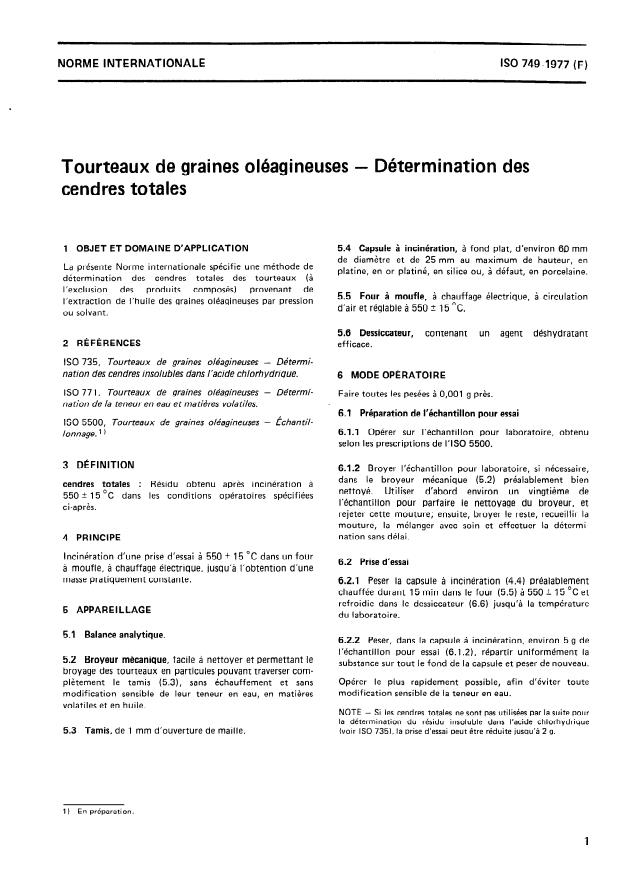

ISO 749:1977 - Tourteaux de graines oléagineuses — Détermination des cendres totales Released:10/1/1977
Overview
ISO 749:1977 specifies a standardized method for determining the total ash content in oilseed residues. This international standard, developed by ISO Technical Committee ISO/TC 34 on Agricultural Food Products, involves incinerating a test portion of the oilseed residue at 550 ± 15 °C in an electrically heated muffle furnace until a constant mass is achieved. The total ash content represents the inorganic mineral residue remaining after combustion, which is an important parameter for quality control and analytical assessment of oilseed by-products. This method applies only to residues obtained by oil extraction through pressure or solvent methods and excludes compounded products.
Key Topics
Scope and Application
The method is relevant for determining total ash in oilseed residues post oil extraction but is not applicable to compounded products containing mixtures or additives.Test Procedure
- Sample preparation involves grinding the oilseed residue to a uniform particle size passing a 1 mm sieve.
- Approximately 5 g of the prepared sample is weighed into a pre-weighed incineration dish.
- The sample is initially carbonized on an electric hot-plate or gas flame, then transferred to a muffle furnace set at 550 ± 15 °C.
- Incineration continues until the mass of the ash residue is constant, typically requiring 2 to 3 hours, and may be extended if necessary by incremental heating.
Calculation and Expression of Results
The total ash content is calculated as the percentage of the residue mass relative to the original sample mass. If requested, results can also be expressed relative to dry matter by adjusting for moisture content.Repeatability and Accuracy
The method requires duplicate determinations on the same sample with a maximum allowable difference of 0.2 g per 100 g sample, ensuring reliability and reproducibility of results.Equipment Requirements
- Analytical balance accurate to 0.001 g
- Mechanical mill for grinding
- Sieve with 1 mm aperture
- Flat-bottomed incineration dishes of platinum, platinum-plated gold, silica or porcelain
- Electrically heated muffle furnace with air circulation capable of controlling temperature at 550 ± 15 °C
- Desiccator for cooling samples
Applications
Agricultural and Food Industry
This standard is vital for quality control laboratories analyzing residuals from oilseed processing. Ash content determination informs the efficiency of oil extraction, assessing mineral content, and identifying possible contamination or adulteration.Research and Development
Researchers studying oilseed residues utilize this method to compare different extraction processes or optimize formulations by measuring inorganic content.Regulatory Compliance
Compliance with ISO 749 ensures uniformity in ash content testing, facilitating trade and certification of oilseed by-products internationally.Feed and Biomass Evaluation
Ash content is a key factor when oilseed residues are used as animal feed or biomass fuel since mineral content impacts nutritional value and combustion properties.
Related Standards
For comprehensive analysis of oilseed residues, the following related ISO standards may be referenced alongside ISO 749:
- ISO 5500 - Oilseed residues – Sampling procedures ensuring representative test samples for analysis.
- ISO 771 - Determination of moisture and volatile matter content in oilseed residues, critical for correcting ash content to dry basis.
- ISO 735 - Determination of ash insoluble in hydrochloric acid, providing additional mineral content detail beyond total ash.
Utilizing these standards supports a holistic approach to the chemical characterization and quality assessment of oilseed residues.
By adhering to ISO 749:1977, laboratories and industries involved in oilseed processing gain an internationally recognized, reproducible, and accurate methodology for determining total ash, ensuring product quality and facilitating global trade and research consistency.
Buy Documents
ISO 749:1977 - Oilseed residues — Determination of total ash Released:10/1/1977
ISO 749:1977 - Tourteaux de graines oléagineuses — Détermination des cendres totales Released:10/1/1977
ISO 749:1977 - Tourteaux de graines oléagineuses — Détermination des cendres totales Released:10/1/1977
Get Certified
Connect with accredited certification bodies for this standard

BSI Group
BSI (British Standards Institution) is the business standards company that helps organizations make excellence a habit.

Bureau Veritas
Bureau Veritas is a world leader in laboratory testing, inspection and certification services.

DNV
DNV is an independent assurance and risk management provider.
Sponsored listings
Frequently Asked Questions
ISO 749:1977 is a standard published by the International Organization for Standardization (ISO). Its full title is "Oilseed residues — Determination of total ash". This standard covers: The method consists in incinerating of a test portion at 550 + 15 C in an electrically heated muffle furnace, until practically constant mass is reached. It isnot applicable to compounded products. It cancels and replaces ISO Recommandation R 749.1968.
The method consists in incinerating of a test portion at 550 + 15 C in an electrically heated muffle furnace, until practically constant mass is reached. It isnot applicable to compounded products. It cancels and replaces ISO Recommandation R 749.1968.
ISO 749:1977 is classified under the following ICS (International Classification for Standards) categories: 67.200.20 - Oilseeds. The ICS classification helps identify the subject area and facilitates finding related standards.
ISO 749:1977 is available in PDF format for immediate download after purchase. The document can be added to your cart and obtained through the secure checkout process. Digital delivery ensures instant access to the complete standard document.
Standards Content (Sample)
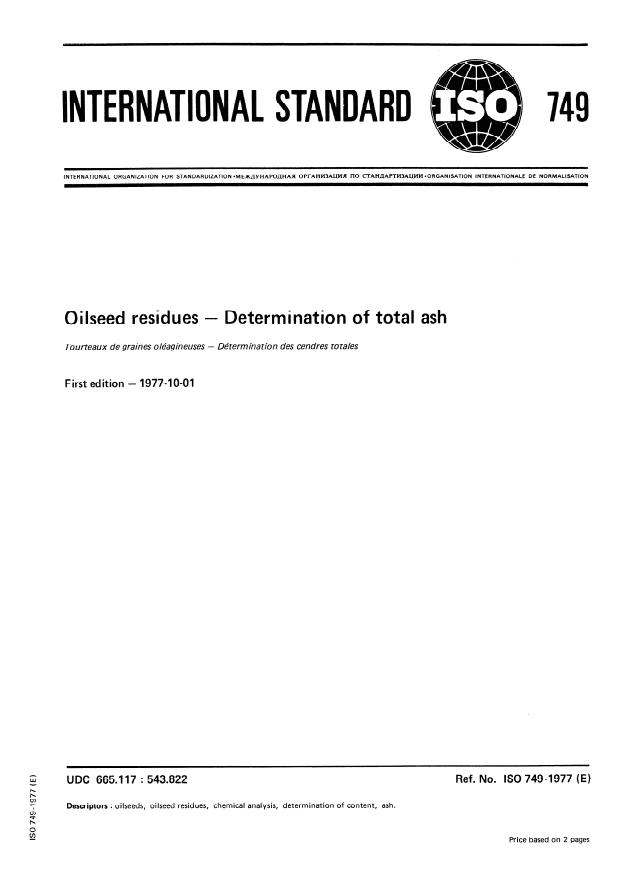
INTERNATIONAL STANDARD 749
INTERNATIONAL ORGANIZATION FOR STANDARDIZATION l MEXAYHAPOAHAII OPl-AHM3AUMII l-IO CTAHAAPTM3AUMM l ORGANIZATION INTERNATIONALE DE NORMALISATION
ilseed residues - Determination of total ash
Tourteaux de graines oGagineuses - De’termination des cendres totales
First edition - 1977-10-01
Ref. No. IS0 749-1977 (E)
UDC 665.117 : 543.822
chemical analysis, determination of content, ash.
Descriptors : oilseeds, oilseed residues,
Price based on 2 pages
FOREWORD
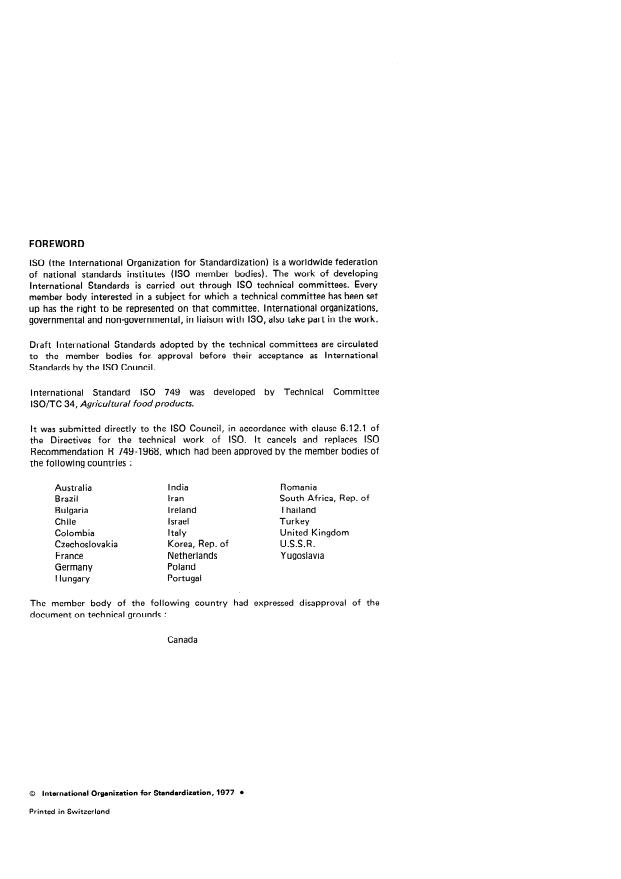
IS0 (the International Organization for Standardization) is a worldwide federation
of national standards institutes (IS0 member bodies). The work of developing
International Standards is carried out through IS0 technical committees. Every
member body interested in a subject for which a technical committee has been set
up has the right to be represented on that committee. International organizations,
governmental and non-governmental, in liaison with ISO, also take part in the work.
Draft International Standards adopted by the technical committees are circulated
to the member bodies for approval before their acceptance as International
Standards by the IS0 Council.
International Standard IS0 749 was developed by Technical Committee
ISO/TC 34, Agricultural food products.
It was submitted directly to the IS0 Council, in accordance with clause 6.12.1 of
the Directives for the technical work of ISO. It cancels and replaces IS0
Recommendation R 749-1968, which had been approved by the member bodies of
the following countries :
Australia India Romania
Brazil Iran South Africa, Rep. of
Bulgaria Ireland Thailand
Chile Israel Turkey
Colombia Italy United Kingdom
Czechoslovakia Korea, Rep. of
U.S.S.R.
Netherlands
France Yugoslavia
Germany Poland
Hungary Portugal
The member body of the following country had expressed disapproval of the
document on technical grounds :
Canada
0 International Organization for Standardization, 1977 l
Printed in Switzerland
IS0 749-1977 (E)
INTERNATIONAL STANDARD
Oilseed residues - Determination of total ash
I
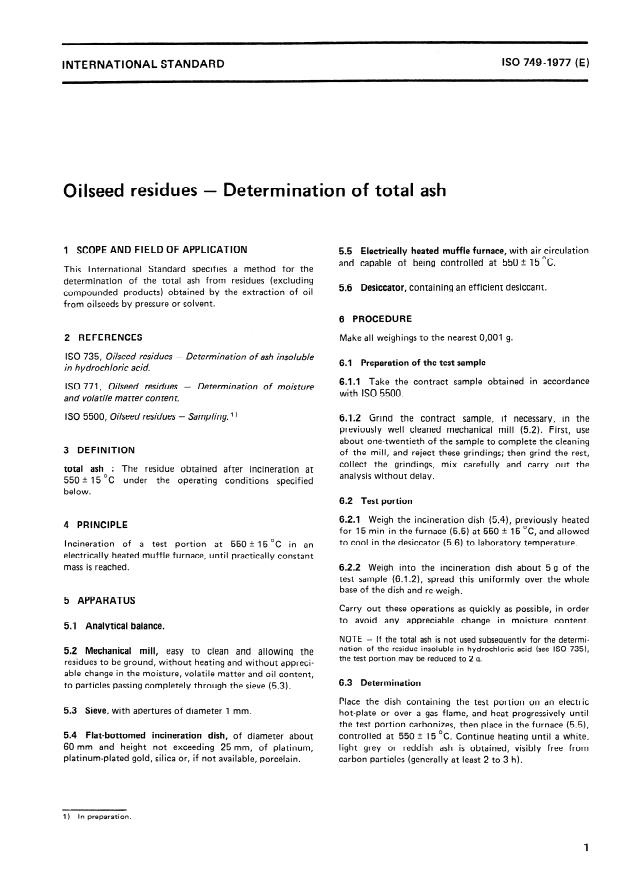
1 SCOPE AND FIELD OF APPLICATION
5.5 Electrically heated muffle furnace, with air circulation
and capable of being controlled at 650 ? I5 “C.
This International Standard specifies a method for the
determination of the total ash from residues (excluding
containing an efficient desiccant.
5.6 Desiccator,
compounded products) obtained by the extraction of oil
from oilseeds by pressure or solvent.
6 PROCEDURE
2 REFERENCES Make all weighings to the nearest 0,001 g.
I SO 735, Oilseed residues - Determination of ash insoluble
6.1 Preparation of the test sample
in hydrochloric acid.
6.1.1 Take the contract sample obtained in accordance
IS0 771, Oilseed residues - Determination of moisture
with IS0 5500.
and volatile matter con tent.
IS0 5500, Oilseed residues - Sampling. 1 )
6.1.2 Grind the contract sample, if necessary, in the
previously well cleaned mechanical mill (5.2). First, use
about one-twentieth of the sample to complete the cleaning
3 DEFINITION
of the mill, and reject these grindings; then grind the rest,
collect the grindings, mix carefully and carry out the
total ash : The residue obtained after incineration at
analysis without delay.
550 + I5 “C under the operating conditions specified
below.
6.2 Test portion
6.2.1 Weigh the incineration dish (5.4), previously heated
4 PRINCIPLE
for I5 min in the furnace (5.5) at 550 + I5 ‘C, and allowed
to cool in the desiccator (5.6) to laboratory temperature.
Incineration of a test portion at 550 + 15 “C in an
electrically heated muffle furnace, until practically constant
mass is reached. 6.2.2 Weigh into the incineration dish about 5 g of the
test sample (6.1.2), spread this uniformly over the whole
base of the dish and re-weigh.
5 APPARATUS
Carry out these oper
...
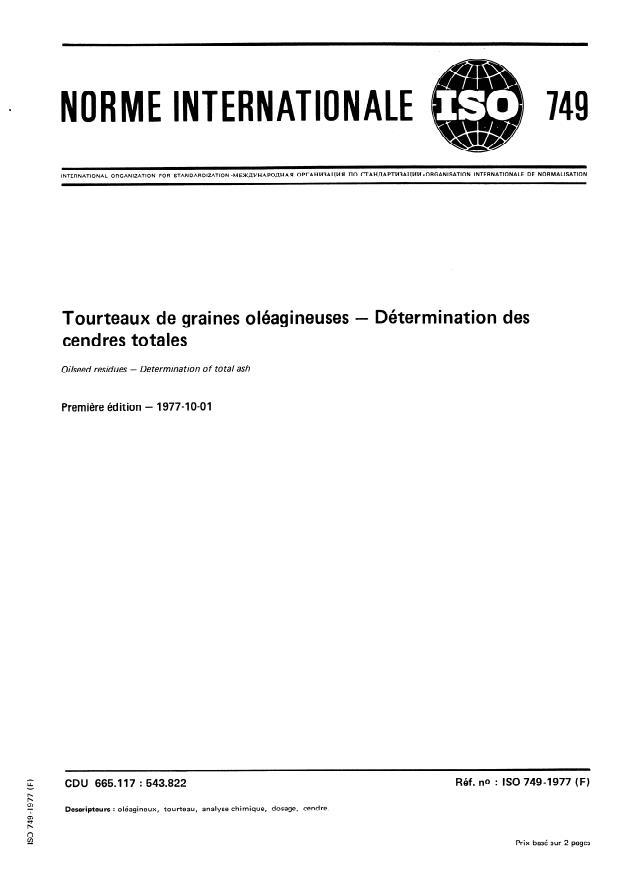
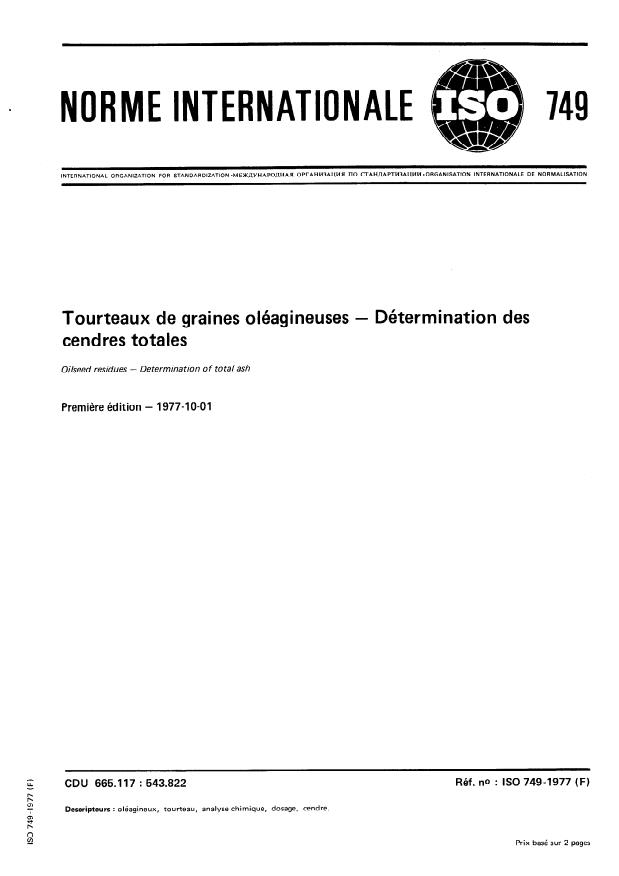
NORME INTERNATIONALE
INTERNATIONAL ORGANIZATION FOR STANDARDIZATION l MEXfiYHAPOAHA(I OPI-AHW3AUMII II0 CTAHAAPTW3ALJWW~ORGANISATION INTERNATIONALE DE NORMALISATION
Tourteaux de graines oléagineuses - Détermination des
cendres totales
Oilseed residues - De termina tion of total ash
Première édition - 1977-10-01
iz Réf. no : ISO 749-1977 (F)
CDU 665.117 : 543.822
Y
tourteau, analyse chimique, dosage, cendre.
Descripteurs : oléagineux,
Prix basé sur 2 pages
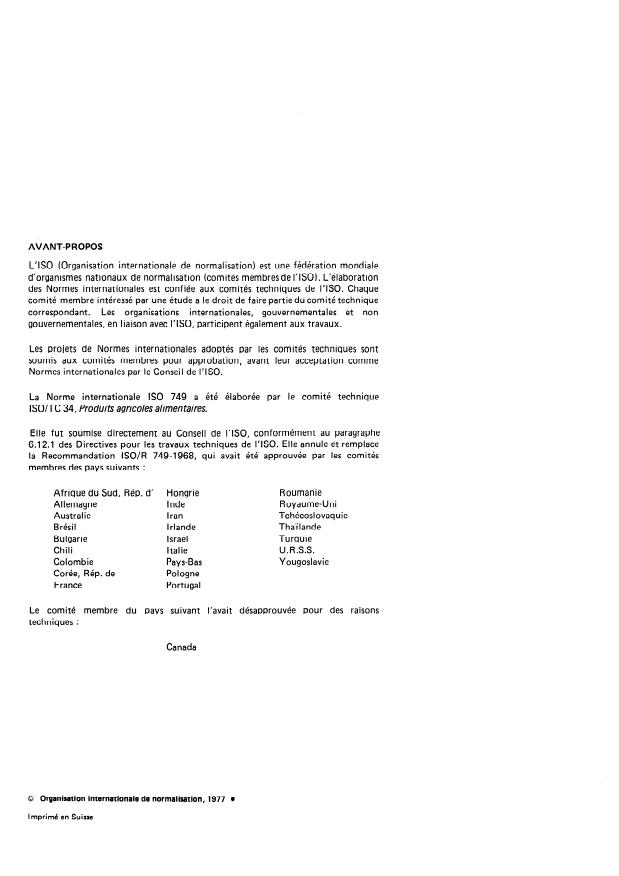
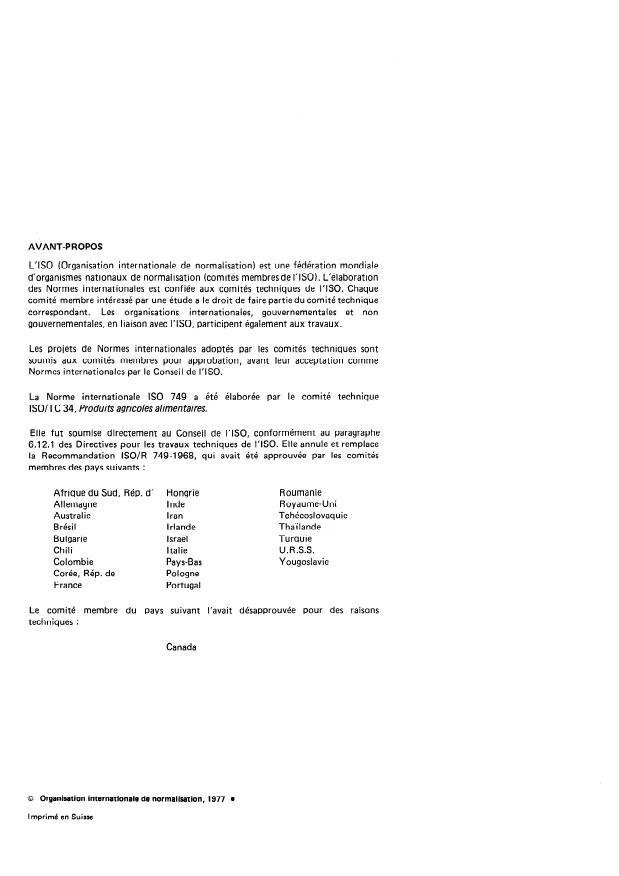
AVANT-PROPOS
L’ISO (Organisation internationale de normalisation) est une fédération mondiale
d’organismes nationaux de normalisation (comités membres de I’ISO). L’élaboration
des Normes internationales est confiée aux comités techniques de I’ISO. Chaque
comité membre intéressé par une étude a le droit de faire partiedu comité technique
correspondant. Les organisations internationales, gouvernementales et non
gouvernementales, en liaison avec I’ISO, participent également aux travaux.
Les projets de Normes internationales adoptés par les comités techniques sont
soumis aux comités membres pour approbation, avant leur acceptation comme
Normes internationales par le Conseil de I’ISO.
La Norme internationale ISO 749 a été élaborée par le comité technique
lSO/TC 34, Produits agricoles alimentaires.
Elle fut soumise directement au Conseil de I’ISO, conformément au paragraphe
6.12.1 des Directives pour les travaux techniques de I’ISO. Elle annule et remplace
la Recommandation ISO/R 749-1968, qui avait été approuvée par les comités
membres des pays suivants :
Afrique du Sud, Rép. d’ Hongrie Roumanie
Royaume-Uni
Allemagne Inde
Australie Iran Tchécoslovaquie
Brésil Irlande Thaïlande
Bulgarie Israël Turquie
Chili Italie U.R.S.S.
Colombie Pays-Bas Yougoslavie
Corée, Rép. de Pologne
France Portugal
Le comité membre du pays suivant l’avait désapprouvée pour des raisons
techniques :
Canada
0 Organisation internationale de normalisation, 1977 l
Imprimé en Suisse
Iso 749-1977 (F)
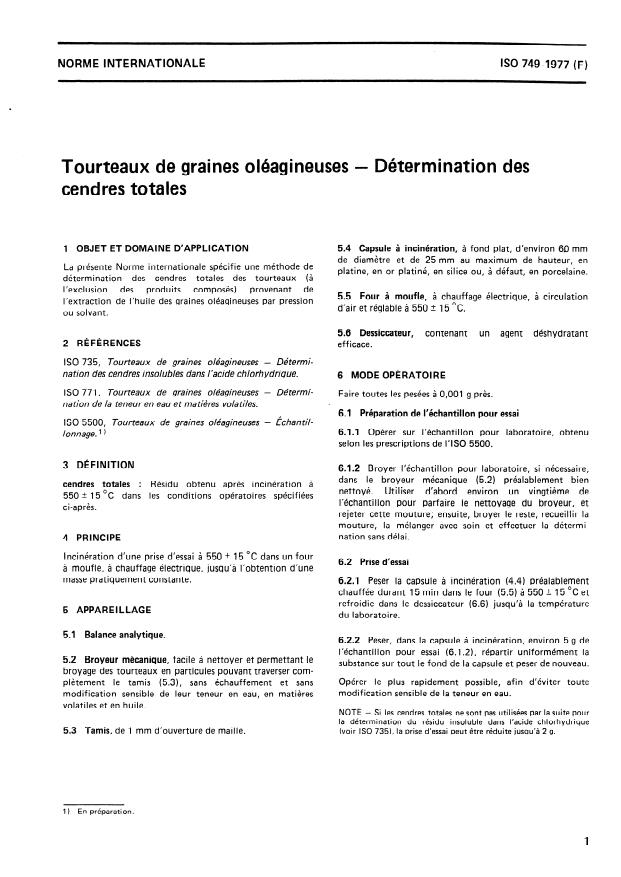
NORME INTERNATIONALE
.
Tourteaux de graines oléagineuses - Détermination des
cendres totales
5.4 Capsule à incinération, à fond plat, d’environ 60 mm
1 OBJET ET DOMAINE D’APPLICATION
de diamètre et de 25 mm au maximum de hauteur, en
La présente Norme internationale spécifie une méthode de
platine, en or platiné, en silice ou, à défaut, en porcelaine.
des cendres totales des tourteaux (à
détermination
l’exclusion des produits composés) provenant de
5.5 Four à moufle, à chauffage électrique, à circulation
l’extraction de I’huile des graines oléagineuses par pression
d’air et réglable à 550 rf: 15 “C.
ou solvant.
5.6 Dessiccateur, contenant un agent déshydratant
2 RÉFÉRENCES efficace.
ISO 735, Tourteaux de graines oléagineuses - Détermi-
nation des cendres insolubles dans /acide chlorhydrique.
6 MODE OPÉRATOIRE
ISO 77 1, Tourteaux de graines oléagineuses - Détermi-
Faire toutes les pesées à 0,001 g près.
nation de la teneur en eau et matières volatiles.
6.1 Préparation de l’échantillon pour essai
ISO 5500, Tourteaux de graines oléagineuses - Échantil-
6.1.1 Opérer sur l’échantillon pour laboratoire, obtenu
lonnage. l)
selon les prescriptions de I’ISO 5500.
3 DÉFINITION
6.1.2 Broyer l’échantillon pour laboratoire, si nécessaire,
dans le broyeur mécanique (5.2) préalablement bien
cendres totales : Résidu obtenu après incinération à
nettoyé. Utiliser d’abord environ un vingtième de
550 + 15 “C dans les conditions opératoires spécifiées
l’échantillon pour parfaire le nettoyage du broyeur, et
ci-après.
rejeter cette mouture; ensuite, broyer le reste, recueillir la
mouture, la mélanger avec soin et effectuer la détermi-
nation sans délai.
4 PRINCIPE
Incinération d’une prise d’essai à 550 + 15 “C dans un four
6.2 Prise d’essai
à moufle, à chauffage électrique, jusqu’à l’obtention d’une
masse pratiquement constante.
6.2.1 Peser la capsule à incinération (4.4) préalablement
chauffée durant 15 min dans le four (5.5) à 550 + 15 “C et
refroidie dans le dessiccateur (6.6) jusqu’à la température
5 APPAREILLAGE
du laboratoire.
5.1 Balance analytique.
6.2.2 Peser, dans la capsule à incinération, environ 5 g de
l
...
NORME INTERNATIONALE
INTERNATIONAL ORGANIZATION FOR STANDARDIZATION l MEXfiYHAPOAHA(I OPI-AHW3AUMII II0 CTAHAAPTW3ALJWW~ORGANISATION INTERNATIONALE DE NORMALISATION
Tourteaux de graines oléagineuses - Détermination des
cendres totales
Oilseed residues - De termina tion of total ash
Première édition - 1977-10-01
iz Réf. no : ISO 749-1977 (F)
CDU 665.117 : 543.822
Y
tourteau, analyse chimique, dosage, cendre.
Descripteurs : oléagineux,
Prix basé sur 2 pages
AVANT-PROPOS
L’ISO (Organisation internationale de normalisation) est une fédération mondiale
d’organismes nationaux de normalisation (comités membres de I’ISO). L’élaboration
des Normes internationales est confiée aux comités techniques de I’ISO. Chaque
comité membre intéressé par une étude a le droit de faire partiedu comité technique
correspondant. Les organisations internationales, gouvernementales et non
gouvernementales, en liaison avec I’ISO, participent également aux travaux.
Les projets de Normes internationales adoptés par les comités techniques sont
soumis aux comités membres pour approbation, avant leur acceptation comme
Normes internationales par le Conseil de I’ISO.
La Norme internationale ISO 749 a été élaborée par le comité technique
lSO/TC 34, Produits agricoles alimentaires.
Elle fut soumise directement au Conseil de I’ISO, conformément au paragraphe
6.12.1 des Directives pour les travaux techniques de I’ISO. Elle annule et remplace
la Recommandation ISO/R 749-1968, qui avait été approuvée par les comités
membres des pays suivants :
Afrique du Sud, Rép. d’ Hongrie Roumanie
Royaume-Uni
Allemagne Inde
Australie Iran Tchécoslovaquie
Brésil Irlande Thaïlande
Bulgarie Israël Turquie
Chili Italie U.R.S.S.
Colombie Pays-Bas Yougoslavie
Corée, Rép. de Pologne
France Portugal
Le comité membre du pays suivant l’avait désapprouvée pour des raisons
techniques :
Canada
0 Organisation internationale de normalisation, 1977 l
Imprimé en Suisse
Iso 749-1977 (F)
NORME INTERNATIONALE
.
Tourteaux de graines oléagineuses - Détermination des
cendres totales
5.4 Capsule à incinération, à fond plat, d’environ 60 mm
1 OBJET ET DOMAINE D’APPLICATION
de diamètre et de 25 mm au maximum de hauteur, en
La présente Norme internationale spécifie une méthode de
platine, en or platiné, en silice ou, à défaut, en porcelaine.
des cendres totales des tourteaux (à
détermination
l’exclusion des produits composés) provenant de
5.5 Four à moufle, à chauffage électrique, à circulation
l’extraction de I’huile des graines oléagineuses par pression
d’air et réglable à 550 rf: 15 “C.
ou solvant.
5.6 Dessiccateur, contenant un agent déshydratant
2 RÉFÉRENCES efficace.
ISO 735, Tourteaux de graines oléagineuses - Détermi-
nation des cendres insolubles dans /acide chlorhydrique.
6 MODE OPÉRATOIRE
ISO 77 1, Tourteaux de graines oléagineuses - Détermi-
Faire toutes les pesées à 0,001 g près.
nation de la teneur en eau et matières volatiles.
6.1 Préparation de l’échantillon pour essai
ISO 5500, Tourteaux de graines oléagineuses - Échantil-
6.1.1 Opérer sur l’échantillon pour laboratoire, obtenu
lonnage. l)
selon les prescriptions de I’ISO 5500.
3 DÉFINITION
6.1.2 Broyer l’échantillon pour laboratoire, si nécessaire,
dans le broyeur mécanique (5.2) préalablement bien
cendres totales : Résidu obtenu après incinération à
nettoyé. Utiliser d’abord environ un vingtième de
550 + 15 “C dans les conditions opératoires spécifiées
l’échantillon pour parfaire le nettoyage du broyeur, et
ci-après.
rejeter cette mouture; ensuite, broyer le reste, recueillir la
mouture, la mélanger avec soin et effectuer la détermi-
nation sans délai.
4 PRINCIPE
Incinération d’une prise d’essai à 550 + 15 “C dans un four
6.2 Prise d’essai
à moufle, à chauffage électrique, jusqu’à l’obtention d’une
masse pratiquement constante.
6.2.1 Peser la capsule à incinération (4.4) préalablement
chauffée durant 15 min dans le four (5.5) à 550 + 15 “C et
refroidie dans le dessiccateur (6.6) jusqu’à la température
5 APPAREILLAGE
du laboratoire.
5.1 Balance analytique.
6.2.2 Peser, dans la capsule à incinération, environ 5 g de
l
...