

ISO/TS 30431:2021
(Main)Human resource management — Leadership metrics cluster
General Information
- Abstract
This document describes the elements of the leadership metrics cluster. This document provides the formula for comparable measures for internal and external reporting. This document also highlights issues that need to be considered when interpreting the leadership data, especially when deciding on the appropriate intervention internally and when reporting these to external stakeholders (e.g. regulators, investors).
- Status
- Published
- Publication Date
- 22-Mar-2021
- Technical Committee
- ISO/TC 260 - Human resource management
- Drafting Committee
- ISO/TC 260/WG 2 - Metrics
- Current Stage
- 9060 - Close of review
- Completion Date
- 02-Sep-2027
Buy Documents
ISO/TS 30431:2021 - Human resource management — Leadership metrics cluster Released:3/23/2021
ISO/TS 30431:2021 - Human resource management — Leadership metrics cluster/23/2021
Overview
ISO/TS 30431:2021 - Human resource management - Leadership metrics cluster - defines a compact set of leadership metrics and standardized formulas to support consistent internal and external reporting. The technical specification focuses on leadership trust, span of control, and leadership development, and explains how to calculate comparable measures, interpret results, and consider contextual and predictive factors when deciding interventions or reporting to stakeholders (e.g., regulators, investors).
Key Topics
- Metrics covered
- Leadership trust: guidance on survey-based measures (employee engagement subsets, Likert-to-percentile conversions, Crawford/LePine/Rich scales) to produce an aggregate leadership trust index (0–100%).
- Span of control: two formulae are provided:
- Overall average method: total workforce population / total management population.
- Specific method (management span): total workforce population / total management with direct reports.
- Leadership development: percentage of leaders who participated in leadership development programmes and/or training within a defined period.
- Components defined for each metric
- Description, purpose, formula, how to use, intended users, contextual factors, predictive factors, and examples.
- Interpretation guidance
- Discussion of contextual factors (FTE changes, reorganizations, cultural shifts, economic conditions) and predictive factors (planned structural changes, acquisitions, industry impacts) that affect metric meaning.
Applications
ISO/TS 30431:2021 is practical for organizations aiming to measure and report leadership quality and structure in a consistent, comparable way:
- Human resources & people analytics: standardize leadership surveys, compute spans of control by function, and track development programme coverage.
- Organizational design & workforce planning: use span-of-control metrics to evaluate layers, manager workload, and potential impacts on engagement and turnover.
- Internal reporting & governance: inform leadership interventions, succession planning and targeted development based on trust and training participation metrics.
- External reporting & stakeholders: provide comparable leadership data for investors, regulators, auditors and sustainability/human-capital disclosures.
- Benchmarking: compare leadership metrics across business units, regions or against industry expectations when contextual factors are documented.
Related Standards
- ISO 30414:2018 - Guidelines for internal and external human capital reporting (leadership described in 4.7.5).
- ISO 30400 - Human resource management - Vocabulary (terms and definitions used).
ISO/TS 30431:2021 supports consistent, transparent leadership measurement as part of broader human capital reporting and can be integrated into HR metrics frameworks for improved decision-making and stakeholder communication.
Relations
- Consolidated By
ISO 717-1:2020 - Acoustics — Rating of sound insulation in buildings and of building elements — Part 1: Airborne sound insulation - Effective Date
- 06-Jun-2022
Buy Documents
ISO/TS 30431:2021 - Human resource management — Leadership metrics cluster Released:3/23/2021
ISO/TS 30431:2021 - Human resource management — Leadership metrics cluster/23/2021
Get Certified
Connect with accredited certification bodies for this standard

BSI Group
BSI (British Standards Institution) is the business standards company that helps organizations make excellence a habit.

Bureau Veritas
Bureau Veritas is a world leader in laboratory testing, inspection and certification services.

DNV
DNV is an independent assurance and risk management provider.
Sponsored listings
Frequently Asked Questions
ISO/TS 30431:2021 is a technical specification published by the International Organization for Standardization (ISO). Its full title is "Human resource management — Leadership metrics cluster". This standard covers: This document describes the elements of the leadership metrics cluster. This document provides the formula for comparable measures for internal and external reporting. This document also highlights issues that need to be considered when interpreting the leadership data, especially when deciding on the appropriate intervention internally and when reporting these to external stakeholders (e.g. regulators, investors).
This document describes the elements of the leadership metrics cluster. This document provides the formula for comparable measures for internal and external reporting. This document also highlights issues that need to be considered when interpreting the leadership data, especially when deciding on the appropriate intervention internally and when reporting these to external stakeholders (e.g. regulators, investors).
ISO/TS 30431:2021 is classified under the following ICS (International Classification for Standards) categories: 03.100.30 - Management of human resources. The ICS classification helps identify the subject area and facilitates finding related standards.
ISO/TS 30431:2021 has the following relationships with other standards: It is inter standard links to ISO 717-1:2020. Understanding these relationships helps ensure you are using the most current and applicable version of the standard.
ISO/TS 30431:2021 is available in PDF format for immediate download after purchase. The document can be added to your cart and obtained through the secure checkout process. Digital delivery ensures instant access to the complete standard document.
Standards Content (Sample)
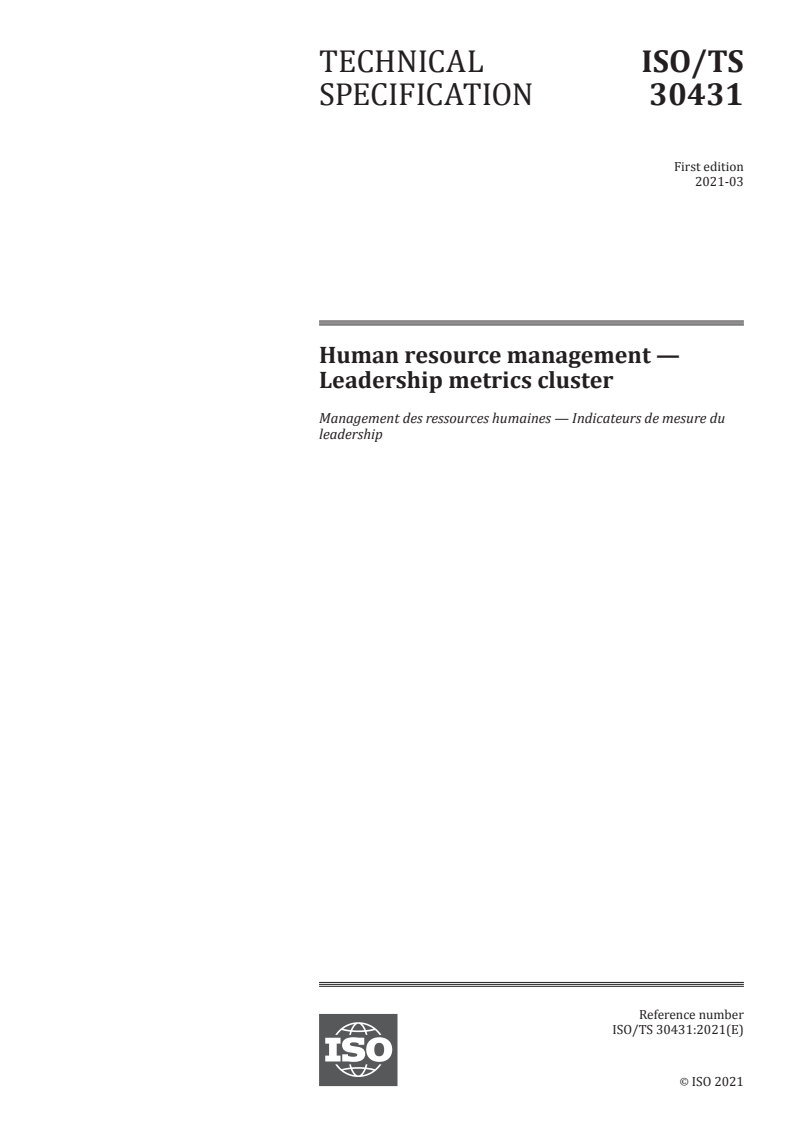
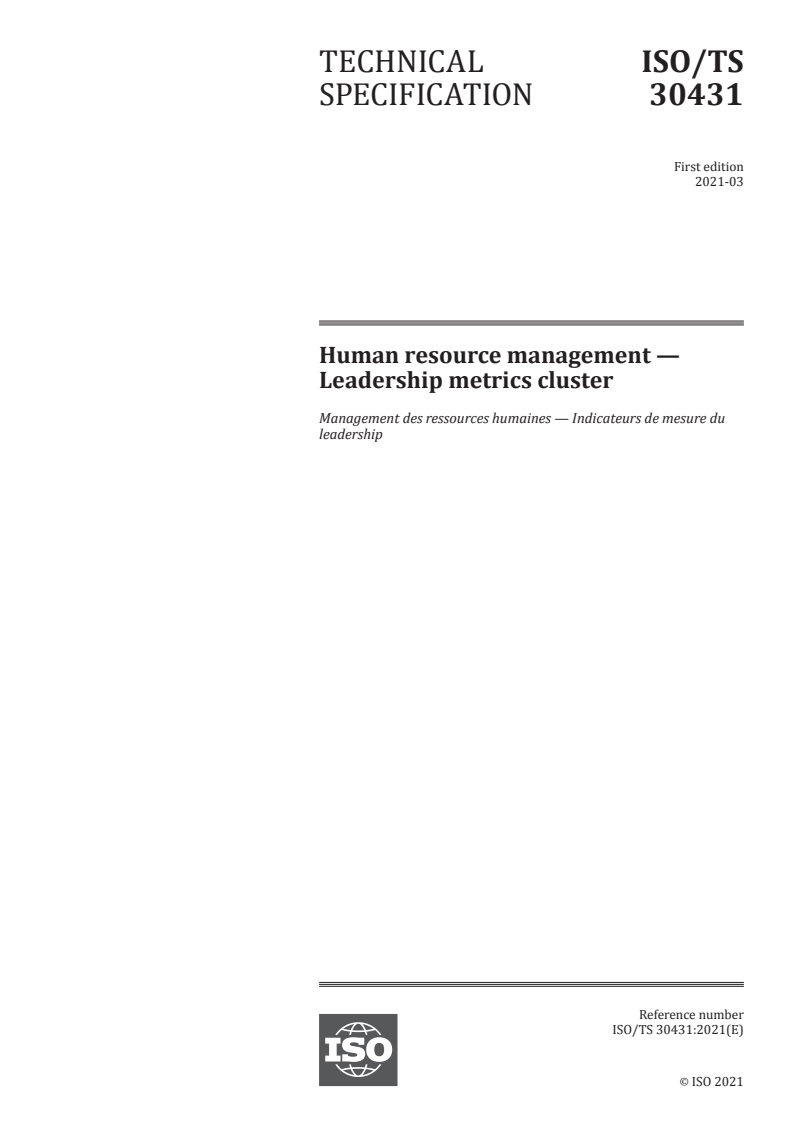
TECHNICAL ISO/TS
SPECIFICATION 30431
First edition
2021-03
Human resource management —
Leadership metrics cluster
Management des ressources humaines — Indicateurs de mesure du
leadership
Reference number
©
ISO 2021
© ISO 2021
All rights reserved. Unless otherwise specified, or required in the context of its implementation, no part of this publication may
be reproduced or utilized otherwise in any form or by any means, electronic or mechanical, including photocopying, or posting
on the internet or an intranet, without prior written permission. Permission can be requested from either ISO at the address
below or ISO’s member body in the country of the requester.
ISO copyright office
CP 401 • Ch. de Blandonnet 8
CH-1214 Vernier, Geneva
Phone: +41 22 749 01 11
Email: copyright@iso.org
Website: www.iso.org
Published in Switzerland
ii © ISO 2021 – All rights reserved
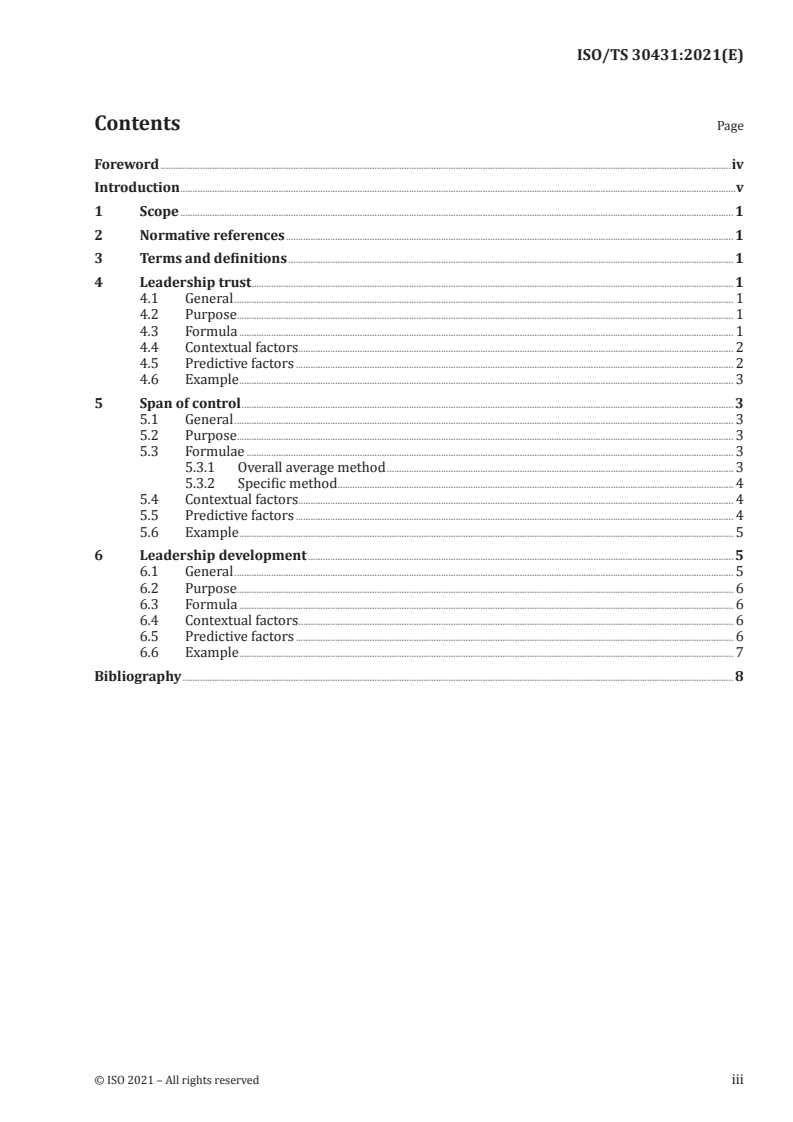
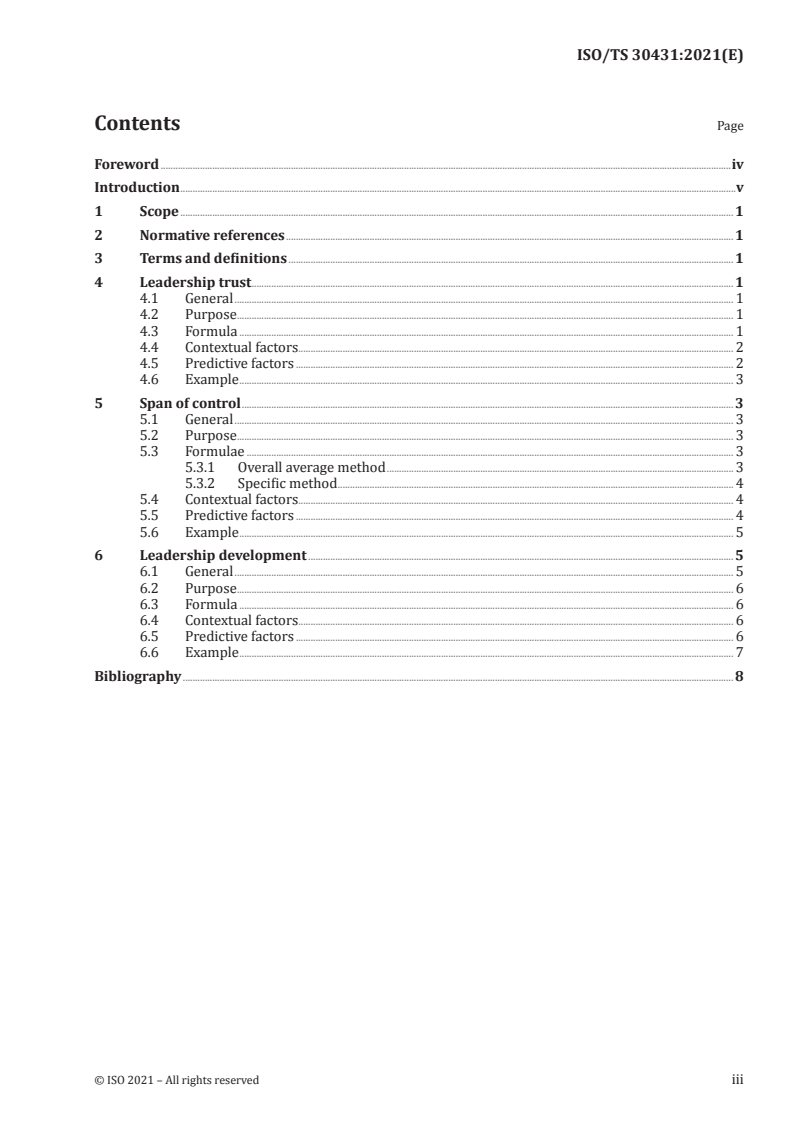
Contents Page
Foreword .iv
Introduction .v
1 Scope . 1
2 Normative references . 1
3 Terms and definitions . 1
4 Leadership trust . 1
4.1 General . 1
4.2 Purpose . 1
4.3 Formula . 1
4.4 Contextual factors . 2
4.5 Predictive factors . 2
4.6 Example . 3
5 Span of control . 3
5.1 General . 3
5.2 Purpose . 3
5.3 Formulae . 3
5.3.1 Overall average method . 3
5.3.2 Specific method . 4
5.4 Contextual factors . 4
5.5 Predictive factors . 4
5.6 Example . 5
6 Leadership development . 5
6.1 General . 5
6.2 Purpose . 6
6.3 Formula . 6
6.4 Contextual factors . 6
6.5 Predictive factors . 6
6.6 Example . 7
Bibliography . 8
Foreword
ISO (the International Organization for Standardization) is a worldwide federation of national standards
bodies (ISO member bodies). The work of preparing International Standards is normally carried out
through ISO technical committees. Each member body interested in a subject for which a technical
committee has been established has the right to be represented on that committee. International
organizations, governmental and non-governmental, in liaison with ISO, also take part in the work.
ISO collaborates closely with the International Electrotechnical Commission (IEC) on all matters of
electrotechnical standardization.
The procedures used to develop this document and those intended for its further maintenance are
described in the ISO/IEC Directives, Part 1. In particular, the different approval criteria needed for the
different types of ISO documents should be noted. This document was drafted in accordance with the
editorial rules of the ISO/IEC Directives, Part 2 (see www .iso .org/ directives).
Attention is drawn to the possibility that some of the elements of this document may be the subject of
patent rights. ISO shall not be held responsible for identifying any or all such patent rights. Details of
any patent rights identified during the development of the document will be in the Introduction and/or
on the ISO list of patent declarations received (see www .iso .org/ patents).
Any trade name used in this document is information given for the convenience of users and does not
constitute an endorsement.
For an explanation of the voluntary nature of standards, the meaning of ISO specific terms and
expressions related to conformity assessment, as well as information about ISO's adherence to the
World Trade Organization (WTO) principles in the Technical Barriers to Trade (TBT), see www .iso .org/
iso/ foreword .html.
This document was prepared by Technical Committee ISO/TC 260, Human resource management.
Any feedback or questions on this document should be directed to the user’s national standards body. A
complete listing of these bodies can be found at www .iso .org/ members .html.
iv © ISO 2021 – All rights reserved
Introduction
ISO 30414 highlights guidelines on the following core human capital reporting areas or "clusters":
— compliance and ethics;
— costs;
— diversity;
— leadership;
— organizational culture;
— organizational health, safety and well-being;
— productivity;
— recruitment, mobility and turnover;
— skills and capabilities;
— succession planning;
— workforce availability.
ISO 30414:2018, 4.7.5, describes leadership in organizations.
The following metrics grouping or cluster is included in this document:
a) leadership trust;
b) span of control;
c) leadership development.
Leadership development is expressed as one or both of the following:
— percentage of leaders who have participated in leadership development programmes within a
defined period;
— percentage of leaders who have participated in training.
This document describes the following components for each of the above metrics:
— description;
— purpose;
— formula;
— how to use;
— intended user(s);
— contextual factors;
— predictive factors.
The quality and sustainability of leadership has a strong impact on the results of an organization.
It depends, for instance, on identifying and developing the most appropriate leaders, for example
segmented by executive leaders and managers. Metrics within this area make statements about the
process of identifying and developing leaders.
As leadership impacts the workforce, organizations can consider establishing and implementing
strategies for consultation and participation of all workers, and their representatives as appropriate,
ensuring an open and regular dialogue.
vi © ISO 2021 – All rights reserved
TECHNICAL SPECIFICATION ISO/TS 30431:2021(E)
Human resource management — Leadership metrics cluster
1 Scope
This document describes the elements of the leadership metrics cluster. This document provides the
formula for comparable measures for internal and external reporting.
This document also highlights issues that need to be considered when interpreting the leadership
data, especially when deciding on the appropriate intervention internally and when reporting these to
external stakeholders (e.g. regulators, investors).
2 Normative references
The following documents are referred to in the text in such a way that some or all of their content
constitutes requirements of this document. For dated references, only the edition cited applies. For
undated references, the latest edition of the referenced document (including any amendments) applies.
ISO 30400, Human resource management — Vocabulary
ISO 30414:2018, Human resource management — Guidelines for internal and external human capital
reporting
3 Terms and definitions
For the purposes of this document, the terms and definitions given in ISO 30400 and ISO 30414 apply.
ISO and IEC maintain terminological databases for use in standardization at the following addresses:
— ISO Online browsing platform: available at https:// www .iso .org/ obp
— IEC Electropedia: available at http:// www .electropedia .org/
4 Leadership trust
4.1 General
ISO 30414:2018, 4.7.5.1, describes leadership trust.
4.2 Purpose
To gauge the trust employees have in their managers and leaders.
4.3 Formula
Leadership t
...
TECHNICAL ISO/TS
SPECIFICATION 30431
First edition
2021-03
Human resource management —
Leadership metrics cluster
Management des ressources humaines — Indicateurs de mesure du
leadership
Reference number
©
ISO 2021
© ISO 2021
All rights reserved. Unless otherwise specified, or required in the context of its implementation, no part of this publication may
be reproduced or utilized otherwise in any form or by any means, electronic or mechanical, including photocopying, or posting
on the internet or an intranet, without prior written permission. Permission can be requested from either ISO at the address
below or ISO’s member body in the country of the requester.
ISO copyright office
CP 401 • Ch. de Blandonnet 8
CH-1214 Vernier, Geneva
Phone: +41 22 749 01 11
Email: copyright@iso.org
Website: www.iso.org
Published in Switzerland
ii © ISO 2021 – All rights reserved
Contents Page
Foreword .iv
Introduction .v
1 Scope . 1
2 Normative references . 1
3 Terms and definitions . 1
4 Leadership trust . 1
4.1 General . 1
4.2 Purpose . 1
4.3 Formula . 1
4.4 Contextual factors . 2
4.5 Predictive factors . 2
4.6 Example . 3
5 Span of control . 3
5.1 General . 3
5.2 Purpose . 3
5.3 Formulae . 3
5.3.1 Overall average method . 3
5.3.2 Specific method . 4
5.4 Contextual factors . 4
5.5 Predictive factors . 4
5.6 Example . 5
6 Leadership development . 5
6.1 General . 5
6.2 Purpose . 6
6.3 Formula . 6
6.4 Contextual factors . 6
6.5 Predictive factors . 6
6.6 Example . 7
Bibliography . 8
Foreword
ISO (the International Organization for Standardization) is a worldwide federation of national standards
bodies (ISO member bodies). The work of preparing International Standards is normally carried out
through ISO technical committees. Each member body interested in a subject for which a technical
committee has been established has the right to be represented on that committee. International
organizations, governmental and non-governmental, in liaison with ISO, also take part in the work.
ISO collaborates closely with the International Electrotechnical Commission (IEC) on all matters of
electrotechnical standardization.
The procedures used to develop this document and those intended for its further maintenance are
described in the ISO/IEC Directives, Part 1. In particular, the different approval criteria needed for the
different types of ISO documents should be noted. This document was drafted in accordance with the
editorial rules of the ISO/IEC Directives, Part 2 (see www .iso .org/ directives).
Attention is drawn to the possibility that some of the elements of this document may be the subject of
patent rights. ISO shall not be held responsible for identifying any or all such patent rights. Details of
any patent rights identified during the development of the document will be in the Introduction and/or
on the ISO list of patent declarations received (see www .iso .org/ patents).
Any trade name used in this document is information given for the convenience of users and does not
constitute an endorsement.
For an explanation of the voluntary nature of standards, the meaning of ISO specific terms and
expressions related to conformity assessment, as well as information about ISO's adherence to the
World Trade Organization (WTO) principles in the Technical Barriers to Trade (TBT), see www .iso .org/
iso/ foreword .html.
This document was prepared by Technical Committee ISO/TC 260, Human resource management.
Any feedback or questions on this document should be directed to the user’s national standards body. A
complete listing of these bodies can be found at www .iso .org/ members .html.
iv © ISO 2021 – All rights reserved
Introduction
ISO 30414 highlights guidelines on the following core human capital reporting areas or "clusters":
— compliance and ethics;
— costs;
— diversity;
— leadership;
— organizational culture;
— organizational health, safety and well-being;
— productivity;
— recruitment, mobility and turnover;
— skills and capabilities;
— succession planning;
— workforce availability.
ISO 30414:2018, 4.7.5, describes leadership in organizations.
The following metrics grouping or cluster is included in this document:
a) leadership trust;
b) span of control;
c) leadership development.
Leadership development is expressed as one or both of the following:
— percentage of leaders who have participated in leadership development programmes within a
defined period;
— percentage of leaders who have participated in training.
This document describes the following components for each of the above metrics:
— description;
— purpose;
— formula;
— how to use;
— intended user(s);
— contextual factors;
— predictive factors.
The quality and sustainability of leadership has a strong impact on the results of an organization.
It depends, for instance, on identifying and developing the most appropriate leaders, for example
segmented by executive leaders and managers. Metrics within this area make statements about the
process of identifying and developing leaders.
As leadership impacts the workforce, organizations can consider establishing and implementing
strategies for consultation and participation of all workers, and their representatives as appropriate,
ensuring an open and regular dialogue.
vi © ISO 2021 – All rights reserved
TECHNICAL SPECIFICATION ISO/TS 30431:2021(E)
Human resource management — Leadership metrics cluster
1 Scope
This document describes the elements of the leadership metrics cluster. This document provides the
formula for comparable measures for internal and external reporting.
This document also highlights issues that need to be considered when interpreting the leadership
data, especially when deciding on the appropriate intervention internally and when reporting these to
external stakeholders (e.g. regulators, investors).
2 Normative references
The following documents are referred to in the text in such a way that some or all of their content
constitutes requirements of this document. For dated references, only the edition cited applies. For
undated references, the latest edition of the referenced document (including any amendments) applies.
ISO 30400, Human resource management — Vocabulary
ISO 30414:2018, Human resource management — Guidelines for internal and external human capital
reporting
3 Terms and definitions
For the purposes of this document, the terms and definitions given in ISO 30400 and ISO 30414 apply.
ISO and IEC maintain terminological databases for use in standardization at the following addresses:
— ISO Online browsing platform: available at https:// www .iso .org/ obp
— IEC Electropedia: available at http:// www .electropedia .org/
4 Leadership trust
4.1 General
ISO 30414:2018, 4.7.5.1, describes leadership trust.
4.2 Purpose
To gauge the trust employees have in their managers and leaders.
4.3 Formula
Leadership t
...