

ISO/IEC 16500-2:1999
(Main)Information technology — Generic digital audio-visual systems — Part 2: System dynamics, scenarios and protocol requirements
General Information
- Abstract
The purpose of this part of ISO/IEC 16500 is to specify normative protocols and associated dynamic system behavior, including session and connection manipulation, configuration and download, for an ISO/IEC 16500 system. The emphasis is on the significant dynamic system entities (e.g., session control, call/connection control), the behavior of these entities (e.g., information flows, entity actions, parameters passed) and the allowable physical placement(s) of these entities in a DAVIC system (i.e., physical instances). As such, this part of ISO/IEC 16500 complements the static systems reference model described in ISO/IEC 16500-1, specifying normative dynamic behavior as well as specifying the protocol(s) required to realize this behavior. The protocols themselves are specified primarily through the use of "Protocol Network Architecture" diagrams which visually illustrate, for each of the defined physical instances and application scenarios, the various protocol stacks which are to be used. Detailed specification of the individual protocol tools themselves (e.g., the detailed protocol messages used to realize the DAVIC dynamic flow behavior) is provided in ISO/IEC 16500-5 (mid- and higher layers) and ISO/IEC 16500-4 (lower layers) of this specification. This results in instance specifications made up of building blocks from the DAVIC tool set organized in a manner describing a system which performs DAVIC functions.
- Status
- Published
- Publication Date
- 15-Dec-1999
- Current Stage
- 9060 - Close of review
- Completion Date
- 02-Dec-2031
Overview
ISO/IEC 16500-2:1999 - part of the DAVIC-based ISO/IEC 16500 family - defines the system dynamics, scenarios and protocol requirements for generic digital audio‑visual (DAV) systems. It specifies normative protocols and associated dynamic system behavior (for example, session control, call/connection control, configuration and download) and shows how protocol stacks are combined by means of Protocol Network Architecture diagrams. This part complements the static reference model in ISO/IEC 16500-1 by detailing the dynamic flows and the required protocols to achieve end-to-end interoperability.
Key topics and requirements
- Dynamic system modeling (DSDM): normative description of the major dynamic entities (session control, service control, connection control) and their behaviors, information flows and parameters.
- Protocol requirements: identification of required protocol stacks for each physical instance and scenario; use of DAVIC toolset building blocks to form instance specifications.
- Application scenarios covered: Video-on-Demand (VoD), Switched Video Broadcast (SVB), Interactive Broadcast (including PSTN/ISDN return channels), and Internet access scenarios.
- Configuration and download: procedures for STU (set-top unit) configuration, service provider configuration and dynamic download flows (boot-time and in-session).
- Protocol Network Architecture diagrams: visual normative specification illustrating protocol layers and interconnections for each scenario and physical placement.
- Interoperability emphasis: specifies reference points, logical/physical interfaces and required protocol behavior to enable multi-vendor interoperability and conformance testing.
Applications and who uses it
ISO/IEC 16500-2 is primarily used by:
- System architects and solution designers developing DAV services (VoD, interactive broadcast, broadband Internet access via broadcast networks).
- Set-top unit (STU) and middleware vendors implementing session control, download and configuration mechanisms per DAVIC requirements.
- Network operators and service providers planning deployment scenarios and defining interface/protocol requirements across delivery systems.
- Standards engineers and test laboratories creating conformance test suites and validating interoperability across DAVIC-compliant implementations. Practical applications include designing service control flows for VoD, specifying protocol stacks for return-channel interactive services, and defining secure, standardized download and boot procedures for consumer devices.
Related standards
- ISO/IEC 16500-1: System reference models and scenarios (static model).
- ISO/IEC 16500-4: Lower-layer protocols and physical interfaces (detailed lower-layer tools).
- ISO/IEC 16500-5: High- and mid-layer protocols (detailed message-level protocol specifications).
- Other parts in the ISO/IEC 16500 series cover information representation, security, management and usage data.
Keywords: ISO/IEC 16500-2, DAVIC, digital audio‑visual systems, system dynamics, protocol requirements, Video-on-Demand, switched video broadcast, interactive broadcast, Protocol Network Architecture, set-top unit, session control, configuration, download.
Relations
- Consolidated By
ISO 16484-5:2007/Amd 1:2009 - Building automation and control systems — Part 5: Data communication protocol — Amendment 1 - Effective Date
- 06-Jun-2022
Get Certified
Connect with accredited certification bodies for this standard

BSI Group
BSI (British Standards Institution) is the business standards company that helps organizations make excellence a habit.

NYCE
Mexican standards and certification body.
Sponsored listings
Frequently Asked Questions
ISO/IEC 16500-2:1999 is a standard published by the International Organization for Standardization (ISO). Its full title is "Information technology — Generic digital audio-visual systems — Part 2: System dynamics, scenarios and protocol requirements". This standard covers: The purpose of this part of ISO/IEC 16500 is to specify normative protocols and associated dynamic system behavior, including session and connection manipulation, configuration and download, for an ISO/IEC 16500 system. The emphasis is on the significant dynamic system entities (e.g., session control, call/connection control), the behavior of these entities (e.g., information flows, entity actions, parameters passed) and the allowable physical placement(s) of these entities in a DAVIC system (i.e., physical instances). As such, this part of ISO/IEC 16500 complements the static systems reference model described in ISO/IEC 16500-1, specifying normative dynamic behavior as well as specifying the protocol(s) required to realize this behavior. The protocols themselves are specified primarily through the use of "Protocol Network Architecture" diagrams which visually illustrate, for each of the defined physical instances and application scenarios, the various protocol stacks which are to be used. Detailed specification of the individual protocol tools themselves (e.g., the detailed protocol messages used to realize the DAVIC dynamic flow behavior) is provided in ISO/IEC 16500-5 (mid- and higher layers) and ISO/IEC 16500-4 (lower layers) of this specification. This results in instance specifications made up of building blocks from the DAVIC tool set organized in a manner describing a system which performs DAVIC functions.
The purpose of this part of ISO/IEC 16500 is to specify normative protocols and associated dynamic system behavior, including session and connection manipulation, configuration and download, for an ISO/IEC 16500 system. The emphasis is on the significant dynamic system entities (e.g., session control, call/connection control), the behavior of these entities (e.g., information flows, entity actions, parameters passed) and the allowable physical placement(s) of these entities in a DAVIC system (i.e., physical instances). As such, this part of ISO/IEC 16500 complements the static systems reference model described in ISO/IEC 16500-1, specifying normative dynamic behavior as well as specifying the protocol(s) required to realize this behavior. The protocols themselves are specified primarily through the use of "Protocol Network Architecture" diagrams which visually illustrate, for each of the defined physical instances and application scenarios, the various protocol stacks which are to be used. Detailed specification of the individual protocol tools themselves (e.g., the detailed protocol messages used to realize the DAVIC dynamic flow behavior) is provided in ISO/IEC 16500-5 (mid- and higher layers) and ISO/IEC 16500-4 (lower layers) of this specification. This results in instance specifications made up of building blocks from the DAVIC tool set organized in a manner describing a system which performs DAVIC functions.
ISO/IEC 16500-2:1999 is classified under the following ICS (International Classification for Standards) categories: 35.040 - Information coding; 35.040.40 - Coding of audio, video, multimedia and hypermedia information. The ICS classification helps identify the subject area and facilitates finding related standards.
ISO/IEC 16500-2:1999 has the following relationships with other standards: It is inter standard links to ISO 16484-5:2007/Amd 1:2009. Understanding these relationships helps ensure you are using the most current and applicable version of the standard.
ISO/IEC 16500-2:1999 is available in PDF format for immediate download after purchase. The document can be added to your cart and obtained through the secure checkout process. Digital delivery ensures instant access to the complete standard document.
Standards Content (Sample)
INTERNATIONAL ISO/IEC
STANDARD 16500-2
First edition
1999-12-15
Information technology — Generic digital
audio-visual systems —
Part 2:
System dynamics, scenarios and protocol
requirements
Technologies de l'information — Systèmes audiovisuels numériques
génériques —
Partie 2: Dynamique, scénarios et exigences de protocole des systèmes
Reference number
©
ISO/IEC 1999
PDF disclaimer
This PDF file may contain embedded typefaces. In accordance with Adobe's licensing policy, this file may be printed or viewed but shall not
be edited unless the typefaces which are embedded are licensed to and installed on the computer performing the editing. In downloading this
file, parties accept therein the responsibility of not infringing Adobe's licensing policy. The ISO Central Secretariat accepts no liability in this
area.
Adobe is a trademark of Adobe Systems Incorporated.
Details of the software products used to create this PDF file can be found in the General Info relative to the file; the PDF-creation parameters
were optimized for printing. Every care has been taken to ensure that the file is suitable for use by ISO member bodies. In the unlikely event
that a problem relating to it is found, please inform the Central Secretariat at the address given below.
© ISO/IEC 1999
All rights reserved. Unless otherwise specified, no part of this publication may be reproduced or utilized in any form or by any means, electronic
or mechanical, including photocopying and microfilm, without permission in writing from either ISO at the address below or ISO's member body
in the country of the requester.
ISO copyright office
Case postale 56 � CH-1211 Geneva 20
Tel. + 41 22 749 01 11
Fax + 41 22 734 10 79
E-mail copyright@iso.ch
Web www.iso.ch
Printed in Switzerland
ii © ISO/IEC 1999 – All rights reserved
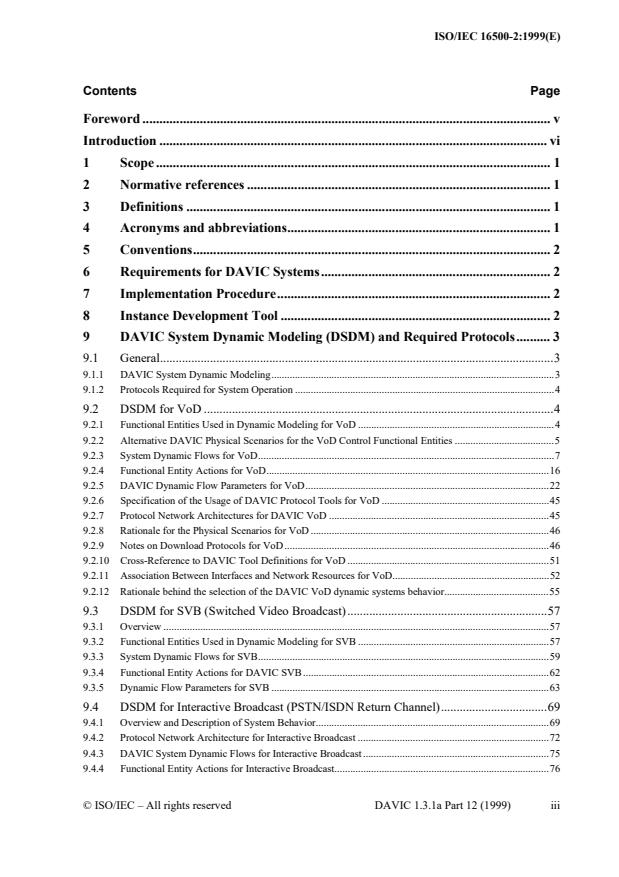
Contents Page
Foreword . v
Introduction . vi
1 Scope . 1
2 Normative references . 1
3 Definitions . 1
4 Acronyms and abbreviations. 1
5 Conventions. 2
6 Requirements for DAVIC Systems. 2
7 Implementation Procedure. 2
8 Instance Development Tool . 2
9 DAVIC System Dynamic Modeling (DSDM) and Required Protocols. 3
9.1 General.3
9.1.1 DAVIC System Dynamic Modeling.3
9.1.2 Protocols Required for System Operation .4
9.2 DSDM for VoD .4
9.2.1 Functional Entities Used in Dynamic Modeling for VoD .4
9.2.2 Alternative DAVIC Physical Scenarios for the VoD Control Functional Entities .5
9.2.3 System Dynamic Flows for VoD.7
9.2.4 Functional Entity Actions for VoD.16
9.2.5 DAVIC Dynamic Flow Parameters for VoD.22
9.2.6 Specification of the Usage of DAVIC Protocol Tools for VoD .45
9.2.7 Protocol Network Architectures for DAVIC VoD .45
9.2.8 Rationale for the Physical Scenarios for VoD .46
9.2.9 Notes on Download Protocols for VoD.46
9.2.10 Cross-Reference to DAVIC Tool Definitions for VoD .51
9.2.11 Association Between Interfaces and Network Resources for VoD.52
9.2.12 Rationale behind the selection of the DAVIC VoD dynamic systems behavior.55
9.3 DSDM for SVB (Switched Video Broadcast).57
9.3.1 Overview .57
9.3.2 Functional Entities Used in Dynamic Modeling for SVB .57
9.3.3 System Dynamic Flows for SVB.59
9.3.4 Functional Entity Actions for DAVIC SVB .62
9.3.5 Dynamic Flow Parameters for SVB .63
9.4 DSDM for Interactive Broadcast (PSTN/ISDN Return Channel).69
9.4.1 Overview and Description of System Behavior.69
9.4.2 Protocol Network Architecture for Interactive Broadcast .72
9.4.3 DAVIC System Dynamic Flows for Interactive Broadcast .75
9.4.4 Functional Entity Actions for Interactive Broadcast.76
© ISO/IEC – All rights reserved DAVIC 1.3.1a Part 12 (1999) iii
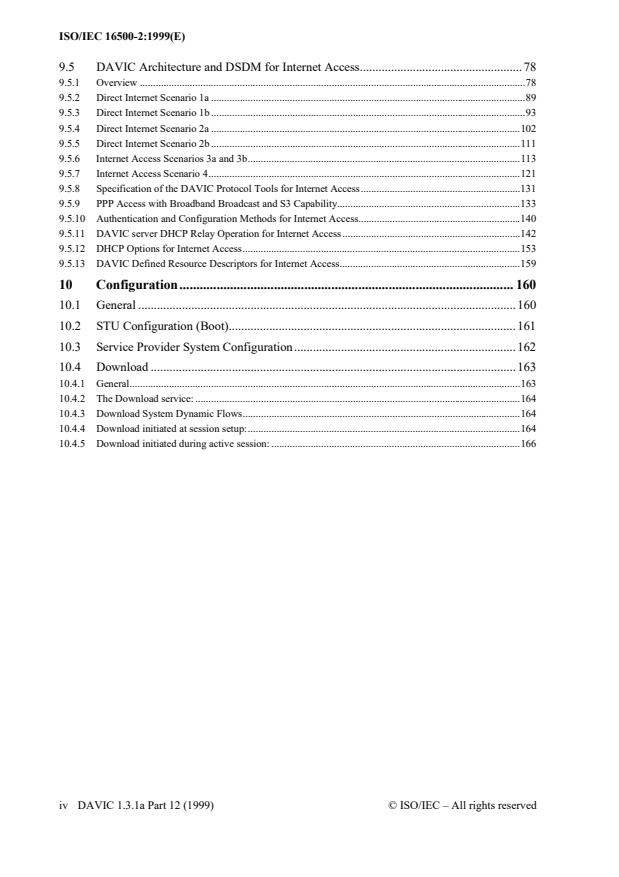
9.5 DAVIC Architecture and DSDM for Internet Access.78
9.5.1 Overview .78
9.5.2 Direct Internet Scenario 1a .89
9.5.3 Direct Internet Scenario 1b .93
9.5.4 Direct Internet Scenario 2a .102
9.5.5 Direct Internet Scenario 2b .111
9.5.6 Internet Access Scenarios 3a and 3b.113
9.5.7 Internet Access Scenario 4.121
9.5.8 Specification of the DAVIC Protocol Tools for Internet Access.131
9.5.9 PPP Access with Broadband Broadcast and S3 Capability.133
9.5.10 Authentication and Configuration Methods for Internet Access.140
9.5.11 DAVIC server DHCP Relay Operation for Internet Access .142
9.5.12 DHCP Options for Internet Access.153
9.5.13 DAVIC Defined Resource Descriptors for Internet Access.159
10 Configuration. 160
10.1 General . 160
10.2 STU Configuration (Boot). 161
10.3 Service Provider System Configuration.162
10.4 Download .163
10.4.1 General.163
10.4.2 The Download service: .164
10.4.3 Download System Dynamic Flows.164
10.4.4 Download initiated at session setup:.164
10.4.5 Download initiated during active session: .166
iv DAVIC 1.3.1a Part 12 (1999) © ISO/IEC – All rights reserved
Foreword
ISO (the International Organization for Standardization) and IEC (the International Electrotechnical Commission)
form the specialized system for worldwide standardization. National bodies that are members of ISO or IEC
participate in the development of International Standards through technical committees established by the
respective organization to deal with particular fields of technical activity. ISO and IEC technical committees
collaborate in fields of mutual interest. Other international organizations, governmental and non-governmental, in
liaison with ISO and IEC, also take part in the work.
International Standards are drafted in accordance with the rules given in the ISO/IEC Directives, Part 3.
In the field of information technology, ISO and IEC have established a joint technical committee, ISO/IEC JTC 1.
Draft International Standards adopted by the joint technical committee are circulated to national bodies for voting.
Publication as an International Standard requires approval by at least 75 % of the national bodies casting a vote.
Attention is drawn to the possibility that some of the elements of this part of ISO/IEC 16500 may be the subject of
patent rights. ISO and IEC shall not be held responsible for identifying any or all such patent rights.
International Standard ISO/IEC 16500-2 was prepared by DAVIC (Digital Audio-Visual Council) and was adopted,
under the PAS procedure, by Joint Technical Committee ISO/IEC JTC 1, Information technology, in parallel with its
approval by national bodies of ISO and IEC.
ISO/IEC 16500 consists of the following parts, under the general title Information technology — Generic digital
audio-visual systems:
� Part 1: System reference models and scenarios
� Part 2: System dynamics, scenarios and protocol requirements
� Part 3: Contours: Technology domain
� Part 4: Lower-layer protocols and physical interfaces
� Part 5: High and mid-layer protocols
� Part 6: Information representation
� Part 7: Basic security tools
� Part 8: Management architecture and protocols
� Part 9: Usage information protocols
© ISO/IEC – All rights reserved DAVIC 1.3.1a Part 12 (1999) v
Introduction
ISO/IEC 16500 defines the minimum tools and dynamic behavior required by digital audio-visual systems for
end-to-end interoperability across countries, applications and services. To achieve this interoperability, it defines
the technologies and information flows to be used within and between the major components of generic digital
audio-visual systems. Interoperability between these components and between individual sub-systems is assured
through specification of tools and specification of dynamic systems behavior at defined reference points. A
reference point can comprise one or more logical (non-physical) information-transfer interfaces, and one or more
physical signal-transfer interfaces. A logical interface is defined by a set of information flows and associated
protocol stacks. A physical interface is an external interface and is fully defined by its physical and electrical
characteristics. Accessible reference points are used to determine and demonstrate compliance of a digital audio-
visual subsystem with this international standard.
A summary of each part follows.
ISO/IEC 16500-1 (DAVIC 1.3.1a Part 2) defines the normative digital audio-visual systems technical framework.
It provides a vocabulary and a Systems Reference Model, which identifies specific functional blocks and
information flows, interfaces and reference points.
ISO/IEC 16500-2 (DAVIC 1.3.1a Part 12) defines system dynamic behavior and physical scenarios. It details the
locations of the control functional entities along with the normative protocols needed to support the systems
behavior. It is structured as a set of protocol walk-throughs, or “Application Notes”, that rehearse both the steady
state and dynamic operation of the system at relevant reference points using specified protocols. Detailed
dynamics are given for the following scenarios: video on demand, switched video broadcast, interactive broadcast,
and internet access.
ISO/IEC 16500-3 (DAVIC 1.3.1a Part 14) provides the normative definition of DAVIC Technology Contours.
These are strict sets of Applications, Functionalities and Technologies which allow compliance and conformance
criteria to be easily specified and assessed. This part of ISO/IEC 16500 contains the full details of two contours.
These are the Enhanced Digital Broadcast (EDB) and Interactive Digital Broadcast (IDB). ISO/IEC 16500-3
specifies required technologies and is a mandatory compliance document for contour implementations.
ISO/IEC 16500-4 (DAVIC 1.3.1a Part 8) defines the toolbox of technologies used for lower layer protocols and
physical interfaces. The tools specified are those required to digitize signals and information in the Core Network
and in the Access Network. Each tool is applicable at one or more of the reference points specified within the
Delivery System. In addition a detailed specification is provided of the physical interfaces between the Network
Interface Unit and the Set Top Unit and of the physical interfaces used to connect Set Top Boxes to various
peripheral devices (digital video recorder, PC, printer). The physical Delivery System mechanisms included are
copper pairs, coaxial cable, fiber, HFC, MMDS, LMDS, satellite and terrestrial broadcasting.
ISO/IEC 16500-5 (DAVIC 1.3.1a Part 7) defines the technologies used for high and mid-layer protocols for
ISO/IEC 16500 digital audio-visual systems. In particular, this part defines the specific protocol stacks and
requirements on protocols at specific interfaces for the content, control and management information flows.
ISO/IEC 16500-6 (DAVIC 1.3.1a Part 9) defines what the user will eventually see and hear and with what quality.
It specifies the way in which monomedia and multimedia information types are coded and exchanged. This
includes the definition of a virtual machine and a set of APIs to support interoperable exchange of program code.
Interoperability of applications is achieved, without specifying the internal design of a set top unit, by a normative
Reference Decoder Model which defines specific memory and behavior constraints for content decoding. Separate
profiles are defined for different sets of multimedia components.
ISO/IEC 16500-7 (DAVIC 1.3.1a Part 10) defines the interfaces and the security tools required for an
ISO/IEC 16500 system implementing security profiles. These tools include security protocols which operate
across one or both of the defined conditional access interfaces CA0 and CA1. The interface CA0 is to all security
and conditional access functions, including the high speed descrambling functions. The interface CA1 is to a
tamper resistant device used for low speed cryptographic processing. This cryptographic processing function is
implemented in a smart card.
ISO/IEC 16500-8 (DAVIC 1.3.1a Part 6) specifies the information model used for managing ISO/IEC 16500
systems. In particular, this part defines the managed object classes and their associated characteristics for
managing the access network and service-related data in the Delivery System. Where these definitions are taken
from existing standards, full reference to the required standards is provided. Otherwise a full description is
integrated in the text of this part. Usage-related information model is defined in ISO/IEC 16500-9.
vi DAVIC 1.3.1a Part 12 (1999) © ISO/IEC – All rights reserved
ISO/IEC 16500-9 (DAVIC 1.3.1a Part 11) specifies the interface requirements and defines the formats for the
collection of usage data used for billing, and other business-related operations such as customer profile
maintenance. It also specifies the protocols for the transfer of Usage Information into and out of the
ISO/IEC 16500 digital audio-visual system. In summary, flows of audio, video and audio-visual works are
monitored at defined usage data collection elements (e.g. servers, elements of the Delivery System, set-top boxes).
Information concerning these flows is then collected, processed and passed to external systems such as billing or a
rights administration society via a standardised usage data transfer interface.
Additional Information
ISO/IEC TR 16501 is an accompanying Technical Report. Further architectural and conformance information is
provided in other non-normative parts of DAVIC 1.3.1a (1999). A summary of these documents is included here
for information.
ISO/IEC TR 16501 (DAVIC 1.3.1a Part 1) provides a detailed listing of the functionalities required by users and
providers of digital audio-visual applications and systems. It introduces the concept of a contour and defines the
IDB (Interactive Digital Broadcast) and EDB (Enhanced Digital Broadcast) functionality requirements which are
used to define the normative contour technology toolsets provided in ISO/IEC 16500-3.
DAVIC 1.3.1a Parts 3, 4 and 5 are DAVIC technical reports. They provide additional architectural and other
information for the server, the delivery-system, and the Service Consumer systems respectively. Part 3 defines
how to load an application, once created, onto a server and gives information and guidance on the protocols
transmitted from the set-top user to the server, and those used to control the set-up and execution of a selected
application. Part 4 provides an overview of Delivery Systems and describes instances of specific DAVIC
networked service architectures. These include physical and wireless networks. Non-networked delivery (e.g.
local storage physical media like discs, tapes and CD-ROMs) are not specified. Part 5 provides a Service
Consumer systems architecture and a description of the DAVIC Set Top reference points defined elsewhere in the
normative parts of the specification.
DAVIC 1.3.1a Part 13 is a DAVIC technical report, which provides guidelines on how to validate the systems,
technology tools and protocols through conformance and / or interoperability testing.
© ISO/IEC – All rights reserved DAVIC 1.3.1a Part 12 (1999) vii
INTERNATIONAL STANDARD ©ISO/IEC ISO/IEC 16500-2:1999(E)
Information technology — Generic digital audio-visual
systems — Part 2: System dynamics, scenarios and
protocol requirements
1 Scope
The purpose of this part of ISO/IEC 16500 is to specify normative protocols and associated dynamic system
behavior, including session and connection manipulation, configuration and download, for an ISO/IEC 16500
system. The emphasis is on the significant dynamic system entities (e.g., session control, call/connection
control), the behavior of these entities (e.g., information flows, entity actions, parameters passed) and the
allowable physical placement(s) of these entities in a DAVIC system (i.e., physical instances). As such, this
part of ISO/IEC 16500 complements the static systems reference model described in ISO/IEC 16500-1,
specifying normative dynamic behavior as well as specifying the protocol(s) required to realize this behavior.
The protocols themselves are specified primarily through the use of "Protocol Network Architecture"
diagrams which visually illustrate, for each of the defined physical instances and application scenarios, the
various protocol stacks which are to be used. Detailed specification of the individual protocol tools
themselves (e.g., the detailed protocol messages used to realize the DAVIC dynamic flow behavior) is
provided in ISO/IEC 16500-5 (mid- and higher layers) and ISO/IEC 16500-4 (lower layers) of this
specification.
This results in instance specifications made up of building blocks from the DAVIC tool set organized in a
manner describing a system which performs DAVIC functions.
2 Normative references
Detailed bibliographic references for the normative protocols identified in this part of ISO/IEC 16500 (e.g. in
Table 9.2-28 and Table 9.2-29) are provided in ISO/IEC 16500-2 Annex E.
3 Definitions
This clause defines new terms, and the intended meaning of certain common terms, used in this part of
ISO/IEC 16500. Annex A of ISO/IEC 16500-1 defines additional terms and, in some cases, alternative
interpretations that are appropriate in other contexts. For convenience, the normative definitions below are
included in the annex.
3.1 call entity or connection entity: user or network process which terminates S4 flow (c/c).
3.2 functional control entities: call/connection entity and session entity.
3.3 functional entity: process which terminates an information flow.
3.4 proxy signaling agent: signaling process performing end point signaling function on behalf of the
end user. Extended definition is required if proxy is used also in hybrid network, e.g., MPEG HFC and ATM.
3.5 Q.2931 MACRO: single notation which summarizes the exchange of information (S4 flow) between
call/connection control entities during the call set-up or release phases.
3.6 session entity: user or network process which terminates S3 flow (ses).
4 Acronyms and abbreviations
This clause defines the acronyms and abbreviations used in this part of ISO/IEC 16500. Annex B of ISO/IEC
16500-1 defines acronyms and abbreviations used within ISO/IEC 16500.
c/c call/connection entity
CRM Connection Resource Manager
DSDM DAVIC System Dynamic Modeling
e-e cntrl end-to-end control
© ISO/IEC – All rights reserved DAVIC 1.3.1a Part 12 (1999) 1
MPTS Multi-Program Transport Stream (ISO/IEC 13818–1 MPEG-2 Systems)
pses Pseudo-session control entity (used in some Internet Access scenarios)
Ses Session control entity
SPTS Single Program Transport Stream (ISO/IEC 13818–1 MPEG-2 Systems)
5 Conventions
The style of ISO/IEC 16500 follows the Guide for ITU-T and ISO/IEC JTC1 co-operation. Appendix H: Rules
for presentation of ITU-T | ISO/IEC common text (March, 1993).
6 Requirements for DAVIC Systems
DAVIC systems are characterized as follows:
� The system must be built from the set of tools defined in ISO/IEC 16500.
� The system must reflect one of the allowable physical instances specified in this part of
ISO/IEC 16500.
� The system must illustrate DAVIC behavior at the various reference points as defined
in ISO/IEC 16500-1.
� The system must perform functionalities outlined in ISO/IEC TR 16501.
� The system dynamic behavior must be in accordance with the dynamic flow scenarios,
entity actions, and parameters, and protocols specified in this part of ISO/IEC 16500,
utilizing the detailed protocols specified in ISO/IEC 16500-4 and ISO/IEC 16500-5.
� The reference points must be accessible to allow effective interoperability testing at the
reference points and throughout the system as appropriate.
7 Implementation Procedure
The following list defines the procedure for the description of a DAVIC system instance:
1. Define the instance in terms of the static DAVIC reference model of ISO/IEC 16500-1 and
one of the allowed physical allocations of the dynamic functional entities specified in this
part of ISO/IEC 16500. Identify the required protocol tools outlined in ISO/IEC 16500 from
the physical instances, dynamic behavior and the protocol network architecture diagrams of
this part of ISO/IEC 16500.
2. Define the identified points using the tools outlined in ISO/IEC 16500.
3. Identify the required DAVIC functionalities and demonstrate the implementation of these
functions through the network instance, utilizing the system dynamic behavior as specified
in the dynamic flows of this part of ISO/IEC 16500.
4. Repeat steps 2 through 3 for the various network types (i.e., for the various physical layer
access technologies) to which the instance applies.
8 Instance Development Tool
The instance development tool for definition of a DAVIC system is defined with the following elements:
� Service Provider System (SPS) (e.g., the video server for the case of VoD)
� Delivery System comprising:
� Core Network (CN)
� Access Network (AN)
� Service User System (e.g., the Set Top Unit)
� Information Flows S1, S2, S3, S4, S5
� Reference Points A11, A10, A9, A4, A1, A0 (Note: A0 and A4 is not shown in Figure
9.1-1 below. See ISO/IEC 16500-1 for this information).
� Functional Entities: c/c, ses, content source, content sink, e-e cntrl
2 DAVIC 1.3.1a Part 12 (1999) © ISO/IEC – All rights reserved
The SPS, CN, AN, SUS, Information Flows, and Reference Points are as defined in DAVIC static system
reference model of ISO/IEC 16500-1.
Content Service Service
Provider Provider User
System
System System
Principal Services
S1
Layer Interface
Application Services
S2
Layer Interface
Session/Transport
S3
Services Layer Interface
Network Services
S4
Layer Interface
Physical Interface
Delivery Delivery
System System
A10 A9 A1
A11
Figure 9.1-1 — DAVIC System Reference Model
The details of the relationships internal to and external to the SPS, Delivery System and SUS are as defined in
the DAVIC static Systems Reference Model of ISO/IEC 16500-1.
9 DAVIC System Dynamic Modeling (DSDM) and Required
Protocols
9.1 General
9.1.1 DAVIC System Dynamic Modeling
The DAVIC System Dynamic Modeling describes the following:
� Functional Entities used within the Dynamic Model(s)
� DAVIC Physical Scenarios (Physical Instances) for the allowable location(s) of the
control functional entities.
� System Dynamic Flows which describe the dynamics of the DAVIC System for, e.g.,
the following actions, where appropriate:
� Session & Call/connection Establishment
� Adding Resources
� Releasing Resources
� Session Transfer
� Service Transfer
� Session & Call/connection Release
� Functional Entity Actions (performed by entities in conjunction with the dynamic
flows)
� DAVIC Dynamic Flow Parameters (carried within the dynamic flows)
Collectively, these descriptive mechanisms specify the overall system dynamic behavior required of a DAVIC
system for each application area (e.g., VoD, Interactive Broadcast, etc.)
© ISO/IEC – All rights reserved DAVIC 1.3.1a Part 12 (1999) 3
9.1.2 Protocols Required for System Operation
The protocols required for the dynamic operation of a DAVIC compliant systems are identified in this part of
ISO/IEC 16500 (for each application scenario) by means of either protocol network architecture diagrams,
tables, or via descriptive text. Regardless of the means of identification, these protocols identified here are
actually pointers to further detailed information specified in either ISO/IEC 16500-4 or ISO/IEC 16500-5 or
in other documents as appropriate.
9.2 DSDM for VoD
9.2.1 Functional Entities Used in Dynamic Modeling for VoD
Figure 9.2-1 shows the key dynamic functional entities within a DAVIC VoD system.
� Content Source (e.g., MPEG Video Pump)
Content Sink (e.g., Video decoder in an STU)
�
� e-e cntrl: entity which terminates the S2 flow and performs end-to-end control (e.g.,
VCR-like control: pause, fast forward, etc.)
� ses: Session Control Entities which terminate the S3 flow and coordinate the
manipulation of resources, e.g., connections, in a DAVIC service instance
� c/c: call/connection control which terminate the S4 flow and set up conventional
network connections
Other dynamic functional entities are introduced in the appropriate sections for the corresponding additional
capabilities.
S1
Content Source Content Sink
S2
e-e cntrl e-e cntrl
S3 S3
ses ses ses
t n t
S4 S4
c/c c/c c/c
t n t
Service Provider
Logical network Service User
Figure 9.2-1 — Functional Entities and Relationships of a DAVIC System Instance
Figure 9.2-2 shows a mapping of the dynamic functional entities onto the DAVIC static Systems Reference
Model. It should be noted that this figure illustrates, for simplicity, only the physical scenario in which the
Service Client (i.e., the Set Top Unit) contains call/connection control signaling (c/c(t)). In other scenarios, as
shown in Figure 9.2-3, this entity is located within the delivery system, either in the access or core network,
and is called "proxy signaling".
4 DAVIC 1.3.1a Part 12 (1999) © ISO/IEC – All rights reserved
Content Service Service
Provider Provider Client
System System
Principal Services
S1
Layer Interface
content
content
sink
source
Application Services
S2
Layer Interface
e-e
e-e
cntrl
cntrl
Session/Transport
S3
Services Layer
If
ses ses
ses
t n t
Network Services
S4
Layer Interface
c/c c/c
n t
c/c
t
Physical Interface
Delivery Delivery
System System
TBD TBD A9 A1
Note: In some physical scenarios, the
c/c call/connection control entity
t
shown in the Service Client (I.e.,
STU) is actually located inside the
network (e.g., proxy signalling).
Figure 9.2-2 — Mapping of Dynamic Modeling Functional Entities to Systems Reference Model
9.2.2 Alternative DAVIC Physical Scenarios for the VoD Control Functional
Entities
The DAVIC physical scenarios are a particular allocation of control functional entities (e.g., ses(t), ses(n),
c/c(t), c/c(n)) to a specific physical entity or location within a DAVIC VoD system (e.g., STU, access
network, etc.). This section also includes a physical scenario which describes the case when pre-provisioned
connection resources (VP or VC) are utilized .
9.2.2.1 Physical Scenarios for Switched Connections (SVCs)
The three physical scenarios shown in Figure 9.2-3 are supported in DAVIC VoD. Physical scenario 1 is the
only scenario supported for HFC when ATM is terminated in the access. All three scenarios are supported for
ATM end-to-end. (Additional physical scenarios are introduced in the appropriate sections.)
© ISO/IEC – All rights reserved DAVIC 1.3.1a Part 12 (1999) 5
A9 A4 A1 A0
core access
Server
NIU STU
network
network
mpeg
content S1 content
U-plane entities
source sink
and relationships
common to all
end to end S2 end to end
physical scenarios control control
S3
S3
ses
ses n ses
t t
Physical Scenario #1
S4
S4
c/c c/c
c/c
t n
t
(proxy connection
control signalling)
S3
S3
ses ses ses
t n t
Physical Scenario #2
S4
S4
c/c c/c c/c
t n t
S3
S3
ses ses ses
t n t
Physical Scenario #3
S4
S4
c/c c/c
c/c
t t
n
(proxy connection
control signalling)
c/c = Call/connection control entity ses = Session Control Entity
Suffix = t = terminal side Suffix = n = network side
Figure 9.2-3
6 DAVIC 1.3.1a Part 12 (1999) © ISO/IEC – All rights reserved
9.2.2.2 Physical Scenario 4, PVC, pre-provisioned connection resources
The physical scenario model depicted in Figure 9.2-4 shows the case where one or more than one static
connection resources (VP or VC) are pre-provisioned. Case 4a shows both the ses(n) and CRM (Connection
Resource Manager) located in the access whereas Case 4b shows both ses(n) and CRM located in the core
network. As is the case for SVC's discussed earlier, only the Scenario 4a is supported for HFC when ATM is
terminated in the access. Both 4a and 4b are supported for ATM end-to-end.
In the case of ATM access network, the connection resources may be end-to-end between the STU and the
server, or the server side connection resources and the client side connection resources may be separate.
Physical Scenario 4a includes the case where the client side connection resources are not ATM connections
but, rather, are HFC-specific resources providing MPEG transport streams. In this case, the CRM has the
capability of establishing the connection between the ATM connections on the server side and the HFC
resources on the client side.
In both of these scenario's (4a and 4b), the session manager ses(n) is co-located with a functional entity called
CRM (Connection Resource Manager). CRM has knowledge about the pre-provisioned connection resources
and selects an appropriate VC (and its VCI) when the ses(n) receives the request.
A9 A4 A1 A0
core access
Server
NIU STU
network
network
mpeg
content S1 content
U-plane entities
source sink
and relationships
common to all
end to end S2 end to end
physical scenarios control control
S3 S3
ses
ses n ses
t t
Physical Scenario #4a
CRM
S3
S3
ses ses ses
t n t
Physical Scenario #4b
CRM
CRM = Connection Resource Manager ses = Session Control Entity
Suffix = t = terminal side Suffix = n = network side
Figure 9.2-4
9.2.3 System Dynamic Flows for VoD
The dynamic behavior of a DAVIC system is described by sequences of information flows which carry
information (e.g., parameters) between the control functional entities. Actions taken by functional entities as a
result of the information received in these flows are described in clause 9.2.4. The parameters carried in these
flows are specified in clause 9.2.5.
When interacting functional entities are located in separate physical equipment or different geographical
locations, protocol messages are used to transport these parameters.
© ISO/IEC – All rights reserved DAVIC 1.3.1a Part 12 (1999) 7
Figure 9.2-5 illustrates the relationships between functional entities, flows, protocol entities, and protocol
messages.
Figure 9.2-6 through Figure 9.2-12 show the dynamic behavior of a DAVIC VoD system. The following
dynamic flow scenarios are illustrated:
� Session & Call/Connection Setup
� Resource Add
� STU-initiated
� Server-initiated
� Resource Delete
� STU-initiated
� Server-initiated
� Transfer of Session & Call/Connections Between Servers
Service Transfer
�
� Session & Call/Connection Release:
� STU-initiated
� Server-initiated
� Network-initiated
It should be noted that the STU-initiated Resource Add and Resource Delete are only considered informative
rather than normative DAVIC VoD system. However, they are shown here in order to illustrate completeness,
consistency, and (optional) extendibility for more symmetrical DAVIC VoD and other systems.
8 DAVIC 1.3.1a Part 12 (1999) © ISO/IEC – All rights reserved
Example Illustrating the Relationships Between
Functional Entities, Information Flows, Protocol
Entities, Primitives, and Protocol Messages
Function Entities
conn
S4 (relationship) conn
cntrl
cntrl
SETUP req.ind.[parameters …]
.
.
time
.
Information Flow
conn control conn control
application application
SETUP req. SETUP ind.
Signaling Protocol
primitive primitive
Entities
Q.2931 Q.2931
SAAL SAAL
Transport Protocols for
Q.2931 Sig. Protocol
ATM ATM
Messages
PHY PHY
SETUP [addresses, parameters, etc.]
Q.2931 protocol message (encasulated in lower layer transport protocols)
Figure 9.2-5
© ISO/IEC – All rights reserved DAVIC 1.3.1a Part 12 (1999) 9
DAVIC Dynamic System Modeling -- Session & Call/Connection Setup Scenario
STU
network (logical)
Server
S1
content content
source sink
S2
e-e e-e
cntrl cntrl
S3
S3
ses
t
ses ses
t n
S4
c/c
c/c c/c t
t n
S4
(assumed sig channels in-place eg, via boot, config or PVC)
Flow Scenario for
Session & Call/Connection Setup to
e.g., a Level-1 Gateway
Sess SETUP req.ind
1a
1b
Sess SETUP req.ind
1d 1c
2a
2b
SETUP
SETUP
c/c sig
3b c/c sig 3c
3a
S1
S2
4a
Resource ADDed req.ind
4b
5a
5b
(see Note 1)
Resource ADD req.ind
6b
6a
(see Note 2) Resource ADD resp.conf
7b 7a
Session SETUP resp.conf
8b
8a
Session SETUP resp.conf
9b
9a
(e.g., navigation for video service provider performed)
10a
10b
Note 2: When all resources are to be allocated by the
Note 1: This flow is used to allow the client-side
server (and not by Ses(n)), as is the case for SVCs, the
call/connection control entity (proxy) to inform
parameters in Resource ADD, req.ind flow (6a-6b, 7a-
the ses(t) entity (in the STU) that the ATM
7b) are carried in a Session SETUP resp.conf flows (8a-
connection has been completed to the access,
8b, 9a-9b) and Resource ADD req.ind/resp.conf flows
passing relevant resource information to it such as
(6a-6b, 7a-7b) are not used.
VPI/VCI if appropriate. This is performed via
Figure 9.2-6
10 DAVIC 1.3.1a Part 12 (1999) © ISO/IEC – All rights reserved
DAVIC Dynamic System Modeling -- Resource Add Scenarios
STU
network (logical)
Server
content S1 content
source sink
S2
e-e e-e
cntrl cntrl
S3
S3
ses
t
ses ses
t n
S4
c/c
c/c c/c t
t n
S4
Flow Scenario for STU-
Initiated Resource Add
Resource ADD req.ind
(Informative for DAVIC 1.0) 1a
1b
Resource ADD req.ind
1d 1c
Note:
This STU-initiated scenario is
2a
presented for information only.
It is not normative behavior for
DAVIC 1.0
2b
SETUP
SETUP
c/c sig 3b c/c sig 3c
3a
S1
S2
4a
4b
Resource ADDED resp.conf
5b
5a
Resource ADDED resp.conf
6b
6a
Flow Scenario for
Server-Initiated
1a
Resource Add
1b
SETUP
SETUP
c/c sig c/c sig 2c
2a 2b
S1
S2
3a
3b
Resource ADDED req.ind
4b
4a
Rsource ADDED req.ind
5b
5a
Resource ADDED resp.conf
6a
6b
Resource ADDED resp.conf
7a
7b
Figure 9.2-7
© ISO/IEC – All rights reserved DAVIC 1.3.1a Part 12 (1999) 11
DAVIC Dynamic System Modeling -- Resource Delete Scenarios
STU
network (logical)
Server
S1
content content
source sink
S2
e-e e-e
cntrl cntrl
S3
S3
ses
t
ses ses
t n
S4
c/c
c/c c/c
t
t n
S4
Flow Scenario for STU-Initiated
Resource Delete
(Informative for DAVIC 1.0)
Resource DELETE req.ind
1a
1b
Resource DELETE req.ind
Note:
1c
1d
This STU-initiated scenario is
presented for information only.
It is not normative behavior for
2a
DAVIC 1.0
2b
RELEASE RELEASE
c/c sig
3b c/c sig 3c
3a
S1
X
S2
X
4a
4b
Resource DELETED resp.conf
5b
5a
Resource DELETE resp.conf
6b
6a
Flow Scenario for Server-
Initiated Resource Delete
Resource DELETE req.ind
1b
1a
Resource DELETE req.ind
2b
2a
Resource DELETE resp.conf
3a
3b
Resource DELETE resp.conf
4b 4a
5a
5b
RELEASE
RELEASE
c/c sig
6a 6b c/c sig 6c
S1
X
S2
X
7a
7b
Figure 9.2-8
12 DAVIC 1.3.1a Part 12 (1999) © ISO/IEC – All rights reserved
DAVIC Dynamic System Modeling -- Scenario For Transfer of Session & Call/Connections Between Servers
network (logical)
Server B Server A STU
S1
content S1
content
content
source
sink
source
S2
S2 e-e
e-e
e-e
cntrl
cntrl
cntrl S3
S3
S3
ses ses
n t
ses
t
ses
t
S4 S4
S4
c/c
c/c con
t t
c/c
t
Note:
It is assumed that the STU can
Server Sess TRANSFER
accept additional connection(s)
req.ind
prior to the release of existing
1b
1a connection(s).
Server Sess TRANSFER req.ind
2a
2b
3a
3b
SETUP
SETUP
c/c sig
4c
c/c sig 4b
4a
S1
S2
5a
5b
Resource ADDED req.ind
6b
6a
( See Note 2)
Resource ADDED resp.conf
7a
7b
Server Sess TRANSFER resp.conf
8b
8a
Note:
At this point in time, the STU
(Note: flow number 9a-9b not used)
is capable of accepting
Server Sess TRANSFER information on the new S1
req.ind and/or S2 connections.
Note 2: When all resources are to be allocated by the
10a
10b
server (and not by Ses(n)), as is the case for SVCs, the
Server Sess TRANSFER
parameters in Resource ADD, req.ind flow (6a-6b, 7a-7b)
resp.conf
11b
are carried in a Session SETUP resp.conf flows (8a-8b, 11a
9a-9b) and Resource ADD req.ind/resp.conf flows (6a-6b,
Server Session TRANSFER
7a-7b) are not used.
resp.conf
12a
12b
Resource DELETE req.ind
13a
13b
14a
14b
RELEASE
RELEASE
c/c sig 15c
15a c/c sig 15b
S1
X
S2
X
16a
16b
Resource DELETE
resp.conf
17b
17a
Resource DELETED
req.ind
18a
18b
Figure 9.2-9
© ISO/IEC – All rights reserved DAVIC 1.3.1a Part 12 (1999) 13
DAVIC Dynamic System Modeling -- Scenario for Service Transfer between between Servers
Server B Server A network (logical) STU
S1
S1
content
content content
source
source source
S2
S2
e-e
e-e e-e
cntrl
cntrl cntrl
S3 S3
S3
ses
ses ses
ses
n
t t
t
S4
S4
S4
c/c
c/c
c/c
c/c
n t
t
t
1a Application download of Service Xfr capable program 1b
2b
2a Next Server Information
SUSPEND
3b 3a
Session & Call/Connection Release Scenario STU to Server A
I
Resource Delete Scenario for all connections except S2
II
Session & Call/Connection Setup Scenario STU to Server B
Session & Call/Connection Release Scenario STU to Server B
Session & Call/Connection Setup Scenario STU to Server A
I
RESUME
4b 4a
II
Resource Add Scenario for all connections except S2
Note: Scenario "I" shows the case of release of the session between STU
and Server A, and scenario "II" shows the case of minimization of
resources between STU and server A.
Figure 9.2-10
14 DAVIC 1.3.1a Part 12 (1999) © ISO/IEC – All rights reserved
DAVIC Dynamic System Modeling -- Session & Call/Connection Release Scenarios
STU
network (logical)
Server
S1
content content
source sink
S2
e-e
e-e
cntrl cntrl
S3
S3
ses ses ses
t
t n
S4
c/c c/c c/c
t
t n
S4
Flow Scenario for STU-Initiated
Session & Call/Connection
Release Sess RELEASE req.ind
1a
1b
Sess RELEASE req.ind
1d 1c
2a
2b
RELEASE
RELEASE
c/c sig 3b c/c sig 3c
3a
S1
X
S2
X
4a
4b
Sess RELEASE resp.conf
5b
5a
Sess RELEASE resp.conf
6a 6b
Flow Scenario for Server-
Initiated Session &
Call/Connection Release
Sess RELEASE req.ind
1b
1a
Sess RELEASE req.ind
2b
2a
Sess RELEASE resp.conf
3a
3b
Sess REL
...