

ISO 14490-8:2011
(Main)Optics and optical instruments — Test methods for telescopic systems — Part 8: Test methods for night-vision devices
General Information
- Abstract
ISO 14490-8:2011 describes test methods for determining the performance of night-vision devices as specified in ISO 21094.
- Status
- Published
- Publication Date
- 15-Sep-2011
- Technical Committee
- ISO/TC 172/SC 4 - Telescopic systems
- Drafting Committee
- ISO/TC 172/SC 4 - Telescopic systems
- Current Stage
- 9060 - Close of review
- Completion Date
- 02-Sep-2029
Overview - ISO 14490-8:2011 (Test methods for night-vision devices)
ISO 14490-8:2011 is part of the ISO 14490 series on optics and optical instruments. It defines standardized test methods for determining the performance of night-vision devices (NVDs) as specified in ISO 21094. The standard specifies laboratory conditions, test arrangements, measurement sequences and assessment criteria for objective evaluation of NVD characteristics used in telescopic systems and image-intensifier-based equipment.
Key topics and technical requirements
The standard covers a comprehensive set of test methods and requirements, including:
- Environmental and test conditions: recommended ambient temperature (20.0 ± 5.0 °C), relative humidity (40–60 %), allowed variation during tests (±2 °C and ±4 %), and recommended dark-room illuminance (0.01 lx to 0.04 lx).
- Power and illumination: use of a dedicated power supply (external supply acceptable within ±0.1 V), incandescent lamp sources with filament colour temperature (2 856 ± 50) K for certain measurements, and lamp voltage stability limits (≤ 0.3 %).
- Measurement scope: standardized methods for measuring magnification (including variable magnification), night-vision device gain, angular field of view, exit pupil diameter and eye relief, dioptre zero-position error, image rotation, non-parallelism of emerging ray bundles, limit of resolution, working resolution and range of vision, close distance of observation, imperfections in the field of view, and continuous work time.
- Test arrangements and procedures: detailed requirements for collimators, scales, reticles, telescope read-outs and other optical test rigs, including scale dimensions, line widths relative to resolution, and required read-out accuracy.
- Reporting and repeatability: assessment of results and repeatability to be stated in accordance with ISO 5725-1, and systematic error to be evaluated analytically or by inter-laboratory comparison.
Practical applications
ISO 14490-8 provides the objective measurement framework used for:
- Product development and optical design validation of night-vision goggles, scopes and imaging modules.
- Production quality control and acceptance testing for manufacturers.
- Independent laboratory testing and type-approval for defense, law enforcement and security procurement.
- Comparative benchmarking of NVD performance (resolution, gain, field of view, ergonomics like eye relief).
Who uses this standard
- Optical and photonics engineers, test laboratory personnel, and quality managers in NVD manufacturing.
- Military and security procurement officers and certification bodies specifying performance requirements.
- R&D teams developing image intensifier modules, night-vision scopes and augmented night optics.
Related standards
- ISO 21094 - Specifications for night vision devices
- ISO 14490-1 to -7 - Other telescopic system test methods
- ISO 5725-1 - Accuracy (trueness and precision) of measurement methods
- ISO 11664-2 - Standard illuminants (colour/illumination considerations)
Keywords: ISO 14490-8:2011, night-vision devices test methods, optics, telescopic systems, image intensifier, magnification, resolution, field of view, exit pupil, eye relief.
Frequently Asked Questions
ISO 14490-8:2011 is a standard published by the International Organization for Standardization (ISO). Its full title is "Optics and optical instruments — Test methods for telescopic systems — Part 8: Test methods for night-vision devices". This standard covers: ISO 14490-8:2011 describes test methods for determining the performance of night-vision devices as specified in ISO 21094.
ISO 14490-8:2011 describes test methods for determining the performance of night-vision devices as specified in ISO 21094.
ISO 14490-8:2011 is classified under the following ICS (International Classification for Standards) categories: 37.020 - Optical equipment. The ICS classification helps identify the subject area and facilitates finding related standards.
ISO 14490-8:2011 is available in PDF format for immediate download after purchase. The document can be added to your cart and obtained through the secure checkout process. Digital delivery ensures instant access to the complete standard document.
Standards Content (Sample)
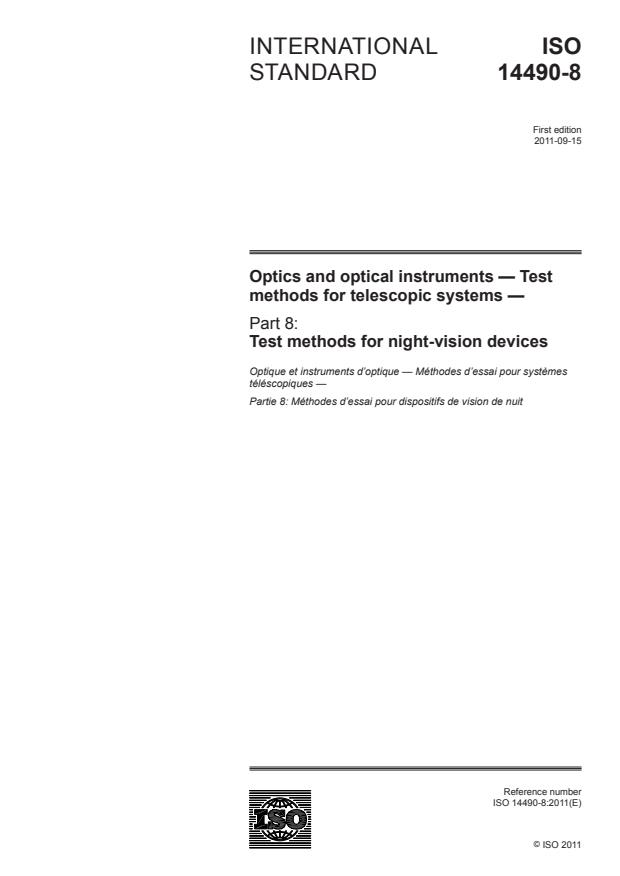
INTERNATIONAL ISO
STANDARD 14490-8
First edition
2011-09-15
Optics and optical instruments — Test
methods for telescopic systems —
Part 8:
Test methods for night-vision devices
Optique et instruments d’optique — Méthodes d’essai pour systèmes
téléscopiques —
Partie 8: Méthodes d’essai pour dispositifs de vision de nuit
Reference number
ISO 14490-8:2011(E)
©
ISO 2011
© ISO 2011
All rights reserved. Unless otherwise specified, no part of this publication may be reproduced or utilized in any form or by any means,
electronic or mechanical, including photocopying and microfilm, without permission in writing from either ISO at the address below or ISO’s
member body in the country of the requester.
ISO copyright office
Case postale 56 • CH-1211 Geneva 20
Tel. + 41 22 749 01 11
Fax + 41 22 749 09 47
E-mail copyright@iso.org
Web www.iso.org
Published in Switzerland
ii © ISO 2011 – All rights reserved
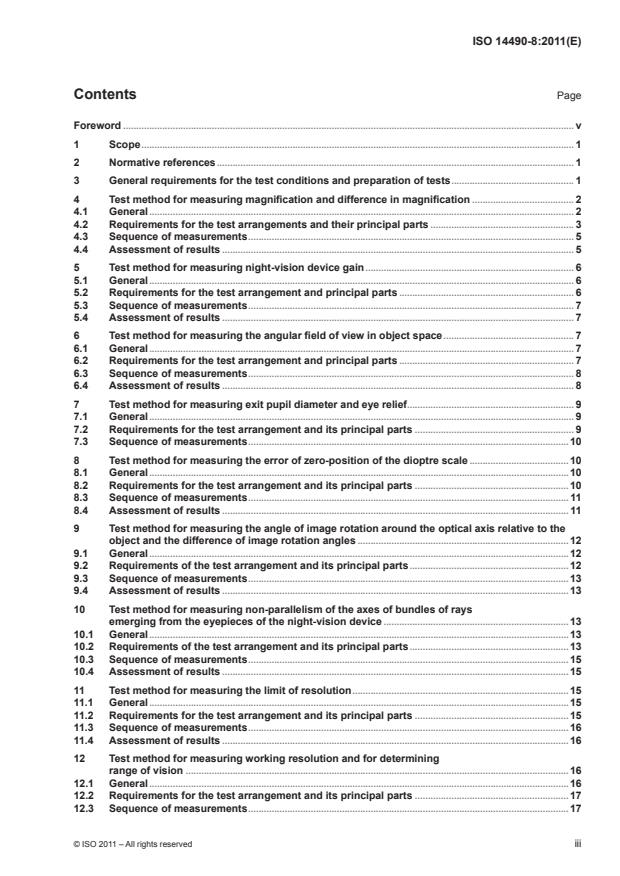
Contents Page
Foreword . v
1 Scope . 1
2 Normative references . 1
3 General requirements for the test conditions and preparation of tests . 1
4 Test method for measuring magnification and difference in magnification . 2
4.1 General . 2
4.2 Requirements for the test arrangements and their principal parts . 3
4.3 Sequence of measurements . 5
4.4 Assessment of results . 5
5 Test method for measuring night-vision device gain . 6
5.1 General . 6
5.2 Requirements for the test arrangement and principal parts . 6
5.3 Sequence of measurements . 7
5.4 Assessment of results . 7
6 Test method for measuring the angular field of view in object space . 7
6.1 General . 7
6.2 Requirements for the test arrangement and principal parts . 7
6.3 Sequence of measurements . 8
6.4 Assessment of results . 8
7 Test method for measuring exit pupil diameter and eye relief . 9
7.1 General . 9
7.2 Requirements for the test arrangement and its principal parts . 9
7.3 Sequence of measurements .10
8 Test method for measuring the error of zero-position of the dioptre scale .10
8.1 General .10
8.2 Requirements for the test arrangement and its principal parts .10
8.3 Sequence of measurements . 11
8.4 Assessment of results . 11
9 Test method for measuring the angle of image rotation around the optical axis relative to the
object and the difference of image rotation angles .12
9.1 General .12
9.2 Requirements of the test arrangement and its principal parts .12
9.3 Sequence of measurements .13
9.4 Assessment of results .13
10 Test method for measuring non-parallelism of the axes of bundles of rays
emerging from the eyepieces of the night-vision device .13
10.1 General .13
10.2 Requirements of the test arrangement and its principal parts .13
10.3 Sequence of measurements .15
10.4 Assessment of results .15
11 Test method for measuring the limit of resolution .15
11.1 General .15
11.2 Requirements for the test arrangement and its principal parts .15
11.3 Sequence of measurements .16
11.4 Assessment of results .16
12 Test method for measuring working resolution and for determining
range of vision .16
12.1 General .16
12.2 Requirements for the test arrangement and its principal parts .17
12.3 Sequence of measurements .17
© ISO 2011 – All rights reserved iii
12.4 Assessment of results .18
13 Test method for measuring the close distance of observation .19
13.1 General .19
13.2 Requirements for the test arrangement and its principal parts .19
13.3 Sequence of measurements .20
13.4 Assessment of results .20
14 Test method for imperfections in the field of view .20
14.1 General .20
14.2 Requirements for the test arrangement and its principal parts .20
14.3 Sequence of measurements .21
14.4 Assessment of results .22
15 Test method for measuring the continuous work time of a night-vision device .22
15.1 General .22
15.2 Requirements for the test arrangement and its principal parts .22
15.3 Sequence of measurements .22
15.4 Assessment of results .22
Bibliography .23
iv © ISO 2011 – All rights reserved
Foreword
ISO (the International Organization for Standardization) is a worldwide federation of national standards bodies
(ISO member bodies). The work of preparing International Standards is normally carried out through ISO
technical committees. Each member body interested in a subject for which a technical committee has been
established has the right to be represented on that committee. International organizations, governmental and
non-governmental, in liaison with ISO, also take part in the work. ISO collaborates closely with the International
Electrotechnical Commission (IEC) on all matters of electrotechnical standardization.
International Standards are drafted in accordance with the rules given in the ISO/IEC Directives, Part 2.
The main task of technical committees is to prepare International Standards. Draft International Standards
adopted by the technical committees are circulated to the member bodies for voting. Publication as an
International Standard requires approval by at least 75 % of the member bodies casting a vote.
Attention is drawn to the possibility that some of the elements of this document may be the subject of patent
rights. ISO shall not be held responsible for identifying any or all such patent rights.
ISO 14490-8 was prepared by Technical Committee ISO/TC 172, Optics and photonics, Subcommittee SC 4,
Telescopic systems.
ISO 14490 consists of the following parts, under the general title Optics and optical instruments — Test methods
for telescopic systems:
— Part 1: Test methods for basic characteristics
— Part 2: Test methods for binocular systems
— Part 3: Test methods for telescopic sights
— Part 4: Test methods for astronomical telescopes
— Part 5: Test methods for transmittance
— Part 6: Test methods for veiling glare index
— Part 7: Test methods for limit of resolution
— Part 8: Test methods for night-vision devices
© ISO 2011 – All rights reserved v
INTERNATIONAL STANDARD ISO 14490-8:2011(E)
Optics and optical instruments — Test methods for
telescopic systems —
Part 8:
Test methods for night-vision devices
1 Scope
This International Standard describes the test methods for determining the performance of night-vision devices
as specified in ISO 21094.
2 Normative references
The following referenced documents are indispensable for the application of this document. For dated
references, only the edition cited applies. For undated references, the latest edition of the referenced document
(including any amendments) applies.
ISO 5725-1, Accuracy (trueness and precision) of measurement methods and results — Part 1: General
principles and definitions
ISO 11664-2, Colorimetry — Part 2: CIE standard illuminants
ISO 14490-1, Optics and optical instruments — Test methods for telescopic systems — Part 1: Test methods
for basic characteristics
ISO 14490-7, Optics and optical instruments — Test methods for telescopic systems — Part 7: Test methods
for limit of resolution
ISO 21094, Optics and photonics — Telescopic systems — Specifications for night vision devices
3 General requirements for the test conditions and preparation of tests
Measurements shall be carried out under the normal conditions of the work area, namely:
— air temperature: (20,0 ± 5,0) °C;
— relative humidity of the air: 40 % to 60 %.
During measurements, the temperature shall not vary by more than ± 2 °C and the relative humidity shall not
vary by more than 4 %.
The measurements should be carried out in conditions in which the test specimen is protected from stray light
and electrical and strong magnetic fields.
The recommended illuminance in the test room is 0,01 lx to 0,04 lx.
Measurements of the basic characteristics of night-vision devices shall be carried out with the aid of a dedicated
power supply.
The use of an external power supply is acceptable subject to its voltage not departing from the nominal voltage
of the dedicated power supply by more than ± 0,1 V.
The testing of instruments equipped with a source of radiation shall be carried out while the source is switched off.
© ISO 2011 – All rights reserved 1
The source of radiation used in collimators and other instruments for measuring the characteristics of production
prototypes of night-vision devices shall be incandescent lamps which have a filament colour temperature, T,
c
of (2 856 ± 50) K, unless otherwise stated. The instability of the voltage on incandescent lamps, at the time of
measurement, shall not exceed 0,3 %.
It is important that the spectral characteristics of the source of radiation cover the full range of spectral sensitivity
of the image intensifier. The transmission spectrum of filters placed in collimators or in front of a night-vision
device shall correspond to the sensitivity spectral region of the test specimen.
When measuring the characteristics of production samples, the use of incandescent lamps, where the filament
colour temperature, T, is different from the one specified above, is acceptable.
c
The objectives of collimators used in test arrangements may be lens, mirror or catadioptric systems.
Integrating spheres may be used for uniform illumination of scales and reticles in collimators.
During all measurements of the characteristics of night-vision devices, the luminance of the image intensifier
screen shall be the optimum for the observer.
In the assessment of results (see 4.4, 5.4, 6.4, 7.4, 8.4, 9.4, 10.4, 11.4, 13.4 and 14.4), repeatability shall be
stated in accordance with ISO 5725-1. The assessment of the correctness of the average value obtained,
i.e. the assessment of the systematic error, shall be carried out either analytically or by comparison of the
measurement results obtained in different test laboratories.
4 Test method for measuring magnification and difference in magnification
4.1 General
The measurement of magnification is based on the measurement of the image size of an object within the field
of view of the night-vision device.
The magnification, Γ, is calculated in accordance with the following equation:
tanw′
Γ = (1)
tanw
where w and w′ are the angles between the conjugate rays and the optical axis in object space and in image
space respectively.
For night-vision devices with variable magnification, Γ shall be measured for the maximum and minimum
magnifications.
Depending on the value of magnification and the size of the field of view of the night-vision device, the
measurements of Γ shall be carried out in accordance with the arrangements shown in Figure 1 or Figure 2.
The diameter of the collimator lens used in these arrangements shall exceed by 15 % to 20 % the lens diameter
of the test specimen.
The diameter of the telescope objective lens used shall exceed by 15 % to 20 % the diameter of the pencil of
light that emerges from the test specimen.
2 © ISO 2011 – All rights reserved
4.2 Requirements for the test arrangements and their principal parts
4.2.1 Requirements for the test arrangement shown in Figure 1
Key
1 source of radiation 7 collimator lens
2 condenser 8 test specimen
3 filter 9 telescope objective lens
4 diffusing plate 10 telescope read-out device
a
5 collimator scale with cross-lines 11 reticle
6 opaque diaphragm with aperture 12 telescope eyepiece
a
For this method, a scale without cross-lines may be used. When testing as specified in other test methods, the use of a cross-line
can be indispensable. For the sake of unification, it is recommended that a scale with cross-lines be used in all test arrangements.
Figure 1 — Arrangement for measurement of the magnification and difference in magnification of
night-vision devices with fields of view up to 12° and magnifications up to 1,5×
The linear size of the collimator scale shall be such that the size of the image of the scale at the image
intensifier screen of the night-vision device would cover 1/5 to 2/5 of the diameter of image intensifier screen.
For the scale (5), the line widths and the spaces between them shall have dimensions that are at least 2½ times
greater than the limit of resolution of the test specimen, so that they can be clearly resolved.
The marginal part of the scale (5) shall be opaque; this is achieved by means of a diaphragm (6).
The range of the scale of the telescope read-out device (10) (see Figure 1) shall be at least 25 mm with a read-
out error of no more than 0,05 mm.
Aberrations of the optical systems of the collimator and telescope shall be within the limits that allow for the
specified precision of measurements.
NOTE The requirements for the aberrations of the optical systems might be less severe if corrections for the
real angular sizes of the scale divisions and of the telescope scale movement read-out mechanism are applied to the
measurement results.
It is important that the spectral characteristics of the source of radiation cover the long-wavelength cut-off of
the image intensifier.
It is recommended that the support beneath the test specimen allows for its movement normal to the collimator
axis, in order to enable successive measurements to be made of the magnification in each channel of the
night-vision device.
© ISO 2011 – All rights reserved 3
4.2.2 Requirements for the test arrangement shown in Figure 2
Key
1 source of radiation 8 telescope objective lens
2 condenser 9 reticle with cross-line
3 filter 10 telescope eyepiece
4 diffusing plate 11 angle-measuring device
5 scale with cross-lines 12 angle-measuring device
6 collimator lens 13 fixed indexes
7 test specimen 14 fixed indexes
Figure 2 — Arrangement for measurement of the magnification and difference in magnification of
night-vision devices with any field of view and any magnification
The focal plane of the collimator lens shall bear a scale with cross-lines, where the line width shall exceed the
limit of resolution of the night-vision device under test at least by 2½ times.
The field of view of the collimator and that of the telescope may not exceed 1°.
The focal plane of the telescope lens shall have a reticle with cross-lines or a straight line.
The use of a telescope in accordance with the arrangement shown in Figure 1 is acceptable, provided the
telescope read-out device and the reticle remain stationary.
The axes of rotation of the angle-measuring devices shall be situated as close as possible to the objective and
eyepiece of the night-vision device under test.
In addition to the test arrangement shown in Figure 2, two other versions of this test arrangement are acceptable:
a) the test specimen is mounted on the angle-measuring device while the other angle-measuring device
bears the collimator (Figure 2, key items 1 to 6) or the telescope (Figure 2, key items 8 to 10);
b) two independent angle-measuring devices use a common axis of rotation, which shall be situated
approximately in the middle of the test specimen.
In any version, the vignetting of bundles of rays that enter or emerge from the night-vision device under test
shall be reduced to the minimum.
The angle measurement error of the angle-measuring devices (Figure 2, key items 11 and 12) shall not exceed
6 minutes of arc.
4 © ISO 2011 – All rights reserved
4.3 Sequence of measurements
4.3.1 Sequence of measurements in arrangement of Figure 1
‒1
— Adjust the eyepiece of the test specimen to 0 D (0 m ).
— Mount the test specimen, or one of its channels, so as to obtain an image of the central point of the scale
in the centre of the image intensifier screen.
— By adjustment of the objective (provided that the objective of the night-vision device is focusable) and of
the eyepiece, obtain a sharp image of the scale.
— Determine the number, n, of divisions of the telescope read-out mechanism that conforms to as large a
number as possible of collimator scale divisions.
— Remove the test specimen from the support and determine the number, n, of divisions of the telescope
read-out mechanism that corresponds to the previously selected number of collimator scale divisions.
4.3.2 Sequence of measurements in arrangement of Figure 2
— Mount the test specimen, or one of its channels, in the test position in such a manner that the image of the
collimator cross-line would be found in the centre of the image intensifier screen and the collimator scale
would be observed sharply through the eyepiece of the telescope.
— Rotate the angle-measuring device and collimator by the angle, w, and take a reading of the angle.
— Rotate the angle-measuring device and telescope by the angle, w′, until the previously selected line of the
telescope scale coincides with the image of the selected line of the collimator scale, and take a reading
of this angle.
4.4 Assessment of results
The angular magnification measured in the test arrangement shown in Figure 1 shall be calculated in accordance
with the following equation:
n
Γ = (2)
n
where
n is the number of divisions of the telescope read-out mechanism;
n is the number of the collimator scale divisions.
Calculations in accordance with Equation (2) shall be carried out for each channel of the night-vision device.
The difference in magnification, ΔΓ, expressed as a percentage (%), shall be calculated in accordance with
Equation (3):
Γ −Γ
max min
ΔΓ = ×100% (3)
Γ
min
where
Γ is the maximum angular magnification;
max
Γ is the minimum angular magnification.
min
The angular magnification measured in the test arrangement shown in Figure 2, shall be calculated in
accordance with the Equation (1).
© ISO 2011 – All rights reserved 5
The repeatability of the measured value of angular magnification of the night-vision device shall not exceed
1 % of the average value. The repeatability of the measured value of the difference in channel magnification
shall not exceed 2 %.
5 Test method for measuring night-vision device gain
5.1 General
The test method for measuring night-vision device gain consists of measuring the ratio of the luminance of the
output screen, measured in the plane of the exit pupil, to the luminance of the object of observation. This test
method is based on the assumption that both the radiation from the diffuse translucent screen (Figure 3, key
item 2) and that emerging from the eyepiece of the test specimen obey the Lambert law within ±20° from the
screen normal and from the optical axis of the eyepiece, accordingly.
NOTE See 7.1 for an explanation of the concept of exit pupil as applied to night vision devices.
5.2 Requirements for the test arrangement and principal parts
Measurement of night-vision device gain shall be carried out using the test arrangement shown in Figure 3.
Key
1 incandescent lamps 6 filter
2 diffuse translucent screen 7 test specimen
3 field diaphragm 8 neutral filter
4 glare baffles 9 luminance meter
5 shutter
Figure 3 — Arrangement for measuring night-vision device gain
The colour temperature of lamp filaments shall comply with CIE standard illuminant A, in accordance with ISO 11664-2.
−3 −3 2
The luminance of the diffuse translucent screen shall be within the limits of 1⋅10 to 3⋅10 cd/m across the
area limited by the opening in the diaphragm. The size of this opening shall allow for the illumination of an area
of 1/5 to 2/5 of the diameter of the image intensifier screen but it shall not be less than 7 mm. The number and
position of incandescent lamps shall be such as to ensure that these requirements are met.
The spectral transmittance of the filter is to be specified by the manufacturer and shall comply with the radiation
spectrum of the image intensifier screen.
6 © ISO 2011 – All rights reserved
The number and position of glare baffles, as well as the sizes of the apertures in the baffles, shall be selected
in such a manner as to reduce as much as possible the influence of any stray light on the measurement result.
The shutter shall have matt black surfaces.
The transmittance of the neutral filter shall ensure that the measurements with the luminance meter are carried
out at the same measurement distance in each setup, according to Figure 3. The acceptance angle of the
luminance meter shall not exceed 5°.
5.3 Sequence of measurements
Mount the test specimen in the test arrangement shown in Figure 3.
The voltage on the image intensifier shall be the rated voltage or one recommended by the manufacturer of
the image intensifier.
Close the shutter. Adjust the luminance meter to image the screen onto its detector. Take a reading, L, from
the luminance meter scale. Open the shutter, insert the neutral filter if required and take a new reading, L,
from the luminance meter.
Remove the night-vision device and the filter (if applicable) from the test arrangement shown in Figure 3 and
position the luminance meter at the same distance from the screen as it was from the last surface of the eyepiece.
Close the shutter and take a reading, L, from the luminance meter. Then open the shutter and take a new
reading, L.
5.4 Assessment of results
Night-vision device gain should be calculated in accordance with the following equation:
L
−L
τ
K = (4)
L −L
4 3
where τ is the average transmittance of the neutral filter in the spectral range of the radiation from the image
intensifier screen.
The repeatability of measurement results shall be better than 20 % of the measured night-vision device gain value.
NOTE In order to obtain an unambiguous result for the measurement, the tests can be carried out at the saturation
-3
range. For most modern image intensifiers this range starts at an illuminance of (1…3)⋅10 ⋅lx.
6 Test method for measuring the angular field of view in object space
6.1 General
According to ISO 14132-1, the field of view of a night-vision device is defined by the angle between two rays
that propagate from two marginal points of an infinitely distant object, which are still visible through the night-
vision device.
6.2 Requirements for the test arrangement and principal parts
Measurement of the field of view of the night-vision device is to be carried out using the test arrangement
shown in Figure 4.
© ISO 2011 – All rights reserved 7
Key
1 source of radiation 5 scale with cross-line
2 condenser 6 collimator lens
3 filter (optional) 7 test specimen
4 diffusing plate 8 angle-measuring device
Figure 4 — Arrangement for measuring the angular field of view in the object space
The collimator shall meet the requirements given in 4.2.2.
NOTE The use of a collimator without a filter and without an opaque diaphragm with aperture (see Figure 1) is acceptable.
The axis of rotation of the angle-measuring device should be situated as close to the objective of the test
specimen as possible.
An optional version of the test arrangement where the test specimen is situated at the angle-measuring device
and the collimator is stationary, is acceptable.
The angle measurement error of the measuring device shall not exceed 6 minutes of arc.
With any version of the test arrangement, the vignetting of the bundle of rays that enters the night-vision device
shall be reduced to the minimum.
6.3 Sequence of measurements
— Focus the eyepiece of the test specimen to obtain a sharp image of the image intensifier screen.
— By moving the collimator, determine the angles of rotation, ±w, with the angle-measuring device, at which
the image of the collimator scale first gets to one edge of the image intensifier screen and then to the other.
— The angle, 2w, is to be taken as the field of view.
6.4 Assessment of results
The repeatability of the measured value of the angle of view shall be better than 15 minutes of arc or, in relative
units, 3 % of the size of the field of view.
8 © ISO 2011 – All rights reserved
7 Test method for measuring exit pupil diameter and eye relief
7.1 General
Instruments equipped with image inte
...