

ISO 14490-3:2021
(Main)Optics and photonics — Test methods for telescopic systems — Part 3: Test methods for telescopic sights
General Information
- Abstract
This document specifies test equipment and test procedures for determination of the following optical characteristics of telescopic sights: — axial parallax; — parallax; — eye relief range, eye relief, critical eye relief; — reticle tracking; — line of sight shift due to zooming; — line of sight shift due to focusing.
- Status
- Published
- Publication Date
- 22-Mar-2021
- Technical Committee
- ISO/TC 172/SC 4 - Telescopic systems
- Drafting Committee
- ISO/TC 172/SC 4/WG 2 - Telescopic devices
- Current Stage
- 9060 - Close of review
- Completion Date
- 02-Sep-2031
Buy Documents


ISO 14490-3:2021 - Optics and photonics -- Test methods for telescopic systems
ISO 14490-3:2021 - Optics and photonics — Test methods for telescopic systems — Part 3: Test methods for telescopic sights/23/2021
Overview
ISO 14490-3:2021 - Optics and photonics - Test methods for telescopic systems - Part 3: Test methods for telescopic sights - defines standardized test equipment and procedures to measure key optical characteristics of telescopic sights. This third edition (2021) replaces the 2016 edition and adds critical eye relief to the set of measured parameters. The standard is intended for laboratory testing of telescopic sights to produce repeatable, comparable performance data.
Key topics and technical requirements
The standard specifies methods, test arrangements and reporting for the following characteristics:
- Axial parallax - measurement of axial distance between the reticle plane and the image formed by the objective (expressed in dioptres) using an auxiliary telescope.
- Parallax - lateral parallax measurement and related test set-up.
- Eye relief range, eye relief, critical eye relief - procedures to determine usable eye distance and safety/critical positions.
- Reticle tracking - verification of reticle displacement relative to the image during adjustments (e.g., zoom/focus).
- Line of sight shift due to zooming - measurement of boresight or optical axis shift across the zoom range.
- Line of sight shift due to focusing - assessment of sighting shift when focusing at different distances.
Typical test equipment and arrangement elements described:
- Collimator with useful diameter > objective lens diameter and focal length ≥ 10 × collimator lens diameter; uniform illumination and a green filter (~0.55 μm) to reduce chromatic aberration.
- Auxiliary telescope, dioptric tester, measuring magnifier, and illumination units arranged for adjustable alignment and repeatable measurement.
- Defined measurement procedures, precision considerations and required test reporting elements.
Applications and users
ISO 14490-3:2021 is used to:
- Validate and certify optical performance of hunting, sporting and tactical telescopic sights.
- Support product development, quality control and acceptance testing by manufacturers and test laboratories.
- Provide objective data for procurement specifications, compliance demonstrations and comparative performance claims.
Primary users:
- Optical/mechanical engineers, QA/test labs, R&D teams of sight manufacturers, procurement specialists and regulatory bodies.
Related standards
- ISO 14132-1 and ISO 14132-3 (vocabulary and terms for telescopic systems and sights)
- ISO 14135-1 and ISO 14135-2 (specifications for general-purpose and high-performance telescopic sights)
Keywords: ISO 14490-3:2021, telescopic sights test methods, axial parallax, eye relief, reticle tracking, line of sight shift, optics and photonics.
Relations
- Effective Date
- 23-Apr-2020
Buy Documents
ISO 14490-3:2021 - Optics and photonics -- Test methods for telescopic systems
ISO 14490-3:2021 - Optics and photonics — Test methods for telescopic systems — Part 3: Test methods for telescopic sights/23/2021
Frequently Asked Questions
ISO 14490-3:2021 is a standard published by the International Organization for Standardization (ISO). Its full title is "Optics and photonics — Test methods for telescopic systems — Part 3: Test methods for telescopic sights". This standard covers: This document specifies test equipment and test procedures for determination of the following optical characteristics of telescopic sights: — axial parallax; — parallax; — eye relief range, eye relief, critical eye relief; — reticle tracking; — line of sight shift due to zooming; — line of sight shift due to focusing.
This document specifies test equipment and test procedures for determination of the following optical characteristics of telescopic sights: — axial parallax; — parallax; — eye relief range, eye relief, critical eye relief; — reticle tracking; — line of sight shift due to zooming; — line of sight shift due to focusing.
ISO 14490-3:2021 is classified under the following ICS (International Classification for Standards) categories: 37.020 - Optical equipment. The ICS classification helps identify the subject area and facilitates finding related standards.
ISO 14490-3:2021 has the following relationships with other standards: It is inter standard links to ISO 14490-3:2016. Understanding these relationships helps ensure you are using the most current and applicable version of the standard.
ISO 14490-3:2021 is available in PDF format for immediate download after purchase. The document can be added to your cart and obtained through the secure checkout process. Digital delivery ensures instant access to the complete standard document.
Standards Content (Sample)
INTERNATIONAL ISO
STANDARD 14490-3
Third edition
2021-03
Optics and photonics — Test methods
for telescopic systems —
Part 3:
Test methods for telescopic sights
Optique et photonique — Méthodes d'essai pour systèmes
télescopiques —
Partie 3: Méthodes d'essai pour viseurs de tir
Reference number
©
ISO 2021
© ISO 2021
All rights reserved. Unless otherwise specified, or required in the context of its implementation, no part of this publication may
be reproduced or utilized otherwise in any form or by any means, electronic or mechanical, including photocopying, or posting
on the internet or an intranet, without prior written permission. Permission can be requested from either ISO at the address
below or ISO’s member body in the country of the requester.
ISO copyright office
CP 401 • Ch. de Blandonnet 8
CH-1214 Vernier, Geneva
Phone: +41 22 749 01 11
Email: copyright@iso.org
Website: www.iso.org
Published in Switzerland
ii © ISO 2021 – All rights reserved
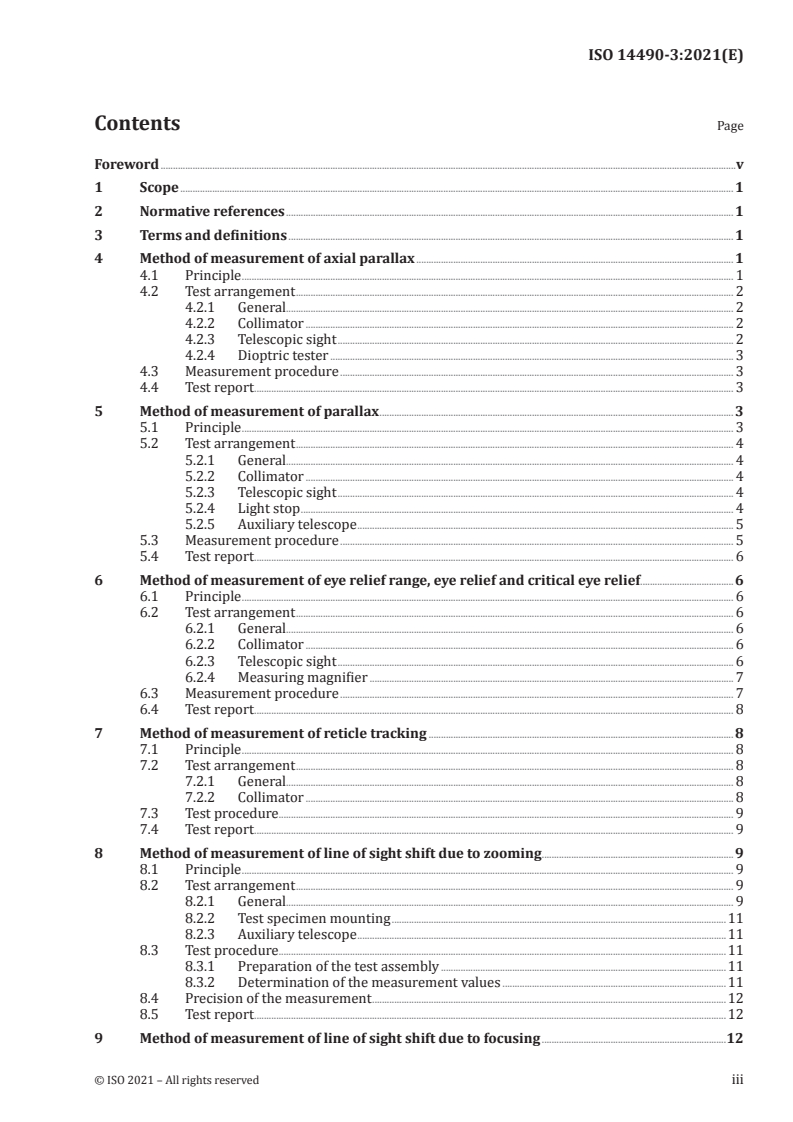
Contents Page
Foreword .v
1 Scope . 1
2 Normative references . 1
3 Terms and definitions . 1
4 Method of measurement of axial parallax . 1
4.1 Principle . 1
4.2 Test arrangement . 2
4.2.1 General. 2
4.2.2 Collimator . 2
4.2.3 Telescopic sight . 2
4.2.4 Dioptric tester . 3
4.3 Measurement procedure . 3
4.4 Test report . 3
5 Method of measurement of parallax . 3
5.1 Principle . 3
5.2 Test arrangement . 4
5.2.1 General. 4
5.2.2 Collimator . 4
5.2.3 Telescopic sight . 4
5.2.4 Light stop . 4
5.2.5 Auxiliary telescope . 5
5.3 Measurement procedure . 5
5.4 Test report . 6
6 Method of measurement of eye relief range, eye relief and critical eye relief.6
6.1 Principle . 6
6.2 Test arrangement . 6
6.2.1 General. 6
6.2.2 Collimator . 6
6.2.3 Telescopic sight . 6
6.2.4 Measuring magnifier . 7
6.3 Measurement procedure . 7
6.4 Test report . 8
7 Method of measurement of reticle tracking . 8
7.1 Principle . 8
7.2 Test arrangement . 8
7.2.1 General. 8
7.2.2 Collimator . 8
7.3 Test procedure . 9
7.4 Test report . 9
8 Method of measurement of line of sight shift due to zooming . 9
8.1 Principle . 9
8.2 Test arrangement . 9
8.2.1 General. 9
8.2.2 Test specimen mounting .11
8.2.3 Auxiliary telescope .11
8.3 Test procedure .11
8.3.1 Preparation of the test assembly .11
8.3.2 Determination of the measurement values .11
8.4 Precision of the measurement .12
8.5 Test report .12
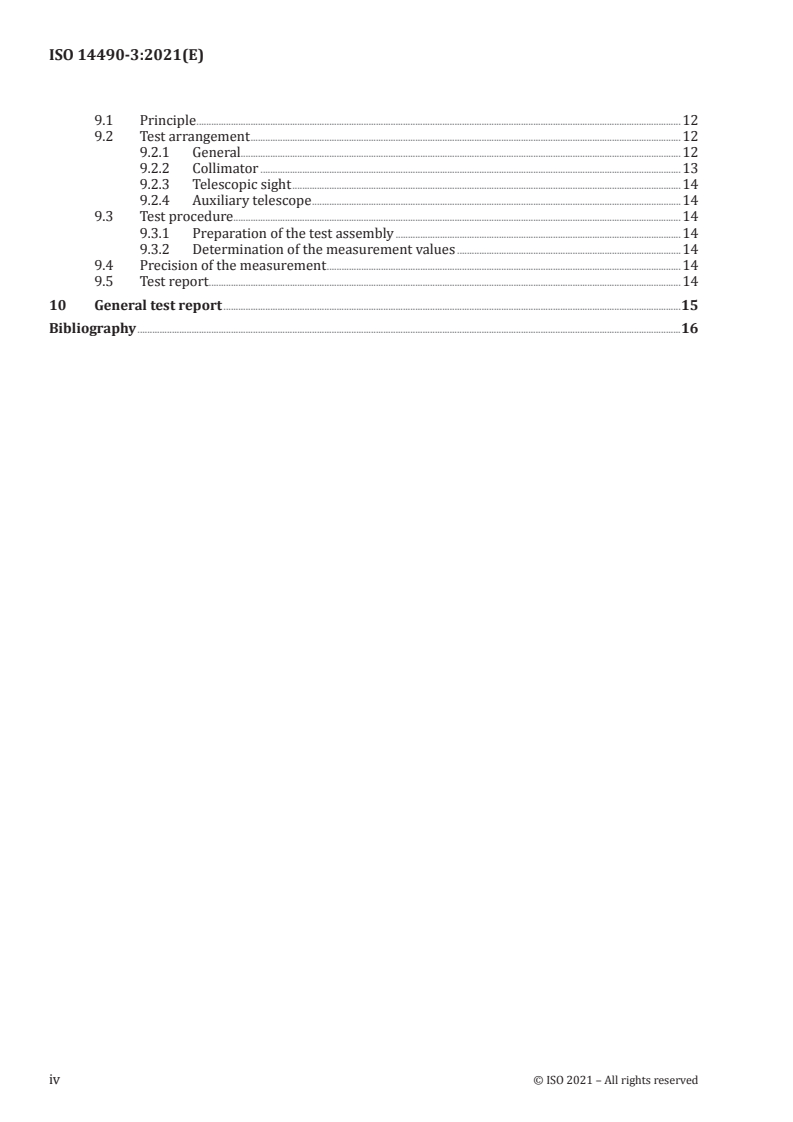
9 Method of measurement of line of sight shift due to focusing .12
9.1 Principle .12
9.2 Test arrangement .12
9.2.1 General.12
9.2.2 Collimator .13
9.2.3 Telescopic sight .14
9.2.4 Auxiliary telescope .14
9.3 Test procedure .14
9.3.1 Preparation of the test assembly .14
9.3.2 Determination of the measurement values .14
9.4 Precision of the measurement .14
9.5 Test report .14
10 General test report .15
Bibliography .16
iv © ISO 2021 – All rights reserved
Foreword
ISO (the International Organization for Standardization) is a worldwide federation of national standards
bodies (ISO member bodies). The work of preparing International Standards is normally carried out
through ISO technical committees. Each member body interested in a subject for which a technical
committee has been established has the right to be represented on that committee. International
organizations, governmental and non-governmental, in liaison with ISO, also take part in the work.
ISO collaborates closely with the International Electrotechnical Commission (IEC) on all matters of
electrotechnical standardization.
The procedures used to develop this document and those intended for its further maintenance are
described in the ISO/IEC Directives, Part 1. In particular, the different approval criteria needed for the
different types of ISO documents should be noted. This document was drafted in accordance with the
editorial rules of the ISO/IEC Directives, Part 2 (see www .iso .org/ directives).
Attention is drawn to the possibility that some of the elements of this document may be the subject of
patent rights. ISO shall not be held responsible for identifying any or all such patent rights. Details of
any patent rights identified during the development of the document will be in the Introduction and/or
on the ISO list of patent declarations received (see www .iso .org/ patents).
Any trade name used in this document is information given for the convenience of users and does not
constitute an endorsement.
For an explanation of the voluntary nature of standards, the meaning of ISO specific terms and
expressions related to conformity assessment, as well as information about ISO's adherence to the
World Trade Organization (WTO) principles in the Technical Barriers to Trade (TBT), see www .iso .org/
iso/ foreword .html.
This document was prepared by Technical Committee ISO/TC 172, Optics and photonics, Subcommittee
SC 4, Telescopic systems.
This third edition cancels and replaces the second edition (ISO 14490-3:2016), which has been
technically revised. The main changes compared to the previous edition are as follows:
— critical eye relief added in the test method according to ISO 14135 series and ISO 14132-3.
A list of all parts in the ISO 14490 series can be found on the ISO website.
Any feedback or questions on this document should be directed to the user’s national standards body. A
complete listing of these bodies can be found at www .iso .org/ members .html.
INTERNATIONAL STANDARD ISO 14490-3:2021(E)
Optics and photonics — Test methods for telescopic
systems —
Part 3:
Test methods for telescopic sights
1 Scope
This document specifies test equipment and test procedures for determination of the following optical
characteristics of telescopic sights:
— axial parallax;
— parallax;
— eye relief range, eye relief, critical eye relief;
— reticle tracking;
— line of sight shift due to zooming;
— line of sight shift due to focusing.
2 Normative references
The following documents are referred to in the text in such a way that some or all of their content
constitutes requirements of this document. For dated references, only the edition cited applies. For
undated references, the latest edition of the referenced document (including any amendments) applies.
ISO 14132-1, Optics and photonics — Vocabulary for telescopic systems — Part 1: General terms and
alphabetical indexes of terms in ISO 14132
ISO 14132-3, Optics and photonics — Vocabulary for telescopic systems — Part 3: Terms for telescopic sights
ISO 14135-1:2021, Optics and photonics — Specifications for telescopic sights — Part 1: General-purpose
instruments
ISO 14135-2:2021, Optics and photonics — Specifications for telescopic sights — Part 2: High-performance
instruments
3 Terms and definitions
For the purposes of this document, the terms and definitions given in ISO 14132-1 and ISO 14132-3 apply.
4 Method of measurement of axial parallax
4.1 Principle
This test method describes the measurement of the axial distance between the reticle of a telescopic
sight and an image, formed by the objective lens of this telescopic sight (where the reticle is in the first
image plane) or by the objective lens and erecting system (where the reticle is in the second image
plane). The distance between the reticle of the telescopic sight and image plane of the collimator reticle
−1
along the optical axis, p′ , is expressed in dioptres (m ) and measured with the auxiliary telescope.
ax
4.2 Test arrangement
4.2.1 General
Measurement of the axial parallax shall be carried out with the test arrangement shown in Figure 1.
It shall be possible to adjust the alignment of the collimator and the telescopic sight relative to each
other. This can be achieved by adjusting the collimator and/or the telescopic sight.
Key
1 collimator 6 filter
2 telescopic sight 7 reticle of collimator
3 dioptric tester 8 reticle of telescopic sight
4 observer’s eye 9 image plane of collimator reticle
5 illumination unit 10 reticle of dioptric tester
Figure 1 — Test arrangement for measuring axial parallax
4.2.2 Collimator
The collimator shall have a useful diameter larger than the objective lens diameter of the telescopic
sight under test and a focal length of at least ten times the diameter of the collimator lens.
The reticle of the collimator should have geometric features appropriate to assess the offset, e.g. a
cross-hair. The axial position of this reticle shall be correctly adjusted to form an image at the specified
parallax-free distance of the telescopic sight under test.
The illumination unit shall create a uniform brightness over the aperture of the collimator.
To avoid chromatic aberrations, a green filter (~0,55 µm) shall be used.
4.2.3 Telescopic sight
The telescopic sight and/or the collimator shall be adjusted relative to each other so that both optical
axes are parallel and in such a position that the objective lens of the telescopic sight is completely
illuminated.
The centre of the reticle of the telescopic sight shall be near the optical axis of the sight.
2 © ISO 2021 – All rights reserved
4.2.4 Dioptric tester
The dioptric tester shall have an aperture larger than the exit pupil of the telescopic sight and a
magnifying power sufficient to ensure a precise measurement (i.e. ×3 to ×6).
4.3 Measurement procedure
Set the dioptric tester to zero with its eyepiece adjusted to obtain a sharp image of its own reticle.
The eyepiece of the telescopic sight shall be focused on the reticle of the telescopic sight to obtain a
sharp image while viewing through the dioptric tester.
For telescopic sights with a fixed eyepiece, use the dioptric tester to focus on the reticle of the
telescopic sight.
The dioptre setting of the dioptric tester shall be adjusted to obtain a sharp image of the collimator
reticle.
The axial parallax in the image space, p′ , shall be determined by the difference of the two readings on
ax
the dioptric tester.
−1
The uncertainty of measurement for p′ (expressed in m ) shall not exceed Formula (1):
ax
27,
−1
uncertaintymp′≤ (1)
ax
10 ⋅D′
where
-1
p′ is the axial parallax in the image space in m ;
ax
D' is the exit pupil diameter of the telescopic sight expressed in metres.
For exit pupil diameters larger than 7 mm, the value in the formula shall be D′ = 0,007 m.
The axial parallax in the object space, p , is calculated as given in Formula (2):
ax
p′
ax
p = (2)
ax
Γ
where Γ is the magnifying power of the telescopic sight under test.
NOTE The image quality of the test setup (including the telescopic sight under test) influences the
measurement error.
4.4 Test report
A test report shall be presented and shall include the general information specified in Clause 10 and the
result of the test as specified in 4.3.
5 Method of measurement of parallax
5.1 Principle
This method describes the determination of the angular deviation between the aiming lines for on-axis
and off-axis observation.
NOTE For exit pupil diameters of approximately 2 mm or less, only the test method for axial parallax is
appropriate.
5.2 Test arrangement
5.2.1 General
Measurement of the parallax shall be carried out with the test arrangement shown in Figure 2.
It shall be possible to adjust the alignment of the collimator and the telescopic sight relative to each
other. This can be achieved by adjusting the collimator and/or the telescopic sight.
Key
1 collimator 6 filter
2 telescopic sight 7 reticle of collimator
3 auxiliary telescope 8 light stop, off-axis
4 observer’s eye 9 reticle of telescopic sight
5 illumination unit 10 reticle of auxiliary telescope
Figure 2 — Test arrangement for measuring parallax
5.2.2 Collimator
The collimator shall have a diameter larger than the objective lens diameter of the telescopic sight
under test and a focal length of at least ten times the diameter of the collimator lens.
The reticle of the collimator should have geometric features appropriate to assess the offset, e.g. a
cross-hair. The axial position of this reticle shall be correctly adjusted to form an image at the specified
parallax-free distance of the telescopic sight under test.
The illumination unit shall create a uniform brightness over the aperture of the collimator. To avoid
chromatic aberrations, a green filter (~0,55 µm) shall be used.
5.2.3 Telescopic sigh
...
INTERNATIONAL ISO
STANDARD 14490-3
Third edition
2021-03
Optics and photonics — Test methods
for telescopic systems —
Part 3:
Test methods for telescopic sights
Optique et photonique — Méthodes d'essai pour systèmes
télescopiques —
Partie 3: Méthodes d'essai pour viseurs de tir
Reference number
©
ISO 2021
© ISO 2021
All rights reserved. Unless otherwise specified, or required in the context of its implementation, no part of this publication may
be reproduced or utilized otherwise in any form or by any means, electronic or mechanical, including photocopying, or posting
on the internet or an intranet, without prior written permission. Permission can be requested from either ISO at the address
below or ISO’s member body in the country of the requester.
ISO copyright office
CP 401 • Ch. de Blandonnet 8
CH-1214 Vernier, Geneva
Phone: +41 22 749 01 11
Email: copyright@iso.org
Website: www.iso.org
Published in Switzerland
ii © ISO 2021 – All rights reserved
Contents Page
Foreword .v
1 Scope . 1
2 Normative references . 1
3 Terms and definitions . 1
4 Method of measurement of axial parallax . 1
4.1 Principle . 1
4.2 Test arrangement . 2
4.2.1 General. 2
4.2.2 Collimator . 2
4.2.3 Telescopic sight . 2
4.2.4 Dioptric tester . 3
4.3 Measurement procedure . 3
4.4 Test report . 3
5 Method of measurement of parallax . 3
5.1 Principle . 3
5.2 Test arrangement . 4
5.2.1 General. 4
5.2.2 Collimator . 4
5.2.3 Telescopic sight . 4
5.2.4 Light stop . 4
5.2.5 Auxiliary telescope . 5
5.3 Measurement procedure . 5
5.4 Test report . 6
6 Method of measurement of eye relief range, eye relief and critical eye relief.6
6.1 Principle . 6
6.2 Test arrangement . 6
6.2.1 General. 6
6.2.2 Collimator . 6
6.2.3 Telescopic sight . 6
6.2.4 Measuring magnifier . 7
6.3 Measurement procedure . 7
6.4 Test report . 8
7 Method of measurement of reticle tracking . 8
7.1 Principle . 8
7.2 Test arrangement . 8
7.2.1 General. 8
7.2.2 Collimator . 8
7.3 Test procedure . 9
7.4 Test report . 9
8 Method of measurement of line of sight shift due to zooming . 9
8.1 Principle . 9
8.2 Test arrangement . 9
8.2.1 General. 9
8.2.2 Test specimen mounting .11
8.2.3 Auxiliary telescope .11
8.3 Test procedure .11
8.3.1 Preparation of the test assembly .11
8.3.2 Determination of the measurement values .11
8.4 Precision of the measurement .12
8.5 Test report .12
9 Method of measurement of line of sight shift due to focusing .12
9.1 Principle .12
9.2 Test arrangement .12
9.2.1 General.12
9.2.2 Collimator .13
9.2.3 Telescopic sight .14
9.2.4 Auxiliary telescope .14
9.3 Test procedure .14
9.3.1 Preparation of the test assembly .14
9.3.2 Determination of the measurement values .14
9.4 Precision of the measurement .14
9.5 Test report .14
10 General test report .15
Bibliography .16
iv © ISO 2021 – All rights reserved
Foreword
ISO (the International Organization for Standardization) is a worldwide federation of national standards
bodies (ISO member bodies). The work of preparing International Standards is normally carried out
through ISO technical committees. Each member body interested in a subject for which a technical
committee has been established has the right to be represented on that committee. International
organizations, governmental and non-governmental, in liaison with ISO, also take part in the work.
ISO collaborates closely with the International Electrotechnical Commission (IEC) on all matters of
electrotechnical standardization.
The procedures used to develop this document and those intended for its further maintenance are
described in the ISO/IEC Directives, Part 1. In particular, the different approval criteria needed for the
different types of ISO documents should be noted. This document was drafted in accordance with the
editorial rules of the ISO/IEC Directives, Part 2 (see www .iso .org/ directives).
Attention is drawn to the possibility that some of the elements of this document may be the subject of
patent rights. ISO shall not be held responsible for identifying any or all such patent rights. Details of
any patent rights identified during the development of the document will be in the Introduction and/or
on the ISO list of patent declarations received (see www .iso .org/ patents).
Any trade name used in this document is information given for the convenience of users and does not
constitute an endorsement.
For an explanation of the voluntary nature of standards, the meaning of ISO specific terms and
expressions related to conformity assessment, as well as information about ISO's adherence to the
World Trade Organization (WTO) principles in the Technical Barriers to Trade (TBT), see www .iso .org/
iso/ foreword .html.
This document was prepared by Technical Committee ISO/TC 172, Optics and photonics, Subcommittee
SC 4, Telescopic systems.
This third edition cancels and replaces the second edition (ISO 14490-3:2016), which has been
technically revised. The main changes compared to the previous edition are as follows:
— critical eye relief added in the test method according to ISO 14135 series and ISO 14132-3.
A list of all parts in the ISO 14490 series can be found on the ISO website.
Any feedback or questions on this document should be directed to the user’s national standards body. A
complete listing of these bodies can be found at www .iso .org/ members .html.
INTERNATIONAL STANDARD ISO 14490-3:2021(E)
Optics and photonics — Test methods for telescopic
systems —
Part 3:
Test methods for telescopic sights
1 Scope
This document specifies test equipment and test procedures for determination of the following optical
characteristics of telescopic sights:
— axial parallax;
— parallax;
— eye relief range, eye relief, critical eye relief;
— reticle tracking;
— line of sight shift due to zooming;
— line of sight shift due to focusing.
2 Normative references
The following documents are referred to in the text in such a way that some or all of their content
constitutes requirements of this document. For dated references, only the edition cited applies. For
undated references, the latest edition of the referenced document (including any amendments) applies.
ISO 14132-1, Optics and photonics — Vocabulary for telescopic systems — Part 1: General terms and
alphabetical indexes of terms in ISO 14132
ISO 14132-3, Optics and photonics — Vocabulary for telescopic systems — Part 3: Terms for telescopic sights
ISO 14135-1:2021, Optics and photonics — Specifications for telescopic sights — Part 1: General-purpose
instruments
ISO 14135-2:2021, Optics and photonics — Specifications for telescopic sights — Part 2: High-performance
instruments
3 Terms and definitions
For the purposes of this document, the terms and definitions given in ISO 14132-1 and ISO 14132-3 apply.
4 Method of measurement of axial parallax
4.1 Principle
This test method describes the measurement of the axial distance between the reticle of a telescopic
sight and an image, formed by the objective lens of this telescopic sight (where the reticle is in the first
image plane) or by the objective lens and erecting system (where the reticle is in the second image
plane). The distance between the reticle of the telescopic sight and image plane of the collimator reticle
−1
along the optical axis, p′ , is expressed in dioptres (m ) and measured with the auxiliary telescope.
ax
4.2 Test arrangement
4.2.1 General
Measurement of the axial parallax shall be carried out with the test arrangement shown in Figure 1.
It shall be possible to adjust the alignment of the collimator and the telescopic sight relative to each
other. This can be achieved by adjusting the collimator and/or the telescopic sight.
Key
1 collimator 6 filter
2 telescopic sight 7 reticle of collimator
3 dioptric tester 8 reticle of telescopic sight
4 observer’s eye 9 image plane of collimator reticle
5 illumination unit 10 reticle of dioptric tester
Figure 1 — Test arrangement for measuring axial parallax
4.2.2 Collimator
The collimator shall have a useful diameter larger than the objective lens diameter of the telescopic
sight under test and a focal length of at least ten times the diameter of the collimator lens.
The reticle of the collimator should have geometric features appropriate to assess the offset, e.g. a
cross-hair. The axial position of this reticle shall be correctly adjusted to form an image at the specified
parallax-free distance of the telescopic sight under test.
The illumination unit shall create a uniform brightness over the aperture of the collimator.
To avoid chromatic aberrations, a green filter (~0,55 µm) shall be used.
4.2.3 Telescopic sight
The telescopic sight and/or the collimator shall be adjusted relative to each other so that both optical
axes are parallel and in such a position that the objective lens of the telescopic sight is completely
illuminated.
The centre of the reticle of the telescopic sight shall be near the optical axis of the sight.
2 © ISO 2021 – All rights reserved
4.2.4 Dioptric tester
The dioptric tester shall have an aperture larger than the exit pupil of the telescopic sight and a
magnifying power sufficient to ensure a precise measurement (i.e. ×3 to ×6).
4.3 Measurement procedure
Set the dioptric tester to zero with its eyepiece adjusted to obtain a sharp image of its own reticle.
The eyepiece of the telescopic sight shall be focused on the reticle of the telescopic sight to obtain a
sharp image while viewing through the dioptric tester.
For telescopic sights with a fixed eyepiece, use the dioptric tester to focus on the reticle of the
telescopic sight.
The dioptre setting of the dioptric tester shall be adjusted to obtain a sharp image of the collimator
reticle.
The axial parallax in the image space, p′ , shall be determined by the difference of the two readings on
ax
the dioptric tester.
−1
The uncertainty of measurement for p′ (expressed in m ) shall not exceed Formula (1):
ax
27,
−1
uncertaintymp′≤ (1)
ax
10 ⋅D′
where
-1
p′ is the axial parallax in the image space in m ;
ax
D' is the exit pupil diameter of the telescopic sight expressed in metres.
For exit pupil diameters larger than 7 mm, the value in the formula shall be D′ = 0,007 m.
The axial parallax in the object space, p , is calculated as given in Formula (2):
ax
p′
ax
p = (2)
ax
Γ
where Γ is the magnifying power of the telescopic sight under test.
NOTE The image quality of the test setup (including the telescopic sight under test) influences the
measurement error.
4.4 Test report
A test report shall be presented and shall include the general information specified in Clause 10 and the
result of the test as specified in 4.3.
5 Method of measurement of parallax
5.1 Principle
This method describes the determination of the angular deviation between the aiming lines for on-axis
and off-axis observation.
NOTE For exit pupil diameters of approximately 2 mm or less, only the test method for axial parallax is
appropriate.
5.2 Test arrangement
5.2.1 General
Measurement of the parallax shall be carried out with the test arrangement shown in Figure 2.
It shall be possible to adjust the alignment of the collimator and the telescopic sight relative to each
other. This can be achieved by adjusting the collimator and/or the telescopic sight.
Key
1 collimator 6 filter
2 telescopic sight 7 reticle of collimator
3 auxiliary telescope 8 light stop, off-axis
4 observer’s eye 9 reticle of telescopic sight
5 illumination unit 10 reticle of auxiliary telescope
Figure 2 — Test arrangement for measuring parallax
5.2.2 Collimator
The collimator shall have a diameter larger than the objective lens diameter of the telescopic sight
under test and a focal length of at least ten times the diameter of the collimator lens.
The reticle of the collimator should have geometric features appropriate to assess the offset, e.g. a
cross-hair. The axial position of this reticle shall be correctly adjusted to form an image at the specified
parallax-free distance of the telescopic sight under test.
The illumination unit shall create a uniform brightness over the aperture of the collimator. To avoid
chromatic aberrations, a green filter (~0,55 µm) shall be used.
5.2.3 Telescopic sigh
...