

ISO 11648-2:2001
(Main)Statistical aspects of sampling from bulk materials — Part 2: Sampling of particulate materials
General Information
- Abstract
- Status
- Published
- Publication Date
- 31-Oct-2001
- Technical Committee
- ISO/TC 69/SC 6 - Measurement methods and results
- Drafting Committee
- ISO/TC 69/SC 6 - Measurement methods and results
- Current Stage
- 9093 - International Standard confirmed
- Start Date
- 05-Oct-2023
- Completion Date
- 29-Aug-2026
Buy Documents
ISO 11648-2:2001 - Statistical aspects of sampling from bulk materials — Part 2: Sampling of particulate materials Released:11/1/2001
ISO 11648-2:2001 - Aspects statistiques de l'échantillonnage des matériaux en vrac — Partie 2: Échantillonnage des matériaux particulaires Released:11/1/2001
Overview
ISO 11648-2:2001 - Statistical aspects of sampling from bulk materials - Part 2: Sampling of particulate materials defines statistical methods for taking representative samples of bulk particulate materials (ores, concentrates, coal, powders, granular chemicals, grain) from moving streams and stationary situations. The standard emphasizes dynamic sampling (moving streams) and stopped-belt sampling as the reference method, with the objective of obtaining unbiased measurements of one or more variables (chemical analysis, physical tests) and quantifying the precision of the sampling process. It does not provide acceptance-sampling decision rules.
Key topics and technical requirements
- Sampling models and terminology: Definitions for sample, sampling unit, strata, increments, bias and precision.
- Principles of sampling: One-dimensional dynamic sampling model for conveyor/stream sampling and limitations of three-dimensional static sampling (stockpiles, wagons, silos).
- Sampling schemes: How to establish schemes, choose increment mass, minimize bias, and determine number of increments and gross/sample masses.
- Sampling bases: Mass-basis sampling, time-basis sampling, and stratified random/systematic sampling within fixed intervals.
- Extraction methods: Mechanical and manual sampling from moving streams, stopped-belt sampling, and sampling from stationary situations with recommended implements.
- Sample preparation: Principles, precision and bias control, reduction for moisture, chemical analysis and physical testing.
- Measurement quality: Guidance on precision, bias assessment, packing and marking of samples.
- Informative annexes: Worked examples, sampling implements, sample preparation schemes, particle-size reduction equipment, mixers and dividers.
Applications and practical value
ISO 11648-2 is used to design and evaluate sampling programs where accurate lot characterization is critical:
- Commercial transactions and contract settlements (lot value, lot mean estimation)
- Quality control and compliance testing of bulk particulate materials
- Laboratory and field sampling procedures to reduce systematic errors (bias) and quantify random error (precision)
- Design and validation of sampling equipment (cutters, cross-belt and falling-stream samplers)
Using the standard helps organizations produce legally and technically defensible samples for chemical analysis and physical tests.
Who should use this standard
- Mining and mineral processing engineers
- Coal and bulk commodity producers and traders
- Grain and agricultural product handlers
- Quality assurance/quality control (QA/QC) professionals and testing laboratories
- Sampling equipment manufacturers and metrologists
- Statisticians involved in sampling design
Related standards
- ISO 11648-1 (General principles)
- ISO 3534 (Statistics vocabulary)
- ISO 5725 series (Accuracy - trueness and precision)
- ISO 565, ISO 3084–3086, ISO 13909 parts, and GUM (Guide to the expression of uncertainty in measurement)
Relations
- Effective Date
- 25-Aug-2026
- Effective Date
- 25-Aug-2026
- Effective Date
- 25-Aug-2026
- Effective Date
- 10-Jun-2026
Buy Documents
ISO 11648-2:2001 - Statistical aspects of sampling from bulk materials — Part 2: Sampling of particulate materials Released:11/1/2001
ISO 11648-2:2001 - Aspects statistiques de l'échantillonnage des matériaux en vrac — Partie 2: Échantillonnage des matériaux particulaires Released:11/1/2001
Get Certified
Connect with accredited certification bodies for this standard

BSI Group
BSI (British Standards Institution) is the business standards company that helps organizations make excellence a habit.

Bureau Veritas
Bureau Veritas is a world leader in laboratory testing, inspection and certification services.

DNV
DNV is an independent assurance and risk management provider.
Sponsored listings
Frequently Asked Questions
ISO 11648-2:2001 is a standard published by the International Organization for Standardization (ISO). Its full title is "Statistical aspects of sampling from bulk materials — Part 2: Sampling of particulate materials". This standard covers: La présente partie de l'ISO 11648 établit les méthodes de base d'échantillonnage des matériaux particulaires en vrac (par exemples minerais, concentrés minéraux, charbon, produits chimiques industriels en poudre ou en grains, et produits agricoles tels que les grains) prélevés dans des écoulements et en des lieux fixes, y compris l'échantillonnage par bande de manipulation à l'arrêt, afin de produire des échantillons pour mesurer une ou plusieurs variables avec justesse et un degré de fidélité connu. Les variables sont mesurées par analyse chimique et/ou essai physique. Ces méthodes d'échantillonnage s'appliquent aux matériaux qui nécessitent un contrôle afin de vérifier la conformité avec les spécifications produit ou les accords contractuels, en vue de calculer la valeur de la moyenne de lot d'une grandeur mesurable comme base d'accord entre les partenaires, ou d'estimer l'ensemble de variables et de variances qui décrit un système ou une méthode.
La présente partie de l'ISO 11648 établit les méthodes de base d'échantillonnage des matériaux particulaires en vrac (par exemples minerais, concentrés minéraux, charbon, produits chimiques industriels en poudre ou en grains, et produits agricoles tels que les grains) prélevés dans des écoulements et en des lieux fixes, y compris l'échantillonnage par bande de manipulation à l'arrêt, afin de produire des échantillons pour mesurer une ou plusieurs variables avec justesse et un degré de fidélité connu. Les variables sont mesurées par analyse chimique et/ou essai physique. Ces méthodes d'échantillonnage s'appliquent aux matériaux qui nécessitent un contrôle afin de vérifier la conformité avec les spécifications produit ou les accords contractuels, en vue de calculer la valeur de la moyenne de lot d'une grandeur mesurable comme base d'accord entre les partenaires, ou d'estimer l'ensemble de variables et de variances qui décrit un système ou une méthode.
ISO 11648-2:2001 is classified under the following ICS (International Classification for Standards) categories: 03.120.30 - Application of statistical methods. The ICS classification helps identify the subject area and facilitates finding related standards.
ISO 11648-2:2001 has the following relationships with other standards: It is inter standard links to EN ISO 14719:2011, CEN/TS 16010:2013, CEN/TS 16010:2020, CEN/TS 16011:2013. Understanding these relationships helps ensure you are using the most current and applicable version of the standard.
ISO 11648-2:2001 is available in PDF format for immediate download after purchase. The document can be added to your cart and obtained through the secure checkout process. Digital delivery ensures instant access to the complete standard document.
Standards Content (Sample)
INTERNATIONAL ISO
STANDARD 11648-2
First edition
2001-10-15
Statistical aspects of sampling from bulk
materials —
Part 2:
Sampling of particulate materials
Aspects statistiques de l'échantillonnage des matériaux en vrac —
Partie 2: Échantillonnage des matériaux particulaires
Reference number
©
ISO 2001
PDF disclaimer
This PDF file may contain embedded typefaces. In accordance with Adobe's licensing policy, this file may be printed or viewed but shall not
be edited unless the typefaces which are embedded are licensed to and installed on the computer performing the editing. In downloading this
file, parties accept therein the responsibility of not infringing Adobe's licensing policy. The ISO Central Secretariat accepts no liability in this
area.
Adobe is a trademark of Adobe Systems Incorporated.
Details of the software products used to create this PDF file can be found in the General Info relative to the file; the PDF-creation parameters
were optimized for printing. Every care has been taken to ensure that the file is suitable for use by ISO member bodies. In the unlikely event
that a problem relating to it is found, please inform the Central Secretariat at the address given below.
All rights reserved. Unless otherwise specified, no part of this publication may be reproduced or utilized in any form or by any means, electronic
or mechanical, including photocopying and microfilm, without permission in writing from either ISO at the address below or ISO's member body
in the country of the requester.
ISO copyright office
Case postale 56 � CH-1211 Geneva 20
Tel. + 41 22 749 01 11
Fax + 41 22 749 09 47
E-mail copyright@iso.ch
Web www.iso.ch
Printed in Switzerland
ii © ISO 2001 – All rights reserved
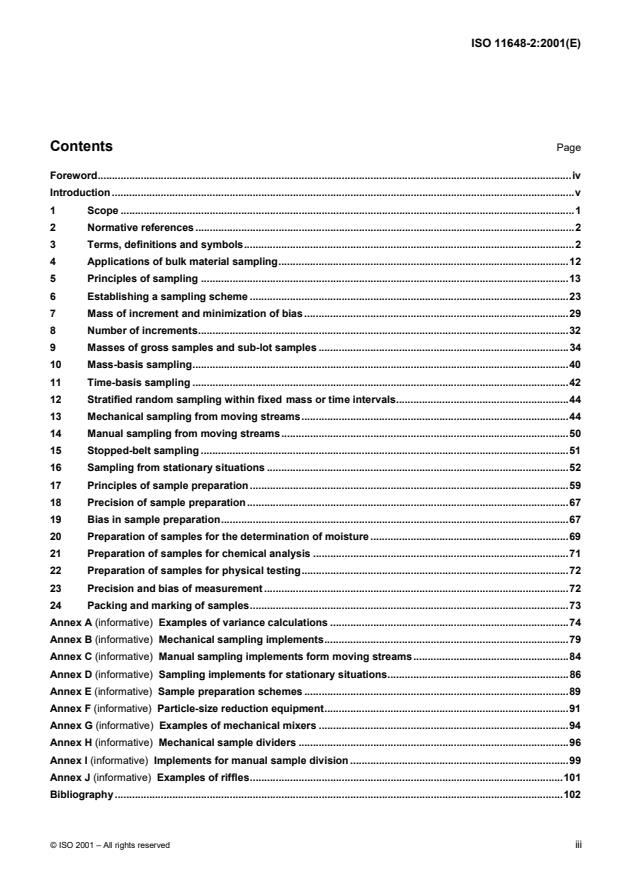
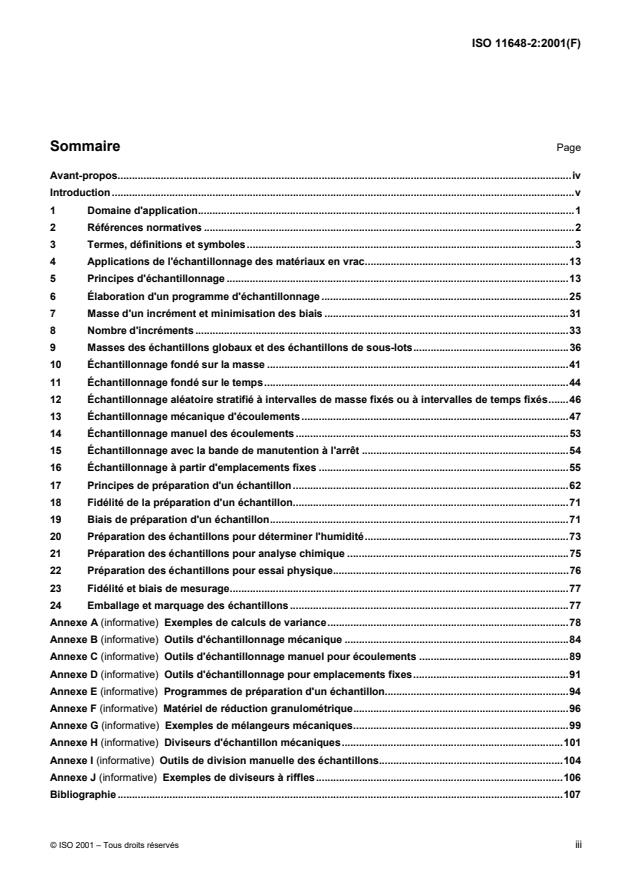
Contents Page
Foreword.iv
Introduction.v
1 Scope .1
2 Normative references .2
3 Terms, definitions and symbols.2
4 Applications of bulk material sampling.12
5 Principles of sampling .13
6 Establishing a sampling scheme .23
7 Mass of increment and minimization of bias .29
8 Number of increments.32
9 Masses of gross samples and sub-lot samples .34
10 Mass-basis sampling.40
11 Time-basis sampling .42
12 Stratified random sampling within fixed mass or time intervals.44
13 Mechanical sampling from moving streams.44
14 Manual sampling from moving streams.50
15 Stopped-belt sampling .51
16 Sampling from stationary situations .52
17 Principles of sample preparation.59
18 Precision of sample preparation.67
19 Bias in sample preparation.67
20 Preparation of samples for the determination of moisture .69
21 Preparation of samples for chemical analysis .71
22 Preparation of samples for physical testing.72
23 Precision and bias of measurement .72
24 Packing and marking of samples.73
Annex A (informative) Examples of variance calculations .74
Annex B (informative) Mechanical sampling implements.79
Annex C (informative) Manual sampling implements form moving streams.84
Annex D (informative) Sampling implements for stationary situations.86
Annex E (informative) Sample preparation schemes .89
Annex F (informative) Particle-size reduction equipment.91
Annex G (informative) Examples of mechanical mixers .94
Annex H (informative) Mechanical sample dividers .96
Annex I (informative) Implements for manual sample division .99
Annex J (informative) Examples of riffles.101
Bibliography.102
Foreword
ISO (the International Organization for Standardization) is a worldwide federation of national standards bodies (ISO
member bodies). The work of preparing International Standards is normally carried out through ISO technical
committees. Each member body interested in a subject for which a technical committee has been established has
the right to be represented on that committee. International organizations, governmental and non-governmental, in
liaison with ISO, also take part in the work. ISO collaborates closely with the International Electrotechnical
Commission (IEC) on all matters of electrotechnical standardization.
International Standards are drafted in accordance with the rules given in the ISO/IEC Directives, Part 3.
Draft International Standards adopted by the technical committees are circulated to the member bodies for voting.
Publication as an International Standard requires approval by at least 75 % of the member bodies casting a vote.
Attention is drawn to the possibility that some of the elements of this part of ISO 11648 may be the subject of
patent rights. ISO shall not be held responsible for identifying any or all such patent rights.
International Standard ISO 11648-2 was prepared by Technical Committee ISO/TC 69, Applications of statistical
methods, Subcommittee SC 3, Application of statistical methods in standardization.
ISO 11648 consists of the following parts, under the general title Statistical aspects of sampling from bulk materials:
� Part 1: General principles
� Part 2: Sampling of particulate materials
It is the intention of ISO/TC 69/SC 3 to develop additional parts to ISO 11648 to cover the sampling of liquids and
gases, if the need exists.
Annexes A to J of this part of ISO 11648 are for information only.
iv © ISO 2001 – All rights reserved
Introduction
This part of ISO 11648 gives the basic methods for sampling bulk particulate materials in bulk (e.g. ores, mineral
concentrates, coal, industrial chemicals in powder and granular form, and agricultural products such as grain) from
moving streams and stationary situations.
Part 1 of ISO 11648 gives a broad outline of the statistical aspects of sampling from bulk materials.
INTERNATIONAL STANDARD ISO 11648-2:2001(E)
Statistical aspects of sampling from bulk materials —
Part 2:
Sampling of particulate materials
1 Scope
This part of ISO 11648 establishes the basic methods for sampling particulate materials in bulk (e.g. ores, mineral
concentrates, coal, industrial chemicals in powder or granular form, and agricultural products such as grain) from
moving streams and stationary situations, including stopped-belt sampling, to provide samples for measuring one
or more variables in an unbiased manner and with a known degree of precision. The variables are measured by
chemical analysis and/or physical testing. These sampling methods are applicable to materials that require
inspection to verify compliance with product specifications or contract settlements, to calculate the value of the lot
mean of a measurable quantity as a basis for settlement between trading partners, or to estimate the set of
variables and variances that describes a system or procedure.
Stopped-belt sampling is the reference method against which other sampling procedures are compared. Dynamic
sampling from moving streams is the preferred method whereby a sampling device (called a cutter) is passed
through the stream of the particulate material. A complete cross-section of the moving stream can be removed as a
primary increment at a conveyor belt transfer point with a falling-stream cutter, or removed from the belt with a
cross-belt cutter. In both cases, the selection and extraction of increments can be described by a one-dimensional
dynamic sampling model.
Static sampling of bulk material from stationary situations, such as stockpiles, rail or road wagons, the holds of
ships and barges, silos, and even comparatively small volumes, is used only where sampling from moving streams
is not possible. Such sampling from three-dimensional lots is prone to systematic errors, because some parts of the
lot usually have reduced or no chance of being collected for the gross sample. This is in violation of the
requirement of the three-dimensional sampling model that all parts have an equal probability of being collected.
The procedures described in this part of ISO 11648 for sampling from stationary lots of bulk particulate material
with implements such as mechanical augers merely minimize some of the systematic sampling errors.
For these reasons, this part of ISO 11648 is primarily concerned with dynamic sampling from moving streams or
stopped-belt static sampling from conveyor belts and is based on a sampling model for one-dimensional lots.
Nonetheless, procedures for static sampling from three-dimensional lots are provided where these situations
cannot be avoided.
This part of ISO 11648 is concerned with the methods of sampling particulate materials in bulk with the objective of
obtaining unbiased measurements of one or more variables of the material with a known degree of precision.
However, it does not provide methods for deciding whether to accept or reject a bulk material lot with specified
degrees of risk of accepting a sub-standard lot, or of rejecting what is in fact an acceptable lot. These latter
procedures are usually called acceptance sampling or sampling inspection methods.
2 Normative references
The following normative documents contain provisions which, through reference in this text, constitute provisions of
this part of ISO 11648. For dated references, subsequent amendments to, or revisions of, any of these publications
do not apply. However, parties to agreements based on this part of ISO 11648 are encouraged to investigate the
possibility of applying the most recent editions of the normative documents indicated below. For undated
references, the latest edition of the normative document referred to applies. Members of ISO and IEC maintain
registers of currently valid International Standards.
ISO 565, Test sieves — Metal wire cloth, perforated metal plate and electroformed sheet — Nominal sizes of
openings.
ISO 3084, Iron ores — Experimental methods for evaluation of quality variation.
ISO 3085, Iron ores — Experimental methods for checking the precision of sampling.
ISO 3086, Iron ores — Experimental methods for checking the bias of sampling.
ISO 3534 (all parts), Statistics — Vocabulary and symbols.
ISO 5725-1, Accuracy (trueness and precision) of measurement methods and results — Part 1: General principles
and definitions.
ISO 5725-2, Accuracy (trueness and precision) of measurement methods and results — Part 2: Basic method for
the determination of repeatability and reproducibility of a standard measurement method.
ISO 5725-3, Accuracy (trueness and precision) of measurement methods and results — Part 3: Intermediate
measures of the precision of a standard measurement method.
ISO 5725-4, Accuracy (trueness and precision) of measurement methods and results — Part 4: Basic methods for
the determination of the trueness of a standard measurement method.
ISO 5725-6, Accuracy (trueness and precision) of measurement methods and results — Part 6: Useinpracticeof
accuracy values.
1)
ISO 11648-1:— , Statistical aspects of sampling from bulk materials — Part 1: General principles.
1)
ISO 13909-7:— , Hard coal and coke — Mechanical sampling — Part 7: Methods for determining the precision of
sampling, sample preparation and testing.
1)
ISO 13909-8:— , Hard coal and coke — Mechanical sampling — Part 8: Methods of testing for bias.
Guide to the expression of uncertainty in measurement (GUM). BIPM, IEC, IFCC, ISO, IUPAC, IUPAP, OIML, 1st edition,
1995.
3 Terms, definitions and symbols
3.1 Terms and definitions
For the purpose of this part of ISO 11648, the terms and definitions of ISO 3534 (all parts) and the following (taken
from the current draft revision of ISO 3534-2) apply.
NOTE The text �bulk material� shown after terms means the definition given is confined to the field of bulk material
sampling.
1)
To be published.
2 © ISO 2001 – All rights reserved
3.1.1
bulk material
amount of material within which component parts are not initially distinguishable on the macroscopic level
3.1.2
sample
�bulk material� subset of a specified population made up of one or more sampling units
3.1.3
sampling
act of drawing or constituting a sample
3.1.4
simple random sampling
sampling whereasampleof n sampling units is taken from a population in such a way that all combinations of
n sampling units have the same probability of being taken
NOTE In bulk material sampling, if the sampling unit is an increment, the positioning, delimitation and extraction of
increments should ensure that all sampling units have an equal probability of being selected.
3.1.5
stratum
mutually exclusive and exhaustive sub-population considered to be more homogeneous with respect to the
characteristic investigated than the total population
EXAMPLES In bulk material, strata, based on time, mass and space, are typically production periods (e.g. 15 min),
production masses (e.g. 100 t), holds in vessels, wagons in a train, or containers.
3.1.6
stratified sampling
sampling such that portions of the sample are drawn from the different strata and each stratum is sampled with at
least one sampling unit
NOTE In some cases, the portions are specified proportions determined in advance. However, in post-stratified sampling,
the specified proportions would not be known in advance.
3.1.7
stratified simple random sampling
simple random sampling from each stratum
3.1.8
systematic sampling
sampling according to a methodical scheme
NOTE 1 In bulk sampling, systematic sampling may be achieved by taking items at fixed distances or after time intervals of
fixed length. Intervals may, for example, be on a mass or time basis. In the case of a mass basis, sampling units or increments
should be of equal mass. With respect to a time basis, sampling units or increments should be taken from a moving stream or
conveyor, for example, at uniform time intervals. In this case, the mass of each sampling unit or increment should be
proportional to the mass flow rate at the instant of taking the entity or increment.
NOTE 2 If the lot is divided into strata, stratified systematic sampling can be carried out by taking increments at the same
relative locations within each stratum.
3.1.9
sampling unit
�bulk material� one of the member parts, each with equal probability of selection in sampling, into which a
population, comprised of the total quantity of bulk material under consideration, is divided
NOTE 1 In bulk sampling, the operative characteristics of the sampling unit are that the probability of selection of all sampling
units should be equal and that the entire sampling unit becomes part of the sample when it is selected.
NOTE 2 When sampling from a bulk material is performed by extraction of individual increments, the sampling unit is the
primary increment.
3.1.10
precision
closeness of agreement between independent test results obtained under stipulated conditions
NOTE1 Precision depends only on the distribution of random errors and does not relate to the true value or the specified
value.
NOTE 2 The measure of precision is usually expressed in terms of imprecision and computed as a standard deviation of the
test result. Less precision is reflected by a larger standard deviation.
NOTE 3 Quantitative measures of precision depend critically on the stipulated conditions. Repeatability and reproducibility
conditions are particular sets of extreme stipulated conditions.
3.1.11
bias
difference between the expectation of a test result and an accepted reference value
NOTE 1 Bias is the total systematic error as contrasted to random error. There may be one or more systematic error
components contributing to the bias. A larger systematic difference from the accepted reference value is reflected by a larger
bias value.
NOTE 2 The bias of a measurement instrument is normally estimated by averaging the error of indication over an
appropriate number of repeated measurements. In this case, the error of indication is the
“indication of a measuring instrument minus a true value of the corresponding input quantity”.
3.1.12
lot
�bulk material� definite part of a population, comprised of the total quantity of bulk material under consideration, and
where this part is considered as a quantity of material for which specific characteristics are to be determined
NOTE Commerce in bulk material often encompasses transactions involving single lots, and, in these cases, the lot
becomes the population.
3.1.13
sub-lot
�bulk material� definite part of a lot of bulk material
3.1.14
increment
�bulk material� quantity of bulk material taken in one action by a sampling device
NOTE 1 The positioning, delimitation and extraction of the increment should ensure that all parts of the bulk material in the
lot have an equal probability of being selected.
NOTE 2 Sampling is often carried out in progressive mechanical stages, in which case it is necessary to distinguish between
a primary increment which is a sampling unit that is extracted from the lot at the first sampling stage, and a secondary increment
which is extracted from the primary increment at the secondary sampling stage, and so on.
3.1.15
composite sample
�bulk material� aggregation of two or more increments taken from a lot
3.1.16
gross sample
�bulk material� aggregation of all the increments taken from a sub-lot or lot by the procedures of routine sampling
3.1.17
test sample
�bulk material� sample, as prepared for testing or analysis, the whole quantity or a part of it being used for testing or
analysis at one time
4 © ISO 2001 – All rights reserved
NOTE The term may be used in such ways as “test sample for chemical analysis”, “test sample for moisture
determination”, “test sample for particle size determination” and “test sample for physical testing”.
3.1.18
test portion
�bulk material� part of a test sample which is used for analysis or testing at one time
3.1.19
multi-stage sampling
�bulk material� sampling in which the sample is selected by stages, the sampling units at each stage being sampled
from the larger sampling units chosen at the previous stage
3.1.20
routine sampling
�bulk material� sampling for commercial purposes carried out by the stipulated procedures in the specific
International Standard in order to determine the average quality of the lot
NOTE The term “regular sampling” is sometimes used as an alternative to “routine sampling”.
3.1.21
experimental sampling
�bulk material� non-routine sampling where special purpose experimental design is applied to investigate sources of
variance and/or sampling bias
3.1.22
interpenetrating sampling
�bulk material� replicate sampling from several lots or sub-lots, where for each lot i or sub-lot i, consecutive primary
increments are diverted in rotation into different containers to give multiple composite samples (A , B , C , …)in
i i i
order to investigate the variance between the increments in the lot or the sub-lot
NOTE 1 The term “interleaved sampling” is sometimes used as an alternative to “interpenetrating sampling”.
NOTE 2 Most interpenetrating sampling schemes use a duplicate sampling method with composite sample pairs (A , B )
i i
being constituted for each lot i or sub-lot i.
3.1.23
replicate sampling
�bulk material� sampling where increments are taken simultaneously or consecutively in pairs in order to constitute
multiple composite samples
3.1.24
duplicate sampling
�bulk material� replicate sampling where increments are taken simultaneously or consecutively in pairs in order to
constitute two composite samples
NOTE Duplicate sampling is a special case of replicate sampling.
3.1.25
manual sampling
�bulk material� collection of increments by human effort
3.1.26
mechanical sampling
�bulk material� collection of increments by mechanical means
3.1.27
cut
�bulk material� single traverse of the sample cutter, in mechanical sampling, through the stream
3.1.28
sample preparation
�bulk material� set of material operations necessary to transform a sample into a test sample
EXAMPLE Reduction of sizes, mixing and dividing.
NOTE For particulate materials, the completion of each operation of sample division defines the commencement of the
next sample preparation stage. Thus the number of stages in sample preparation is equal to the number of divisions made.
3.1.29
sample reduction
�bulk material� process in sample preparation whereby the particle size is reduced by crushing, grinding or
pulverization
3.1.30
sample division
�bulk material� process in sample preparation whereby a sample of a bulk material is divided by such means as
riffling, mechanical division, or quartering into separate parts, one or more of which is retained
EXAMPLE Riffling, mechanical division or quartering.
3.1.31
fixed ratio division
�bulk material� sample division in which the retained parts from individual samples are a constant proportion of the
original
3.1.32
fixed mass division
�bulk material� sample division in which the retained divided parts are of almost uniform mass, irrespective of
variations in mass of the samples being divided
3.1.33
sample drying
�bulk material� process in sample preparation of partial drying of the sample to bring its moisture content near to a
level which will not bias the results of further testing or sample preparation
3.1.34
routine sample preparation
�bulk material� sample preparation carried out by the stipulated procedures in the specific International Standard in
order to determine the average quality of the lot
3.1.35
non-routine sample preparation
�bulk material� sample preparation carried out for experimental sampling
3.1.36
nominal top size
�bulk material� particle size expressed by the aperture dimension of the test sieve (from a square hole sieve series
complying with ISO 565) on which no more than 5 % of the sample is retained
3.1.37
nominal bottom size
�bulk material� particle size expressed by the aperture dimension of the test sieve (from a square hole sieve series
complying with ISO 565) through which no more than 5 % of the sample passes
3.1.38
quality variation
�bulk material� standard deviation of the quality characteristics determined either by estimating the variance
between interpenetrating samples taken from the lot or sub-lot, or by estimating the variance from a variographic
analysis of the differences between individual increments separated by various lagged intervals
6 © ISO 2001 – All rights reserved
3.1.39
sampling procedure
�bulk material� operational requirements and/or instructions relating to taking increments and constituting a sample
3.1.40
sample preparation procedure
�bulk material� operational requirements and/or instructions relating to methods and criteria for sample division
3.1.41
sampling scheme
�bulk material� specification of the type of sampling to be used combined with the operational specification of the
entities or increments to be taken, the samples to be constituted and the measurements to be made
EXAMPLE The scheme may specify, for example, that the sampling shall be systematic and in two stages. In combination
with the specification of the type of sampling, the scheme, in this example, also may specify the number of increments to be
taken from a lot, the number of composite samples (or gross samples) per lot, the number of test samples per composite
sample, and the number of measurements per test sample.
3.1.42
sampling system
�bulk material� operational mechanism and/or mechanical installation for taking increments and sample preparation
3.2 Symbols
A list of symbols used in this part of ISO 11648 is presented in Table 1 with short descriptions of symbol meanings
and references to the subclauses where the symbols are first mentioned. Table 2 gives a list of subscripts with their
meanings that are used in this part of ISO 11648.
Table 1 — Symbols
Symbol Meaning Units First mention
random component of variance of the corrected variogram and
A — 5.3.2
cor
equal to its intercept
derived variogram intercept for the increment mass to be used for
A — 8.2.2
der
sampling
kg/mm
constant used to calculate the fundamental error component of the
A or 5.3.2
F
variogram intercept and with the units of a density
3 �9
kg/m � 10
constant derived from a least squares fit to between-sample
A — 9.2.2
variance data
measurement of the quality characteristic of the test sample
a — 5.3.3
i
prepared from sub-lot sample A
i
�1
min (time)
gradient (i.e. slope) of variogram, for mass-basis sampling, or for
B 5.3.2
�1
time-basis sampling t (mass)
mm
b effective aperture width of cutter 13.3.4
measurement of the quality characteristic of the test sample
b — 5.3.3
i
prepared from sub-lot sample B
i
Table 1 — Symbols (continued)
Units
Symbol Meaning First mention
m
b minimum cutting aperture width 7.2
min
mm
d nominal top size of particles 5.3.2
lower size limit and defined as the finest sieve aperture width that
d
mm 9.2.3
L
passes 5 % of the undersized particles
d
nominal top size at which complete liberation occurs mm 9.2.3
�
e
increment-delimitation error — 5.2.1
del
e
increment-extraction error — 5.2.1
E
e
fundamental error — 5.2.1
F
e
segregation and grouping error — 5.2.1
G
e
preparation error (also known as accessory error) — 5.2.1
P
e — 5.2.1
short-range quality fluctuation error
Q1
e
long-range quality fluctuation error — 5.2.1
Q2
e
periodic quality fluctuation error — 5.2.1
Q3
e
total sampling error — 5.2.1
T
e — 5.2.1
weighting error
W
f
mineralogical composition factor t/m 9.2.3
comp
f
size range factor — 9.2.3
r
f
particle shape factor — 9.2.3
s
H
heterogeneity index of the bulk material — 9.2.4
H
heterogeneity index for the size range S of the bulk material — 9.2.4
S
index designating the number of an increment or sub-lot depending
i — 5.3.2
on context
total number of particles in the experimental method for determining
J
— 9.2.4
fundamental error
index designating the number of a particle in the experimental
j — 9.2.4
method for determining fundamental error
number of increments defining the lag of a variogram value; or in
k — 5.3.2
5.4, the number of sub-lot samples
m
gross sample mass kg 5.3.2
g
m
increment mass kg 5.3.2
I
m
total mass for lot t 5.3.2
lot
estimate of the mass of particles in the size range d/2 to d and used
m
kg 9.2.4
H
to calculate the heterogeneity index
combined dry mass of the particles selected in the method to
m
kg 9.2.4
sel
determine the heterogeneity index
m
increment mass to be used for routine sampling kg 8.2.2
IS
m
mass of the sub-lot t 8.2.1
sub
8 © ISO 2001 – All rights reserved
Table 1 — Symbols (continued)
Symbol Meaning Units First mention
m
mass of container plus lid plus material test portion kg 20.4.2
m
mass of drying tray kg 20.4.2
mass of dry container plus lid plus drying tray plus material test
m
kg 20.4.2
portion
m
mass of dry empty container kg 20.4.2
n number of increments — 5.3.2
n number of increments comprising each subsample A or B
— 5.3.3
I i i
n
minimum number of increments for the lot 16.5
lot
n
number of increments taken from each sub-lot — 16.2
sub
q flow rate of bulk material stream t/h 7.2
R
range of paired measurements — 5.3.3
i
average of the ranges R
— 5.3.3
R i
r number of replicate determinations — 5.4
s between-sample variance — 9.2.2
BS
s composition variance of a unit mass increment — 5.3.2
comp
distribution variance — 5.3.2
s
D
fundamental error variance — 5.3.2
s
F
s segregation and grouping error variance — 5.3.2
G
s primary increment variance — 5.3.3
I
uncorrected increment variance — 5.3.3
s
Iunc
measurement (or analysis) variance — 5.4
s
M
s sample preparation variance — 5.4
P
s sample preparation and measurement variance — 5.3.3
PM
short-range quality fluctuation variance — 5.3.1
s
Q1
s long-range quality fluctuation variance — 5.3.1
Q2
s relative variance — 9.2.4
rel
— 5.3.1
s sampling variance
S
primary sampling variance — 5.4
s
S1
s secondary sampling variance — 5.4
S2
s tertiary sampling variance — 5.4
S3
s sub-lot variance — 16.5
sub
Table 1 — Symbols (continued)
Units
Symbol Meaning First mention
overall variance — 5.4
s
SPM
s within-sub-lot variance — 5.3.3
wsl
lag value for calculating the variogram either on a time or mass min (time)
t 5.3.2
basis t (mass)
t
total time for sampling the lot min 5.3.2
lot
t
total time for sampling the sub-lot min 5.3.2
sub
u
number of sub-lots in the lot — 16.5
lot
number of sub-lots actually sampled in an intermittent sampling
u
— 16.5
sub
scheme
V
value of corrected variogram — 5.3.2
cor
V
value of experimental variogram — 5.3.2
exp
v
maximum cutter speed of sampler m/s 7.2
cut
v
speed of conveyor belt m/s 7.3
B
w % by mass 9.2.3
percentage by mass of key component
k
w
air-dried moisture content of the test portion % by mass 20.4.2
m
x
value of quality characteristic for increment i — 5.3.2
i
x
mass-weighted average of the quality characteristic — 9.2.4
m
x
mean quality characteristic for all increments — 5.3.3
�
total (or overall) precision — 5.4
SPM
�m mass interval between increments t 5.3.2
�t
time interval between increments min 5.3.2
� liberation factor — 9.2.3
� bulk density of material t/m 7.4
� density of particles of key component t/m 9.2.3
k
�
density of particles of non-key component t/m 9.2.3
nk
ˆ
� estimate of the fundamental error variance — 9.2.3
F
10 © ISO 2001 – All rights reserved
Table 2 — Subscripts
Subscript Meaning
B conveyor belt
BS between-sample
comp composition
cor corrected value
cut cutter
del delimitation
der derived
D
distribution
E extraction
e experimental
F fundamental
G
segregation and grouping
ggross
H heterogeneity index
index designating the number of an increment or sub-lot depending
i
on context
I increment
Iunc uncorrected increment
index designating the number of a particle in the experimental
j
method for determining fundamental error
k key component
L lower size limit
lot lot
M measurement
m air-dried moisture content
m
mass-weighted average
min minimum
nk non-key
P sample preparation
PM
sample preparation and measurement
Q1 short-range quality
Q2 long-range quality
Q3 periodic quality
r size range of sieve aperture widths
rel relative
S size range
Table 2 — Subscripts (continued)
Subscript Meaning
S sampling
S1 primary sampling
S2 secondary sampling
S3 tertiary sampling
SPM sampling, sample preparation and measurement (= total or overall)
s particle shape
sel particles selected
sub sub-lot
T total sampling
W weighting
wsl within-sub-lot
� liberation factor
4 Applications of bulk material sampling
This part of ISO 11648 provides guidelines for sampling, sample preparation and testing of particulate materials in
bulk for a wide range of applications. Typical examples of quantities in bulk are a cargo of coal or iron ore from a
single source, a partial cargo (a few cargo spaces) of concentrate or fertilizer, a barge with cement, a unit train with
grain, and so on. Quantities in bulk that are defined on a time basis are less commonly specified, but examples of
such quantities in bulk are masses or volumes produced during certain time intervals (e.g. shifts or 24-h periods).
Generally, a quantity of material in bulk is inspected and evaluated by collecting a set of unbiased primary
increments, preparing test samples (for physical properties and/or chemical composition) without introducing a
bias, and analysing test portions by applying approved test methods with properly calibrated apparatus. Adjectives
are often added to describe test samples. For example, the terms “chemical analysis sample, moisture sample,
size sample”, and other types of samples, are used in various ISO standard methods. The term “test portion” is
used in reference to the sample mass or volume taken from test samples for testing or analysis.
Under certain conditions, the effect of a serial correlation on the sampling variance can be taken into account to
refine precision estimates and to optimize statistical process control. For many materials, primary increments
collected at short intervals (typically 10 min or less) are often correlated. If a sequence of measurements is
correlated in space or time, variability between the serial measurements is overstated by the overall variance. On-
line analysers are useful to test sets of consecutive measurements for serial correlations.
However, for most manual sampling regimes and many mechanical sampling systems, the sampling interval is too
long to show a significant serial correlation between consecutive increments. Thus, the time series variance
increases as a function of the sampling interval until it becomes equal to the variance of the measurements for the
set of increments collected. At that spacing between primary increments, the measurements are no longer
[2]
correlated in time, but have become statistically independent .
Duplicate test portions provide an estimate for the analytical variance, often as a function of the variable of interest.
The variances between randomly distributed and ordered data sets, and the analytical variance, can be used to
optimize sampling regimes for a quantity in bulk of a given intrinsic variability.
12 © ISO 2001 – All rights reserved
5 Principles of sampling
5.1 General
Sample inspections or evaluations of bulk particulate materials for a single lot are normally based on collecting a
set of unbiased primary increments from the lot (cargo or shipment), preparing a test sample from the lot sample
without introducing a systematic error, and taking a test portion from the test sample and analysing it by applying
an appropriate and properly calibrated analytical method or test procedure under prescribed conditions. The
precision of the variable of interest in valuable bulk materials can be estimated by dividing a shipment into four or
more lots, and by selecting a pair of interpenetrating primary samples of each lot.
NOTE Statistical concepts used in this part of ISO 11648 to describe uncertainty in the measurements on samples, such
as bias, precision and variance, are described in the Guide to the expression of uncertainty in measurement.
The objective of the operational sequence of sample collection, test sample preparation and analysis of test
portions is to estimate the variable of interest in an unbiased manner, with an acceptable and affordable degree of
precision. The general sampling theory, which is based on the additive property of variances, can be applied to
describe how the variances of sampling, preparation and chemical analysis or physical testing cumulate to
determine the total variance.
If a sampling scheme is to ensure correct selection probabilities, it is a requirement that all parts of the bulk
particulate material in the lot have an equal opportunity of being selected and appearing in the lot sample for
testing. Thus a quantity of material in bulk should be sampled in such a way that all possible primary increments in
the set into which the quantity can be divided have a uniform finite probability to be selected. Any deviation from
this basic requirement can result in an unacceptable bias. A sampling scheme with incorrect selection techniques
(i.e. with non-uniform selection probabilities) cannot be relied upon to provide representative samples.
The objective of this part of ISO 11648 is to describe a common and consistent approach for collecting a set of
primary increments from a lot of bulk particulate material (clauses 5 to 16) and for preparing one or more test
samples without introducing a systematic error (clauses 17 to 23).
In a strict interpretation of the term, a lot of bulk material is always three dimensional. However, in many practical
circumstances, two of the dimensions of the lot can be regarded as being of secondary importance. In industrial
operations requiring bulk material transportation mechanisms such as conveyor belts and falling streams at transfer
points, the lot can be well described by a one-dimensional model. Dynamic sampling using a stream cutter or static
sampling from a stopped conveyor belt can be performed to collect representative samples from such a lot.
Clauses 5 to 15 relate to dynamic and static sampling on lots regarded as being one dimensional.
In some situations, static sampling from three-dimensional lots such as stockpiles, ships' holds and wagons cannot
be avoided, but it presents considerably more difficult sampling problems, and the risk of collecting
unrepresentative samples is considerable. Clause 16 provides sampling procedures for sampling from three-
dimensional lots.
Sampling of one-dimensional lots should preferably be carried out by stratified systematic sampling (see 5.3.2),
either on a mass basis (see clause 10) or on a time basis (see clause 11). However, it needs to be shown that no
systematic error (or bias) can possibly be introduced by periodic variation in quality or quantity when the proposed
sampling interval is approximately equal to a multiple of the period of variation in quality or quantity.
As an example, a primary cutter may be cutting a stream of ore which is being reclaimed from a stockpile by a
bucket-wheel reclaimer. At both limits of the bucket-wheel traverse across the material interface on the stockpile,
the material may have different properties from that of the stockpile average (e.g. due to segregation, surface
drying, oxidation, addition of dust-suppressing chemicals, or water sprays). In this case, it is quite possible that
every time the primary cutter makes a cut, the cut coincides with ore being delivered from the limit of a traverse of
the bucket-wheel reclaimer. Thus, a systematic error can occur.
When a systematic error is introduced at the primary sampling stage by periodic variation in quality or quantity of
the particulate material, or where it is felt that, owing to the manner in which the material is handled and presented
to subsequent division apparatus, a systematic error can occur in the secondary and subsequent stages of division,
it is strongly recommended that stratified random sampling within fixed time or mass intervals be carried out (see
clause 12).
The methods for sampling and sample preparation depend on the final choice of sampling scheme and on the
steps necessary to minimize possible systematic errors arising during subsequent division steps.
5.2 Sampling errors
5.2.1 General
The processes of sampling, sample preparation and measurement are experimental procedures. As a
consequence of these procedures, each process has its own element of uncertainty which results as random
variations in the values measured. These random variations which average out to be a negligible value are called
experimental errors. A more adverse component contributing to the uncertainty of results are systematic errors
appearing as random variables which average out to a biased value away from zero. There is also the category of
human errors which are variations that result from departures from the prescribed procedures and which are not
random variables suited to statistical analysis.
[1]
The total sampling error e can be expressed as the sum of a number of independent components . However,
T
such a simple additive combination is not appropriate for components which are correlated. The total sampling
error, expressed as a sum of its components, is:
ee� ���e e e��e e�e (1)
TQ1 Q2 Q3 W del E P
where
e is the short-range quality fluctuation error associated with short-range variations in quality;
Q1
e is the long-range quality fluctuation error associated with long-range variations in quality;
Q2
e is the periodic quality fluctuation error associated with periodic variations in quality;
Q3
e is the weighting error associated with variations in flow rate;
W
e is the increment-delimitation error introduced by incorrect increment delimitation;
del
e is the increment-extraction error introduced by incorrect increm
...
NORME ISO
INTERNATIONALE 11648-2
Première édition
2001-10-15
Aspects statistiques de l'échantillonnage
des matériaux en vrac —
Partie 2:
Échantillonnage des matériaux
particulaires
Statistical aspects of sampling from bulk materials —
Part 2: Sampling of particulate materials
Numéro de référence
©
ISO 2001
PDF – Exonération de responsabilité
Le présent fichier PDF peut contenir des polices de caractères intégrées. Conformément aux conditions de licence d'Adobe, ce fichier peut
être imprimé ou visualisé, mais ne doit pas être modifiéà moins que l'ordinateur employéà cet effet ne bénéficie d'une licence autorisant
l'utilisation de ces polices et que celles-ci y soient installées. Lors du téléchargement de ce fichier, les parties concernées acceptent de fait la
responsabilité de ne pas enfreindre les conditions de licence d'Adobe. Le Secrétariat central de l'ISO décline toute responsabilité en la
matière.
Adobe est une marque déposée d'Adobe Systems Incorporated.
Les détails relatifs aux produits logiciels utilisés pour la créationduprésent fichier PDF sont disponibles dans la rubrique General Info du
fichier; les paramètres de création PDF ont été optimisés pour l'impression. Toutes les mesures ont été prises pour garantir l'exploitation de
ce fichier par les comités membres de l'ISO. Dans le cas peu probable où surviendrait un problème d'utilisation, veuillez en informer le
Secrétariat central à l'adresse donnée ci-dessous.
Droits de reproduction réservés. Sauf prescription différente, aucune partie de cette publication ne peut être reproduite ni utilisée sous quelque
forme que ce soit et par aucun procédé, électronique ou mécanique, y compris la photocopie et les microfilms, sans l'accord écrit de l’ISO à
l’adresse ci-aprèsouducomité membre de l’ISO dans le pays du demandeur.
ISO copyright office
Case postale 56 � CH-1211 Geneva 20
Tel. + 41 22 749 01 11
Fax. + 41 22 749 09 47
E-mail copyright@iso.ch
Web www.iso.ch
Imprimé en Suisse
ii © ISO 2001 – Tous droits réservés
Sommaire Page
Avant-propos.iv
Introduction.v
1 Domaine d'application.1
2Références normatives .2
3 Termes, définitions et symboles.3
4 Applications de l'échantillonnage des matériaux en vrac.13
5 Principes d'échantillonnage .13
6 Élaboration d'un programme d'échantillonnage .25
7 Masse d'un incrément et minimisation des biais .31
8 Nombre d'incréments .33
9 Masses des échantillons globaux et des échantillons de sous-lots.36
10 Échantillonnage fondé sur la masse .41
11 Échantillonnage fondé sur le temps.44
12 Échantillonnage aléatoire stratifiéà intervalles de masse fixésou à intervallesdetempsfixés.46
13 Échantillonnage mécanique d'écoulements.47
14 Échantillonnage manuel des écoulements .53
15 Échantillonnage avec la bande de manutention à l'arrêt .54
16 Échantillonnage à partir d'emplacements fixes .55
17 Principesdepréparation d'un échantillon.62
18 Fidélité de la préparation d'un échantillon.71
19 Biais de préparation d'un échantillon.71
20 Préparation des échantillons pour déterminer l'humidité.73
21 Préparation des échantillons pour analyse chimique .75
22 Préparation des échantillons pour essai physique.76
23 Fidélité et biais de mesurage.77
24 Emballage et marquage des échantillons .77
Annexe A (informative) Exemples de calculs de variance.78
Annexe B (informative) Outils d'échantillonnage mécanique .84
Annexe C (informative) Outils d'échantillonnage manuel pour écoulements .89
Annexe D (informative) Outils d'échantillonnage pour emplacements fixes.91
Annexe E (informative) Programmes de préparation d'un échantillon.94
Annexe F (informative) Matériel de réduction granulométrique.96
Annexe G (informative) Exemples de mélangeurs mécaniques.99
Annexe H (informative) Diviseurs d'échantillon mécaniques.101
Annexe I (informative) Outils de division manuelle des échantillons.104
Annexe J (informative) Exemples de diviseurs à riffles.106
Bibliographie .107
Avant-propos
L'ISO (Organisation internationale de normalisation) est une fédération mondiale d'organismes nationaux de
normalisation (comités membres de l'ISO). L'élaboration des Normes internationales est en général confiéeaux
comités techniques de l'ISO. Chaque comité membre intéressé par une étude aledroit de fairepartie ducomité
technique créé à cet effet. Les organisations internationales, gouvernementales et non gouvernementales, en
liaison avec l'ISO participent également aux travaux. L'ISO collabore étroitement avec la Commission
électrotechnique internationale (CEI) en ce qui concerne la normalisation électrotechnique.
Les Normes internationales sont rédigées conformément aux règles données dans les Directives ISO/CEI, Partie 3.
Les projets de Normes internationales adoptés par les comités techniques sont soumis aux comités membres pour
vote. Leur publication comme Normes internationales requiert l'approbation de 75 % au moins des comités
membres votants.
L’attention est appelée sur le fait que certains des éléments delaprésente partie de l’ISO 11648 peuvent faire
l’objet de droits de propriété intellectuelle ou de droits analogues. L’ISO ne saurait être tenue pour responsable de
ne pas avoir identifié de tels droits de propriété et averti de leur existence.
La Norme internationale ISO 11648-2 a étéélaborée par le comité technique ISO/TC 69, Application des méthodes
statistiques, sous-comité SC 3, Application des méthodes statistiques en normalisation.
L'ISO 11648 comprend les parties suivantes, présentées sous le titre général Aspects statistiques de
l'échantillonnage des matériaux en vrac:
� Partie 1: Principes fondamentaux
� Partie 2: Échantillonnage des matériaux particulaires
Le sous-comité SC3del'ISO/TC69 se propose de développer, si le besoin s’en fait sentir, des parties supplé-
mentaires à l’ISO 11648, relatives à l'échantillonnage des liquides et des gaz.
Les annexes A àJ delaprésente partie de l’ISO 11648 sont données uniquement à titre d’information.
iv © ISO 2001 – Tous droits réservés
Introduction
La présente partie de l'ISO 11648 donne les méthodes de base pour l'échantillonnage des matériaux particulaires
en vrac (par exemples minerais, concentrésminéraux, charbon, produits chimiques industriels en poudre et
granulats, et produits agricoles tels que les grains) prélevés dans des écoulements et en des lieux fixes.
La partie 1 de l'ISO 11648 donne les grandes lignes des aspects statistiques de l'échantillonnage des matériaux en
vrac.
NORME INTERNATIONALE ISO 11648-2:2001(F)
Aspectsstatistiquesdel'échantillonnage des matériaux en vrac —
Partie 2:
Échantillonnage des matériaux particulaires
1 Domaine d'application
La présente partie de l’ISO 11648 établit les méthodes de base d'échantillonnage des matériaux particulaires en
vrac (par exemples minerais, concentrésminéraux, charbon, produits chimiques industriels en poudre ou en
grains, et produits agricoles tels que les grains) prélevés dans des écoulements et en des lieux fixes, y compris
l'échantillonnage par bande de manipulation à l'arrêt, afin de produire des échantillons pour mesurer une ou
plusieurs variables avec justesse et un degré de fidélité connu. Les variables sont mesurées par analyse chimique
et/ou essai physique. Ces méthodes d'échantillonnage s'appliquent aux matériaux qui nécessitent un contrôle afin
de vérifier la conformité avec les spécifications produit ou les accords contractuels, en vue de calculer la valeur de
la moyenne de lot d'une grandeur mesurable comme base d'accord entre les partenaires, ou d'estimer l'ensemble
de variables et de variances qui décrit un système ou une méthode.
L'échantillonnage par bande de manipulation à l'arrêtest laméthode de référence utilisée pour comparer les autres
procédures d'échantillonnage. L'échantillonnage dynamique à partir des écoulements représente la méthode
préférée avec laquelle un dispositif d'échantillonnage (appelééchantillonneur à lame) passe dans l'écoulement du
matériau particulaire. Une section transversale complète de l'écoulement peut êtreextraitecomme incrément
primaire au niveau d'un point de transfert d'une bande de manipulation à l'aide d'un échantillonneur àécoulement
descendant, ou extraite de la bande à l'aide d'un échantillonneur à bande transversale. Dans les deux cas, la
sélection et l'extraction des incréments peuvent être décrites par un modèle d'échantillonnage dynamique
unidimensionnel.
L'échantillonnage statique des matériaux en vrac à partir de lieux fixes tels que stocks de réserves, wagons
ferroviaires ou routiers, cales de navires et de barges, silos, voire même des volumes comparativement faibles,
n'est utilisé que lorsque l'échantillonnage à partir d'écoulements n'est pas possible. Cet échantillonnage à partir de
lots tridimensionnels est susceptible d'engendrer des erreurs systématiques, dans la mesure où certaines pièces
du lot ont peu, voire aucune probabilité d'être prélevées pour l'échantillon global. Ceci est contraire à la prescription
du modèle d'échantillonnage tridimensionnel stipulant que toutes les pièces ont la même probabilité d'être
prélevées. Les procédures décrites dans la présente partie de l’ISO 11648 relatives à l'échantillonnage à partir de
lots fixes de matériaux particulaires en vrac à l'aide d'outils tels que sondes à vis ne minimisent que certaines
erreurs systématiques d'échantillonnage.
Pour toutes ces raisons, la présente partie de l’ISO 11648 concerne principalement l'échantillonnage dynamique à
partir d'écoulements ou l'échantillonnage statique à bande de manipulation à l'arrêt et se fonde sur un modèle
d'échantillonnage pour lots unidimensionnels. Néanmoins, des procédures d'échantillonnage statique à partir de
lots tridimensionnels sont prévues lorsque ces situations ne peuvent être évitées.
La présente partie de l’ISO 11648 concerne les méthodes d'échantillonnage des matériaux particulaires en vrac
dans le but d'obtenir des mesurages non biaisés d'une ou plusieurs variables du matériau avec un degré de fidélité
connu. Toutefois, elle ne fournit pas de méthodes permettant de décider de l'acceptation ou du rejet d'un lot de
matériau en vrac, avec des degrésderisquespécifiés d'accepter un lot inférieur à la norme ou de rejeter un lot qui
est en fait acceptable. Ces démarches sont généralement appelées «échantillonnage pour acceptation» ou
«méthodes de contrôle d'échantillonnage».
2Références normatives
Les documents normatifs suivants contiennent des dispositions qui, par suite de la référence qui y est faite,
constituent des dispositions valables pour la présente partie de l'ISO 11648. Pour les références datées, les
amendements ultérieurs ou les révisions de ces publications ne s’appliquent pas. Toutefois, les parties prenantes
aux accords fondés sur la présente partie de l'ISO 11648 sont invitées à rechercher la possibilité d'appliquer les
éditions les plus récentes des documents normatifs indiqués ci-après. Pour les références non datées, la dernière
édition du document normatif en référence s’applique. Les membres de l'ISO et de la CEI possèdent le registre des
Normes internationales en vigueur.
ISO 565, Tamis de contrôle — Tissus métalliques, tôles métalliques perforées et feuilles électroformées —
Dimensions nominales des ouvertures.
ISO 3084, Minerais de fer — Méthodes expérimentales pour l’évaluation de la variation de qualité.
ISO 3085, Minerais de fer — Méthodes expérimentales de contrôle de la fidélité de l’échantillonnage.
ISO 3086, Minerais de fer — Méthodes expérimentales de contrôle de l’erreur systématique d’échantillonnage.
ISO 3534 (toutes les parties), Statistique — Vocabulaire et symboles.
ISO 5725-1, Exactitude (justesse et fidélité) des résultats et méthodes de mesure — Partie 1: Principes généraux
et définitions.
ISO 5725-2, Exactitude (justesse et fidélité) des résultats et méthodes de mesure — Partie 2: Méthode de base
pour la déterminationdelarépétabilité et de la reproductibilité d’une méthodedemesurenormalisée.
ISO 5725-3, Exactitude (justesse et fidélité) des résultats et méthodes de mesure — Partie 3: Mesures inter-
médiaires de la fidélité d’une méthode de mesure normalisée.
ISO 5725-4, Exactitude (justesse et fidélité) des résultats et méthodes de mesure — Partie 4: Méthodes de base
pour la déterminationdelajustessed’une méthode de mesure normalisée.
ISO 5725-6, Exactitude (justesse et fidélité) des résultats et méthodes de mesure — Partie 6: Utilisation dans la
pratique des valeurs d’exactitude.
1)
ISO 11648-1:— , Aspects statistiques de l’échantillonnage des matériaux en vrac — Partie 1: Principes fonda-
mentaux.
1)
ISO 13909-7:— , Houille et coke —Échantillonnage mécanique — Partie 7: Méthodes pour la détermination de la
fidélité de l’échantillonnage, de la préparation de l’échantillon et de l’essai.
1)
ISO 13909-8:— , Houille et coke —Échantillonnage mécanique — Partie 8: Méthode de détectiondubiais.
re
Guide pour l’expression de l’incertitude de mesure. BIPM/CEI/FICC/ISO/OILM /UICPA/UIPPA, 1 édition, 1995.
1)
À publier.
2 © ISO 2001 – Tous droits réservés
3 Termes, définitions et symboles
3.1 Termes et définitions
Pour les besoins de la présente partie de l'ISO 11648, les termes et définitions donnés dans l’ISO 3534 (toutes les
parties) s’appliquent, ainsi que les termes et définitions suivants (tirésdel’actuel projet de révision de
l’ISO 3534-2).
NOTE Le vocable �matériaux en vrac� placé au début d’une définition signifie que le terme concerné se limite au domaine
de l'échantillonnage des matériaux en vrac.
3.1.1
matériaux en vrac
quantité de matériaux, dont les éléments constitutifs ne peuvent être à l'origine facilement distingués au niveau
macroscopique
3.1.2
échantillon
�matériaux en vrac� sous-ensemble d’une population déterminéeconstituéed’une ou de plusieurs unités
d’échantillonnage
3.1.3
échantillonnage
action de prélever ou de constituer un échantillon
3.1.4
échantillonnage simple aléatoire
échantillonnage où un échantillon de n unitésd’échantillonnage est prélevé dans une population de sorte que
toutes les combinaisons possibles de n unités échantillonnage aient la même probabilité d’être prélevées
NOTE Pour les matériaux en vrac, si l’unité d’échantillonnage est un incrément, il convient que le positionnement, la
délimitation et l’extraction de l’incrément assurent que toutes les unitésd’échantillonnage ont une probabilitéégale d’être
choisies.
3.1.5
strate
sous-population exclusive et exhaustive considérée être plus homogène par rapport aux caractéristiques étudiées
que la population totale
EXEMPLES Pour les matériaux en vrac, les strates, basées sur le temps, la masse ou le volume, sont généralement les
temps de production (par exemple 15 min), les masses de production (par exemple 100 t), les contenus de cales de navires, les
wagonnets d'un train, ou encore des conteneurs.
3.1.6
échantillonnage stratifié
échantillonnage effectué de manière qu'une portion de l’échantillon soit prélevée dans les différentes strates et que
chaque strate soit échantillonnée avec au moins une unité d’échantillonnage
NOTE Dans certains cas, les portions sont des proportions spécifiées à l’avance. Néanmoins, dans l’échantillonnage post-
stratifié, les proportions spécifiées ne seront pas connues à l’avance.
3.1.7
échantillonnage simple aléatoire stratifié
échantillonnage stratifié simple de chaque strate
3.1.8
échantillonnage systématique
échantillonnage selon un plan méthodique
NOTE 1 Pour les matériaux en vrac, l’échantillonnage systématique peut être effectué en prélevant des échantillons à des
distances déterminées ou après des intervalles de temps de longueur déterminée. Les intervalles peuvent, par exemple,
dépendre de la masse ou du temps. Dans le cas d'un intervalle de masse, il convient que les unitésd’échantillonnage ou
incréments soient de masse égale. Pour un intervalle de temps, il convient que les unitésd’échantillonnage ou incréments
soient prélevés à partir d'un écoulement ou d'une bande de manutention, à intervalles réguliers. Dans ce cas, il convient que la
masse de chaque unité d’échantillonnage ou incrément soit proportionnelle au débit massique au moment de l'échantillonnage
de l'unité ou de l'incrément.
NOTE 2 Lorsque le lot est divisé en strates, l'échantillonnage systématique stratifié peut être réalisé en prélevant les
incréments aux mêmes emplacements relatifs de chaque strate.
3.1.9
unité d'échantillonnage
�matériaux en vrac� une des parties membres, chacune ayant une probabilitéégaledesélection dans l’échantillon,
dans lesquelles une population, comprise dans la quantité totale des matériaux en vrac considérés, est divisée
NOTE 1 Pour les matériaux en vrac, les caractéristiques principales de l’unité d’échantillonnage sont que la probabilité de
sélection de toutes les unitésd’échantillonnage soit égale et que l’unité d’échantillonnage entière devienne une partie de
l’échantillon quand elle est sélectionnée.
NOTE 2 Quand l’échantillonnage de matériaux en vrac est réalisé par extraction d’incréments individuels, l’unité
d’échantillonnage est l’incrément primaire.
3.1.10
fidélité
degré d'adéquation entre des résultats d'essai indépendants obtenus sous des conditions stipulées
NOTE 1 La fidélité ne dépend que de la distribution des erreurs aléatoires et ne se rapporte pas à la valeur vraie ou la valeur
spécifiée.
NOTE 2 La mesure de la fidélité est habituellement expriméeen terme d’imprécision et calculéecomme un écart-type des
résultats d'essais. Une faible fidélité s’exprime par un écart-type plus grand.
NOTE 3 Les mesures quantitatives de la fidélité dépendent beaucoup des conditions stipulées. Les conditions de répétabilité
et de reproductibilité sont des exemples particuliers de conditions stipulées extrêmes.
3.1.11
biais
différence entre l’espérance d’un résultat de mesure et une valeur de référence acceptée
NOTE 1 Le biais est l’erreur systématique totale en contraste avec l’erreur aléatoire. Il peut y avoir un ou plusieurs
composants de l’erreur systématique qui contribuent aux biais. Une différence systématique plus importante de la valeur de
référence acceptéese reflète par une valeur du biais plus importante.
NOTE 2 Le biais d’un instrument de mesure est généralement estimé par la moyenne de l’erreur d’indication sur un nombre
approprié de mesures répétées. Dans ce cas, l’erreur de l’indication est
«l’indication d’un instrument de mesure moins une valeur vraie de la quantité d’entrée correspondante».
3.1.12
lot
�matériaux en vrac� une partie définie d’une population, comprise dans la quantité totale du matériau en vrac
considéré, considérée comme une quantité de matériau pour laquelle des caractéristiques spécifiques doivent être
déterminées
NOTE Le commerce des matériaux en vrac englobe souvent des transactions impliquant des lots simples, et, dans ce cas,
le lot devient la population.
4 © ISO 2001 – Tous droits réservés
3.1.13
sous-lot
�matériaux en vrac� partie définied'unlotde matériaux en vrac
3.1.14
incrément
�matériaux en vrac� quantité de matériau en vrac prélevée en une seule fois par un dispositif d'échantillonnage
NOTE 1 Il convient que le positionnement, la délimitation et l'extraction des incréments assurent que toutes les parties du
matériau en vrac dans le lot ont la même probabilité d'être sélectionnées.
NOTE 2 L'échantillonnage est souvent effectué par degrésmécaniques progressifs. Si c'est le cas, il est nécessaire de
distinguer un incrément primaire, qui est extrait du lot au premier degré d'échantillonnage, d'un incrément secondaire, qui est
extrait de l'incrément primaire au second degré d'échantillonnage, etc.
3.1.15
échantillon composite
�matériaux en vrac� ensemble de deux ou plusieurs incréments d'un lot
3.1.16
échantillon global
�matériaux en vrac� ensemble de tous les incréments d'un sous-lot ou d'un lot prélevéspar les procédures
d'échantillonnage courant
3.1.17
échantillon pour essai
�matériaux en vrac� échantillon, tel que préparé pour un essai ou une analyse, dont la totalité ou une partie est
utilisée pour l'essai ou l'analyse en une seule fois
NOTE Le terme peut être utilisé sous diverses acceptions telles que «échantillon pour essai pour analyse chimique»,
«échantillon pour essai pour déterminer le degré d'humidité», «échantillon pour essai pour déterminer la granulométrie» et
«échantillon pour essai pour essai physique».
3.1.18
prise d'essai
�matériaux en vrac� partie d'un échantillon pour essai utilisée pour l'analyse ou l'essai en une seule fois
3.1.19
échantillonnage à plusieurs degrés
�matériaux en vrac� échantillonnage selon lequel l'échantillon est prélevé par degrés, les unitésd'échantillonnage à
chaque degréétant échantillonnées à partir d'unitésd'échantillonnage plus importantes choisies au degré
précédent
3.1.20
échantillonnage courant
�matériaux en vrac� échantillonnage dans un but commercial effectué par les méthodes spécifiées dans la Norme
internationale spécifique afin de déterminer la qualité moyenne du lot
NOTE Le terme «échantillonnage régulier» est parfois utiliséà la place d’«échantillonnage courant».
3.1.21
échantillonnage expérimental
�matériaux en vrac� échantillonnage non courant dans lequel un plan expérimental spécial est mis en œuvre pour
déterminer les sources de variance et/ou de biais d’échantillonnage
3.1.22
échantillonnage d'interpénétration
�matériaux en vrac� échantillonnage dupliqué de plusieurs lots ou sous-lots, où pour chaque lot i ou sous-lot i,les
incréments primaires consécutifs sont placés en rotation dans des conteneurs différents pour obtenir plusieurs
échantillons composites (A , B , C , …) afin d'analyser la variance entre les incréments dans le lot ou le sous-lot
i i i
NOTE 1 Le terme «échantillonnage intercalé» est parfois utiliséà la place d’«échantillonnage d’interpénétration».
NOTE 2 La plupart des plans d’échantillonnage d’interpénétration utilisent une méthode d’échantillonnage dédoublé avec
des paires d’échantillons composites (A , B)constitués pour chaque lot i ou sous-lot i.
i i
3.1.23
échantillonnage dupliqué
�matériaux en vrac� échantillonnage où les incréments sont prélevéssimultanément ou consécutivement par paires
afin de constituer des échantillons composites multiples
3.1.24
échantillonnage dédoublé
�matériaux en vrac� échantillonnage dupliqué où les incréments sont prélevéssimultanément ou consécutivement
par paires afin de constituer deux échantillons composites
NOTE L’échantillonnage dédoublé est un cas particulier d’échantillonnage dupliqué.
3.1.25
échantillonnage manuel
�matériaux en vrac� groupement d'incréments effectués par l'homme
3.1.26
échantillonnage mécanique
�matériaux en vrac� groupement d'incréments par des moyens mécaniques
3.1.27
coupe
�matériaux en vrac� passage unique de la lame d'échantillonnage, dans l’échantillonnage mécanique, à travers
l'écoulement
3.1.28
préparation d'un échantillon
�matériaux en vrac� ensemble des opérations matérielles nécessaires pour transformer un échantillon en
échantillon pour essai
EXEMPLE Réduction de dimensions, mélange, division.
NOTE Pour les matériaux particulaires, la fin de chaque opération de division d'un échantillon définit le début du degré de
préparation de l'échantillon suivant. Ainsi, le nombre de degrésdela préparation d'un échantillon est égal au nombre de
divisions effectuées.
3.1.29
réduction d'un échantillon
�matériaux en vrac� processus dans la préparation d'un échantillon dans lequel la granulométrie est réduite par
broyage, meulage ou pulvérisation
3.1.30
division d'un échantillon
�matériaux en vrac� processus dans la préparation d'un échantillon par lequel un échantillon de matériau en vrac
est divisé, par exemple par pelletée, par division mécanique ou par séparation, en plusieurs parts dont une ou
plusieurs sont retenues
EXEMPLE Pelletée, division mécanique, ou séparation.
6 © ISO 2001 – Tous droits réservés
3.1.31
division par rapport fixé
�matériaux en vrac� division d'un échantillon dans laquelle les parties retenues à partir des échantillons individuels
constituent une proportion constante de l'original
3.1.32
division par masse fixée
�matériaux en vrac� division d'échantillons dans laquelle les parties divisées retenues ont une masse presque
uniforme, indépendamment des variations de masse des échantillons divisés
3.1.33
séchage d'un échantillon
�matériaux en vrac� processus de séchage partiel de l'échantillon dans la préparation d'un échantillon, pour
atteindre une teneur en humidité proche d'un niveau qui ne fausse pas les résultats des essais ou de la préparation
d'un échantillon ultérieur
3.1.34
préparation d'un échantillon courant
�matériaux en vrac� préparation d'un échantillon effectuéeselon les méthodes spécifiées dans la Norme
internationale spécifique afin de déterminer la qualité moyenne du lot
3.1.35
préparation d'un échantillon non courant
�matériaux en vrac� préparation d'un échantillon effectuéepour l’échantillonnage expérimental
3.1.36
dimension supérieure nominale
�matériaux en vrac� granulométrie exprimée par la dimension d'ouverture du tamis de contrôle (à partir d'une série
de tamis à trous carrés conforme à l'ISO 565), ne retenant pas plus de 5 % de l'échantillon
3.1.37
dimension inférieure nominale
�matériaux en vrac� granulométrie exprimée par la dimension d'ouverture du tamis de contrôle (à partir d'une série
de tamis à trous carrés conforme à l'ISO 565), ne filtrant pas plus de 5 % de l'échantillon
3.1.38
variation de qualité
�matériaux en vrac� écart-typedelacaractéristique qualité,déterminé soit par l’estimation de la variance entre les
échantillons interpénétrésprélevés dans le lot ou le sous-lot, soit par l’estimation de la variance de l’analyse
variographique des différences entre les incréments individuels séparés par des intervalles variés
3.1.39
procédure d'échantillonnage
�matériaux en vrac� exigences et/ou instructions opérationnelles concernant les prélèvements d'incréments et la
constitution d'un échantillon
3.1.40
procéduredepréparation d'un échantillon
�matériaux en vrac� exigences et/ou instructions opérationnelles concernant les méthodes et critères de division
d'un échantillon
3.1.41
plan d'échantillonnage
�matériaux en vrac� spécification du type d'échantillonnage devant être utilisé, associée à la spécification
opérationnelle des unitésouincréments àéchantillonner, des échantillons à constituer et des mesurages à
effectuer
EXEMPLE Le plan peut préciser, par exemple, que l'échantillonnage doit être systématique et à deux degrés. Outre la
spécification du type d'échantillonnage, le plan dont il est question dans cet exemple peut également spécifier le nombre
d'incréments àéchantillonner d'un lot, le nombre d'échantillons composites (ou échantillons globaux) par lot, le nombre
d'échantillons pour essai par échantillon composite et le nombre de mesurages par échantillon pour essai.
3.1.42
système d'échantillonnage
�matériaux en vrac� mécanisme et/ou installation mécanique opérationnels destinésauprélèvement des
incréments et à la préparation d'un échantillon
3.2 Symboles
Le Tableau 1 présente une liste des symboles utilisésdans la présente partie de l’ISO 11648, ainsi qu'une brève
définition de la signification de ces symboles et la référence aux paragraphes dans lesquels ces derniers sont
utilisés pour la première fois. Le Tableau 2 donne la signification des souscrits utilisés.
Tableau 1 — Symboles
Première
Symbole Signification Unités
utilisation
composante aléatoire de variance du variogramme corrigé et égale à
A — 5.3.2
cor
la partie de sa ligne
partiedelalignedu variogrammedérivé pour la masse d'incrément
A — 8.2.2
der
à utiliser pour l'échantillonnage
constante utilisée pour calculer la composante d'erreur fondamentale kg/mm
A de la partie de la ligne du variogramme avec les unités de masse ou 5.3.2
F
3 �9
volumique kg/m � 10
constante dérivée à partir d'un ajustement par moindres carrés aux
A — 9.2.2
données de variance interéchantillons
mesurage de la caractéristique de qualité de l'échantillon pour essai
a — 5.3.3
i
préparéà partir de l'échantillon de sous-lot A
i
�1
gradient (c'est-à-dire pente) du variogramme pour l'échantillonnage min (temps)
B 5.3.2
�1
en fonction de la masse ou en fonction du temps t (masse)
b largeur effective de l’ouverture de la lame mm 13.3.4
mesurage de la caractéristique de qualité de l'échantillon pour essai
b — 5.3.3
i
préparéà partir de l'échantillon de sous-lot B
i
b largeur minimale de l’ouverture de coupe m 7.2
min
d granulométrie supérieure nominale des particules mm 5.3.2
limite inférieure de taille, définie par la plus fine ouverture du tamis
d mm 9.2.3
L
laissant passer 5 %
granulométrie supérieure nominale à laquelle s'effectue la libération
d mm 9.2.3
�
complète
e erreur de délimitation des incréments — 5.2.1
del
e erreur d'extraction des incréments — 5.2.1
E
e erreur fondamentale — 5.2.1
F
e erreur de ségrégation et de groupement — 5.2.1
G
e erreur de préparation (également connue comme erreur accessoire) — 5.2.1
P
8 © ISO 2001 – Tous droits réservés
Tableau 1 — Symboles (suite)
Première
Symbole Signification Unités
utilisation
e erreur de fluctuation de la qualité de faible étendue — 5.2.1
Q1
e erreur de fluctuation de la qualité de grande étendue — 5.2.1
Q2
e erreur de fluctuation périodique de la qualité— 5.2.1
Q3
e erreur d'échantillonnage totale — 5.2.1
T
e erreur de pondération — 5.2.1
W
f facteur de composition minéralogique t/m 9.2.3
comp
f facteur de taille — 9.2.3
r
f facteur de forme des particules — 9.2.3
s
H indice d'hétérogénéité du matériau en vrac — 9.2.4
indice d'hétérogénéité de l'étendue granulométrique S du matériau
H — 9.2.4
S
en vrac
indice désignant le nombre d'un incrément ou d'un sous-lot en
i — 5.3.2
fonction du contexte
nombre total de particules dans la méthode expérimentale utilisée
J — 9.2.4
pour déterminer l'erreur fondamentale
indice désignant le nombre d'une particule dans la méthode
j — 9.2.4
expérimentale utilisée pour déterminer l'erreur fondamentale
nombre d'incréments définissant le décalage d'une valeur de
k — 5.3.2
variogramme, ou, en 5.4, le nombre d'échantillons de sous-lot
m masse de l'échantillon global kg 5.3.2
g
estimation de la masse de particules dans l'étendue granulométrique
m comprise entre d/2 et d et utilisée pour calculer l'indice kg 9.2.4
H
d'hétérogénéité
m masse de l'incrément kg 5.3.2
I
m masse de l'incrément à utiliser pour l'échantillonnage courant kg 8.2.2
IS
m masse totale d'un lot t 5.3.2
lot
masse sèche combinée des particules sélectionnées dans la
m kg 9.2.4
sel
méthode utilisée pour déterminer l'indice d'hétérogénéité
m masse du sous-lot t 8.2.1
sub
m masse du réservoir, du couvercle et de la prise d'essai du matériau kg 20.4.2
m masse du plateau de séchage kg 20.4.2
masse du réservoir sec, du couvercle, du plateau de séchage et de
m kg 20.4.2
la prise d'essai du matériau
m masse du réservoir vide sec kg 20.4.2
n nombre d'incréments — 5.3.2
n nombre d'incréments constituant chaque sous-échantillon A ou B — 5.3.3
I i i
n nombre minimal d’incréments pour un lot — 16.5
lot
n nombre d'incréments prélevés de chaque sous-lot — 16.2
sub
Tableau 1 — Symboles (suite)
Première
Symbole Signification Unités
utilisation
q débit de l’écoulement du matériaux en vrac t/h 7.2
R étendue des mesurages appariés — 5.3.3
i
R moyenne des étendues R — 5.3.3
i
r nombre de déterminations dupliquées — 5.4
variance interéchantillons — 9.2.2
s
BS
variance de composition d'un incrément de masse unitaire — 5.3.2
s
comp
variance de distribution — 5.3.2
s
D
variance d'erreur fondamentale — 5.3.2
s
F
variance de l'erreur de ségrégation et de groupement — 5.3.2
s
G
variance de l'incrément primaire — 5.3.3
s
I
variance de l'incrément non corrigée — 5.3.3
s
Iunc
variance de mesurage (ou d'analyse) — 5.4
s
M
variance de préparation de l'échantillon — 5.4
s
P
variance de préparation et de mesurage de l'échantillon — 5.3.3
s
PM
s variance de fluctuation de la qualité de faible étendue — 5.3.1
Q1
s variance de fluctuation de la qualité de grande étendue — 5.3.1
Q2
variance relative — 9.2.4
s
rel
variance d'échantillonnage — 5.3.1
s
S
s variance d'échantillonnage primaire — 5.4
S1
s variance d'échantillonnage secondaire — 5.4
S2
s variance d'échantillonnage tertiaire — 5.4
S3
variance de sous-lot — 16.5
s
sub
variance globale — 5.4
s
SPM
variance intra-sous-lots — 5.3.3
s
wsl
valeur de décalage pour calculer le variogramme en fonction du min (temps)
t 5.3.2
temps ouenfonctiondelamasse t (masse)
t temps total d'échantillonnage du lot min 5.3.2
lot
t temps total d'échantillonnage du sous-lot min 5.3.2
sub
u nombre de sous-lots dans un lot — 16.5
lot
nombre de sous-lots réellement échantillonnésdansunplan
u — 16.5
sub
d’échantillonnage intermittent
V valeur du variogramme corrigé— 5.3.2
cor
V valeur du variogramme expérimental — 5.3.2
exp
v vitesse maximale de coupe de l'échantillonneur m/s 7.2
cut
v vitesse de la bande de manutention m/s 7.3
B
w pourcentage de masse d’un composant clé % en masse 9.2.3
k
10 © ISO 2001 – Tous droits réservés
Tableau 1 — Symboles (suite)
Première
Symbole Signification Unités
utilisation
w teneur en humidité de la prise d’essai séchée à l’air % en masse 20.4.2
m
x valeur de la caractéristique de qualité de l'incrément i — 5.3.2
i
x moyenne pondérée de la masse de la caractéristique de qualité— 9.2.4
m
x caractéristique moyenne de qualité de tous les incréments — 5.3.3
� précision totale (ou globale) — 5.4
SPM
�m intervalle de masse entre prises d'incréments t 5.3.2
�t intervalle de temps entre prises d'incréments min 5.3.2
� facteur de libération — 9.2.3
� masse volumique apparente du matériau t/m 7.4
� densité des particules de la composante fondamentale t/m 9.2.3
k
� densité des particules de la composante non fondamentale t/m 9.2.3
nk
ˆ variance estimée absolue — 9.2.3
�
F
Tableau 2 — Souscrits
Souscrits Signification
B bande de manutention
BS interéchantillons
comp composition
cor valeur corrigée
cut coupe de l’échantillonneur
del délimitation
der dérivé
D distribution
E extraction
eexpérimental
F fondamental
Gségrégation et groupement
g global
H indice d’hétérogénéité
i indice désignant le nombre d'un incrément ou d'un sous-lot en fonction du contexte
I incrément
Iunc incrément non corrigé
indice désignant le nombre d'une particule dans la méthode expérimentale utilisée
j
pour déterminer l'erreur fondamentale
Tableau 2 — Souscrits (suite)
Souscrits Signification
k composante fondamentale
L limite inférieure de taille
lot lot
M mesurage
m teneur en humidité (séchage à l’air)
m moyenne pondéréedelamasse
min minimum
nk composante non fondamentale
Ppréparation de l’échantillon
PM préparation de l’échantillon et mesurage
Q1 qualité de faible étendue
Q2 qualité de grande étendue
Q3 qualité périodique
r gamme des largeurs d’ouverture des tamis
rel relatif
S étendue granulométrique
S échantillonnage
S1 échantillonnage primaire
S2 échantillonnage secondaire
S3 échantillonnage tertiaire
SPM échantillonnage, préparation de l’échantillon et mesurage (= total ou global)
s forme des particules
sel particules sélectionnées
sub sous-lot
T échantillonnage total
W pondération
wsl intra-sous-lot
� facteur de libération
12 © ISO 2001 – Tous droits réservés
4 Applications de l'échantillonnage des matériaux en vrac
La présente partie de l’ISO 11648 fournit des lignes directrices relatives à l'échantillonnage, à la préparation et à
l'essai d'un échantillon de matériaux particulaires en vrac pour toute une série d'applications. Les exemples types
de quantités en vrac sont les chargements de charbon ou de minerai de fer à partir d'une seule source, les
cargaisons partielles (quelques compartiments à marchandises) de concentré ou de fertilisant, une barge de
ciment, un train cargo de grains, etc. Les quantitésenvracqui sont définies en fonction du temps sont moins
souvent spécifiées, mais des exemples de ces quantités en vrac sont les masses ou les volumes produits au cours
de certains intervalles de temps (par exemple cycles de travail posté ou périodes de 24 h).
En général, une quantité de matériaux en vrac est analyséeet évaluée par groupement d'un ensemble
d'incréments primaires sans biais, par préparation d'échantillons pour essai (pour les propriétés physiques et/ou la
composition chimique) sans erreurs, et par analyse des prises d'essai en appliquant des méthodes d'essai
approuvées avec un appareil correctement étalonné. On ajoute souvent des qualificatifs pour décrire les
échantillons pour essai. Par exemple, les termes «échantillon pour analyse chimique», «échantillon pour
déterminer le degré d'humidité», «échantillon pour déterminer la granulométrie», et d'autres types d'échantillons
sont utilisésdansdifférentes méthodes de normes ISO. Le terme «prise d'essai» est utilisé en référence à la
masse ou au volume de l'échantillon prélevé aux fins d’essais ou d’analyses.
Dans certaines conditions, l'effet d'une corrélation en série sur la variance d'échantillonnage peut être pris en
compte afin d'affiner les estimations de fidélité et d'optimiser la maîtrise statistique de processus. Pour de
nombreux matériaux, les incréments primaires recueillis à des intervalles fréquents (typiquement 10 min ou moins)
sont souvent corrélés. Si une séquence de mesurages est corrélée dans l'espace ou le temps, la variabilité entre
les mesurages en série est surestimée par la variance globale. Des analyseurs en ligne sont utiles pour soumettre
à l'essai des ensembles de mesurages consécutifs pour des corrélations en série.
Cependant, pour la plupart des méthodes d'échantillonnage manuel et pour de nombreux systèmes d'échantillon-
nage mécanique, l'intervalle d'échantillonnage est trop long pour faire état d'une corrélation en série significative
entre des incréments consécutifs. Ainsi,lavariance delasérie chronologique augmente en fonction de l'intervalle
d'échantillonnage jusqu'à ce qu'elle devienne égale à la variance des mesurages de l'ensemble des incréments
recueillis. Avec cet espacement entre les incréments recueillis, les mesurages ne sont plus corrélésdansletemps
[2]
mais sont devenus statistiquement indépendants .
Des prises d'essai dupliquées fournissent une estimation de la variance analytique, souvent en fonction de la
variable recherchée. Les variances entre les ensembles de données distribués au hasard, et la variance
analytique, peuvent être utilisées pour optimiser les méthodes d'échantillonnage pour une quantité en vrac d'une
variabilité intrinsèque donnée.
5 Principes d'échantillonnage
5.1 Généralités
Les contrôles ou les évaluations des matériaux particulaires en vrac sont normalement fondés sur le prélèvement,
pour un échantillon d'un seul lot, d'un ensemble d'incréments primaires sans biais à partir du lot (chargement ou
expédition), sur la préparation d'un échantillon pour essai à partir de l'échantillon de lot sans risque d'erreur
systématique, et en prélevant une prise d'essai à partir de l'échantillon pour essai et en l'analysant par une
méthode d'analyse ou un mode opératoire d'essai approprié(e) et correctement étalonné(e), dans les conditions
prescrites. La fidélité de la variable recherchée dans les matériaux en vrac de valeur peut être estimée en divisant
une expédition en quatre lots ou plus, et en sélectionnant une paire d'échantillons primaires interpénétrants de
chaque lot.
NOTE Les concepts statistiques employés dans la présente partie de l’ISO 11648 pour décrire l'incertitude des mesurages
sur les échantillons, tels que le biais, la fidélité et la variance, sont décrits dans le Guide sur l'incertitude de mesurage.
L'objectif de la séquence opérationnelle de prélèvement des échantillons, de la préparation des échantillons pour
essai et de l'analyse des prises d'essai est d'évaluer avec justesse la variable recherchée, et avec un degré de
fidélité acceptable et abordable. La théorie générale d'échantillonnage, fondée sur la propriété d'additivité des
variances, peut être appliquéepour décrire comment s'accumulent les variances d'échantillonnage, de préparation
et d'analyse chimique ou d'essai physique pour déterminer la variance totale.
...