


ISO 7752-2
(Main)Cranes — Control layout and characteristics — Part 2: Basic arrangement and requirements for mobile cranes
Cranes — Control layout and characteristics — Part 2: Basic arrangement and requirements for mobile cranes
ISO 7752-2:2011 establishes the arrangement, requirements and direction of movement of the basic controls for slewing, load hoisting and lowering, and boom luffing and telescoping, on mobile cranes as defined in ISO 4306-2. It deals with bi-directional controls and the basic arrangement and requirements for cross-shift levers (multi-directional controls). It is intended to be used in conjunction with ISO 7752-1.
Appareils de levage à charge suspendue — Disposition et caractéristiques des commandes — Partie 2: Disposition et exigences de base pour les grues mobiles
General Information
Relations

Standards Content (Sample)
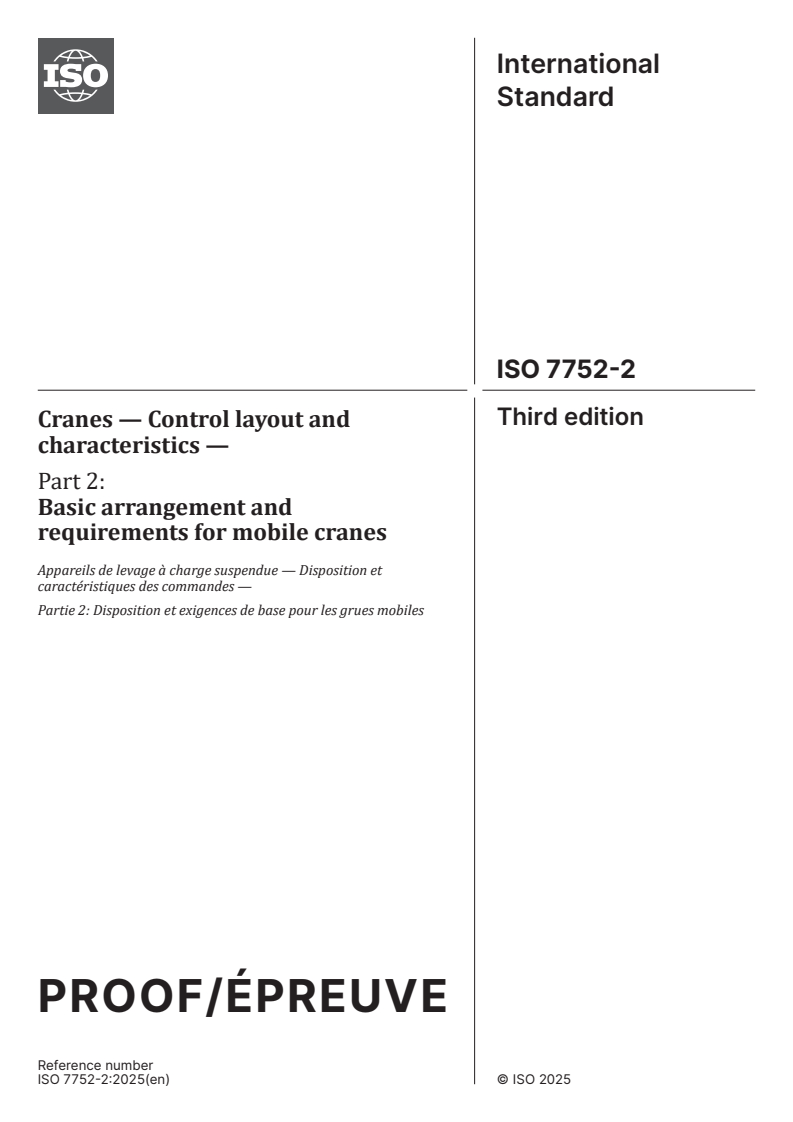
International
Standard
Third edition
Cranes — Control layout and
characteristics —
Part 2:
Basic arrangement and
requirements for mobile cranes
Appareils de levage à charge suspendue — Disposition et
caractéristiques des commandes —
Partie 2: Disposition et exigences de base pour les grues mobiles
PROOF/ÉPREUVE
Reference number
© ISO 2025
All rights reserved. Unless otherwise specified, or required in the context of its implementation, no part of this publication may
be reproduced or utilized otherwise in any form or by any means, electronic or mechanical, including photocopying, or posting on
the internet or an intranet, without prior written permission. Permission can be requested from either ISO at the address below
or ISO’s member body in the country of the requester.
ISO copyright office
CP 401 • Ch. de Blandonnet 8
CH-1214 Vernier, Geneva
Phone: +41 22 749 01 11
Email: copyright@iso.org
Website: www.iso.org
Published in Switzerland
PROOF/ÉPREUVE
ii
Contents Page
Foreword .v
Introduction .vi
1 Scope . 1
2 Normative references . 1
3 Terms and definitions . 1
4 General requirements . 2
5 Bi-directional levers, cranes with fixed-length boom and fly jib . 2
5.1 Basic control arrangements .2
5.2 Direction of movement .4
5.2.1 Slewing control — Hand lever 1 .4
5.2.2 Hoisting control — Hand lever 2 and foot pedal 6, hand lever 3 and foot pedal 7 .4
5.2.3 Boom luffing control — Hand lever 4 .4
5.2.4 Fly jib luffing control — Hand lever 5 .4
5.3 Boom luffing control — Alternative arrangement (foot pedal operation) .4
5.3.1 Slewing control — Hand lever 1 .5
5.3.2 Hoisting control — Hand lever 2, hand lever 3 .5
5.3.3 Boom luffing control — Foot pedals 4 and 5 .5
6 Bi-directional levers, cranes with telescoping boom and fly jib . 6
6.1 Basic control arrangement — 5 lever configuration .6
6.2 Direction of movement — 5 lever configuration .6
6.2.1 Slewing control — Hand lever 1 .6
6.2.2 Boom telescoping or fly jib luffing or fly jib telescoping control — Hand lever 2
(in case of changing by selection switch 8) .6
6.2.3 Hoisting control — Hand lever 3 and foot pedal 9, hand lever 4 and foot pedal 10 .7
6.2.4 Boom luffing control — Hand lever 5 .7
6.3 Basic control arrangement — 6 lever configuration .7
6.4 Direction of movement — 6 lever configuration .8
6.4.1 General .8
6.4.2 Boom telescoping control in conjunction with selection switch 8 — hand lever
2 and selection switch 8 in position “Boom telescoping” .8
6.4.3 Fly jib luffing or fly jib telescoping control in conjunction with selection switch
7 and selection switch 8 — hand lever 2 .8
6.4.4 Boom telescoping control in conjunction with selection switch 8 — hand lever
6 and selection switch 8 in position “fly jib luffing/ fly jib telescoping” .8
6.4.5 Fly jib luffing or fly jib telescoping control in conjunction with selection switch
7 and selection switch 8 — hand lever 6 .9
7 Cross-shift levers (multi-directional controls), cranes with fixed-length boom and fly jib . 9
7.1 Basic control arrangement .9
7.2 Direction of movement .10
7.2.1 Hoisting 2 and slewing control — Hand lever 1 and foot pedal 3 .10
7.2.2 Hoisting 1 and luffing control — Hand lever 2 and foot pedal 4 .10
7.2.3 Foot pedals 3 and 4 .10
7.2.4 Boom luffing/fly jib luffing selection switch 5 in conjunction with hand lever 2 .10
8 Cross-shift levers (multi-directional controls), cranes with telescoping boom and fly jib .11
8.1 Basic control arrangement .11
8.2 Direction of movement .11
8.2.1 Hoisting 2 and slewing control — Hand lever 1 and foot pedal 5 .11
8.2.2 Hoisting 1 and boom luffing control — Hand lever 2 and foot pedal 6 . 12
8.2.3 Boom telescoping control in conjunction with a separate hand lever 3 . 12
8.2.4 Boom telescoping or fly jib luffing or telescoping control with foot pedal 4
(optional) in place of hand lever 3 in conjunction with selection switch 9. 12
PROOF/ÉPREUVE
iii
8.2.5 Boom luffing/boom telescoping or fly jib luffing/ fly jib telescoping selection
switch 7 in conjunction with hand lever 2 instead of hand lever 1 or 3 and foot
pedal 4 . 13
8.2.6 Boom telescoping or fly jib luffing/telescoping control (instead of hoisting 2)
selection switch 8 in conjunction with hand lever 1 . 13
9 Remote control station . 14
10 Control for other functions . 14
Bibliography .15
PROOF/ÉPREUVE
iv
Foreword
ISO (the International Organization for Standardization) is a worldwide federation of national standards
bodies (ISO member bodies). The work of preparing International Standards is normally carried out through
ISO technical committees. Each member body interested in a subject for which a technical committee
has been established has the right to be represented on that committee. International organizations,
governmental and non-governmental, in liaison with ISO, also take part in the work. ISO collaborates closely
with the International Electrotechnical Commission (IEC) on all matters of electrotechnical standardization.
The procedures used to develop this document and those intended for its further maintenance are described
in the ISO/IEC Directives, Part 1. In particular, the different approval criteria needed for the different types
of ISO document should be noted. This document was drafted in accordance with the editorial rules of the
ISO/IEC Directives, Part 2 (see www.iso.org/directives).
ISO draws attention to the possibility that the implementation of this document may involve the use of (a)
patent(s). ISO takes no position concerning the evidence, validity or applicability of any claimed patent
rights in respect thereof. As of the date of publication of this document, ISO had not received notice of (a)
patent(s) which may be required to implement this document. However, implementers are cautioned that
this may not represent the latest information, which may be obtained from the patent database available at
www.iso.org/patents. ISO shall not be held responsible for identifying any or all such patent rights.
Any trade name used in this document is information given for the convenience of users and does not
constitute an endorsement.
For an explanation of the voluntary nature of standards, the meaning of ISO specific terms and expressions
related to conformity assessment, as well as information about ISO's adherence to the World Trade
Organization (WTO) principles in the Technical Barriers to Trade (TBT), see www.iso.org/iso/foreword.html.
This document was prepared by Technical Committee ISO/TC 96, Cranes, Subcommittee SC 6, Mobile cranes.
This third edition cancels and replaces the second edition (ISO 7752-2:2011), which has been technically
revised.
The main changes are as follows:
— introduction of the telescoping fly jib;
— introduction of the luffing fly jib with the bi-directional levers.
A list of all parts in the ISO ISO 7752 series can be found on the ISO website.
Any feedback or questions on this document should be directed to the user’s national standards body. A
complete listing of these bodies can be found at www.iso.org/members.html.
PROOF/ÉPREUVE
v
Introduction
Mobile crane operators frequently transfer from one crane to another of different model or manufacturer.
This document establishes a consistent arrangement and movement for the basic controls used during the
crane-operating cycle, to reduce operator confusion or incorrect control in an emergency. Some cranes may
not be equipped with all functions shown in the figures of this document.
PROOF/ÉPREUVE
vi
International Standard ISO 7752-2:2025(en)
Cranes — Control layout and characteristics —
Part 2:
Basic arrangement and requirements for mobile cranes
1 Scope
This document establishes the arrangement, requirements and direction of movement of the basic controls
for slewing, load lifting and lowering, and boom luffing and telescoping, on mobile cranes as defined in
ISO 4306-2. It deals with bi-directional controls and the basic arrangement and requirements for cross-shift
levers (multi-directional controls). It is intended to be used in conjunction with ISO 7752-1.
2 Normative references
The following documents are referred to in the text in such a way that some or all of their content constitutes
requirements of this document. For dated references, only the edition cited applies. For undated references,
the latest edition of the referenced document (including any amendments) applies.
ISO 4306-2, Cranes — Vocabulary — Part 2: Mobile cranes
ISO 7752-1, Cranes — Control layout and characteristics — Part 1: General principles
3 Terms and definitions
For the purposes of this document, the terms and definitions given in ISO 4306-2 and the following apply.
ISO and IEC maintain terminology databases for use in standardization at the following addresses:
— ISO Online browsing platform: available at https:// www .iso .org/ obp
— IEC Electropedia: available at https:// www .electropedia .org/
3.1
operator
person who is operating the crane for the purpose of positioning loads or operating for erection of the crane
1)
[SOURCE: ISO 4306-1:— , 11.1.3, modified — The term was originally crane operator and Note 1 to entry
has been deleted.]
3.2
control
actuating device which forms an interface between the crane operator (3.1) and crane control system
[SOURCE: ISO 7752-1:2010, 3.6]
3.3
control station
assembly of one or more control devices fixed on the same panel or located in the same enclosure
2)
[SOURCE: ISO 4306-1:— ,4.7.5]
1) Fifth edition under preparation. Stage at the time of publication: ISO 4306-1:2025.
2) Fifth edition under preparation. Stage at the time of publication: ISO 4306-1:2025.
PROOF/ÉPREUVE
4 General requirements
The basic control arrangement of a mobile crane and the direction of movement of the controls shall not
differ from those specified in Clause 5 through Clause 8, to avoid the operator's confusion and physical
interference when operating different cranes. Some cranes may not be equipped with all functions shown.
Other arrangements for control devices may be chosen due to the nature and work of the machine, provided
the same directions of movement of this document are followed.
a) The basic controls used during the crane operating cycle (see Figures 1 to 7) shall be located within
easy reach of the operator while he/she is at his station.
b) For controls with multiple funct
...
ISO/DISPRF 7752-2.2:2025(en)
ISO/TC 96/SC 6
Secretariat: ANSI
Date: 2025-07-2210-08
Cranes — Control layout and characteristics — —
Part 2:
Basic arrangement and requirements for mobile cranes
Appareils de levage à charge suspendue — Disposition et caractéristiques des commandes — —
Partie 2: Disposition et exigences de base pour les grues mobiles
Copyright notice
ThisPROOF
ISO/DISPRF 7752-2.2:2025(en)
© ISO document is a Draft International Standard and is copyright-protected by ISO. Except as permitted under 2025
All rights reserved. Unless otherwise specified, or required in the applicable lawscontext of the user's country, neither
its implementation, no part of this ISO draft nor any extract from itpublication may be reproduced, stored in a retrieval
system or transmitted or utilized otherwise in any form or by any means, electronic, or mechanical, including
photocopying, recording or otherwiseor posting on the internet or an intranet, without prior written permission being
secured.
Requests for permission to reproduce should be addressed to . Permission can be requested from either ISO at the
address below or ISO'sISO’s member body in the country of the requester.
ISO copyright office
Case postale 56 • CP 401 • Ch. de Blandonnet 8
CH-12111214 Vernier, Geneva 20
Tel.Phone: + 41 22 749 01 11
Fax + 41 22 749 09 47
E-mail: copyright@iso.org
WebWebsite: www.iso.org
Reproduction may be subject to royalty payments or a licensing agreement.
Violators may be prosecuted.
Published in Switzerland
iii
ISO/DISPRF 7752-2:2024(E2025(en)
Contents
Foreword . v
Introduction . vi
1 Scope . 1
2 Normative references . 1
3 Terms and definitions . 1
4 General requirements . 2
5 Bi-directional levers, cranes with fixed‑length boom and fly jib . 2
5.1 Basic control arrangements . 2
5.2 Direction of movement . 5
5.3 Boom luffing control — Alternative arrangement (foot pedal operation) . 5
6 Bi-directional levers, cranes with telescoping boom and fly jib . 7
6.1 Basic control arrangement — 5 lever configuration . 7
6.2 Direction of movement — 5 lever configuration . 9
6.3 Basic control arrangement — 6 lever configuration . 10
6.4 Direction of movement — 6 lever configuration . 12
7 Cross-shift levers (multi-directional controls), cranes with fixed‑length boom and fly jib14
7.1 Basic control arrangement . 14
7.2 Direction of movement . 15
8 Cross-shift levers (multi-directional controls), cranes with telescoping boom and fly jib 17
8.1 Basic control arrangement . 17
8.2 Direction of movement . 19
9 Remote control station . 22
10 Control for other functions . 22
Bibliography . 23
iv
iv
ISO/DISPRF 7752-2.2:2025(en)
Foreword
ISO (the International Organization for Standardization) is a worldwide federation of national standards
bodies (ISO member bodies). The work of preparing International Standards is normally carried out through
ISO technical committees. Each member body interested in a subject for which a technical committee has been
established has the right to be represented on that committee. International organizations, governmental and
non-governmental, in liaison with ISO, also take part in the work. ISO collaborates closely with the
International Electrotechnical Commission (IEC) on all matters of electrotechnical standardization.
The procedures used to develop this document and those intended for its further maintenance are described
in the ISO/IEC Directives, Part 1. In particular, the different approval criteria needed for the different types of
ISO document should be noted. This document was drafted in accordance with the editorial rules of the
ISO/IEC Directives, Part 2 (see www.iso.org/directives).
ISO draws attention to the possibility that the implementation of this document may involve the use of (a)
patent(s). ISO takes no position concerning the evidence, validity or applicability of any claimed patent rights
in respect thereof. As of the date of publication of this document, ISO had not received notice of (a) patent(s)
which may be required to implement this document. However, implementers are cautioned that this may not
represent the latest information, which may be obtained from the patent database available at
www.iso.org/patents. ISO shall not be held responsible for identifying any or all such patent rights.
Any trade name used in this document is information given for the convenience of users and does not
constitute an endorsement.
For an explanation of the voluntary nature of standards, the meaning of ISO specific terms and expressions
related to conformity assessment, as well as information about ISO's adherence to the World Trade
Organization (WTO) principles in the Technical Barriers to Trade (TBT), see www.iso.org/iso/foreword.html.
This document was prepared by Technical Committee ISO/TC 96, Cranes, Subcommittee SC 6, Mobile cranes.
This third edition cancels and replaces the second edition (ISO 7752--2:2011), which has been technically
revised.
The main changes are as follows:
— — introduction of the telescoping fly jib;
— — introduction of the luffing fly jib with the bi-directional levers.
AllA list of all parts parts ofin the ISO ISO 7752 series can be found on the ISO website.
Any feedback or questions on this document should be directed to the user’s national standards body. A
complete listing of these bodies can be found at www.iso.org/members.html.
v
ISO/DISPRF 7752-2:2024(E2025(en)
Introduction
Mobile crane operators frequently transfer from one crane to another of different model or manufacturer. This
document establishes a consistent arrangement and movement for the basic controls used during the crane-
operating cycle, to reduce operator confusion or incorrect control in an emergency. Some cranes may not be
equipped with all functions shown in the figures of this document.
vi
vi
ISO/DIS 7752-2.2:2025(en)
DRAFT International Standard
Cranes — Control layout and characteristics — —
Part 2:
Basic arrangement and requirements for mobile cranes
1 Scope
This document establishes the arrangement, requirements and direction of movement of the basic controls
for slewing, load lifting and lowering, and boom luffing and telescoping, on mobile cranes as defined in
ISO 4306--2. It deals with bi-directional controls and the basic arrangement and requirements for cross-shift
levers (multi-directional controls). It is intended to be used in conjunction with ISO 7752-1.
2 Normative references
The following documents are referred to in the text in such a way that some or all of their content constitutes
requirements of this document. For dated references, only the edition cited applies. For undated references,
the latest edition of the referenced document (including any amendments) applies.
ISO 4306--2, Cranes — Vocabulary — Part 2: Mobile cranes
ISO 7752--1, Cranes — Control layout and characteristics — Part 1: General principles
3 Terms and definitions
For the purposes of this document, the terms and definitions given in ISO 4306-2 and the following apply.
ISO and IEC maintain terminology databases for use in standardization at the following addresses:
— — ISO Online browsing platform: available at https://www.iso.org/obp
— — IEC Electropedia: available at https://www.electropedia.org/
3.1 3.1
operator
person who is operating the crane for the purpose of positioning loads or operating for erection of the crane
1 1)
[SOURCE: ISO 4306-1:— , , 11.1.3, modified — The term was originally crane operator and Note 1 to entry
has been deleted.]
3.2 3.2
control
actuating device which forms an interface between the crane operator (3.1(3.1)) and crane control system
[SOURCE: ISO 7752-1:2010, 3.6]
Fifth edition under preparation. Stage at the time of publication: ISO/DIS 4306-1:2025.
1)
Fifth edition under preparation. Stage at the time of publication: ISO 4306-1:2025.
ISO/DISPRF 7752-2:2024(E2025(en)
3.3 3.3
control station
assembly of one or more control devices fixed on the same panel or located in the same enclosure
2 2)
[SOURCE: ISO 4306-1:— , ,4.7.5]
4 General requirements
The basic control arrangement of a mobile crane and the direction of movement of the controls shall not differ
from those specified in 5Clause 5 through 8Clause 8,, to avoid the operator's confusion and physical
interference when operating different cranes. Some cranes may not be equipped with all functions shown.
Other arrangements for control devices may be chosen due to the nature and work of the machine, provided
the same directions of movement of this document are followed.
a) a) The basic controls used during the crane operating cycle (see Figures 1Figures 1 to 77)) shall
be located within easy reach of the operator while he/she is at his station.
b) b) For controls with multiple functions assigned by a switch, an indicator is required to display
the selected function.
c) c) Means shall be provided to prevent the same function from being available on different levers
at the same time.
d) d) Hoisting 1 and hoisting 2 (see Figures 6Figures 6 and 77)) refer to primary and secondary
movements of the winches. The primary hoisting should always be on the right hand side, regardless of
the individual winch used.
e) e) Hand levers and foot pedals shall be provided with a means for holding the control in the
neutral position without the use of positive holding devices. They shall return to the neutral position
automatically upon release by the operator.
f) f) The required control operating forces shall be consistent with ISO 7752-1.
g) g) The required control operating distances shall be consistent with ISO 7752-1.
h) h) To minimize operator fatigue, ergonomic control design and positioning shall be consistent
with ISO 7752-1.
i) i) To ensure visibility of selections when operating in the dark, the selectors switches shall either
be illuminated, or cabin lighting shall be easily reachable to check settings.
5 Bi-directional levers, cranes with fixed-‑length boom and fly jib
5.1 Basic control arrangements
The basic controls shall be arranged as shown in Figure 1Figure 1 or Figure 2Figure 2.
Fifth edition under preparation. Stage at the time of publication: ISO/DIS 4306-1:2025.
2)
Fifth edition under preparation. Stage at the time of publication: ISO 4306-1:2025.
ISO/DISPRF 7752-2.2:2025(en)
Figure 1 — Crane control diagram for cranes fitted with fixed-‑length boom and fly jib
ISO/DISPRF 7752-2:2024(E2025(en)
Figure 2 — Crane control diagram for cranes fitted with fixed-‑length boom and fly jib
ISO/DISPRF 7752-2.2:2025(en)
5.2 Direction of movement
5.2.1 Slewing control — Hand lever 1
Push the lever forward to slew towards the boom:
— — slew left (operator's position on right side);
— — slew right (operator's position on left side or centre of crane).
Centre the lever to release the slewing power.
Pull back the lever to reverse direction.
5.2.2 Hoisting control — Hand lever 2 and foot pedal 6, hand lever 3 and foot pedal 7
Pull the lever back to lift the load.
Centre the lever to release the power and to hold the load (if equipped with an automatic brake) or to control
the load by depressing the brake pedal.
Push the lever forward to lower the load.
5.2.3 Boom luffing control — Hand lever 4
Pull the lever back to raise the boom.
Centre the lever to hold the boom in position.
Push the lever forward to lower the boom.
5.2.4 Fly jib luffing control — Hand lever 5
Pull the lever back to raise the fly jib.
Centre lever to hold the fly jib in position.
Push the lever forward to lower the fly jib.
5.3 Boom luffing control — Alternative arrangement (foot pedal operation)
The basic controls shall be arranged as shown in Figure 3Figure 3.
ISO/DISPRF 7752-2:2024(E2025(en)
ISO
...
Questions, Comments and Discussion
Ask us and Technical Secretary will try to provide an answer. You can facilitate discussion about the standard in here.
Loading comments...