

ISO 10972-1:2025
(Main)Cranes — Requirements for mechanisms — Part 1: General
General Information
- Abstract
This document establishes requirements for mechanisms and related components of cranes as described in ISO 4306 series, concerning: a) general layout and design of mechanisms; b) selection and/or design requirements of components. This document does not provide requirements for proof of competence calculation regarding different limit states (yield strength, fatigue, wear).
- Status
- Published
- Publication Date
- 16-Feb-2025
- Technical Committee
- ISO/TC 96/SC 9 - Bridge and gantry cranes
- Drafting Committee
- ISO/TC 96/SC 9 - Bridge and gantry cranes
- Current Stage
- 6060 - International Standard published
- Start Date
- 17-Feb-2025
- Due Date
- 24-Oct-2025
- Completion Date
- 17-Feb-2025

Overview
ISO 10972-1:2025 - Cranes - Requirements for mechanisms - Part 1: General establishes general design and selection requirements for crane mechanisms and related components as defined in the ISO 4306 series. This second edition provides up‑to‑date guidance on layout, component selection and system arrangements for cranes (hoists, travel, slewing and related drives). It is a design‑level standard intended to help manufacturers, designers and safety professionals ensure safe, reliable crane mechanisms. Note: this part does not include proof‑of‑competence calculations for limit states (yield strength, fatigue, wear).
Key Topics
The standard addresses practical technical requirements across core crane mechanism systems:
- Design criteria and general layout - principles for arrangement and integration of mechanisms.
- Power transmission components - selection and installation of motors, couplings, clutches and gear drives.
- Braking systems - requirements for in‑service, out‑of‑service and emergency braking; specific notes for hoist, travel and slewing brakes.
- Hydraulic and pneumatic systems - reservoir, filtration and installation requirements consistent with ISO 4413/4414.
- Rope and chain drives - drums, sheaves, ropes and chains, including guidance updated in line with ISO 16625 and chain standards.
- Gears, shafts and bearings - strength, enclosure and support considerations linked to gear calculation references (ISO 6336 series, ISO 10300).
- Load lifting attachments - hooks and attachments requirements (aligned with EN/ISO lifting attachment standards).
- Out‑of‑service and high‑risk applications - special provisions, including additional requirements for transporting molten metal or similar hazardous materials (Clause 5).
Applications
Who uses ISO 10972-1:2025 and how:
- Crane designers and manufacturers - to define mechanism layouts, select gears/ropes/chains, specify brakes and powertrain items.
- Safety and compliance engineers - to align designs with international best practice for crane mechanisms.
- Inspection and maintenance teams - to understand required component characteristics and serviceability expectations.
- Specifiers and purchasers - to write procurement requirements for crane mechanisms and ensure interoperability and safety.
Practical uses include component selection, design reviews, risk mitigation for high‑risk lifts, and as a reference during product development and conformity assessment.
Related Standards
ISO 10972-1:2025 is part of the ISO 10972 series and references a number of related standards, including: ISO 4306 (vocabulary), ISO 16625 (wire ropes, drums, sheaves), ISO 6336 (gear calculations), ISO 4413/4414 (hydraulic/pneumatic systems), and ISO standards for hooks, chains and proof of competence (e.g., ISO 17440). These cross‑references help integrate mechanism requirements with load, control and structural design practice.
Relations
- Effective Date
- 29-Oct-2022
Frequently Asked Questions
ISO 10972-1:2025 is a standard published by the International Organization for Standardization (ISO). Its full title is "Cranes — Requirements for mechanisms — Part 1: General". This standard covers: This document establishes requirements for mechanisms and related components of cranes as described in ISO 4306 series, concerning: a) general layout and design of mechanisms; b) selection and/or design requirements of components. This document does not provide requirements for proof of competence calculation regarding different limit states (yield strength, fatigue, wear).
This document establishes requirements for mechanisms and related components of cranes as described in ISO 4306 series, concerning: a) general layout and design of mechanisms; b) selection and/or design requirements of components. This document does not provide requirements for proof of competence calculation regarding different limit states (yield strength, fatigue, wear).
ISO 10972-1:2025 is classified under the following ICS (International Classification for Standards) categories: 53.020.20 - Cranes. The ICS classification helps identify the subject area and facilitates finding related standards.
ISO 10972-1:2025 has the following relationships with other standards: It is inter standard links to ISO 10972-1:1998. Understanding these relationships helps ensure you are using the most current and applicable version of the standard.
ISO 10972-1:2025 is available in PDF format for immediate download after purchase. The document can be added to your cart and obtained through the secure checkout process. Digital delivery ensures instant access to the complete standard document.
Standards Content (Sample)
International
Standard
ISO 10972-1
Second edition
Cranes — Requirements for
2025-02
mechanisms —
Part 1:
General
Appareils de levage à charge suspendue — Prescriptions pour les
mécanismes —
Partie 1: Généralités
Reference number
© ISO 2025
All rights reserved. Unless otherwise specified, or required in the context of its implementation, no part of this publication may
be reproduced or utilized otherwise in any form or by any means, electronic or mechanical, including photocopying, or posting on
the internet or an intranet, without prior written permission. Permission can be requested from either ISO at the address below
or ISO’s member body in the country of the requester.
ISO copyright office
CP 401 • Ch. de Blandonnet 8
CH-1214 Vernier, Geneva
Phone: +41 22 749 01 11
Email: copyright@iso.org
Website: www.iso.org
Published in Switzerland
ii
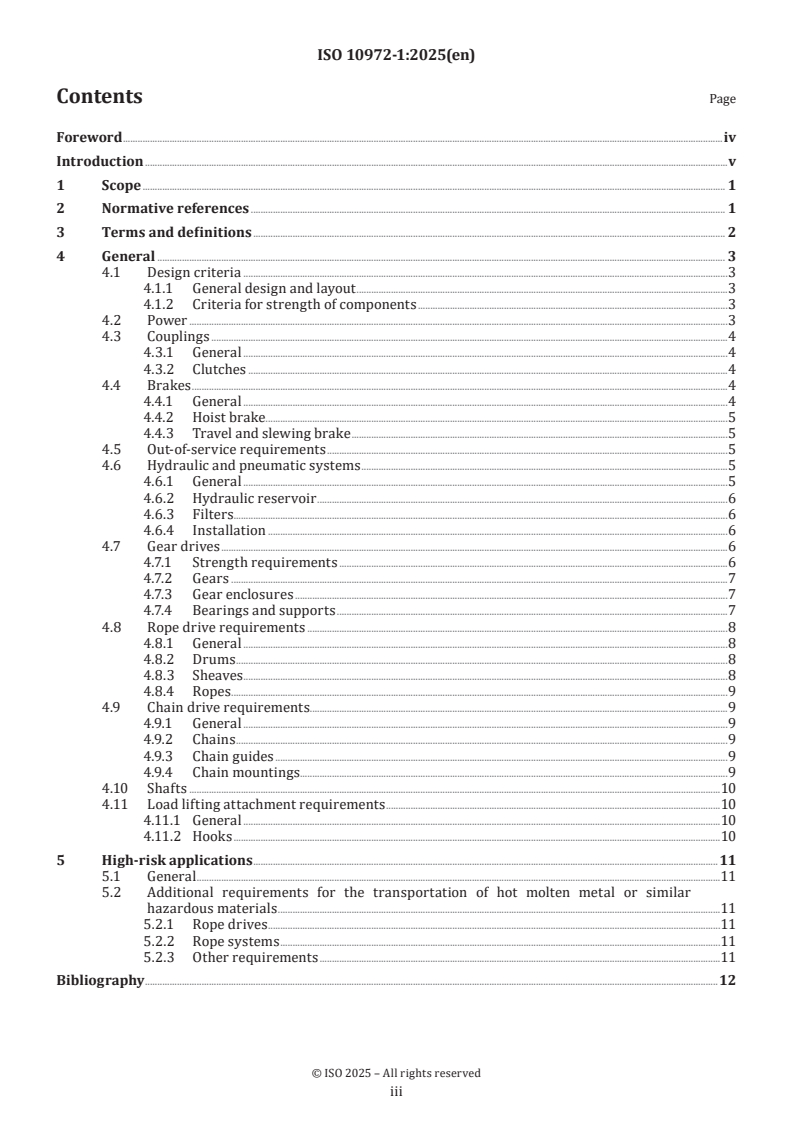
Contents Page
Foreword .iv
Introduction .v
1 Scope . 1
2 Normative references . 1
3 Terms and definitions . 2
4 General . 3
4.1 Design criteria .3
4.1.1 General design and layout .3
4.1.2 Criteria for strength of components .3
4.2 Power .3
4.3 Couplings .4
4.3.1 General .4
4.3.2 Clutches .4
4.4 Brakes .4
4.4.1 General .4
4.4.2 Hoist brake.5
4.4.3 Travel and slewing brake .5
4.5 Out-of-service requirements .5
4.6 Hydraulic and pneumatic systems .5
4.6.1 General .5
4.6.2 Hydraulic reservoir .6
4.6.3 Filters.6
4.6.4 Installation .6
4.7 Gear drives .6
4.7.1 Strength requirements .6
4.7.2 Gears .7
4.7.3 Gear enclosures .7
4.7.4 Bearings and supports .7
4.8 Rope drive requirements .8
4.8.1 General .8
4.8.2 Drums .8
4.8.3 Sheaves .8
4.8.4 Ropes . .9
4.9 Chain drive requirements.9
4.9.1 General .9
4.9.2 Chains .9
4.9.3 Chain guides .9
4.9.4 Chain mountings.9
4.10 Shafts .10
4.11 Load lifting attachment requirements .10
4.11.1 General .10
4.11.2 Hooks .10
5 High-risk applications .11
5.1 General .11
5.2 Additional requirements for the transportation of hot molten metal or similar
hazardous materials .11
5.2.1 Rope drives .11
5.2.2 Rope systems .11
5.2.3 Other requirements .11
Bibliography .12
iii
Foreword
ISO (the International Organization for Standardization) is a worldwide federation of national standards
bodies (ISO member bodies). The work of preparing International Standards is normally carried out through
ISO technical committees. Each member body interested in a subject for which a technical committee
has been established has the right to be represented on that committee. International organizations,
governmental and non-governmental, in liaison with ISO, also take part in the work. ISO collaborates closely
with the International Electrotechnical Commission (IEC) on all matters of electrotechnical standardization.
The procedures used to develop this document and those intended for its further maintenance are described
in the ISO/IEC Directives, Part 1. In particular, the different approval criteria needed for the different types
of ISO document should be noted. This document was drafted in accordance with the editorial rules of the
ISO/IEC Directives, Part 2 (see www.iso.org/directives).
ISO draws attention to the possibility that the implementation of this document may involve the use of (a)
patent(s). ISO takes no position concerning the evidence, validity or applicability of any claimed patent
rights in respect thereof. As of the date of publication of this document, ISO had not received notice of (a)
patent(s) which may be required to implement this document. However, implementers are cautioned that
this may not represent the latest information, which may be obtained from the patent database available at
www.iso.org/patents. ISO shall not be held responsible for identifying any or all such patent rights.
Any trade name used in this document is information given for the convenience of users and does not
constitute an endorsement.
For an explanation of the voluntary nature of standards, the meaning of ISO specific terms and expressions
related to conformity assessment, as well as information about ISO's adherence to the World Trade
Organization (WTO) principles in the Technical Barriers to Trade (TBT), see www.iso.org/iso/foreword.html.
This document was prepared by Technical Committee ISO/TC 96, Cranes, Subcommittee SC 9, Bridge and
gantry cranes.
This second edition cancels and replaces the first edition (ISO 10972-1:1998), which has been technically
revised.
The main changes are as follows:
— in 4.4, the requirement for cranes intended for transportation of molten metals or similar hazardous
materials has been moved to a new Clause 5;
— in 4.8, the requirement of rope drives has been revised according to ISO 16625;
— in 4.11, the requirement of load lifting attachment has been revised according to EN 13135:2013+A1:2018;
— a new Clause 5 on high-risk applications has been added.
A list of all parts in the ISO 10972 series can be found on the ISO website.
Any feedback or questions on this document should be directed to the user’s national standards body. A
complete listing of these bodies can be found at www.iso.org/members.html.
iv
Introduction
This document establishes design requirements and guidance that reflect the present state of the art in the
field of crane machine design. This document enables cranes to fulfil the essential safety requirements and
ensures adequate service of their components. It is acknowledged that new technologies, materials, etc. can
bring about new solutions that result in equal or improved safety and durability.
v
International Standard ISO 10972-1:2025(en)
Cranes — Requirements for mechanisms —
Part 1:
General
1 Scope
This document establishes requirements for mechanisms and related components of cranes as described in
ISO 4306 series, concerning:
a) general layout and design of mechanisms;
b) selection and/or design requirements of components.
This document does not provide requirements for proof of competence calculation regarding different limit
states (yield strength, fatigue, wear).
2 Normative references
The following documents are referred to in the text in such a way that some or all of their content constitutes
requirements of this document. For dated references, only the edition cited applies. For undated references,
the latest edition of the referenced document (including any amendments) applies.
ISO 3077, Short-link chain for lifting purposes — Grade T, (types T, DAT and DT), fine-tolerance hoist chain
ISO 4301-1, Cranes — Classification — Part 1: General
ISO 4306 (all parts), Cranes — Vocabulary
ISO 16625, Cranes and hoists —Selection of wire ropes, drums and sheaves
ISO 4302, Cranes — Wind load assessment
ISO 4310, Cranes — Test code and procedures
ISO 4347, Leaf chains, clevises and sheaves — Dimensions, measuring forces, tensile strengths and dynamic
strengths
ISO 4413, Hydraulic fluid power — General rules and safety requirements for systems and their components
ISO 4414, Pneumatic fluid power — General rules and safety requirements for systems and their components
ISO 4779, Chain components for lifting purposes — Forged eye hook with point and latch — Grade 4, stainless
steel, solution annealed
ISO 6336-1, Calculation of load capacity of spur and helical gears — Part 1: Basic principles, introduction and
general influence factors
ISO 6336-2, Calculation of load capacity of spur and helical gears — Part 2: Calculation of surface durability
(pitting)
ISO 6336-3, Calculation of load capacity of spur and helical gears — Part 3: Calculation of tooth bending strength
ISO 6336-5, Calculation of load capacity of spur and helical gears — Part 5: Strength and quality of materials
ISO 7752-1, Cranes — Control layout and characteristics — Part 1: General principles
ISO 7752-2, Cranes — Control layout and characteristics — Part 2: Basic arrangement and requirements for
mobile cranes
ISO 7752-4, Cranes — Controls — Layout and characteristics — Part 4: Jib cranes
ISO 7597, Forged steel lifting hooks with latch, grade 8
ISO 8686 (all parts), Cranes — Design principles for loads and load combinations
ISO 10300-1, Calculation of load capacity of bevel gears — Part 1: Introduction and general influence factors
ISO 10300-2, Calculation of load capacity of bevel gears — Part 2: Calculation of surface durability (macropitting)
ISO 10300-3, Calculation of load capacity of bevel gears — Part 3: Calculation of tooth root strength
ISO 12210, Cranes — Anchoring devices for in-service and out-of-service conditions
ISO/TS 14521, Gears — Calculation of load capacity of worm gears
ISO 17440, Cranes — General design — Limit states and proof of competence of forged steel hooks
ISO 20332, Cranes — Proof of competence of steel structures
ISO 21940-11, Mechanical vibration — Rotor balancing — Part 11: Procedures and tolerances for rotors with
rigid behaviour
ISO 23778, Proof of competence of hydraulic cylinders in crane applications
3 Terms and definitions
For the purposes of this document, the terms and definitions given in the ISO 4306 series and the following apply.
ISO and IEC maintain terminology databases for use in standardization at the following addresses:
— ISO Online browsing platform: available at https:// www .iso .org/ obp
— IEC Electropedia: available at https:// www .electropedia .org/
3.1
in-service braking
stopping or slowing the crane motion with the motor disconnected, through an immediate and easy control
by the operator from the normal working position
3.2
out-of-service braking
avoiding unwanted starts for indefinite periods of time
Note 1 to entry: Actuation may be automatic or manual.
3.3
emergency braking
backup braking
safety braking
stopping the crane motion in case of loss of power or pressure supply through engagement with a limiting
device or the activation of an emergency stop switch
3.4
control braking
maintaining a desired speed, automatically or by the operator, with the motor engaged
3.5
chain drive
device for supporting and moving loads via chain and roller arrangement
3.6
rope drive
device for supporting and moving loads via rope, sheave and drum arrangement
4 General
4.1 Design criteria
4.1.1 General design and layout
The general design and layout of a crane mechanism shall take into consideration:
— requirements of the user;
— specific function of the mechanism and its use;
— reliability of the mechanism, considering the consequences of failure;
— displacement of the structure supporting the mechanism;
— avoidance of uncontrolled motions considering the limits of transmission of force or moments, when
provided, for example, by motors, clutches, brakes;
— avoidance of undesirable or excessive vibrations;
— avoidance of excessive noise emissions;
— protective measures for rotating parts;
— ease of use and controls of the mechanism with adequate space and motion limiters and indicators;
— recommendations of the component supplier for the selection and installations of component parts;
— serviceability, i.e. easy accessibility for maintenance of components (see ISO 11660-1);
— interchangeability of components;
— availability of lifting lugs or lifting points for handling;
— access for operator or maintenance personnel (see ISO 11660-1);
— environmental conditions and hazards.
4.1.2 Criteria for strength of components
When selecting the components of the mechanisms, it shall be verified that the applicable loading conditions
in terms of maximum loading, load spectrum and number of load cycles conform to the corresponding rated
characteristics of the components. The loadings shall be in accordance with the ISO 8686 series.
References for the proof of competence calculations may be given for the mechanical components in 4.3 to 4.11.
4.2 Power
The power mechanism shall be an electrical, hydraulic or pneumatic motor or an internal combustion engine.
The crane mechanism or mechanisms shall have a force and torque equal to or greater than the force and
torque values required to properly control the crane under the specified design conditions. Gravitational,
inertial, in-service wind, friction forces and mechanism efficiency shall be taken into account.
a) The average distance per work cycle of each motion (see ISO 4301-1) shall be taken into account, when
determining an appropriate rating type of the motor duty and thermal power rating requirement.
b) The loads to be applied shall be in accordance with the ISO 8686 series, setting all the dynamic factors
to ϕ = 1 and the partial safety factors to γ = 1. The hoisted load shall be applied with the value of the
i p
rated load, unless otherwise specified. The wind state for an outdoor crane shall be that specified for
the crane and applied in calculation of wind forces in accordance with ISO 4302. Travel resistance shall
be taken into account as an external load action.
For the thermal capacity calculation, the load combinations A of the ISO 8686 series shall be applied, with
the ad
...