

ISO 9927-5:2017
(Main)Cranes — Inspections — Part 5: Bridge and gantry cranes, including portal and semi-portal cranes and their supporting structures
General Information
- Abstract
ISO 9927-5:2017 specifies the inspections to be carried out on bridge and gantry cranes. It is intended to be used in conjunction with ISO 9927‑1. It does not cover inspection prior to the first use of a bridge or gantry crane.
- Status
- Published
- Publication Date
- 20-Aug-2017
- Technical Committee
- ISO/TC 96/SC 9 - Bridge and gantry cranes
- Drafting Committee
- ISO/TC 96/SC 9 - Bridge and gantry cranes
- Current Stage
- 9093 - International Standard confirmed
- Start Date
- 09-Dec-2022
- Completion Date
- 29-Aug-2026





Overview
ISO 9927-5:2017 - "Cranes - Inspections - Part 5: Bridge and gantry cranes, including portal and semi-portal cranes and their supporting structures" specifies required inspections for bridge and gantry cranes and their supporting structures. Intended to be used together with ISO 9927‑1, it defines inspection types (daily, frequent, periodic and exceptional), recordkeeping, and the roles of the competent person responsible for inspection. It does not cover pre‑use (first‑use) inspection.
Key topics and requirements
- Inspection types
- Daily inspections: carried out at the start of each shift to test functionality and visually check for defects (no dismantling normally required).
- Frequent inspections: more detailed visual, auditory and functional tests (generally no dismantling); maximum interval typically up to 6 months unless extended by a competent review.
- Periodic inspections: visual and functional tests with and without rated load; scheduled at defined intervals and carried out by a competent person using historical records and any registered automatic data.
- Exceptional inspections: provisions exist for inspections triggered by unusual events (see Clause 8).
- Core inspection items (examples specified in the standard)
- Wire ropes, chains and belts (damage, wear, see ISO 4309 for wire rope guidance)
- Hooks, safety latches and terminations
- Sheaves, bushes, pins and retaining devices
- Crane structure (deformation, cracked welds, loose fasteners)
- Wheels, wheel flanges and guide roller systems
- Brakes, load limiters and motion‑limiting devices
- Electrical equipment and power feed systems (insulation resistance check)
- Rails, end stops, buffers, guards and signage (rated capacities, operator controls)
- Records and reporting
- Written records required for daily, frequent and periodic inspections (identity, date, inspector, results, actions taken).
- Manufacturer’s inspection instructions take precedence where applicable.
- Competence
- Inspections must be performed by a competent person with practical and theoretical knowledge of the crane and lifting operations.
Applications and users
Who uses ISO 9927-5:2017:
- Crane operators and shift personnel (daily checks)
- Maintenance technicians and inspection teams (frequent/periodic inspections)
- Safety managers, plant managers and asset custodians (inspection scheduling, recordkeeping)
- Third‑party inspectors and regulatory authorities verifying compliance Practical uses include developing inspection checklists, preventive maintenance schedules, compliance documentation, and safety programs for industrial facilities with bridge or gantry crane installations.
Related standards
- ISO 9927‑1 - Cranes - Inspections - Part 1: General (use in conjunction)
- ISO 4309 - Cranes - Wire ropes - Care, maintenance, inspection and discard
Keywords: ISO 9927-5:2017, bridge and gantry cranes inspections, crane inspection checklist, daily inspections, frequent inspections, periodic inspections, crane safety, competent person, ISO 4309, ISO 9927-1.
Frequently Asked Questions
ISO 9927-5:2017 is a standard published by the International Organization for Standardization (ISO). Its full title is "Cranes — Inspections — Part 5: Bridge and gantry cranes, including portal and semi-portal cranes and their supporting structures". This standard covers: ISO 9927-5:2017 specifies the inspections to be carried out on bridge and gantry cranes. It is intended to be used in conjunction with ISO 9927‑1. It does not cover inspection prior to the first use of a bridge or gantry crane.
ISO 9927-5:2017 specifies the inspections to be carried out on bridge and gantry cranes. It is intended to be used in conjunction with ISO 9927‑1. It does not cover inspection prior to the first use of a bridge or gantry crane.
ISO 9927-5:2017 is classified under the following ICS (International Classification for Standards) categories: 53.020.20 - Cranes. The ICS classification helps identify the subject area and facilitates finding related standards.
ISO 9927-5:2017 is available in PDF format for immediate download after purchase. The document can be added to your cart and obtained through the secure checkout process. Digital delivery ensures instant access to the complete standard document.
Standards Content (Sample)
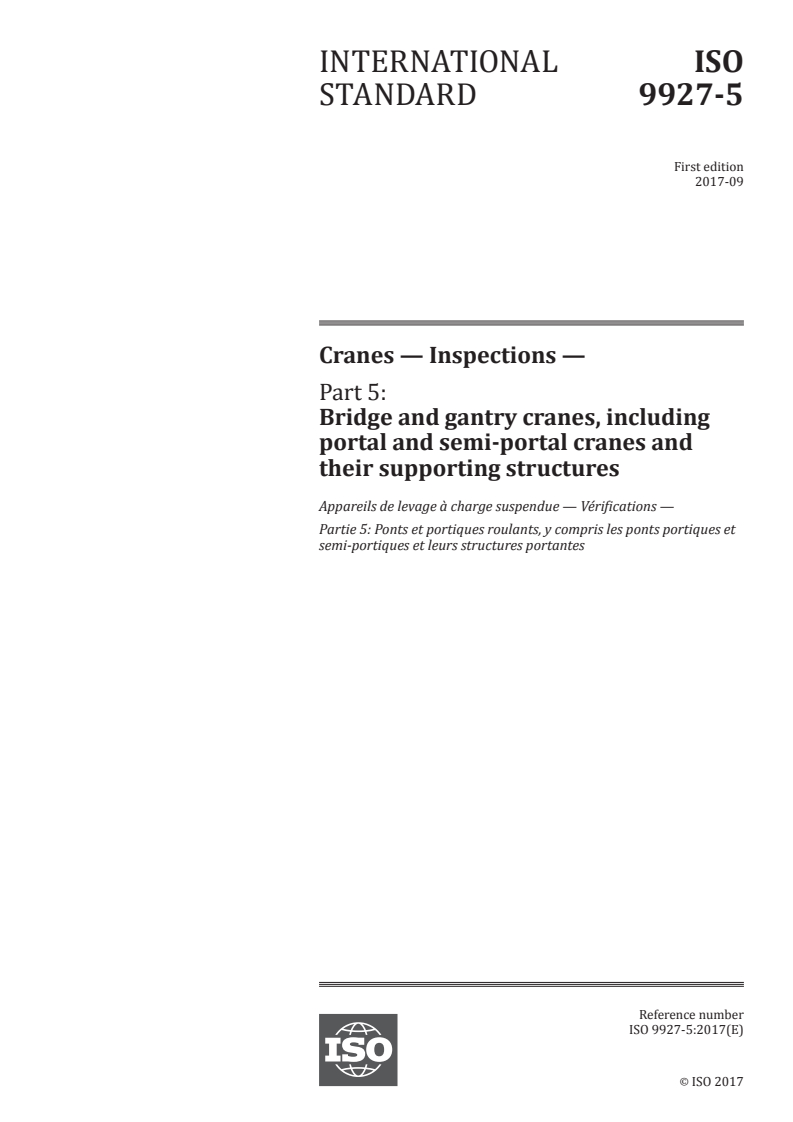
INTERNATIONAL ISO
STANDARD 9927-5
First edition
2017-09
Cranes — Inspections —
Part 5:
Bridge and gantry cranes, including
portal and semi-portal cranes and
their supporting structures
Appareils de levage à charge suspendue — Vérifications —
Partie 5: Ponts et portiques roulants, y compris les ponts portiques et
semi-portiques et leurs structures portantes
Reference number
©
ISO 2017
© ISO 2017, Published in Switzerland
All rights reserved. Unless otherwise specified, no part of this publication may be reproduced or utilized otherwise in any form
or by any means, electronic or mechanical, including photocopying, or posting on the internet or an intranet, without prior
written permission. Permission can be requested from either ISO at the address below or ISO’s member body in the country of
the requester.
ISO copyright office
Ch. de Blandonnet 8 • CP 401
CH-1214 Vernier, Geneva, Switzerland
Tel. +41 22 749 01 11
Fax +41 22 749 09 47
copyright@iso.org
www.iso.org
ii © ISO 2017 – All rights reserved
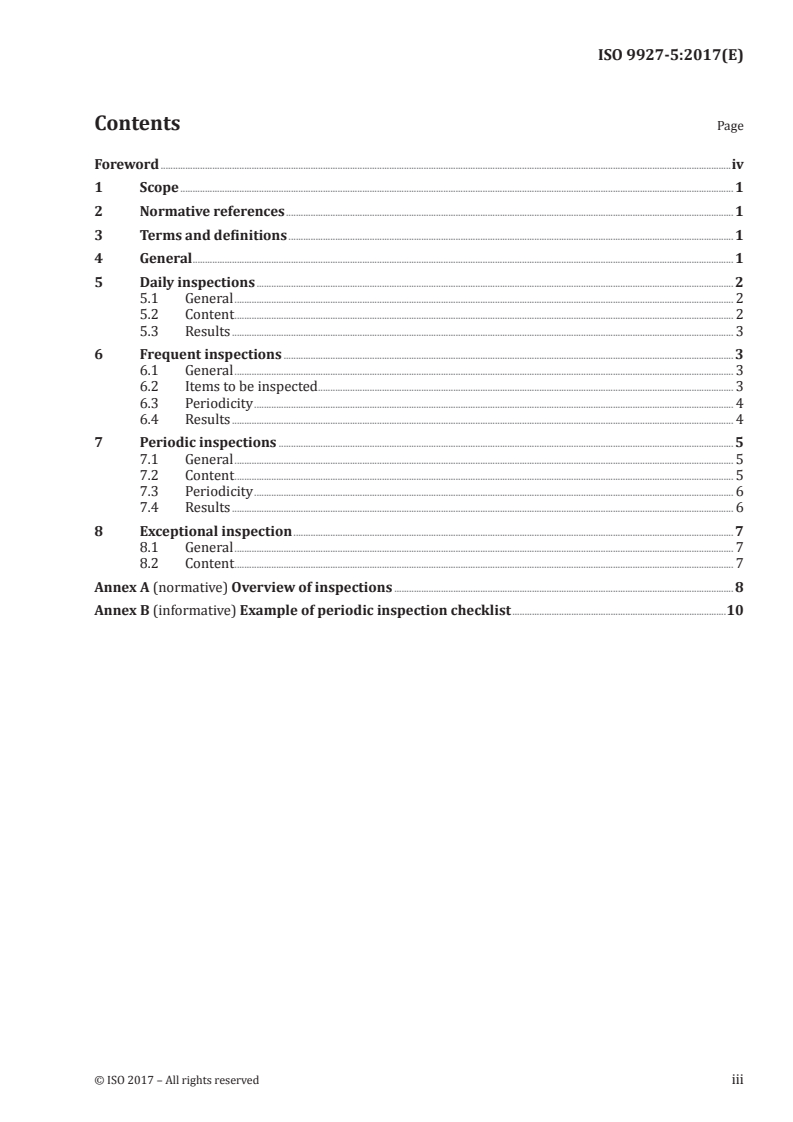
Contents Page
Foreword .iv
1 Scope . 1
2 Normative references . 1
3 Terms and definitions . 1
4 General . 1
5 Daily inspections . 2
5.1 General . 2
5.2 Content . 2
5.3 Results . 3
6 Frequent inspections . 3
6.1 General . 3
6.2 Items to be inspected . 3
6.3 Periodicity . 4
6.4 Results . 4
7 Periodic inspections . 5
7.1 General . 5
7.2 Content . 5
7.3 Periodicity . 6
7.4 Results . 6
8 Exceptional inspection . 7
8.1 General . 7
8.2 Content . 7
Annex A (normative) Overview of inspections . 8
Annex B (informative) Example of periodic inspection checklist .10
Foreword
ISO (the International Organization for Standardization) is a worldwide federation of national standards
bodies (ISO member bodies). The work of preparing International Standards is normally carried out
through ISO technical committees. Each member body interested in a subject for which a technical
committee has been established has the right to be represented on that committee. International
organizations, governmental and non-governmental, in liaison with ISO, also take part in the work.
ISO collaborates closely with the International Electrotechnical Commission (IEC) on all matters of
electrotechnical standardization.
The procedures used to develop this document and those intended for its further maintenance are
described in the ISO/IEC Directives, Part 1. In particular the different approval criteria needed for the
different types of ISO documents should be noted. This document was drafted in accordance with the
editorial rules of the ISO/IEC Directives, Part 2 (see www.iso.org/directives).
Attention is drawn to the possibility that some of the elements of this document may be the subject of
patent rights. ISO shall not be held responsible for identifying any or all such patent rights. Details of
any patent rights identified during the development of the document will be in the Introduction and/or
on the ISO list of patent declarations received (see www.iso.org/patents).
Any trade name used in this document is information given for the convenience of users and does not
constitute an endorsement.
For an explanation on the voluntary nature of standards, the meaning of ISO specific terms and
expressions related to conformity assessment, as well as information about ISO's adherence to the
World Trade Organization (WTO) principles in the Technical Barriers to Trade (TBT) see the following
URL: www.iso.org/iso/foreword.html.
The committee responsible for this document is ISO/TC 96, Cranes, Subcommittee SC 9, Bridge and
gantry cranes.
A list of all parts in the ISO 9927 series can be found on the ISO website.
iv © ISO 2017 – All rights reserved
INTERNATIONAL STANDARD ISO 9927-5:2017(E)
Cranes — Inspections —
Part 5:
Bridge and gantry cranes, including portal and semi-portal
cranes and their supporting structures
1 Scope
This document specifies the inspections to be carried out on bridge and gantry cranes. It is intended to
be used in conjunction with ISO 9927-1.
It does not cover inspection prior to the first use of a bridge or gantry crane.
2 Normative references
The following documents are referred to in the text in such a way that some or all of their content
constitutes requirements of this document. For dated references, only the edition cited applies. For
undated references, the latest edition of the referenced document (including any amendments) applies.
ISO 4309, Cranes — Wire ropes — Care and maintenance, inspection and discard
ISO 9927-1, Cranes — Inspections — Part 1: General
3 Terms and definitions
For the purposes of this document, the following terms and definitions apply.
ISO and IEC maintain terminological databases for use in standardization at the following addresses:
— ISO Online browsing platform: available at http://www.iso.org/obp
— IEC Electropedia: available at http://www.electropedia.org/
3.1
competent person
person who has the necessary practical and theoretical knowledge and the necessary experience of the
crane and equipment used in the lifting operation to carry out the function satisfactorily
Note 1 to entry: Some countries have legislation about the qualifications required for persons inspecting cranes.
4 General
In order to ensure safe operation of bridge and gantry cranes, their proper working and operational
condition shall be maintained. Therefore, all cranes need to undergo regular inspections. This ensures
that deviations from safe conditions are detected and can be rectified. The inspections shall be
arranged by the user.
The regular inspections are
— daily inspections,
— frequent inspections,
— periodic inspections, and
— exceptional inspections.
If the crane is to be used for lifting a person, an appropriate inspection and risk assessment should be
carried out before the lift is commenced.
The manufacturer’s instructions for inspection shall take precedence over the requirements of this
document.
Annex A gives an overview of the inspections (periodicity, content, persons in charge, results and
reports).
5 Daily inspections
5.1 General
Daily inspections shall be carried out at the start of each shift during which the crane is to be used. These
are to test the functionality of the crane and visually check for any defects (in general, no dismantling is
required). It is essential that these are carried out from a position of safety. Visual and auditory checks
are normally made from floor level unless a better permanent vantage point is available.
They shall be carried out by a competent person (e.g. the crane driver).
5.2 Content
The inspections shall include the following:
a) the functioning of emergency stop controls;
b) the functioning of all crane motion controls (generally without a load);
c) the functioning of electrical isolator switch;
d) the functioning of motion limiting devices, exercising caution while making checks in case of
malfunction;
e) the functioning of brakes (generally without a load);
f) the functioning of limiting and indicating devices and audible warning devices, where fitted;
g) a visual examination of the general condition of the crane structure and mechanisms, with
particular attention to the ropes, chains or belts, the sheaves, the hook and its latch;
h) any unusual noises or erratic movement during operation;
i) for cab-controlled cranes and cranes with access to the bridge, a visual examination to ensure
that the work areas on the crane are tidy and free from any item which might fall, that access and
egress from the cab is adequate and that the appropriate fire-fighting equipment is available and
serviceable;
j) a visual examination of the condition of the cab controls, the pendant and associated cables
or remote control station as appropriate; in particular, the condition of the casings and seals of
pendant and remote controls, as damage can lead to false commands;
k) where an intelligent self-diagnosis and fault-finding system is provided, checking any information
on the display;
l) a visual examination to ensure that there are no obstructions in the path of travel of the crane and
power feed system and that adequate precautions are in place to prevent collisions; in particular
for portal and semi-portal cranes, a check for any debris or other track obstructions;
2 © ISO 2017 – All rights reserved
m) a visual examination to ensure that the crane signage is present and legible including the rated
capacity, any individual hoist and hoist combination capacities and motion signage on crane/hoist
structures corresponding to the operator controls.
In respect of d) above, when it is impractical, due to speed or distance, to check long travel limiting
devices on every occasion, a check need only be made when the crane is to be used in their vicinity.
5.3 Results
Written records of all daily checks shall be kept and include at least the following information:
— identity of the crane;
— date of inspection;
— result of the check, i.e. whether or not the crane passed;
— name and signature of the person carrying out the check.
NOTE This can be kept to a minimum by, for example, completing a single line of a pro-forma record card
located near the crane.
Any defect found shall be reported to a person authorized and competent to decide on the action to take
(e.g. to leave the crane in use, repair it, make a more detailed inspection of a part of the crane or the
whole crane or, in the event that the crane is not safe to use, to isolate and lock-off the crane to prevent
further use until the problem has been resolved).
The crane record shall be updated with the result of the inspection and the action taken.
6 Frequent inspections
6.1 General
Frequent inspections shall comprise visual and auditory inspections as specified in 6.2, and the
functional tests according to 5.2.
NOTE In general, no dismantling is required, although it might be convenient to schedule the inspections
concurrently with planned preventive maintenance.
They shall be carried out by a competent person (e.g. an experienced technician; see ISO 9927-1).
6.2 Items to be inspected
In addition to any checks specified by the manufacturer, the following items, as summarized in Table 1,
shall be inspected:
a) all wire ropes for broken wires, flattening, basket distortion or other signs of damage, excessive
wear and surface corrosion in accordance with ISO 4309, other lifting media such as chain or
webbing belts for damage or excessive wear;
b) all rope, chain or belt terminations, pins and retaining devices, and inspection of all sheaves, for
d
...
INTERNATIONAL ISO
STANDARD 9927-5
First edition
2017-09
Cranes — Inspections —
Part 5:
Bridge and gantry cranes, including
portal and semi-portal cranes and
their supporting structures
Appareils de levage à charge suspendue — Vérifications —
Partie 5: Ponts et portiques roulants, y compris les ponts portiques et
semi-portiques et leurs structures portantes
Reference number
©
ISO 2017
© ISO 2017, Published in Switzerland
All rights reserved. Unless otherwise specified, no part of this publication may be reproduced or utilized otherwise in any form
or by any means, electronic or mechanical, including photocopying, or posting on the internet or an intranet, without prior
written permission. Permission can be requested from either ISO at the address below or ISO’s member body in the country of
the requester.
ISO copyright office
Ch. de Blandonnet 8 • CP 401
CH-1214 Vernier, Geneva, Switzerland
Tel. +41 22 749 01 11
Fax +41 22 749 09 47
copyright@iso.org
www.iso.org
ii © ISO 2017 – All rights reserved
Contents Page
Foreword .iv
1 Scope . 1
2 Normative references . 1
3 Terms and definitions . 1
4 General . 1
5 Daily inspections . 2
5.1 General . 2
5.2 Content . 2
5.3 Results . 3
6 Frequent inspections . 3
6.1 General . 3
6.2 Items to be inspected . 3
6.3 Periodicity . 4
6.4 Results . 4
7 Periodic inspections . 5
7.1 General . 5
7.2 Content . 5
7.3 Periodicity . 6
7.4 Results . 6
8 Exceptional inspection . 7
8.1 General . 7
8.2 Content . 7
Annex A (normative) Overview of inspections . 8
Annex B (informative) Example of periodic inspection checklist .10
Foreword
ISO (the International Organization for Standardization) is a worldwide federation of national standards
bodies (ISO member bodies). The work of preparing International Standards is normally carried out
through ISO technical committees. Each member body interested in a subject for which a technical
committee has been established has the right to be represented on that committee. International
organizations, governmental and non-governmental, in liaison with ISO, also take part in the work.
ISO collaborates closely with the International Electrotechnical Commission (IEC) on all matters of
electrotechnical standardization.
The procedures used to develop this document and those intended for its further maintenance are
described in the ISO/IEC Directives, Part 1. In particular the different approval criteria needed for the
different types of ISO documents should be noted. This document was drafted in accordance with the
editorial rules of the ISO/IEC Directives, Part 2 (see www.iso.org/directives).
Attention is drawn to the possibility that some of the elements of this document may be the subject of
patent rights. ISO shall not be held responsible for identifying any or all such patent rights. Details of
any patent rights identified during the development of the document will be in the Introduction and/or
on the ISO list of patent declarations received (see www.iso.org/patents).
Any trade name used in this document is information given for the convenience of users and does not
constitute an endorsement.
For an explanation on the voluntary nature of standards, the meaning of ISO specific terms and
expressions related to conformity assessment, as well as information about ISO's adherence to the
World Trade Organization (WTO) principles in the Technical Barriers to Trade (TBT) see the following
URL: www.iso.org/iso/foreword.html.
The committee responsible for this document is ISO/TC 96, Cranes, Subcommittee SC 9, Bridge and
gantry cranes.
A list of all parts in the ISO 9927 series can be found on the ISO website.
iv © ISO 2017 – All rights reserved
INTERNATIONAL STANDARD ISO 9927-5:2017(E)
Cranes — Inspections —
Part 5:
Bridge and gantry cranes, including portal and semi-portal
cranes and their supporting structures
1 Scope
This document specifies the inspections to be carried out on bridge and gantry cranes. It is intended to
be used in conjunction with ISO 9927-1.
It does not cover inspection prior to the first use of a bridge or gantry crane.
2 Normative references
The following documents are referred to in the text in such a way that some or all of their content
constitutes requirements of this document. For dated references, only the edition cited applies. For
undated references, the latest edition of the referenced document (including any amendments) applies.
ISO 4309, Cranes — Wire ropes — Care and maintenance, inspection and discard
ISO 9927-1, Cranes — Inspections — Part 1: General
3 Terms and definitions
For the purposes of this document, the following terms and definitions apply.
ISO and IEC maintain terminological databases for use in standardization at the following addresses:
— ISO Online browsing platform: available at http://www.iso.org/obp
— IEC Electropedia: available at http://www.electropedia.org/
3.1
competent person
person who has the necessary practical and theoretical knowledge and the necessary experience of the
crane and equipment used in the lifting operation to carry out the function satisfactorily
Note 1 to entry: Some countries have legislation about the qualifications required for persons inspecting cranes.
4 General
In order to ensure safe operation of bridge and gantry cranes, their proper working and operational
condition shall be maintained. Therefore, all cranes need to undergo regular inspections. This ensures
that deviations from safe conditions are detected and can be rectified. The inspections shall be
arranged by the user.
The regular inspections are
— daily inspections,
— frequent inspections,
— periodic inspections, and
— exceptional inspections.
If the crane is to be used for lifting a person, an appropriate inspection and risk assessment should be
carried out before the lift is commenced.
The manufacturer’s instructions for inspection shall take precedence over the requirements of this
document.
Annex A gives an overview of the inspections (periodicity, content, persons in charge, results and
reports).
5 Daily inspections
5.1 General
Daily inspections shall be carried out at the start of each shift during which the crane is to be used. These
are to test the functionality of the crane and visually check for any defects (in general, no dismantling is
required). It is essential that these are carried out from a position of safety. Visual and auditory checks
are normally made from floor level unless a better permanent vantage point is available.
They shall be carried out by a competent person (e.g. the crane driver).
5.2 Content
The inspections shall include the following:
a) the functioning of emergency stop controls;
b) the functioning of all crane motion controls (generally without a load);
c) the functioning of electrical isolator switch;
d) the functioning of motion limiting devices, exercising caution while making checks in case of
malfunction;
e) the functioning of brakes (generally without a load);
f) the functioning of limiting and indicating devices and audible warning devices, where fitted;
g) a visual examination of the general condition of the crane structure and mechanisms, with
particular attention to the ropes, chains or belts, the sheaves, the hook and its latch;
h) any unusual noises or erratic movement during operation;
i) for cab-controlled cranes and cranes with access to the bridge, a visual examination to ensure
that the work areas on the crane are tidy and free from any item which might fall, that access and
egress from the cab is adequate and that the appropriate fire-fighting equipment is available and
serviceable;
j) a visual examination of the condition of the cab controls, the pendant and associated cables
or remote control station as appropriate; in particular, the condition of the casings and seals of
pendant and remote controls, as damage can lead to false commands;
k) where an intelligent self-diagnosis and fault-finding system is provided, checking any information
on the display;
l) a visual examination to ensure that there are no obstructions in the path of travel of the crane and
power feed system and that adequate precautions are in place to prevent collisions; in particular
for portal and semi-portal cranes, a check for any debris or other track obstructions;
2 © ISO 2017 – All rights reserved
m) a visual examination to ensure that the crane signage is present and legible including the rated
capacity, any individual hoist and hoist combination capacities and motion signage on crane/hoist
structures corresponding to the operator controls.
In respect of d) above, when it is impractical, due to speed or distance, to check long travel limiting
devices on every occasion, a check need only be made when the crane is to be used in their vicinity.
5.3 Results
Written records of all daily checks shall be kept and include at least the following information:
— identity of the crane;
— date of inspection;
— result of the check, i.e. whether or not the crane passed;
— name and signature of the person carrying out the check.
NOTE This can be kept to a minimum by, for example, completing a single line of a pro-forma record card
located near the crane.
Any defect found shall be reported to a person authorized and competent to decide on the action to take
(e.g. to leave the crane in use, repair it, make a more detailed inspection of a part of the crane or the
whole crane or, in the event that the crane is not safe to use, to isolate and lock-off the crane to prevent
further use until the problem has been resolved).
The crane record shall be updated with the result of the inspection and the action taken.
6 Frequent inspections
6.1 General
Frequent inspections shall comprise visual and auditory inspections as specified in 6.2, and the
functional tests according to 5.2.
NOTE In general, no dismantling is required, although it might be convenient to schedule the inspections
concurrently with planned preventive maintenance.
They shall be carried out by a competent person (e.g. an experienced technician; see ISO 9927-1).
6.2 Items to be inspected
In addition to any checks specified by the manufacturer, the following items, as summarized in Table 1,
shall be inspected:
a) all wire ropes for broken wires, flattening, basket distortion or other signs of damage, excessive
wear and surface corrosion in accordance with ISO 4309, other lifting media such as chain or
webbing belts for damage or excessive wear;
b) all rope, chain or belt terminations, pins and retaining devices, and inspection of all sheaves, for
d
...