

ISO 12210:2021
(Main)Cranes — Anchoring devices for in-service and out-of-service conditions
General Information
- Abstract
This document provides specific requirements for anchoring devices for in-service and out-of-service conditions for cranes and crane parts as defined in ISO 4306-1.
- Status
- Published
- Publication Date
- 29-Nov-2021
- Technical Committee
- ISO/TC 96/SC 9 - Bridge and gantry cranes
- Drafting Committee
- ISO/TC 96/SC 9/WG 3 - Anchoring devices
- Current Stage
- 6060 - International Standard published
- Start Date
- 30-Nov-2021
- Due Date
- 07-Jun-2022
- Completion Date
- 30-Nov-2021
Buy Documents


ISO 12210:2021 - Cranes -- Anchoring devices for in-service and out-of-service conditions
ISO 12210:2021 - Cranes — Anchoring devices for in-service and out-of-service conditions/30/2021
Overview
ISO 12210:2021 - "Cranes - Anchoring devices for in-service and out-of-service conditions" specifies requirements for anchoring devices used to control position and prevent undesirable motion of cranes and crane parts (as defined in ISO 4306-1). The standard focuses on anchoring under normal operation, sudden wind gusts that exceed in-service design values, and out‑of‑service/storm situations. It is intended to guide selection, design and documentation of crane anchoring solutions for safety and reliability.
Key topics and technical requirements
- Scope and definitions: Anchoring devices are defined to include items such as rail clamps, rail brakes, wheel brakes, braking wedges, boom latches, anchor pins and tie‑downs.
- Design loading: Devices must withstand forces from dead and live loads, wind and other environmental factors, and comply with wind assessment and load combination principles in ISO 4302 and the ISO 8686 series.
- Power independence: The holding action of anchoring devices should not require continuous power supply, ensuring effectiveness during power loss or storms.
- Actuation: Anchoring devices shall be actuated automatically or by the crane operator when wind speed exceeds the in‑service design value (per ISO 8686‑1). Mechanisms must:
- Provide holding at any track position, or
- Offer alternative means that reliably hold crane components (trolley, boom, slewing device) in anchoring positions.
- Crane‑type and motion requirements: The standard specifies which motions typically require anchoring for specific crane types (portal/semi‑portal, derrick, pillar jib, gantry, bridge). For example, travelling and slewing are mandatory for certain out‑of‑service or sudden‑wind conditions; other motions may be optional or not required.
- Information and documentation: Manufacturers/suppliers must provide design and usage parameters, plus instructions for operation, testing, maintenance and repair so crane manufacturers and owners can select components with appropriate safety margins and service life.
Applications and users
ISO 12210:2021 is practical for:
- Crane manufacturers and designers specifying anchoring and braking systems
- Procurement teams preparing technical specifications for cranes and anchoring components
- Safety engineers and risk assessors evaluating wind and storm resilience
- Maintenance teams and inspectors establishing testing and maintenance regimes
- Asset owners planning storm preparedness and out‑of‑service procedures
Typical uses include selecting rail clamps/anchor pins, designing fail‑safe anchoring systems that operate without continuous power, and documenting testing/maintenance schedules for compliance and safe operation.
Related standards
- ISO 4306‑1 - vocabulary for cranes (defines crane types/parts)
- ISO 4302 - wind load assessment for cranes
- ISO 8686 (all parts) - design principles for loads and load combinations
ISO 12210:2021 is the authoritative reference for crane anchoring devices addressing in‑service and out‑of‑service conditions, wind‑related safety and reliable anchoring design.
Relations
- Consolidated By
ISO 17635:2025 - Non-destructive testing of welds — General rules for metallic materials - Effective Date
- 08-Oct-2022
- Effective Date
- 23-Apr-2020
- Effective Date
- 23-Apr-2020
Buy Documents
ISO 12210:2021 - Cranes -- Anchoring devices for in-service and out-of-service conditions
ISO 12210:2021 - Cranes — Anchoring devices for in-service and out-of-service conditions/30/2021
Frequently Asked Questions
ISO 12210:2021 is a standard published by the International Organization for Standardization (ISO). Its full title is "Cranes — Anchoring devices for in-service and out-of-service conditions". This standard covers: This document provides specific requirements for anchoring devices for in-service and out-of-service conditions for cranes and crane parts as defined in ISO 4306-1.
This document provides specific requirements for anchoring devices for in-service and out-of-service conditions for cranes and crane parts as defined in ISO 4306-1.
ISO 12210:2021 is classified under the following ICS (International Classification for Standards) categories: 53.020.20 - Cranes. The ICS classification helps identify the subject area and facilitates finding related standards.
ISO 12210:2021 has the following relationships with other standards: It is inter standard links to ISO 17635:2025, ISO 12210-4:1998, ISO 12210-1:1998. Understanding these relationships helps ensure you are using the most current and applicable version of the standard.
ISO 12210:2021 is available in PDF format for immediate download after purchase. The document can be added to your cart and obtained through the secure checkout process. Digital delivery ensures instant access to the complete standard document.
Standards Content (Sample)
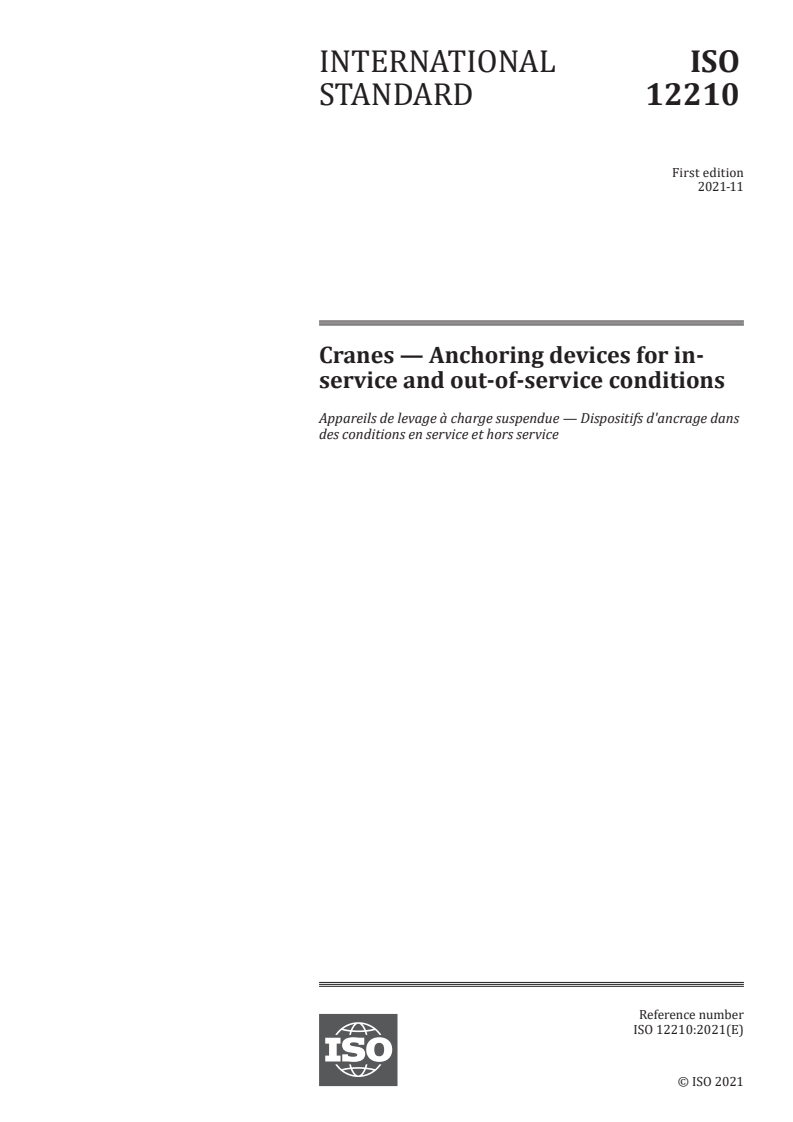
INTERNATIONAL ISO
STANDARD 12210
First edition
2021-11
Cranes — Anchoring devices for in-
service and out-of-service conditions
Appareils de levage à charge suspendue — Dispositifs d'ancrage dans
des conditions en service et hors service
Reference number
© ISO 2021
All rights reserved. Unless otherwise specified, or required in the context of its implementation, no part of this publication may
be reproduced or utilized otherwise in any form or by any means, electronic or mechanical, including photocopying, or posting on
the internet or an intranet, without prior written permission. Permission can be requested from either ISO at the address below
or ISO’s member body in the country of the requester.
ISO copyright office
CP 401 • Ch. de Blandonnet 8
CH-1214 Vernier, Geneva
Phone: +41 22 749 01 11
Email: copyright@iso.org
Website: www.iso.org
Published in Switzerland
ii
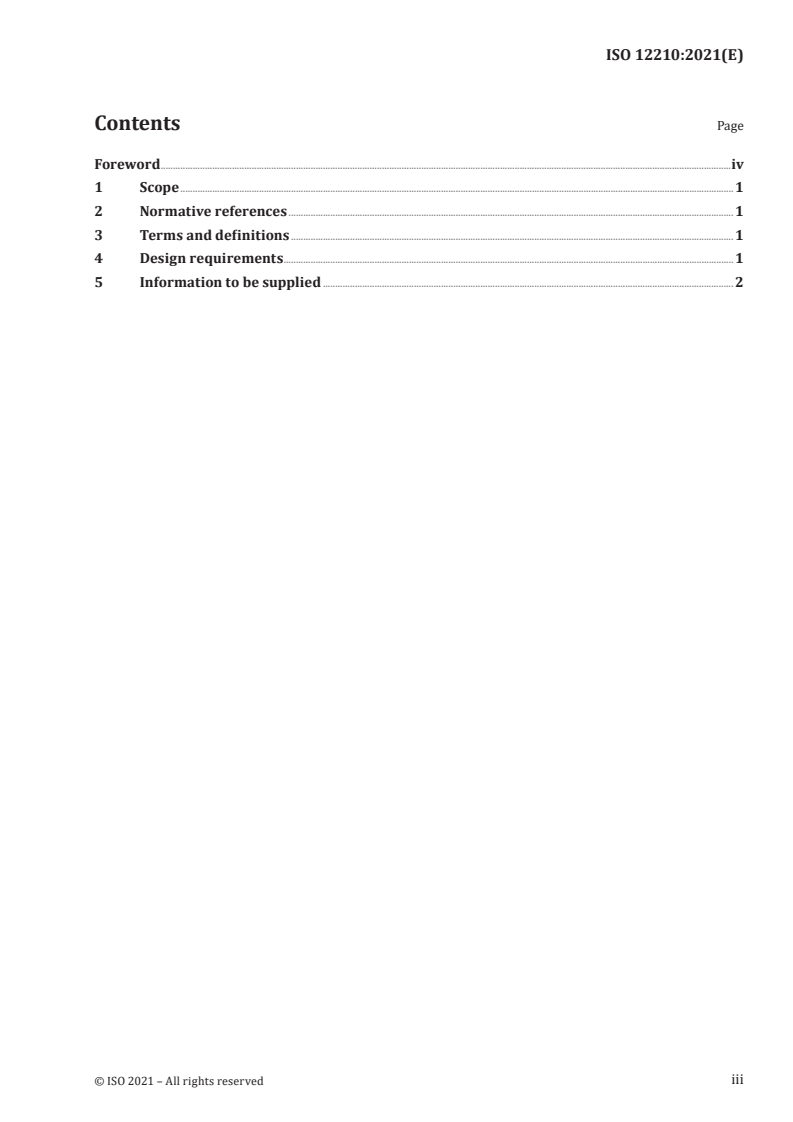
Contents Page
Foreword .iv
1 Scope . 1
2 Normative references . 1
3 Terms and definitions . 1
4 Design requirements .1
5 Information to be supplied . 2
iii
Foreword
ISO (the International Organization for Standardization) is a worldwide federation of national standards
bodies (ISO member bodies). The work of preparing International Standards is normally carried out
through ISO technical committees. Each member body interested in a subject for which a technical
committee has been established has the right to be represented on that committee. International
organizations, governmental and non-governmental, in liaison with ISO, also take part in the work.
ISO collaborates closely with the International Electrotechnical Commission (IEC) on all matters of
electrotechnical standardization.
The procedures used to develop this document and those intended for its further maintenance are
described in the ISO/IEC Directives, Part 1. In particular, the different approval criteria needed for the
different types of ISO documents should be noted. This document was drafted in accordance with the
editorial rules of the ISO/IEC Directives, Part 2 (see www.iso.org/directives).
Attention is drawn to the possibility that some of the elements of this document may be the subject of
patent rights. ISO shall not be held responsible for identifying any or all such patent rights. Details of
any patent rights identified during the development of the document will be in the Introduction and/or
on the ISO list of patent declarations received (see www.iso.org/patents).
Any trade name used in this document is information given for the convenience of users and does not
constitute an endorsement.
For an explanation of the voluntary nature of standards, the meaning of ISO specific terms and
expressions related to conformity assessment, as well as information about ISO's adherence to
the World Trade Organization (WTO) principles in the Technical Barriers to Trade (TBT), see
www.iso.org/iso/foreword.html.
This document was prepared by Technical Committee ISO/TC 96, Cranes, Subcommittee SC 9, Bridge
and gantry cranes.
This first edition of ISO 12210 cancels and replaces ISO 12210-1:1998, ISO 12210-4:1998 and
ISO 12210-5, which have been technically revised.
Any feedback or questions on this document should be directed to the user’s national standards body. A
complete listing of these bodies can be found at www.iso.org/members.html.
iv
INT
...
INTERNATIONAL ISO
STANDARD 12210
First edition
2021-11
Cranes — Anchoring devices for in-
service and out-of-service conditions
Appareils de levage à charge suspendue — Dispositifs d'ancrage dans
des conditions en service et hors service
Reference number
© ISO 2021
All rights reserved. Unless otherwise specified, or required in the context of its implementation, no part of this publication may
be reproduced or utilized otherwise in any form or by any means, electronic or mechanical, including photocopying, or posting on
the internet or an intranet, without prior written permission. Permission can be requested from either ISO at the address below
or ISO’s member body in the country of the requester.
ISO copyright office
CP 401 • Ch. de Blandonnet 8
CH-1214 Vernier, Geneva
Phone: +41 22 749 01 11
Email: copyright@iso.org
Website: www.iso.org
Published in Switzerland
ii
Contents Page
Foreword .iv
1 Scope . 1
2 Normative references . 1
3 Terms and definitions . 1
4 Design requirements .1
5 Information to be supplied . 2
iii
Foreword
ISO (the International Organization for Standardization) is a worldwide federation of national standards
bodies (ISO member bodies). The work of preparing International Standards is normally carried out
through ISO technical committees. Each member body interested in a subject for which a technical
committee has been established has the right to be represented on that committee. International
organizations, governmental and non-governmental, in liaison with ISO, also take part in the work.
ISO collaborates closely with the International Electrotechnical Commission (IEC) on all matters of
electrotechnical standardization.
The procedures used to develop this document and those intended for its further maintenance are
described in the ISO/IEC Directives, Part 1. In particular, the different approval criteria needed for the
different types of ISO documents should be noted. This document was drafted in accordance with the
editorial rules of the ISO/IEC Directives, Part 2 (see www.iso.org/directives).
Attention is drawn to the possibility that some of the elements of this document may be the subject of
patent rights. ISO shall not be held responsible for identifying any or all such patent rights. Details of
any patent rights identified during the development of the document will be in the Introduction and/or
on the ISO list of patent declarations received (see www.iso.org/patents).
Any trade name used in this document is information given for the convenience of users and does not
constitute an endorsement.
For an explanation of the voluntary nature of standards, the meaning of ISO specific terms and
expressions related to conformity assessment, as well as information about ISO's adherence to
the World Trade Organization (WTO) principles in the Technical Barriers to Trade (TBT), see
www.iso.org/iso/foreword.html.
This document was prepared by Technical Committee ISO/TC 96, Cranes, Subcommittee SC 9, Bridge
and gantry cranes.
This first edition of ISO 12210 cancels and replaces ISO 12210-1:1998, ISO 12210-4:1998 and
ISO 12210-5, which have been technically revised.
Any feedback or questions on this document should be directed to the user’s national standards body. A
complete listing of these bodies can be found at www.iso.org/members.html.
iv
INT
...