

ISO 16094-3
(Main)Water quality — Analysis of microplastic in water — Part 3: Thermo-analytical methods for waters with low content of suspended solids including drinking water
- Abstract
This document sets out key principles for the investigation of microplastics using thermo-analytical methods in water with low content of natural suspended solids. This document gives requirements for the standardisation of methods towards harmonized procedures for determination of microplastics contents.
- Status
- Not Published
- Technical Committee
- ISO/TC 147/SC 2 - Physical, chemical and biochemical methods
- Current Stage
- 6000 - International Standard under publication - 60 Publication
- Start Date
- 11-Nov-2026
Buy Documents
ISO/FDIS 16094-3 - Water quality — Analysis of microplastic in water — Part 3: Thermo-analytical methods for waters with low content of suspended solids including drinking water
REDLINE ISO/FDIS 16094-3 - Water quality — Analysis of microplastic in water — Part 3: Thermo-analytical methods for waters with low content of suspended solids including drinking water
ISO/FDIS 16094-3 - Qualité de l'eau — Analyse des microplastiques dans l'eau — Partie 3: Méthodes thermo-analytiques pour les eaux à faible teneur en matières en suspension, y compris l'eau potable
ISO 16094-3, published by ISO, specifies thermo-analytical methods for analyzing microplastics in water with low content of suspended solids, including drinking water. It covers procedures for determining polymer type and microplastic mass, so laboratories can produce comparable results using harmonized sample preparation, measurement, quality control, and reporting steps.
What does ISO 16094-3 specify?
ISO 16094-3 sets out the scope, principles, materials, precautions, sample handling, analytical procedures, and reporting format for thermo-analytical microplastics analysis in low-solid water matrices. It is written for water samples with low content of natural total suspended solids (TSS) and it focuses on what can be measured by thermal methods - especially polymer type and mass.
The document is organized into 10 clauses and 3 informative annexes. Clause 9 contains the three analytical methods, while Clause 10 defines the test report content.
| Annex | What it covers |
|---|---|
| Annex A | Example limit of detection (LOD) and limit of quantification (LOQ) values |
| Annex B | Performance data from an interlaboratory trial (ILT) |
| Annex C | Conditions used in the ILT |
What are the key requirements of ISO 16094-3?
Sample handling and contamination control
ISO 16094-3 requires careful control of contamination because plastic particles are ubiquitous in laboratories and during sampling. Clause 7 stresses blank test determination and field blank procedures, and it expects the sample preparation area to be plastic-free or to contain as little plastic as possible.
In practice, that means the laboratory must protect low-level samples from airborne and contact contamination. The document recommends clean working conditions, regular cleaning, and the use of a laminar flow hood according to ISO 14644-1. It also gives operator precautions such as hand washing, cotton or antistatic coats, and avoiding clothing or products that can shed plastics.
Sample preparation before analysis
Clause 8 covers filtration, drying, and homogenization of filtration residues. For water analysis, filtration is the normal way to separate particles from the liquid, although isolated particles can also be selected visually and analyzed individually.
Drying should continue until constant mass is reached, and temperatures above 60 °C should be avoided. That matters because heat can change common plastics and affect the analytical result. The document also calls for accurate weighing and, where needed, cryogenic milling or other homogenization steps that avoid loss of material.
TED-GC-MS method 1
Clause 9.2 describes thermal extraction and desorption gas chromatography-mass spectrometry (TED-GC-MS) for solid filtration residues from water. The method uses a larger sample mass than Py-GC-MS, and it is suitable when the filtered residue can be handled in the milligram range.
The method identifies polymers through characteristic decomposition products and marker ions, then quantifies mass using calibration material (CM). Clause 9.2.3 gives three quantification approaches - response factors, standard addition, and matrix-related response factors. In practice, this lets a laboratory choose between higher throughput and higher matrix control depending on the sample set.
Clause 9.2.4 requires blank testing of the complete system before each measurement, recovery checks with at least one CM before a series, and field blanks that follow the sampling route. It also links LOD and LOQ to signal-to-noise or standard deviation approaches. The practical value is traceability at low concentrations, where small contamination errors can dominate the result.
Clause 9.2.5 notes a limitation for PVC, which cannot be determined with TED-GC-MS using a specific decomposition product in the way described. It also states that quantification is tied to the defined basic pure polymer, not to a polymer blend as a separate analytical entity.
Py-GC-MS method 2
Clause 9.3 describes pyrolysis gas chromatography-mass spectrometry (Py-GC-MS) for filtration residues from water. Compared with TED-GC-MS, this approach uses smaller sample masses and often needs more attention to pre-concentration and matrix removal.
The clause allows direct use of filtration residues or transfer to a pyrolysis-neutral carrier. It also allows optional online derivatization with tetramethylammonium hydroxide (TMAH), which can improve the treatment of some pyrolysis products and reduce matrix effects. Internal standards (ISTD) can be added to improve quantification where matrix effects are important.
Clause 9.3.3 requires a complete calibration curve for each sample sequence. Standard addition is also possible, but it needs sufficiently homogeneous material and repeat measurements. Clause 9.3.4 requires blank tests alongside each small set of samples, field blanks that mimic the sampling procedure, and a critical assessment of all blanks. Field blank values are not subtracted from the sample result.
Isolated particles by Py-GC-MS
Clause 9.4 covers individual isolated particles, typically in the larger micrometre size class. A particle is removed from the filter with tweezers or a needle, verified visually under a stereomicroscope, and placed into the pyrolysis vessel.
This method is useful when the laboratory wants to identify a single particle rather than a bulk residue. Clause 9.4.3 is clear that the GC-MS signal is not used for quantification in this case - the mass is obtained by weighing the isolated particle. That matters when a user needs both identity and size-linked handling, but still wants a polymer identification based on thermal decomposition products.
Reporting and traceability
Clause 10 requires the report to identify the method used, the sample, the detection principle, sampled water volume, filter residue mass, filter pore size, test sample mass, quantification method, microplastic mass by polymer type, repeat measurements, blank measurements, and any deviation that could affect the result. This is the information that lets another laboratory, auditor, or customer understand how the result was produced.
What terms does ISO 16094-3 define?
- Microplastic - a solid plastic or synthetic polymer particle insoluble in water with the largest dimension between 1 μm and 5 mm.
- Pyrolysis - irreversible chemical decomposition caused by heating without oxidation.
- Thermal decomposition - a heat-driven change in chemical composition of a material.
- Matrix interference - a change in analytical response caused by variations in the sample matrix.
- Field sample - the sample prepared in the field and sent to the laboratory for test sample preparation.
- Test sample - the laboratory-prepared sample from which test portions are taken.
- Field blank - a test sample obtained to check whether contamination occurred during the measurement chain.
- Blank test - a test run without sample, performed in the same way as a real analysis.
Who uses ISO 16094-3?
ISO 16094-3 is used by laboratories that analyze water for microplastics, especially laboratories working with drinking water and waters with low suspended solids. It is relevant to environmental testing labs, water quality labs, and method developers who need harmonized thermo-analytical procedures.
It also matters to quality managers, buyers, and technical reviewers who need comparable data for health or environmental assessment work. Because the document stresses qualified trained staff, it is most useful where analysts already have GC-MS experience and controlled laboratory practices.
Which standards are used with ISO 16094-3?
- ISO 14644-1 - used for the cleanroom-style classification of air cleanliness, supporting the document’s contamination-control approach.
- ISO 16094-2 - the companion part for vibrational spectroscopy methods on the same type of water samples; useful when a laboratory wants a spectroscopic route instead of thermo-analysis.
- ISO/TS 13530 - cited for the standard deviation approach used in one LOD calculation route.
- ISO 11358-1 - cited as an example thermogravimetric reference in the TED-GC-MS principle.
What does the ISO 16094-3 document contain?
ISO 16094-3 contains a general principle for thermo-analytical microplastics measurement, followed by detailed procedures for TED-GC-MS, Py-GC-MS on filtration residues, and Py-GC-MS on isolated particles. It also includes method-specific identification tables with example decomposition products and marker ions for common polymers.
The document provides practical guidance on clean handling, filtration, drying, sample homogenization, calibration material, internal standards, and blank control. Annex A gives example LOD and LOQ values, Annex B summarizes interlaboratory performance data, and Annex C lists the trial conditions used to generate that data.
Relations
- Effective Date
- 12-Feb-2026
Buy Documents
ISO/FDIS 16094-3 - Water quality — Analysis of microplastic in water — Part 3: Thermo-analytical methods for waters with low content of suspended solids including drinking water
REDLINE ISO/FDIS 16094-3 - Water quality — Analysis of microplastic in water — Part 3: Thermo-analytical methods for waters with low content of suspended solids including drinking water
ISO/FDIS 16094-3 - Qualité de l'eau — Analyse des microplastiques dans l'eau — Partie 3: Méthodes thermo-analytiques pour les eaux à faible teneur en matières en suspension, y compris l'eau potable
Get Certified
Connect with accredited certification bodies for this standard

CIS Institut d.o.o.
Personal Protective Equipment (PPE) certification body. Notified Body NB-2890 for EU Regulation 2016/425 PPE.

Kiwa BDA Testing
Building and construction product certification.
Kmetijski inštitut Slovenije
Agricultural Institute of Slovenia. Soil testing, plant health, agricultural product analysis.
Sponsored listings
Frequently Asked Questions
ISO 16094-3 is a draft published by the International Organization for Standardization (ISO). Its full title is "Water quality — Analysis of microplastic in water — Part 3: Thermo-analytical methods for waters with low content of suspended solids including drinking water". This standard covers: This document sets out key principles for the investigation of microplastics using thermo-analytical methods in water with low content of natural suspended solids. This document gives requirements for the standardisation of methods towards harmonized procedures for determination of microplastics contents.
This document sets out key principles for the investigation of microplastics using thermo-analytical methods in water with low content of natural suspended solids. This document gives requirements for the standardisation of methods towards harmonized procedures for determination of microplastics contents.
ISO 16094-3 is classified under the following ICS (International Classification for Standards) categories: 13.060.45 - Examination of water in general. The ICS classification helps identify the subject area and facilitates finding related standards.
ISO 16094-3 has the following relationships with other standards: It is inter standard links to FprEN ISO 16094-3. Understanding these relationships helps ensure you are using the most current and applicable version of the standard.
ISO 16094-3 is available in PDF format for immediate download after purchase. The document can be added to your cart and obtained through the secure checkout process. Digital delivery ensures instant access to the complete standard document.
Standards Content (Sample)
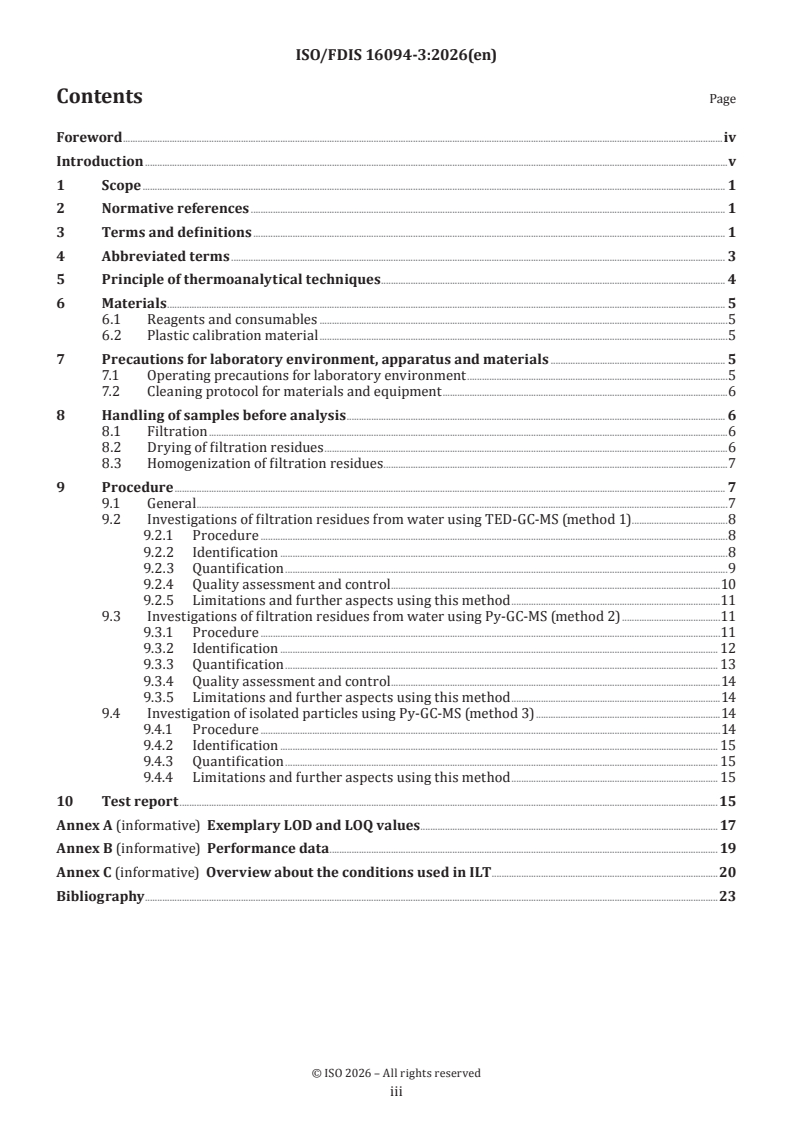
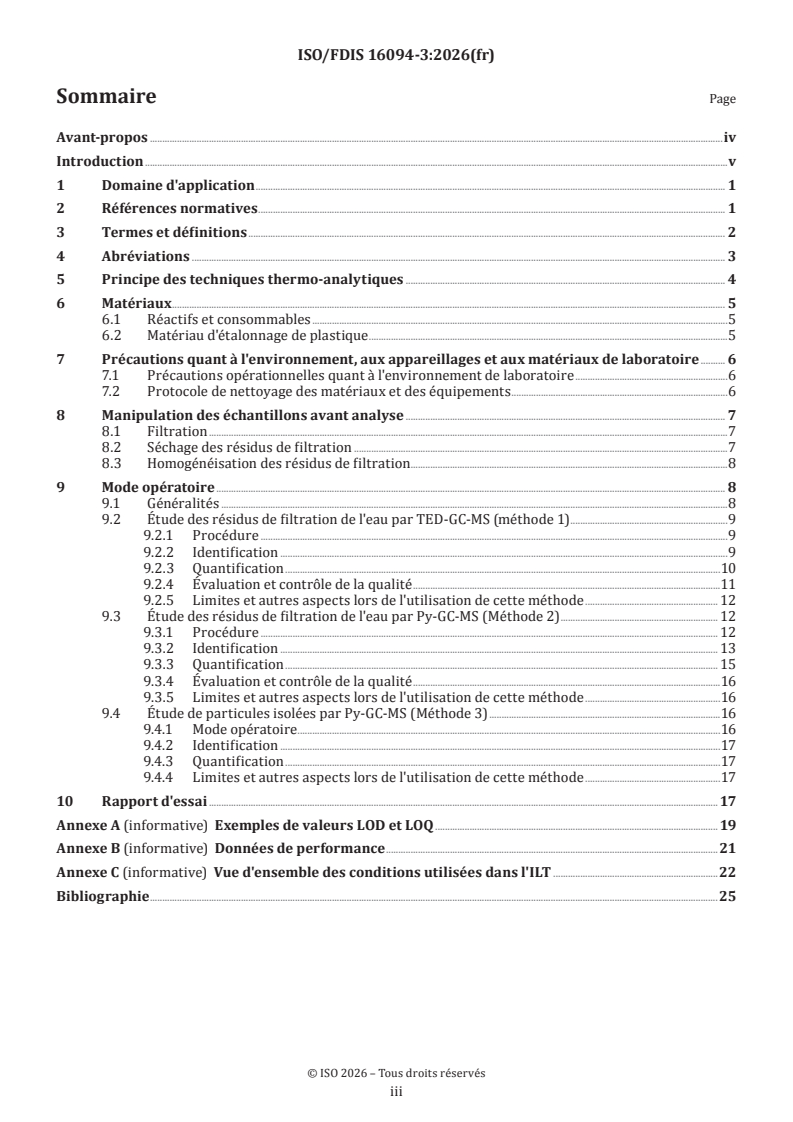
Contents
- Introduction
- 1 Scope
- 2 Normative references
- 3 Terms and definitions
- 3.1 microplastic
- 3.2 pyrolysis
- 3.3 thermal decomposition
- 3.4 matrix interference
- 3.5 field sample
- 3.6 test sample
- 3.7 field blank
- 3.8 field blank procedure
- 3.9 blank test
- 4 Abbreviated terms
- 5 Principle of thermoanalytical techniques
- 6 Materials
- 6.1 Reagents and consumables
- 6.2 Plastic calibration material
- 7 Precautions for laboratory environment, apparatus and materials
- 7.1 Operating precautions for laboratory environment
- 7.2 Cleaning protocol for materials and equipment
- 8 Handling of samples before analysis
- 8.1 Filtration
- 8.2 Drying of filtration residues
- 8.3 Homogenization of filtration residues
- 9 Procedure
- 9.1 General
- 9.2 Investigations of filtration residues from water using TED-GC-MS (method 1)
- 1 S S
- 9.3 Investigations of filtration residues from water using Py-GC-MS (method 2)
- 9.4 Investigation of isolated particles using Py-GC-MS (method 3)
- 10 Test report
- Annex A
- Annex B
- Annex C
- 10 K/min 300 °C
- 5 K/min 40 to (2 min)
- Bibliography
Introduction
Pollution linked to microplastics is recognized as a global phenomenon. The standardization of the sampling, quantification and identification protocols is required to ensure reliability and comparability of the data produced for health and environmental risk assessments.
Microplastics in water can be identified and quantified using various methodological approaches. Depending on the measurement objectives, several complementary approaches can be used to cover the full spectrum of microplastics (size and chemical nature). Table 1 summarizes the characteristics and the information obtained with the thermo-analytical technics. ISO 16094-2 is applicable for the determination of microplastic with spectroscopic techniques.
Table 1 — Characteristics of the various analytical techniques and information obtained TED-GC-MS Py-GC-MS Characteristics and Investigations of filtration Investigations of filtration Investigation of isolated particles information obtained residues from water (Method residues from water (Method (Method 3) 1) 2) Type of sample Water filtration residue / particles Isolated particles Chemical nature of the Yes polymer Information provided Thermal decomposition products by analytical technique Results expression Polymer type, mass Polymer type Minimum measurable NA Visual identification size of particles Minimum mass subject to measurement after 0,1 mg up to 2 mg (absolute) 0,01 mg up to 1 mg (absolute) NA preparation Key TED-GC-MS thermal extraction and desorption - gas chromatography - mass spectrometry Py-GC-MS pyrolysis - gas chromatography - mass spectrometry NA not applicable
FINAL DRAFT International Standard ISO/FDIS 16094-3:2026(en) Water quality — Analysis of microplastic in water — Part 3:
Thermo-analytical methods for waters with low content of suspended solids including drinking water WARNING — Persons using this document should be familiar with normal laboratory practice. This document does not purport to address all of the safety problems, if any, associated with its use. It is the responsibility of the user to establish appropriate safety and health practices. IMPORTANT — Tests conducted according to this document shall be carried out by suitably trained staff.
1 Scope
This document provides the key principles for the analysis of microplastics in drinking water and water with low content of natural suspended solids using thermo-analytical methods. This document covers the determination of polymer types and the mass of microplastics in the sample. This document is not applicable for the determination of particle size, particle shape and particle numbers. This document is applicable for the detection of microplastics in drinking water and waters with low content 1) of natural total suspended solids (TSS) .
The described detection procedures are suitable for various types of samples. NOTE In cases where this document is used for the detection of microplastics in water with TSS contents higher than those defined here, laboratories commonly include additional quality assessment and control measures (including preparation) to evaluate whether the detection methods perform adequately for increased amounts of TSS. This document describes the detection of different types of polymers, [the most used ones in the industry and the most abundant ones in the environment being polyethylene (PE), polypropylene (PP), polyethylene terephthalate (PET) and polystyrene (PS), which are analysed by thermo-analytical methods]. Depending on the used thermo-analytic methods, additional further polymer can be detected, such as polyvinylchloride (PVC), polycarbonate (PC), poly-methylmethacrylate (PMMA) polyamides (PA), polyurethanes (PU), as well 2) as signals from PS-co-polymers .
2 Normative references
The following documents are referred to in the text in such a way that some or all of their content constitutes requirements of this document. For dated references, only the edition cited applies. For undated references, the latest edition of the referenced document (including any amendments) applies.
3 Terms and definitions
For the purposes of this document, the following terms and definitions apply. 1) ISO 6107 or ISO 5667-27 (1 mg/l to 100 mg/l) or lower if they interfere with determination. 2) PS-co-polymers are polymers of styrene, acrylonitrile and butadiene (such as ABS). Signals from PS-co-polymers can be derivate from tire wear (including SBR) and can be detect with the methods as well, but elastomers are outside the scope of this document.
ISO/FDIS 16094-3:2026(en) ISO and IEC maintain terminology databases for use in standardization at the following addresses:
- ISO Online browsing platform: available at https:// www .iso .org/ obp
- IEC Electropedia: available at https:// www .electropedia .org/
3.1 microplastic
solid plastic or synthetic polymer particle insoluble in water with the largest dimension between 1 μm and 5 mm Note 1 to entry: Microplastics can have various shapes.
Note 2 to entry: This definition encompasses the ISO/TR 21960 definitions of large microplastics and microplastics. Note 3 to entry: The term “microplastics” covers the sum of several individual microplastic particles.
3.2 pyrolysis
irreversible chemical decomposition of a material due to an increase in temperature without oxidation [SOURCE: ISO 4880:1997, 53]
3.3 thermal decomposition
process whereby the action of heat or elevated temperature on an item causes changes in the chemical composition Note 1 to entry: “Thermal decomposition” is not the same as “thermal degradation”. Thermal degradation is an irreversible process leading to a significant change in the structure of a material, typically characterized by a change of properties (e.g. integrity, molecular mass or structure, mechanical strength) and/or by fragmentation, affected by environmental conditions, proceeding over a period of time and comprising one or more steps [SOURCE: ISO 472:2013, 2.262].
Note 2 to entry: Pyrolysis is a specific type of thermal degradation which takes place in the absence of oxygen. [SOURCE: ISO 472:2013, 2.1285, modified — Note 1 to entry has been modified and Note 2 to entry has been added.]
3.4 matrix interference
change in analytical response for a specified analyte, caused by variations in matrix composition [SOURCE: ISO 15796:2005, 2.10]
3.5 field sample
field condition sample, prepared by sampling personnel for sending to the laboratory, from which a test sample can be prepared [SOURCE: ISO 14388-1:2014, 3.22]
3.6 test sample
sample, prepared from the laboratory sample (sample or sub-sample(s) sent to or received by the laboratory), from which test portions are removed for testing or analysis [SOURCE: ISO 21268-1:2019, 3.8, modified — "(sample or sub-sample(s) sent to or received by the laboratory)" has been added to the definition.]
3.7 field blank
test sample obtained according to the field blank procedure
ISO/FDIS 16094-3:2026(en) [SOURCE: ISO 12141:2024, 3.13], modified — "sample" has been added to the definition.]
3.8 field blank procedure
procedure used to ensure that no significant contamination has occurred during all the steps of the measurement Note 1 to entry: This includes for instance the equipment preparation in laboratory, its transport and installation in the field as well as the subsequent analytical work in the laboratory. [SOURCE: ISO 12141:2024, 3.14]
3.9 blank test
test performed without sample in the same manner as, and parallel with, a test using an analytical sample [SOURCE: ISO 11323:2010, 8.13] Note 1 to entry: Analytical sample is used synonymous to test sample.
4 Abbreviated terms
ABS acrylonitrile butadiene styrene CM calibration material GC-MS gas chromatography – mass spectrometry GFF glass fibres filters ILT interlaboratory trial LOD limit of detection LOQ limit of quantification ISTD internal standard m/z mass-to-charge ratio PA polyamide (polymer of caprolactam = PA6, polymer of hexamethylenediamine and adipic acid = PA 66) PC polycarbonate PE polyethylene PET poly(ethylene terephthalate) PMMA poly(methyl methacrylate) PP polypropylene PS polystyrene PUR-MDI polyurethane, based on methylene diphenyl diisocyanate PVC poly(vinyl chloride) Py-GC-MS pyrolysis-gas chromatography – mass spectrometry
ISO/FDIS 16094-3:2026(en) SBR styrene butadiene rubber S/N signal-to-noise ratio TED-GC-MS thermal extraction and desorption - gas chromatography - mass spectrometry TMAH tetramethylammonium hydroxide TPU-MDI thermoplastic polyurethane, based on methylene diphenyl diisocyanate
5 Principle of thermoanalytical techniques
All thermo-analytical techniques described in this document consist of different steps: pyrolysis, transfer and separation, and detection and quantification. In a first step, the samples are heated up in an inert atmosphere until decomposition (pyrolysis). In a second step, the resulting decomposition products are either directly separated on a gas chromatographic column or first selectively adsorbed or desorbed on a solid-phase material before they are introduced into the chromatographic system. In a third step, polymerspecific decomposition products are detected and quantified (detection and quantification) by mass spectrometry. The various techniques available differ in how these three steps are utilized. This document encompasses thermo-analytical techniques using GC-MS as separation and detection/ quantification step. For microplastics detection, there are mainly two GC-MS-based techniques available:
- TED-GC-MS;
- Py-GC-MS.
In TED-GC-MS, a sample is heated up in a thermobalance (e.g. according to ISO 11358-1) under a continuous nitrogen gas flow. At the outlet of the oven, a solid phase sorbent is located, collecting a part of the decomposition products of the sample. After this process the solid phase sorbent is transferred to a thermal desorption unit, in which the collected decomposition products are remobilized, trapped, re-focused and then transferred to the GC-MS system. A relatively large sample mass of filtration residues (5 mg to 100 mg) can be analysed with TED-GC-MS.
In Py-GC-MS, a sample is thermally decomposed at defined temperatures and under inert conditions. The volatile decomposition products are transferred via a high temperature split injector into a GC-MS system with optional cryo-trapping.
Using Py-GC-MS, only lower sample masses of filtration residues (<1 mg) can be analysed. Therefore, when Py-GC-MS is applied, the investigated volume should be adjusted accordingly. Depending on the load of organic accompanying matrix, an additional sample preparation step can be analytically useful. However, in case of water samples with very low content of natural organic solids, no additional sample preparation is needed.
The total mass of microplastics captured on filters shall be related to the total sample mass (i.e. µg/g), when reporting the microplastics content as a mass fraction. In case of water filtrate samples, the analysed (i.e. filtered) volume can be used to express the microplastics concentration in terms of mass per volume (i.e. µg/l).
More detailed descriptions of the techniques and measurement parameters are provided in Clause 9. A validation ILT for the determination of microplastics particles and mass fraction in water was carried out and the related performance data is provided in Annex B. The overview about the conditions used in the ILT is given in Annex C.
ISO/FDIS 16094-3:2026(en)
6 Materials
6.1 Reagents and consumables
Filters with appropriate pore size according to the definition of microplastics (see 3.1), used for analysis should be made of inorganic materials (e.g. glass fibre, alumina filters). When prefiltration is included, the use of filters made of organic materials (e.g. cellulose) or stainless steel are possible. In case a cleaning or purging detergent solution is needed, the following cleaning and purge solutions are available:
- ultrapure water: prefiltered using an inorganic < 1 μm pore size filter made of inorganic materials;
- ethanol with water in the above-described quality;
- pharmaceutical quality water or water for injections (water for the preparation of medicines for parenteral administration when water is used as a vehicle and for dissolving or diluting substances or preparations for parenteral administration).
6.2 Plastic calibration material
For all thermo-analytical methods, polymers (pure reference materials, solved polymers or polymer powders with inorganic diluents), ideally without significant amounts of additives or fillers are suitable as reference material (here named as calibration material, CM). Since thermo-analytical methods do not measure particle size, generally CM can be used in any form. However, homogeneous polymer powders (<100 µm) that are easy to dose are particularly suitable and prevent size related effects on heat transfer. In some cases, aged polymers particles can be easier to handle (static charge, cryogenic grinding). Such CMs are offered as commercial products in the chemical trade or by manufacturers. However, dealing with environmental samples with a wide variety of possible and unknown polymer sources, the same decomposition products from one analytical sample can originate from different types of polymers (including copolymers) or combinations of polymers (including polymer blends, reinforced materials). This type cannot be identified by further signals or additional sample preparation steps. In these cases, the results can be used for identification and clustering purposes. Quantification can only be related to the respective, defined basic pure polymer.
7 Precautions for laboratory environment, apparatus and materials
7.1 Operating precautions for laboratory environment
Since plastic particles are ubiquitous, contamination during sampling and analysis is likely to occur. Therefore, the determination of field blank procedures and blank tests is of high importance. This is especially important in the case of very low microplastics content of the sample. It is recommended, that the space dedicated to the preparation of samples should be plastic-free or the amount of plastic should be kept to a minimum (e.g. wall fabrics, flooring). Cleaning of the working environment is essential (e.g. hood, bench) and shall be carried out regularly. Suitable purging detergent (see 6.1) or wipes (that do not contaminate the working area with additional particles) shall be used. The work should be carried out in a laminar flow hood (e.g. according to ISO 14644-1). It is recommended to switch on the fume hood and to let it work for at least 30 min before starting the analysis. Then, the fume hood shall be shut down before starting the analysis to prevent any particle loss. In particular, operators shall - wash hands (including gloves) before initiating the measurement procedure and at each critical step thereof, particularly after the external washing of the containers and when entering the premises dedicated to handling samples; - wear a cotton laboratory coat or, if applicable, a clean antistatic laboratory coat, 100 % cotton textiles shall be used;
ISO/FDIS 16094-3:2026(en) - when possible, avoid wearing protective polypropylene face masks; - avoid wearing clothing made of synthetic fibres (e.g. fleece jackets, scarfs), personal hygiene or cosmetic products (e.g. abrasion of nail polish, presence of microplastics in foundations) liable to release microplastics in the work environment; - ensure that any equipment or part of the body placed inside the laminar flow hood has undergone a decontamination step.
The laboratory shall ensure that the sample is protected from any contamination due to the working environment, particularly during the transport of the sample between the sample preparation and the place of measurement unit.
7.2 Cleaning protocol for materials and equipment
The use of plastic laboratory equipment in contact with the sample should be kept to a minimum. This includes containers and covers for sample storage, tubes for filtrations, filter holders or sealings. Where possible materials made of glass or metal shall be used. Containers where sampling and processing material will be stored shall be decontaminated for microplastics to reduce cross-contamination. Special care shall be taken not to contaminate glassware and metal items not to be in contact with samples, including sample containers, vessels for pyrolysis experiments (i.e. crucibles, vials, quartz tubes or cups). The following procedures or steps shall be applied to those materials:
- The glass elements should be immersed in a suitable detergent solution with sufficient contact time (e.g. 12 h). Then, rinse the elements with an appropriate product (e.g. 70 % ethanol) and finish the rinsing with water filtrated using a filter made of inorganic materials with a pore size smaller than 1 µm.
- Utensils containers should be calcined in an oven at a minimum of 480 °C for 2 h or 450 °C for 6 h. This includes GFF. Containers where sampling and processing material will be stored shall be decontaminated for microplastics to reduce cross-contamination.
- Quartz wool, used in particular to maintain samples in pyrolysis supports, shall be conditioned beforehand at a minimum temperature of 500 °C for at least 2 h. Unless the wool is guaranteed to be plastic free, this shall serve to minimize microplastic contamination in the particularly critical pyrolysis unit.
- A possibility is also the treatment with open flame (Bunsen burner or similar) for 10 s as a cleaning protocol, especially when using tweezers in direct contact with microplastics.
- After cleaning, glassware and metal parts shall be stored in glass or metal containers or under a laminar flow hood. Contamination of particles can be minimized by storing glassware covered with aluminium foil or in glass Petri dishes.
8 Handling of samples before analysis
8.1 Filtration
Clause 8 describes sample preparation steps of thermo-analytical methods which are mandatory for the detection of microplastics in drinking water and water with low suspended solids to avoid contamination. The analysis of water samples usually includes a filtration step to separate solid matter (particles) from the water. Alternatively, individual particles can be selected visually or under an optical microscope, separated using tweezers and analysed individually.
8.2 Drying of filtration residues
Thermo-analytical methods analyse solid samples. In the case of microplastics analysis of water, a water filtration residue using a meaningful sampling tool shall be analysed. Therefore, it is advisable to first dry
ISO/FDIS 16094-3:2026(en) the sample to determine a dry weight. Drying is also advantageous to avoid biological growth during longer storage. The drying process shall continue until the weight of the sample is constant. The duration until the weight is constant (measured under room conditions at 20 °C, 1 013 hPa (1,013 bar), e.g. ISO 1) depends on the source of the sample, the chemical composition and the temperature which is applied. Drying shall be carried out at room temperature up to a maximum of 40 °C, a temperature over 60 °C should be avoided, since above this temperature conventional plastic types (PE, PP, PS, PET, PA and PVC) exhibit specific phase transitions (glass transition temperature and melting temperature) that are associated with altered decomposition mechanisms. With respect to larger amounts of sample material, the use of freeze drying helps to avoid agglomeration.
...
Contents
- Introduction
- 1 Scope
- 2 Normative references
- 3 Terms and definitions
- 3.3 thermal decomposition
- 4 Abbreviated terms
- 5 Principle of thermoanalytical techniques
- 6 Materials
- 6.1 Reagents/Consumables and consumables
- 6.2 Plastic calibration material
- 7 Precautions for laboratory environment, apparatus and materials
- 7.1 Operating precautions for laboratory environment
- 7.2 Cleaning protocol for materials and equipment
- 8 Handling of samples before analysis
- 8.1 Filtration
- 8.2 Drying of filtration residues
- 8.3 Homogenization of filtration residues
- 9 Procedure
- 9.1 General
- 9.2 Investigations of filtration residues from water using TED-GC-MS (method 1)
- 9.3 Investigations of filtration residues from water using Py-GC-MS (method 2)
- 9.4 Investigation of isolated particles using Py-GC-MS (method 3)
- 10 Test report
- Annex A
- Annex B
- Annex C
- 10 K/min
- 5 K/min 40 to 300 °C
- Bibliography
Introduction
Pollution linked to microplastics is recognized as a global phenomenon. The standardization of the sampling, quantification and identification protocols is required to ensure reliability and comparability of the data produced for health and environmental risk assessments.
Microplastics in water can be identified and quantified using various methodological approaches. Depending on the measurement objectives, several complementary approaches can be used to cover the full spectrum of microplastics (size and chemical nature). Table 1 Table 1 summarizes the characteristics and the information obtained with the thermo-analytical technics. ISO 16094-2 is applicable for the determination of microplastic with spectroscopic techniques.
Table 1 — Characteristics of the various analytical techniques and information obtained Thermal extraction and desorption Pyrolysis associated with gas associated with gas chromatography - mass Characteristics chromatography - mass spectrometryPy-GC-MS and information spectrometryTED-GC-MS obtained Investigations of filtration Investigations of filtration Investigation of isolated particles residues from water using TED- residues from water using Py- using Py-GC-MS (Method 3) GC-MS (Method 1) GC-MS (Method 2) Type of sample Water filtration residue / particles Isolated particles Chemical nature of the Yes polymer Information provided by Thermal decomposition products analytical technique Results expression Polymer type, mass Polymer type Minimum measurable Undefined / not applicableNA Visual identification size of particles Minimum mass subject to measurement after 0,1 mg up to 2 mg (absolute) 0,01 mg up to 1 mg (absolute) N.A.NA preparation Key TED-GC-MS thermal extraction and desorption - gas chromatography - mass spectrometry Py-GC-MS pyrolysis - gas chromatography - mass spectrometry NA not applicable
ISO/FDIS 16094-3:2026(en) Water quality — Analysis of microplasticsmicroplastic in water —
Part 3:
Thermo-analytical methods for waters with low content of suspended solids including drinking water WARNING — Persons using this document should be familiar with normal laboratory practice. This document does not purport to address all of the safety problems, if any, associated with its use. It is the responsibility of the user to establish appropriate safety and health practices. IMPORTANT — It is absolutely essential that testsTests conducted in accordance withaccording to this document shall be carried out by suitably qualifiedtrained staff.
1 Scope
This document provides the key principles for the analysis of microplastics in drinking water and water with low content of natural suspended solids using thermo-analytical methods. This document is applicable forcovers the determination of polymer types of polymers and the mass of microplastics in the sample.
This document is not applicable for the determination of particle size, particle shape and particle numbers. This document is applicable for the detection of microplastics in drinking water and waters with low content 1) of natural total suspended solids (TSS). .
NOTE However, theThe described detection procedures can also be applied to other sorts of are suitable for various types of samples. Whenever a laboratory applies NOTE In cases where this document is used for the detection of microplastics in water with higherTSS contents of TSShigher than those defined here, laboratories commonly include additional quality assessment and control measures (including preparation) is recommended to be applied to verify thatevaluate whether the detection methods are also applicableperform adequately for higherincreased amounts of TSS. This document describes the detection of different typetypes of polymers, which are [the main ones (most used ones in the industry and the most abundant ones in the environment) being: polyethylene (PE), polypropylene (PP), polyethylene terephthalate (PET),) and polystyrene (PS). These types of polymers can be analyzed), which are analysed by all thermo-analytical methods.]. Depending on the used thermo-analytic methods, additional further polymer can be detected, such as polyvinylchloride (PVC), polycarbonate (PC), poly-methylmethacrylate (PMMA) polyamides (PA), polyurethanes (PU) and), as well as signals from PS-co- 2) polymers. .
1) ISO 6107 or ISO 5667-27 (1 mg/l to 100 mg/l) or lower if they interfere with determination.
2) PS-co-polymers are polymers of styrene, acrylonitrile and butadiene (such as ABS). Signals from PS-co-polymers can be derivate from tire wear (including SBR) and can be detect with the methods as well, but elastomers are outside the scope of this document.
ISO #####-#:####(X/FDIS 16094-3:2026(en)
2 Normative references
The following documents are referred to in the text in such a way that some or all of their content constitutes requirements of this document. For dated references, only the edition cited applies. For undated references, the latest edition of the referenced document (including any amendments) applies. ISO 14644-1, Cleanrooms and associated controlled environments — Part 1: Classification of air cleanliness by particle concentration
3 Terms and definitions
For the purposes of this document, the following terms and definitions apply. ISO and IEC maintain terminology databases for use in standardization at the following addresses:
- — ISO Online browsing platform: available at https://www.iso.org/obp
- — IEC Electropedia: available at https://www.electropedia.org/ 3.1 3.1 microplastic solid plastic or synthetic polymer particle insoluble in water with the largest dimension between 1 μm and 5 mm Note 1 to entry: Microplastics can showhave various shapes.
Note 2 to entry: This definition encompasses the ISO/TR 21960 [11] definitions of large microplastics and microplastics. Note 3 to entry: The term “microplastics” covers the sum of several individual microplastic particles. 3.2 3.2 pyrolysis irreversible chemical decomposition of a material due to an increase in temperature without oxidation [SOURCE: ISO 4880:1997, 53]
3.3 thermal decomposition
process whereby the action of heat or elevated temperature on an item causes changes in the chemical composition 3.3 Note 1 to entry: “Thermal decomposition” is not the same as “thermal degradation”. Thermal degradation is an irreversible process leading to a significant change in the structure of a material, typically characterized by a change of properties (e.g. integrity, molecular mass or structure, mechanical strength) and/or by fragmentation, affected by environmental conditions, proceeding over a period of time and comprising one or more steps [SOURCE: ISO 472:2013, 2.262].
[SOURCE: ISO 472:2013, 2.262] 3.31.1 3.4 thermal decomposition process whereby the action of heat or elevated temperature on an item causes changes in the chemical composition Note 1 2 to entry: “Thermal decomposition” is not the same as “thermal degradation”.
ISO/FDIS 16094-3:2026(en) Note 2 to entry: Pyrolysis is a specific type of thermal degradation which takes place in the absence of oxygen. [SOURCE: ISO 472:2013, 2.1285], modified — Note 1 to entry has been modified and Note 2 to entry has been added.] 3.4 3.5 matrix interference change in analytical response for a specified analyte, caused by variations in matrix composition [SOURCE: ISO 15796:2005, 2.10] 3.5 3.6 field sample field condition sample, prepared by sampling personnel for sending to the laboratory, from which a test sample can be prepared [SOURCE: ISO 14388-1:2014(en),, 3.22] 3.6 3.7 test sample sample, prepared from the laboratory sample (sample or sub-sample(s) sent to or received by the laboratory), from which test portions are removed for testing or analysis [SOURCE: ISO 21268-1:2019(en), 3.8], 3.8, modified — "(sample or sub-sample(s) sent to or received by the laboratory)" has been added to the definition.] 3.7 3.8 field blank test sample obtained according to the field blank procedure [SOURCE: ISO 12141:2024(en), 3.8]13], modified — "sample" has been added to the definition.] 3.8 3.9 field blank procedure procedure used to ensure that no significant contamination has occurred during all the steps of the measurement Note 1 to entry: This includes for instance the equipment preparation in laboratory, its transport and installation in the field as well as the subsequent analytical work in the laboratory. [SOURCE: ISO 12141:2024(en), 3.14] 3.9 3.10 blank test test performed without sample in the same manner as, and parallel with, a test using an analytical sample [SOURCE: ISO 11323:2010(en),, 8.13] Note 1 to entry: Analytical sample is used synonymous to test sample.
4 Abbreviated terms
ABS acrylonitrile butadiene styrene CM calibration material
ISO #####-#:####(X/FDIS 16094-3:2026(en) GC-MS gas chromatography – mass spectrometry GFF glass fibres filters ILT interlaboratory trial LOD limit of detection LOQ limit of quantification ISTD internal standard m/z mass-to-charge ratio PA polyamide (polymer of caprolactam = = PA6, polymer of hexamethylenediamine and adipic acid = = PA 66) PC polycarbonate PE polyethylene PET poly(ethylene terephthalate) PMMA poly(methyl methacrylate) PP polypropylene PS polystyrene PUR-MDI polyurethane, based on methylene diphenyl diisocyanate PVC poly(vinyl chloride) Py-GC-MS pyrolysis-gas chromatography – mass spectrometry SBR styrene butadiene rubber S/N signal-to-noise ratio TED-GC-MS thermal extraction and desorption- - gas chromatography –- mass spectrometry TMAH tetramethylammonium hydroxide TPU-MDI thermoplastic polyurethane, based on methylene diphenyl diisocyanate
5 Principle of thermoanalytical techniques
All thermo-analytical techniques described in this document consist of different steps: pyrolysis, transfer/ and separation, and detection/ and quantification. In a first step, the samples are heated up in an inert atmosphere until decomposition (pyrolysis). In a second step, the resulting decomposition products are either directly separated on a gas chromatographic column or first selectively adsorbed/ or desorbed on a solid-phase material before they are introduced into the chromatographic system. In a third step, polymer-specific decomposition products are detected and quantified (detection/ and quantification) by mass spectrometry. The various techniques available differ in how these three steps are utilized. This document encompasses thermo-analytical techniques using gas chromatography/mass spectrometry (GC-MS)GC-MS as separation and detection/quantification step. For microplastics detection, there are mainly two GC-MS-based techniques available:
- — thermal extraction and desorption gas chromatography/mass spectrometry (TED-GC-MS).
- — pyrolysis gas chromatography/mass spectrometry (Py-GC-MS).
- TED-GC-MS;
ISO/FDIS 16094-3:2026(en) - Py-GC-MS.
In TED-GC-MS, a sample is heated up in a thermobalance (e.g. according to ISO 11358-1) under a continuous nitrogen gas flow. At the outlet of the oven, a solid phase sorbent is located, collecting a part of the decomposition products of the sample. After this process the solid phase sorbent is transferred to a thermal desorption unit, in which the collected decomposition products are remobilized, trapped, re-focused and then transferred to the GC-MS system. A relatively large sample mass of filtration residues (5 mg to 100 mg) can be analyzedanalysed with TED-GC-MS.
In Py-GC-MS, a sample is thermally decomposed at defined temperatures and under inert conditions. The volatile decomposition products are transferred via a high temperature split injector into a GC-MS system with optional cryo-trapping.
Using Py-GC-MS, only lower sample masses of filtration residues (<1 mg) can be analyzedanalysed. Therefore, when Py-GC-MS is applied, the investigated volume should be adjusted accordingly. Depending on the load of organic accompanying matrix, an additional sample preparation step can be analytically useful. However, in case of water samples with very low content of natural organic solids, no additional sample preparation is needed.
The total mass of microplastics captured on filters shall be related to the total sample mass (i.e. µg/g), when reporting the microplastics content as a mass fraction. In case of water filtrate samples, the analyzedanalysed (i.e. filtered) volume can be used to express the microplastics concentration in terms of mass per volume (i.e. µg/l).
More detailed descriptions of the techniques and measurement parameters are provided in 9Clause 9.. A validation ILT for the determination of microplastics particles and mass fraction in water was carried out and the related performance data is provided in Annex B. The overview about the conditions used in the ILT is given in Annex C.
6 Materials
6.1 Reagents/Consumables and consumables
Filters with appropriate pore size according to the definition of microplastics (see 3.13.1),), used for analysis should be made of inorganic materials (e.g. glass fibre, alumina filters, etc.).). When prefiltration is included, the use of filters made of organic materials (e.g. cellulose) or stainless steel are possible. In case a cleaning or purging detergent solution is needed, the following cleaning and purge solutions are available:
- — Ultrapureultrapure water: prefiltered using an inorganic < < 1 μm pore size filter made of inorganic materials;
- — Ethanolethanol with water in the above-described quality;
- — Pharmaceuticalpharmaceutical quality water /or water for injections (water for the preparation of medicines for parenteral administration when water is used as a vehicle and for dissolving or diluting substances or preparations for parenteral administration).
6.2 Plastic calibration material
For all thermo-analytical methods, polymers (pure reference materials, solved polymers or polymer powders with inorganic diluents), ideally without significant amounts of additives or fillers are suitable as reference material (here named as calibration material, CM). Since thermo-analytical methods do not measure particle size, generally CM can be used in any form. However, homogeneous polymer powders (<100 µm) that are easy
ISO #####-#:####(X/FDIS 16094-3:2026(en) to dose are particularly suitable and prevent size related effects on heat transfer. In some cases, aged polymers particles can be easier to handle (static charge, cryogenic grinding). Such CMs are offered as commercial products in the chemical trade or by manufacturers. However, dealing with environmental samples with a wide variety of possible and unknown polymer sources, the same decomposition products from one analytical sample can originate from different types of polymers (including copolymers) or combinations of polymers (including polymer blends, reinforced materials). This type cannot be identified by further signals or additional sample preparation steps. In these cases, the results can be used for identification and clustering purposes. Quantification can only be related to the respective, defined basic pure polymer.
7 Precautions for laboratory environment, apparatus and materials
7.1 Operating precautions for laboratory environment
Since plastic particles are ubiquitous, contamination during sampling and analysis is likely to occur. Therefore, the determination of field blank procedures and blank tests is of high importance. This is especially important in the case of very low microplastics content of the sample.
It is recommended, that the space dedicated to the preparation of samples shallshould be plastic-free or the amount of plastic should be kept to a minimum (e.g. wall fabrics, flooring). Regular cleaningCleaning of the working environment is essential (for examplee.g. hood, bench).) and shall be carried out regularly. Suitable purging detergent (see 6.16.1)) or wipes (that do not contaminate the working area with additional particles) shall be used. Ideally, theThe work willshould be donecarried out in a laminar flow hood (e.g. according to ISO 14644-1.). It is recommended to switch on the fume hood and to let it work for at least 30 min before starting the analysis. Then, the fume hood shall be shut down before starting the analysis to prevent any particle loss.
In particular, operators shall - — wash hands (including gloves) before initiating the measurement procedure and at each critical step thereof, particularly after the external washing of the containers and when entering the premises dedicated to handling samples.; - — wear a cotton laboratory coat or, if applicable, a clean antistatic laboratory coat, 100 % cotton textiles shall be used.; - — when possible, avoid wearing protective polypropylene face masks.; - — avoid wearing clothing made of synthetic fibres (e.g. fleece jackets, scarfs), personal hygiene or cosmetic products (e.g. abrasion of nail polish, presence of microplastics in foundations) liable to release microplastics in the work environment.; - — ensure that any equipment or part of the body placed inside the laminar flow hood has undergone a decontamination step.
The laboratory shall ensure that the sample is protected from any contamination due to the working environment, particularly during the transport of the sample between the sample preparation and the place of measurement unit.
7.2 Cleaning protocol for materials and equipment
The use of plastic laboratory equipment in contact with the sample should be kept to a minimum. This includes containers and covers for sample storage, tubes for filtrations, filter holders or sealings. Where possible
ISO/FDIS 16094-3:2026(en) materials made of glass or metal shall be used. Containers where sampling and processing material will be stored are also required toshall be decontaminated for microplastics to reduce cross-contamination. Special care shall be taken not to contaminate glassware and metal items not to be in contact with samples, including sample containers, vessels for pyrolysis experiments (i.e. crucibles, vials, quartz tubes or cups). The following procedures or steps shall be applied to those materials:
- — The glass elements should be immersed in a suitable detergent solution with sufficient contact time (e.g. 12 h). Then, rinse the elements with an appropriate product (e.g. 70 % ethanol) and finish the rinsing with water filtrated using a filter made of inorganic materials with a pore size smaller than 1 µm.
- — Utensils containers should be calcined in an oven at a minimum of 480 °C for 2 h or 450 °C for 6 h. This includes glass fibre filters (GFF).. Containers where sampling and processing material will be stored are also required toshall be decontaminated for microplastics to reduce cross-contamination.
- — Quartz wool, used in particular to maintain samples in pyrolysis supports, shall be conditioned beforehand at a minimum temperature of 500 °C for at least 2 h. Unless the wool is guaranteed to be plastic free, this shall serve to minimize microplastic contamination in the particularly critical pyrolysis unit.
- — A possibility is also the treatment with open flame (Bunsen burner or similar) for 10 seconds s as a cleaning protocol, especially when using tweezers in direct contact with microplastics.
- — After cleaning, glassware and metal parts shall be stored in glass or metal containers or under a laminar flow hood. Contamination of particles can be minimized by storing glassware covered with aluminumaluminium foil or in glass Petri dishes.
...
Contents
- Introduction
- 1 Domaine d'application
- 2 Références normatives
- 3 Termes et définitions
- 3.1 microplastique
- 3.2 pyrolyse
- 3.3 décomposition thermique
- 3.4 interaction due à la matrice
- 3.5 échantillon de terrain
- 3.6 échantillon pour essai
- 3.7 blanc de site
- 3.8 mode opératoire de réalisation du blanc de site
- 3.9 essai à blanc
- 4 Abréviations
- 5 Principe des techniques thermo-analytiques
- 6 Matériaux
- 6.1 Réactifs et consommables
- 6.2 Matériau d'étalonnage de plastique
- 7 Précautions quant à l'environnement, aux appareillages et aux matériaux de
- 7.1 Précautions opérationnelles quant à l'environnement de laboratoire
- 7.2 Protocole de nettoyage des matériaux et des équipements
- 8 Manipulation des échantillons avant analyse
- 8.1 Filtration
- 8.2 Séchage des résidus de filtration
- 8.3 Homogénéisation des résidus de filtration
- 9 Mode opératoire
- 9.1 Généralités
- 9.2 Étude des résidus de filtration de l'eau par TED-GC-MS (méthode 1)
- 9.3 Étude des résidus de filtration de l'eau par Py-GC-MS (Méthode 2)
- 9.4 Étude de particules isolées par Py-GC-MS (Méthode 3)
- 10 Rapport d'essai
- Annexe A
- Annexe B
- Annexe C
- 10 K/min
- 5 K/min 40 à 300 °C
- Bibliographie
Introduction
La pollution liée aux microplastiques est reconnue comme un phénomène mondial. La normalisation des protocoles d'échantillonnage, de quantification et d'identification est nécessaire pour assurer la fiabilité et la comparabilité des données produites pour l'évaluation des risques sanitaires et environnementaux. L'identification et la quantification des microplastiques dans les eaux peuvent être réalisées par différentes approches méthodologiques. Selon les objectifs de mesure, plusieurs approches complémentaires peuvent être utilisées pour couvrir le spectre total des microplastiques (taille et nature chimique). Le Tableau 1 synthétise les caractéristiques et les informations obtenues à l'aide des techniques thermoanalytiques. L'ISO 16094-2 est applicable pour la détermination des microplastiques avec des techniques spectroscopiques.
Tableau 1 — Caractéristiques des différentes techniques d'analyse et informations obtenues TED-GC-MS Py-GC-MS Caractéristiques Étude des résidus Étude des résidus Étude de particules et informations de filtration de l'eau de filtration de l'eau isolées obtenues (Méthode 1) (Méthode 2) (Méthode 3) Type d'échantillon Résidu de filtration d'eau/particules Particules isolées Nature chimique du Oui polymère Informations fournies par la technique Produits de décomposition thermique d'analyse Expression des résul- Type de polymère, masse Type de polymère tats Taille minimale mesurable de parti- NA Identification visuelle cules Masse minimale 0,1 mg jusqu'à 2 mg 0,01 mg jusqu'à 1 mg soumise à mesurage NA (en valeur absolue) (en valeur absolue) après préparation Légende TED-GC-MS: extraction et désorption thermique - chromatographie en phase gazeuse - spectrométrie de masse. Py-GC-MS: pyrolyse - chromatographie en phase gazeuse - spectrométrie de masse. NA: non applicable.
PROJET FINAL Norme internationale ISO/FDIS 16094-3:2026(fr) Qualité de l'eau — Analyse des microplastiques dans l'eau — Partie 3:
Méthodes thermo-analytiques pour les eaux à faible teneur en matières en suspension, y compris l'eau potable AVERTISSEMENT — Il convient que l'utilisateur du présent document connaisse bien les pratiques courantes de laboratoire. Le présent document n'a pas pour but de traiter tous les problèmes de sécurité qui sont, le cas échéant, liés à son utilisation. Il est de la responsabilité de l'utilisateur de mettre en place des mesures de sécurité et d'hygiène appropriées. IMPORTANT — Les essais effectués conformément au présent document doivent être réalisés par du personnel ayant reçu une qualification appropriée.
1 Domaine d'application
Le présent document fournit les principes clés pour l'analyse des microplastiques dans l'eau potable et l'eau à faible teneur en matières en suspension naturelles à l'aide de méthodes thermo-analytiques. Le présent document couvre la détermination des types de polymères et de la masse des microplastiques dans l'échantillon.
Le présent document ne s'applique pas à la détermination de la granulométrie, de la forme des particules et du nombre de particules.
Le présent document s'applique à la détection des microplastiques dans l'eau potable et les eaux ayant une 1) faible teneur en matières en suspension totales (MEST) ) naturelles. Les procédures de détection décrites sont adaptées à différents types d'échantillons. NOTE Dans les cas où le présent document est utilisé pour la détection de microplastiques dans de l'eau ayant des teneurs en MEST plus élevées que celle définie ici, les laboratoires incluent généralement des mesures supplémentaires d'évaluation et de contrôle de la qualité (y compris la préparation) pour évaluer si les méthodes de détection fonctionnent correctement pour des quantités plus élevées de MEST. Le présent document décrit la détection de différents types de polymères, [les plus utilisés dans l'industrie et les plus abondants dans l'environnement étant le polyéthylène (PE), le polypropylène (PP), le polyéthylène téréphtalate (PET) et le polystyrène (PS), qui sont analysés par des méthodes thermo-analytiques]. En fonction des méthodes thermo-analytiques utilisées, d'autres polymères peuvent être détectés, tels que le polychlorure de vinyle (PVC), le polycarbonate (PC), le polyméthacrylate de méthyle (PMMA), les polyamides 2) (PA), les polyuréthanes (PU) et les signaux des copolymères PS .
2 Références normatives
Les documents suivants sont cités dans le texte de sorte qu'ils constituent, pour tout ou partie de leur contenu, des exigences du présent document. Pour les références datées, seule l'édition citée s'applique. Pour les références non datées, la dernière édition du document de référence s'applique (y compris les éventuels amendements).
1) ISO 6107 ou ISO 5667-27 (1 mg/l à 100 mg/l) ou moins, s'ils interfèrent avec la détermination. 2) Les copolymères PS sont des polymères de styrène, d'acrylonitrile et de butadiène (comme l'ABS). Les signaux des copolymères PS peuvent provenir de l'usure de pneus (y compris le SBR) et ils peuvent également être détectés à l'aide de ces méthodes, mais les élastomères ne relèvent pas du domaine d'application du présent document.
ISO/FDIS 16094-3:2026(fr)
3 Termes et définitions
Pour les besoins du présent document, les termes et définitions suivants s'appliquent. L'ISO et l'IEC tiennent à jour des bases de données terminologiques destinées à être utilisées en normalisation, consultables aux adresses suivantes:
- ISO Online browsing platform: disponible à l'adresse https:// www .iso .org/ obp
- IEC Electropedia: disponible à l'adresse https:// www .electropedia .org/
3.1 microplastique
particule de polymère solide plastique ou synthétique insoluble dans l'eau dont la dimension la plus large est comprise entre 1 μm et 5 mm Note 1 à l'article: Les microplastiques peuvent présenter des formes différentes. Note 2 à l'article: Cette définition englobe les définitions ISO/TR 21960 des grands microplastiques et des microplastiques.
Note 3 à l'article: Le terme "microplastiques" couvre la somme de plusieurs particules individuelles de microplastiques.
3.2 pyrolyse
décomposition chimique irréversible d'un matériau, produite par élévation de température sans réaction avec l'oxygène [SOURCE: ISO 4880:1997, 53]
3.3 décomposition thermique
processus où l'action de la chaleur ou de températures élevées sur un objet conduit à des changements de la composition chimique Note 1 à l'article: Cette définition est différente de la dégradation thermique. La dégradation thermique est un processus irréversible entraînant une modification significative de la structure d'un matériau, caractérisé par une variation de propriétés (intégrité, poids ou structure moléculaire, résistance mécanique, par exemple) et/ou par une fragmentation; la dégradation est influencée par des conditions environnementales et se déroule sur une période de temps comprenant une ou plusieurs étapes [SOURCE: ISO 472:2013, 2.262]. Note 2 à l'article: La pyrolyse est un type spécifique de dégradation thermique qui se produit en l'absence d'oxygène. [SOURCE: ISO 472:2013, 2.1285, modifiée — La Note 1 à l'article a été modifiée et la Note 2 à l'article a été ajoutée.]
3.4 interaction due à la matrice
variation de la réponse analytique pour un analyte spécifié, due aux variations de la composition de cette matrice [SOURCE: ISO 15796:2005, 2.10, modifié]
3.5 échantillon de terrain
échantillon de terrain préparé par le personnel en charge de l'échantillonnage pour envoi au laboratoire et à partir duquel un échantillon pour essai peut être préparé [SOURCE: ISO 14388-1:2014, 3.22]
ISO/FDIS 16094-3:2026(fr)
3.6 échantillon pour essai
échantillon préparé à partir de l'échantillon pour laboratoire (échantillon ou sous-échantillon(s) envoyé(s) au laboratoire ou reçu(s) par le laboratoire) et duquel des prises d'essai sont prélevées pour essai ou analyse [SOURCE: ISO 21268-1:2019, 3.8, modifiée — "(échantillon ou sous-échantillon(s) envoyé(s) au laboratoire ou reçu(s) par le laboratoire)" a été ajouté à la définition.]
3.7 blanc de site
échantillon pour essai obtenu en appliquant le mode opératoire de réalisation du blanc de site [SOURCE: ISO 12141:2024, 3.13], modifiée — "pour essai" a été ajouté à la définition.]
3.8 mode opératoire de réalisation du blanc de site
mode opératoire utilisé pour s'assurer qu’aucune contamination significative ne s'est produite au cours de toutes les étapes du mesurage Note 1 à l'article: Ce mode opératoire comprend, par exemple, la préparation de l’équipement en laboratoire, son transport et son installation sur site, ainsi que les analyses de laboratoire réalisées ultérieurement. [SOURCE: ISO 12141:2024, 3.14]
3.9 essai à blanc
essai réalisé sans échantillon, de la même manière et parallèlement à un essai utilisant un échantillon analytique [SOURCE: ISO 11323:2010, 8.13] Note 1 à l'article: L'échantillon analytique est utilisé comme synonyme d'échantillon pour essai.
4 Abréviations
ABS acrylonitrile-butadiène-styrène CM matériau d'étalonnage GC-MS chromatographie en phase gazeuse couplée à la spectrométrie de masse GFF filtres en fibres de verre ILT essai interlaboratoires LOD limite de détection LOQ limite de quantification ISTD étalon interne m/z rapport masse sur charge PA polyamide (polymère de caprolactame = PA6, polymère d'hexaméthylènediamine et d'acide adipique = PA 66) PC polycarbonate PE polyéthylène PET poly(éthylène téréphtalate)
ISO/FDIS 16094-3:2026(fr) PMMA poly(méthacrylate de méthyle) PP polypropylène PS polystyrène PUR-MDI polyuréthane, à base de diisocyanate de diphénylméthane PVC poly(chlorure de vinyle) Py-GC-MS chromatographie en phase gazeuse à pyrolyse couplée à la spectrométrie de masse SBR caoutchouc styrène-butadiène S/N rapport signal/bruit TED-GC-MS Extraction et désorption thermique - chromatographie en phase gazeuse - spectrométrie de masse TMAH hydroxyde de tétraméthylammonium TPU-MDI polyuréthane thermoplastique, à base de diisocyanate de diphénylméthane
5 Principe des techniques thermo-analytiques
Toutes les techniques thermo-analytiques décrites dans le présent document se composent de différentes étapes: pyrolyse, transfert et séparation, et détection et quantification. Lors de la première étape, les échantillons sont chauffés dans une atmosphère inerte jusqu'à leur décomposition (pyrolyse). À la deuxième étape, les produits de décomposition qui en résultent sont soit directement séparés sur une colonne de chromatographie en phase gazeuse, soit d'abord adsorbés ou désorbés de manière sélective sur un matériau en phase solide avant d'être introduits dans le système chromatographique. Durant la troisième étape, les produits de décomposition spécifiques aux polymères sont détectés et quantifiés (détection et quantification) par spectrométrie de masse. Les différentes techniques disponibles diffèrent quant à la manière dont ces trois étapes sont utilisées.
Le présent document englobe des techniques thermo-analytiques qui utilisent la GC-MS comme étape de séparation et de détection/quantification. Pour la détection des microplastiques, il existe principalement deux techniques basées sur la GC-MS:
- TED-GC-MS;
- Py-GC-MS.
Lors de la TED-GC-MS, un échantillon est chauffé dans une thermobalance (par exemple, conformément à l'ISO 11358-1) sous un flux continu d'azote. Un sorbant en phase solide est placé à la sortie du four pour recueillir une partie des produits de décomposition de l'échantillon. Au terme de ce procédé, le sorbant en phase solide est transféré dans une unité de désorption thermique, dans laquelle les produits de décomposition recueillis sont remobilisés, piégés, réorientés puis transférés dans le système de GC-MS. Une masse d'échantillon relativement importante de résidus de filtration (5 mg à 100 mg) peut être analysée par TED-GC-MS.
Durant la Py-GC-MS, un échantillon est décomposé thermiquement à des températures définies et dans des conditions inertes. Les produits de décomposition volatils sont transférés par l'intermédiaire d'un injecteurdiviseur à haute température dans un système de GC-MS avec un système cryogénique facultatif. Si la Py-GC-MS est utilisée, seules des masses d'échantillons inférieures de résidus de filtration (< 1 mg) peuvent être analysées. Par conséquent, lorsque la Py-GC-MS est appliquée, il convient d'ajuster le volume étudié en conséquence.
ISO/FDIS 16094-3:2026(fr) Selon la charge de la matrice organique d'accompagnement, une étape supplémentaire de préparation de l'échantillon peut être utile d'un point de vue analytique. Toutefois, dans le cas d'échantillons d'eau contenant très peu de solides organiques naturels, aucune préparation de l'échantillon supplémentaire n'est nécessaire. La masse totale de microplastiques récupérés sur les filtres doit être liée à la masse totale de l'échantillon (c'est-à-dire μg/g), lorsque la teneur en microplastiques est rapportée sous forme de fraction massique. Dans le cas d'échantillons de filtrat d'eau, le volume analysé (c'est-à-dire filtré) peut être utilisé pour exprimer la concentration en microplastiques en termes de masse par volume (c'est-à-dire μg/l). Des descriptions plus détaillées des techniques et des paramètres de mesure sont fournies à l’Article 9. Un ILT de validation pour la détermination des particules de microplastiques et de la fraction massique dans l'eau a été effectué et les données de performance correspondantes sont fournies dans l’Annexe B. La vue d'ensemble des conditions utilisées dans l'ILT est donnée dans l'Annexe C.
6 Matériaux
6.1 Réactifs et consommables
Il convient que les filtres présentant une taille de pores appropriée selon la définition du microplastique (voir 3.1), utilisés pour l'analyse, soient constitués de matériaux inorganiques (par exemple, filtres en fibre de verre, filtres avec de l'alumine). Lorsque la préfiltration est incluse, l'utilisation de filtres constitués de matériaux organiques (par exemple, cellulose) ou d'acier inoxydable est possible. Si une solution de nettoyage ou de décontamination est nécessaire, les solutions de nettoyage et de décontamination suivantes sont disponibles:
- eau ultra-pure: préfiltrée à l'aide d'un filtre inorganique présentant une taille des pores de < 1 μm constitué de matériaux inorganiques;
- éthanol avec de l'eau de la qualité décrite ci-dessus;
- eau de qualité pharmaceutique ou eau destinée aux injections (eau pour la préparation de médicaments pour administration parentérale lorsque de l'eau est utilisée comme véhicule et pour dissoudre ou diluer des substances ou des préparations pour administration parentérale).
6.2 Matériau d'étalonnage de plastique
Pour toutes les méthodes thermo-analytiques, les polymères (matériaux de référence purs, polymères en solution ou poudres de polymères avec diluants inorganiques), idéalement, sans quantités significatives d'additifs ou de matériaux d'apport, sont appropriés en tant que matériaux de référence (appelés ici matériau d'étalonnage, CM). Les méthodes thermo-analytiques ne mesurent pas la granulométrie. Par conséquent, le CM peut généralement être utilisé sous quelque forme que ce soit. Cependant, les poudres de polymères homogènes (< 100 μm) faciles à doser sont particulièrement appropriées et empêchent les effets liés à la taille sur le transfert thermique. Dans certains cas, les particules de polymères vieillis peuvent être plus faciles à manipuler (charge statique, cryobroyage).
Ces CM sont offerts en tant que produits commerciaux dans le commerce chimique ou par des fabricants. Cependant, pour traiter des échantillons de l'environnement avec une grande variété de sources possibles et inconnues de polymères, les mêmes produits de décomposition d'un échantillon analytique peuvent provenir de différents types de polymères (y compris des copolymères) ou de combinaisons de polymères (y compris des mélanges de polymères, des matériaux renforcés). Ce type ne peut pas être identifié par des signaux supplémentaires ou des étapes supplémentaires de préparation de l'échantillon. Dans ces cas, les résultats peuvent être utilisés à des fins d'identification et de regroupement. La quantification ne peut être associée qu'au polymère pur de base défini correspondant.
ISO/FDIS 16094-3:2026(fr)
7 Précautions quant à l'environnement, aux appareillages et aux matériaux de
laboratoire
7.1 Précautions opérationnelles quant à l'environnement de laboratoire
Étant donné que les particules de plastique sont des éléments omniprésents, il est probable qu'une contamination se produise au cours de l'échantillonnage et de l'analyse. Par conséquent, la détermination des modes opératoires de réalisation du blanc de terrain et des essais à blanc est d'une grande importance. Cela est particulièrement important dans le cas d'une très faible teneur en microplastiques de l'échantillon. La recommandation suivante est de vigueur: il convient que l'espace dédié à la préparation des échantillons soit exempt de matière plastique ou il convient que la quantité de matériau plastique soit réduite au minimum (par exemple, tissus muraux, revêtement de sol). Un nettoyage de l'environnement de travail est essentiel (par exemple, hotte, banc) et doit être effectué régulièrement. Une solution de nettoyage ou de décontamination (voir 6.1) ou des lingettes approprié(es) (qui ne contamine(nt) pas la zone de travail avec des particules supplémentaires) doi(ven)t être utilisé(es). Il convient de réaliser les travaux dans une hotte à flux laminaire (par exemple, conformément à l'ISO 14644-1). Il est recommandé d'allumer la hotte de captation des fumées et de la laisser fonctionner pendant au moins 30 minutes avant de commencer l'analyse. Ensuite, la hotte de captation des fumées doit être arrêtée avant de commencer l'analyse afin d'éviter toute perte de particules.
Les opérateurs doivent notamment:
- se laver les mains (y compris les gants) avant d'initier la procédure de mesurage et à chaque étape critique de celle-ci, particulièrement après le lavage extérieur des récipients et lors de l'entrée dans les locaux dédiés à la manipulation des échantillons;
- porter une blouse de laboratoire en coton ou, le cas échéant, une blouse de laboratoire antistatique propre, des textiles intégralement en coton doivent être utilisés;
- si possible, éviter de porter des masques de protection en polypropylène;
- éviter de porter des vêtements en fibres synthétiques (par exemple, vestes en polaire, écharpes), des produits d'hygiène personnelle ou des produits cosmétiques (par exemple, écaillement d'un vernis à ongle, présence de microplastiques dans les fonds de teint) susceptibles de relâcher des microplastiques dans l'environnement de travail;
- s'assurer que tout équipement ou partie du corps placé à l'intérieur de la hotte à flux laminaire a fait l'objet d'une étape de décontamination.
Le laboratoire doit s'assurer que l'échantillon est protégé de toute contamination due à l'environnement de travail, notamment pendant le transport de l'échantillon entre la préparation de ce dernier et l'emplacement des équipements de mesure.
7.2 Protocole de nettoyage des matériaux et des équipements
Il convient de limiter autant que possible l'utilisation d'un équipement de laboratoire plastique en contact avec l'échantillon. Ceci inclut les récipients et les couvercles pour le stockage de l'échantillon, les tubes pour les filtrations, les porte-filtres ou les éléments d'étanchéification. Lorsque cela est possible, des matériaux en verre ou en métal doivent être utilisés. Les récipients utilisés pour stocker l’échantillon lors du prélèvement et pour la réalisation des analyses doivent être décontaminés pour les microplastiques afin de réduire la contamination croisée.
...