

ISO 7112:2018
(Main)Machinery for forestry — Portable brush-cutters and grass-trimmers — Vocabulary
General Information
- Abstract
This document defines terms relating to portable hand-held brush-cutters and grass-trimmers, their cutting attachments and power sources. The brush-cutter position is shown in Annex A.
- Status
- Published
- Publication Date
- 17-Oct-2018
- Current Stage
- 9092 - International Standard to be revised
- Start Date
- 06-Dec-2024
- Completion Date
- 29-Aug-2026
Buy Documents
ISO 7112:2018 - Machinery for forestry -- Portable brush-cutters and grass-trimmers -- Vocabulary
ISO 7112:2018 - Machinery for forestry — Portable brush-cutters and grass-trimmers — Vocabulary/18/2018
ISO 7112:2018 - Matériel forestier -- Débroussailleuses et coupe-herbe portatifs -- Vocabulaire
ISO 7112:2018 - Matériel forestier — Débroussailleuses et coupe-herbe portatifs — Vocabulaire/18/2018
Overview
The ISO 7112:2018 standard, titled "Machinery for forestry - Portable brush-cutters and grass-trimmers - Vocabulary," provides a comprehensive glossary of terms related to portable, hand-held brush-cutters and grass-trimmers. Developed by the International Organization for Standardization (ISO), this document defines essential terminology covering these forestry machines, their cutting attachments, power sources, and related safety and control components. The standard supports clear communication and consistency within the forestry machinery industry, contributing to safety, effective usage, and technical clarity.
ISO 7112:2018 is the fifth edition, reflecting minor revisions to its predecessor ISO 7112:2017. It is a key reference for manufacturers, operators, safety professionals, and regulatory bodies engaged in forestry machinery design, use, and maintenance.
Key Topics
ISO 7112:2018 systematically categorizes vocabulary into the following critical topics, ensuring detailed coverage of portable forestry machinery:
Work Functions: Defines operations such as felling (cutting down trees), shredding (breaking down bushes and small trees), and trimming (cutting grass and soft vegetation). It also includes terms like cutting means thrust-uncontrolled reactions during operation.
Machine Types: Classifies equipment such as brush-cutters (metal/plastic rotating cutters for tough vegetation), brush saws (brush-cutters with circular saw blades for cutting saplings), grass-trimmers (using flexible non-metallic lines), lawn-trimmers, and lawn edge-trimmers.
Cutting Equipment: Describes cutting devices including cutting means, saw blades, and flexible cutting means, each designed for specific vegetation types and purposes.
Safety Devices: Highlights vital safety components like cutting means retainers, cutting attachment guards, quick-release mechanisms, harnesses, throttle trigger lockouts, and hip pads. These features are crucial for operator safety and risk mitigation.
Control Systems: Defines engine and machine controls such as starter types (recoil and electric), choke, stop switch, primer, throttle controls and linkages, decompression valve, and throttle triggers-all essential for operational efficiency and safety.
Carburettor Settings: Details components for adjusting fuel and air mixtures, including idle speed adjusters and mixture screws vital for optimal engine performance.
Handles and Grips: Clarifies the types and roles of handles and handgrips, including components designed to improve machine handling and operator comfort.
Exhaust Systems: Covers exhaust-related devices like mufflers and spark arresters that manage noise and prevent fire hazards.
Miscellaneous Components: Includes power transmission shafts, clutches, governors, idling speeds, maximum power speeds, and dry weight definitions, providing a holistic understanding of machine construction.
Brush-cutter Position: Annex A provides a visual representation of the brush-cutter's suspension points and positioning to aid in understanding and operator training.
Applications
ISO 7112:2018 is a practical resource that benefits a range of forestry equipment stakeholders:
Manufacturers use the standardized vocabulary to design, document, and market portable brush-cutters and grass-trimmers, ensuring clear communication and compliance with international norms.
Forestry Operators and Technicians gain precise definitions to improve understanding of machine functions, safety features, and controls, enhancing operating procedures and reducing accidents.
Safety and Compliance Officers rely on the standard to validate machine compliance, risk assessments, and training materials, fostering safer forestry environments.
Regulatory Bodies and Standardization Groups apply the vocabulary to harmonize forestry machinery regulations and certifications globally.
Equipment Maintenance Teams benefit from common terminology that aids troubleshooting, repairs, and parts replacements.
Overall, ISO 7112:2018 facilitates global cohesion in terminology and practices, which is critical for safety, efficiency, and innovation in forestry machinery.
Related Standards
ISO 7112:2018 relates closely to other international standards and resources, including:
ISO 8893: Forestry machinery - Portable brush-cutters and grass-trimmers - Engine performance and fuel consumption, which complements ISO 7112 by specifying performance metrics.
ISO/IEC Directives: Governing the editorial rules and procedures for ISO standards development and maintenance.
ISO Online Browsing Platform: An accessible database providing definitions and standardization terminology.
By referencing related standards, users ensure comprehensive adherence to global requirements and best practices in forestry machinery technology.
Keywords: ISO 7112:2018, portable brush-cutters, grass-trimmers, forestry machinery standard, brush-cutter vocabulary, cutting attachments, power sources, safety devices, control systems, carburettor settings, machine terminology, forestry equipment standards.
Relations
- Effective Date
- 09-Feb-2026
- Effective Date
- 09-Feb-2026
- Effective Date
- 09-Feb-2026
- Effective Date
- 09-Feb-2026
- Effective Date
- 09-Feb-2026
- Revises
ISO 7112:2017 - Machinery for forestry — Portable brush-cutters and grass-trimmers — Vocabulary - Effective Date
- 21-Apr-2018
Buy Documents
ISO 7112:2018 - Machinery for forestry -- Portable brush-cutters and grass-trimmers -- Vocabulary
ISO 7112:2018 - Machinery for forestry — Portable brush-cutters and grass-trimmers — Vocabulary/18/2018
ISO 7112:2018 - Matériel forestier -- Débroussailleuses et coupe-herbe portatifs -- Vocabulaire
ISO 7112:2018 - Matériel forestier — Débroussailleuses et coupe-herbe portatifs — Vocabulaire/18/2018
Get Certified
Connect with accredited certification bodies for this standard

Control Union Certifications
Global certification for agriculture and sustainability.

ECOCERT
Organic and sustainability certification.

FSC International
Forest Stewardship Council certification.
Sponsored listings
Frequently Asked Questions
ISO 7112:2018 is a standard published by the International Organization for Standardization (ISO). Its full title is "Machinery for forestry — Portable brush-cutters and grass-trimmers — Vocabulary". This standard covers: This document defines terms relating to portable hand-held brush-cutters and grass-trimmers, their cutting attachments and power sources. The brush-cutter position is shown in Annex A.
This document defines terms relating to portable hand-held brush-cutters and grass-trimmers, their cutting attachments and power sources. The brush-cutter position is shown in Annex A.
ISO 7112:2018 is classified under the following ICS (International Classification for Standards) categories: 01.040.65 - Agriculture (Vocabularies); 65.060.80 - Forestry equipment. The ICS classification helps identify the subject area and facilitates finding related standards.
ISO 7112:2018 has the following relationships with other standards: It is inter standard links to EN ISO 22867:2021, EN ISO 11680:2025, EN ISO 11680-1:2021, EN ISO 11806-1:2022, EN ISO 22868:2021, ISO 7112:2017. Understanding these relationships helps ensure you are using the most current and applicable version of the standard.
ISO 7112:2018 is available in PDF format for immediate download after purchase. The document can be added to your cart and obtained through the secure checkout process. Digital delivery ensures instant access to the complete standard document.
Standards Content (Sample)
INTERNATIONAL ISO
STANDARD 7112
Fifth edition
2018-10
Machinery for forestry — Portable
brush-cutters and grass-trimmers —
Vocabulary
Matériel forestier — Débroussailleuses et coupe-herbe portatifs —
Vocabulaire
Reference number
©
ISO 2018
© ISO 2018
All rights reserved. Unless otherwise specified, or required in the context of its implementation, no part of this publication may
be reproduced or utilized otherwise in any form or by any means, electronic or mechanical, including photocopying, or posting
on the internet or an intranet, without prior written permission. Permission can be requested from either ISO at the address
below or ISO’s member body in the country of the requester.
ISO copyright office
CP 401 • Ch. de Blandonnet 8
CH-1214 Vernier, Geneva
Phone: +41 22 749 01 11
Fax: +41 22 749 09 47
Email: copyright@iso.org
Website: www.iso.org
Published in Switzerland
ii © ISO 2018 – All rights reserved
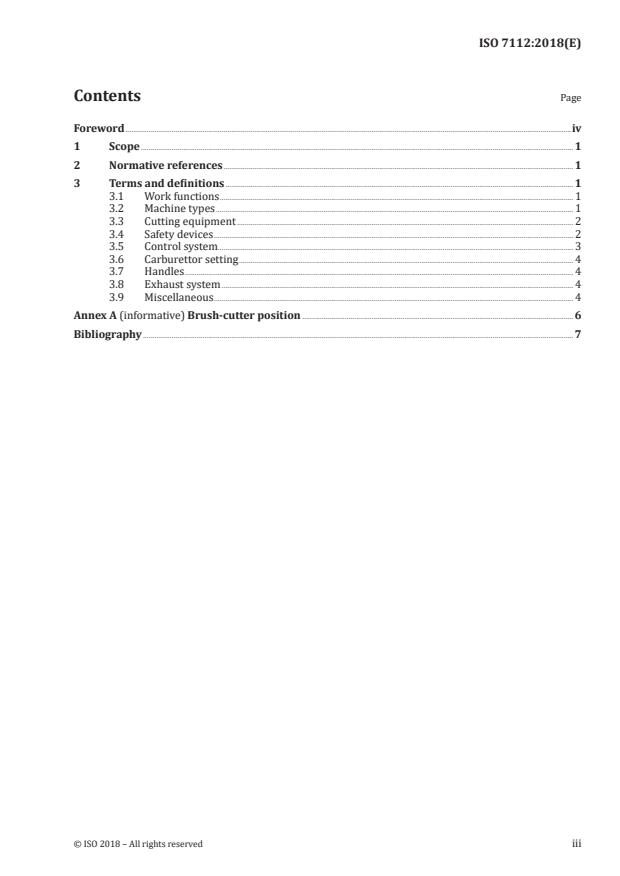
Contents Page
Foreword .iv
1 Scope . 1
2 Normative references . 1
3 Terms and definitions . 1
3.1 Work functions . 1
3.2 Machine types . 1
3.3 Cutting equipment . 2
3.4 Safety devices . 2
3.5 Control system. 3
3.6 Carburettor setting . 4
3.7 Handles . 4
3.8 Exhaust system . 4
3.9 Miscellaneous . 4
Annex A (informative) Brush-cutter position . 6
Bibliography . 7
Foreword
ISO (the International Organization for Standardization) is a worldwide federation of national standards
bodies (ISO member bodies). The work of preparing International Standards is normally carried out
through ISO technical committees. Each member body interested in a subject for which a technical
committee has been established has the right to be represented on that committee. International
organizations, governmental and non-governmental, in liaison with ISO, also take part in the work.
ISO collaborates closely with the International Electrotechnical Commission (IEC) on all matters of
electrotechnical standardization.
The procedures used to develop this document and those intended for its further maintenance are
described in the ISO/IEC Directives, Part 1. In particular, the different approval criteria needed for the
different types of ISO documents should be noted. This document was drafted in accordance with the
editorial rules of the ISO/IEC Directives, Part 2 (see www .iso .org/directives).
Attention is drawn to the possibility that some of the elements of this document may be the subject of
patent rights. ISO shall not be held responsible for identifying any or all such patent rights. Details of
any patent rights identified during the development of the document will be in the Introduction and/or
on the ISO list of patent declarations received (see www .iso .org/patents).
Any trade name used in this document is information given for the convenience of users and does not
constitute an endorsement.
For an explanation of the voluntary nature of standards, the meaning of ISO specific terms and
expressions related to conformity assessment, as well as information about ISO's adherence to the
World Trade Organization (WTO) principles in the Technical Barriers to Trade (TBT) see www .iso
.org/iso/foreword .html.
This document was prepared by Technical Committee ISO/TC 23, Tractors and machinery for agriculture
and forestry, Subcommittee SC 17, Manually portable forest machinery.
This fifth edition cancels and replaces the fourth edition (ISO 7112:2017), of which it constitutes a
minor revision. The changes compared to the previous edition are as follows:
— 3.7.2 handgrip: The reference to the backpack power unit has been corrected from 3.5.6 to 3.9.2.
Any feedback or questions on this document should be directed to the user’s national standards body. A
complete listing of these bodies can be found at www .iso .org/members .html.
iv © ISO 2018 – All rights reserved
INTERNATIONAL STANDARD ISO 7112:2018(E)
Machinery for forestry — Portable brush-cutters and
grass-trimmers — Vocabulary
1 Scope
This document defines terms relating to portable hand-held brush-cutters and grass-trimmers, their
cutting attachments and power sources.
The brush-cutter position is shown in Annex A.
2 Normative references
There are no normative references in this document.
3 Terms and definitions
For the purposes of this document, the following terms and definitions apply.
ISO and IEC maintain terminological databases for use in standardization at the following addresses:
— ISO Online browsing platform: available at https: //www .iso .org/obp
— IEC Electropedia: available at http: //www .electropedia .org/
3.1 Work functions
3.1.1
felling
separation of a standing tree from its root system
3.1.2
shredding
reduction of b
...
INTERNATIONAL ISO
STANDARD 7112
Fifth edition
2018-10
Machinery for forestry — Portable
brush-cutters and grass-trimmers —
Vocabulary
Matériel forestier — Débroussailleuses et coupe-herbe portatifs —
Vocabulaire
Reference number
©
ISO 2018
© ISO 2018
All rights reserved. Unless otherwise specified, or required in the context of its implementation, no part of this publication may
be reproduced or utilized otherwise in any form or by any means, electronic or mechanical, including photocopying, or posting
on the internet or an intranet, without prior written permission. Permission can be requested from either ISO at the address
below or ISO’s member body in the country of the requester.
ISO copyright office
CP 401 • Ch. de Blandonnet 8
CH-1214 Vernier, Geneva
Phone: +41 22 749 01 11
Fax: +41 22 749 09 47
Email: copyright@iso.org
Website: www.iso.org
Published in Switzerland
ii © ISO 2018 – All rights reserved
Contents Page
Foreword .iv
1 Scope . 1
2 Normative references . 1
3 Terms and definitions . 1
3.1 Work functions . 1
3.2 Machine types . 1
3.3 Cutting equipment . 2
3.4 Safety devices . 2
3.5 Control system. 3
3.6 Carburettor setting . 4
3.7 Handles . 4
3.8 Exhaust system . 4
3.9 Miscellaneous . 4
Annex A (informative) Brush-cutter position . 6
Bibliography . 7
Foreword
ISO (the International Organization for Standardization) is a worldwide federation of national standards
bodies (ISO member bodies). The work of preparing International Standards is normally carried out
through ISO technical committees. Each member body interested in a subject for which a technical
committee has been established has the right to be represented on that committee. International
organizations, governmental and non-governmental, in liaison with ISO, also take part in the work.
ISO collaborates closely with the International Electrotechnical Commission (IEC) on all matters of
electrotechnical standardization.
The procedures used to develop this document and those intended for its further maintenance are
described in the ISO/IEC Directives, Part 1. In particular, the different approval criteria needed for the
different types of ISO documents should be noted. This document was drafted in accordance with the
editorial rules of the ISO/IEC Directives, Part 2 (see www .iso .org/directives).
Attention is drawn to the possibility that some of the elements of this document may be the subject of
patent rights. ISO shall not be held responsible for identifying any or all such patent rights. Details of
any patent rights identified during the development of the document will be in the Introduction and/or
on the ISO list of patent declarations received (see www .iso .org/patents).
Any trade name used in this document is information given for the convenience of users and does not
constitute an endorsement.
For an explanation of the voluntary nature of standards, the meaning of ISO specific terms and
expressions related to conformity assessment, as well as information about ISO's adherence to the
World Trade Organization (WTO) principles in the Technical Barriers to Trade (TBT) see www .iso
.org/iso/foreword .html.
This document was prepared by Technical Committee ISO/TC 23, Tractors and machinery for agriculture
and forestry, Subcommittee SC 17, Manually portable forest machinery.
This fifth edition cancels and replaces the fourth edition (ISO 7112:2017), of which it constitutes a
minor revision. The changes compared to the previous edition are as follows:
— 3.7.2 handgrip: The reference to the backpack power unit has been corrected from 3.5.6 to 3.9.2.
Any feedback or questions on this document should be directed to the user’s national standards body. A
complete listing of these bodies can be found at www .iso .org/members .html.
iv © ISO 2018 – All rights reserved
INTERNATIONAL STANDARD ISO 7112:2018(E)
Machinery for forestry — Portable brush-cutters and
grass-trimmers — Vocabulary
1 Scope
This document defines terms relating to portable hand-held brush-cutters and grass-trimmers, their
cutting attachments and power sources.
The brush-cutter position is shown in Annex A.
2 Normative references
There are no normative references in this document.
3 Terms and definitions
For the purposes of this document, the following terms and definitions apply.
ISO and IEC maintain terminological databases for use in standardization at the following addresses:
— ISO Online browsing platform: available at https: //www .iso .org/obp
— IEC Electropedia: available at http: //www .electropedia .org/
3.1 Work functions
3.1.1
felling
separation of a standing tree from its root system
3.1.2
shredding
reduction of b
...
NORME ISO
INTERNATIONALE 7112
Cinquième édition
2018-10
Matériel forestier —
Débroussailleuses et coupe-herbe
portatifs — Vocabulaire
Machinery for forestry — Portable brush-cutters and grass-trimmers
— Vocabulary
Numéro de référence
©
ISO 2018
DOCUMENT PROTÉGÉ PAR COPYRIGHT
© ISO 2018
Tous droits réservés. Sauf prescription différente ou nécessité dans le contexte de sa mise en œuvre, aucune partie de cette
publication ne peut être reproduite ni utilisée sous quelque forme que ce soit et par aucun procédé, électronique ou mécanique,
y compris la photocopie, ou la diffusion sur l’internet ou sur un intranet, sans autorisation écrite préalable. Une autorisation peut
être demandée à l’ISO à l’adresse ci-après ou au comité membre de l’ISO dans le pays du demandeur.
ISO copyright office
Case postale 401 • Ch. de Blandonnet 8
CH-1214 Vernier, Genève
Tél.: +41 22 749 01 11
Fax: +41 22 749 09 47
E-mail: copyright@iso.org
Web: www.iso.org
Publié en Suisse
ii © ISO 2018 – Tous droits réservés
Sommaire Page
Avant-propos .iv
1 Domaine d'application . 1
2 Références normatives . 1
3 Termes et définitions . 1
3.1 Fonctions de travail . 1
3.2 Types de machines . 1
3.3 Organe de coupe . 2
3.4 Dispositifs de sécurité . 2
3.5 Système de réglage . 3
3.6 Réglage du carburateur . 4
3.7 Poignées . 4
3.8 Système d'échappement . 4
3.9 Divers . 5
Annexe A (informative) Positions de la débroussailleuse . 7
Bibliographie . 8
Avant-propos
L'ISO (Organisation internationale de normalisation) est une fédération mondiale d'organismes
nationaux de normalisation (comités membres de l'ISO). L'élaboration des Normes internationales est
en général confiée aux comités techniques de l'ISO. Chaque comité membre intéressé par une étude
a le droit de faire partie du comité technique créé à cet effet. Les organisations internationales,
gouvernementales et non gouvernementales, en liaison avec l'ISO participent également aux travaux.
L'ISO collabore étroitement avec la Commission électrotechnique internationale (IEC) en ce qui
concerne la normalisation électrotechnique.
Les procédures utilisées pour élaborer le présent document et celles destinées à sa mise à jour sont
décrites dans les Directives ISO/IEC, Partie 1. Il convient, en particulier, de prendre note des différents
critères d'approbation requis pour les différents types de documents ISO. Le présent document a été
rédigé conformément aux règles de rédaction données dans les Directives ISO/IEC, Partie 2 (voir www
.iso .org/directives).
L'attention est attirée sur le fait que certains des éléments du présent document peuvent faire l'objet de
droits de propriété intellectuelle ou de droits analogues. L'ISO ne saurait être tenue pour responsable
de ne pas avoir identifié de tels droits de propriété et averti de leur existence. Les détails concernant
les références aux droits de propriété intellectuelle ou autres droits analogues identifiés lors de
l'élaboration du document sont indiqués dans l'Introduction et/ou dans la liste des déclarations de
brevets reçues par l'ISO (voir www .iso .org/brevets).
Les appellations commerciales éventuellement mentionnées dans le présent document sont données
pour information, par souci de commodité, à l’intention des utilisateurs et ne sauraient constituer un
engagement.
Pour une explication de la nature volontaire des normes, la signification des termes et expressions
spécifiques de l'ISO liés à l'évaluation de la conformité, ou pour toute information au sujet de l'adhésion
de l'ISO aux principes de l’Organisation mondiale du commerce (OMC) concernant les obstacles
techniques au commerce (OTC), voir www .iso .org/avant -propos.
Le présent document a été élaboré par le comité technique ISO/TC 23, Tracteurs et matériels agricoles et
forestiers, sous-comité SC 17, Matériel forestier portatif à main.
Cette cinquième édition annule et remplace la quatrième édition (ISO 7112:2017), dont elle constitue
une révision mineure. Les modifications par rapport à l'édition précédente sont les suivants:
— 3.7.2 poignée: La référence à l'unité d'alimentation de l’unité portée à dos a été corrigée du 3.5.6
au 3.9.2.
Il convient que l’utilisateur adresse tout retour d’information ou toute question concernant le présent
document à l’organisme national de normalisation de son pays. Une liste exhaustive desdits organismes
se trouve à l’adresse www .iso .org/fr/members .html.
iv © ISO 2018 – Tous droits réservés
NORME INTERNATIONALE ISO 7112:2018(F)
Matériel forestier — Débroussailleuses et coupe-herbe
portatifs — Vocabulaire
1 Domaine d'application
Le présent document définit les termes relatifs aux débroussailleuses et aux coupe-herbe portatifs, ainsi
qu'aux dispositifs de fixation des dispositifs de coupe et aux sources d'énergie qui leur sont associés.
Les positions de la débroussailleuse sont spécifiées dans l'Annexe A.
2 Références normatives
Le présent document ne contient pas de références normatives.
3 Termes et définitions
Pour les besoins du présent document, les termes et définitions suivants s'appliquent.
L’ISO et l’IEC maintiennent des bases de données terminologiques pour utilisation dans le domaine de la
normalisation aux adresses suivantes:
— ISO Online browsing platform: disponible à https: //www .iso .org/obp
— IEC Electropedia: disponible à http: //www .electropedia .org/
3.1 Fonctions de travail
3.1.1
abattage
action de séparer un arbre sur pied de ses racines
3.1.2
broyage
réduction en particules (ou en morceaux) de broussailles, arbustes et autres pousses de végétaux
3.1.3
coupe
coupe des mauvaises herbes, de l'herbe et d'autres plantes similaires à faible résistance
3.1.4
rebond de l’organe de coupe
mouvement soudain et incontrôlé dirigé vers le côté de l'opérateur ou vers l'arrière, qui peut survenir
lorsque l’organe de coupe (3.3.1.1) entre en contact avec un élément solide
3.2 Types de machines
3.2.1
débroussailleuse
machine dotée d'un organe de coupe (3.3.1.1) en métal ou en matière plastique, destinée à couper les
mauvaises h
...
NORME ISO
INTERNATIONALE 7112
Cinquième édition
2018-10
Matériel forestier —
Débroussailleuses et coupe-herbe
portatifs — Vocabulaire
Machinery for forestry — Portable brush-cutters and grass-trimmers
— Vocabulary
Numéro de référence
©
ISO 2018
DOCUMENT PROTÉGÉ PAR COPYRIGHT
© ISO 2018
Tous droits réservés. Sauf prescription différente ou nécessité dans le contexte de sa mise en œuvre, aucune partie de cette
publication ne peut être reproduite ni utilisée sous quelque forme que ce soit et par aucun procédé, électronique ou mécanique,
y compris la photocopie, ou la diffusion sur l’internet ou sur un intranet, sans autorisation écrite préalable. Une autorisation peut
être demandée à l’ISO à l’adresse ci-après ou au comité membre de l’ISO dans le pays du demandeur.
ISO copyright office
Case postale 401 • Ch. de Blandonnet 8
CH-1214 Vernier, Genève
Tél.: +41 22 749 01 11
Fax: +41 22 749 09 47
E-mail: copyright@iso.org
Web: www.iso.org
Publié en Suisse
ii © ISO 2018 – Tous droits réservés
Sommaire Page
Avant-propos .iv
1 Domaine d'application . 1
2 Références normatives . 1
3 Termes et définitions . 1
3.1 Fonctions de travail . 1
3.2 Types de machines . 1
3.3 Organe de coupe . 2
3.4 Dispositifs de sécurité . 2
3.5 Système de réglage . 3
3.6 Réglage du carburateur . 4
3.7 Poignées . 4
3.8 Système d'échappement . 4
3.9 Divers . 5
Annexe A (informative) Positions de la débroussailleuse . 7
Bibliographie . 8
Avant-propos
L'ISO (Organisation internationale de normalisation) est une fédération mondiale d'organismes
nationaux de normalisation (comités membres de l'ISO). L'élaboration des Normes internationales est
en général confiée aux comités techniques de l'ISO. Chaque comité membre intéressé par une étude
a le droit de faire partie du comité technique créé à cet effet. Les organisations internationales,
gouvernementales et non gouvernementales, en liaison avec l'ISO participent également aux travaux.
L'ISO collabore étroitement avec la Commission électrotechnique internationale (IEC) en ce qui
concerne la normalisation électrotechnique.
Les procédures utilisées pour élaborer le présent document et celles destinées à sa mise à jour sont
décrites dans les Directives ISO/IEC, Partie 1. Il convient, en particulier, de prendre note des différents
critères d'approbation requis pour les différents types de documents ISO. Le présent document a été
rédigé conformément aux règles de rédaction données dans les Directives ISO/IEC, Partie 2 (voir www
.iso .org/directives).
L'attention est attirée sur le fait que certains des éléments du présent document peuvent faire l'objet de
droits de propriété intellectuelle ou de droits analogues. L'ISO ne saurait être tenue pour responsable
de ne pas avoir identifié de tels droits de propriété et averti de leur existence. Les détails concernant
les références aux droits de propriété intellectuelle ou autres droits analogues identifiés lors de
l'élaboration du document sont indiqués dans l'Introduction et/ou dans la liste des déclarations de
brevets reçues par l'ISO (voir www .iso .org/brevets).
Les appellations commerciales éventuellement mentionnées dans le présent document sont données
pour information, par souci de commodité, à l’intention des utilisateurs et ne sauraient constituer un
engagement.
Pour une explication de la nature volontaire des normes, la signification des termes et expressions
spécifiques de l'ISO liés à l'évaluation de la conformité, ou pour toute information au sujet de l'adhésion
de l'ISO aux principes de l’Organisation mondiale du commerce (OMC) concernant les obstacles
techniques au commerce (OTC), voir www .iso .org/avant -propos.
Le présent document a été élaboré par le comité technique ISO/TC 23, Tracteurs et matériels agricoles et
forestiers, sous-comité SC 17, Matériel forestier portatif à main.
Cette cinquième édition annule et remplace la quatrième édition (ISO 7112:2017), dont elle constitue
une révision mineure. Les modifications par rapport à l'édition précédente sont les suivants:
— 3.7.2 poignée: La référence à l'unité d'alimentation de l’unité portée à dos a été corrigée du 3.5.6
au 3.9.2.
Il convient que l’utilisateur adresse tout retour d’information ou toute question concernant le présent
document à l’organisme national de normalisation de son pays. Une liste exhaustive desdits organismes
se trouve à l’adresse www .iso .org/fr/members .html.
iv © ISO 2018 – Tous droits réservés
NORME INTERNATIONALE ISO 7112:2018(F)
Matériel forestier — Débroussailleuses et coupe-herbe
portatifs — Vocabulaire
1 Domaine d'application
Le présent document définit les termes relatifs aux débroussailleuses et aux coupe-herbe portatifs, ainsi
qu'aux dispositifs de fixation des dispositifs de coupe et aux sources d'énergie qui leur sont associés.
Les positions de la débroussailleuse sont spécifiées dans l'Annexe A.
2 Références normatives
Le présent document ne contient pas de références normatives.
3 Termes et définitions
Pour les besoins du présent document, les termes et définitions suivants s'appliquent.
L’ISO et l’IEC maintiennent des bases de données terminologiques pour utilisation dans le domaine de la
normalisation aux adresses suivantes:
— ISO Online browsing platform: disponible à https: //www .iso .org/obp
— IEC Electropedia: disponible à http: //www .electropedia .org/
3.1 Fonctions de travail
3.1.1
abattage
action de séparer un arbre sur pied de ses racines
3.1.2
broyage
réduction en particules (ou en morceaux) de broussailles, arbustes et autres pousses de végétaux
3.1.3
coupe
coupe des mauvaises herbes, de l'herbe et d'autres plantes similaires à faible résistance
3.1.4
rebond de l’organe de coupe
mouvement soudain et incontrôlé dirigé vers le côté de l'opérateur ou vers l'arrière, qui peut survenir
lorsque l’organe de coupe (3.3.1.1) entre en contact avec un élément solide
3.2 Types de machines
3.2.1
débroussailleuse
machine dotée d'un organe de coupe (3.3.1.1) en métal ou en matière plastique, destinée à couper les
mauvaises h
...