

ISO 10049:2019
(Main)Aluminium alloy castings — Visual method for assessing porosity
General Information
- Abstract
This document specifies a visual method for assessing the porosity of the machined surface of aluminium alloy castings. The method does not apply to assessing porosity shown on radiograms.
- Status
- Published
- Publication Date
- 18-Jun-2019
- Technical Committee
- ISO/TC 79/SC 7 - Aluminium and cast aluminium alloys
- Drafting Committee
- ISO/TC 79/SC 7 - Aluminium and cast aluminium alloys
- Current Stage
- 9093 - International Standard confirmed
- Start Date
- 08-Oct-2024
- Completion Date
- 29-Aug-2026
Buy Documents
ISO 10049:2019 - Aluminium alloy castings -- Visual method for assessing porosity
ISO 10049:2019 - Aluminium alloy castings — Visual method for assessing porosity/19/2019
Overview
ISO 10049:2019 is an international standard developed by ISO Technical Committee ISO/TC 79, Subcommittee SC 7, focused on aluminium and cast aluminium alloys. This second edition standardizes a visual method for assessing porosity on the machined surfaces of aluminium alloy castings. The method applies exclusively to visual surface inspection and does not cover porosity assessment via radiographic techniques.
By providing clear guidelines on inspection procedures, acceptance criteria, and severity levels, ISO 10049:2019 ensures consistent and reliable evaluation of surface porosity in aluminium castings, which is critical for quality assurance and metallurgical integrity assessments.
Key Topics
Inspection Requirements
Inspections focus on the machined surfaces of aluminium alloy castings. The extent and location of inspection must be agreed upon and specified during tendering or ordering phases to ensure clarity between customer and founder.Visual Inspection Method
Porosity is assessed primarily using the naked eye or a magnifying glass with up to ×10 magnification to measure pore diameters. The standard defines surface preparation, such as cleaning and achieving suitable roughness, to optimize pore visibility.Lighting Conditions
Proper lighting at an angle of 10° to 15°, opposite the inspection direction, is required for accurate detection. Diffused lighting is discouraged as it may obscure defect visibility.Severity Levels and Acceptance Criteria
Porosity is quantified within a 10 mm × 10 mm inspection frame, counting pores and measuring their diameters. The standard features six severity levels ranging from Level 0 (no visible pores) to Level 5 (up to 25 pores including larger sizes), supported by reference images for consistent classification.Operator Qualifications
Inspection and interpretation must be conducted by technically competent and qualified personnel, ensuring consistent and standardized evaluations.Result Interpretation
Casting acceptance relies on porosity levels not exceeding the agreed severity level in the surface area with the highest pore concentration. Minor exceptions allow a one-level exceedance for less than 25% of the inspected area.Ordering Details
The standard specifies essential order elements such as the parts and percentage of castings inspected, surface preparation, inspection stage, severity levels, and operator qualifications.
Applications
ISO 10049:2019 is vital for industries relying on aluminium alloy castings where surface integrity and porosity control affect mechanical performance, safety, and longevity. Typical applications include:
- Automotive and aerospace sectors-ensuring cast components meet stringent quality levels.
- Manufacturing of machinery parts and structural aluminium components where surface defects may compromise strength or corrosion resistance.
- Quality assurance processes within foundries and casting manufacturers to verify conformance to customer specifications.
- Metallurgical evaluations and non-destructive visual testing during or post-machining stages.
Adoption of ISO 10049:2019 helps reduce costly rejects, ensures compliance with contract requirements, and supports continuous improvement by providing repeatable inspection techniques.
Related Standards
- ISO 3547-1:2019 - Aluminium and aluminium alloys – Aluminium castings – Part 1: Chemical composition.
- ISO 4506:2019 - Aluminium and aluminium alloys – Determination of tensile properties.
- ISO 8062-3:2019 - Geometrical Product Specifications (GPS) – Dimensional tolerancing for castings.
- Other applicable visual and non-destructive testing standards relevant to casting quality assessment.
Implementing ISO 10049:2019 alongside complementary standards ensures a holistic approach to aluminium alloy casting quality control, covering chemical, mechanical, and visual inspection domains.
By following ISO 10049:2019, manufacturers and quality inspectors can reliably identify and quantify surface porosity in aluminium castings-supporting higher quality products and enhanced customer satisfaction through standardized visual assessment practices.
Relations
- Effective Date
- 30-Jun-2018
Buy Documents
ISO 10049:2019 - Aluminium alloy castings -- Visual method for assessing porosity
ISO 10049:2019 - Aluminium alloy castings — Visual method for assessing porosity/19/2019
Get Certified
Connect with accredited certification bodies for this standard

Element Materials Technology
Materials testing and product certification.

Inštitut za kovinske materiale in tehnologije
Institute of Metals and Technology. Materials testing, metallurgical analysis, NDT.
Sponsored listings
Frequently Asked Questions
ISO 10049:2019 is a standard published by the International Organization for Standardization (ISO). Its full title is "Aluminium alloy castings — Visual method for assessing porosity". This standard covers: This document specifies a visual method for assessing the porosity of the machined surface of aluminium alloy castings. The method does not apply to assessing porosity shown on radiograms.
This document specifies a visual method for assessing the porosity of the machined surface of aluminium alloy castings. The method does not apply to assessing porosity shown on radiograms.
ISO 10049:2019 is classified under the following ICS (International Classification for Standards) categories: 77.040.20 - Non-destructive testing of metals. The ICS classification helps identify the subject area and facilitates finding related standards.
ISO 10049:2019 has the following relationships with other standards: It is inter standard links to ISO 10049:1992. Understanding these relationships helps ensure you are using the most current and applicable version of the standard.
ISO 10049:2019 is available in PDF format for immediate download after purchase. The document can be added to your cart and obtained through the secure checkout process. Digital delivery ensures instant access to the complete standard document.
Standards Content (Sample)
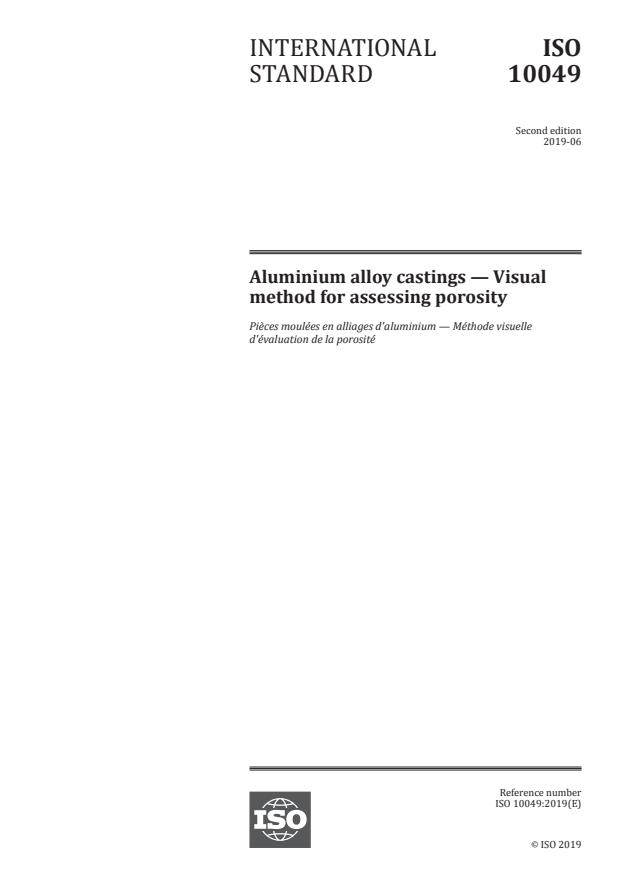
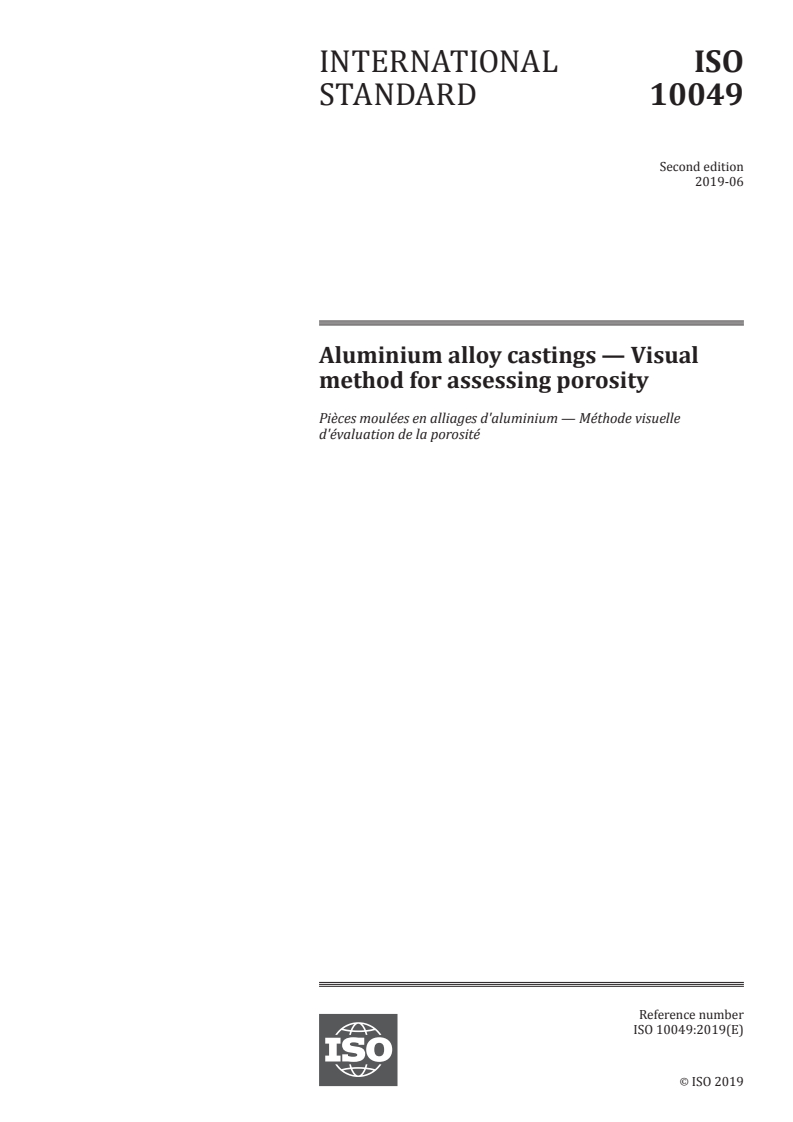
INTERNATIONAL ISO
STANDARD 10049
Second edition
2019-06
Aluminium alloy castings — Visual
method for assessing porosity
Pièces moulées en alliages d'aluminium — Méthode visuelle
d'évaluation de la porosité
Reference number
©
ISO 2019
© ISO 2019
All rights reserved. Unless otherwise specified, or required in the context of its implementation, no part of this publication may
be reproduced or utilized otherwise in any form or by any means, electronic or mechanical, including photocopying, or posting
on the internet or an intranet, without prior written permission. Permission can be requested from either ISO at the address
below or ISO’s member body in the country of the requester.
ISO copyright office
CP 401 • Ch. de Blandonnet 8
CH-1214 Vernier, Geneva
Phone: +41 22 749 01 11
Fax: +41 22 749 09 47
Email: copyright@iso.org
Website: www.iso.org
Published in Switzerland
ii © ISO 2019 – All rights reserved
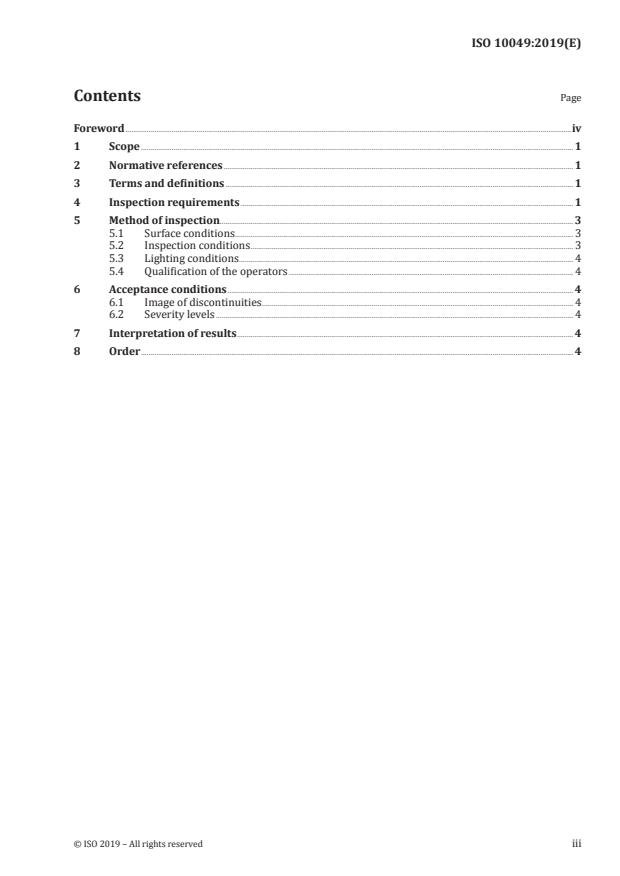
Contents Page
Foreword .iv
1 Scope . 1
2 Normative references . 1
3 Terms and definitions . 1
4 Inspection requirements . 1
5 Method of inspection. 3
5.1 Surface conditions . 3
5.2 Inspection conditions . 3
5.3 Lighting conditions . 4
5.4 Qualification of the operators . 4
6 Acceptance conditions . 4
6.1 Image of discontinuities . 4
6.2 Severity levels . 4
7 Interpretation of results . 4
8 Order . 4
Foreword
ISO (the International Organization for Standardization) is a worldwide federation of national standards
bodies (ISO member bodies). The work of preparing International Standards is normally carried out
through ISO technical committees. Each member body interested in a subject for which a technical
committee has been established has the right to be represented on that committee. International
organizations, governmental and non-governmental, in liaison with ISO, also take part in the work.
ISO collaborates closely with the International Electrotechnical Commission (IEC) on all matters of
electrotechnical standardization.
The procedures used to develop this document and those intended for its further maintenance are
described in the ISO/IEC Directives, Part 1. In particular, the different approval criteria needed for the
different types of ISO documents should be noted. This document was drafted in accordance with the
editorial rules of the ISO/IEC Directives, Part 2 (see www .iso .org/directives).
Attention is drawn to the possibility that some of the elements of this document may be the subject of
patent rights. ISO shall not be held responsible for identifying any or all such patent rights. Details of
any patent rights identified during the development of the document will be in the Introduction and/or
on the ISO list of patent declarations received (see www .iso .org/patents).
Any trade name used in this document is information given for the convenience of users and does not
constitute an endorsement.
For an explanation of the voluntary nature of standards, the meaning of ISO specific terms and
expressions related to conformity assessment, as well as information about ISO's adherence to the
World Trade Organization (WTO) principles in the Technical Barriers to Trade (TBT) see www .iso
.org/iso/foreword .html.
This document was prepared by Technical Committee ISO/TC 79, Light metals and their alloys,
Subcommittee SC 7, Aluminium and cast aluminium alloys.
This second edition cancels and replaces the first edition (ISO 10049:1992), which has been technically
revised. The main changes compared with the previous edition are as follows:
— the NOTE in the Scope has been modified;
— Clause 3 for terms and definitions has been added;
— Table 1 has been converted into Figures 1 to 6 and the figures have been redrawn;
— the subclauses in Clause 5 have been reorde
...
INTERNATIONAL ISO
STANDARD 10049
Second edition
2019-06
Aluminium alloy castings — Visual
method for assessing porosity
Pièces moulées en alliages d'aluminium — Méthode visuelle
d'évaluation de la porosité
Reference number
©
ISO 2019
© ISO 2019
All rights reserved. Unless otherwise specified, or required in the context of its implementation, no part of this publication may
be reproduced or utilized otherwise in any form or by any means, electronic or mechanical, including photocopying, or posting
on the internet or an intranet, without prior written permission. Permission can be requested from either ISO at the address
below or ISO’s member body in the country of the requester.
ISO copyright office
CP 401 • Ch. de Blandonnet 8
CH-1214 Vernier, Geneva
Phone: +41 22 749 01 11
Fax: +41 22 749 09 47
Email: copyright@iso.org
Website: www.iso.org
Published in Switzerland
ii © ISO 2019 – All rights reserved
Contents Page
Foreword .iv
1 Scope . 1
2 Normative references . 1
3 Terms and definitions . 1
4 Inspection requirements . 1
5 Method of inspection. 3
5.1 Surface conditions . 3
5.2 Inspection conditions . 3
5.3 Lighting conditions . 4
5.4 Qualification of the operators . 4
6 Acceptance conditions . 4
6.1 Image of discontinuities . 4
6.2 Severity levels . 4
7 Interpretation of results . 4
8 Order . 4
Foreword
ISO (the International Organization for Standardization) is a worldwide federation of national standards
bodies (ISO member bodies). The work of preparing International Standards is normally carried out
through ISO technical committees. Each member body interested in a subject for which a technical
committee has been established has the right to be represented on that committee. International
organizations, governmental and non-governmental, in liaison with ISO, also take part in the work.
ISO collaborates closely with the International Electrotechnical Commission (IEC) on all matters of
electrotechnical standardization.
The procedures used to develop this document and those intended for its further maintenance are
described in the ISO/IEC Directives, Part 1. In particular, the different approval criteria needed for the
different types of ISO documents should be noted. This document was drafted in accordance with the
editorial rules of the ISO/IEC Directives, Part 2 (see www .iso .org/directives).
Attention is drawn to the possibility that some of the elements of this document may be the subject of
patent rights. ISO shall not be held responsible for identifying any or all such patent rights. Details of
any patent rights identified during the development of the document will be in the Introduction and/or
on the ISO list of patent declarations received (see www .iso .org/patents).
Any trade name used in this document is information given for the convenience of users and does not
constitute an endorsement.
For an explanation of the voluntary nature of standards, the meaning of ISO specific terms and
expressions related to conformity assessment, as well as information about ISO's adherence to the
World Trade Organization (WTO) principles in the Technical Barriers to Trade (TBT) see www .iso
.org/iso/foreword .html.
This document was prepared by Technical Committee ISO/TC 79, Light metals and their alloys,
Subcommittee SC 7, Aluminium and cast aluminium alloys.
This second edition cancels and replaces the first edition (ISO 10049:1992), which has been technically
revised. The main changes compared with the previous edition are as follows:
— the NOTE in the Scope has been modified;
— Clause 3 for terms and definitions has been added;
— Table 1 has been converted into Figures 1 to 6 and the figures have been redrawn;
— the subclauses in Clause 5 have been reorde
...