


ISO 6934-2:1991
(Main)Steel for the prestressing of concrete — Part 2: Cold-drawn wire
Steel for the prestressing of concrete — Part 2: Cold-drawn wire
Acier pour armatures de précontrainte — Partie 2: Fil tréfilé à froid
General Information
- Status
- Withdrawn
- Publication Date
- 10-Jul-1991
- Technical Committee
- ISO/TC 17/SC 16 - Steels for the reinforcement and prestressing of concrete
- Current Stage
- 9599 - Withdrawal of International Standard
- Start Date
- 02-Dec-2024
- Completion Date
- 14-Feb-2026
Relations
- Effective Date
- 09-Feb-2026
- Effective Date
- 06-Jun-2022
Overview
ISO 6934-2:1991 is an international standard developed by the International Organization for Standardization (ISO) that specifies the requirements for cold-drawn wire steel used in the prestressing of concrete. As Part 2 of the ISO 6934 series on steel for prestressing applications, this document focuses specifically on cold-drawn wire used for high tensile strength reinforcement in prestressed concrete structures.
This standard ensures the consistency, quality, and performance of cold-drawn wires to meet the rigorous demands of prestressed concrete applications. It aligns with the general specifications outlined in ISO 6934-1 and provides detailed parameters related to wire dimensions, mechanical properties, surface conditions, and delivery requirements.
Key Topics
Material and Manufacturing
The standard requires the cold-drawn wire to be produced from high carbon steel according to ISO 6934-1, ensuring material quality and consistency. The wire must be free from welds or joints to guarantee structural integrity.Surface Conditions
The wire surface can be smooth, indented, ribbed, or twisted to optimize the bonding characteristics with concrete. Surface types are specified to improve adherence within prestressed concrete elements. Examples of these surface textures are provided in the annexes.Mechanical Properties
Detailed specifications for tensile strength, yield limit, elongation, and fatigue resistance are included:- Tensile strength ranges typically from 1380 to 1960 N/mm² depending on wire diameter and class.
- Minimum elongation under maximum load must meet criteria (e.g., 1.5% for raw wire, 3.5% for relaxed wire).
- Fatigue resistance testing requires the wire to withstand 2 million cycles without failure under alternating stresses.
- Relaxation limits are set to not exceed 10% after 1000 hours under specific load conditions.
Dimensions and Tolerances
Nominal diameters range from 3 mm up to 12.2 mm, with corresponding mass, tensile capacities, and bending radii stipulated. The wire must withstand mandatory bending and alternating bending tests to confirm ductility and performance.Delivery and Marking
The wire should be supplied in coils or cut lengths, with coil diameters recommended to prevent damage and maintain material properties. Designation includes diameter, tensile strength class, surface type, and relaxation class.
Applications
ISO 6934-2:1991 cold-drawn wire steel is primarily used for:
Prestressed Concrete Structures
Utilized as reinforcement in beams, slabs, and other components where high tensile strength is required to withstand prestressing forces.Infrastructure Projects
These wires are ideal for bridges, tunnels, railway sleepers, and retaining walls where durability and strong concrete bonding are critical.Precast Concrete Elements
Applicable in precast units that demand uniform tensile properties and reliable stress transfer between steel and concrete.Specialized Construction
The wire can be employed in applications such as sheet piling, tanks, and other concrete structures requiring prestress reinforcement.
Related Standards
ISO 6934-2 works in conjunction with several ISO standards including:
- ISO 6934-1:1991 - General specifications for steel used in prestressing concrete, covering fundamental material and mechanical quality requirements applicable to all wire types.
- ISO 6934-3, 4, 5 - Covering quenched and tempered wire, strands, and rolled steel bars respectively for prestressing applications.
- ISO 3768-1, ISO 3768-2 - These standards provide test methods relevant to stress relaxation and fatigue properties which complement the requirements for prestressing wires.
- ISO 9001 - For quality management systems ensuring production consistency and traceability of prestressing steel products.
By adhering to ISO 6934-2:1991, manufacturers and engineers ensure that cold-drawn prestressing wires meet strict international quality standards, providing high strength, durability, and reliability necessary for long-lasting prestressed concrete construction. This robust standard supports best practices in material selection, testing, and application, essential for optimal structural performance and safety.
Buy Documents

ISO 6934-2:1991 - Steel for the prestressing of concrete — Part 2: Cold-drawn wire Released:7/11/1991

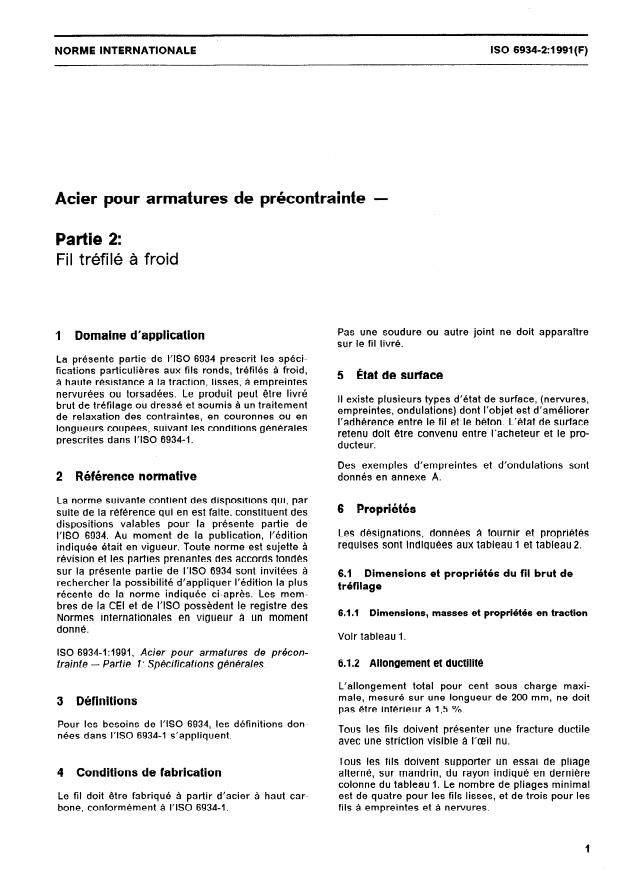
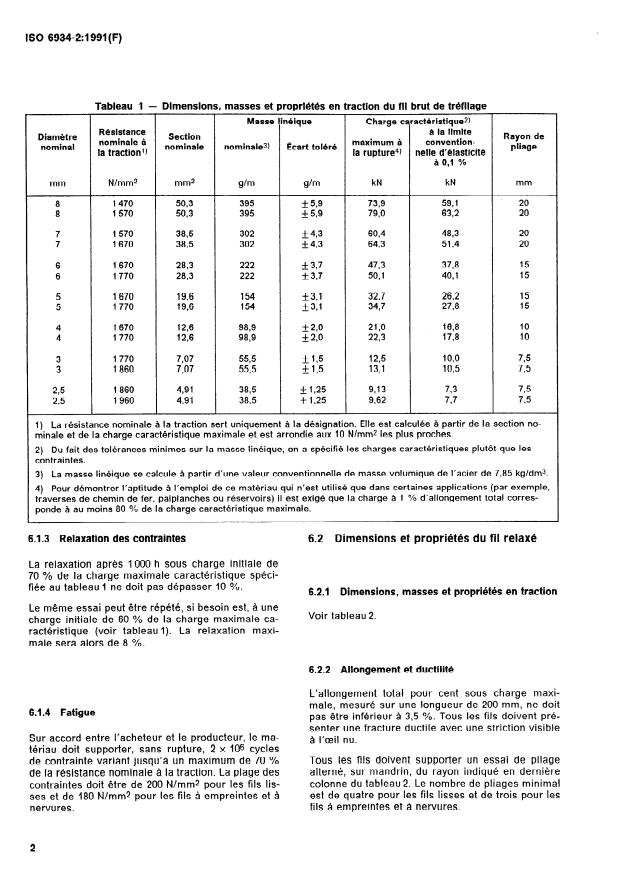
ISO 6934-2:1991 - Acier pour armatures de précontrainte — Partie 2: Fil tréfilé a froid Released:7/11/1991

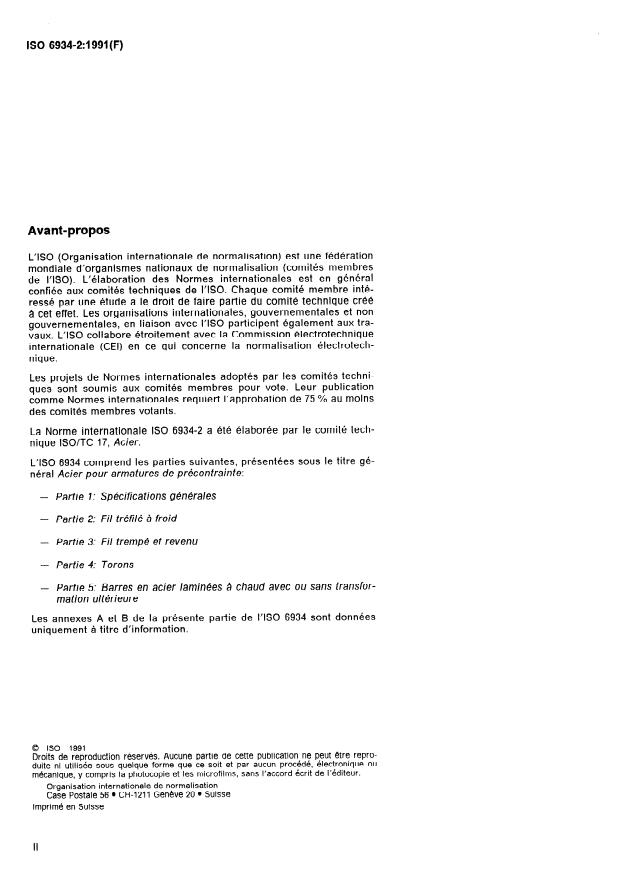
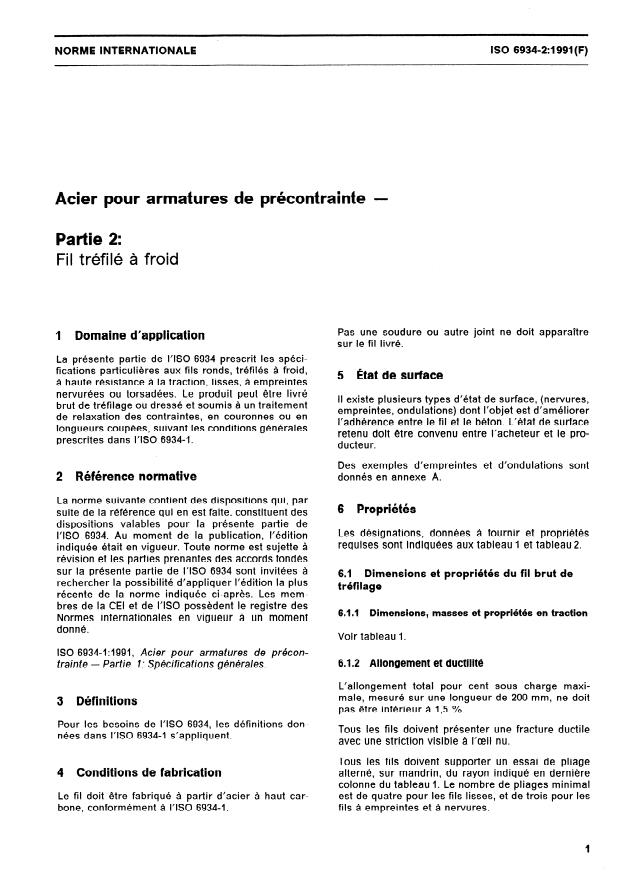
ISO 6934-2:1991 - Acier pour armatures de précontrainte — Partie 2: Fil tréfilé a froid Released:7/11/1991
Get Certified
Connect with accredited certification bodies for this standard

Element Materials Technology
Materials testing and product certification.

ICC Evaluation Service
Building products evaluation and certification.

QAI Laboratories
Building and construction product testing and certification.
Sponsored listings
Frequently Asked Questions
ISO 6934-2:1991 is a standard published by the International Organization for Standardization (ISO). Its full title is "Steel for the prestressing of concrete — Part 2: Cold-drawn wire". This standard covers: Steel for the prestressing of concrete — Part 2: Cold-drawn wire
Steel for the prestressing of concrete — Part 2: Cold-drawn wire
ISO 6934-2:1991 is classified under the following ICS (International Classification for Standards) categories: 77.140.15 - Steels for reinforcement of concrete; 91.080.40 - Concrete structures. The ICS classification helps identify the subject area and facilitates finding related standards.
ISO 6934-2:1991 has the following relationships with other standards: It is inter standard links to EN ISO 19903:2006, ISO 6934-2:2024. Understanding these relationships helps ensure you are using the most current and applicable version of the standard.
ISO 6934-2:1991 is available in PDF format for immediate download after purchase. The document can be added to your cart and obtained through the secure checkout process. Digital delivery ensures instant access to the complete standard document.
Standards Content (Sample)
INTERNATIONAL
STANDARD
First edition
1991-07-01
--
Steel for the prestressing of concrete -
Part 2:
Cold-drawn wire
Acier pour armatures de prkontrainte -
Partie 2: Fil h-Ml& B froid
Reference number
IS0 6934-2: 199 1 (E)
IS0 6934=2:1991(E)
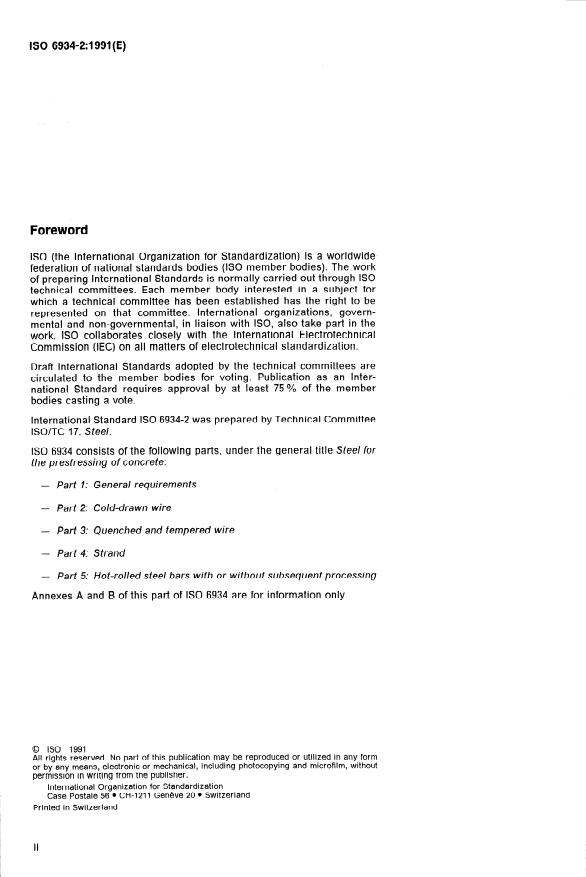
Foreword
IS0 (the International Organization for Standardization) is a worldwide
federation of national standards bodies (IS0 member bodies). The work
of preparing International Standards is normally carried out through IS0
technical committees. Each member body interested in a subject for
which a technical committee has been established has the right to be
represented on that committee. International organizations, govern-
mental and non-governmental, in liaison with ISO, also take part in the
work. Is0 collaborates closely with the International Electrotechnical
Commission (IEC) on all matters of electrotechnical standardization.
Draft International Standards adopted by the technical committees are
circulated to the member bodies for voting. Publicatjon as an Inter-
national Standard requires approval by at least 75 % of the member
bodies casting a vote.
International Standard IS0 6934-Z was prepared by Technical Committee
ISO/TC 17, Steel.
IS0 6934 consists of the following parts, under fhe general title Steel for
the prestressing of concrete:
-
Par-t I: General requirements
- Part 2: Cold-drawn wire
- Part 3: Quenched and tempered wire
- Part 4: Strand
-
Part 5: Hot-rolled steel bars with or without subsequent processing
Annexes A and B of this part of IS0 6934 are for information only.
0 IS0 1991
All rights reserved. No part of this publication may be reproduced or utilized in any form
or by any means, electronic or mechanical, including photocopying and microfilm, without
permission in writing from the publisher.
International Organization for Standardization
Case Postale 56 l CH-1211 Geneve 20 l Switzerland
Printed in Switzerland
ii
IS0 693402:1991 (E)
INTERNATIONAL STANDARD
-
Steel for the prestressing of concrete
Part 2:
Cold-drawn wire
5 Surface configuration
1 Scope
There are several types of surface configuration
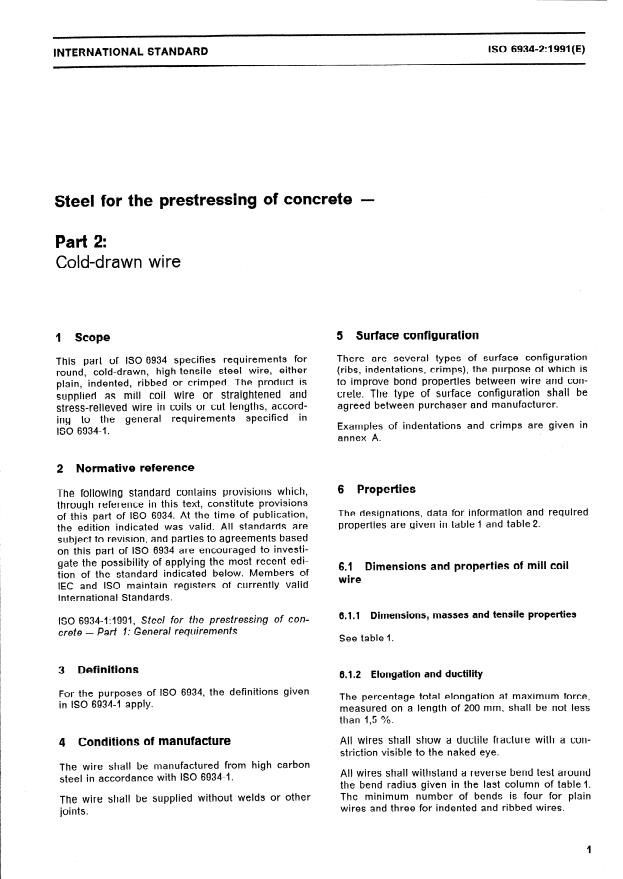
This part of IS0 6934 specifies requirements for
(ribs, indentations, crimps), the purpose of which is
round, cold-drawn, high-tensile steel wire, either
to improve bond properties between wire and con-
plain, indented, ribbed or crimped. The product is
supplied as mill coil wire or straightened and crete. The type of surface configuration shall be
agreed between purchaser and manufacturer.
stress-relieved wire in coils or cut lengths, accord-
ing to the general requirements specified in
Examples of indentations and crimps are given in
IS0 6934-l.
annex A.
2 Normative reference
6 Properties
The following standard contains provisions which,
through reference in this text, constitute provisions
The designations, data for information and required
of this part of IS0 6934. At the time of publication,
properties are given in table 1 and table 2.
the edition indicated was valid. All standards are
subject to revision, and parties to agreements based
on this part of IS0 6934 are encouraged to investi-
gate the possibility of applying the most recent edi-
6.1 Dimensions and properties of mill coil
tion of the standard indicated below. Members of
wire
IEC and IS0 maintain registers of currently valid
International Standards.
6.1 .I Dimensions, masses and tensile properties
IS0 6934-1:1991, Steel for the prestressing of con-
crete - Part I: General requirements.
See table 1.
3 Definitions
6.1.2 Elongation and ductility
For the purposes of IS0 6934, the definitions given
The percentage total elongation at maximum force,
in IS0 6934-l apply.
measured on a length of 200 mm, shall be not less
than I,5 %.
All wires shall show a ductile fracture with a con-
4 Conditions of manufacture
striction visible to the naked eye.
The wire shall be manufactured from high carbon
All wires shall withstand a reverse bend test around
steel in accordance with IS0 6934-l.
the bend radius given in the last column of table 1.
The minimum number of bends is four for plain
The wire shall be supplied without welds or other
wires and three for indented and ribbed wires.
joints.
IS0 693492:1991 (E)
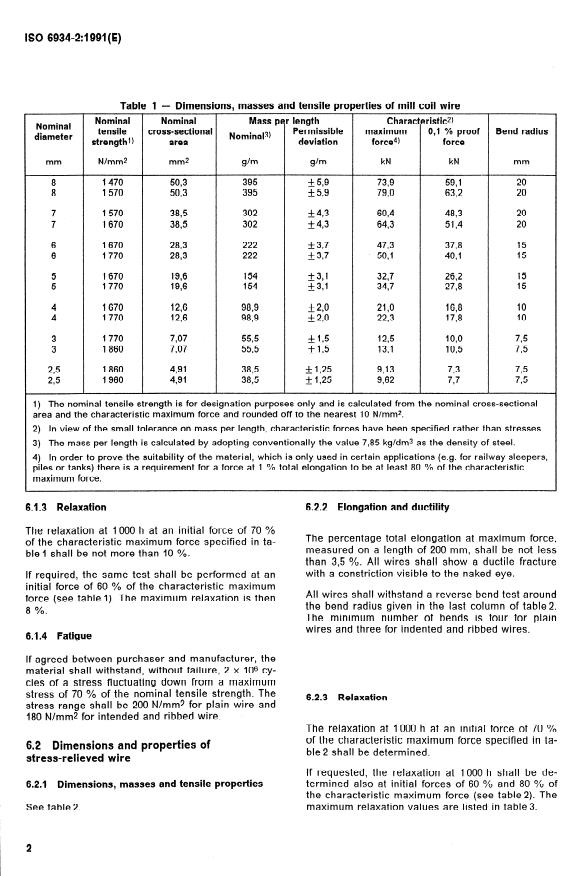
Table 1 - Dlmensions, masses and tensile properties of mill coil wire
Nominal Nominal Mass per length Characteristic*J
Nominal
tensile cross-sectional Permissible maximum 0,l % proof Bend radius
diameter NominaW
strength’) area deviation force4) force
mm N/mm* mm* kN kN mm
g/m
g/m
8 1470 50,3 395 + 5,9 73,9 59,l 20
8 1570 50,3 395 T59 7 79,0 63,2 20
-
7 1570 38,5 302 +4,3 60,4 48,3 20
7 1670 38,5 302 T43 7 64,3 51,4 20
-
6 1670 28,3 222 +3,7 47,3 37,8 15
6 1770 28,3 222 T37 9 50,l 40,l 15
-
5 1670 19,6 154 +3,1 32,7 26,2 15
5 1770 19,6 154 +31 ? 34,7 27,8 15
-
4 1670 12,6 98,9 +2,0 21,0 16,8 10
4 1770 12,6 98,9 T-20 9 22,3 17,8 10
-
3 1770 7,07 55,5 +1,5 12,5 10,o 73
3 1860 7,07 55,5 715 - 1 13,l 10,5 73
23 1860 4,91 38,5 + 1,25 9,13 7,3 795
2,5 1960 4,91 38,5 Tl - 9 25 9,62 797 795
1) The nominal tensile strength is for designation purposes only and is calculated from the nominal cross-sectional
area and the characteristic maximum force and rounded off to the nearest 10 N/mm*.
2) In view of the small tolerance on mass per length, characteristic forces have been specified rather than stresses.
3) The mass per length is calculated by adopting conventionally the value 7,85 kg/dm3 as the density of steel.
4) In order to prove the suitability of the material, which is only used in certain applications (e.g. for railway sleepers,
piles or tanks) there is a requirement for a force at 1 OXJ total elongation to be at least 80 % of the characteristic
maximum force.
6.1.3 Relaxation 6.2.2 Elongation and ductility
The relaxation at 1000 h at an initial force of 70 %
The percentage total elongation at maximum force,
of the characteristic maximum force specified in ta-
measured on a length of 200 mm, shall be not less
ble 1 shall be not more than IO %.
than 3,5 %. All wires shall show a ductile fracture
with a constriction visible to the naked eye.
If required, the same test shall be performed at an
initial force of 60 % of the characteristic maximum
All wires shall withstand a reverse bend test around
force (see table 1). The maximum relaxation is then
the bend radius given in the last column of table2.
8 %.
The minimum number of bends is four for plain
wires and three for indented and ribbed wires.
6.1.4 Fatigue
If agreed between purchaser and manufacturer, the
material shall withstand, without failure, 2 x 10⁶ cy-
cles of a stress fluctuating down from a max
...
iso
NORME
6934-2
INTERNATIONALE
Première édition
1991-07-01
Acier pour armatures de précontrainte -
Partie 2:
Fil tréfilé à froid
Steel for the prestressing of concrete -
Part 2: Cold-drawn wire
Numéro de référence
ISO 6934-2: 1991 (F)
ISO 693402:1991 (F)
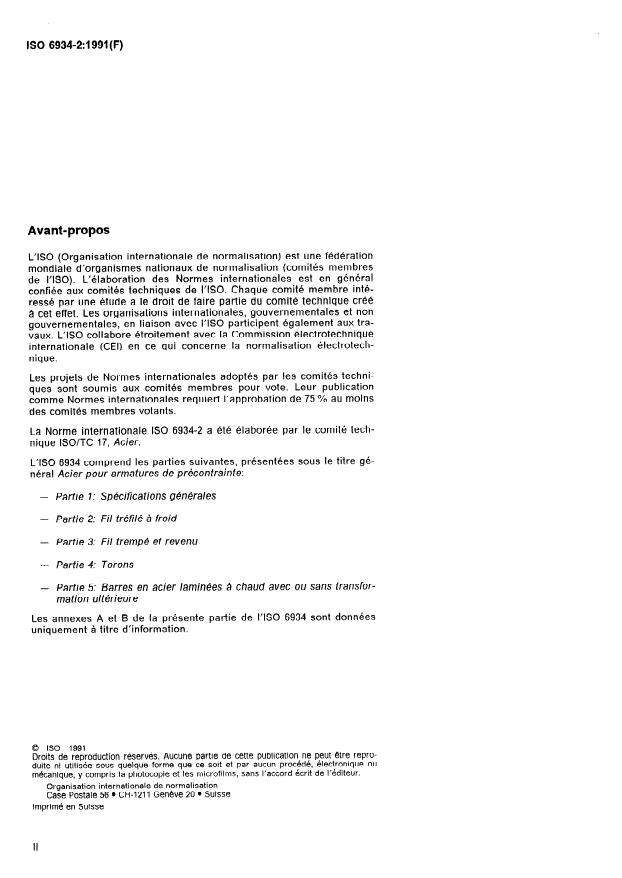
Avant-propos
L’ISO (Organisation internationale de normalisation) est une fédération
mondiale d’organismes nationaux de normalisation (comités membres
de I’ISO). L’élaboration des Normes internationales est en général
confiée aux comités techniques de I’ISO. Chaque comité membre inté-
ressé par une étude a le droit de faire partie du comité technique créé
à cet effet. Les organisations internationales, gouvernementales et non
gouvernementales, en liaison avec I’ISO participent également aux tra-
vaux. L’ISO collabore étroitement avec la Commission électrotechnique
internationale (CH) en ce qui concerne la normalisation électrotech-
nique.
Les projets de Normes internationales adoptés par les comités techni-
ques sont soumis aux comités membres pour vote. Leur publication
comme Normes internationales requiert l’approbation de 75 % au moins
des comités membres votants.
La Norme internationale ISO 6934-2 a été élaborée par le comité tech-
nique ISO/TC 17, Acier.
L’ISO 6934 comprend les parties suivantes, présentées sous le titre gé-
néral Acier pour armatures de précontrainte:
-
Partie 1: Spécifications générales
-
Partie 2: Fil tréfilé à froid
- Partie 3: Fil trempé ef revenu
- Partie 4: Torons
- Partie 5: Barres en acier laminées à chaud avec ou sans transfor-
mation ultérieure
Les annexes A et B de la présente partie de I’ISO 6934 sont données
uniquement à titre d’information.
0 ISO 1991
Droits de reproduction réservés. Aucune partie de cette publication ne peut être repro-
duite ni utilisée sous quelque forme que ce soit et par aucun procédé, électronique ou
mécanique, y compris la photocopie et les microfilms, sans l’accord écrit de l’éditeur.
Organisation internationale de normalisation
Case Postale 56 l CH-1211 Genève 20 l Suisse
Imprimé en Suisse
ii
NORME INTERNATIONALE ISO 693492:1991 (F)
précontrainte -
Acier pour armatures de
Partie 2:
Fil tréfilé à froid
Pas une soudure ou autre joint ne doit apparaître
1 Domaine d’application
sur le fil livré.
La présente partie de I’ISO 6934 prescrit les spéci-
fications particulières aux fils ronds, tréfilés à froid,
5 État de surface
à haute résistance à la traction, lisses, à empreintes
nervurées ou torsadées. Le produit peut être livré
Il existe plusieurs types d’état de surface, (nervures,
brut de tréfilage ou dressé et soumis à un traitement
empreintes, ondulations) dont l’objet est d’améliorer
de relaxation des contraintes, en couronnes ou en
l’adhérence entre le fil et le béton. L’état de surface
longueurs coupées, suivant les conditions générales
retenu doit être convenu entre l’acheteur et le pro-
prescrites dans I’ISO 6934-l.
ducteur.
Des exemples d’empreintes et d’ondulations sont
2 Référence normative donnés en annexe A.
La norme suivante contient des dispositions qui, par
6 Propriétés
suite de la référence qui en est faite, constituent des
dispositions valables pour la présente partie de
Les c désignations, données à fournir et propriétés
I’ISO 6934. Au moment de la publication, l’édition
requ i ses sont indiquées aux tableau 1 et tableau 2.
indiquée était en vigueur. Toute norme est sujette à
révision et les parties prenantes des accords fondés
sur la présente partie de I’ISO 6934 sont invitées à
61 Dimensions et propriétés du fil brut de
, e
rechercher la possibilité d’appliquer l’édition la plus
t;efl I
age
récente de la norme indiquée ci-après. Les mem-
bres de la CEI et de I’ISO possèdent le registre des
6.1 .l Dimensions, masses et propriétés en traction
Normes internationales en vigueur à un moment
donné.
Voir tableau 1.
ISO 6934.1:1991, Acier pour armatures de précon-
- Partie 1: Spécifications générales. 6.1.2 Allongement et ductilité
train te
L’allongement total pour cent sous charge maxi-
male, mesuré sur une longueur de 200 mm, ne doit
3 Définitions
pas être inférieur à 1,5 %.
Pour les besoins de I’ISO 6934, les définitions don-
Tous les fils doivent présenter une fracture ductile
nées dans I’ISO 6934-l s’appliquent.
avec une striction visible à l’oeil nu.
Tous les fils doivent supporter un essai de pliage
4 Conditions de fabrication alterné, sur mandrin, du rayon indiqué en dernière
colonne du tableau 1. Le nombre de pliages minimal
Le fil doit être fabriqué à partir d’acier à haut car- est de quatre pour les fils lisses, et de trois pour les
bone, conformément à I’ISO 6934-l. fils à empreintes et à nervures.
ISO 693402:1991 (F)
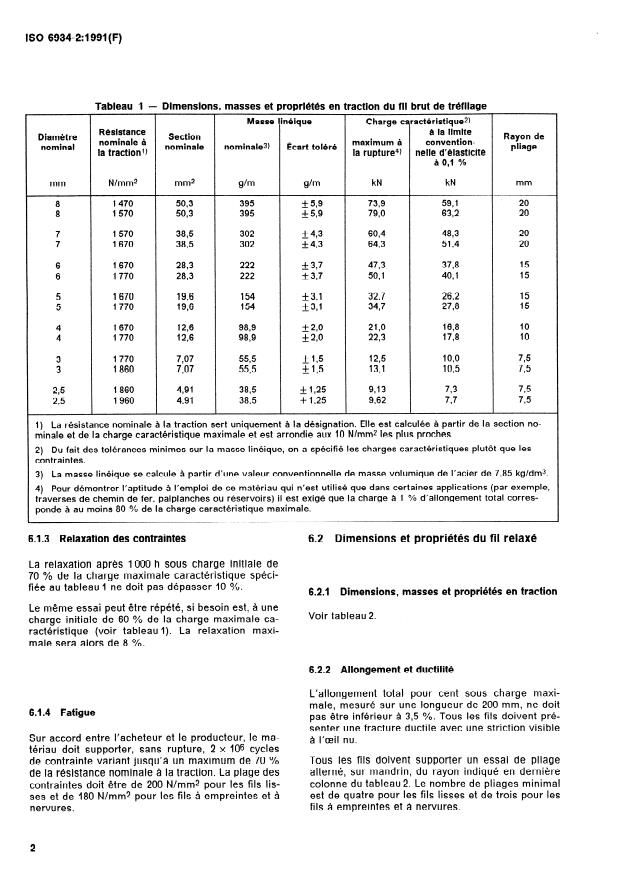
Tableau 1
- Dimensions, masses et propriétés en traction du fil brut de tréfilage
T
Masse linéique Charge caractéristique*)
Résistance à la limite
Section Rayon de
Diamètre
nominale à
maximum à convention-
nominale nominale3) pliage
nominal Ecart toléré
la traction’)
la rupture41 nelle d’élasticité
à 0,l %
mm N/mm* mm* kN kN mm
cm cm
8 1470 50,3 395
+ 5,Q 73,Q 59,l y 20
8 1570 50,3 395 T59 9 79,0 63,2 20
-
7 1570
38,5 302 +4,3 60,4 48,3 20
7 1670 38,5 302
T43 9 64,3 51,4 20
-
6 i ,670 28,3 222 + 3,7 47,3
37,8 15
6 1770 28,3 222 T37 9 50,l 40,l
-
5 1670 19,6 154 +3,1 32,7 26,2 15
5 1770 19,6 154 T31 P 34,7 27,8 15
-
4 1670
12,6 98,Q +2,0 21,0 16,8 10
4 1770 12,6 98,Q + 2,0 22,3
17,8 10
-
3 1770 7,07 55,5 + 1,5 12,5 10,o 795
3 1860 7,07 55,5 +15 - > 13,l 10,5 73
25 1860 4,Ql 38,5 + 1,25 9,13
793 7,5
23 1960 4,Ql 38,5 Tl - P 25 9,62 7,7 7,5
1) La résistance nominale à la traction sert uniquement à la désignation. Elle est calculée à partir de la section no-
minale et de la charge caractéristique maximale et est arrondie aux 10 N/mm* les plus proches.
2) Du fait des tolérances minimes sur la masse linéique, on a spécifié les charges caractéristiques plutôt que les
contraintes.
3) La masse linéique se calcule à partir d’une valeur conventionnelle de masse volumique de l’acier de 7,85 kg/dm?
4) Pour démontrer l’aptitude à l’emploi de ce matériau qui n’est utilisé que dans certaines applications (par exemple,
traverses de chemin de fer, palplanches ou réservoirs) il est exigé que la charge à 1 O/a d’allongement total corres-
ponde à au moins 80 O/o de la charge caractéristique maximale.
6.1.3 Relaxation des contraintes 6.2 Dimensions et propriétés du fil relaxé
La relaxation après 1000 h sous charge initiale de
70 % de la charge maximale caractéristique spéci-
fiée au tableau 1 ne doit pas dépasser 10 %.
6.2.1 Dimensions, masses et propriétés en traction
Le même essai peut être répété, si besoin est, à une
Voir tableau 2.
charge initiale de 60 % de la charge maximale ca-
ractéristique (voir tableau 1). La relaxation maxi-
male sera alors de 8 Oh.
6.2.2 Allongement et ductilité
L’allongement total pour cent sous charge maxi-
male, mesuré sur une longueur de 200 mm, ne doit
6.1.4 Fatigue
pas être inférieur a 3,5 O/o. Tous les fils doivent pré-
senter une fracture ductile avec une striction visible
Sur accord entre l’acheteur et le producteur, le ma-
à l’oeil nu.
tériau doit supporter, sans rupture, 2 x 10⁶ cycles
Tous les fils doivent supporter un essai de pliage
de contrainte variant jusqu’à un maximum de 70 %
...
iso
NORME
6934-2
INTERNATIONALE
Première édition
1991-07-01
Acier pour armatures de précontrainte -
Partie 2:
Fil tréfilé à froid
Steel for the prestressing of concrete -
Part 2: Cold-drawn wire
Numéro de référence
ISO 6934-2: 1991 (F)
ISO 693402:1991 (F)
Avant-propos
L’ISO (Organisation internationale de normalisation) est une fédération
mondiale d’organismes nationaux de normalisation (comités membres
de I’ISO). L’élaboration des Normes internationales est en général
confiée aux comités techniques de I’ISO. Chaque comité membre inté-
ressé par une étude a le droit de faire partie du comité technique créé
à cet effet. Les organisations internationales, gouvernementales et non
gouvernementales, en liaison avec I’ISO participent également aux tra-
vaux. L’ISO collabore étroitement avec la Commission électrotechnique
internationale (CH) en ce qui concerne la normalisation électrotech-
nique.
Les projets de Normes internationales adoptés par les comités techni-
ques sont soumis aux comités membres pour vote. Leur publication
comme Normes internationales requiert l’approbation de 75 % au moins
des comités membres votants.
La Norme internationale ISO 6934-2 a été élaborée par le comité tech-
nique ISO/TC 17, Acier.
L’ISO 6934 comprend les parties suivantes, présentées sous le titre gé-
néral Acier pour armatures de précontrainte:
-
Partie 1: Spécifications générales
-
Partie 2: Fil tréfilé à froid
- Partie 3: Fil trempé ef revenu
- Partie 4: Torons
- Partie 5: Barres en acier laminées à chaud avec ou sans transfor-
mation ultérieure
Les annexes A et B de la présente partie de I’ISO 6934 sont données
uniquement à titre d’information.
0 ISO 1991
Droits de reproduction réservés. Aucune partie de cette publication ne peut être repro-
duite ni utilisée sous quelque forme que ce soit et par aucun procédé, électronique ou
mécanique, y compris la photocopie et les microfilms, sans l’accord écrit de l’éditeur.
Organisation internationale de normalisation
Case Postale 56 l CH-1211 Genève 20 l Suisse
Imprimé en Suisse
ii
NORME INTERNATIONALE ISO 693492:1991 (F)
précontrainte -
Acier pour armatures de
Partie 2:
Fil tréfilé à froid
Pas une soudure ou autre joint ne doit apparaître
1 Domaine d’application
sur le fil livré.
La présente partie de I’ISO 6934 prescrit les spéci-
fications particulières aux fils ronds, tréfilés à froid,
5 État de surface
à haute résistance à la traction, lisses, à empreintes
nervurées ou torsadées. Le produit peut être livré
Il existe plusieurs types d’état de surface, (nervures,
brut de tréfilage ou dressé et soumis à un traitement
empreintes, ondulations) dont l’objet est d’améliorer
de relaxation des contraintes, en couronnes ou en
l’adhérence entre le fil et le béton. L’état de surface
longueurs coupées, suivant les conditions générales
retenu doit être convenu entre l’acheteur et le pro-
prescrites dans I’ISO 6934-l.
ducteur.
Des exemples d’empreintes et d’ondulations sont
2 Référence normative donnés en annexe A.
La norme suivante contient des dispositions qui, par
6 Propriétés
suite de la référence qui en est faite, constituent des
dispositions valables pour la présente partie de
Les c désignations, données à fournir et propriétés
I’ISO 6934. Au moment de la publication, l’édition
requ i ses sont indiquées aux tableau 1 et tableau 2.
indiquée était en vigueur. Toute norme est sujette à
révision et les parties prenantes des accords fondés
sur la présente partie de I’ISO 6934 sont invitées à
61 Dimensions et propriétés du fil brut de
, e
rechercher la possibilité d’appliquer l’édition la plus
t;efl I
age
récente de la norme indiquée ci-après. Les mem-
bres de la CEI et de I’ISO possèdent le registre des
6.1 .l Dimensions, masses et propriétés en traction
Normes internationales en vigueur à un moment
donné.
Voir tableau 1.
ISO 6934.1:1991, Acier pour armatures de précon-
- Partie 1: Spécifications générales. 6.1.2 Allongement et ductilité
train te
L’allongement total pour cent sous charge maxi-
male, mesuré sur une longueur de 200 mm, ne doit
3 Définitions
pas être inférieur à 1,5 %.
Pour les besoins de I’ISO 6934, les définitions don-
Tous les fils doivent présenter une fracture ductile
nées dans I’ISO 6934-l s’appliquent.
avec une striction visible à l’oeil nu.
Tous les fils doivent supporter un essai de pliage
4 Conditions de fabrication alterné, sur mandrin, du rayon indiqué en dernière
colonne du tableau 1. Le nombre de pliages minimal
Le fil doit être fabriqué à partir d’acier à haut car- est de quatre pour les fils lisses, et de trois pour les
bone, conformément à I’ISO 6934-l. fils à empreintes et à nervures.
ISO 693402:1991 (F)
Tableau 1
- Dimensions, masses et propriétés en traction du fil brut de tréfilage
T
Masse linéique Charge caractéristique*)
Résistance à la limite
Section Rayon de
Diamètre
nominale à
maximum à convention-
nominale nominale3) pliage
nominal Ecart toléré
la traction’)
la rupture41 nelle d’élasticité
à 0,l %
mm N/mm* mm* kN kN mm
cm cm
8 1470 50,3 395
+ 5,Q 73,Q 59,l y 20
8 1570 50,3 395 T59 9 79,0 63,2 20
-
7 1570
38,5 302 +4,3 60,4 48,3 20
7 1670 38,5 302
T43 9 64,3 51,4 20
-
6 i ,670 28,3 222 + 3,7 47,3
37,8 15
6 1770 28,3 222 T37 9 50,l 40,l
-
5 1670 19,6 154 +3,1 32,7 26,2 15
5 1770 19,6 154 T31 P 34,7 27,8 15
-
4 1670
12,6 98,Q +2,0 21,0 16,8 10
4 1770 12,6 98,Q + 2,0 22,3
17,8 10
-
3 1770 7,07 55,5 + 1,5 12,5 10,o 795
3 1860 7,07 55,5 +15 - > 13,l 10,5 73
25 1860 4,Ql 38,5 + 1,25 9,13
793 7,5
23 1960 4,Ql 38,5 Tl - P 25 9,62 7,7 7,5
1) La résistance nominale à la traction sert uniquement à la désignation. Elle est calculée à partir de la section no-
minale et de la charge caractéristique maximale et est arrondie aux 10 N/mm* les plus proches.
2) Du fait des tolérances minimes sur la masse linéique, on a spécifié les charges caractéristiques plutôt que les
contraintes.
3) La masse linéique se calcule à partir d’une valeur conventionnelle de masse volumique de l’acier de 7,85 kg/dm?
4) Pour démontrer l’aptitude à l’emploi de ce matériau qui n’est utilisé que dans certaines applications (par exemple,
traverses de chemin de fer, palplanches ou réservoirs) il est exigé que la charge à 1 O/a d’allongement total corres-
ponde à au moins 80 O/o de la charge caractéristique maximale.
6.1.3 Relaxation des contraintes 6.2 Dimensions et propriétés du fil relaxé
La relaxation après 1000 h sous charge initiale de
70 % de la charge maximale caractéristique spéci-
fiée au tableau 1 ne doit pas dépasser 10 %.
6.2.1 Dimensions, masses et propriétés en traction
Le même essai peut être répété, si besoin est, à une
Voir tableau 2.
charge initiale de 60 % de la charge maximale ca-
ractéristique (voir tableau 1). La relaxation maxi-
male sera alors de 8 Oh.
6.2.2 Allongement et ductilité
L’allongement total pour cent sous charge maxi-
male, mesuré sur une longueur de 200 mm, ne doit
6.1.4 Fatigue
pas être inférieur a 3,5 O/o. Tous les fils doivent pré-
senter une fracture ductile avec une striction visible
Sur accord entre l’acheteur et le producteur, le ma-
à l’oeil nu.
tériau doit supporter, sans rupture, 2 x 10⁶ cycles
Tous les fils doivent supporter un essai de pliage
de contrainte variant jusqu’à un maximum de 70 %
...
Questions, Comments and Discussion
Ask us and Technical Secretary will try to provide an answer. You can facilitate discussion about the standard in here.
Loading comments...