

ISO 6469-2:2022
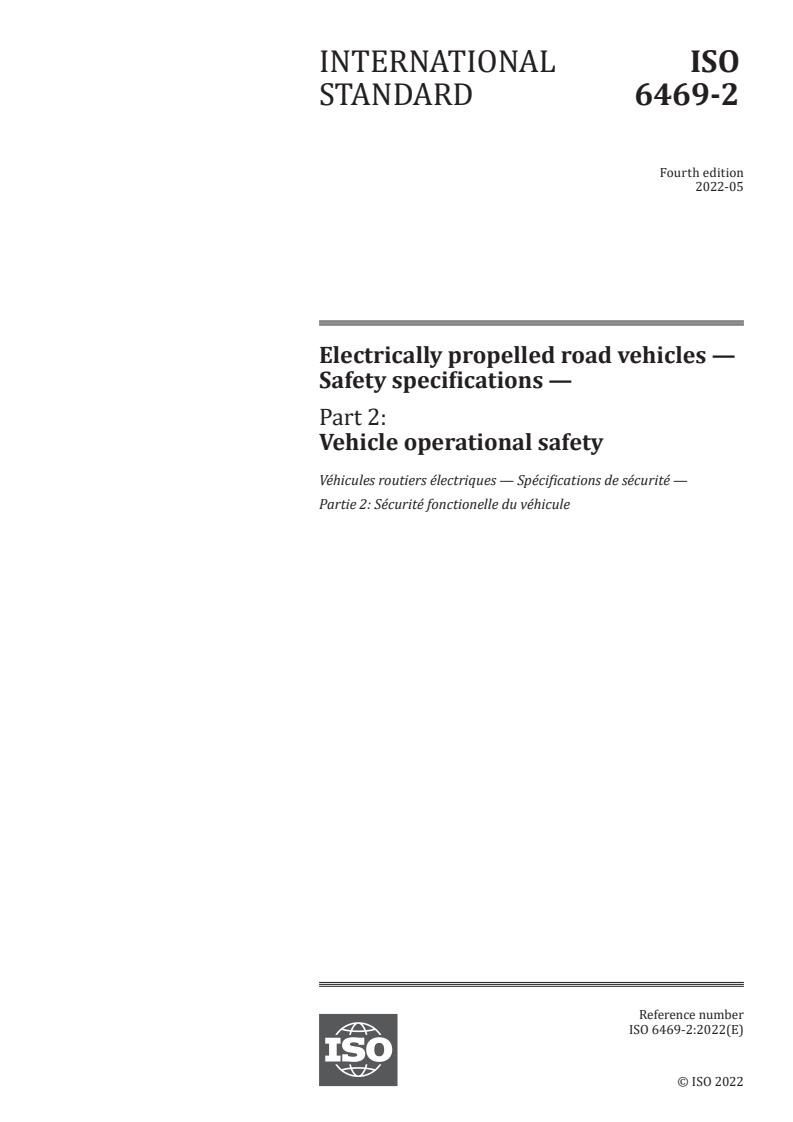
(Main)Electrically propelled road vehicles — Safety specifications — Part 2: Vehicle operational safety
General Information
- Abstract
This document specifies requirements for operational safety specific to electrically propelled road vehicles, for the protection of persons inside and outside the vehicle. Relevant requirements for motorcycles and mopeds are outside the scope of this document, they are described in the ISO 13063 series. This document does not provide comprehensive safety information for manufacturing, maintenance, and repair personnel. This document does not consider specific aspects of driving automation features. NOTE 1 For the definition of the term “driving automation features”, see SAE J3016. EMC is not covered by this document. NOTE 2 For EMC see ISO 11451 and IEC 61851-21-1.
- Status
- Published
- Publication Date
- 15-May-2022
- Technical Committee
- ISO/TC 22/SC 37 - Electrically propelled vehicles
- Drafting Committee
- ISO/TC 22/SC 37 - Electrically propelled vehicles
- Current Stage
- 6060 - International Standard published
- Start Date
- 16-May-2022
- Due Date
- 23-Jun-2022
- Completion Date
- 16-May-2022


Overview
ISO 6469-2:2022 - "Electrically propelled road vehicles - Safety specifications - Part 2: Vehicle operational safety" defines operational safety requirements specific to electrically propelled road vehicles (EVs). It focuses on protecting people inside and outside the vehicle during normal operation (driving, parking, auxiliary functions and charging connections). The standard excludes motorcycles/mopeds (covered by ISO 13063 series), electromagnetic compatibility (EMC), manufacturing/maintenance safety, and detailed driving automation aspects.
Key topics and requirements
- Driving‑enabled mode: Activation of propulsion must require at least two deliberate and distinctive actions; vehicles must indicate when propulsion is enabled. A main switch function is required for activation/deactivation.
- Single‑point failure management: Measures (for example, normally open/closed switches) must address credible single‑point failures that affect safety.
- Low energy (RESS) indications: If a low state of charge (SOC) affects driving performance, the vehicle must warn the driver and still be capable of being driven out of traffic; minimum energy reserve for lights is required if no separate storage for auxiliaries exists.
- Driving and reversing safeguards: Prevent unintentional switch into reverse - switching direction requires two actions or a safety device that only permits transition when stationary or moving slowly; the selected drive direction must be indicated to the driver.
- External sound generation system (ESGS / AVAS): New requirements for external acoustic signals to alert pedestrians and other road users. If fitted, the ESGS must automatically operate from vehicle start up to at least 20 km/h and during reversing (national regulations may vary). Sound characteristics should convey vehicle behavior and may be selectable by driver. A driver-accessible pause function may be provided but must default to “on” after restart.
- Auxiliary electric systems: Operational requirements apply to conductively connected auxiliary systems (e.g., lifts, cranes) because EVs emit less audible noise.
- Parking and information: Indication when propulsion remains in driving‑enabled mode; owners’ manual and first responder information are required.
Practical applications - who uses it
- EV manufacturers and vehicle systems engineers - to design propulsion controls, ESGS, indicators, and safety interlocks.
- Safety and compliance teams - to demonstrate operational safety requirements during type approval and conformity assessment.
- Test laboratories and certification bodies - for operational safety verification and EMC handoff references.
- Regulators and policymakers - to align national regulations with international operational safety norms.
- Emergency responders and fleet operators - to understand vehicle behavior, available warnings, and first‑responder guidance required by the standard.
Related standards
- ISO 6469 series (other parts address RESS, functional safety, etc.)
- ISO 16254 for testing external sound generation systems
- ISO 6469-1 / ISO 6469-3 for definitions and system-level safety
- IEC 61851 and ISO 11451 for EMC and charging interfaces (EMC not covered in ISO 6469-2)
- SAE J3016 for definition of driving automation features
Keywords: ISO 6469-2:2022, electrically propelled road vehicles, vehicle operational safety, external sound generation system, RESS, driving-enabled mode, EV safety specifications.
Relations
- Effective Date
- 10-Jul-2021
Get Certified
Connect with accredited certification bodies for this standard

TÜV Rheinland
TÜV Rheinland is a leading international provider of technical services.

TÜV SÜD
TÜV SÜD is a trusted partner of choice for safety, security and sustainability solutions.

DEKRA Certification Inc.
DEKRA US certification services.
Sponsored listings
Frequently Asked Questions
ISO 6469-2:2022 is a standard published by the International Organization for Standardization (ISO). Its full title is "Electrically propelled road vehicles — Safety specifications — Part 2: Vehicle operational safety". This standard covers: This document specifies requirements for operational safety specific to electrically propelled road vehicles, for the protection of persons inside and outside the vehicle. Relevant requirements for motorcycles and mopeds are outside the scope of this document, they are described in the ISO 13063 series. This document does not provide comprehensive safety information for manufacturing, maintenance, and repair personnel. This document does not consider specific aspects of driving automation features. NOTE 1 For the definition of the term “driving automation features”, see SAE J3016. EMC is not covered by this document. NOTE 2 For EMC see ISO 11451 and IEC 61851-21-1.
This document specifies requirements for operational safety specific to electrically propelled road vehicles, for the protection of persons inside and outside the vehicle. Relevant requirements for motorcycles and mopeds are outside the scope of this document, they are described in the ISO 13063 series. This document does not provide comprehensive safety information for manufacturing, maintenance, and repair personnel. This document does not consider specific aspects of driving automation features. NOTE 1 For the definition of the term “driving automation features”, see SAE J3016. EMC is not covered by this document. NOTE 2 For EMC see ISO 11451 and IEC 61851-21-1.
ISO 6469-2:2022 is classified under the following ICS (International Classification for Standards) categories: 43.120 - Electric road vehicles. The ICS classification helps identify the subject area and facilitates finding related standards.
ISO 6469-2:2022 has the following relationships with other standards: It is inter standard links to ISO 6469-2:2018. Understanding these relationships helps ensure you are using the most current and applicable version of the standard.
ISO 6469-2:2022 is available in PDF format for immediate download after purchase. The document can be added to your cart and obtained through the secure checkout process. Digital delivery ensures instant access to the complete standard document.
Standards Content (Sample)
INTERNATIONAL ISO
STANDARD 6469-2
Fourth edition
2022-05
Electrically propelled road vehicles —
Safety specifications —
Part 2:
Vehicle operational safety
Véhicules routiers électriques — Spécifications de sécurité —
Partie 2: Sécurité fonctionelle du véhicule
Reference number
© ISO 2022
All rights reserved. Unless otherwise specified, or required in the context of its implementation, no part of this publication may
be reproduced or utilized otherwise in any form or by any means, electronic or mechanical, including photocopying, or posting on
the internet or an intranet, without prior written permission. Permission can be requested from either ISO at the address below
or ISO’s member body in the country of the requester.
ISO copyright office
CP 401 • Ch. de Blandonnet 8
CH-1214 Vernier, Geneva
Phone: +41 22 749 01 11
Email: copyright@iso.org
Website: www.iso.org
Published in Switzerland
ii
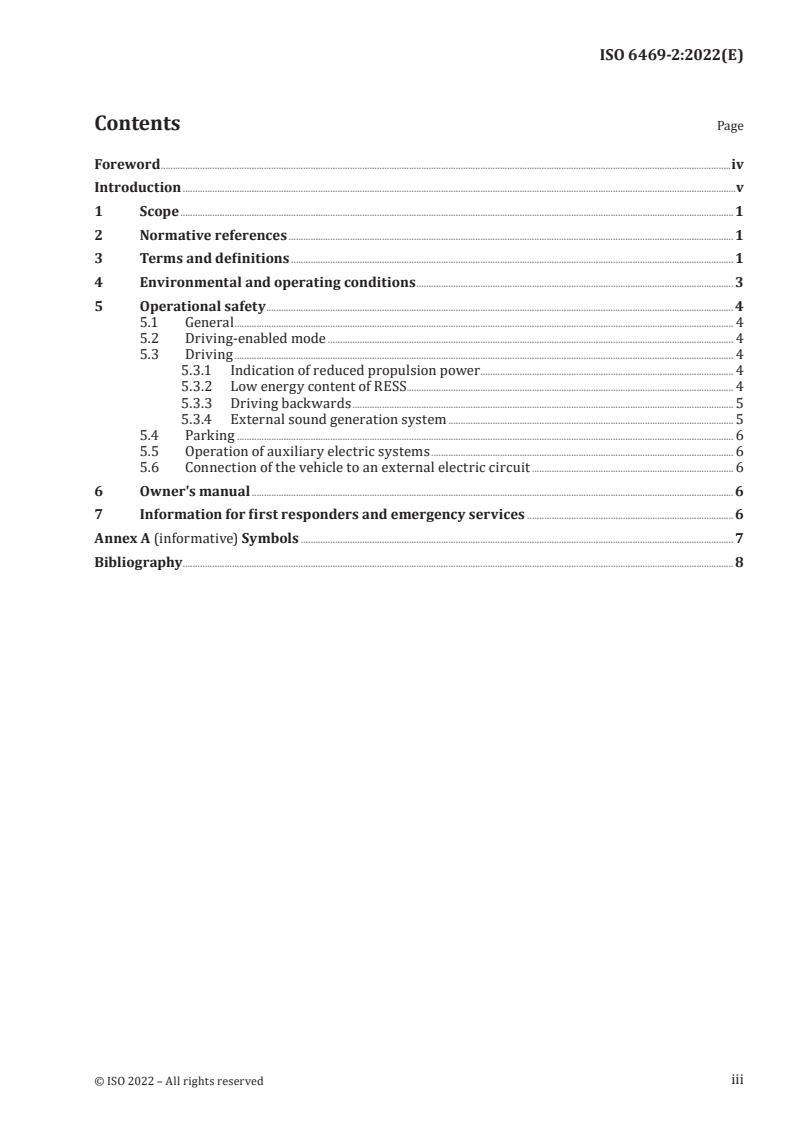
Contents Page
Foreword .iv
Introduction .v
1 Scope . 1
2 Normative references . 1
3 Terms and definitions . 1
4 Environmental and operating conditions . 3
5 Operational safety . 4
5.1 General . 4
5.2 Driving-enabled mode . 4
5.3 Driving . 4
5.3.1 Indication of reduced propulsion power . 4
5.3.2 Low energy content of RESS. 4
5.3.3 Driving backwards . 5
5.3.4 External sound generation system . 5
5.4 Parking . 6
5.5 Operation of auxiliary electric systems . 6
5.6 Connection of the vehicle to an external electric circuit . 6
6 Owner's manual . 6
7 Information for first responders and emergency services . 6
Annex A (informative) Symbols . 7
Bibliography . 8
iii
Foreword
ISO (the International Organization for Standardization) is a worldwide federation of national standards
bodies (ISO member bodies). The work of preparing International Standards is normally carried out
through ISO technical committees. Each member body interested in a subject for which a technical
committee has been established has the right to be represented on that committee. International
organizations, governmental and non-governmental, in liaison with ISO, also take part in the work.
ISO collaborates closely with the International Electrotechnical Commission (IEC) on all matters of
electrotechnical standardization.
The procedures used to develop this document and those intended for its further maintenance are
described in the ISO/IEC Directives, Part 1. In particular, the different approval criteria needed for the
different types of ISO documents should be noted. This document was drafted in accordance with the
editorial rules of the ISO/IEC Directives, Part 2 (see www.iso.org/directives).
Attention is drawn to the possibility that some of the elements of this document may be the subject of
patent rights. ISO shall not be held responsible for identifying any or all such patent rights. Details of
any patent rights identified during the development of the document will be in the Introduction and/or
on the ISO list of patent declarations received (see www.iso.org/patents).
Any trade name used in this document is information given for the convenience of users and does not
constitute an endorsement.
For an explanation of the voluntary nature of standards, the meaning of ISO specific terms and
expressions related to conformity assessment, as well as information about ISO's adherence to
the World Trade Organization (WTO) principles in the Technical Barriers to Trade (TBT), see
www.iso.org/iso/foreword.html.
This document was prepared by Technical Committee ISO/TC 22, Road vehicles, Subcommittee SC 37,
Electrically propelled vehicles.
This fourth edition cancels and replaces the third edition (ISO 6469-2:2018), which has been technically
revised.
The main changes are as follows:
— introduction of requirements for an external sound generation system;
— introduction of requirements for the operation of auxiliary electric systems;
— addition of an informative annex on standardized symbols for driver information.
A list of all parts in the ISO 6469 series can be found on the ISO website.
Any feedback or questions on this document should be directed to the user’s national standards body. A
complete listing of these bodies can be found at www.iso.org/members.html.
iv
Introduction
This document is the second part of the ISO 6469 series that provide safety specifications for electrically
propelled road vehicles.
Electrically propelled road vehicles have different functions and characteristics compared to
conventional vehicles.
This document addresses such characteristics with regard to the operational safety of electrically
propelled road vehicles.
v
INTERNATIONAL STANDARD ISO 6469-2:2022(E)
Electrically propelled road vehicles — Safety
specifications —
Part 2:
Vehicle operational safety
1 Scope
This document specifies requirements for operational safety specific to electrically propelled road
vehicles, for the protection of persons inside and outside the vehicle.
Relevant requirements for motorcycles and mopeds are outside the scope of this document, they are
described in the ISO 13063 series.
This document does not provide comprehensive safety information for manufacturing, maintenance,
and repair personnel.
This document does not consider specific aspects of driving automation features.
NOTE 1 For the definition of the term “driving automation features”, see SAE J3016.
EMC is not covered by this document.
NOTE 2 For EMC see ISO 11451 and IEC 61851-21-1.
2 Normative references
There are no normative references in this document.
3 Terms and definitions
For the purposes of this document, the following terms and definitions apply.
ISO and IEC maintain terminology databases for use in standardization at the following addresses:
— ISO Online browsing platform: available at https:// www .iso .org/ obp
— IEC Electropedia: available at http:// www .electropedia .org/
3.1
auxiliary electric system
vehicle system, other than for vehicle propulsion, that operates on electric energy
[SOURCE: ISO 6469-3:2021, 3.1]
3.2
case A
connection of an electrically-propelled vehicle (EV) (3.6) to the supply network with a plug and cable
permanently attached to the EV
[SOURCE: IEC 61851-1:2017, 3.1.10]
3.3
case B
connection of an electrically-propelled vehicle (EV) (3.6) to the AC supply network with a cable assembly
detachable at both ends
[SOURCE: IEC 61851-1:2017, 3.1.11]
3.4
case C
connection of an electrically-propelled vehicle (EV) (3.6) to the AC supply network utilizing a cable and
vehicle connector (3.16) permanently attached to the EV charging station
[SOURCE: IEC 61851-1:2017, 3.1.12]
3.5
driving-enabled mode
operating mode in which the vehicle can be moved by its own propulsion system (3.12) by one action
Note 1 to entry: Examples for this action are: pressure to the accelerator pedal, activation of an equivalent
control, release of the brake system.
3.6
electrically-propelled vehicle
EV
vehicle with one or more electric drive(s) for vehicle propulsion
[SOURCE: ISO 6469-3:2021, 3.15]
3.7
external electric circuit
electric circuit which connects to the vehicle power supply circuit (3.18) using the plug [case A (3.2)], the
vehicle inlet [case B (3.3) and case C (3.4)], the ACD counterpart [case D] or the ACD [case E] or electric
circuit which is magnetically coupled with the secondary coil
3.8
external electric power supply
electric power source that is not part of the vehicle for supplying electric energy to a vehicle
[SOURCE: ISO 17409:2020, 3.28]
3.9
external sound generation system
system that provides an acoustic signal to the external environment of the vehicle for the purpose to
provide information to pedestrians
[SOURCE: ISO 16254:2016, 3.3]
Note 1 to entry: Some documents use the equivalent term “acoustic vehicle alerting system (AVAS)”.
3.10
fuel cell system
system, typically containing the following subsystems: fuel cell stack, air processing, fuel processing,
thermal management, water management, and their control
[SOURCE: ISO 6469-3:2021, 3.21]
---------------------- Page
...