

ISO 4883:1978
(Main)Hardmetals — Determination of contents of metallic elements by X-ray fluorescence — Solution method
General Information
- Abstract
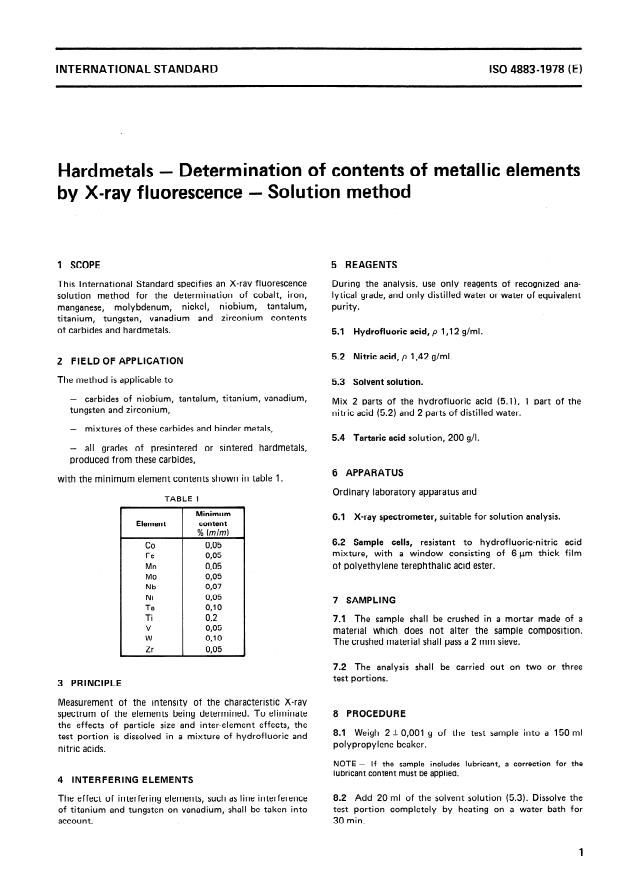
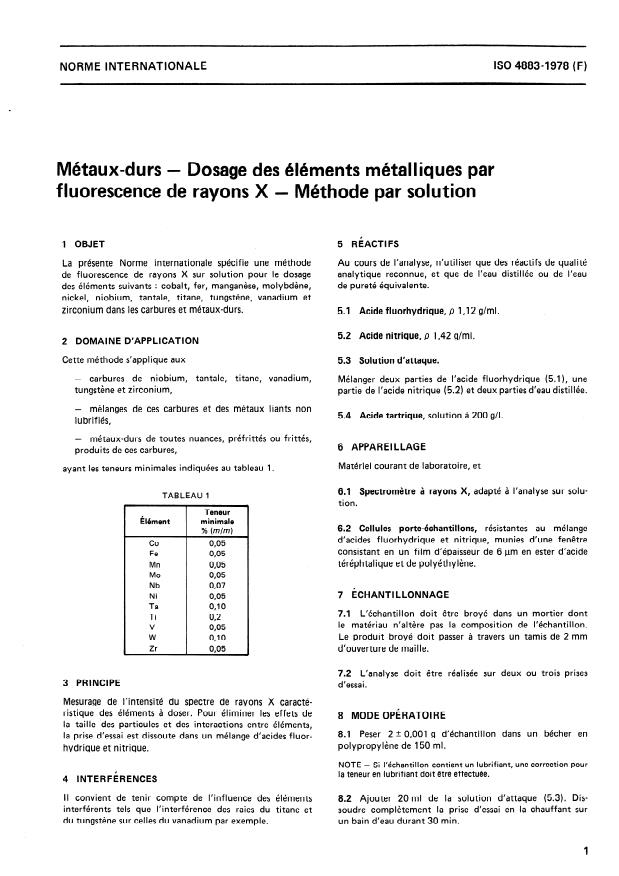
The solution method determines cobalt, iron, manganese, molybdenum, nickel, niobium, tantalum, titanium, tungsten, vanadium and zirconium. Is applicable to carbides of niobium, tantalum, titanium, vanadium, tungsten and zirconium, mixtures of these carbides and binder metals, all grades of presintered or sintered hardmetals, produce from these carbides, with the minimum element contents shown in table 1.
- Status
- Published
- Publication Date
- 31-May-1978
- Technical Committee
- ISO/TC 119/SC 4 - Sampling and testing methods for hardmetals
- Drafting Committee
- ISO/TC 119/SC 4 - Sampling and testing methods for hardmetals
- Current Stage
- 9093 - International Standard confirmed
- Start Date
- 22-Sep-2022
- Completion Date
- 29-Aug-2026
Buy Documents

ISO 4883:1978 - Hardmetals — Determination of contents of metallic elements by X-ray fluorescence — Solution method Released:6/1/1978

ISO 4883:1978 - Métaux-durs — Dosage des éléments métalliques par fluorescence de rayons X — Méthode par solution Released:6/1/1978

ISO 4883:1978 - Métaux-durs — Dosage des éléments métalliques par fluorescence de rayons X — Méthode par solution Released:6/1/1978
Overview
ISO 4883:1978 is an international standard developed by the International Organization for Standardization (ISO) specifying a solution method using X-ray fluorescence (XRF) for the accurate determination of metallic element contents in hardmetals. This method applies to carbides of niobium, tantalum, titanium, vanadium, tungsten, and zirconium, as well as mixtures of these carbides with binder metals. It is suitable for all grades of presintered or sintered hardmetals produced from these carbides, with minimum elemental contents defined for analysis.
The standard outlines procedures for preparing samples, reagents, and calibration curves along with detailed instructions on measurement, ensuring precision and repeatability in quantifying cobalt, iron, manganese, molybdenum, nickel, niobium, tantalum, titanium, tungsten, vanadium, and zirconium in hardmetal materials using XRF spectrometry.
Key Topics
Scope and Applicability
Applicable to carbides and hardmetals with minimum elemental content thresholds. Focuses on metallic elements critical to hardmetal quality.Principle of Analysis
Utilizes X-ray fluorescence spectrometry, measuring the characteristic X-ray emission from dissolved samples to identify and quantify metal elements.Sample Preparation
Includes crushing samples to a fine size, dissolution in hydrofluoric and nitric acid mixture, and proper filtration before measurement.Reagents and Apparatus
Specifies the use of analytical-grade hydrofluoric acid, nitric acid, tartaric acid solution, and solvent mixtures. Requires an X-ray spectrometer equipped with suitable sample cells resistant to acids.Calibration Curves
Calibration performed with mixtures of known pure metals or compounds to generate element-specific curves enabling precise concentration calculations.Interference and Accuracy
Addresses inter-element interference, notably between titanium, tungsten, and vanadium, and requires background corrections where necessary for reliable results.Result Expression and Reporting
Results reported as the mean of two or three determinations within specified tolerance ranges. Detailed test report requirements ensure comprehensive documentation.
Applications
Hardmetal Quality Control
Enables manufacturers to verify the elemental composition of hardmetals used in cutting tools and wear-resistant parts, maintaining product standards.Material Certification
Facilitates testing labs in certifying hardmetal products according to international norms, promoting consistency and market acceptance.Research and Development
Supports metallurgists and material scientists in analyzing carbide mixtures and optimizing formulations for improved hardness and durability.Process Monitoring
Provides a rapid, reliable testing method for monitoring production batches, ensuring conformity with required chemical specifications.
Related Standards
ISO/TC 119: Powder Metallurgical Materials and Products
The technical committee responsible for powder metallurgy, under which ISO 4883 was developed.ISO Standards on X-ray Fluorescence Methods
Complementary standards detailing various XRF analytical methods for metals and alloys.ISO Standards for Hardmetal Material Specifications
Other applicable standards focusing on mechanical and physical properties testing of hardmetals.
Keywords: ISO 4883, hardmetals, X-ray fluorescence, metallic element determination, solution method, cobalt analysis, tungsten carbide, niobium carbide, sintered hardmetals, chemical analysis, powder metallurgy, metallurgical standards, calibration curves, sample preparation.
Buy Documents
ISO 4883:1978 - Hardmetals — Determination of contents of metallic elements by X-ray fluorescence — Solution method Released:6/1/1978
ISO 4883:1978 - Métaux-durs — Dosage des éléments métalliques par fluorescence de rayons X — Méthode par solution Released:6/1/1978
ISO 4883:1978 - Métaux-durs — Dosage des éléments métalliques par fluorescence de rayons X — Méthode par solution Released:6/1/1978
Get Certified
Connect with accredited certification bodies for this standard

Element Materials Technology
Materials testing and product certification.

Inštitut za kovinske materiale in tehnologije
Institute of Metals and Technology. Materials testing, metallurgical analysis, NDT.
Sponsored listings
Frequently Asked Questions
ISO 4883:1978 is a standard published by the International Organization for Standardization (ISO). Its full title is "Hardmetals — Determination of contents of metallic elements by X-ray fluorescence — Solution method". This standard covers: The solution method determines cobalt, iron, manganese, molybdenum, nickel, niobium, tantalum, titanium, tungsten, vanadium and zirconium. Is applicable to carbides of niobium, tantalum, titanium, vanadium, tungsten and zirconium, mixtures of these carbides and binder metals, all grades of presintered or sintered hardmetals, produce from these carbides, with the minimum element contents shown in table 1.
The solution method determines cobalt, iron, manganese, molybdenum, nickel, niobium, tantalum, titanium, tungsten, vanadium and zirconium. Is applicable to carbides of niobium, tantalum, titanium, vanadium, tungsten and zirconium, mixtures of these carbides and binder metals, all grades of presintered or sintered hardmetals, produce from these carbides, with the minimum element contents shown in table 1.
ISO 4883:1978 is classified under the following ICS (International Classification for Standards) categories: 77.160 - Powder metallurgy. The ICS classification helps identify the subject area and facilitates finding related standards.
ISO 4883:1978 is available in PDF format for immediate download after purchase. The document can be added to your cart and obtained through the secure checkout process. Digital delivery ensures instant access to the complete standard document.
Standards Content (Sample)
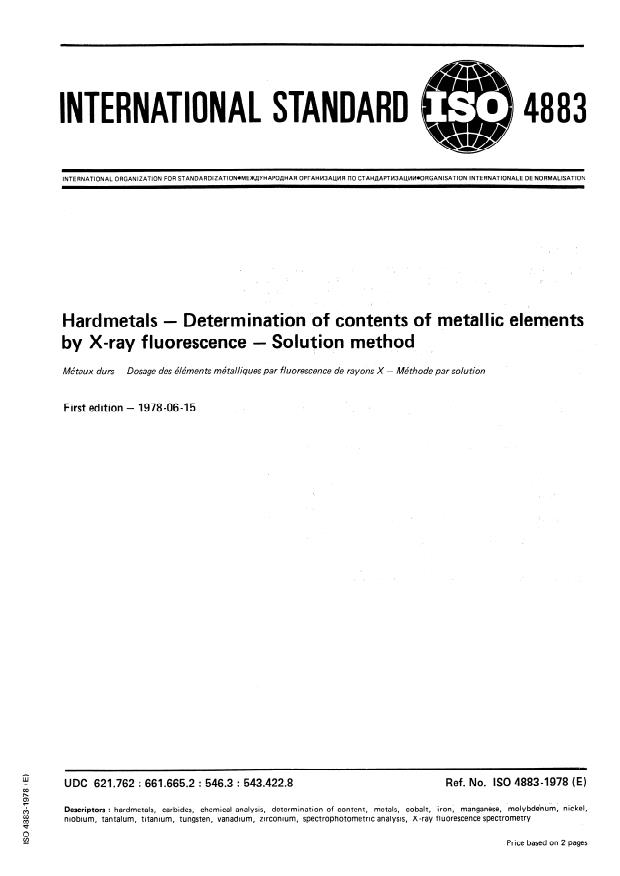
INTERNATIONAL ‘STANDARD
INTERNATIONAL ORGANIZATION FOR STANDARDIZATION*MEWYHAPO,llHAR OPI-AHM3ALWlR fl0 CTAH~APTM3ALWWl.ORGANISATlON INTERNATIONALE DE NORMALISATION
. ,
:
Hardmetals - Determination ‘of contents of metallic elements
by X-ray fluorescence - Solution method
Mb taux-durs - Dosage des bfkmen ts metalliques par fluorescence de rayons X - Mthode par Solution
First edition - 1978-06-15
Ref. No. ISO 4883-1978 (E)
UDC 621.762 : 661.665.2 : 546.3 : 543.422.8
determination of content, metals, Cobalt, ironj manganke, molybdenum; nickel,
Descriptors : hardmetals, carbides, Chemical analysis,
X -ray fluorescence spectrometry
niobium, tantalum, titanium, tungsten, vanadium, zirconium, spectrophotometric analysis,
Price based on 2 pages
FOREWORD
ISO (the International Organization for Standardization) is a worldwide federation
of national Standards institutes (ISO member bodies). The work of developing
International Standards is carried out through ISO technical committees. Every
member body interested in a subject for which a technical committee has been set
up has the right to be represented on that committee. International organizations,
governmental and non-governmental, in liaison with ISO, also take part in the work.
Draft International Standards adopted by the technical committees are circulated
to the member bodies for approval before their acceptance as International
Standards by the ISO Council.
International Standard ISO 4883 was developed by Technical Committee
ISO/TC 119, Powder metallurgical materials and products, and was circulated
to the member bodies in December 1977.
lt has been approved by the member bodies of the following countries :
Germany South Africa, Rep. of
Australia
Austria I reland Spain
Bulgaria I taly Sweden
Canada Japan Turkey
Chile Korea, Rep. of United Kingdom
Mexico U.S.A
Czechoslovakia
Poland U.S.S. R
Egypt, Arab Rep. of
Romania
France
No member body expressed disapproval of the document.
@ International Organkation for Standardkation, 1978 l
Printed in Switzerland
INTERNATIONAL STANDARD
ISO 4883-1978 (El
Determination of contents of metallic elements
Hardmetals -
by X-ray fluorescence - Solution method
5 REAGENTS
1 SCOPE
During the analysis, use only reagents of recognized ana-
This International Standard specifies an X-ray f luorescence
lytical grade, and only distilled water or water of eouivalent
Solution method for the determination of Cobalt, iron,
nickel, niobium, tantalum, purity.
manganese, molybdenum,
vanadium and zirconium contents
titanium, tungsten,
of carbides and hardmetals.
5.1 Hydrofluoric acid, p 1 ,12 g/ml.
5.2 Nitrit acid, p 1,42 g/ml.
2 FIELD OF APPLICATION
The method is applicable to
5.3 Solvent Solution.
-
carbides of niobium, tantalum, titanium, vanadium,
Mix 2 Parts of the hydrofluoric acid (5.1), 1 part of the
tungsten and zirconium,
nitric acid (5.2) and 2 Parts of distilled water.
-
mixtures of these carbides and binder metals,
5.4 Tartaric acid Solution, 200 g/l.
-
all grades of presintered or sintered hardmetals,
produced f rom these carbides,
6 APPARATUS
with the minimum element contents shown in table 1.
Ordinary laboratory apparatus and
TABLE 1
Minimum
6.1 X-ray spectrometer, suitable for Solution analysis.
Element content
% (mlm)
6.2 Sample cells, resistant to hydrofluoric-nitric acid
Co 0,05
mixture, with a window consisting of 6 um thick film
Fe 0,05
Mn 0,05 of polyethylene terephthalic acid ester.
Mo 0,05
Nb 0,07
Ni 0,05
7 SAMPLING
Ta 0,lO
Ti 02
7.1 The Sample
...
~~ ~-
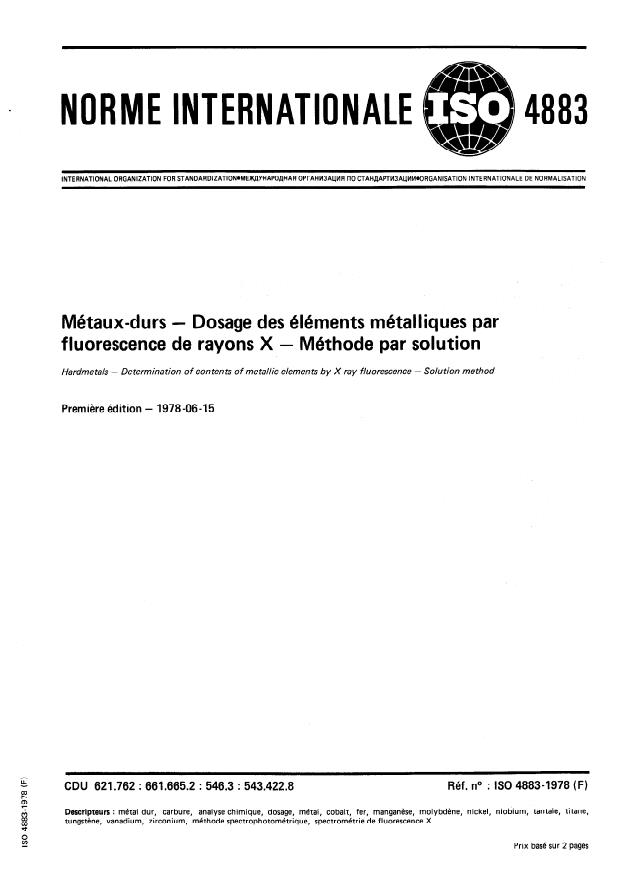
NORME INTERNATIONALE
INTERNATIONAL ORGANIZATION FOR STANDARDlzATlON.MEWYHAPO4HAR OPI-AHM3ALWlR fl0 CTAH~APTbl3A~MM.ORGANISATlON INTERNATIONALE DE NORMALISATION
Métaux-durs - Dosage des 6léments métalliques par
fluorescence de rayons X - Méthode par solution
Hardme tals - Determination of contents of metallic elemen ts b y X-ray fluorescence - Solution method
Première édition - 1978-06-15
Réf. no : ISO 48834978 (F)
CDU 621.762 : 661.665.2 : 546.3 : 543.422.8
Descripteurs : métal dur, carbure, analyse chimique, dosage, métal, cobalt, fer, manganèse, molybdène, nickel, niobium, tantale, titane,
tungstène, vanadium, zirconium, méthode spectrophotométrique, spectrométrie de fluorescence X
Prix basé sur 2 pages
AVANT-PROPOS
L’ISO (Organisation internationale de normalisation) est une fédération mondiale
d’organismes nationaux de normalisation (comités membres de I’ISO). L’élaboration
des Normes internationales est confiée aux comités techniques de I’ISO. Chaque
comité membre intéressé par une étude a le droit de faire partie du comité technique
correspondant. Les organisations internationales, gouvernementales et non
gouvernementales, en liaison avec I’ISO, participent également aux travaux.
Les projets de Normes internationales adoptés par les comités techniques sont
soumis aux comités membres pour approbation, avant leur acceptation comme
Normes internationales par le Conseil de I’ISO.
La Norme internationale ISO 4883 a été élaborée par le comité technique
ISO /TC 119, Matières premières et produits de la métallurgie des poudres, et
a été soumise aux comités membres en décembre 1977.
Les comités membres des pays suivants l’ont approuvée :
Afrique du Sud, Rép. d’ Égypte, Rép. arabe d’ Roumanie
Allemagne Espagne Royaume-Uni
Australie France Suède
Autriche Irlande Tchécoslovaquie
Bulgarie Italie Turquie
Canada Japon U.R.S.S
Chili Mexique U.S.A
Corée, Rép. de Pologne
Aucun comité membre ne l’a désapprouvée.
0 Organisation internationale de normalisation, 1978 l
Imprimé en Suisse
NORME INTERNATIONALE ISO 4883-1978 (F)
Métaux-durs
- Dosage des éléments métalliques par
fluorescence de rayons X - Méthode par solution
1 OBJET 5 RÉACTIFS
Au cours de l’analyse, n’utiliser que des réactifs de qualité
La présente Norme internationale spécifie une méthode
analytique reconnue, et que de l’eau distillée ou de l’eau
de fluorescence de rayons X sur solution pour le dosage
de pureté équivalente.
des éléments suivants : cobalt, fer, manganèse, molybdène,
nickel, niobium, tantale, titane, tungstène, vanadium et
zirconium dans les carbures et métaux-durs.
5.1 Acide fluorhydrique, p 1 ,12 g/ml.
5.2 Acide nitrique, p 1,42 g/ml.
2 DOMAINE D’APPLICATION
Cette méthode s’applique aux
5.3 Solution d’attaque.
-
carbures de niobium, tantale, titane, vanadium,
Mélanger deux parties de l’acide fluorhydrique (5.1), une
tungstène et zirconium, partie de l’acide nitrique (5.2) et deux parties d’eau distillée.
-
mélanges de ces carbures et des métaux liants non
5.4 Acide tartrique, solution à 200 g/l.
lubrifiés,
-
métaux-durs de toutes nuances, préfrittés ou frittés,
6 APPAREILLAGE
produits de ces carbures,
Matériel courant de laboratoire, et
ayant les teneurs minimales indiquées au tableau 1.
6.1 Spectromètre à rayons X, adapté à l’analyse sur solu-
TABLEAU 1
tion.
Teneur
Éldment minimale
6.2 Cellules porte-échantillons, résistantes au mélange
% (mlm)
d’acides fluorhydrique et nitrique, munies d’une fenêtre
CO 0,05
consistant en un film d’épaisseur de 6 um en ester d’acide
Fe 0,05
téréphtalique et de polyéthylène.
Mn 0,05
Mo 0,05
Nb 0,07
Ni 0,05 7 ÉCHANTILLONNAGE
Ta 0,lO
7.1 L’échantillon doit être broyé dans un mortier dont
Ti
le matériau n’altère pas la composition de l’échantillon.
v 0,05
Le produit broyé doit passer à tr
...
~~ ~-
NORME INTERNATIONALE
INTERNATIONAL ORGANIZATION FOR STANDARDlzATlON.MEWYHAPO4HAR OPI-AHM3ALWlR fl0 CTAH~APTbl3A~MM.ORGANISATlON INTERNATIONALE DE NORMALISATION
Métaux-durs - Dosage des 6léments métalliques par
fluorescence de rayons X - Méthode par solution
Hardme tals - Determination of contents of metallic elemen ts b y X-ray fluorescence - Solution method
Première édition - 1978-06-15
Réf. no : ISO 48834978 (F)
CDU 621.762 : 661.665.2 : 546.3 : 543.422.8
Descripteurs : métal dur, carbure, analyse chimique, dosage, métal, cobalt, fer, manganèse, molybdène, nickel, niobium, tantale, titane,
tungstène, vanadium, zirconium, méthode spectrophotométrique, spectrométrie de fluorescence X
Prix basé sur 2 pages
AVANT-PROPOS
L’ISO (Organisation internationale de normalisation) est une fédération mondiale
d’organismes nationaux de normalisation (comités membres de I’ISO). L’élaboration
des Normes internationales est confiée aux comités techniques de I’ISO. Chaque
comité membre intéressé par une étude a le droit de faire partie du comité technique
correspondant. Les organisations internationales, gouvernementales et non
gouvernementales, en liaison avec I’ISO, participent également aux travaux.
Les projets de Normes internationales adoptés par les comités techniques sont
soumis aux comités membres pour approbation, avant leur acceptation comme
Normes internationales par le Conseil de I’ISO.
La Norme internationale ISO 4883 a été élaborée par le comité technique
ISO /TC 119, Matières premières et produits de la métallurgie des poudres, et
a été soumise aux comités membres en décembre 1977.
Les comités membres des pays suivants l’ont approuvée :
Afrique du Sud, Rép. d’ Égypte, Rép. arabe d’ Roumanie
Allemagne Espagne Royaume-Uni
Australie France Suède
Autriche Irlande Tchécoslovaquie
Bulgarie Italie Turquie
Canada Japon U.R.S.S
Chili Mexique U.S.A
Corée, Rép. de Pologne
Aucun comité membre ne l’a désapprouvée.
0 Organisation internationale de normalisation, 1978 l
Imprimé en Suisse
NORME INTERNATIONALE ISO 4883-1978 (F)
Métaux-durs
- Dosage des éléments métalliques par
fluorescence de rayons X - Méthode par solution
1 OBJET 5 RÉACTIFS
Au cours de l’analyse, n’utiliser que des réactifs de qualité
La présente Norme internationale spécifie une méthode
analytique reconnue, et que de l’eau distillée ou de l’eau
de fluorescence de rayons X sur solution pour le dosage
de pureté équivalente.
des éléments suivants : cobalt, fer, manganèse, molybdène,
nickel, niobium, tantale, titane, tungstène, vanadium et
zirconium dans les carbures et métaux-durs.
5.1 Acide fluorhydrique, p 1 ,12 g/ml.
5.2 Acide nitrique, p 1,42 g/ml.
2 DOMAINE D’APPLICATION
Cette méthode s’applique aux
5.3 Solution d’attaque.
-
carbures de niobium, tantale, titane, vanadium,
Mélanger deux parties de l’acide fluorhydrique (5.1), une
tungstène et zirconium, partie de l’acide nitrique (5.2) et deux parties d’eau distillée.
-
mélanges de ces carbures et des métaux liants non
5.4 Acide tartrique, solution à 200 g/l.
lubrifiés,
-
métaux-durs de toutes nuances, préfrittés ou frittés,
6 APPAREILLAGE
produits de ces carbures,
Matériel courant de laboratoire, et
ayant les teneurs minimales indiquées au tableau 1.
6.1 Spectromètre à rayons X, adapté à l’analyse sur solu-
TABLEAU 1
tion.
Teneur
Éldment minimale
6.2 Cellules porte-échantillons, résistantes au mélange
% (mlm)
d’acides fluorhydrique et nitrique, munies d’une fenêtre
CO 0,05
consistant en un film d’épaisseur de 6 um en ester d’acide
Fe 0,05
téréphtalique et de polyéthylène.
Mn 0,05
Mo 0,05
Nb 0,07
Ni 0,05 7 ÉCHANTILLONNAGE
Ta 0,lO
7.1 L’échantillon doit être broyé dans un mortier dont
Ti
le matériau n’altère pas la composition de l’échantillon.
v 0,05
Le produit broyé doit passer à tr
...