

ISO 17939:2015
(Main)Ships and marine technology — Oil tank hatches
General Information
- Abstract
ISO 17939:2015 specifies the classification, structure and main dimensions, materials, quality of manufacture, testing of watertightness and designation for oil tank hatches for application on board ships in order to ensure interchangeability of the hatches. The remaining dimensions, welding, and other details are left to the manufacturer. These hatches generally conform to the requirements of the International Convention on Load Lines 1966 (ILLC66). These structures and specifications of oil-tight hatch covers in this ISO 17939:2015 meet IACS UR S26 requirements. The possibility for application in position 1 and position 2 has to be considered for each situation and, where necessary, the hatch covers shall be provided with additional stiffening. ISO 17939:2015 is applicable to the design, manufacturing, and test of accommodation ladders, as well as accommodation ladder used specifically in combination with pilot ladder (hereinafter referred as "pilot accommodation ladder"). Users of ISO 17939:2015 should note that while observing the requirements of ISO 17939:2015, they should, at the same time, ensure compliance with such statutory requirements, rules, and regulations as may be applicable to the individual ship concerned.
- Status
- Published
- Publication Date
- 31-Aug-2015
- Technical Committee
- ISO/TC 8/SC 8 - Ship design
- Drafting Committee
- ISO/TC 8/SC 8 - Ship design
- Current Stage
- 9060 - Close of review
- Completion Date
- 02-Sep-2031
Buy Documents
ISO 17939:2015 - Ships and marine technology -- Oil tank hatches
ISO 17939:2015 - Ships and marine technology — Oil tank hatches/1/2015
Overview - ISO 17939:2015 (Oil tank hatches)
ISO 17939:2015 establishes requirements for oil tank hatches used on ships and other marine structures to ensure interchangeability, structural integrity and watertight performance. The standard specifies classification, structure and main dimensions, materials, quality of manufacture, testing of watertightness and designation for a range of hatch types. It aligns with the International Convention on Load Lines 1966 (ILLC66) and meets IACS UR S26 requirements. While ISO 17939:2015 defines key dimensions and components, remaining detailed design elements (welding, secondary dimensions) are left to the manufacturer. Users must also ensure compliance with applicable statutory and classification society rules.
Key topics and technical requirements
- Classification and types: Defines hatch categories (A1, A1F, A2, A2F, B, BF, C1, C1F, C2, C2F) to cover flat, curved and combined configurations for circular and long-circular openings.
- Main dimensions and nominal sizes: Provides dimensional tables and figures for standard nominal sizes (examples: A-type circular hatches 600–1 200 mm; B-type long circular 600×800 up to 850×1 500 mm; C-types for combined openings).
- Structure and components: Specifies typical hatch elements such as coaming, cover plate, seal ring, clamping ring, clamp plate, lock catch, wing clamp, actuators and bearing pads to achieve oil-tight performance.
- Materials and manufacture: Addresses material selection and quality of manufacture, including surface treatment and rust protection in line with ISO 8501‑1 visual preparation guidelines.
- Watertightness testing: Requires testing procedures to verify oil‑tight integrity; testing and designation requirements are included to ensure interchangeability and performance.
- Application positions and stiffening: Notes consideration of installation positions (position 1 and position 2) and the need for additional stiffening where necessary.
- Designation and documentation: Defines how hatches should be designated and documented for identification and installation.
Practical applications and who uses ISO 17939:2015
- Shipbuilders and hatch-cover manufacturers - for standardized design, production and interchangeability.
- Naval architects and marine engineers - to specify hatch types, dimensions and structural requirements during vessel design.
- Classification societies and surveyors - to assess compliance with IACS UR S26 and load‑line requirements.
- Ship owners, operators and shipyards - for procurement, retrofit and maintenance of oil-tight hatch covers.
- Regulators and flag administrations - as part of compliance checks against statutory load-line rules.
Users should apply ISO 17939:2015 together with applicable statutory regulations and classification society rules to ensure full compliance.
Related standards and references
- ISO 8501‑1 (surface preparation - rust grades and preparation grades)
- International Convention on Load Lines 1966 (ILLC66)
- IACS Unified Requirement S26 (UR S26)
Buy Documents
ISO 17939:2015 - Ships and marine technology -- Oil tank hatches
ISO 17939:2015 - Ships and marine technology — Oil tank hatches/1/2015
Get Certified
Connect with accredited certification bodies for this standard

DNV
DNV is an independent assurance and risk management provider.

Lloyd's Register
Lloyd's Register is a global professional services organisation specialising in engineering and technology.

FSC International
Forest Stewardship Council certification.
Sponsored listings
Frequently Asked Questions
ISO 17939:2015 is a standard published by the International Organization for Standardization (ISO). Its full title is "Ships and marine technology — Oil tank hatches". This standard covers: ISO 17939:2015 specifies the classification, structure and main dimensions, materials, quality of manufacture, testing of watertightness and designation for oil tank hatches for application on board ships in order to ensure interchangeability of the hatches. The remaining dimensions, welding, and other details are left to the manufacturer. These hatches generally conform to the requirements of the International Convention on Load Lines 1966 (ILLC66). These structures and specifications of oil-tight hatch covers in this ISO 17939:2015 meet IACS UR S26 requirements. The possibility for application in position 1 and position 2 has to be considered for each situation and, where necessary, the hatch covers shall be provided with additional stiffening. ISO 17939:2015 is applicable to the design, manufacturing, and test of accommodation ladders, as well as accommodation ladder used specifically in combination with pilot ladder (hereinafter referred as "pilot accommodation ladder"). Users of ISO 17939:2015 should note that while observing the requirements of ISO 17939:2015, they should, at the same time, ensure compliance with such statutory requirements, rules, and regulations as may be applicable to the individual ship concerned.
ISO 17939:2015 specifies the classification, structure and main dimensions, materials, quality of manufacture, testing of watertightness and designation for oil tank hatches for application on board ships in order to ensure interchangeability of the hatches. The remaining dimensions, welding, and other details are left to the manufacturer. These hatches generally conform to the requirements of the International Convention on Load Lines 1966 (ILLC66). These structures and specifications of oil-tight hatch covers in this ISO 17939:2015 meet IACS UR S26 requirements. The possibility for application in position 1 and position 2 has to be considered for each situation and, where necessary, the hatch covers shall be provided with additional stiffening. ISO 17939:2015 is applicable to the design, manufacturing, and test of accommodation ladders, as well as accommodation ladder used specifically in combination with pilot ladder (hereinafter referred as "pilot accommodation ladder"). Users of ISO 17939:2015 should note that while observing the requirements of ISO 17939:2015, they should, at the same time, ensure compliance with such statutory requirements, rules, and regulations as may be applicable to the individual ship concerned.
ISO 17939:2015 is classified under the following ICS (International Classification for Standards) categories: 47.020.10 - Hulls and their structure elements. The ICS classification helps identify the subject area and facilitates finding related standards.
ISO 17939:2015 is available in PDF format for immediate download after purchase. The document can be added to your cart and obtained through the secure checkout process. Digital delivery ensures instant access to the complete standard document.
Standards Content (Sample)
INTERNATIONAL ISO
STANDARD 17939
First edition
2015-09-01
Ships and marine technology — Oil
tank hatches
Navires et technologie maritime — Huile trappe
Reference number
©
ISO 2015
© ISO 2015, Published in Switzerland
All rights reserved. Unless otherwise specified, no part of this publication may be reproduced or utilized otherwise in any form
or by any means, electronic or mechanical, including photocopying, or posting on the internet or an intranet, without prior
written permission. Permission can be requested from either ISO at the address below or ISO’s member body in the country of
the requester.
ISO copyright office
Ch. de Blandonnet 8 • CP 401
CH-1214 Vernier, Geneva, Switzerland
Tel. +41 22 749 01 11
Fax +41 22 749 09 47
copyright@iso.org
www.iso.org
ii © ISO 2015 – All rights reserved
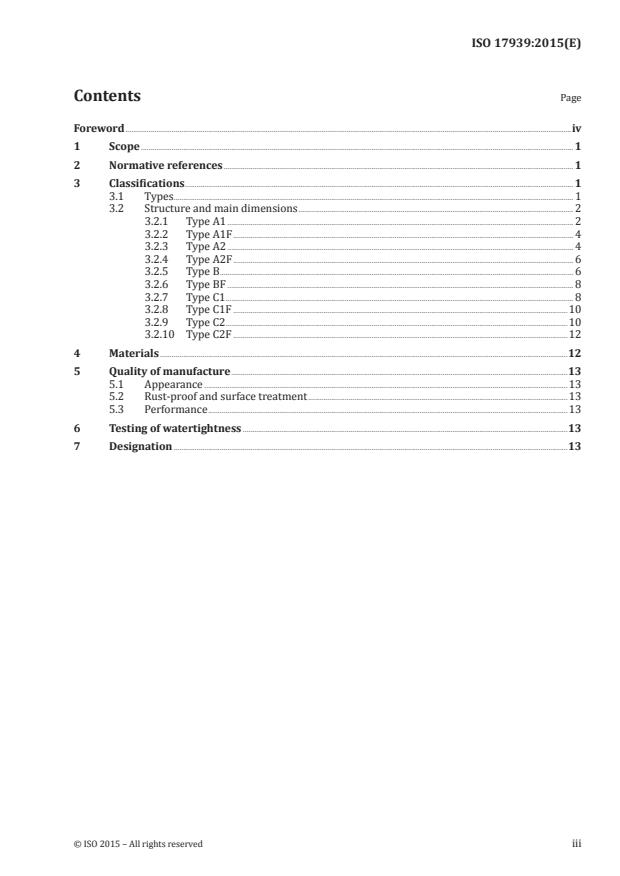
Contents Page
Foreword .iv
1 Scope . 1
2 Normative references . 1
3 Classifications . 1
3.1 Types. 1
3.2 Structure and main dimensions . 2
3.2.1 Type A1 . 2
3.2.2 Type A1F . 4
3.2.3 Type A2 . 4
3.2.4 Type A2F . 6
3.2.5 Type B . 6
3.2.6 Type BF . 8
3.2.7 Type C1 . 8
3.2.8 Type C1F .10
3.2.9 Type C2 .10
3.2.10 Type C2F .12
4 Materials .12
5 Quality of manufacture .13
5.1 Appearance .13
5.2 Rust-proof and surface treatment .13
5.3 Performance .13
6 Testing of watertightness .13
7 Designation .13
Foreword
ISO (the International Organization for Standardization) is a worldwide federation of national standards
bodies (ISO member bodies). The work of preparing International Standards is normally carried out
through ISO technical committees. Each member body interested in a subject for which a technical
committee has been established has the right to be represented on that committee. International
organizations, governmental and non-governmental, in liaison with ISO, also take part in the work.
ISO collaborates closely with the International Electrotechnical Commission (IEC) on all matters of
electrotechnical standardization.
The procedures used to develop this document and those intended for its further maintenance are
described in the ISO/IEC Directives, Part 1. In particular the different approval criteria needed for the
different types of ISO documents should be noted. This document was drafted in accordance with the
editorial rules of the ISO/IEC Directives, Part 2 (see www.iso.org/directives).
Attention is drawn to the possibility that some of the elements of this document may be the subject of
patent rights. ISO shall not be held responsible for identifying any or all such patent rights. Details of
any patent rights identified during the development of the document will be in the Introduction and/or
on the ISO list of patent declarations received (see www.iso.org/patents).
Any trade name used in this document is information given for the convenience of users and does not
constitute an endorsement.
For an explanation on the meaning of ISO specific terms and expressions related to conformity
assessment, as well as information about ISO’s adherence to the WTO principles in the Technical
Barriers to Trade (TBT) see the following URL: Foreword - Supplementary information.
The committee responsible for this document is ISO/TC 8, Ships and marine technology, Subcommittee
SC 8, Ship design.
iv © ISO 2015 – All rights reserved
INTERNATIONAL STANDARD ISO 17939:2015(E)
Ships and marine technology — Oil tank hatches
1 Scope
This International Standard specifies the classification, structure and main dimensions, materials,
quality of manufacture, testing of watertightness and designation for oil tank hatches for application on
board ships in order to ensure interchangeability of the hatches. The remaining dimensions, welding,
and other details are left to the manufacturer.
These hatches generally conform to the requirements of the International Convention on Load Lines
1966 (ILLC66). These structures and specifications of oil-tight hatch covers in this International
Standard meet IACS UR S26 requirements. The possibility for application in position 1 and position 2
has to be considered for each situation and, where necessary, the hatch covers shall be provided with
additional stiffening.
This International Standard is applicable to the design, manufacturing, and test of accommodation
ladders, as well as accommodation ladder used specifically in combination with pilot ladder (hereinafter
referred as “pilot accommodation ladder”).
Users of this International Standard should note that while observing the requirements of this
International Standard, they should, at the same time, ensure compliance with such statutory
requirements, rules, and regulations as may be applicable to the individual ship concerned.
2 Normative references
The following documents, in whole or in part, are normatively referenced in this document and are
indispensable for its application. For dated references, only the edition cited applies. For undated
references, the latest edition of the referenced document (including any amendments) applies.
ISO 8501–1, Preparation of steel substrates before application of paints and related products — Visual
assessment of surface cleanliness — Part 1: Rust grades and preparation grades of uncoated steel substrates
and of steel substrates after overall removal of previous coatings.
3 Classifications
3.1 Types
Oil tank hatches are divided into the following types, see Table 1.
Table 1 — Classification of oil tank hatches
Dimensions in millimetres
Application in
accordance with
Types Definition Nominal size
ILLC66
in position (s)
A1 circular flat hatch cover 2
A1F circular flat hatch cover with stiffener 1
600, 700, 800,
A (circular)
900, 1 000, 1 200
A2 circular curve hatch cover 2
A2F circular curve hatch cover with stiffener 1
B long circular hatch cover 600 × 800, 750 × 1 200, 2
B (long circular) 750 × 1 300,
BF long circular hatch cover with stiffener 1
750 × 1 500, 850 × 1 500
flat hatch cover
C1 2
(upper circular, lower long circular)
a
750 (750 × 1 200)
flat hatch cover with stiffener
C1F a 1
C (upper circular, 750 (750 × 1 300)
(upper circular, lower long circular)
a
lower long 750 (750 × 1 500)
curve hatch cover
a
circular) 850 (850 × 1 500)
C2 2
(upper circular, lower long circular)
a
900 (900 × 1 500)
curve hatch cover with stiffener
C2F 1
(upper circular, lower long circular)
a
The data between parentheses are the size of lower long circular.
3.2 Structure and main dimensions
3.2.1 Type A1
Structure and main dimensions of type A1 hatch cover shall conform to the detail of Figure 1 and
Table 2.
2 © ISO 2015 – All rights reserved
Dimensions in millimetres
4 5
D₁
D
11 12
Key
1 coaming 8 lock catch
2 bearing 9 wing clamp
3 actuator 10 stiffener
4 junction plate 11 measuring hole cover (optional)
5 cover plate 12 clamp plate
6 seal ring 13 bearing pad welded on the bracket of a toggle bolt for metal to metal contact
7 clamping ring
NOTE Thickness of coaming shall comply with the related requirements, such as the requirements of
classification societies.
Figure 1 — Structure of type A1 ha
...
INTERNATIONAL ISO
STANDARD 17939
First edition
2015-09-01
Ships and marine technology — Oil
tank hatches
Navires et technologie maritime — Huile trappe
Reference number
©
ISO 2015
© ISO 2015, Published in Switzerland
All rights reserved. Unless otherwise specified, no part of this publication may be reproduced or utilized otherwise in any form
or by any means, electronic or mechanical, including photocopying, or posting on the internet or an intranet, without prior
written permission. Permission can be requested from either ISO at the address below or ISO’s member body in the country of
the requester.
ISO copyright office
Ch. de Blandonnet 8 • CP 401
CH-1214 Vernier, Geneva, Switzerland
Tel. +41 22 749 01 11
Fax +41 22 749 09 47
copyright@iso.org
www.iso.org
ii © ISO 2015 – All rights reserved
Contents Page
Foreword .iv
1 Scope . 1
2 Normative references . 1
3 Classifications . 1
3.1 Types. 1
3.2 Structure and main dimensions . 2
3.2.1 Type A1 . 2
3.2.2 Type A1F . 4
3.2.3 Type A2 . 4
3.2.4 Type A2F . 6
3.2.5 Type B . 6
3.2.6 Type BF . 8
3.2.7 Type C1 . 8
3.2.8 Type C1F .10
3.2.9 Type C2 .10
3.2.10 Type C2F .12
4 Materials .12
5 Quality of manufacture .13
5.1 Appearance .13
5.2 Rust-proof and surface treatment .13
5.3 Performance .13
6 Testing of watertightness .13
7 Designation .13
Foreword
ISO (the International Organization for Standardization) is a worldwide federation of national standards
bodies (ISO member bodies). The work of preparing International Standards is normally carried out
through ISO technical committees. Each member body interested in a subject for which a technical
committee has been established has the right to be represented on that committee. International
organizations, governmental and non-governmental, in liaison with ISO, also take part in the work.
ISO collaborates closely with the International Electrotechnical Commission (IEC) on all matters of
electrotechnical standardization.
The procedures used to develop this document and those intended for its further maintenance are
described in the ISO/IEC Directives, Part 1. In particular the different approval criteria needed for the
different types of ISO documents should be noted. This document was drafted in accordance with the
editorial rules of the ISO/IEC Directives, Part 2 (see www.iso.org/directives).
Attention is drawn to the possibility that some of the elements of this document may be the subject of
patent rights. ISO shall not be held responsible for identifying any or all such patent rights. Details of
any patent rights identified during the development of the document will be in the Introduction and/or
on the ISO list of patent declarations received (see www.iso.org/patents).
Any trade name used in this document is information given for the convenience of users and does not
constitute an endorsement.
For an explanation on the meaning of ISO specific terms and expressions related to conformity
assessment, as well as information about ISO’s adherence to the WTO principles in the Technical
Barriers to Trade (TBT) see the following URL: Foreword - Supplementary information.
The committee responsible for this document is ISO/TC 8, Ships and marine technology, Subcommittee
SC 8, Ship design.
iv © ISO 2015 – All rights reserved
INTERNATIONAL STANDARD ISO 17939:2015(E)
Ships and marine technology — Oil tank hatches
1 Scope
This International Standard specifies the classification, structure and main dimensions, materials,
quality of manufacture, testing of watertightness and designation for oil tank hatches for application on
board ships in order to ensure interchangeability of the hatches. The remaining dimensions, welding,
and other details are left to the manufacturer.
These hatches generally conform to the requirements of the International Convention on Load Lines
1966 (ILLC66). These structures and specifications of oil-tight hatch covers in this International
Standard meet IACS UR S26 requirements. The possibility for application in position 1 and position 2
has to be considered for each situation and, where necessary, the hatch covers shall be provided with
additional stiffening.
This International Standard is applicable to the design, manufacturing, and test of accommodation
ladders, as well as accommodation ladder used specifically in combination with pilot ladder (hereinafter
referred as “pilot accommodation ladder”).
Users of this International Standard should note that while observing the requirements of this
International Standard, they should, at the same time, ensure compliance with such statutory
requirements, rules, and regulations as may be applicable to the individual ship concerned.
2 Normative references
The following documents, in whole or in part, are normatively referenced in this document and are
indispensable for its application. For dated references, only the edition cited applies. For undated
references, the latest edition of the referenced document (including any amendments) applies.
ISO 8501–1, Preparation of steel substrates before application of paints and related products — Visual
assessment of surface cleanliness — Part 1: Rust grades and preparation grades of uncoated steel substrates
and of steel substrates after overall removal of previous coatings.
3 Classifications
3.1 Types
Oil tank hatches are divided into the following types, see Table 1.
Table 1 — Classification of oil tank hatches
Dimensions in millimetres
Application in
accordance with
Types Definition Nominal size
ILLC66
in position (s)
A1 circular flat hatch cover 2
A1F circular flat hatch cover with stiffener 1
600, 700, 800,
A (circular)
900, 1 000, 1 200
A2 circular curve hatch cover 2
A2F circular curve hatch cover with stiffener 1
B long circular hatch cover 600 × 800, 750 × 1 200, 2
B (long circular) 750 × 1 300,
BF long circular hatch cover with stiffener 1
750 × 1 500, 850 × 1 500
flat hatch cover
C1 2
(upper circular, lower long circular)
a
750 (750 × 1 200)
flat hatch cover with stiffener
C1F a 1
C (upper circular, 750 (750 × 1 300)
(upper circular, lower long circular)
a
lower long 750 (750 × 1 500)
curve hatch cover
a
circular) 850 (850 × 1 500)
C2 2
(upper circular, lower long circular)
a
900 (900 × 1 500)
curve hatch cover with stiffener
C2F 1
(upper circular, lower long circular)
a
The data between parentheses are the size of lower long circular.
3.2 Structure and main dimensions
3.2.1 Type A1
Structure and main dimensions of type A1 hatch cover shall conform to the detail of Figure 1 and
Table 2.
2 © ISO 2015 – All rights reserved
Dimensions in millimetres
4 5
D₁
D
11 12
Key
1 coaming 8 lock catch
2 bearing 9 wing clamp
3 actuator 10 stiffener
4 junction plate 11 measuring hole cover (optional)
5 cover plate 12 clamp plate
6 seal ring 13 bearing pad welded on the bracket of a toggle bolt for metal to metal contact
7 clamping ring
NOTE Thickness of coaming shall comply with the related requirements, such as the requirements of
classification societies.
Figure 1 — Structure of type A1 ha
...