

ISO 23121-2:2019
(Main)Ships and marine technology — Inflatable buoyancy support systems against flooding of ships — Part 2: Buoyancy chamber
General Information
- Abstract
This document specifies general requirements, the materials and test methods for the buoyancy chamber of inflatable buoyancy support systems, which serve residual buoyancy for damaged ships not to sink or capsize, and which can be installed in machinery spaces and/or cargo holds.
- Status
- Published
- Publication Date
- 15-Dec-2019
- Technical Committee
- ISO/TC 8/SC 8 - Ship design
- Drafting Committee
- ISO/TC 8/SC 8 - Ship design
- Current Stage
- 9093 - International Standard confirmed
- Start Date
- 06-Mar-2025
- Completion Date
- 29-Aug-2026
Buy Documents
ISO 23121-2:2019 - Ships and marine technology -- Inflatable buoyancy support systems against flooding of ships
ISO 23121-2:2019 - Ships and marine technology — Inflatable buoyancy support systems against flooding of ships — Part 2: Buoyancy chamber/16/2019
Overview
ISO 23121-2:2019 is an international standard published by the International Organization for Standardization (ISO) under the title “Ships and marine technology - Inflatable buoyancy support systems against flooding of ships - Part 2: Buoyancy chamber.” This document establishes general requirements, materials, and test methods for the buoyancy chamber component of inflatable buoyancy support systems used on ships. These systems are critical for providing residual buoyancy to damaged vessels, helping to prevent sinking or capsizing. The standard is applicable to buoyancy chambers that can be installed in machinery spaces and cargo holds of ships.
Key Topics
ISO 23121-2:2019 addresses several important areas, including:
- General Requirements: Outlines performance expectations for buoyancy chambers, such as operating within an air temperature range from -15 °C to +65 °C.
- Valves: Specifies types and functionality, including topping-up inflation valves, non-return valves, and relief valves, ensuring proper gas containment and release.
- Indicators: Requirement for pressure and temperature indicators to monitor the inflation state and internal conditions of the buoyancy chamber.
- High-Pressure Hose Assembly: Details on hose assemblies, if fitted, for gas transfer, including test and operational temperature ranges, leak resistance, and burst pressure requirements.
- Materials: Defines acceptable materials for both metallic and fabric components, including corrosion resistance, strength, and performance under extreme conditions.
- Test Methods: Describes procedures for testing tensile strength, tear resistance, low temperature resilience, porosity, ageing, hydrolysis, oil resistance, seam strength, and more.
- Inflation and Pressure Tests: Mandates tests at different ambient, high, and low temperatures, as well as pressure retention and excess pressure tests for safety assurance.
Applications
ISO 23121-2:2019 is primarily used in the field of marine technology and ship safety. Its practical applications include:
- Ship Design and Construction: Assists naval architects and engineers in integrating effective buoyancy support systems for improved survivability of damaged ships.
- Safety Equipment Manufacturing: Guides manufacturers in producing buoyancy chambers that meet international safety and quality benchmarks.
- Ship Operator Compliance: Helps operators ensure that installed inflatable buoyancy systems are fit for purpose and compliant with regulatory requirements, including the Safety of Life at Sea (SOLAS) convention.
- Accident Response: Supports rapid response in marine accidents by ensuring buoyancy chambers can be quickly deployed and remain reliable across varying environmental conditions.
- Inspections and Maintenance: Provides a reference for regular inspection and testing regimes to verify continued performance of buoyancy chambers throughout their service life.
Related Standards
For thorough implementation and quality management, ISO 23121-2:2019 should be used in conjunction with these related standards:
- ISO 23121-1:2019 - Inflatable buoyancy support system against flooding of ships - Part 1: Gas supply system
- ISO 1402 - Rubber and plastics hoses and hose assemblies - Hydrostatic testing
- ISO 1419:2019 - Rubber- or plastics-coated fabrics - Accelerated-ageing tests
- ISO 1421:2016 - Rubber- or plastics-coated fabrics - Determination of tensile strength and elongation at break
- ISO 9650-3 - Small craft - Inflatable liferafts - Part 3: Materials
- IMO Resolution MSC 81(70) - Testing of life-saving appliances
Summary
ISO 23121-2:2019 sets critical requirements and testing procedures for inflatable buoyancy chambers, underpinning the safety and reliability of ships’ flood countermeasures. Compliance with this standard ensures robust performance of buoyancy support systems in emergency scenarios, supporting vessel integrity and crew survival. Ship designers, manufacturers, operators, and safety inspectors will find practical guidance within this standard to enhance maritime safety and regulatory adherence.
Buy Documents
ISO 23121-2:2019 - Ships and marine technology -- Inflatable buoyancy support systems against flooding of ships
ISO 23121-2:2019 - Ships and marine technology — Inflatable buoyancy support systems against flooding of ships — Part 2: Buoyancy chamber/16/2019
Get Certified
Connect with accredited certification bodies for this standard

DNV
DNV is an independent assurance and risk management provider.

Lloyd's Register
Lloyd's Register is a global professional services organisation specialising in engineering and technology.

FSC International
Forest Stewardship Council certification.
Sponsored listings
Frequently Asked Questions
ISO 23121-2:2019 is a standard published by the International Organization for Standardization (ISO). Its full title is "Ships and marine technology — Inflatable buoyancy support systems against flooding of ships — Part 2: Buoyancy chamber". This standard covers: This document specifies general requirements, the materials and test methods for the buoyancy chamber of inflatable buoyancy support systems, which serve residual buoyancy for damaged ships not to sink or capsize, and which can be installed in machinery spaces and/or cargo holds.
This document specifies general requirements, the materials and test methods for the buoyancy chamber of inflatable buoyancy support systems, which serve residual buoyancy for damaged ships not to sink or capsize, and which can be installed in machinery spaces and/or cargo holds.
ISO 23121-2:2019 is classified under the following ICS (International Classification for Standards) categories: 47.020.10 - Hulls and their structure elements. The ICS classification helps identify the subject area and facilitates finding related standards.
ISO 23121-2:2019 is available in PDF format for immediate download after purchase. The document can be added to your cart and obtained through the secure checkout process. Digital delivery ensures instant access to the complete standard document.
Standards Content (Sample)
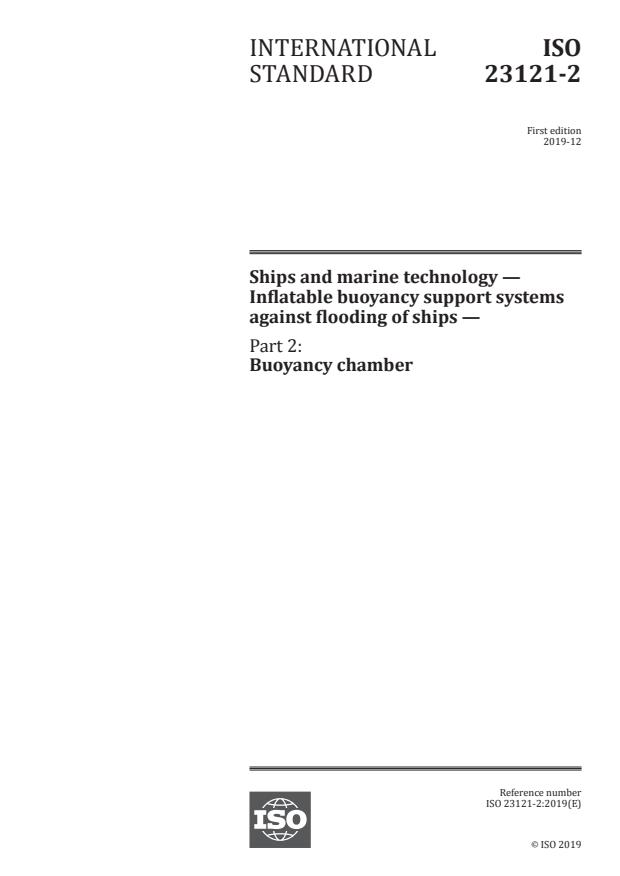
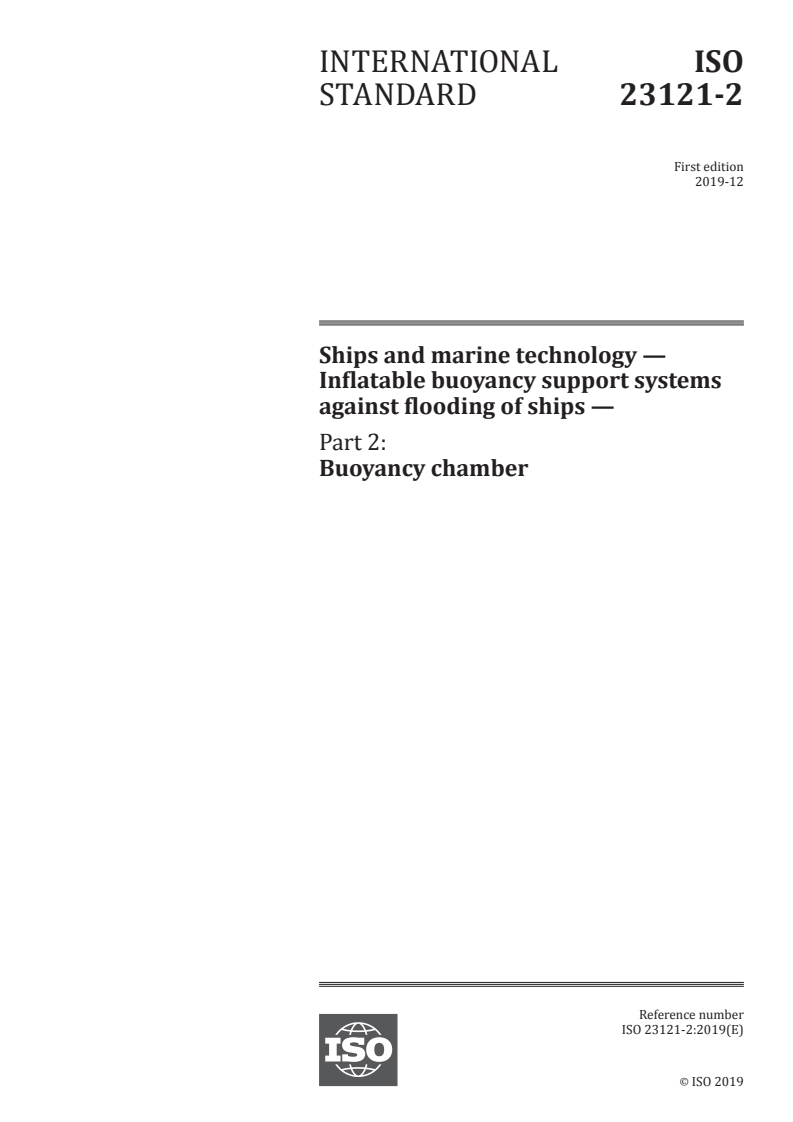
INTERNATIONAL ISO
STANDARD 23121-2
First edition
2019-12
Ships and marine technology —
Inflatable buoyancy support systems
against flooding of ships —
Part 2:
Buoyancy chamber
Reference number
©
ISO 2019
© ISO 2019
All rights reserved. Unless otherwise specified, or required in the context of its implementation, no part of this publication may
be reproduced or utilized otherwise in any form or by any means, electronic or mechanical, including photocopying, or posting
on the internet or an intranet, without prior written permission. Permission can be requested from either ISO at the address
below or ISO’s member body in the country of the requester.
ISO copyright office
CP 401 • Ch. de Blandonnet 8
CH-1214 Vernier, Geneva
Phone: +41 22 749 01 11
Fax: +41 22 749 09 47
Email: copyright@iso.org
Website: www.iso.org
Published in Switzerland
ii © ISO 2019 – All rights reserved
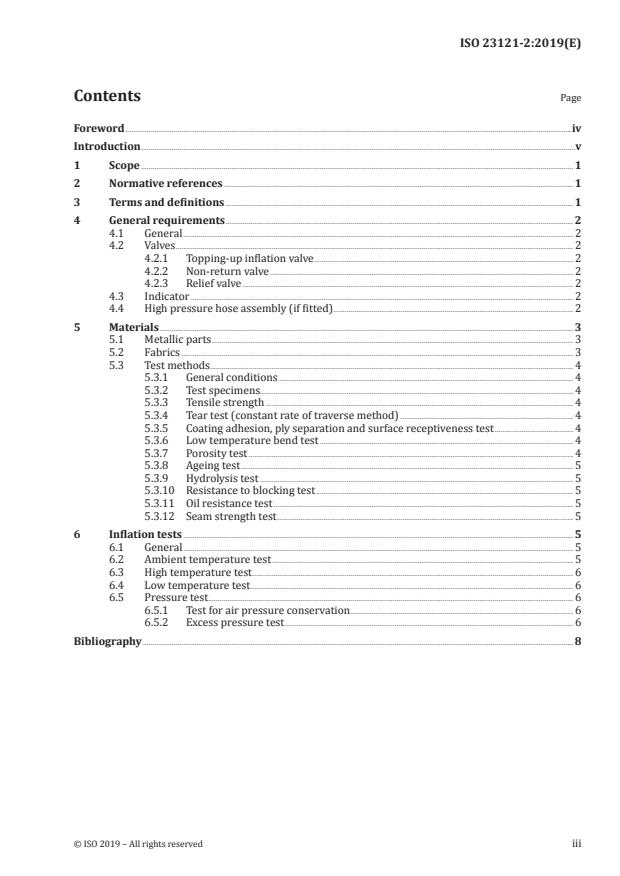
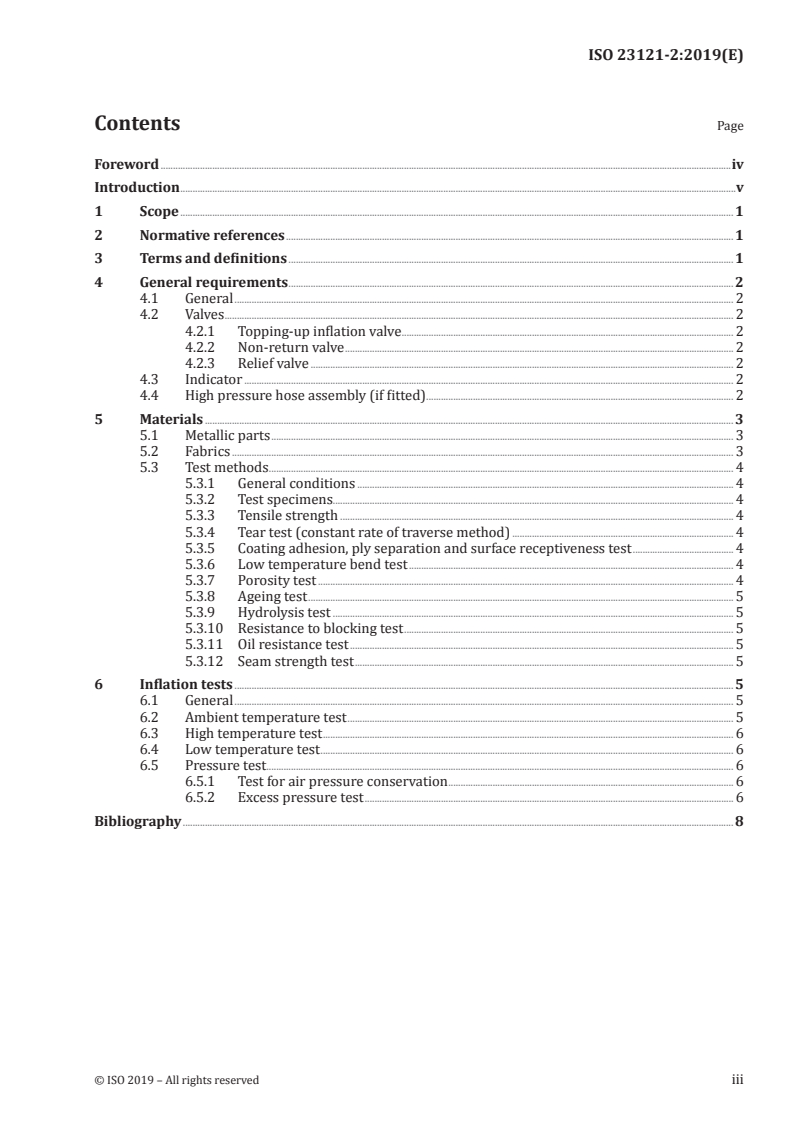
Contents Page
Foreword .iv
Introduction .v
1 Scope . 1
2 Normative references . 1
3 Terms and definitions . 1
4 General requirements . 2
4.1 General . 2
4.2 Valves . 2
4.2.1 Topping-up inflation valve . 2
4.2.2 Non-return valve . 2
4.2.3 Relief valve . 2
4.3 Indicator . 2
4.4 High pressure hose assembly (if fitted) . 2
5 Materials . 3
5.1 Metallic parts . 3
5.2 Fabrics . 3
5.3 Test methods . 4
5.3.1 General conditions . 4
5.3.2 Test specimens. 4
5.3.3 Tensile strength . 4
5.3.4 Tear test (constant rate of traverse method) . 4
5.3.5 Coating adhesion, ply separation and surface receptiveness test . 4
5.3.6 Low temperature bend test . 4
5.3.7 Porosity test . 4
5.3.8 Ageing test . 5
5.3.9 Hydrolysis test . 5
5.3.10 Resistance to blocking test . 5
5.3.11 Oil resistance test . 5
5.3.12 Seam strength test . 5
6 Inflation tests . 5
6.1 General . 5
6.2 Ambient temperature test . 5
6.3 High temperature test . 6
6.4 Low temperature test . 6
6.5 Pressure test . 6
6.5.1 Test for air pressure conservation . 6
6.5.2 Excess pressure test . 6
Bibliography . 8
Foreword
ISO (the International Organization for Standardization) is a worldwide federation of national standards
bodies (ISO member bodies). The work of preparing International Standards is normally carried out
through ISO technical committees. Each member body interested in a subject for which a technical
committee has been established has the right to be represented on that committee. International
organizations, governmental and non-governmental, in liaison with ISO, also take part in the work.
ISO collaborates closely with the International Electrotechnical Commission (IEC) on all matters of
electrotechnical standardization.
The procedures used to develop this document and those intended for its further maintenance are
described in the ISO/IEC Directives, Part 1. In particular the different approval criteria needed for the
different types of ISO documents should be noted. This document was drafted in accordance with the
editorial rules of the ISO/IEC Directives, Part 2 (see www .iso .org/ directives).
Attention is drawn to the possibility that some of the elements of this document may be the subject of
patent rights. ISO shall not be held responsible for identifying any or all such patent rights. Details of
any patent rights identified during the development of the document will be in the Introduction and/or
on the ISO list of patent declarations received (see www .iso .org/ patents).
Any trade name used in this document is information given for the convenience of users and does not
constitute an endorsement.
For an explanation of the voluntary nature of standards, the meaning of ISO specific terms and
expressions related to conformity assessment, as well as information about ISO's adherence to the
World Trade Organization (WTO) principles in the Technical Barriers to Trade (TBT), see www .iso .org/
iso/ foreword .html.
This document was prepared by Technical Committee ISO/TC 8, Ships and marine technology,
Subcommittee SC 8, Ship design.
Any feedback or questions on this document should be directed to the user’s national standards body. A
complete listing of these bodies can be found at www .iso .org/ members .html.
iv © ISO 2019 – All rights reserved
Introduction
This document is intended to support the development and technical implementation of various types
of buoyancy support systems.
In case of marine accidents, such as collisions and groundings, excessive damage and flooding can
cause the ship to sink, capsize or impede the use of its essential navigation equipment. As a ship has
watertight bulkheads, doors, hatches and other equipment, the consequences of flooding accidents can
usually be mitigated at the early phases of the accident. Subsequently, the progressive flooding after an
important accident can cause the sinking or capsizing of the ship.
To counter these problems, inflatable buoyancy support systems can be used, which are composed of
a gas supply system and a buoyancy chamber, where the gas supply system provides the medium for
the inflation of the buoyancy chamber. A fixed fire extinguisher can be used as a gas inlet when the
ship is at risk of sinking or overturning. When fire extinguishers are used to supply the media into the
buoyancy chamber, additional means must be available not to impair fire-fighting, following SOLAS,
Chapter II-2A, Regulation 4. Buoyancy chambers have various shapes and capacities to aid a damaged
ship’s buoyancy.
INTERNATIONAL STANDARD ISO 23121-2:2019(E)
Ships and marine technology — Inflatable buoyancy
support systems against flooding of ships —
Part 2:
Buoyancy chamber
1 Scope
This document specifies general requirements, the materials and test methods for the buoyancy
chamber of inflatable buoyancy support systems, which serve residual buoyancy for damaged ships not
to sink or capsize, and which can be installed in machinery spaces and/or cargo holds.
2 Normative references
The following documents are referred to in the text in such a way that some or all of their content
constitutes requirements of this document. For dated references, only the edition cited applies. For
undated references, the latest edition of the referenced document (including any amendments) applies.
ISO 1402, Rubber and plastics hoses and hose assemblies — Hydrostatic testing
ISO 1419:2019, Rubber- or plastics-coated fabrics — Accelerated-ageing tests
ISO 1421:2016, Rubber- or plastics-coated fabrics — Determination of tensile strength and elongation
at break
ISO 2231:1989, Rubber- or plastics-coated fabrics — Standard atmospheres for conditioning and testing
ISO 2411, Rubber- or plastics-coated fabrics — Determination of coating adhesion
ISO 4674-1:2016, Rubber- or plastics-coated fabrics — Determination of tear resistance — Part 1: Constant
ra
...
INTERNATIONAL ISO
STANDARD 23121-2
First edition
2019-12
Ships and marine technology —
Inflatable buoyancy support systems
against flooding of ships —
Part 2:
Buoyancy chamber
Reference number
©
ISO 2019
© ISO 2019
All rights reserved. Unless otherwise specified, or required in the context of its implementation, no part of this publication may
be reproduced or utilized otherwise in any form or by any means, electronic or mechanical, including photocopying, or posting
on the internet or an intranet, without prior written permission. Permission can be requested from either ISO at the address
below or ISO’s member body in the country of the requester.
ISO copyright office
CP 401 • Ch. de Blandonnet 8
CH-1214 Vernier, Geneva
Phone: +41 22 749 01 11
Fax: +41 22 749 09 47
Email: copyright@iso.org
Website: www.iso.org
Published in Switzerland
ii © ISO 2019 – All rights reserved
Contents Page
Foreword .iv
Introduction .v
1 Scope . 1
2 Normative references . 1
3 Terms and definitions . 1
4 General requirements . 2
4.1 General . 2
4.2 Valves . 2
4.2.1 Topping-up inflation valve . 2
4.2.2 Non-return valve . 2
4.2.3 Relief valve . 2
4.3 Indicator . 2
4.4 High pressure hose assembly (if fitted) . 2
5 Materials . 3
5.1 Metallic parts . 3
5.2 Fabrics . 3
5.3 Test methods . 4
5.3.1 General conditions . 4
5.3.2 Test specimens. 4
5.3.3 Tensile strength . 4
5.3.4 Tear test (constant rate of traverse method) . 4
5.3.5 Coating adhesion, ply separation and surface receptiveness test . 4
5.3.6 Low temperature bend test . 4
5.3.7 Porosity test . 4
5.3.8 Ageing test . 5
5.3.9 Hydrolysis test . 5
5.3.10 Resistance to blocking test . 5
5.3.11 Oil resistance test . 5
5.3.12 Seam strength test . 5
6 Inflation tests . 5
6.1 General . 5
6.2 Ambient temperature test . 5
6.3 High temperature test . 6
6.4 Low temperature test . 6
6.5 Pressure test . 6
6.5.1 Test for air pressure conservation . 6
6.5.2 Excess pressure test . 6
Bibliography . 8
Foreword
ISO (the International Organization for Standardization) is a worldwide federation of national standards
bodies (ISO member bodies). The work of preparing International Standards is normally carried out
through ISO technical committees. Each member body interested in a subject for which a technical
committee has been established has the right to be represented on that committee. International
organizations, governmental and non-governmental, in liaison with ISO, also take part in the work.
ISO collaborates closely with the International Electrotechnical Commission (IEC) on all matters of
electrotechnical standardization.
The procedures used to develop this document and those intended for its further maintenance are
described in the ISO/IEC Directives, Part 1. In particular the different approval criteria needed for the
different types of ISO documents should be noted. This document was drafted in accordance with the
editorial rules of the ISO/IEC Directives, Part 2 (see www .iso .org/ directives).
Attention is drawn to the possibility that some of the elements of this document may be the subject of
patent rights. ISO shall not be held responsible for identifying any or all such patent rights. Details of
any patent rights identified during the development of the document will be in the Introduction and/or
on the ISO list of patent declarations received (see www .iso .org/ patents).
Any trade name used in this document is information given for the convenience of users and does not
constitute an endorsement.
For an explanation of the voluntary nature of standards, the meaning of ISO specific terms and
expressions related to conformity assessment, as well as information about ISO's adherence to the
World Trade Organization (WTO) principles in the Technical Barriers to Trade (TBT), see www .iso .org/
iso/ foreword .html.
This document was prepared by Technical Committee ISO/TC 8, Ships and marine technology,
Subcommittee SC 8, Ship design.
Any feedback or questions on this document should be directed to the user’s national standards body. A
complete listing of these bodies can be found at www .iso .org/ members .html.
iv © ISO 2019 – All rights reserved
Introduction
This document is intended to support the development and technical implementation of various types
of buoyancy support systems.
In case of marine accidents, such as collisions and groundings, excessive damage and flooding can
cause the ship to sink, capsize or impede the use of its essential navigation equipment. As a ship has
watertight bulkheads, doors, hatches and other equipment, the consequences of flooding accidents can
usually be mitigated at the early phases of the accident. Subsequently, the progressive flooding after an
important accident can cause the sinking or capsizing of the ship.
To counter these problems, inflatable buoyancy support systems can be used, which are composed of
a gas supply system and a buoyancy chamber, where the gas supply system provides the medium for
the inflation of the buoyancy chamber. A fixed fire extinguisher can be used as a gas inlet when the
ship is at risk of sinking or overturning. When fire extinguishers are used to supply the media into the
buoyancy chamber, additional means must be available not to impair fire-fighting, following SOLAS,
Chapter II-2A, Regulation 4. Buoyancy chambers have various shapes and capacities to aid a damaged
ship’s buoyancy.
INTERNATIONAL STANDARD ISO 23121-2:2019(E)
Ships and marine technology — Inflatable buoyancy
support systems against flooding of ships —
Part 2:
Buoyancy chamber
1 Scope
This document specifies general requirements, the materials and test methods for the buoyancy
chamber of inflatable buoyancy support systems, which serve residual buoyancy for damaged ships not
to sink or capsize, and which can be installed in machinery spaces and/or cargo holds.
2 Normative references
The following documents are referred to in the text in such a way that some or all of their content
constitutes requirements of this document. For dated references, only the edition cited applies. For
undated references, the latest edition of the referenced document (including any amendments) applies.
ISO 1402, Rubber and plastics hoses and hose assemblies — Hydrostatic testing
ISO 1419:2019, Rubber- or plastics-coated fabrics — Accelerated-ageing tests
ISO 1421:2016, Rubber- or plastics-coated fabrics — Determination of tensile strength and elongation
at break
ISO 2231:1989, Rubber- or plastics-coated fabrics — Standard atmospheres for conditioning and testing
ISO 2411, Rubber- or plastics-coated fabrics — Determination of coating adhesion
ISO 4674-1:2016, Rubber- or plastics-coated fabrics — Determination of tear resistance — Part 1: Constant
ra
...