

ISO 23121-1:2019
(Main)Ships and marine technology — Inflatable buoyancy support systems against flooding of ships — Part 1: Gas supply system
General Information
- Abstract
This document specifies general requirements, the installation and the activation of the gas supply system of inflatable buoyancy support systems, which serve residual buoyancy for damaged ships not to sink or capsize, and which can be installed in machinery spaces and/or cargo holds. It is intended to ensure the functions of the gas supply system, which uses a gas media, such as an asphyxiant, to inflate the buoyancy chamber of the inflatable buoyancy support systems.
- Status
- Published
- Publication Date
- 15-Dec-2019
- Technical Committee
- ISO/TC 8/SC 8 - Ship design
- Drafting Committee
- ISO/TC 8/SC 8 - Ship design
- Current Stage
- 9093 - International Standard confirmed
- Start Date
- 06-Mar-2025
- Completion Date
- 29-Aug-2026
Buy Documents


ISO 23121-1:2019 - Ships and marine technology -- Inflatable buoyancy support systems against flooding of ships
ISO 23121-1:2019 - Ships and marine technology — Inflatable buoyancy support systems against flooding of ships — Part 1: Gas supply system/16/2019
Overview - ISO 23121-1:2019 (Gas supply system)
ISO 23121-1:2019 specifies requirements for the gas supply system of inflatable buoyancy support systems used to prevent damaged ships from sinking or capsizing. The standard covers general requirements, installation and activation of gas-based inflation systems for buoyancy chambers installed in machinery spaces and cargo holds. It is intended to ensure safe, reliable inflation using gas media (including asphyxiants) while protecting habitable spaces and maintaining compatibility with fire‑fighting systems.
Key topics and technical requirements
- Scope and purpose
- Applies to gas supply systems that provide residual buoyancy for flooded or damaged ships.
- Permitted media
- Prohibits inlet media causing toxic concentrations in discharge spaces and forbids Halon 1211, 1301, 2402 and per‑fluorocarbons.
- Defines “asphyxiant” and requires safeguards when media can be harmful to health.
- System installation
- Components (cylinders, regulators, valves, hoses) must be securely fastened to withstand ship motions, shocks and vibrations.
- Cylinders must be installed in non‑habitable, separated spaces, mounted clear of bilge water and water‑accumulation surfaces.
- Pressure regulators (if used) shall comply with ISO 15738 to avoid sudden inflation damage.
- Activation and controls
- Buoyancy chambers must not activate automatically.
- Remote control valves require an indicator visible from the main helm (bridge or machinery control room).
- Systems must be operable between −15 °C and 65 °C.
- When gas media are harmful, a shut‑off valve distinct from the activation system must be fitted close to cylinders.
- Safety warnings and alarms
- Visual/sound alarms are required in protected spaces large enough to be occupied, activated before gas supply.
- Displayed information and warnings should use appropriate language and may use ISO 7010 symbols.
- Performance and sizing
- Quantity of cylinders determined by required buoyant force and chamber volume; cylinder fill must not exceed safe internal pressure at +65 °C.
Practical applications and users
- Who uses this standard:
- Ship designers and naval architects, shipyards, marine equipment manufacturers, classification societies, marine surveyors, ship operators and safety officers.
- Typical uses:
- Designing or retrofitting inflatable buoyancy support systems for damage‑control and flooding mitigation in machinery spaces or cargo holds.
- Specifying installation, controls, alarm integration and gas selection for compliance with safety and SOLAS considerations.
- Ensuring compatibility of buoyancy inflation with fixed fire‑extinguishing systems (see IMO SOLAS, Ch. II‑2A Reg. 4).
Related standards
- IMO SOLAS, Chapter II‑2A, Regulation 4 (fixed fire extinguishing systems)
- ISO 15738 - Gas inflation systems for inflatable life‑saving appliances
- ISO 7010 - Graphical safety symbols
Keywords: ISO 23121-1:2019, inflatable buoyancy support systems, gas supply system, marine safety, flooding mitigation, buoyancy chambers, ship design, IMO SOLAS.
Buy Documents
ISO 23121-1:2019 - Ships and marine technology -- Inflatable buoyancy support systems against flooding of ships
ISO 23121-1:2019 - Ships and marine technology — Inflatable buoyancy support systems against flooding of ships — Part 1: Gas supply system/16/2019
Get Certified
Connect with accredited certification bodies for this standard

DNV
DNV is an independent assurance and risk management provider.

Lloyd's Register
Lloyd's Register is a global professional services organisation specialising in engineering and technology.

FSC International
Forest Stewardship Council certification.
Sponsored listings
Frequently Asked Questions
ISO 23121-1:2019 is a standard published by the International Organization for Standardization (ISO). Its full title is "Ships and marine technology — Inflatable buoyancy support systems against flooding of ships — Part 1: Gas supply system". This standard covers: This document specifies general requirements, the installation and the activation of the gas supply system of inflatable buoyancy support systems, which serve residual buoyancy for damaged ships not to sink or capsize, and which can be installed in machinery spaces and/or cargo holds. It is intended to ensure the functions of the gas supply system, which uses a gas media, such as an asphyxiant, to inflate the buoyancy chamber of the inflatable buoyancy support systems.
This document specifies general requirements, the installation and the activation of the gas supply system of inflatable buoyancy support systems, which serve residual buoyancy for damaged ships not to sink or capsize, and which can be installed in machinery spaces and/or cargo holds. It is intended to ensure the functions of the gas supply system, which uses a gas media, such as an asphyxiant, to inflate the buoyancy chamber of the inflatable buoyancy support systems.
ISO 23121-1:2019 is classified under the following ICS (International Classification for Standards) categories: 47.020.10 - Hulls and their structure elements. The ICS classification helps identify the subject area and facilitates finding related standards.
ISO 23121-1:2019 is available in PDF format for immediate download after purchase. The document can be added to your cart and obtained through the secure checkout process. Digital delivery ensures instant access to the complete standard document.
Standards Content (Sample)
INTERNATIONAL ISO
STANDARD 23121-1
First edition
2019-12
Ships and marine technology —
Inflatable buoyancy support systems
against flooding of ships —
Part 1:
Gas supply system
Reference number
©
ISO 2019
© ISO 2019
All rights reserved. Unless otherwise specified, or required in the context of its implementation, no part of this publication may
be reproduced or utilized otherwise in any form or by any means, electronic or mechanical, including photocopying, or posting
on the internet or an intranet, without prior written permission. Permission can be requested from either ISO at the address
below or ISO’s member body in the country of the requester.
ISO copyright office
CP 401 • Ch. de Blandonnet 8
CH-1214 Vernier, Geneva
Phone: +41 22 749 01 11
Fax: +41 22 749 09 47
Email: copyright@iso.org
Website: www.iso.org
Published in Switzerland
ii © ISO 2019 – All rights reserved
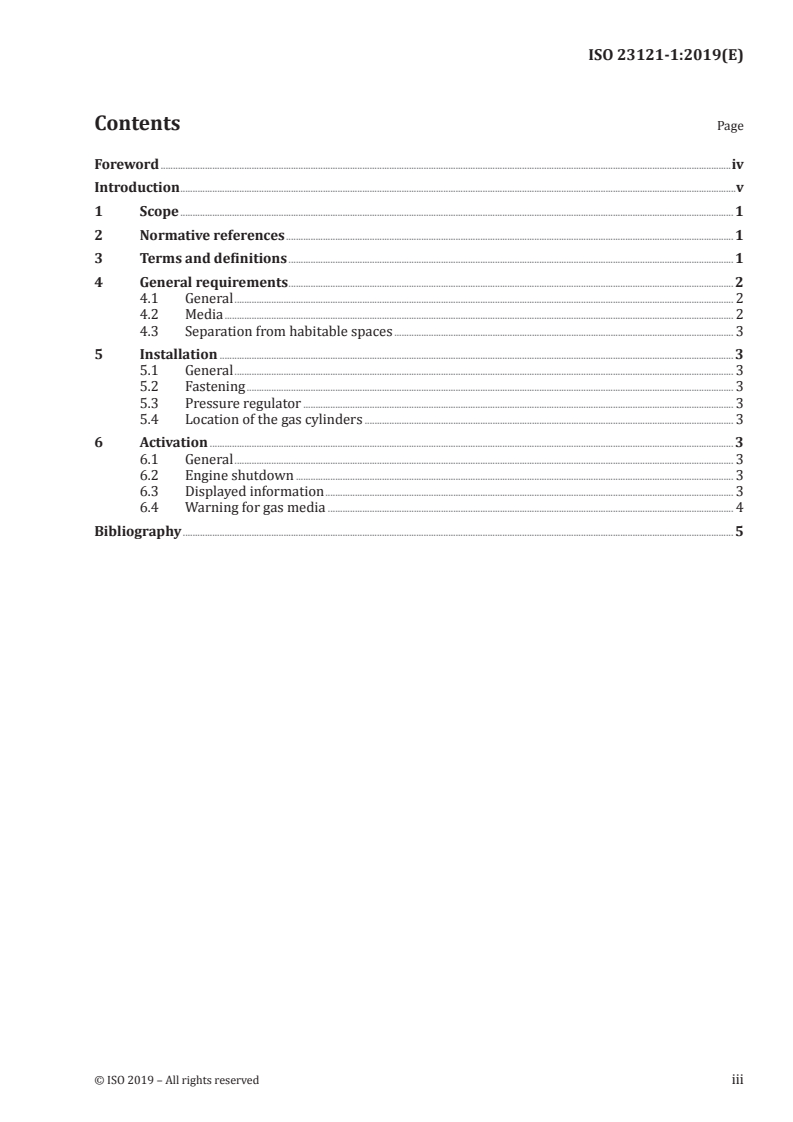
Contents Page
Foreword .iv
Introduction .v
1 Scope . 1
2 Normative references . 1
3 Terms and definitions . 1
4 General requirements . 2
4.1 General . 2
4.2 Media . 2
4.3 Separation from habitable spaces . 3
5 Installation . 3
5.1 General . 3
5.2 Fastening . 3
5.3 Pressure regulator . 3
5.4 Location of the gas cylinders . 3
6 Activation . 3
6.1 General . 3
6.2 Engine shutdown . 3
6.3 Displayed information . 3
6.4 Warning for gas media . 4
Bibliography . 5
Foreword
ISO (the International Organization for Standardization) is a worldwide federation of national standards
bodies (ISO member bodies). The work of preparing International Standards is normally carried out
through ISO technical committees. Each member body interested in a subject for which a technical
committee has been established has the right to be represented on that committee. International
organizations, governmental and non-governmental, in liaison with ISO, also take part in the work.
ISO collaborates closely with the International Electrotechnical Commission (IEC) on all matters of
electrotechnical standardization.
The procedures used to develop this document and those intended for its further maintenance are
described in the ISO/IEC Directives, Part 1. In particular the different approval criteria needed for the
different types of ISO documents should be noted. This document was drafted in accordance with the
editorial rules of the ISO/IEC Directives, Part 2 (see www .iso .org/ directives).
Attention is drawn to the possibility that some of the elements of this document may be the subject of
patent rights. ISO shall not be held responsible for identifying any or all such patent rights. Details of
any patent rights identified during the development of the document will be in the Introduction and/or
on the ISO list of patent declarations received (see www .iso .org/ patents).
Any trade name used in this document is information given for the convenience of users and does not
constitute an endorsement.
For an explanation of the voluntary nature of standards, the meaning of ISO specific terms and
expressions related to conformity assessment, as well as information about ISO's adherence to the
World Trade Organization (WTO) principles in the Technical Barriers to Trade (TBT), see www .iso .org/
iso/ foreword .html.
This document was prepared by Technical Committee ISO/TC 8, Ships and marine technology,
Subcommittee SC 8, Ship design.
Any feedback or questions on this document should be directed to the user’s national standards body. A
complete listing of these bodies can be found at www .iso .org/ members .html.
iv © ISO 2019 – All rights reserved
Introduction
This document is intended to support the development and technical implementation of various types
of buoyancy support systems.
In case of marine accidents, such as collisions and groundings, excessive damage and flo
...
INTERNATIONAL ISO
STANDARD 23121-1
First edition
2019-12
Ships and marine technology —
Inflatable buoyancy support systems
against flooding of ships —
Part 1:
Gas supply system
Reference number
©
ISO 2019
© ISO 2019
All rights reserved. Unless otherwise specified, or required in the context of its implementation, no part of this publication may
be reproduced or utilized otherwise in any form or by any means, electronic or mechanical, including photocopying, or posting
on the internet or an intranet, without prior written permission. Permission can be requested from either ISO at the address
below or ISO’s member body in the country of the requester.
ISO copyright office
CP 401 • Ch. de Blandonnet 8
CH-1214 Vernier, Geneva
Phone: +41 22 749 01 11
Fax: +41 22 749 09 47
Email: copyright@iso.org
Website: www.iso.org
Published in Switzerland
ii © ISO 2019 – All rights reserved
Contents Page
Foreword .iv
Introduction .v
1 Scope . 1
2 Normative references . 1
3 Terms and definitions . 1
4 General requirements . 2
4.1 General . 2
4.2 Media . 2
4.3 Separation from habitable spaces . 3
5 Installation . 3
5.1 General . 3
5.2 Fastening . 3
5.3 Pressure regulator . 3
5.4 Location of the gas cylinders . 3
6 Activation . 3
6.1 General . 3
6.2 Engine shutdown . 3
6.3 Displayed information . 3
6.4 Warning for gas media . 4
Bibliography . 5
Foreword
ISO (the International Organization for Standardization) is a worldwide federation of national standards
bodies (ISO member bodies). The work of preparing International Standards is normally carried out
through ISO technical committees. Each member body interested in a subject for which a technical
committee has been established has the right to be represented on that committee. International
organizations, governmental and non-governmental, in liaison with ISO, also take part in the work.
ISO collaborates closely with the International Electrotechnical Commission (IEC) on all matters of
electrotechnical standardization.
The procedures used to develop this document and those intended for its further maintenance are
described in the ISO/IEC Directives, Part 1. In particular the different approval criteria needed for the
different types of ISO documents should be noted. This document was drafted in accordance with the
editorial rules of the ISO/IEC Directives, Part 2 (see www .iso .org/ directives).
Attention is drawn to the possibility that some of the elements of this document may be the subject of
patent rights. ISO shall not be held responsible for identifying any or all such patent rights. Details of
any patent rights identified during the development of the document will be in the Introduction and/or
on the ISO list of patent declarations received (see www .iso .org/ patents).
Any trade name used in this document is information given for the convenience of users and does not
constitute an endorsement.
For an explanation of the voluntary nature of standards, the meaning of ISO specific terms and
expressions related to conformity assessment, as well as information about ISO's adherence to the
World Trade Organization (WTO) principles in the Technical Barriers to Trade (TBT), see www .iso .org/
iso/ foreword .html.
This document was prepared by Technical Committee ISO/TC 8, Ships and marine technology,
Subcommittee SC 8, Ship design.
Any feedback or questions on this document should be directed to the user’s national standards body. A
complete listing of these bodies can be found at www .iso .org/ members .html.
iv © ISO 2019 – All rights reserved
Introduction
This document is intended to support the development and technical implementation of various types
of buoyancy support systems.
In case of marine accidents, such as collisions and groundings, excessive damage and flo
...