

ISO 3796:2023
(Main)Ships and marine technology — Clear openings for external single-leaf doors
General Information
- Abstract
This document lays down standardized dimensions of clear openings for all types of external single-leaf doors on board ships, for which coamings are required. These dimensions are used as nominal sizes for these doors of ships.
- Status
- Published
- Publication Date
- 25-Oct-2023
- Technical Committee
- ISO/TC 8/SC 8 - Ship design
- Drafting Committee
- ISO/TC 8/SC 8 - Ship design
- Current Stage
- 6060 - International Standard published
- Start Date
- 26-Oct-2023
- Due Date
- 18-Jan-2024
- Completion Date
- 26-Oct-2023
Overview
ISO 3796:2023 - Ships and marine technology - Clear openings for external single-leaf doors specifies standardized clear opening dimensions (nominal sizes) for all types of external single-leaf doors on board ships where coamings are required. This third edition updates the 1999 version and provides guidance on frame types, corner radii and preferred geometries to reduce structural stress and cracking.
Key topics and requirements
- Scope: Defines nominal clear opening dimensions for external single-leaf shipboard doors intended to fit within coamings.
- Clear opening definition: Clear light dimensions are given as height (L) and width (B) measured inside the door frame.
- Frame types: Covers typical frame designs - angle bar frames (rounded or square corners) and flat bar frames (rounded corners).
- Corner radius (R): Corners can be square or rounded; rounded corners with R = 100 mm are preferred to prevent cracking. For plates subject to high longitudinal bending loads, openings should be calculated and doors with rounded corners used.
- Nominal sizes: Table of nominal sizes provided in millimetres. Representative sizes range from 1 200 × 600 mm up to 1 800 × 900 mm (examples include 1 200×600, 1 400×750, 1 600×900, etc.). These sizes are used as the standard nominal dimensions for design and procurement.
- Editorial notes: There are no normative references; terms and definitions are provided for clarity. The third edition adds an angle bar frame with rounded 100 mm corners and introduces six additional nominal sizes.
Applications
- Ship designers and naval architects use ISO 3796:2023 when laying out accommodation, service and machinery spaces to ensure standardized door openings and compatibility with coamings.
- Shipyards and fabricators reference the standard for production, cutting and reinforcement around door openings to meet nominal sizes and recommended corner radii.
- Door manufacturers and suppliers use the nominal sizes for product ranges and to specify frames that fit standardized coamings.
- Classification societies, marine engineers and procurement teams rely on the standard for regulatory compliance, specification writing and minimizing retrofitting issues.
Related standards and sources
- Prepared by ISO/TC 8 (Ships and marine technology). For broader compliance, consult relevant classification society rules and other ISO standards on ship design and safety.
- For official text, figures and full nominal-size tables, obtain ISO 3796:2023 from ISO (www.iso.org).
Keywords: ISO 3796:2023, clear openings, external single-leaf doors, ships, nominal sizes, door frame, coamings, corner radius, ship design standard.
Relations
- Effective Date
- 06-Jun-2022
Get Certified
Connect with accredited certification bodies for this standard

DNV
DNV is an independent assurance and risk management provider.

Lloyd's Register
Lloyd's Register is a global professional services organisation specialising in engineering and technology.

FSC International
Forest Stewardship Council certification.
Sponsored listings
Frequently Asked Questions
ISO 3796:2023 is a standard published by the International Organization for Standardization (ISO). Its full title is "Ships and marine technology — Clear openings for external single-leaf doors". This standard covers: This document lays down standardized dimensions of clear openings for all types of external single-leaf doors on board ships, for which coamings are required. These dimensions are used as nominal sizes for these doors of ships.
This document lays down standardized dimensions of clear openings for all types of external single-leaf doors on board ships, for which coamings are required. These dimensions are used as nominal sizes for these doors of ships.
ISO 3796:2023 is classified under the following ICS (International Classification for Standards) categories: 47.020.10 - Hulls and their structure elements. The ICS classification helps identify the subject area and facilitates finding related standards.
ISO 3796:2023 has the following relationships with other standards: It is inter standard links to ISO 3796:1999. Understanding these relationships helps ensure you are using the most current and applicable version of the standard.
ISO 3796:2023 is available in PDF format for immediate download after purchase. The document can be added to your cart and obtained through the secure checkout process. Digital delivery ensures instant access to the complete standard document.
Standards Content (Sample)
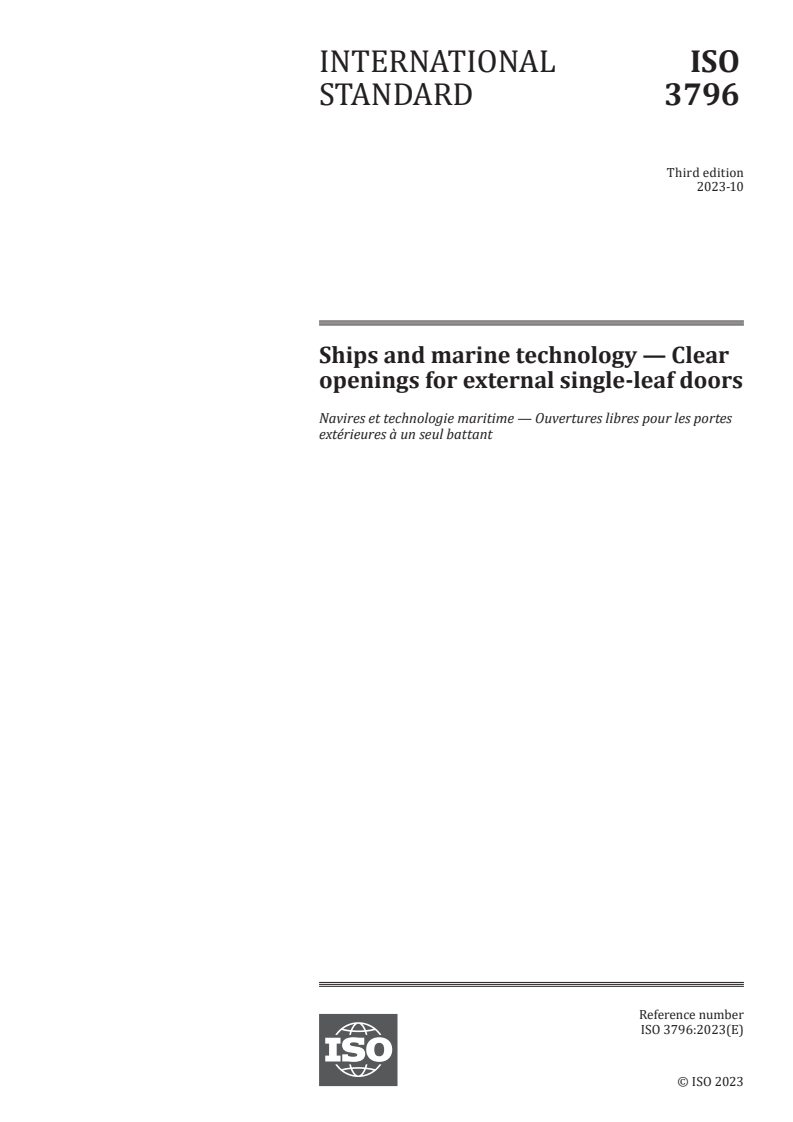
INTERNATIONAL ISO
STANDARD 3796
Third edition
2023-10
Ships and marine technology — Clear
openings for external single-leaf doors
Navires et technologie maritime — Ouvertures libres pour les portes
extérieures à un seul battant
Reference number
© ISO 2023
All rights reserved. Unless otherwise specified, or required in the context of its implementation, no part of this publication may
be reproduced or utilized otherwise in any form or by any means, electronic or mechanical, including photocopying, or posting on
the internet or an intranet, without prior written permission. Permission can be requested from either ISO at the address below
or ISO’s member body in the country of the requester.
ISO copyright office
CP 401 • Ch. de Blandonnet 8
CH-1214 Vernier, Geneva
Phone: +41 22 749 01 11
Email: copyright@iso.org
Website: www.iso.org
Published in Switzerland
ii
Contents Page
Foreword .iv
1 Scope . 1
2 Normative references . 1
3 Terms and definitions . 1
4 Clear openings/nominal sizes .1
iii
Foreword
ISO (the International Organization for Standardization) is a worldwide federation of national standards
bodies (ISO member bodies). The work of preparing International Standards is normally carried out
through ISO technical committees. Each member body interested in a subject for which a technical
committee has been established has the right to be represented on that committee. International
organizations, governmental and non-governmental, in liaison with ISO, also take part in the work.
ISO collaborates closely with the International Electrotechnical Commission (IEC) on all matters of
electrotechnical standardization.
The procedures used to develop this document and those intended for its further maintenance are
described in the ISO/IEC Directives, Part 1. In particular, the different approval criteria needed for the
different types of ISO document should be noted. This document was drafted in accordance with the
editorial rules of the ISO/IEC Directives, Part 2 (see www.iso.org/directives).
ISO draws attention to the possibility that the implementation of this document may involve the use
of (a) patent(s). ISO takes no position concerning the evidence, validity or applicability of any claimed
patent rights in respect thereof. As of the date of publication of this document, ISO had not received
notice of (a) patent(s) which may be required to implement this document. However, implementers are
cautioned that this may not represent the latest information, which may be obtained from the patent
...