

ISO 12641-1:2025
(Main)Graphic technology — Prepress digital data exchange — Part 1: Colour targets for input scanner calibration
General Information
- Abstract
This document defines the layout and colorimetric values of targets for use in the calibration of a photographic product/input scanner combination (as used in the preparatory process for printing and publishing). One target is defined for positive colour transparency film and another is defined for colour photographic paper.
- Status
- Published
- Publication Date
- 13-Feb-2025
- Technical Committee
- ISO/TC 130 - Graphic technology
- Drafting Committee
- ISO/TC 130 - Graphic technology
- Current Stage
- 6060 - International Standard published
- Start Date
- 14-Feb-2025
- Due Date
- 09-Nov-2024
- Completion Date
- 14-Feb-2025




Overview
ISO 12641-1:2025 - Graphic technology - Prepress digital data exchange - Part 1: Colour targets for input scanner calibration - specifies the layout and colorimetric aims for physical colour targets used to calibrate photographic product / input scanner combinations. The standard defines separate targets for positive colour transparency film and for colour photographic paper, and is intended for use in prepress workflows for printing and publishing. The target design is based on the CIE 1976 CIELAB colour space and supports both visual and numerical calibration methods.
Key technical topics and requirements
- Target design and layout
- Defined patch arrangements inspired by established film targets (e.g., Q‑60™ pattern with multiple hue angles, lightness levels and chroma samples).
- Vendor‑optional area for manufacturer‑specific patches.
- Transmission and reflection targets
- Separate clauses for transmission (film) and reflection (paper) targets covering physical characteristics and layout.
- Measurement geometries specified: transmission measurements (diffuse/normal or normal/diffuse) and reflection measurements (0°/45° or 45°/0°) consistent with ISO 13655.
- Patch size and spacing
- Requirements for minimum patch size to ensure accurate scanner sampling and reproducible measurement.
- Colour gamut mapping
- Use of a computed “common gamut” across dye sets; selection of chroma values (including product‑specific maximum chroma).
- Annex A provides computational reference material on gamut mapping.
- Neutral and dye scales / neutral scale mapping
- Inclusion of dye scale patches, dye pairs, neutral scales and product minimum/maximum density areas to characterise dye behaviour.
- Tolerances and target life
- Differing tolerances for uncalibrated vs calibrated targets to balance manufacturability and calibration precision.
- Guidance on usable target life for reliable calibration.
- Spectral measurement, colorimetric calculation and data handling
- Requirements for spectral measurement and colorimetric computation (per ISO 13655).
- Data reporting, file format requirements, keyword syntax and data identifiers for digital interchange.
- Informative guidance
- Annex B contains application notes to help implementers.
Practical applications and users
ISO 12641-1:2025 is used by:
- Scanner and scanner‑calibration tool manufacturers
- Film and photographic paper producers
- Prepress and color management engineers in print and publishing
- Quality assurance and reprographic labs
- Service bureaus and digital imaging workflows needing consistent cross‑device colour reproduction
Benefits include improved scanner-to-film/paper consistency, reproducible colour profiling, and robust prepress digital data exchange.
Related standards
- ISO 13655 - Spectral measurement and colorimetric computation for graphic arts images (referenced by ISO 12641-1)
- Historical alignment with ANSI IT8.7/1 and IT8.7/2 standards (digital data exchange legacy)
Keywords: ISO 12641-1:2025, colour targets, input scanner calibration, prepress, CIELAB, transmission targets, reflection targets, spectral measurement, colour gamut mapping, graphic technology.
Relations
- Effective Date
- 06-Jun-2022
Get Certified
Connect with accredited certification bodies for this standard

BSI Group
BSI (British Standards Institution) is the business standards company that helps organizations make excellence a habit.

NYCE
Mexican standards and certification body.
Sponsored listings
Frequently Asked Questions
ISO 12641-1:2025 is a standard published by the International Organization for Standardization (ISO). Its full title is "Graphic technology — Prepress digital data exchange — Part 1: Colour targets for input scanner calibration". This standard covers: This document defines the layout and colorimetric values of targets for use in the calibration of a photographic product/input scanner combination (as used in the preparatory process for printing and publishing). One target is defined for positive colour transparency film and another is defined for colour photographic paper.
This document defines the layout and colorimetric values of targets for use in the calibration of a photographic product/input scanner combination (as used in the preparatory process for printing and publishing). One target is defined for positive colour transparency film and another is defined for colour photographic paper.
ISO 12641-1:2025 is classified under the following ICS (International Classification for Standards) categories: 35.240.30 - IT applications in information, documentation and publishing; 37.100.99 - Other standards related to graphic technology. The ICS classification helps identify the subject area and facilitates finding related standards.
ISO 12641-1:2025 has the following relationships with other standards: It is inter standard links to ISO 12641-1:2016. Understanding these relationships helps ensure you are using the most current and applicable version of the standard.
ISO 12641-1:2025 is available in PDF format for immediate download after purchase. The document can be added to your cart and obtained through the secure checkout process. Digital delivery ensures instant access to the complete standard document.
Standards Content (Sample)
SLOVENSKI STANDARD
01-april-2025
Nadomešča:
SIST ISO 12641-1:2020
Grafična tehnologija - Izmenjava digitalnih podatkov v grafični pripravi - 1. del:
Barvne tablice za umerjanje skenerjev
Graphic technology — Prepress digital data exchange — Part 1: Colour targets for input
scanner calibration
Technologie graphique — Échange de données numériques de préimpression — Partie
1: Cibles de couleur pour l'étalonnage des scanners en entrée
Ta slovenski standard je istoveten z: ISO 12641-1:2025
ICS:
35.240.30 Uporabniške rešitve IT v IT applications in information,
informatiki, dokumentiranju in documentation and
založništvu publishing
37.100.99 Drugi standardi v zvezi z Other standards related to
grafično tehnologijo graphic technology
2003-01.Slovenski inštitut za standardizacijo. Razmnoževanje celote ali delov tega standarda ni dovoljeno.
International
Standard
ISO 12641-1
Second edition
Graphic technology — Prepress
2025-02
digital data exchange —
Part 1:
Colour targets for input scanner
calibration
Technologie graphique — Échange de données numériques de
préimpression —
Partie 1: Cibles de couleur pour l'étalonnage des scanners en entrée
Reference number
© ISO 2025
All rights reserved. Unless otherwise specified, or required in the context of its implementation, no part of this publication may
be reproduced or utilized otherwise in any form or by any means, electronic or mechanical, including photocopying, or posting on
the internet or an intranet, without prior written permission. Permission can be requested from either ISO at the address below
or ISO’s member body in the country of the requester.
ISO copyright office
CP 401 • Ch. de Blandonnet 8
CH-1214 Vernier, Geneva
Phone: +41 22 749 01 11
Email: copyright@iso.org
Website: www.iso.org
Published in Switzerland
ii
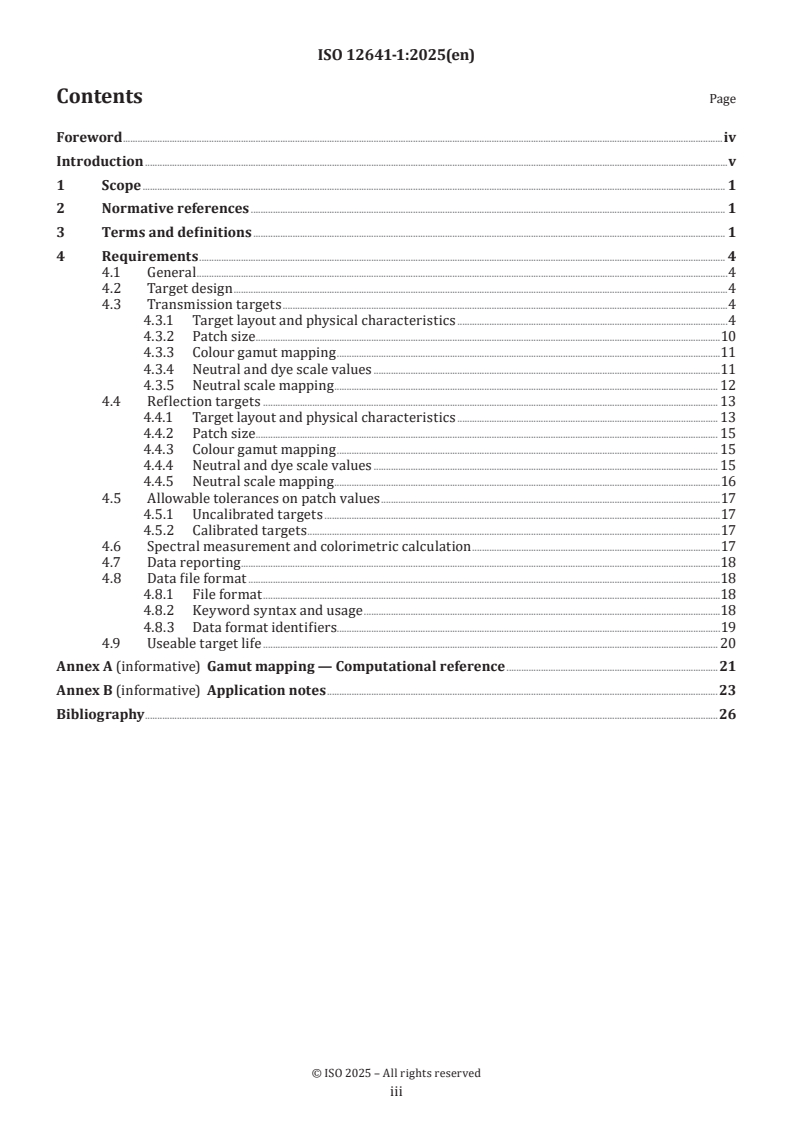
Contents Page
Foreword .iv
Introduction .v
1 Scope . 1
2 Normative references . 1
3 Terms and definitions . 1
4 Requirements . 4
4.1 General .4
4.2 Target design .4
4.3 Transmission targets .4
4.3.1 Target layout and physical characteristics .4
4.3.2 Patch size . .10
4.3.3 Colour gamut mapping .11
4.3.4 Neutral and dye scale values .11
4.3.5 Neutral scale mapping . 12
4.4 Reflection targets . 13
4.4.1 Target layout and physical characteristics . 13
4.4.2 Patch size . . 15
4.4.3 Colour gamut mapping . 15
4.4.4 Neutral and dye scale values . 15
4.4.5 Neutral scale mapping .16
4.5 Allowable tolerances on patch values .17
4.5.1 Uncalibrated targets .17
4.5.2 Calibrated targets .17
4.6 Spectral measurement and colorimetric calculation .17
4.7 Data reporting .18
4.8 Data file format .18
4.8.1 File format .18
4.8.2 Keyword syntax and usage .18
4.8.3 Data format identifiers.19
4.9 Useable target life . 20
Annex A (informative) Gamut mapping — Computational reference .21
Annex B (informative) Application notes .23
Bibliography .26
iii
Foreword
ISO (the International Organization for Standardization) is a worldwide federation of national standards
bodies (ISO member bodies). The work of preparing International Standards is normally carried out through
ISO technical committees. Each member body interested in a subject for which a technical committee
has been established has the right to be represented on that committee. International organizations,
governmental and non-governmental, in liaison with ISO, also take part in the work. ISO collaborates closely
with the International Electrotechnical Commission (IEC) on all matters of electrotechnical standardization.
The procedures used to develop this document and those intended for its further maintenance are described
in the ISO/IEC Directives, Part 1. In particular, the different approval criteria needed for the different types
of ISO document should be noted. This document was drafted in accordance with the editorial rules of the
ISO/IEC Directives, Part 2 (see www.iso.org/directives).
ISO draws attention to the possibility that the implementation of this document may involve the use of (a)
patent(s). ISO takes no position concerning the evidence, validity or applicability of any claimed patent
rights in respect thereof. As of the date of publication of this document, ISO had not received notice of (a)
patent(s) which may be required to implement this document. However, implementers are cautioned that
this may not represent the latest information, which may be obtained from the patent database available at
www.iso.org/patents. ISO shall not be held responsible for identifying any or all such patent rights.
Any trade name used in this document is information given for the convenience of users and does not
constitute an endorsement.
For an explanation of the voluntary nature of standards, the meaning of ISO specific terms and expressions
related to conformity assessment, as well as information about ISO's adherence to the World Trade
Organization (WTO) principles in the Technical Barriers to Trade (TBT), see www.iso.org/iso/foreword.html.
This document was prepared by Technical Committee ISO/TC 130, Graphic technology.
This second edition cancels and replaces the first edition (ISO 12641-1:2016), which has been technically
revised.
The main changes are as follows:
— the title has been changed to align with the ISO/IEC Directives Part 2;
— some subclauses have been corrected;
— the normative references (see Clause 2) have been updated;
— the terms and definitions (see Clause 3) have been updated.
A list of all parts in the ISO 12641 series can be found on the ISO website.
Any feedback or questions on this document should be directed to the user’s national standards body. A
complete listing of these bodies can be found at www.iso.org/members.html.
iv
Introduction
0.1 General
The technical requirements of this document are identical to the American National Standards IT8.7/1-
1993 and IT8.7/2-1993. These standards resulted from the joint efforts of an international industry group
that included participants representing a broad range of prepress vendors, film manufacturers and users.
This group, initially identified as the digital data exchange standards (DDES) committee, later became the
founders of the ANSI IT8 (Image Technology) accredited standards committee which is responsible for
electronic data exchange standards in graphic arts prepress.
0.2 Purpose of this document
Colour input scanners do not all analyse colour the same way the human eye does. These devices are
designed to optimize the signal generated when typical materials are scanned. Colour reflection and
transparency products use various combinations of proprietary dye sets to achieve visual responses that
simulate the colour appearance of natural scene elements. The ability to achieve the same colour appearance
from different combinations of dyes is referred to as metamerism. Because both photographic dyes and
input scanner sensitivities vary from product to product, there is variability in the input scanner response
to metameric colours produced by the various materials. The intent of this document is to define an input
test target that will allow any colour input scanner to be calibrated with any film or paper dye set used to
create the target. This document is intended to address the colour reflection and transparency products
which are generally used for input to the preparatory process for printing and publishing.
The target was designed to be useable for calibration by visual comparison and as a numerical data target
for electronic systems and future development. The target design made use of a uniform colour space to
optimize the spacing of target patches. The tolerances developed for individual coloured patches meet the
values needed for both numerical and visual analysis.
0.3 Design of the target
The CIE 1976 (L*a*b*) or CIELAB colour space was chosen as the space to be used for the design of the
colour calibration target. Uniform spacing in hue angle, lightness and chroma, and tolerancing in terms of
differences in these parameters (∆E* ) is believed to provide a reasonable distribution of coloured patches
ab
in the most effective manner. Although CIELAB was defined with reference to reflection viewing conditions,
tolerancing in terms of vector differences (∆E* ) does provide a reasonable error estimate for transmission
ab
materials as well, although the uniformity of the space is dependent upon the conditions of viewing.
The design goal was to define a target that would have, as its main part, as many common coloured patches
as was practical, regardless of the dye set used. The remainder of the target is intended to define the unique
colour characteristics of the particular dye set used to create a specific target; the values for each target
patch is to be established using a common procedure.
To provide a reasonable measure of the colour gamut that is within the capability of modern colour papers
and films, all manufacturers of these products were invited to provide colour dye data along with the
necessary minimum and maximum density data for each of their image forming colour dye sets. Data were
provided by Agfa Company, Eastman Kodak Company, Fuji Photo Film Company and Konica Corporation.
These data were then used to estimate the CIELAB colour gamut that each paper and film dye set could
produce. This estimate was achieved by mathematical modelling (by several of the participating companies)
using methods which were different but gave very similar results. Annex A provides additional reference
material concerning the method used in selecting aim values.
References [15] and [16] provide reference information on the computational methods used in gamut
determination.
All computations were based upon the use of the CIE 2 degree observer and D illuminant. All transmission
measurements were made using diffuse/normal or normal/diffuse geometry as defined for total
transmittance. All reflection measurements were made using 0°/45° or 45°/0° geometry as defined in
ISO 13655. The reference white was assumed to be a perfect diffuser. The use of an absolute reference allows
v
all colours on similar media (reflection or transmission) that have the same colorimetric definition to also
look the same when viewed at the same time.
The gamut plots developed were then used to determine the colour gamut for film and for paper that were
common to all of the provided dye families. The limiting values of chroma were then reduced to 80 % of their
computed values to create a “common gamut” for purposes of target design.
The goal was to have all coloured patches defined in the same way (regardless of the product used) and to
have as many patches as practical. The defined colour gamut therefore required a pattern with a consistent
reference. An existing colour input target provided by Eastman Kodak Company under the designation of
“Kodak Colour Reproduction Guides, Q-60™” was used as a guide in the development of the target. The Q-60™
target used 12 approximately uniformly spaced hue angles in CIELAB. These were sampled at three chroma
values at each of three lightness levels. Although this pattern does not provide equal spacing in terms of
∆E* , it does provide an easily understandable and defined patch arrangement. It was adopted for these
ab
targets with the addition of a fourth product-specific chroma value at each hue angle/lightness combination.
Lightness levels were chosen for each hue angle to best characterize the gamut at that hue angle. The three
common chroma values were then chosen such that one fell on the computed 80 % chroma limit common
to all the products and the others were equally spaced in chroma between this value and the neutral. The
fourth chroma, which is product-specific, was defined to be the maximum available from each product at the
specific hue angle and lightness level. This provided a consistent mapping for all products.
It was also felt to be important to include scales in each of the individual dyes, dye pairs, and a dye neutral
along with areas to define product minimum and maximum densities.
A “vendor-optional” area was provided so that different target manufacturers could add unique patches of
their own determination beyond those which are required by this document.
0.4 Manufacturing tolerances
In order to permit practical production of these targets, tolerances had to be set which were capable of being
achieved over a significant number of targets. However, this conflicted with the relatively narrow tolerances
required for numerical colour calibration. Different tolerances were therefore defined for differing
applications, with the objective of minimizing variations as far as was reasonable.
vi
International Standard ISO 12641-1:2025(en)
Graphic technology — Prepress digital data exchange —
Part 1:
Colour targets for input scanner calibration
1 Scope
This document defines the layout and colorimetric values of targets for use in the calibration of a photographic
product/input scanner combination (as used in the preparatory process for printing and publishing). One
target is defined for positive colour transparency film and another is defined for colour photographic paper.
2 Normative references
The following documents are referred to in the text in such a way that some or all of their content constitutes
requirements of this document. For dated references, only the edition cited applies. For undated references,
the latest edition of the referenced document (including any amendments) applies.
ISO 1008, Photography — Paper dimensions — Pictorial sheets
ISO 1012, Photography — Films in sheets and rolls for general use — Dimensions
ISO 13655, Graphic technology — Spectral measurement and colorimetric computation for graphic arts images
3 Terms and definitions
For the purposes of this document, the following terms and definitions apply.
ISO and IEC maintain terminology databases for use in standardization at the following addresses:
— ISO Online browsing platform: available at https:// www .iso .org/ obp
— IEC Electropedia: available at https:// www .electropedia .org/
3.1
CIE tristimulus value
tristimulus value
amount of the three reference colour stimuli, in the CIE-specified trichromatic system, required to match
the colour of the stimulus considered
Note 1 to entry: In the 1931 CIE standard colorimetric system, the tristimulus values are represented by the symbols
X, Y, Z.
3.2
CIELAB colour difference
CIE 1976 L*, a*, b* colour difference
∆E*
ab
difference between two colour stimuli defined as the Euclidean distance between the points representing
them in L*, a*, b* space
22 2
** **
ΔΔEL= + ΔΔab+
() () ()
ab
where ∆L*, ∆a*, and ∆b* are the difference between corresponding values for the two stimuli
[SOURCE: International Lighting Vocabulary 845-03-55]
3.3
CIELAB colour space
CIE 1976 L*, a*, b* colour space
three-dimensional, approximately uniform, colour space produced by plotting in rectangular coordinates
the quantities L*, a*, and b* defined by the formulae:
L* = 116[ f(Y/Y )] − 16
n
a* = 500[ f(X/X ) − f(Y/Y )]
n n
b* = 200[ f(Y/Y ) − f(Z/Z )]
n n
where
1/3 3
f(X/X ) = (X/X ) if X/X > (6/29)
n n n
f(X/X ) = (841/108) (X/X ) + 4/29 if X/X ≤ (6/29)
n n n
and
1/3 3
f(Y/Y ) = (Y/Y ) if Y/Y > (6/29)
n n n
f(Y/Y ) = (841/108) (Y/Y ) + 4/29 if Y/Y ≤ (6/29)
n n n
and
1/3 3
f(Z/Z ) = (Z/Z ) if Z/Z > (6/29)
n n n
f(Z/Z ) = (841/108) (Z/Z ) + 4/29 if Z/Z ≤ (6/29)
n n n
and
X =96,,422
n
Ya=100,000 nd
n
Zf=82,,521 ortheconditionsofISO136555.
n
Further
**22*
Ca=+b
ab
and
*
b
ha= rctan
ab
*
a
where
0° < h < 90° if a* > 0 and b* > 0
ab
90° < h < 180° if a* < 0 and b* > 0
ab
180° < h < 270° if a* < 0 and b* < 0
ab
270° < h < 360° if a* > 0 and b* < 0
ab
[SOURCE: ISO 13655 and CIE Publication 15:2018]
3.4
transmittance factor
ratio of the measured flux transmitted by the sample material to the measured flux when the sample
material is removed from the sampling aperture of the measuring device
3.5
reflectance factor
ratio of the measured flux reflected from the sample material to the flux reflected from a perfect reflecting
diffuser
3.6
colour gamut
subset of perceivable colours reproducible by a device or medium
3.7
dye set
combination of light absorbing dyes
Note 1 to entry: Usually referred to as cyan, magenta and yellow. Used in a particular photographic product which
produce object colours by the selective subtraction of the incident light.
3.8
dye scale
array of physical areas having varying amounts of one or more (cyan, magenta, or yellow) dyes
3.9
neutral scale
array of physical areas having combination of dye amounts such that their chroma is equal to, or near, zero
3.10
minimum density
D
min
density corresponding to the maximum transmittance factor (3.4) (film) or reflectance factor (3.5) (paper)
that a photographic product can achieve
Note 1 to entry: It is not necessarily neutral in colour and should not be confused with minimum neutral density.
3.11
minimum neutral density
minimum density that a photographic product can achieve (maximum transmittance or reflectance factors
(3.5)) and maintain a C* = 0
ab
Note 1 to entry: It should not be confused with minimum density (Dmin).
3.12
maximum density
D
max
density corresponding to the minimum transmittance or reflectance factor (3.6) that a photographic product
can achieve
Note 1 to entry: It is not necessarily neutral in colour and should not be confused with maximum neutral density.
3.13
maximum neutral density
density corresponding to the maximum density that a photographic product can achieve (minimum
transmittance or reflectance factors) and maintain a C* = 0
ab
Note 1 to entry: It should not be confused with maximum density (Dmax).
3.14
input scanner
device capable of converting the light reflectance or transmittance of a photographic (or other hardcopy)
sample into an electronic signal, where the electronic signal is arranged to have an organized relationship to
the spatial areas of the image evaluated
4 Requirements
4.1 General
All colorimetry referenced within this document shall be based on D illuminant, CIE 1931 Standard
Colorimetric Observer (2-degree observer) as defined in ISO 13655, and computational procedures further
defined in 4.6. The reference white is the D illuminant.
4.2 Target design
The target is designed with five distinct sections. These are the following:
— sampled colour area;
— colour dye scales;
— neutral dye scale;
— D /D area;
min max
— vendor-optional area.
4.3 Transmission targets
4.3.1 Target layout and physical characteristics
4.3.1.1 Type 1, 4 in × 5 in film: The layout of the Type 1 colour transmission input calibration target as
viewed from the support side of the film shall be as shown in Figure 1. This layout shall be used with film
material having a size of 4 in × 5 in (10,2 cm × 12,7 cm) in accordance with ISO 1012. All non-image areas
of the target shall be approximately neutral and shall have a lightness of (L*) of approximately 50. The non-
image area shall extend at least 4,5 mm beyond the row and column borders on the top and sides at least
10 mm on the bottom to provide for identification information.
Figure 1 — Layout, Type 1 colour transmission target
Figure 2 — Type 1 target, row and column numbering
Target row and column numbering shall be of high density and as shown in Figure 2. Vertical lines may be
used to separate columns 12 and 13, 15, 16 and 17, and 19 and 20. Indicators may be used at the intersection
of target patches. These may be points, crosses, or other symbols, and may be of any density or colour
desired. If used, they shall be less than 0,3 mm in width. No other marking lines shall be included within the
body of the A1 through L19 portion of the target.
Lines shall be included to separate the D area from the first step and the D area from the last step of
min max
the 22-step neutral scale along the bottom of the target.
Unless otherwise noted, all lines shall be neutral and have a lightness (L*) no greater than that specified for
the background.
Fiducial marks shall be included in each corner of the main body of the target as shown in Figure 3. These
shall be arranged such that they “point” towards the inside or centre of the target.
Because target patches are 4,5 mm × 4,5 mm in size (see 4.3.2), the intersection of the lines of the fiducial
marks shall be offset 4,5 mm in both the horizontal and vertical direction from the centre of the nearest
patch to provide a reference for automatic measurement alignment.
Fiducial marks shall be clear lines on the neutral background and shall be approximately 0,1 mm in width.
Figure 3 — Fiducial mark design
The area at the bottom of the target shall contain the following information in English text:
a) a reference to this document, i.e. ISO 12641-1:2025;
b) the name of the film product or product family;
c) the year and month of production of the target in the form yyyy:mm;
d) an area of at least 10 mm × 25 mm for addition of a unique identification.
NOTE Targets bearing the designation IT8.7/1-1993 are prepared in accordance with ANSI IT8.7/1-1993 whose
technical requirements are identical to those of this document. Targets bearing the designation ISO 12641-1:2016 are
still valid and prepared in accordance with a previous version of this document whose technical requirements are
identical to this document.
4.3.1.2 Type 2, 35 mm film: The Type 2 layout of the colour transmission input calibration target, as
viewed from the support side of the product, shall be as shown in Figure 4 (frames 35-1 through 35-7). This
layout is intended for use on film material having a basic format of 35 mm. This layout may be provided
either as a single strip of film or as seven mounted 35 mm transparencies.
The target shall be divided as follows:
Frame 35-1 The D , neutral scale, and D patches from the bottom of Type 1 target format
min max
Frame 35-2 Columns 1 through 4 of the Type 1 target format
Frame 35-3 Columns 5 through 8 of the Type 1 target format
Frame 35-4 Columns 9 through 12 of the Type 1 target format
Frame 35-5 Columns 13 through 16 of the Type 1 target format
Frame 35-6 Columns 17 through 19 of the Type 1 target format
Frame 35-7 Columns 20 through 22 of the Type 1 target format
In addition, each frame shall have a six step neutral scale as column N with L* values as follows:
Step 1 82(top)
Step 2 66
Step 3 50
Step 4 34
Step 5 18
Step 6 2
All non-image areas of the target shall be approximately neutral and shall have a lightness (L*) of
approximately 50.
Each frame of the target shall contain the following information in English text:
a) a reference to this document, i.e. ISO 12641-1:2025;
b) a frame number of the form 35-X;
c) the name of the film product or product family;
d) the year and month of production of the target in the form yyyy:mm.
NOTE Targets bearing the designation IT8.7/1-1993 are prepared in accordance with ANSI IT8.7/1-1993 whose
technical requirements are identical to those of this document.
If provided as individually mounted transparencies, this same information shall be repeated on the mount.
The frame numbering and reference lines shall be high in density and as shown in Figure 5.
a) Frame 35-1 b) Frame 35-2
c) Frame 35-3 d) Frame 35-4
e) Frame 35-5 f) Frame 35-6
g) Frame 35-7
Figure 4 — Layout, Type 2 colour transmission target
Figure 5 — Type 2 target, row and column numbering
Divider lines shall be included in Frame 35-1 between D and step 1 of the neutral scale, and step 22 of the
min
neutral scale and D .
max
Unless otherwise noted, all lines shall be neutral and have a lightness (L*) no greater than that specified for
background.
4.3.1.3 Type 3, 35 mm film version of Type 1 target (optional): A 35 mm version of the Type 1 target
may be provided at the discretion of the film vendor. If provided, it shall contain labelling information to
ensure that scanned data from the 35 mm version of the target cannot be confused with scanned data from
the full size version of the target. This target shall be a reduced size version of the Type 1 target, but shall
not be required to meet the colorimetric requirements of this specification. Colours achieved will be the best
efforts of the manufacturer.
NOTE See Annex B for recommendations on use of this format of the test target.
4.3.2 Patch size
The transmission targets shall be made with patch dimensions as follows:
— Type 1: 4,5 mm × 4,5 mm;
— Type 2: 3,2 mm × 3,2 mm.
The Dmin area, the 22-step neutral scale, and the Dmax area shall be two patches high.
4.3.3 Colour gamut mapping
The hue angle, lightness, and chroma of the target patches contained in the sampled colour area portion
of the target, Rows A through L and Columns 1 through 12, shall be in accordance with Table 1 under the
measurement conditions of 4.6.
Where a product is not capable of achieving specific chroma values indicated in this specification, the patch
corresponding to that value shall be exposed as a background neutral as defined in 4.3.1.1. In all cases,
patches in columns 4, 8, and 12, as shown in Table 1, shall be included.
4.3.4 Neutral and dye scale values
The specific values of patches A13 through L19 shall be defined by the manufacturer of the film used to
create a specific target. The batch mean (for uncalibrated targets) or measured CIE X Y Z and CIE metric
lightness, metric chroma, metric hue angle (L* C* h ) values (for calibrated targets) of these patches shall
ab ab
be reported by the manufacturer in accordance with 4.7.
The criteria by which the aim values for these patches shall be determined (under the measurement
conditions of 4.5) are as follows:
Patch A16 shall be the minimum neutral density (C* = 0) that the product can normally achieve.
ab
Patch L16 shall be the maximum neutral density (C* = 0) that the product can normally achieve.
ab
Patch B16 through K16 shall be equally spaced in L* between the L* values of patches A16 and L16.
Patches A13 through L13 shall contain the same amounts of cyan dye as used to create the neutral patches
of A16 through L16.
Patches A14 through L14 shall contain the same amounts of magenta dye as used to create the neutral
patches of A16 through L16.
Patches A15 through L15 shall contain the same amounts of yellow dye as used to create the neutral patches
of A16 through L16.
Patches A17 through L17 shall contain the same amounts of magenta and yellow dye (will appear red) as
used to create the neutral patches of A16 through L16.
Patches A18 through L18 shall contain the same amounts of cyan and yellow dye (will appear green) as used
to create the neutral patches of A16 through L16.
Patches A19 through L19 shall contain the same amounts of cyan and magenta dye (will appear blue) as used
to create the neutral patches of A16 through L16.
NOTE It is recognized that it will be difficult to achieve these aim dye amounts, particularly in patches of high
density, because of overlapping spectral sensitivities. Manufacturers are expected to achieve these goals to the extent
possible.
Table 1 — Metric hue angle, lightness and chroma for transmission target
Hue
Row angle L1 C1 C2 C3 C4 L2 C1 C2 C3 C4 L3 C1 C2 C3 C4
A 16 15 10 21 31 (1) 35 15 30 44 (1) 60 8 16 24 (1)
B 41 20 11 23 34 (1) 40 17 34 51 (1) 65 7 15 22 (1)
C 67 30 11 22 34 (1) 55 20 40 60 (1) 70 9 17 26 (1)
D 92 25 9 18 27 (1) 50 17 35 52 (1) 75 23 46 69 (1)
E 119 30 11 22 33 (1) 60 20 39 59 (1) 75 12 25 37 (1)
F 161 25 10 21 31 (1) 45 17 35 52 (1) 65 12 25 37 (1)
G 190 20 7 14 21 (1) 45 14 29 43 (1) 65 11 23 34 (1)
H 229 20 7 15 22 (1) 40 13 25 48 (1) 65 7 15 22 (1)
I 274 25 14 27 41 (1) 45 10 21 31 (1) 65 6 12 17 (1)
J 299 10 17 34 51 (1) 35 13 27 14 (1) 60 7 14 21 (1)
K 325 15 10 26 39 (1) 30 17 35 52 (1) 55 12 23 35 (1)
L 350 15 10 21 31 (1) 30 16 33 49 (1) 55 10 21 31 (1)
Column 1 2 3 4 5 6 7 8 9 10 11 12
(1) These values are specific to the product used to create the target and equal to maximum C* available at the hue angle and
ab
L* specified. They are to be defined by the manufacturer of the product used to make the target.
4.3.5 Neutral scale mapping
The neutral scale lying along the bottom of the target shall have the following L* aim values, based on the
measurement conditions of 4.6, reading from left to right across the target. C* aim values shall be 0.
ab
Step 1 82 Step 2 78
Step 3 74 Step 4 70
Step 5 66 Step 6 62
Step 7 58 Step 8 54
Step 9 50 Step 10 46
Step 11 42 Step 12 38
Step 13 34 Step 14 30
Step 15 26 Step 16 22
Step 17 18 Step 18 14
Step 19 10 Step 20 6
Step 21 4 Step 22 2
The patch located to the left of Step 1 of the grey scale (column 0) shall be at the D of the product. The
min
patch to the right of Step 22 (column 23) of the grey scale shall be at product D .
max
4.4 Reflection targets
4.4.1 Target layout and physical characteristics
The layout of the colour reflection input calibration target shall be as shown in Figure 6. This layout shall be
used on material having a basic format of 5 in × 7 in in (12,7 cm × 17,8 cm) in accordance with ISO 1008.
All non-image areas of the target shall be approximately neutral and shall have a lightness (L*) of
approximately 50. The non-image area shall extend at least 4,5 mm beyond the row and column borders on
the top and sides and at least 10 mm on the bottom to provide for identification information.
Figure 6 — Layout, colour reflection target
Figure 7 — Reflection target, row and column numbering
Target row and column numbering shall be of high density and as shown in Figure 7. Vertical lines may be
used to separate columns 12 and 13, 15, 16 and 17, and 19 and 20.
Indicators may be used at the intersection of target patches. These may be points, crosses, or other symbols,
and may be of any density or colour desired. If used, they shall be less than 0,3 mm in width. No other
marking lines shall be included within the body of the A1 through L19 portion of the target.
Lines shall be included to separate the D area from the first step and the D area from the last step of
min max
the 22-step neutral scale along the bottom of the target.
Unless otherwise noted, all lines shall be neutral and have a lightness (L*) no greater than that specified for
background.
Fiducial marks shall be included in each corner of the main body of the target as shown in Figure 8. These
shall be arranged such that they “point” toward the inside or centre of the target.
Because target patches are 6,5 mm × 6,5 mm in size (see 4.4.2) the intersection of the lines of the fiducial
marks shall be offset 6,5 mm in both the horizontal and vertical direction from the centre of the nearest
patch to provide a reference for automatic measurement alignment.
Fiducial marks shall be white lines on the neutral background and shall be approximately 0,1 mm in width.
Figure 8 — Fiducial mark design
The area at the bottom of the target shall contain the following information in English text:
a) a reference to this document, i.e. IS0 12641-1:2025;
b) the name of the paper product or product family
c) the year and month of production of the target in the form yyyy:mm;
d) an area of at least 10 mm × 25 mm for addition of a unique identification.
NOTE Targets bearing the designation IT8.7/2-1993 are prepared in accordance with ANSI IT8.7/2-1993 whose
technical requirements are identical to those of this document.
4.4.2 Patch size
The reflection target shall be made with patch dimensions of 6,5 mm × 6,5 mm.
The D area, the 22-step neutral scale, and the D area shall be two patches high.
min max
4.4.3 Colour gamut mapping
The hue angle, lightness, and chroma of the target patches contained in the sampled colour area portion
of the target, Rows A through L and Columns 1 through 12, shall be in accordance with Table 2 under the
measurement conditions of 4.6.
Where a product is not capable of achieving specific chroma values indicated in this specification, the patch
corresponding to that value shall be exposed as a background neutral as defined in 4.4.1. In all cases, patches
in columns 4, 8, and 12 as shown in Table 2, shall be included.
4.4.4 Neutral and dye scale values
The specific values of target patches A13 through L19 shall be defined by the manufacturer of the paper
used to create a specific target. The batch mean (for uncalibrated targets) or measured CIE X Y Z and CIE L*
a* b* values (for calibrated targets) of these patches shall be reported by the manufacturer in accordance
with 4.6.
The criteria by which the aim values for these patches shall be determined (under the measurement
conditions of 4.6) shall be as follows:
Patch A16 shall be the minimum neutral density (C* = 0) that the product can normally achieve.
ab
Patch L16 shall be the maximum neutral density (C* = 0) that the product can normally achieve.
ab
Patches B16 through K16 shall be equally spaced in L* between the L* values of patches A16 and L16.
Patches A13 through L13 shall contain the same amounts of cyan dye as used to create the neutral patches
of A16 through L16.
Patches A14 through L14 shall contain the same amounts of magenta dye as used to create the neutral
patches of A16 through L16.
Patches A15 through L15 shall contain the same amounts of yellow dye as used to create the neutral patches
of A16 through L16.
Patches A17 through L17 shall contain the same amounts of magenta and yellow dye (will appear red) as
used to create the neutral patches of A16 through L16.
Patches A18 through L18 shall contain the same amounts of cyan and yellow dye (will appear green) as used
to create the neutral patches of A16 through L16.
Patches A19 through L19 shall contain the same amounts of cyan and magenta dye (will appear blue) as used
to create the neutral patches of A16 through L16.
NOTE It is recognized that it will be difficult to achieve these aim dye amounts, particularly in patches of high
density, because of overlapping spectral sensitivities. Manufacturers are expected to achieve these goals to the extent
possible.
Table 2 — Metric hue angle, lightness and chroma for reflection target
Hue
Row angle L1 C1 C2 C3 C4 L2 C1 C2 C3 C4 L3 C1 C2 C3 C4
A 16 20 12 25 37 (1) 40 15 30 44 (1) 70 7 14 21 (1)
B 41 20 12 24 35 (1) 40 20 36 54 (1) 70 8 16 24 (1)
C 67 25 11 21 32 (1) 55 22 44 66 (1) 75 10 20 30 (1)
D 92 25 10 19 29 (1) 60 20 40 60 (1) 80 10 21 31 (1)
E 119 25 11 21 32 (1) 45 16 32 48 (1) 70 9 18 27 (1)
F 161 15 9 19 28 (1) 35 14 28 42 (1) 70 6 12 18 (1)
G 190 20 10 20 30 (1) 40 13 25 38 (1) 70 6 13 19 (1)
H 229 20 9 18 27 (1) 40 12 24 36 (1) 70 7 13 20 (1)
I 274 25 12 24 35 (1) 45 9 19 28 (1) 70 5 10 15 (1)
J 299 15 15 29 44 (1) 40 11 22 33 (1) 70 6 11 17 (1)
K 325 25 16 33 49 (1) 45 14 28 42 (1) 70 8 16 24 (1)
L 350 20 13 26 38 (1) 40 16 32 48 (1) 70 8 15 22 (1)
Column 1 2 3 4 5 6 7 8 9 10 11 12
(1) These values are specific to the product used to create the target and equal to maximum C* available at the hue angle and
ab
L* specified. They are to be defined by the manufacturer of the product used to make the target.
4.4.5 Neutral scale mapping
The neutral scale lying along the bottom of the target shall have the following L* aim values, based on the
measurement conditions of 4.6, reading from left to right across the target. C* aim values shall be 0.
ab
Step 1 87 Step 2 83
Step 3 79 Step 4 75
Step 5 71 Step 6 67
Step 7 63 Step 8 59
Step 9 55 Step 10 51
Step 11 47 Step 12 43
Step 13 39 Step 14 35
Step 15 31 Step 16 27
Step 17 23 Step 18 19
Step 19 15 Step 20 11
Step 21 9 Step 22 7
The patch located to the left of step one of the grey scale (column 0) shall be at the D of the product. The
min
patch to the right of step 22 (column 23) of the grey scale shall be at product D .
max
4.5 Allowable tolerances on patch values
4.5.1 Uncalibrated targets
4.5.1.1 For all targets manufactured: For the patches contained within A1 through L3, A5 through
L7, and A9 through L11, 99 % shall be within 10 ∆E* of the aim values specified in Table 1 or Table 2 as
ab
ap
...
International
Standard
ISO 12641-1
Second edition
Graphic technology — Prepress
2025-02
digital data exchange —
Part 1:
Colour targets for input scanner
calibration
Technologie graphique — Échange de données numériques de
préimpression —
Partie 1: Cibles de couleur pour l'étalonnage des scanners en entrée
Reference number
© ISO 2025
All rights reserved. Unless otherwise specified, or required in the context of its implementation, no part of this publication may
be reproduced or utilized otherwise in any form or by any means, electronic or mechanical, including photocopying, or posting on
the internet or an intranet, without prior written permission. Permission can be requested from either ISO at the address below
or ISO’s member body in the country of the requester.
ISO copyright office
CP 401 • Ch. de Blandonnet 8
CH-1214 Vernier, Geneva
Phone: +41 22 749 01 11
Email: copyright@iso.org
Website: www.iso.org
Published in Switzerland
ii
Contents Page
Foreword .iv
Introduction .v
1 Scope . 1
2 Normative references . 1
3 Terms and definitions . 1
4 Requirements . 4
4.1 General .4
4.2 Target design .4
4.3 Transmission targets .4
4.3.1 Target layout and physical characteristics .4
4.3.2 Patch size . .10
4.3.3 Colour gamut mapping .11
4.3.4 Neutral and dye scale values .11
4.3.5 Neutral scale mapping . 12
4.4 Reflection targets . 13
4.4.1 Target layout and physical characteristics . 13
4.4.2 Patch size . . 15
4.4.3 Colour gamut mapping . 15
4.4.4 Neutral and dye scale values . 15
4.4.5 Neutral scale mapping .16
4.5 Allowable tolerances on patch values .17
4.5.1 Uncalibrated targets .17
4.5.2 Calibrated targets .17
4.6 Spectral measurement and colorimetric calculation .17
4.7 Data reporting .18
4.8 Data file format .18
4.8.1 File format .18
4.8.2 Keyword syntax and usage .18
4.8.3 Data format identifiers.19
4.9 Useable target life . 20
Annex A (informative) Gamut mapping — Computational reference .21
Annex B (informative) Application notes .23
Bibliography .26
iii
Foreword
ISO (the International Organization for Standardization) is a worldwide federation of national standards
bodies (ISO member bodies). The work of preparing International Standards is normally carried out through
ISO technical committees. Each member body interested in a subject for which a technical committee
has been established has the right to be represented on that committee. International organizations,
governmental and non-governmental, in liaison with ISO, also take part in the work. ISO collaborates closely
with the International Electrotechnical Commission (IEC) on all matters of electrotechnical standardization.
The procedures used to develop this document and those intended for its further maintenance are described
in the ISO/IEC Directives, Part 1. In particular, the different approval criteria needed for the different types
of ISO document should be noted. This document was drafted in accordance with the editorial rules of the
ISO/IEC Directives, Part 2 (see www.iso.org/directives).
ISO draws attention to the possibility that the implementation of this document may involve the use of (a)
patent(s). ISO takes no position concerning the evidence, validity or applicability of any claimed patent
rights in respect thereof. As of the date of publication of this document, ISO had not received notice of (a)
patent(s) which may be required to implement this document. However, implementers are cautioned that
this may not represent the latest information, which may be obtained from the patent database available at
www.iso.org/patents. ISO shall not be held responsible for identifying any or all such patent rights.
Any trade name used in this document is information given for the convenience of users and does not
constitute an endorsement.
For an explanation of the voluntary nature of standards, the meaning of ISO specific terms and expressions
related to conformity assessment, as well as information about ISO's adherence to the World Trade
Organization (WTO) principles in the Technical Barriers to Trade (TBT), see www.iso.org/iso/foreword.html.
This document was prepared by Technical Committee ISO/TC 130, Graphic technology.
This second edition cancels and replaces the first edition (ISO 12641-1:2016), which has been technically
revised.
The main changes are as follows:
— the title has been changed to align with the ISO/IEC Directives Part 2;
— some subclauses have been corrected;
— the normative references (see Clause 2) have been updated;
— the terms and definitions (see Clause 3) have been updated.
A list of all parts in the ISO 12641 series can be found on the ISO website.
Any feedback or questions on this document should be directed to the user’s national standards body. A
complete listing of these bodies can be found at www.iso.org/members.html.
iv
Introduction
0.1 General
The technical requirements of this document are identical to the American National Standards IT8.7/1-
1993 and IT8.7/2-1993. These standards resulted from the joint efforts of an international industry group
that included participants representing a broad range of prepress vendors, film manufacturers and users.
This group, initially identified as the digital data exchange standards (DDES) committee, later became the
founders of the ANSI IT8 (Image Technology) accredited standards committee which is responsible for
electronic data exchange standards in graphic arts prepress.
0.2 Purpose of this document
Colour input scanners do not all analyse colour the same way the human eye does. These devices are
designed to optimize the signal generated when typical materials are scanned. Colour reflection and
transparency products use various combinations of proprietary dye sets to achieve visual responses that
simulate the colour appearance of natural scene elements. The ability to achieve the same colour appearance
from different combinations of dyes is referred to as metamerism. Because both photographic dyes and
input scanner sensitivities vary from product to product, there is variability in the input scanner response
to metameric colours produced by the various materials. The intent of this document is to define an input
test target that will allow any colour input scanner to be calibrated with any film or paper dye set used to
create the target. This document is intended to address the colour reflection and transparency products
which are generally used for input to the preparatory process for printing and publishing.
The target was designed to be useable for calibration by visual comparison and as a numerical data target
for electronic systems and future development. The target design made use of a uniform colour space to
optimize the spacing of target patches. The tolerances developed for individual coloured patches meet the
values needed for both numerical and visual analysis.
0.3 Design of the target
The CIE 1976 (L*a*b*) or CIELAB colour space was chosen as the space to be used for the design of the
colour calibration target. Uniform spacing in hue angle, lightness and chroma, and tolerancing in terms of
differences in these parameters (∆E* ) is believed to provide a reasonable distribution of coloured patches
ab
in the most effective manner. Although CIELAB was defined with reference to reflection viewing conditions,
tolerancing in terms of vector differences (∆E* ) does provide a reasonable error estimate for transmission
ab
materials as well, although the uniformity of the space is dependent upon the conditions of viewing.
The design goal was to define a target that would have, as its main part, as many common coloured patches
as was practical, regardless of the dye set used. The remainder of the target is intended to define the unique
colour characteristics of the particular dye set used to create a specific target; the values for each target
patch is to be established using a common procedure.
To provide a reasonable measure of the colour gamut that is within the capability of modern colour papers
and films, all manufacturers of these products were invited to provide colour dye data along with the
necessary minimum and maximum density data for each of their image forming colour dye sets. Data were
provided by Agfa Company, Eastman Kodak Company, Fuji Photo Film Company and Konica Corporation.
These data were then used to estimate the CIELAB colour gamut that each paper and film dye set could
produce. This estimate was achieved by mathematical modelling (by several of the participating companies)
using methods which were different but gave very similar results. Annex A provides additional reference
material concerning the method used in selecting aim values.
References [15] and [16] provide reference information on the computational methods used in gamut
determination.
All computations were based upon the use of the CIE 2 degree observer and D illuminant. All transmission
measurements were made using diffuse/normal or normal/diffuse geometry as defined for total
transmittance. All reflection measurements were made using 0°/45° or 45°/0° geometry as defined in
ISO 13655. The reference white was assumed to be a perfect diffuser. The use of an absolute reference allows
v
all colours on similar media (reflection or transmission) that have the same colorimetric definition to also
look the same when viewed at the same time.
The gamut plots developed were then used to determine the colour gamut for film and for paper that were
common to all of the provided dye families. The limiting values of chroma were then reduced to 80 % of their
computed values to create a “common gamut” for purposes of target design.
The goal was to have all coloured patches defined in the same way (regardless of the product used) and to
have as many patches as practical. The defined colour gamut therefore required a pattern with a consistent
reference. An existing colour input target provided by Eastman Kodak Company under the designation of
“Kodak Colour Reproduction Guides, Q-60™” was used as a guide in the development of the target. The Q-60™
target used 12 approximately uniformly spaced hue angles in CIELAB. These were sampled at three chroma
values at each of three lightness levels. Although this pattern does not provide equal spacing in terms of
∆E* , it does provide an easily understandable and defined patch arrangement. It was adopted for these
ab
targets with the addition of a fourth product-specific chroma value at each hue angle/lightness combination.
Lightness levels were chosen for each hue angle to best characterize the gamut at that hue angle. The three
common chroma values were then chosen such that one fell on the computed 80 % chroma limit common
to all the products and the others were equally spaced in chroma between this value and the neutral. The
fourth chroma, which is product-specific, was defined to be the maximum available from each product at the
specific hue angle and lightness level. This provided a consistent mapping for all products.
It was also felt to be important to include scales in each of the individual dyes, dye pairs, and a dye neutral
along with areas to define product minimum and maximum densities.
A “vendor-optional” area was provided so that different target manufacturers could add unique patches of
their own determination beyond those which are required by this document.
0.4 Manufacturing tolerances
In order to permit practical production of these targets, tolerances had to be set which were capable of being
achieved over a significant number of targets. However, this conflicted with the relatively narrow tolerances
required for numerical colour calibration. Different tolerances were therefore defined for differing
applications, with the objective of minimizing variations as far as was reasonable.
vi
International Standard ISO 12641-1:2025(en)
Graphic technology — Prepress digital data exchange —
Part 1:
Colour targets for input scanner calibration
1 Scope
This document defines the layout and colorimetric values of targets for use in the calibration of a photographic
product/input scanner combination (as used in the preparatory process for printing and publishing). One
target is defined for positive colour transparency film and another is defined for colour photographic paper.
2 Normative references
The following documents are referred to in the text in such a way that some or all of their content constitutes
requirements of this document. For dated references, only the edition cited applies. For undated references,
the latest edition of the referenced document (including any amendments) applies.
ISO 1008, Photography — Paper dimensions — Pictorial sheets
ISO 1012, Photography — Films in sheets and rolls for general use — Dimensions
ISO 13655, Graphic technology — Spectral measurement and colorimetric computation for graphic arts images
3 Terms and definitions
For the purposes of this document, the following terms and definitions apply.
ISO and IEC maintain terminology databases for use in standardization at the following addresses:
— ISO Online browsing platform: available at https:// www .iso .org/ obp
— IEC Electropedia: available at https:// www .electropedia .org/
3.1
CIE tristimulus value
tristimulus value
amount of the three reference colour stimuli, in the CIE-specified trichromatic system, required to match
the colour of the stimulus considered
Note 1 to entry: In the 1931 CIE standard colorimetric system, the tristimulus values are represented by the symbols
X, Y, Z.
3.2
CIELAB colour difference
CIE 1976 L*, a*, b* colour difference
∆E*
ab
difference between two colour stimuli defined as the Euclidean distance between the points representing
them in L*, a*, b* space
22 2
** **
ΔΔEL= + ΔΔab+
() () ()
ab
where ∆L*, ∆a*, and ∆b* are the difference between corresponding values for the two stimuli
[SOURCE: International Lighting Vocabulary 845-03-55]
3.3
CIELAB colour space
CIE 1976 L*, a*, b* colour space
three-dimensional, approximately uniform, colour space produced by plotting in rectangular coordinates
the quantities L*, a*, and b* defined by the formulae:
L* = 116[ f(Y/Y )] − 16
n
a* = 500[ f(X/X ) − f(Y/Y )]
n n
b* = 200[ f(Y/Y ) − f(Z/Z )]
n n
where
1/3 3
f(X/X ) = (X/X ) if X/X > (6/29)
n n n
f(X/X ) = (841/108) (X/X ) + 4/29 if X/X ≤ (6/29)
n n n
and
1/3 3
f(Y/Y ) = (Y/Y ) if Y/Y > (6/29)
n n n
f(Y/Y ) = (841/108) (Y/Y ) + 4/29 if Y/Y ≤ (6/29)
n n n
and
1/3 3
f(Z/Z ) = (Z/Z ) if Z/Z > (6/29)
n n n
f(Z/Z ) = (841/108) (Z/Z ) + 4/29 if Z/Z ≤ (6/29)
n n n
and
X =96,,422
n
Ya=100,000 nd
n
Zf=82,,521 ortheconditionsofISO136555.
n
Further
**22*
Ca=+b
ab
and
*
b
ha= rctan
ab
*
a
where
0° < h < 90° if a* > 0 and b* > 0
ab
90° < h < 180° if a* < 0 and b* > 0
ab
180° < h < 270° if a* < 0 and b* < 0
ab
270° < h < 360° if a* > 0 and b* < 0
ab
[SOURCE: ISO 13655 and CIE Publication 15:2018]
3.4
transmittance factor
ratio of the measured flux transmitted by the sample material to the measured flux when the sample
material is removed from the sampling aperture of the measuring device
3.5
reflectance factor
ratio of the measured flux reflected from the sample material to the flux reflected from a perfect reflecting
diffuser
3.6
colour gamut
subset of perceivable colours reproducible by a device or medium
3.7
dye set
combination of light absorbing dyes
Note 1 to entry: Usually referred to as cyan, magenta and yellow. Used in a particular photographic product which
produce object colours by the selective subtraction of the incident light.
3.8
dye scale
array of physical areas having varying amounts of one or more (cyan, magenta, or yellow) dyes
3.9
neutral scale
array of physical areas having combination of dye amounts such that their chroma is equal to, or near, zero
3.10
minimum density
D
min
density corresponding to the maximum transmittance factor (3.4) (film) or reflectance factor (3.5) (paper)
that a photographic product can achieve
Note 1 to entry: It is not necessarily neutral in colour and should not be confused with minimum neutral density.
3.11
minimum neutral density
minimum density that a photographic product can achieve (maximum transmittance or reflectance factors
(3.5)) and maintain a C* = 0
ab
Note 1 to entry: It should not be confused with minimum density (Dmin).
3.12
maximum density
D
max
density corresponding to the minimum transmittance or reflectance factor (3.6) that a photographic product
can achieve
Note 1 to entry: It is not necessarily neutral in colour and should not be confused with maximum neutral density.
3.13
maximum neutral density
density corresponding to the maximum density that a photographic product can achieve (minimum
transmittance or reflectance factors) and maintain a C* = 0
ab
Note 1 to entry: It should not be confused with maximum density (Dmax).
3.14
input scanner
device capable of converting the light reflectance or transmittance of a photographic (or other hardcopy)
sample into an electronic signal, where the electronic signal is arranged to have an organized relationship to
the spatial areas of the image evaluated
4 Requirements
4.1 General
All colorimetry referenced within this document shall be based on D illuminant, CIE 1931 Standard
Colorimetric Observer (2-degree observer) as defined in ISO 13655, and computational procedures further
defined in 4.6. The reference white is the D illuminant.
4.2 Target design
The target is designed with five distinct sections. These are the following:
— sampled colour area;
— colour dye scales;
— neutral dye scale;
— D /D area;
min max
— vendor-optional area.
4.3 Transmission targets
4.3.1 Target layout and physical characteristics
4.3.1.1 Type 1, 4 in × 5 in film: The layout of the Type 1 colour transmission input calibration target as
viewed from the support side of the film shall be as shown in Figure 1. This layout shall be used with film
material having a size of 4 in × 5 in (10,2 cm × 12,7 cm) in accordance with ISO 1012. All non-image areas
of the target shall be approximately neutral and shall have a lightness of (L*) of approximately 50. The non-
image area shall extend at least 4,5 mm beyond the row and column borders on the top and sides at least
10 mm on the bottom to provide for identification information.
Figure 1 — Layout, Type 1 colour transmission target
Figure 2 — Type 1 target, row and column numbering
Target row and column numbering shall be of high density and as shown in Figure 2. Vertical lines may be
used to separate columns 12 and 13, 15, 16 and 17, and 19 and 20. Indicators may be used at the intersection
of target patches. These may be points, crosses, or other symbols, and may be of any density or colour
desired. If used, they shall be less than 0,3 mm in width. No other marking lines shall be included within the
body of the A1 through L19 portion of the target.
Lines shall be included to separate the D area from the first step and the D area from the last step of
min max
the 22-step neutral scale along the bottom of the target.
Unless otherwise noted, all lines shall be neutral and have a lightness (L*) no greater than that specified for
the background.
Fiducial marks shall be included in each corner of the main body of the target as shown in Figure 3. These
shall be arranged such that they “point” towards the inside or centre of the target.
Because target patches are 4,5 mm × 4,5 mm in size (see 4.3.2), the intersection of the lines of the fiducial
marks shall be offset 4,5 mm in both the horizontal and vertical direction from the centre of the nearest
patch to provide a reference for automatic measurement alignment.
Fiducial marks shall be clear lines on the neutral background and shall be approximately 0,1 mm in width.
Figure 3 — Fiducial mark design
The area at the bottom of the target shall contain the following information in English text:
a) a reference to this document, i.e. ISO 12641-1:2025;
b) the name of the film product or product family;
c) the year and month of production of the target in the form yyyy:mm;
d) an area of at least 10 mm × 25 mm for addition of a unique identification.
NOTE Targets bearing the designation IT8.7/1-1993 are prepared in accordance with ANSI IT8.7/1-1993 whose
technical requirements are identical to those of this document. Targets bearing the designation ISO 12641-1:2016 are
still valid and prepared in accordance with a previous version of this document whose technical requirements are
identical to this document.
4.3.1.2 Type 2, 35 mm film: The Type 2 layout of the colour transmission input calibration target, as
viewed from the support side of the product, shall be as shown in Figure 4 (frames 35-1 through 35-7). This
layout is intended for use on film material having a basic format of 35 mm. This layout may be provided
either as a single strip of film or as seven mounted 35 mm transparencies.
The target shall be divided as follows:
Frame 35-1 The D , neutral scale, and D patches from the bottom of Type 1 target format
min max
Frame 35-2 Columns 1 through 4 of the Type 1 target format
Frame 35-3 Columns 5 through 8 of the Type 1 target format
Frame 35-4 Columns 9 through 12 of the Type 1 target format
Frame 35-5 Columns 13 through 16 of the Type 1 target format
Frame 35-6 Columns 17 through 19 of the Type 1 target format
Frame 35-7 Columns 20 through 22 of the Type 1 target format
In addition, each frame shall have a six step neutral scale as column N with L* values as follows:
Step 1 82(top)
Step 2 66
Step 3 50
Step 4 34
Step 5 18
Step 6 2
All non-image areas of the target shall be approximately neutral and shall have a lightness (L*) of
approximately 50.
Each frame of the target shall contain the following information in English text:
a) a reference to this document, i.e. ISO 12641-1:2025;
b) a frame number of the form 35-X;
c) the name of the film product or product family;
d) the year and month of production of the target in the form yyyy:mm.
NOTE Targets bearing the designation IT8.7/1-1993 are prepared in accordance with ANSI IT8.7/1-1993 whose
technical requirements are identical to those of this document.
If provided as individually mounted transparencies, this same information shall be repeated on the mount.
The frame numbering and reference lines shall be high in density and as shown in Figure 5.
a) Frame 35-1 b) Frame 35-2
c) Frame 35-3 d) Frame 35-4
e) Frame 35-5 f) Frame 35-6
g) Frame 35-7
Figure 4 — Layout, Type 2 colour transmission target
Figure 5 — Type 2 target, row and column numbering
Divider lines shall be included in Frame 35-1 between D and step 1 of the neutral scale, and step 22 of the
min
neutral scale and D .
max
Unless otherwise noted, all lines shall be neutral and have a lightness (L*) no greater than that specified for
background.
4.3.1.3 Type 3, 35 mm film version of Type 1 target (optional): A 35 mm version of the Type 1 target
may be provided at the discretion of the film vendor. If provided, it shall contain labelling information to
ensure that scanned data from the 35 mm version of the target cannot be confused with scanned data from
the full size version of the target. This target shall be a reduced size version of the Type 1 target, but shall
not be required to meet the colorimetric requirements of this specification. Colours achieved will be the best
efforts of the manufacturer.
NOTE See Annex B for recommendations on use of this format of the test target.
4.3.2 Patch size
The transmission targets shall be made with patch dimensions as follows:
— Type 1: 4,5 mm × 4,5 mm;
— Type 2: 3,2 mm × 3,2 mm.
The Dmin area, the 22-step neutral scale, and the Dmax area shall be two patches high.
4.3.3 Colour gamut mapping
The hue angle, lightness, and chroma of the target patches contained in the sampled colour area portion
of the target, Rows A through L and Columns 1 through 12, shall be in accordance with Table 1 under the
measurement conditions of 4.6.
Where a product is not capable of achieving specific chroma values indicated in this specification, the patch
corresponding to that value shall be exposed as a background neutral as defined in 4.3.1.1. In all cases,
patches in columns 4, 8, and 12, as shown in Table 1, shall be included.
4.3.4 Neutral and dye scale values
The specific values of patches A13 through L19 shall be defined by the manufacturer of the film used to
create a specific target. The batch mean (for uncalibrated targets) or measured CIE X Y Z and CIE metric
lightness, metric chroma, metric hue angle (L* C* h ) values (for calibrated targets) of these patches shall
ab ab
be reported by the manufacturer in accordance with 4.7.
The criteria by which the aim values for these patches shall be determined (under the measurement
conditions of 4.5) are as follows:
Patch A16 shall be the minimum neutral density (C* = 0) that the product can normally achieve.
ab
Patch L16 shall be the maximum neutral density (C* = 0) that the product can normally achieve.
ab
Patch B16 through K16 shall be equally spaced in L* between the L* values of patches A16 and L16.
Patches A13 through L13 shall contain the same amounts of cyan dye as used to create the neutral patches
of A16 through L16.
Patches A14 through L14 shall contain the same amounts of magenta dye as used to create the neutral
patches of A16 through L16.
Patches A15 through L15 shall contain the same amounts of yellow dye as used to create the neutral patches
of A16 through L16.
Patches A17 through L17 shall contain the same amounts of magenta and yellow dye (will appear red) as
used to create the neutral patches of A16 through L16.
Patches A18 through L18 shall contain the same amounts of cyan and yellow dye (will appear green) as used
to create the neutral patches of A16 through L16.
Patches A19 through L19 shall contain the same amounts of cyan and magenta dye (will appear blue) as used
to create the neutral patches of A16 through L16.
NOTE It is recognized that it will be difficult to achieve these aim dye amounts, particularly in patches of high
density, because of overlapping spectral sensitivities. Manufacturers are expected to achieve these goals to the extent
possible.
Table 1 — Metric hue angle, lightness and chroma for transmission target
Hue
Row angle L1 C1 C2 C3 C4 L2 C1 C2 C3 C4 L3 C1 C2 C3 C4
A 16 15 10 21 31 (1) 35 15 30 44 (1) 60 8 16 24 (1)
B 41 20 11 23 34 (1) 40 17 34 51 (1) 65 7 15 22 (1)
C 67 30 11 22 34 (1) 55 20 40 60 (1) 70 9 17 26 (1)
D 92 25 9 18 27 (1) 50 17 35 52 (1) 75 23 46 69 (1)
E 119 30 11 22 33 (1) 60 20 39 59 (1) 75 12 25 37 (1)
F 161 25 10 21 31 (1) 45 17 35 52 (1) 65 12 25 37 (1)
G 190 20 7 14 21 (1) 45 14 29 43 (1) 65 11 23 34 (1)
H 229 20 7 15 22 (1) 40 13 25 48 (1) 65 7 15 22 (1)
I 274 25 14 27 41 (1) 45 10 21 31 (1) 65 6 12 17 (1)
J 299 10 17 34 51 (1) 35 13 27 14 (1) 60 7 14 21 (1)
K 325 15 10 26 39 (1) 30 17 35 52 (1) 55 12 23 35 (1)
L 350 15 10 21 31 (1) 30 16 33 49 (1) 55 10 21 31 (1)
Column 1 2 3 4 5 6 7 8 9 10 11 12
(1) These values are specific to the product used to create the target and equal to maximum C* available at the hue angle and
ab
L* specified. They are to be defined by the manufacturer of the product used to make the target.
4.3.5 Neutral scale mapping
The neutral scale lying along the bottom of the target shall have the following L* aim values, based on the
measurement conditions of 4.6, reading from left to right across the target. C* aim values shall be 0.
ab
Step 1 82 Step 2 78
Step 3 74 Step 4 70
Step 5 66 Step 6 62
Step 7 58 Step 8 54
Step 9 50 Step 10 46
Step 11 42 Step 12 38
Step 13 34 Step 14 30
Step 15 26 Step 16 22
Step 17 18 Step 18 14
Step 19 10 Step 20 6
Step 21 4 Step 22 2
The patch located to the left of Step 1 of the grey scale (column 0) shall be at the D of the product. The
min
patch to the right of Step 22 (column 23) of the grey scale shall be at product D .
max
4.4 Reflection targets
4.4.1 Target layout and physical characteristics
The layout of the colour reflection input calibration target shall be as shown in Figure 6. This layout shall be
used on material having a basic format of 5 in × 7 in in (12,7 cm × 17,8 cm) in accordance with ISO 1008.
All non-image areas of the target shall be approximately neutral and shall have a lightness (L*) of
approximately 50. The non-image area shall extend at least 4,5 mm beyond the row and column borders on
the top and sides and at least 10 mm on the bottom to provide for identification information.
Figure 6 — Layout, colour reflection target
Figure 7 — Reflection target, row and column numbering
Target row and column numbering shall be of high density and as shown in Figure 7. Vertical lines may be
used to separate columns 12 and 13, 15, 16 and 17, and 19 and 20.
Indicators may be used at the intersection of target patches. These may be points, crosses, or other symbols,
and may be of any density or colour desired. If used, they shall be less than 0,3 mm in width. No other
marking lines shall be included within the body of the A1 through L19 portion of the target.
Lines shall be included to separate the D area from the first step and the D area from the last step of
min max
the 22-step neutral scale along the bottom of the target.
Unless otherwise noted, all lines shall be neutral and have a lightness (L*) no greater than that specified for
background.
Fiducial marks shall be included in each corner of the main body of the target as shown in Figure 8. These
shall be arranged such that they “point” toward the inside or centre of the target.
Because target patches are 6,5 mm × 6,5 mm in size (see 4.4.2) the intersection of the lines of the fiducial
marks shall be offset 6,5 mm in both the horizontal and vertical direction from the centre of the nearest
patch to provide a reference for automatic measurement alignment.
Fiducial marks shall be white lines on the neutral background and shall be approximately 0,1 mm in width.
Figure 8 — Fiducial mark design
The area at the bottom of the target shall contain the following information in English text:
a) a reference to this document, i.e. IS0 12641-1:2025;
b) the name of the paper product or product family
c) the year and month of production of the target in the form yyyy:mm;
d) an area of at least 10 mm × 25 mm for addition of a unique identification.
NOTE Targets bearing the designation IT8.7/2-1993 are prepared in accordance with ANSI IT8.7/2-1993 whose
technical requirements are identical to those of this document.
4.4.2 Patch size
The reflection target shall be made with patch dimensions of 6,5 mm × 6,5 mm.
The D area, the 22-step neutral scale, and the D area shall be two patches high.
min max
4.4.3 Colour gamut mapping
The hue angle, lightness, and chroma of the target patches contained in the sampled colour area portion
of the target, Rows A through L and Columns 1 through 12, shall be in accordance with Table 2 under the
measurement conditions of 4.6.
Where a product is not capable of achieving specific chroma values indicated in this specification, the patch
corresponding to that value shall be exposed as a background neutral as defined in 4.4.1. In all cases, patches
in columns 4, 8, and 12 as shown in Table 2, shall be included.
4.4.4 Neutral and dye scale values
The specific values of target patches A13 through L19 shall be defined by the manufacturer of the paper
used to create a specific target. The batch mean (for uncalibrated targets) or measured CIE X Y Z and CIE L*
a* b* values (for calibrated targets) of these patches shall be reported by the manufacturer in accordance
with 4.6.
The criteria by which the aim values for these patches shall be determined (under the measurement
conditions of 4.6) shall be as follows:
Patch A16 shall be the minimum neutral density (C* = 0) that the product can normally achieve.
ab
Patch L16 shall be the maximum neutral density (C* = 0) that the product can normally achieve.
ab
Patches B16 through K16 shall be equally spaced in L* between the L* values of patches A16 and L16.
Patches A13 through L13 shall contain the same amounts of cyan dye as used to create the neutral patches
of A16 through L16.
Patches A14 through L14 shall contain the same amounts of magenta dye as used to create the neutral
patches of A16 through L16.
Patches A15 through L15 shall contain the same amounts of yellow dye as used to create the neutral patches
of A16 through L16.
Patches A17 through L17 shall contain the same amounts of magenta and yellow dye (will appear red) as
used to create the neutral patches of A16 through L16.
Patches A18 through L18 shall contain the same amounts of cyan and yellow dye (will appear green) as used
to create the neutral patches of A16 through L16.
Patches A19 through L19 shall contain the same amounts of cyan and magenta dye (will appear blue) as used
to create the neutral patches of A16 through L16.
NOTE It is recognized that it will be difficult to achieve these aim dye amounts, particularly in patches of high
density, because of overlapping spectral sensitivities. Manufacturers are expected to achieve these goals to the extent
possible.
Table 2 — Metric hue angle, lightness and chroma for reflection target
Hue
Row angle L1 C1 C2 C3 C4 L2 C1 C2 C3 C4 L3 C1 C2 C3 C4
A 16 20 12 25 37 (1) 40 15 30 44 (1) 70 7 14 21 (1)
B 41 20 12 24 35 (1) 40 20 36 54 (1) 70 8 16 24 (1)
C 67 25 11 21 32 (1) 55 22 44 66 (1) 75 10 20 30 (1)
D 92 25 10 19 29 (1) 60 20 40 60 (1) 80 10 21 31 (1)
E 119 25 11 21 32 (1) 45 16 32 48 (1) 70 9 18 27 (1)
F 161 15 9 19 28 (1) 35 14 28 42 (1) 70 6 12 18 (1)
G 190 20 10 20 30 (1) 40 13 25 38 (1) 70 6 13 19 (1)
H 229 20 9 18 27 (1) 40 12 24 36 (1) 70 7 13 20 (1)
I 274 25 12 24 35 (1) 45 9 19 28 (1) 70 5 10 15 (1)
J 299 15 15 29 44 (1) 40 11 22 33 (1) 70 6 11 17 (1)
K 325 25 16 33 49 (1) 45 14 28 42 (1) 70 8 16 24 (1)
L 350 20 13 26 38 (1) 40 16 32 48 (1) 70 8 15 22 (1)
Column 1 2 3 4 5 6 7 8 9 10 11 12
(1) These values are specific to the product used to create the target and equal to maximum C* available at the hue angle and
ab
L* specified. They are to be defined by the manufacturer of the product used to make the target.
4.4.5 Neutral scale mapping
The neutral scale lying along the bottom of the target shall have the following L* aim values, based on the
measurement conditions of 4.6, reading from left to right across the target. C* aim values shall be 0.
ab
Step 1 87 Step 2 83
Step 3 79 Step 4 75
Step 5 71 Step 6 67
Step 7 63 Step 8 59
Step 9 55 Step 10 51
Step 11 47 Step 12 43
Step 13 39 Step 14 35
Step 15 31 Step 16 27
Step 17 23 Step 18 19
Step 19 15 Step 20 11
Step 21 9 Step 22 7
The patch located to the left of step one of the grey scale (column 0) shall be at the D of the product. The
min
patch to the right of step 22 (column 23) of the grey scale shall be at product D .
max
4.5 Allowable tolerances on patch values
4.5.1 Uncalibrated targets
4.5.1.1 For all targets manufactured: For the patches contained within A1 through L3, A5 through
L7, and A9 through L11, 99 % shall be within 10 ∆E* of the aim values specified in Table 1 or Table 2 as
ab
appropriate.
4.5.1.2 For each manufacturing batch: 99 % of the patches within the manufacturing batch shall be
within 5 ∆E* of the reference as follows:
ab
— the references for patches A1 through L19, D and D shall be the reported batch mean;
min max
— for the 22-step neutral scale the reference shall be the values specified in 4.3.5 or 4.4.5 as appropriate.
Although the user is most concerned with the statistics of the patches on a particular target, the
manufacturer of targets should apply statistics to the individual patches within a manufacturing run.
These statistics apply to individual patches within the run and not to patches on a particular target. The
above requirements, therefore, should not be interpreted that 99 % of the patches on each target are within
the tolerances specified in this document. Details of quality control statistical procedures used may be
requested from the manufacturer of targets.
4.5.2 Calibrated targets
Calibrated targets are uncalibrated targets which have been measured. The measured values for each patch
shall be provided together with a certificate as to the degree of conformance of the measuring laboratory to
an accredited measurement assurance program (MAP) sponsored by a recognized national standardizing
laboratory. The goal is that all measurements will be accurate within ∆E ≤ 1.
4.6 Spectral measurement and colorimetric calculation
Measurement of the target shall be carried out in accordance with ISO 13655.
----------------------
...