

ISO 15339-1:2024
(Main)Graphic technology — Printing from digital data across multiple technologies — Part 1: Principles
General Information
- Abstract
This document establishes principles for the use of colour characterization data as the definition of the intended relationship between input data and printed colour for file preparation, job assembly, proofing, and graphic arts production printing. It specifies the procedure used to adjust colour characterization data for the normally expected range of substrate colour.
- Status
- Published
- Publication Date
- 18-Jun-2024
- Technical Committee
- ISO/TC 130 - Graphic technology
- Drafting Committee
- ISO/TC 130 - Graphic technology
- Current Stage
- 6060 - International Standard published
- Start Date
- 19-Jun-2024
- Due Date
- 28-Jul-2024
- Completion Date
- 19-Jun-2024


Overview
ISO 15339-1:2024 - Graphic technology: Printing from digital data across multiple technologies - Part 1: Principles - defines the principles for using colour characterization data as the authoritative link between digital input data and the printed colour appearance. It covers file preparation, job assembly, proofing and production printing, and specifies procedures to adjust characterization data for normal substrate colour variation. The standard enables process‑independent production aims so different printing technologies can reproduce a common visual intent.
Key topics and requirements
- Colour characterization data (CCD) as the reference definition of intended printed colour and gamut.
- Characterized Reference Printing Conditions (CRPCs): identified printing conditions linked to CCDs intended for use across multiple printing processes.
- Data encoding and preparation: digital data are encoded (e.g., CMYK or RGB with associated profiles) and should include metadata (PDF/X compatibility) to identify the intended CRPC.
- Adjustment for substrate colour: procedure to fine‑tune CCDs to account for the normally expected range of substrate (paper) colours.
- Process‑independent workflow principles: use reference CCDs to derive process control aims (tone value increase, grey balance, gamut) rather than relying on process‑specific assumptions.
- Colour profiles and transforms: use of ICC/profile rules (ISO 15076‑1) and profile-derived transforms for gamut mapping, tone reproduction, black generation, and TAC limits.
- Preparations for printing & control: guidance on determining device characteristics, maintaining running press characteristics, and job‑specific adjustments.
- Informative annexes: Annex A (correction of colorimetric data for substrate variation) and Annex B (process‑independent workflow).
Practical applications and users
ISO 15339-1:2024 is practical for:
- Prepress and colour management specialists who prepare files and proofs.
- Print buyers and production managers who require consistent visual aims across technologies.
- Press operators and quality control engineers implementing process control aims from CCDs.
- Proofing houses and soft‑proof systems that must simulate final print appearance.
- Software and RIP vendors integrating CRPC metadata, ICC profiles and PDF/X workflows.
Benefits include improved colour consistency across offset, flexo, gravure, digital presses; clearer proofing targets; and streamlined process‑independent production workflows.
Related standards
- ISO 12642‑2 (input data for characterization)
- ISO 13655 (spectral measurement & colorimetric computation)
- ISO 15930 (PDF/X prepress exchange)
- ISO 15076‑1 (ICC profile architecture)
- ISO 12647 series (process control aims)
- ISO/TS 10128 (data adjustment procedures)
Keywords: ISO 15339-1:2024, colour characterization data, CRPC, process independent, graphic technology, PDF/X, ICC profile, substrate colour, print colour management.
Relations
- Effective Date
- 06-Jun-2022
Get Certified
Connect with accredited certification bodies for this standard

BSI Group
BSI (British Standards Institution) is the business standards company that helps organizations make excellence a habit.

NYCE
Mexican standards and certification body.
Sponsored listings
Frequently Asked Questions
ISO 15339-1:2024 is a standard published by the International Organization for Standardization (ISO). Its full title is "Graphic technology — Printing from digital data across multiple technologies — Part 1: Principles". This standard covers: This document establishes principles for the use of colour characterization data as the definition of the intended relationship between input data and printed colour for file preparation, job assembly, proofing, and graphic arts production printing. It specifies the procedure used to adjust colour characterization data for the normally expected range of substrate colour.
This document establishes principles for the use of colour characterization data as the definition of the intended relationship between input data and printed colour for file preparation, job assembly, proofing, and graphic arts production printing. It specifies the procedure used to adjust colour characterization data for the normally expected range of substrate colour.
ISO 15339-1:2024 is classified under the following ICS (International Classification for Standards) categories: 35.240.30 - IT applications in information, documentation and publishing; 37.100.99 - Other standards related to graphic technology. The ICS classification helps identify the subject area and facilitates finding related standards.
ISO 15339-1:2024 has the following relationships with other standards: It is inter standard links to ISO/PAS 15339-1:2015. Understanding these relationships helps ensure you are using the most current and applicable version of the standard.
ISO 15339-1:2024 is available in PDF format for immediate download after purchase. The document can be added to your cart and obtained through the secure checkout process. Digital delivery ensures instant access to the complete standard document.
Standards Content (Sample)
International
Standard
ISO 15339-1
First edition
Graphic technology — Printing
2024-06
from digital data across multiple
technologies —
Part 1:
Principles
Technologie graphique — Impression à partir de données
numériques via des technologies multiples —
Partie 1: Principes
Reference number
© ISO 2024
All rights reserved. Unless otherwise specified, or required in the context of its implementation, no part of this publication may
be reproduced or utilized otherwise in any form or by any means, electronic or mechanical, including photocopying, or posting on
the internet or an intranet, without prior written permission. Permission can be requested from either ISO at the address below
or ISO’s member body in the country of the requester.
ISO copyright office
CP 401 • Ch. de Blandonnet 8
CH-1214 Vernier, Geneva
Phone: +41 22 749 01 11
Email: copyright@iso.org
Website: www.iso.org
Published in Switzerland
ii
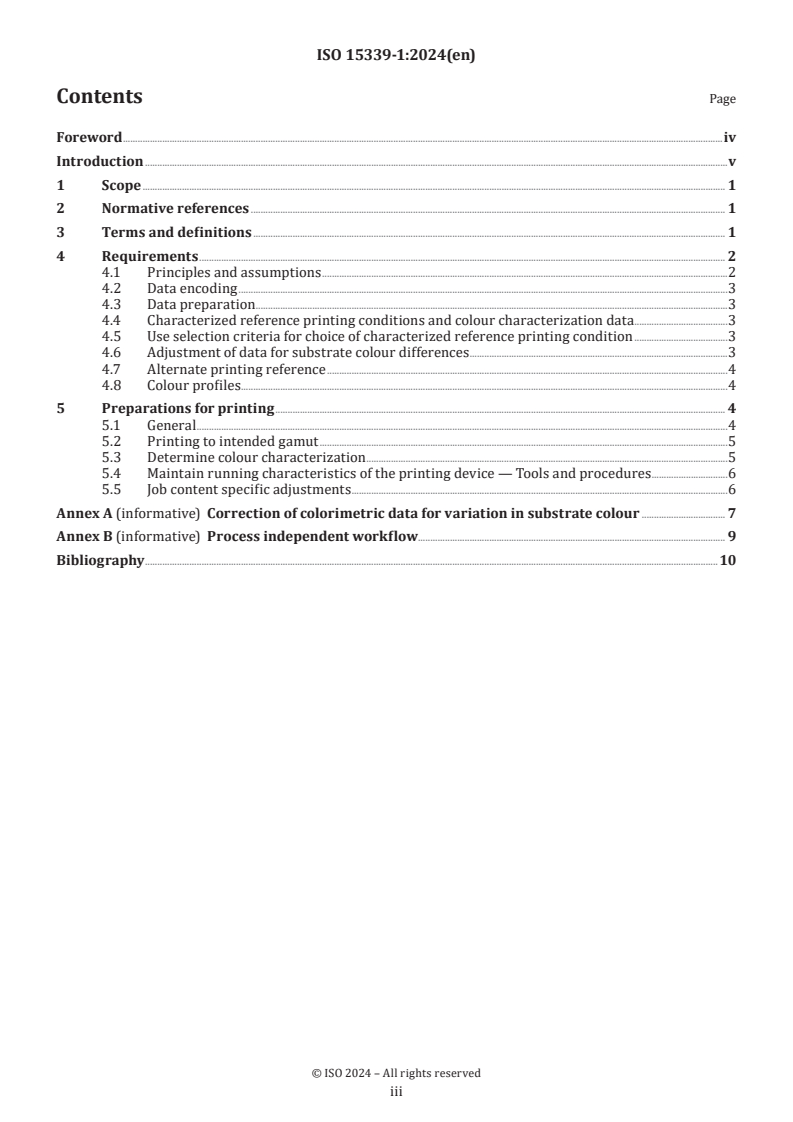
Contents Page
Foreword .iv
Introduction .v
1 Scope . 1
2 Normative references . 1
3 Terms and definitions . 1
4 Requirements . 2
4.1 Principles and assumptions .2
4.2 Data encoding .3
4.3 Data preparation .3
4.4 Characterized reference printing conditions and colour characterization data .3
4.5 Use selection criteria for choice of characterized reference printing condition .3
4.6 Adjustment of data for substrate colour differences .3
4.7 Alternate printing reference .4
4.8 Colour profiles.4
5 Preparations for printing . 4
5.1 General .4
5.2 Printing to intended gamut .5
5.3 Determine colour characterization .5
5.4 Maintain running characteristics of the printing device — Tools and procedures .6
5.5 Job content specific adjustments .6
Annex A (informative) Correction of colorimetric data for variation in substrate colour . 7
Annex B (informative) Process independent workflow. 9
Bibliography .10
iii
Foreword
ISO (the International Organization for Standardization) is a worldwide federation of national standards
bodies (ISO member bodies). The work of preparing International Standards is normally carried out through
ISO technical committees. Each member body interested in a subject for which a technical committee
has been established has the right to be represented on that committee. International organizations,
governmental and non-governmental, in liaison with ISO, also take part in the work. ISO collaborates closely
with the International Electrotechnical Commission (IEC) on all matters of electrotechnical standardization.
The procedures used to develop this document and those intended for its further maintenance are described
in the ISO/IEC Directives, Part 1. In particular, the different approval criteria needed for the different types
of ISO documents should be noted. This document was drafted in accordance with the editorial rules of the
ISO/IEC Directives, Part 2 (see www.iso.org/directives).
ISO draws attention to the possibility that the implementation of this document may involve the use of (a)
patent(s). ISO takes no position concerning the evidence, validity or applicability of any claimed patent
rights in respect thereof. As of the date of publication of this document, ISO had not received notice of (a)
patent(s) which may be required to implement this document. However, implementers are cautioned that
this may not represent the latest information, which may be obtained from the patent database available at
www.iso.org/patents. ISO shall not be held responsible for identifying any or all such patent rights.
Any trade name used in this document is information given for the convenience of users and does not
constitute an endorsement.
For an explanation of the voluntary nature of standards, the meaning of ISO specific terms and expressions
related to conformity assessment, as well as information about ISO's adherence to the World Trade
Organization (WTO) principles in the Technical Barriers to Trade (TBT), see www.iso.org/iso/foreword.html.
This document was prepared by Technical Committee ISO/TC 130, Graphic technology.
This first edition of ISO 15339-1 cancels and replaces ISO/PAS 15339-1:2015, which has been technically
revised.
The main changes are as follows:
— the normative references have been updated;
— former subclause 5.4.2 on tolerances has been deleted;
— former Annex B, Tolerancing schema, has been deleted and subsequent annex has been relabelled;
— published as an International Standard.
A list of all parts in the ISO 15339 series can be found on the ISO website.
Any feedback or questions on this document should be directed to the user’s national standards body. A
complete listing of these bodies can be found at www.iso.org/members.html.
iv
Introduction
This document is based on the premise that in the printing and publishing industries, electronic data are
the intermediary for content storage and exchange throughout production including file preparation, job
assembly, proofing, and process colour printing. It further assumes that data preparation can be largely
process independent and that choice of the printing process or processes to be used for final production will be
based primarily on run length requirements and substrates to be used. There are various tools in place to both
define the relationship of digital data to printed colour for specific instances of printing and to manipulate data
such that similar results can be obtained between and among different printing processes (see ISO/TS 10128).
These specific instances of printing are typically described by colour characterization data.
When producing printed colour reproductions, it is important that the organizations responsible for
material preparation, colour separation, proofing, and printing all working to a common set of parameters
that uniquely define the intended visual characteristics of the final printed product. Such an agreement
enables the correct production of suitable input data and subsequent production of proofs from these data.
The purpose of a proof is to simulate the visual characteristics of the finished print product as closely as
possible prior to production printing.
There is a unique relationship between ink, substrate, and printing process that limits the maximum
chroma of the solids of the printing colorants and therefore limits the range of colours (colour gamut)
that can be achieved for particular combinations. While special inks can be used, the commonly available
ink pigments are used across all traditional ink processes. While toner and ink-jet systems have different
colorant constraints than traditional ink processes, they tend to mimic traditional ink process aims and
they will be treated as a variation of traditional ink processes. The achievable chroma range (gamuts) of ink-
on-paper characterized reference printing conditions can generally be bracketed between cold-set printing
on newsprint on the small end and by printing on gloss coated stocks (by a variety of processes) on the
large end. Between these limits there is significant overlap of process/substrate combinations. The number
of intermediate characterized reference printing conditions that are logical to define between smallest
and largest is in part a function of the tolerances to which printing is expected to conform to the intended
characterized reference printing condition. However, the intermediate characterized reference printing
conditions also need to represent common widely used printing.
A colour characterization data set is required for each characterized reference printing condition specified.
Because the intent of this document is that the data sets provided can be used as the reference for any
printing process, they might not be aligned with the typical TVI and trapping associated with any specific
printing process. The values selected need to represent in effect virtual printing on a virtual printing system.
It is important to realize that digital data can be encoded as already separated CMYK or can consist of un-
separated data (typically in an RGB colour space) with supplementary information (ICC colour profiles, etc.)
defining the colour intended on the printed sheet. Such unseparated data plus the associated supplementary
data are sometimes referred to as “virtual CMYK” data. All data are encoded according to one of the PDF/X
specifications (see the ISO 15930 series) to allow the necessary metadata which identifies the intended
characterized reference printing condition to be included.
The colour of the printing substrate is a critical component of the colour appearance of a printed image (it
behaves like a 5th colour). For halftone images, the colour of the substrate contributes mostly in the area not
covered by ink. ISO 15339 is based on the assumption that the colour characterization data can be adjusted
(fine-tuned) for the range of normal substrate colours expected and that different characterized reference
printing conditions are not required for moderate differences in substrate colour.
Modern characterization data and profile evaluation tools allow identification of the colour of the solids,
the colour and tone values of the single colour scales, and the CMY values associated with the neutral
(achromatic) tone scale. Using the values derived from the colour characterization data for one printing
process when printing on a printing process with substantially different characteristics, is the recommended
input for process control aims used to conform to a particular characterized reference printing condition.
Annex B provides a description of the process independent workflow that is the basis for the concepts
embodied in ISO 15339.
v
International Standard ISO 15339-1:2024(en)
Graphic technology — Printing from digital data across
multiple technologies —
Part 1:
Principles
1 Scope
This document establishes principles for the use of colour characterization data as the definition of the
intended relationship between input data and printed colour for file preparation, job assembly, proofing,
and graphic arts production printing. It specifies the procedure used to adjust colour characterization data
for the normally expected range of substrate colour.
2 Normative references
The following documents are referred to in the text in such a way that some or all of their content constitutes
requirements of this document. For dated references, only the edition cited applies. For undated references,
the latest edition of the referenced document (including any amendments) applies.
ISO 12642-2, Graphic technology — Input data for characterization of 4-colour process printing — Part 2:
Expanded data set
ISO 13655, Graphic technology — Spectral measurement and colorimetric computation for graphic arts images
ISO 15930 (all parts), Graphic technology — Prepress digital data exchange using PDF
3 Terms and definitions
For the purposes of this document, the following terms and definitions apply.
ISO and IEC maintain terminology databases for use in standardization at the following addresses:
— ISO Online browsing platform: available at https:// www .iso .org/ obp
— IEC Electropedia: available at https:// www .electropedia .org/
3.1
colour characterization data
tabulation of data that represents the relationship between device code values (e.g. CMYK) and the colour
(CIELAB) produced or intended to be produced on the printed sheet
Note 1 to entry: Where such a set of colour characterization data are used as a reference, it is referred to as a
characterized reference printing condition (CRPC).
3.2
colour profile
set of transforms, encoded according to the rules of ISO 15076-1, that convert data between (to and from)
device space and profile connection space
Note 1 to entry: The transforms contained within a colour profile can include manipulation of gamut compression/
expansion, tone reproduction, colour separation, black generation, printing limitations (e.g., total area coverage), etc.
3.3
colour gamut
region of CIELAB colour space containing all printable colours
Note 1 to entry: For comparison purposes, the CIELAB values of the primaries and secondaries along with the substrate
are often an adequate, if sparse, definition of a colour gamut. The surface values of the measurements of a target such
as that included in ISO 12642-2 can provide a more complete definition.
3.4
characterized reference printing condition
CRPC
identified printing condition (3.4) and associated colour characterization data (3.1) intended for use with
multiple printing processes
3.5
process independent
independent of the printing process (offset, flexography, gravure, digital, etc.), to be used for production of
printed material
3.6
identified printing condition
printing condition documented in a national or international standard or industry publication in a way that
allows it to be replicated by an industry practitioner
4 Requirements
4.1 Principles and assumptions
One of the key principles upon which this document is based is that colour content data can be adjusted such
that any printing processes capable of achieving a specified colour gamut can produce the within-gamut
image colours specified by the appropriate reference colour characterization data. This allows printing aims
to be process independent.
A second principle is that process control aims and tools should be based on (extracted from) the reference
colour characterization data selected and not based on a priori assumptions. Many of the parameters used
in process control such as tone value increase, grey balance, etc. are contained within, or can be derived
from, the colour characterization data chosen as a reference. Local site tools can also be used for initial
setup processes where these are based on the known differences between the colour characterization data
aims and the colour characterization of the actual printing system being used. The aim values extracted
from characterisation data should match or be aligned with the aim values specified in the appropriate part
of ISO 12647 when printing using the process from which the characterisation data was derived. Where this
is not the case, the process control principles and tolerances should still be used.
NOTE 1 The ISO 12647 series specifies process control aims and requirements. When aim values extracted from
characterisation data meet the requirements of the applicable part of ISO 12647, conformance with both standards is
possible.
Where similar characteristics, such as tone reproduction, are desired between different characterized
reference printing conditions (different colour gamuts), these shall be built into the colour characterization
data associated with these characterized reference printing conditions. Characterized reference printing
conditions, and their associated colour characterization data, can be thought of as a virtual printing system
(press) and as such the characterization data can be manipulated mathematically to fine tune results to
achieve smoothness, uniformity and/or other characteristics.
NOTE 2 The key requirement for successful application of these principals is that the reference colour
characterization data and the characterization data for the printing system being used shall have the same gamut and
be sufficient to allow the necessary data adjustment. See ISO/TS 10128 for recommended procedures to implement
such data adjustment.
4.2 Data encoding
In the absence of other prior agreement, the electronic colour content data to be used as the intermediate
storage and exchange media between file preparation, job assembly, proofing, and printing shall be encoded
in accordance with one of the ISO 15930 series. Any deviation from this, such as encoding in ISO 12639 or in
some other format, and shall include communication of the reference characterization data of the intended
printing condition and, as necessary, a colour profile to transform any data not supplied in the process
colour model of the reference.
4.3 Data preparation
All print elements shall be prepared either as device code values or as colorimetrically defined data. However,
both types of data if present in print elements shall be prepared for a single characterized reference printing
condition. This condition shall be provided in the PDF/X output intent in the case of an ISO 15930 exchange
or shall be communicated by mutually ag
...