


ISO 12142:2001
(Main)Electronic imaging — Media error monitoring and reporting techniques for verification of stored data on optical digital data disks
Electronic imaging — Media error monitoring and reporting techniques for verification of stored data on optical digital data disks
Imagerie électronique — Méthodes de surveillance et d'établissement de compte rendu d'erreurs pour la vérification des données stockées sur des disques optiques numériques
General Information
- Status
- Withdrawn
- Publication Date
- 21-Nov-2001
- Withdrawal Date
- 21-Nov-2001
- Technical Committee
- ISO/TC 171/SC 1 - Quality, preservation and integrity of information
- Drafting Committee
- ISO/TC 171/SC 1 - Quality, preservation and integrity of information
- Current Stage
- 9599 - Withdrawal of International Standard
- Start Date
- 19-Nov-2009
- Completion Date
- 12-Feb-2026
Frequently Asked Questions
ISO 12142:2001 is a standard published by the International Organization for Standardization (ISO). Its full title is "Electronic imaging — Media error monitoring and reporting techniques for verification of stored data on optical digital data disks". This standard covers: Electronic imaging — Media error monitoring and reporting techniques for verification of stored data on optical digital data disks
Electronic imaging — Media error monitoring and reporting techniques for verification of stored data on optical digital data disks
ISO 12142:2001 is classified under the following ICS (International Classification for Standards) categories: 37.080 - Document imaging applications. The ICS classification helps identify the subject area and facilitates finding related standards.
ISO 12142:2001 is available in PDF format for immediate download after purchase. The document can be added to your cart and obtained through the secure checkout process. Digital delivery ensures instant access to the complete standard document.
Standards Content (Sample)
INTERNATIONAL ISO
STANDARD 12142
First edition
2001-11-15
Electronic imaging — Media error
monitoring and reporting techniques for
verification of stored data on optical digital
data disks
Imagerie électronique — Méthodes de surveillance et d'établissement de
compte rendu d'erreurs pour la vérification des données stockées sur des
disques optiques numériques
Reference number
©
ISO 2001
PDF disclaimer
This PDF file may contain embedded typefaces. In accordance with Adobe's licensing policy, this file may be printed or viewed but shall not
be edited unless the typefaces which are embedded are licensed to and installed on the computer performing the editing. In downloading this
file, parties accept therein the responsibility of not infringing Adobe's licensing policy. The ISO Central Secretariat accepts no liability in this
area.
Adobe is a trademark of Adobe Systems Incorporated.
Details of the software products used to create this PDF file can be found in the General Info relative to the file; the PDF-creation parameters
were optimized for printing. Every care has been taken to ensure that the file is suitable for use by ISO member bodies. In the unlikely event
that a problem relating to it is found, please inform the Central Secretariat at the address given below.
© ISO 2001
All rights reserved. Unless otherwise specified, no part of this publication may be reproduced or utilized in any form or by any means, electronic
or mechanical, including photocopying and microfilm, without permission in writing from either ISO at the address below or ISO's member body
in the country of the requester.
ISO copyright office
Case postale 56 • CH-1211 Geneva 20
Tel. + 41 22 749 01 11
Fax + 41 22 749 09 47
E-mail copyright@iso.ch
Web www.iso.ch
Printed in Switzerland
ii © ISO 2001 – All rights reserved
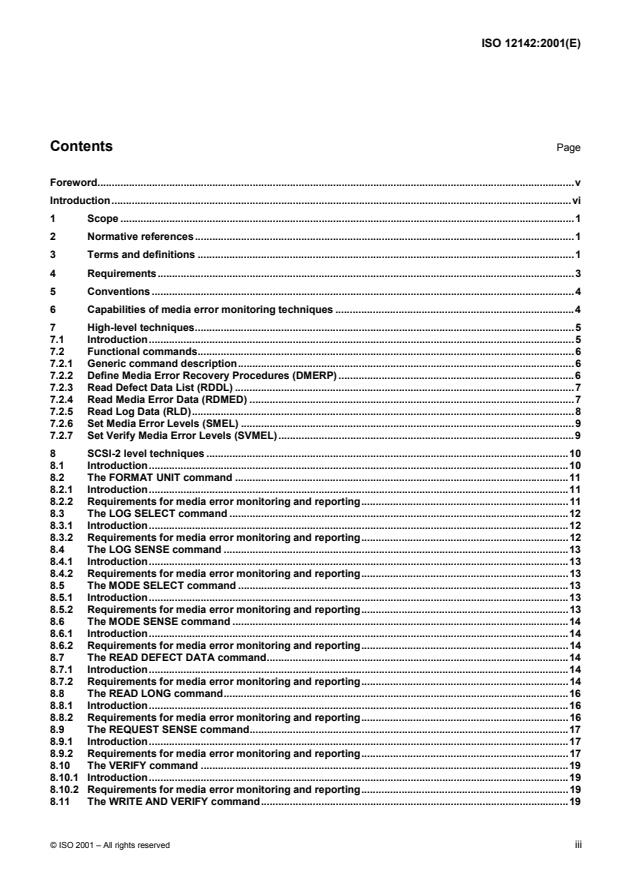
Contents Page
Foreword.v
Introduction.vi
1 Scope .1
2 Normative references.1
3 Terms and definitions .1
4 Requirements.3
5 Conventions .4
6 Capabilities of media error monitoring techniques .4
7 High-level techniques.5
7.1 Introduction.5
7.2 Functional commands.6
7.2.1 Generic command description.6
7.2.2 Define Media Error Recovery Procedures (DMERP) .6
7.2.3 Read Defect Data List (RDDL) .7
7.2.4 Read Media Error Data (RDMED) .7
7.2.5 Read Log Data (RLD).8
7.2.6 Set Media Error Levels (SMEL) .9
7.2.7 Set Verify Media Error Levels (SVMEL).9
8 SCSI-2 level techniques .10
8.1 Introduction.10
8.2 The FORMAT UNIT command .11
8.2.1 Introduction.11
8.2.2 Requirements for media error monitoring and reporting.11
8.3 The LOG SELECT command .12
8.3.1 Introduction.12
8.3.2 Requirements for media error monitoring and reporting.12
8.4 The LOG SENSE command .13
8.4.1 Introduction.13
8.4.2 Requirements for media error monitoring and reporting.13
8.5 The MODE SELECT command .13
8.5.1 Introduction.13
8.5.2 Requirements for media error monitoring and reporting.13
8.6 The MODE SENSE command .14
8.6.1 Introduction.14
8.6.2 Requirements for media error monitoring and reporting.14
8.7 The READ DEFECT DATA command.14
8.7.1 Introduction.14
8.7.2 Requirements for media error monitoring and reporting.14
8.8 The READ LONG command.16
8.8.1 Introduction.16
8.8.2 Requirements for media error monitoring and reporting.16
8.9 The REQUEST SENSE command.17
8.9.1 Introduction.17
8.9.2 Requirements for media error monitoring and reporting.17
8.10 The VERIFY command .19
8.10.1 Introduction.19
8.10.2 Requirements for media error monitoring and reporting.19
8.11 The WRITE AND VERIFY command.19
8.11.1 Introduction.19
8.11.2 Requirements for media error monitoring and reporting.19
8.12 Parameters for optical disk devices .20
8.12.1 Media error monitoring and reporting associated parameters.20
8.12.2 Mode parameters .20
8.12.3 Log parameters.22
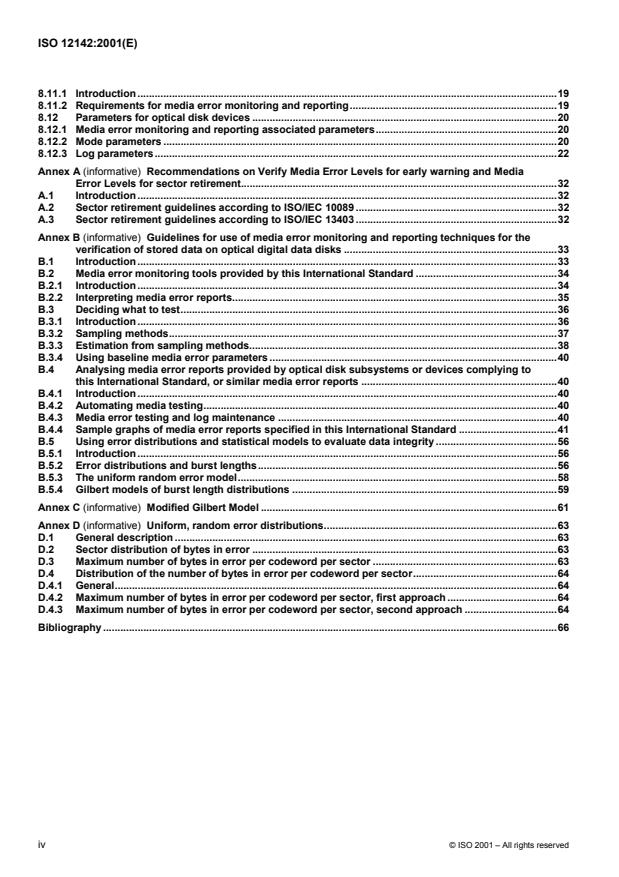
Annex A (informative) Recommendations on Verify Media Error Levels for early warning and Media
Error Levels for sector retirement.32
A.1 Introduction.32
A.2 Sector retirement guidelines according to ISO/IEC 10089 .32
A.3 Sector retirement guidelines according to ISO/IEC 13403 .32
Annex B (informative) Guidelines for use of media error monitoring and reporting techniques for the
verification of stored data on optical digital data disks .33
B.1 Introduction.33
B.2 Media error monitoring tools provided by this International Standard .34
B.2.1 Introduction.34
B.2.2 Interpreting media error reports.35
B.3 Deciding what to test.36
B.3.1 Introduction.36
B.3.2 Sampling methods.37
B.3.3 Estimation from sampling methods.38
B.3.4 Using baseline media error parameters .40
B.4 Analysing media error reports provided by optical disk subsystems or devices complying to
this International Standard, or similar media error reports .40
B.4.1 Introduction.40
B.4.2 Automating media testing.40
B.4.3 Media error testing and log maintenance .40
B.4.4 Sample graphs of media error reports specified in this International Standard .41
B.5 Using error distributions and statistical models to evaluate data integrity .56
B.5.1 Introduction.56
B.5.2 Error distributions and burst lengths.56
B.5.3 The uniform random error model.58
B.5.4 Gilbert models of burst length distributions .59
Annex C (informative) Modified Gilbert Model .61
Annex D (informative) Uniform, random error distributions.63
D.1 General description .63
D.2 Sector distribution of bytes in error .63
D.3 Maximum number of bytes in error per codeword per sector .63
D.4 Distribution of the number of bytes in error per codeword per sector.64
D.4.1 General.64
D.4.2 Maximum number of bytes in error per codeword per sector, first approach .64
D.4.3 Maximum number of bytes in error per codeword per sector, second approach .64
Bibliography .66
iv © ISO 2001 – All rights reserved
Foreword
ISO (the International Organization for Standardization) is a worldwide federation of national standards bodies (ISO
member bodies). The work of preparing International Standards is normally carried out through ISO technical
committees. Each member body interested in a subject for which a technical committee has been established has
the right to be represented on that committee. International organizations, governmental and non-governmental, in
liaison with ISO, also take part in the work. ISO collaborates closely with the International Electrotechnical
Commission (IEC) on all matters of electrotechnical standardization.
International Standards are drafted in accordance with the rules given in the ISO/IEC Directives, Part 3.
Draft International Standards adopted by the technical committees are circulated to the member bodies for voting.
Publication as an International Standard requires approval by at least 75 % of the member bodies casting a vote.
Attention is drawn to the possibility that some of the elements of this International Standard may be the subject of
patent rights. ISO shall not be held responsible for identifying any or all such patent rights.
International Standard ISO 12142 was prepared by Technical Committee ISO/TC 171, Document imaging
applications, Subcommittee SC 1, Quality.
Annexes A to D of this International Standard are for information only.
Introduction
Data and records managers in many organizations are already using optical disk-based information systems for
storing and retrieving large data sets and for storing valuable information. The optical disk drives that are part of
these systems are designed with powerful, but not unlimited, error correction capabilities. If the level of errors in an
optical digital data disk sector exceeds the error detection and correction mechanisms implemented in the optical
disk drive controller, the sector cannot be corrected (data loss might occur). System managers would like to be able
to use media error monitoring and reporting techniques to verify the information stored on optical digital data disks,
both initially when the data is transferred to that media and periodically to monitor the status of their data. The
Media Error Levels of correction taking place in the optical disk drive controller give an indication of the status of
data saved on these optical digital data disks.
This International Standard documents two approaches of media error monitoring and reporting techniques to verify
stored data on optical digital data disks:
a high-level approach with functional commands;
an implementation of a set of Small Computer System Interface-2 (SCSI-2) commands.
The high-level interface approach is independent of the host operating system (e.g. DOS, UNIX, OS/2, etc.) and
the interface that communicates between the optical disk device and the host (e.g. SCSI-2, IPI, LAN, etc.). In
addition, this high-level interface is media type and size independent. That is, it can be used with systems that use
Write-Once-Read-Many (WORM), rewritable, or partially read-only media; and with optical disk drives for different
media sizes from 90 mm to 356 mm media. Standard information about media errors allows end users and system
integrators to retrieve the same information even if their configurations consist of drives of different types, sizes,
and manufacturers. This information can be retrieved using the same software, which can be integrated into the
media error information utilities or device drivers.
The SCSI interface can be used instead of the high-level interface by using the selected set of SCSI-2 commands.
This selected set of SCSI-2 commands allows system manufacturers to develop drive type and size independent
data verification tools at the SCSI level through the use of media error monitoring and reporting techniques. The
use of a selected standard set of commands and approaches for media error monitoring and reporting allows any
implementor to use a common set of software tools that do not change from drive to drive.
The media error information that can be obtained using the high-level or SCSI-2 tools includes:
a list of reallocated sectors;
corrections above some Media Error Levels;
warning above some Verify Media Error Levels;
the total number of bytes in error, the number of bytes in error per sector, and the maximum number of bytes in
error in any sector codeword;
the uncorrected or corrected sector content;
errors encountered when reading header information, such as the sector address, sector marks, and
synchronization signals;
the maximum length of contiguous defective bytes.
By acquiring optical disk-based information systems that comply with this International Standard, system managers
will be able to access media error information at both a functional (higher) level and an interface level for optical
vi © ISO 2001 – All rights reserved
disk drives that implement ISO/IEC 9316. These tools facilitate a better understanding of the status of information
stored on optical digital data disks. The tools provide for design of more efficient media error monitoring and
reporting techniques, and data verification and recopying policies for transferring recorded data to similar or
different media in a timely and economic manner.
These media error monitoring and reporting techniques also allow system managers to obtain media error
information either in quasi-real time or during off-line operations. These techniques provide data recovery and
media error monitoring tools with different levels of sophistication. Information on media errors can be obtained,
which will enable the highlighting of trends on particular selected disks or in their entire data sets. Decisions on
frequency of use of these tools and the level of sophistication selected are not part of this International Standard.
INTERNATIONAL STANDARD ISO 12142:2001(E)
Electronic imaging — Media error monitoring and reporting
techniques for verification of stored data on optical digital data
disks
1 Scope
This International Standard specifies two techniques for media error monitoring and reporting for the verification of
data stored on optical digital data disks:
high-level, which uses a set of functional commands;
SCSI-2 level, which uses a set of SCSI-2 commands.
It specifies two media error monitoring and reporting levels:
system level, which uses a set of functional commands that can be used by the operating system, application
software, and remote users;
optical disk device level, which uses a set of SCSI-2 commands that can be used by the device driver or a
device application programme.
Compliance to the requirements of this International Standard is specified in clause 4.
This International Standard applies to both rewritable and read only optical disk media.
Part of the information in this International Standard may be useful for CD-ROM subsystems, but implementations
for that technology are beyond the scope of this International Standard.
2 Normative references
The following normative documents contain provisions which, through reference in this text, constitute provisions of
this International Standard. For dated references, subsequent amendments to, or revisions of, any of these
publications do not apply. However, parties to agreements based on this International Standard are encouraged to
investigate the possibility of applying the most recent editions of the normative documents indicated below. For
undated references, the latest edition of the normative document referred to applies. Members of ISO and IEC
maintain registers of currently valid International Standards.
ISO/IEC 9316:1995, Information technology — Small Computer System Interface-2
ISO 12651:1999, Electronic imaging — Vocabulary
3 Terms and definitions
For the purposes of this International Standard, the terms and definitions given in ISO/IEC 9316, ISO 12651 and
the following apply.
3.1
band
specified number of contiguous tracks
NOTE It is a useful notation for referencing disk regions and plotting physically descriptive media error results.
3.2
byte error rate
BER
total number of bytes in error in a given sample divided by the sample size
3.3
constant angular velocity
recording method in which the number of clock periods per revolution is constant, independent of radius
NOTE This method implies that the amount of data per track is independent of radial position.
3.4
continuous–servo media
media on which the servo information for tracking is continuously available on adjacent grooves
3.5
data field
user data, defect management pointers (DMP), cyclic redundancy check (CRC), and error correction code (ECC)
bytes of a recorded sector
3.6
format
arrangement or layout of the data on the disk
3.7
initiator
SCSI device that requests an I/O process to be performed by another SCSI device (a target)
3.8
interleaving
process of allocating the physical sequence of units of data in order to render the data more immune to burst errors
3.9
native format
error correction code (ECC) data and control bytes, and stripping sync bytes
3.10
Reed−−Solomon codes
−−
error correction code particularly suited to the correction of errors that occur in bursts or are strongly correlated
3.11
sampled–servo media
media on which the servo information for focusing and tracking, along with clock information, is obtained by means
of periodic sampling of information on the optical disk
3.12
target
SCSI device that performs an operation requested by the initiator
3.13
verification of data
verification of the integrity and status of data
2 © ISO 2001 – All rights reserved
4 Requirements
This International Standard specifies the following two levels of compliance:
the BASIC level which uses a minimal set of functions and commands;
the EXTENDED level which uses all of the functions and commands in the BASIC level plus a MEDIA ERROR
LOG and user-set optical disk device programmable Media Error Levels and Verify Media Error Levels. The
EXTENDED level also allows users to interrogate the optical disk system (using the functional commands) or
the optical disk device (using a set of SCSI-2 commands) about the current setting of the optical disk device
set Media Error Levels and set Verify Media Error Levels.
Statements of compliance to the requirements of this International Standard shall state the level of compliance
used, BASIC or EXTENDED, at the system level interface and device level.
An optical disk-based information system is in accordance with this International Standard when it meets all the
requirements specified in clause 7 (for BASIC or EXTENDED compliance).
An optical disk device that conforms to ISO/IEC 9316 is in accordance with this International Standard when it
meets all the requirements specified in clause 8 (for BASIC or EXTENDED compliance).
Table 1 summarizes the BASIC and EXTENDED levels of compliance at the optical disk-based system level
(system level). Table 2 summarizes the BASIC and EXTENDED levels of compliance at the optical disk device
level (application of SCSI-2 commands for optical disk devices).
Table 1 — System level compliance
Functional level for optical disk-based subsystems: Level of compliance
Function description BASIC EXTENDED
Define media error recovery procedures (DMERP) Yes Yes
Read defect data list (RDDL) Yes Yes
Read media error data (RDMED) Yes Yes
Read log data (RLD) – Media error log and current Media Error No Yes
Levels
Set Media Error Levels (SMEL) No Yes
Set Verify Media Error Levels (SVMEL) No Yes
Table 2 — Conformance at the optical disk device level
Application of SCSI-2 commands for Level of compliance
optical disk devices BASIC EXTENDED
The FORMAT UNIT command Yes Yes
The LOG SELECT command and the following pages: No Yes
The media error log (MEL) page No Yes
The clear MEL page No Yes
The LOG SENSE command and the following pages: No Yes
The MEL page No Yes
The clear MEL page No Yes
The MODE SELECT command and the following pages: No Yes
The read-write error recovery page for optical disk devices
No Yes
The verify recovery page for optical disk devices No Yes
The MODE SENSE command and the following pages: No Yes
The read-write error recovery page for optical disk devices No Yes
The verify recovery page for optical disk devices No Yes
The READ DEFECT DATA command and the PDL, SDL, and WDL Yes Yes
The READ LONG command Yes Yes
The REQUEST SENSE command, the sense keys 01h or 03h, and Yes Yes
the related ASC or ASCQs
The VERIFY command Yes Yes
The WRITE AND VERIFY command Yes Yes
5 Conventions
This International Standard follows the conventions given in 4.2 of ISO/IEC 9316:1995. For the purpose of
identification, the parameters “Media Error Levels” and “Verify Media Error Levels” used in this International
Standard are shown with first upper case letters. The following conventions from ISO/IEC 9316 are reproduced:
Numbers that are not immediately followed by lower-case b or h are decimal values.
Numbers immediately followed by lower-case b (xxb) are binary values.
Numbers immediately followed by lower case h (xxh) are hexadecimal values.
6 Capabilities of media error monitoring techniques
The high-level interface functions specified in clause 7 and the application of SCSI-2 commands specified in
clause 8 provide two approaches for retrieving the following information about a disk:
consumption of spare sectors (physical address of each sector reallocated and of spare sectors still available
in the reallocation table, when a reallocation table exists, or a list of sector addresses of the replaced sector
and its replacement);
corrections that exceeded Media Error Levels;
warning on Verify Media Error Levels;
4 © ISO 2001 – All rights reserved
the total number of bytes in error, the number of bytes in error per sector, and the maximum number of bytes in
error in any codeword;
the uncorrected or corrected sector content;
errors encountered when reading header information (bad IDs, sector missing marks, data syncs, and resync
marks);
maximum length of contiguous defective bytes.
Media Error Levels and Verify Media Error Levels can be set.
7 High-level techniques
7.1 Introduction
The purpose of this clause is to provide high-level (a set of functional commands) media error monitoring and
reporting techniques for verifying stored data on optical digital data disks. By implementing this International
Standard, the following are enabled:
set Media Error Levels to reallocate sectors whenever one of the Media Error Levels is exceeded;
obtain the value of the Media Error Levels;
set Verify Media Error Levels to obtain early warning information on the status of the data when one of the
Verify Media Error Levels is exceeded;
obtain the values of the Verify Media Error Levels;
obtain information about all the reallocated sectors and a defect list of initial media defects;
retrieve a media error log with information about the media error activity detected by the drive;
obtain the corrected sector content or the uncorrected sector content including user data bytes and error
correction code (ECC) bytes.
The high-level interface approach is independent of the host operating system (e.g. DOS, UNIX, OS/2, etc.) and
the interface between the optical disk device and the host (e.g. SCSI-2, IPI, LAN, etc.). In addition, this high-level
interface is media type and size independent. That is, it can be used with systems that use WORM, rewritable or
partially read-only media, and optical disk devices for different media sizes (e.g. 90 mm to 356 mm).
Standard formats for disk errors will allow the retrieval of the same information from configurations consisting of
drives of different types, sizes, and manufacturers by using the same routines integrated into the media error
information utilities or device drivers.
7.2 Functional commands
The following functional, or high-level (host), commands shall be used for verifying the data.
7.2.1 Generic command description
The following command syntax is used in this International Standard:
Command name [parameter 1] [parameter 2] [parameter 3] ……… [parameter n]
At least one parameter shall be included with the command name. A parameter that can be set ON or OFF is
indicated as:
Parameter ON
OFF
7.2.2 Define Media Error Recovery Procedures (DMERP)
The DMERP command shall be used to define to the optical disk device the following error recovery procedures:
media error reporting;
media error data transfer that shall be executed.
The default for an unspecified parameter shall be OFF.
DMERP WR ON RE ON RRE ON
OFF OFF OFF
WR: Sector Reallocation on Write Error
ON: Enables the device error recovery procedures to automatically reallocate a sector(s) to a spare sector
area on the disk whenever the optical disk device encounters an error level that exceeds the set Media Error
Levels during writing operations;
OFF: Disables the optical disk device error recovery procedures from automatically reallocating a sector(s)
whenever the optical disk drive encounters an error level that exceeds the set Media Error Levels during
writing operations.
RE: Sector Reallocation on Read Error
ON: Enables the optical disk device error recovery procedures to automatically reallocate a sector(s) to a
spare sector area on the disk, whenever the optical disk device encounters an error level that exceeds the set
Media Error Levels when reading a sector(s);
OFF: Disables the device error recovery procedures from automatically reallocating a sector(s) whenever the
optical disk device encounters an error level that exceeds the set Media Error Levels when reading a sector(s).
RRE: Report Recovered Errors
ON: The optical disk device shall report recovered errors to the host computer;
OFF: The optical disk device shall not report recovered errors to the host computer.
6 © ISO 2001 – All rights reserved
7.2.3 Read Defect Data List (RDDL)
The RDDL command shall be used to read the defect data list from the optical disk device. The defect data list is
shown in Table 3.
Table 3 — Defect data list
Byte Description
1 Number of entries in the list (MSB)
2 Number of entries in the list (LSB)
3 Defective sector track number (MSB)
4 Defective sector track number
5 Defective sector track number (LSB)
6 Defective sector number
n – 3 Defective sector track number (MSB)
n – 2 Defective sector track number
n – 1
Defective sector track number (LSB)
n
Defective sector number
RDDL [List Size]
List Size specifies, in hexadecimal, the number of bytes to be transferred. The defect list data shall be returned to
the host in the format shown in Table 3. If List Size is set to zero, no data shall be transferred. Bytes shall be
transferred in hexadecimal values.
7.2.4 Read Media Error Data (RDMED)
The RDMED command shall be used to request the optical disk device to transfer the content of a sector to the
host computer. The data transferred to the host shall include the following:
the user data bytes;
the ECC bytes;
the defect management pointers (DMP) bytes;
any other bytes that are part of the sector data field and can be corrected by the ECC.
These bytes shall be sent to the host in the same order as they occur on the medium, according to any existing
related medium International Standard (e.g. for ISO/IEC 10089, format A media, the type of bytes shall be Data,
DMP, CRC, and ECC. See ISO/IEC 10089:1991, annex G). The bytes shall be expressed in hexadecimal values.
The most recent data written to the addressed sector shall be read from the medium and returned.
RDMED
ADDR BXFER CORR ON
OFF
where
ADDR is the logical or physical address of the sector that shall be transferred expressed as track and sector
number (expressed in hexadecimal values);
BXFER is the number of bytes that shall be read by the optical disk device and transferred to the host
computer (expressed in hexadecimal values);
CORR is the data corrected by the ECC. The default shall be to turn ECC correction ON.
ON: Causes data to be corrected by the ECC before being transferred to the host computer.
OFF: Causes uncorrected data to be transferred to the host computer.
7.2.5 Read Log Data (RLD)
The RLD command shall be used to request that the optical disk device report log data to the host. Each parameter
included with the command identifies a different log.
The logs shall be returned to the host in the order that the log parameters are passed to the optical disk device.
RLD [CMELL] [VCMELL]
MEL CLRMEL ON
OFF
MEL is the Media Error Log; it provides detailed information about different media error indicators. The data in the
MEL shall be sent to the host in the sequence defined in clause 8 and Table 22. That is, number of read retries
shall be sent first, followed by number or write retries, etc. Each parameter shall have a length of 6 bytes. This is
the same parameter length specified for the same parameters in 8.12.3.2 and Table 21. The parameters shall be
transferred as hexadecimal values.
CLRMEL specifies that the MEL shall be cleared when read. The default shall be OFF.
ON: The MEL shall be cleared when it is read.
OFF: The MEL shall not be cleared when it is read.
CMELL is the Current Media Error Levels Log; it reports the current set media error level values. These values
shall be used by the optical disk device to reallocate a sector(s). Table 4 shows the four specified media error level
parameters.
The media error level values shall be sent to the host in the sequence shown in Table 4. Each parameter shall
have a length of 6 bytes. This is the same parameter length specified for the same parameters in 8.12.2.1 and
Table 18. The parameters shall be transferred as hexadecimal values.
Table 4 — Media Error Levels
Maximum number of bytes in error per codeword per sector
Number of bytes in error per sector
Number of bad IDs
a
Number missing resync
a
If the medium does not use resyncs, this level is N/A and the parameter shall be FFh.
If either the WR or the RE parameters from the DMERP command is ON, the optical disk device shall reallocate
sector(s) that have an error recovery level exceeding one or more of the set Media Error Levels as specified in
Table 4.
8 © ISO 2001 – All rights reserved
VCMELL is the Verify Current Media Error Levels Log; it reports the current set verify level values. These levels
shall be used by the optical disk device to provide an early warning to the host computer that the correction level
exceeded the value for the related set level as defined in Table 5.
The sector(s) that provoke the early warning can be found through the MEL. Table 5 shows the four specified verify
media error level parameters. The data in the VCMELL shall be sent to the host in the sequence shown in Table 3.
Each parameter shall have a length of 6 bytes. This is the same parameter length specified for the same
parameters in 8.12.2.2 and Table 19. The parameters shall be transferred as hexadecimal values.
Table 5 — Verify Media Error Levels
Verify maximum number of bytes in error per codeword per sector
Verify number of bytes in error per sector
Verify number of bad IDs
a
Verify number missing resync
a
If the medium does not use resyncs, this level is N/A and the parameter shall be FFh.
7.2.6 Set Media Error Levels (SMEL)
The SMEL command shall be used to set Media Error Levels that the optical disk device shall use for error
recovery. The four Media Error Levels that can be set with this command are specified in Table 4. The Media Error
Levels are the same as those that are reported by CMELL using the RLD command.
The Media Error Levels shall be used for reallocating sectors. If the ECC level of correction exceeds one or more of
the set levels and the parameters WR or RE in the DMERP command are ON, the sector shall be reallocated to a
spare sector. If the parameters WR or RE in the DMERP command are OFF, the optical disk device shall not
reallocate the sector. In either case, the optical disk device shall report that a set level was exceeded, identify the
level, and indicate whether the data were recovered or unrecovered.
SMEL [LBECW = n1] [LBES = n2] [LID = n3] [LMRS = n4]
where n1 to n4 are the level values (expressed in hexadecimal) specified below:
LBECW: level for maximum number of bytes in error per codeword per sector;
LBES: level for number of bytes in error per sector;
LID: level for number of bad IDs;
LMRS: level for missing resync.
7.2.7 Set Verify Media Error Levels (SVMEL)
The SVMEL command shall be used to set Verify Media Error Levels that the optical disk device shall use for error
recovery. The four Verify Media Error Levels that can be set with this command are specified in Table 5. The Verify
Media Error Levels are the same as those that are reported by VCMELL using the RLD command.
These levels shall be used for obtaining an early warning of media errors that exceeded any level set by this
command. The optical disk device shall report that a set level was exceeded, identify the level, and indicate
whether the data were recovered or unrecovered.
SVMEL [ VLBECW = n1 ] [ VLBES = n2 ] [ VLID = n3 ] [ VLMRS = n4 ]
where n1 to n4 are the level values (expressed in hexadecimal) specified below:
VLBECW: verify level for maximum number of bytes in error per codeword per sector;
VLBES: verify level for number of bytes in error per sector;
VLID: verify level for number of bad IDs;
VLMRS: verify level for missing resync.
8 SCSI-2 level techniques
8.1 Introduction
The purpose of this clause is to provide an application of a selected set of SCSI-2 commands.
Selected commands from the SCSI-2 command set can be used to tailor the retrieval of media error information
according to system requirements. The application of a selected set of SCSI-2 commands from the SCSI-2
command set in this International Standard is related to media error information only and is to be used in
conjunction with ISO/IEC 9316. Some of the SCSI-2 commands that are specified in ISO/IEC 9316 are included
here. However, to use the SCSI-2 commands for applications other than media error monitoring and reporting refer
to ISO/IEC 9316.
In 8.2 to 8.11, requirements for media error monitoring and reporting are described. These requirements define
information about methods for implementing better media error monitoring and reporting approaches, and provide
users with more information on how to satisfy the system requirements through the use of this International
Standard. Requirements for media error monitoring and reporting described in each command implementation
supersede the implementation requirements given in ISO/IEC 9316. Any command, option, or implementation not
covered in this International Standard will remain as specified in ISO/IEC 9316. It is the responsibility of the user to
request from the target any information provided by the commands as specified in this clause.
The FORMAT UNIT command shall be used to format the media. This command allows users, as an option, to
certify the media and create a certification list, which is retrievable as part of the information available through the
READ DEFECT DATA command (see 8.2 and 8.7).
The LOG SELECT command shall be used to clear the MEL page specified in this International Standard, which
provides information about different media error indicators (see 8.3 and 8.12.3.3).
The LOG SENSE command shall be used to retrieve
...
Questions, Comments and Discussion
Ask us and Technical Secretary will try to provide an answer. You can facilitate discussion about the standard in here.
Loading comments...