

ISO 18408:2019
(Main)Simplified structural design for reinforced concrete wall buildings
General Information
- Abstract
This document applies to reinforced concrete building consisting of load bearing walls of reinforced concrete buildings [such buildings are called reinforced concrete box-shaped wall buildings and (RC wall building)] or to the part of RC wall building which uses both this and other types of structure. This document applies to RC wall building as follows: — RC wall building with 5 or fewer aboveground storeys; — eaves height of 16 m or less; — storey height on each storey of 3 m or less; — on the top storey, the storey height can be 3,3 m or less; — if the roof has a slope, the sum of the storey height of the top storey and the height from the eaves to the ridge of 4 m or less. Deep foundations, such as piles and caissons, and their pile footings and caps, are beyond the scope of this document, and are not covered by it.
- Status
- Withdrawn
- Publication Date
- 03-Sep-2019
- Technical Committee
- ISO/TC 71/SC 5 - Simplified design standard for concrete structures
- Drafting Committee
- ISO/TC 71/SC 5 - Simplified design standard for concrete structures
- Current Stage
- 9599 - Withdrawal of International Standard
- Start Date
- 08-Dec-2025
- Completion Date
- 29-Aug-2026
Buy Documents
ISO 18408:2019 - Simplified structural design for reinforced concrete wall buildings/4/2019



ISO 18408:2019 - Simplified structural design for reinforced concrete wall buildings
Overview
ISO 18408:2019 - Simplified structural design for reinforced concrete wall buildings - provides a streamlined, prescriptive framework for designing low-rise reinforced concrete (RC) buildings whose primary vertical load-resisting elements are reinforced concrete walls (often called RC box-shaped wall buildings). The standard targets simplified design for buildings with limited height and storey counts, and excludes deep foundation systems such as piles and caissons.
Key scope limits include:
- Maximum of 5 aboveground storeys
- Eaves height ≤ 16 m
- Typical storey height ≤ 3.0 m (top storey up to 3.3 m)
- If roof-sloped, top-storey height plus ridge rise ≤ 4.0 m
Use this standard to accelerate design, improve consistency, and support compliance checks for small to mid-rise RC wall buildings.
Key Topics and Requirements
ISO 18408:2019 covers practical technical topics needed for simplified RC wall building design:
- Materials: cement, aggregates, water, admixtures and reinforcement types and storage.
- Design procedures: limit states (ultimate and serviceability), factor formats and documentation requirements.
- Design limitations: occupancy, maximum storeys, storey height, minimum wall area ratio, shear stress limits, and drift limits.
- Structural systems and layout: floor systems, vertical supporting elements, lateral load-resisting systems and planning rules for bearing walls.
- Actions (loads): dead, live, snow, wind and seismic design provisions including seismic hazard categories, soil profiles, site effects and computation of design base shear.
- Analysis methods: simplified procedures for moments, shear, axial forces and storey drift.
- Concrete wall detailing: dimensional guides, reinforcement detailing (shear and flexural), and wall-girder design requirements.
These topics are presented in a prescriptive, user-friendly format intended to reduce the need for advanced numerical modelling for qualifying building types.
Applications and Users
Who will benefit:
- Structural engineers and designers working on small-to-mid-rise residential, office or mixed-use RC wall buildings.
- Architects and design teams integrating structural layout early in projects.
- Contractors and fabricators seeking clear reinforcement and construction requirements.
- Regulators and inspectors who review compliance with simplified RC design methods.
Practical benefits:
- Faster design cycles for qualifying buildings
- Consistent reinforcement detailing and construction documentation
- Clear seismic classification and simplified base shear calculations for low-rise RC wall structures
Related Standards (if applicable)
ISO 18408:2019 is intended to be used alongside applicable national building codes, material standards and local seismic regulations. Users should coordinate this simplified approach with local code requirements for concrete, reinforcement and foundation design where deep foundations or special site conditions apply.
Buy Documents
ISO 18408:2019 - Simplified structural design for reinforced concrete wall buildings/4/2019
ISO 18408:2019 - Simplified structural design for reinforced concrete wall buildings
Get Certified
Connect with accredited certification bodies for this standard

DIBt (Deutsches Institut für Bautechnik)
German Institute for Building Technology.
DIN CERTCO
DIN Group product certification.

Aboma Certification B.V.
Specialized in construction, metal, and transport sectors.
Sponsored listings
Frequently Asked Questions
ISO 18408:2019 is a standard published by the International Organization for Standardization (ISO). Its full title is "Simplified structural design for reinforced concrete wall buildings". This standard covers: This document applies to reinforced concrete building consisting of load bearing walls of reinforced concrete buildings [such buildings are called reinforced concrete box-shaped wall buildings and (RC wall building)] or to the part of RC wall building which uses both this and other types of structure. This document applies to RC wall building as follows: — RC wall building with 5 or fewer aboveground storeys; — eaves height of 16 m or less; — storey height on each storey of 3 m or less; — on the top storey, the storey height can be 3,3 m or less; — if the roof has a slope, the sum of the storey height of the top storey and the height from the eaves to the ridge of 4 m or less. Deep foundations, such as piles and caissons, and their pile footings and caps, are beyond the scope of this document, and are not covered by it.
This document applies to reinforced concrete building consisting of load bearing walls of reinforced concrete buildings [such buildings are called reinforced concrete box-shaped wall buildings and (RC wall building)] or to the part of RC wall building which uses both this and other types of structure. This document applies to RC wall building as follows: — RC wall building with 5 or fewer aboveground storeys; — eaves height of 16 m or less; — storey height on each storey of 3 m or less; — on the top storey, the storey height can be 3,3 m or less; — if the roof has a slope, the sum of the storey height of the top storey and the height from the eaves to the ridge of 4 m or less. Deep foundations, such as piles and caissons, and their pile footings and caps, are beyond the scope of this document, and are not covered by it.
ISO 18408:2019 is classified under the following ICS (International Classification for Standards) categories: 91.080.40 - Concrete structures. The ICS classification helps identify the subject area and facilitates finding related standards.
ISO 18408:2019 is available in PDF format for immediate download after purchase. The document can be added to your cart and obtained through the secure checkout process. Digital delivery ensures instant access to the complete standard document.
Standards Content (Sample)
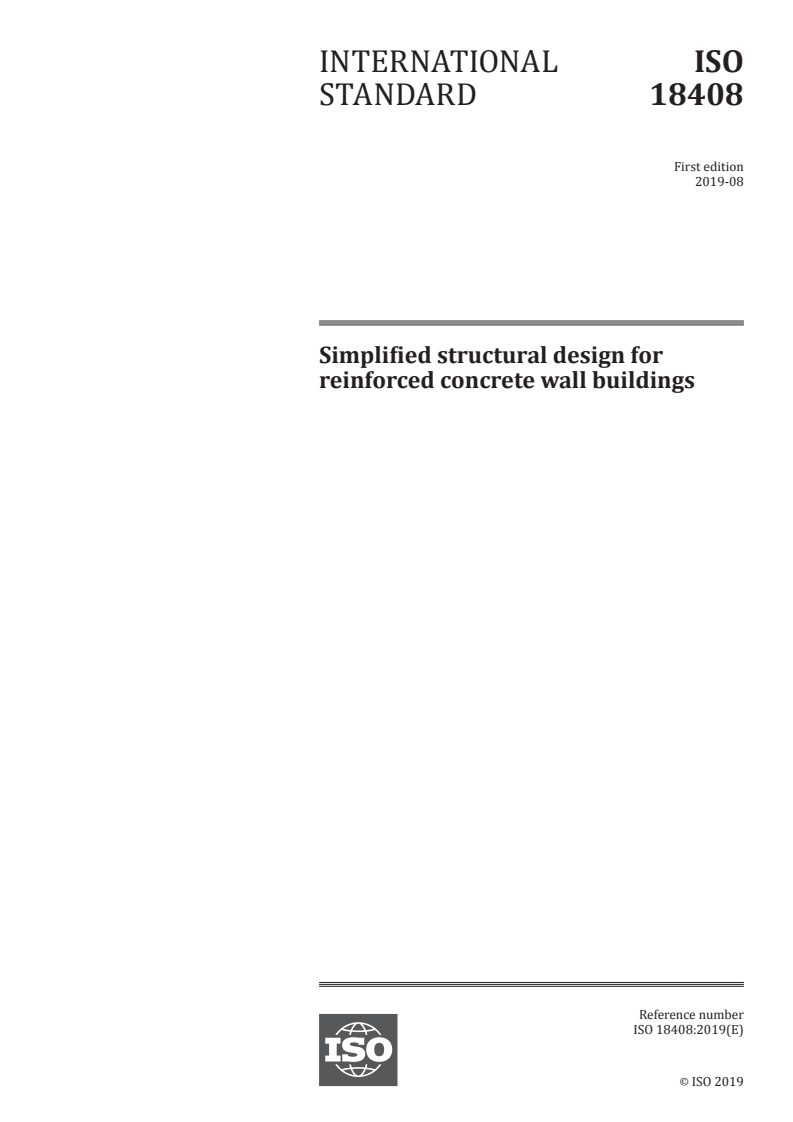
INTERNATIONAL ISO
STANDARD 18408
First edition
2019-08
Simplified structural design for
reinforced concrete wall buildings
Reference number
©
ISO 2019
© ISO 2019
All rights reserved. Unless otherwise specified, or required in the context of its implementation, no part of this publication may
be reproduced or utilized otherwise in any form or by any means, electronic or mechanical, including photocopying, or posting
on the internet or an intranet, without prior written permission. Permission can be requested from either ISO at the address
below or ISO’s member body in the country of the requester.
ISO copyright office
CP 401 • Ch. de Blandonnet 8
CH-1214 Vernier, Geneva
Phone: +41 22 749 01 11
Fax: +41 22 749 09 47
Email: copyright@iso.org
Website: www.iso.org
Published in Switzerland
ii © ISO 2019 – All rights reserved
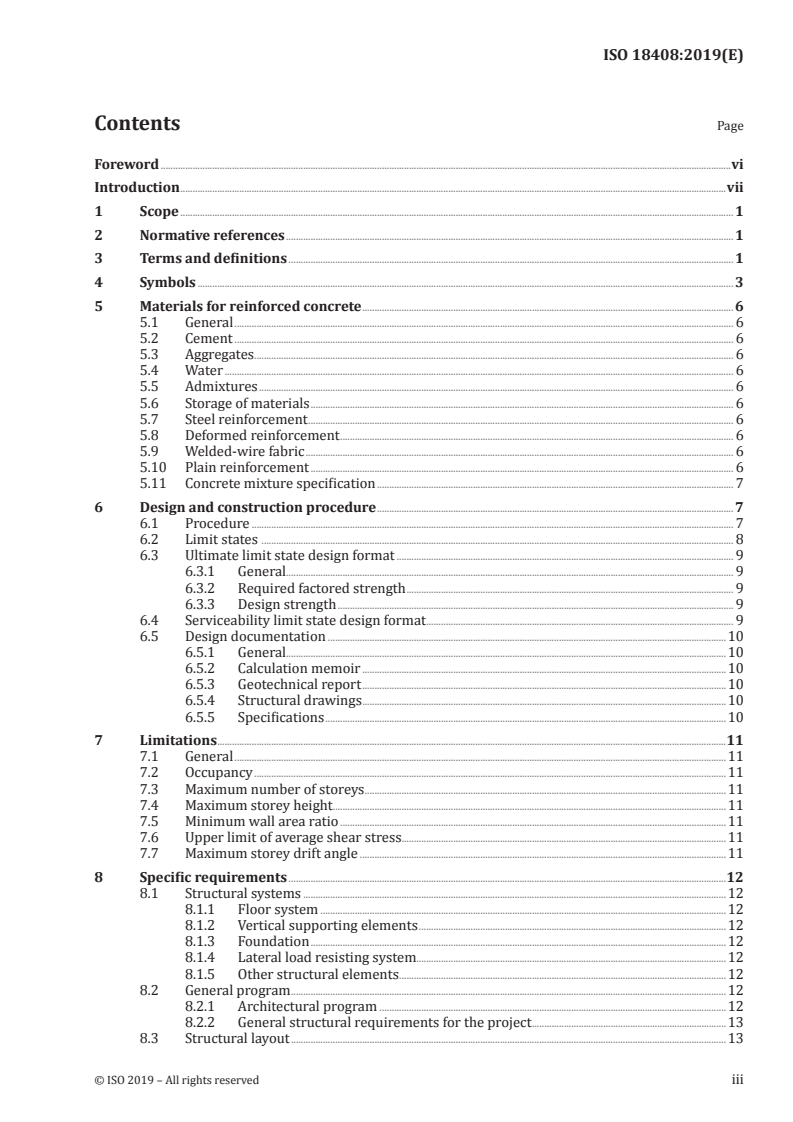
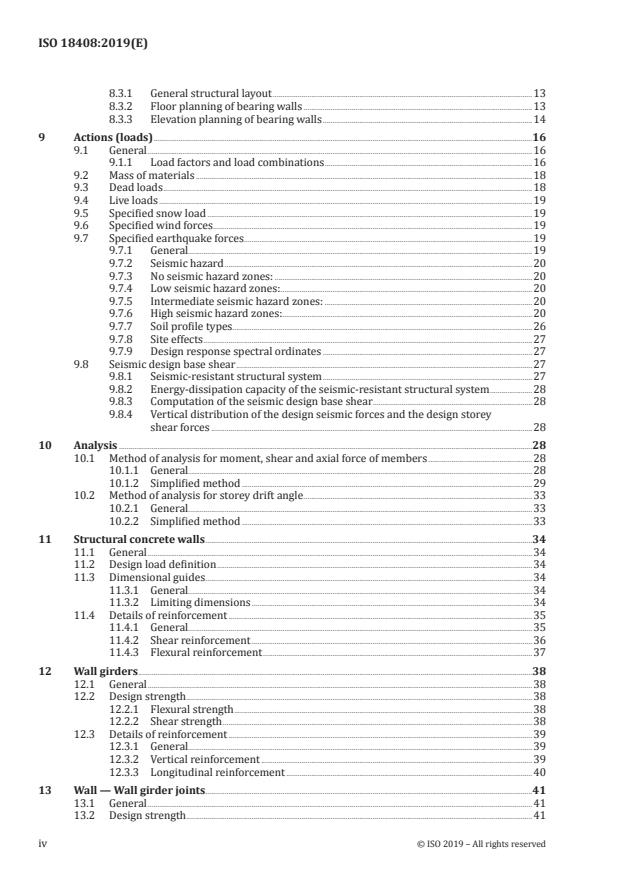
Contents Page
Foreword .vi
Introduction .vii
1 Scope .1
2 Normative references .1
3 Terms and definitions .1
4 Symbols .3
5 Materials for reinforced concrete .6
5.1 General . 6
5.2 Cement . 6
5.3 Aggregates . 6
5.4 Water . 6
5.5 Admixtures . 6
5.6 Storage of materials . 6
5.7 Steel reinforcement . 6
5.8 Deformed reinforcement . 6
5.9 Welded-wire fabric . 6
5.10 Plain reinforcement . 6
5.11 Concrete mixture specification . 7
6 Design and construction procedure .7
6.1 Procedure . 7
6.2 Limit states . 8
6.3 Ultimate limit state design format . 9
6.3.1 General. 9
6.3.2 Required factored strength . 9
6.3.3 Design strength . 9
6.4 Serviceability limit state design format . 9
6.5 Design documentation .10
6.5.1 General.10
6.5.2 Calculation memoir .10
6.5.3 Geotechnical report .10
6.5.4 Structural drawings .10
6.5.5 Specifications .10
7 Limitations .11
7.1 General .11
7.2 Occupancy .11
7.3 Maximum number of storeys .11
7.4 Maximum storey height .11
7.5 Minimum wall area ratio .11
7.6 Upper limit of average shear stress .11
7.7 Maximum storey drift angle .11
8 Specific requirements .12
8.1 Structural systems .12
8.1.1 Floor system .12
8.1.2 Vertical supporting elements .12
8.1.3 Foundation .12
8.1.4 Lateral load resisting system.12
8.1.5 Other structural elements .12
8.2 General program .12
8.2.1 Architectural program .12
8.2.2 General structural requirements for the project .13
8.3 Structural layout .13
8.3.1 General structural layout .13
8.3.2 Floor planning of bearing walls .13
8.3.3 Elevation planning of bearing walls .14
9 Actions (loads) .16
9.1 General .16
9.1.1 Load factors and load combinations .16
9.2 Mass of materials .18
9.3 Dead loads .18
9.4 Live loads .19
9.5 Specified snow load .19
9.6 Specified wind forces .19
9.7 Specified earthquake forces .19
9.7.1 General.19
9.7.2 Seismic hazard .20
9.7.3 No seismic hazard zones: .20
9.7.4 Low seismic hazard zones: .20
9.7.5 Intermediate seismic hazard zones: .20
9.7.6 High seismic hazard zones: .20
9.7.7 Soil profile types.26
9.7.8 Site effects .27
9.7.9 Design response spectral ordinates .27
9.8 Seismic design base shear .27
9.8.1 Seismic-resistant structural system .27
9.8.2 Energy-dissipation capacity of the seismic-resistant structural system .28
9.8.3 Computation of the seismic design base shear .28
9.8.4 Vertical distribution of the design seismic forces and the design storey
shear forces .28
10 Analysis .28
10.1 Method of analysis for moment, shear and axial force of members .28
10.1.1 General.28
10.1.2 Simplified method .29
10.2 Method of analysis for storey drift angle .33
10.2.1 General.33
10.2.2 Simplified method .33
11 Structural concrete walls .34
11.1 General .34
11.2 Design load definition .34
11.3 Dimensional guides .34
11.3.1 General.34
11.3.2 Limiting dimensions .34
11.4 Details of reinforcement .35
11.4.1 General.35
11.4.2 Shear reinforcement .36
11.4.3 Flexural reinforcement .37
12 Wall girders .38
12.1 General .38
12.2 Design strength .38
12.2.1 Flexural strength .38
12.2.2 Shear strength .38
12.3 Details of reinforcement .39
12.3.1 General.39
12.3.2 Vertical reinforcement .39
12.3.3 Longitudinal reinforcement .40
13 Wall — Wall girder joints .41
13.1 General .41
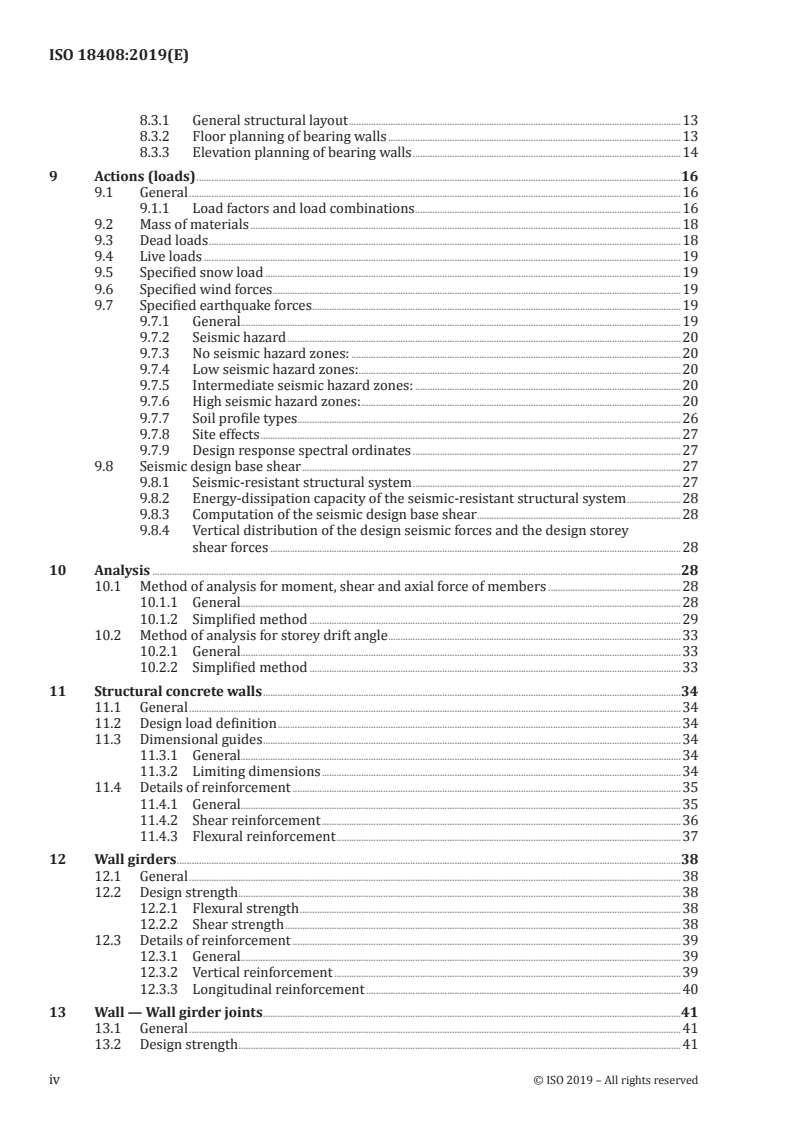
13.2 Design strength .41
iv © ISO 2019 – All rights reserved
13.3 Development length for reinforcing bars .42
13.4 Details of reinforcement .43
14 Floor slab .43
14.1 General .43
14.2 Design load definition .43
14.2.1 Loads to be included .43
14.2.2 Dead load and live load .43
14.2.3 Factored design load . .43
14.3 Two-way solid slabs supported on wall girders or structural concrete walls .43
14.3.1 Dimensional guides .43
14.3.2 Design strength .44
14.3.3 Design bending moment .45
14.4 End anchorage of reinforcement .46
15 General reinforced concrete requirements .46
15.1 General .46
15.2 Cover concrete depth .46
15.2.1 Minimum concrete cover .46
15.2.2 Special fire protection .48
15.2.3 Special corrosion protection . .48
15.3 Minimum and maximum reinforcement bar diameter .48
15.4 Minimum reinforcement bend diameter .49
15.5 Standard hook dimensions .49
15.6 Bar separation and maximum aggregate size .50
15.6.1 General.50
15.6.2 Maximum nominal coarse aggregate size .50
15.6.3 Minimum clear spacing between parallel bars in a layer .51
15.6.4 Minimum clear spacing between parallel layers of reinforcement .51
15.6.5 Clear spacing between parallel lap splices .51
15.7 Development length, lap splicing and anchorage of reinforcement.51
15.7.1 Development length .51
15.7.2 Lap splice dimensions .53
15.7.3 Minimum standard hook anchorage distance .54
16 Foundations .54
16.1 Dimensioning of the foundation elements .54
16.2 Footings .55
16.2.1 Moment in footings .55
16.2.2 Shear in footings .55
16.2.3 Development of reinforcement in footings .55
16.2.4 Minimum footing depth .56
16.2.5 Transfer of forces at base of column, wall or reinforced pedestal .56
16.2.6 Sloped or stepped footings.56
16.3 Foundation mats .56
16.4 Footings on piles .56
16.4.1 General.56
16.4.2 Anchorage of reinforcement .56
16.4.3 Maximum axial stresses .56
16.4.4 Reinforcement minimum ratios and lengths .57
16.5 Foundation beams .57
16.5.1 Dimensional guides .57
16.5.2 Longitudinal reinforcement .57
16.5.3 Transverse reinforcement .57
Bibliography .58
Foreword
ISO (the International Organization for Standardization) is a worldwide federation of national standards
bodies (ISO member bodies). The work of preparing International Standards is normally carried out
through ISO technical committees. Each member body interested in a subject for which a technical
committee has been established has the right to be represented on that committee. International
organizations, governmental and non-governmental, in liaison with ISO, also take part in the work.
ISO collaborates closely with the International Electrotechnical Commission (IEC) on all matters of
electrotechnical standardization.
The procedures used to develop this document and those intended for its further maintenance are
described in the ISO/IEC Directives, Part 1. In particular, the different approval criteria needed for the
different types of ISO documents should be noted. This document was drafted in accordance with the
editorial rules of the ISO/IEC Directives, Part 2 (see www .iso .org/directives).
Attention is drawn to the possibility that some of the elements of this document may be the subject of
patent rights. ISO shall not be held responsible for identifying any or all such patent rights. Details of
any patent rights identified during the development of the document will be in the Introduction and/or
on the ISO list of patent declarations received (see www .iso .org/patents).
Any trade name used in this document is information given for the convenience of users and does not
constitute an endorsement.
For an explanation of the voluntary nature of standards, the meaning of ISO specific terms and
expressions related to conformity assessment, as well as information about ISO's adherence to the
World Trade Organization (WTO) principles in the Technical Barriers to Trade (TBT) see www .iso
.org/iso/foreword .html.
This document was prepared by Technical Committee ISO/TC 71, Concrete, reinforced concrete and pre-
stressed concrete, Subcommittee SC 5, Simplified design standard for concrete structures.
Any feedback or questions on this document should be directed to the user’s national standards body. A
complete listing of these bodies can be found at www .iso .org/members .html.
vi © ISO 2019 – All rights reserved
Introduction
This document aims to provide rules for the design and construction of reinforced concrete (RC)
wall structures. The design rules are based on the ratio of wall cross-sectional area to the floor
area. Therefore, actions (loads) and simplified analysis procedures are included as well as minimum
acceptable construction practice guidelines.
Reinforced concrete wall buildings (WRC) consist of bearing walls, wall girders, slabs, footing girders
and foundations. These buildings have excellent seismic performance and fire-resistance and are low-
priced construction compared to frame structures. This type of structure is one of the most popular
buildings for residential apartment houses in the world.
Structural features of WRC buildings can be summarized as follows:
— high seismic performance (according to the damage of the past earthquakes, the damage ratio of
WRC structures is much smaller than that of other types of structures);
— fire resistance (the performance is as good as that of RC buildings);
— economical superiority (bearing walls are as thick as wall girders).
Buildings designed according to this document will consequently:
a) for moderate earthquake motions, not produce cracks on bearing walls.
b) for extremely large earthquake motions, prevent from collapse and fall.
The charactersitics of this document to achieve the above performances are as follows:
1) Prevention of shear cracks developing in bearing walls during moderate earthquake motions
The shear stress intensity in bearing walls during moderate earthquake motions on every storey
and in every direction should be less than shear cracking stress of concrete being used, in order not
to produce cracks in the bearing walls.
Seismic shear force on every storey and in every direction should be set forth corresponding to
moderate earthquake motions.
2) Prevention of buildings collapsing during extremely large earthquake motions
The design storey shear force should be set forth corresponding to extremely large earthquake
motions. However, this magnitude is reduced, considering the ductility of structures. The reduction
value may be about 0,5 for this type of structures. Finally, for example, this magnitude for the first
storey almost corresponds to half of the total weight of a building.
In order to secure the structural safety in case of such storey shear, some structural specifications
are prescribed in the structural design. The upper limits of average shear stress as well as the
maximum storey drift angle are defined in order to control the shearing stress of the wall during
the extremely large earthquake motions. That is one of such important specifications. Also,
steel bar arrangement specifications and bearing wall arrangement/configuration, etc., are very
important specifications to secure structural safety.
This document contains provisions that can be modified by the National Standards Body due to local
design and construction requirements and practices. The specifications that can be modified are
indicated using [“boxed values”]. The National Standards Body is expected to review the “boxed values”
and may substitute alternative definitive values for these elements for use in the national application of
this document.
INTERNATIONAL STANDARD ISO 18408:2019(E)
Simplified structural design for reinforced concrete wall
buildings
1 Scope
This document applies to reinforced concrete building consisting of load bearing walls of reinforced
concrete buildings [such buildings are called reinforced concrete box-shaped wall buildings and (RC
wall building)] or to the part of RC wall building which uses both this and other types of structure.
This document applies to RC wall building as follows:
— RC wall building with 5 or fewer aboveground storeys;
— eaves height of 16 m or less;
— storey height on each storey of 3 m or less;
— on the top storey, the storey height can be 3,3 m or less;
— if the roof has a slope, the sum of the storey height of the top storey and the height from the eaves to
the ridge of 4 m or less.
Deep foundations, such as piles and caissons, and their pile footings and caps, are beyond the scope of
this document, and are not covered by it.
2 Normative references
The following documents are referred to in the text in such a way that some or all of their content
constitutes requirements of this document. For dated references, only the edition cited applies. For
undated references, the latest edition of the referenced document (including any amendments) applies.
ISO 2103, Loads due to use and occupancy in residential and public buildings
ISO 2633, Determination of imposed floor loads in production buildings and warehouses
ISO 4354, Wind actions on structures
ISO 4355, Bases for design of structures — Determination of snow loads on roofs
ISO 6935-1, Steel for the reinforcement of concrete — Part 1: Plain bars
ISO 6935-2, Steel for the reinforcement of concrete — Part 2: Ribbed bars
ISO 6935-3, Steel for the reinforcement of concrete — Part 3: Welded fabric
ISO 9194, Bases for design of structures — Actions due to the self-weight of structures, non-structural
elements and stored materials — Density
ISO 15673, Guidelines for the simplified design of structural reinforced concrete for buildings
ISO 28842, Guidelines for simplified design of reinforced concrete bridges
3 Terms and definitions
For the purposes of this document, the terms and definitions in ISO 28842 and the following apply.
ISO and IEC maintain terminological databases for use in standardization at the following addresses:
— ISO Online browsing platform: available at https: //www .iso .org/obp
— IEC Electropedia: available at https: //www .electropedia .org/
3.1
base
level of a structure at which earthquake motions are assumed to be imparted to a building
Note 1 to entry: The base does not necessarily coincide with the ground level.
3.2
load bearing wall
wall proportioned to resist combinations of shear, moments, and axial forces
Note 1 to entry: A "shear wall" is a "structural wall."
3.3
drift
difference between the horizontal displacements of two levels
3.4
factored load
specified nominal load multiplied by the appropriate load factor
3.5
floor system
set of structural elements that comprise the floor of a storey in a building
Note 1 to entry: It includes the beams and girders, the joists (if employed), and the slab that spans between them.
3.6
foundation girder
girder that rests on the foundation soil and spans between footings, used either to support walls or to
limit differential settlement of the foundation
3.7
hoop
closed stirrup, tie, or continuously wound spiral
Note 1 to entry: A closed stirrup or tie can be made up of several reinforcement elements, each having seismic
hooks at both ends. A continuously wound spiral shall have a seismic hook at both ends.
3.8
non-structural element
set of architectural, mechanical, and electrical components and systems permanently attached to the
building
3.9
occupancy
purpose for which a building or other structure, or part thereof, is used or intended to be used
3.10
partition
non-structural wall that is employed to divide spaces
Note 1 to entry: Partitions do not support other parts of the building except themselves. When they are built in
the exterior, they are sometimes referred as curtain walls.
3.11
slab on grade
slab set directly on the ground that serves either as an internal traffic surface or as part of the foundation
2 © ISO 2019 – All rights reserved
3.12
storey height
vertical distance between the upper part of the slab of a storey and the upper part of the slab of the
floor below
3.13
storey drift angle
angle of the inter-storey drift divided by the storey height
3.14
diaphragm
structural member, such as floor and roof slabs, which transmits inertial induced by earthquake motions
3.15
wall area ratio
ratio of the total wall area in each direction to the floor area
4 Symbols
Symbol Description Unit
a depth of equivalent uniform compressive stress block mm
a acceleration magnifying factor —
m
a acceleration at floor level —
x
A effective peak horizontal acceleration coefficient —
a
A area of an individual reinforcement bar or wire mm
b
A area of the i-th floor m
fi
A gross area of section of element mm
g
a area of longitudinal tension reinforcement mm
t
A area of shear reinforcement within a distance, s mm
w
A sectional area of the structural wall in the x- or y- direction at the i storey —
wi
b width of the section of the member mm
b effective width of the compression flange in a T shaped section mm
f
d effective depth, shall be taken as the distance from extreme compression fibre to cen- mm
troid of tension reinforcement
d nominal diameter of reinforcing bar mm
b
E load effects of earthquake, or related internal moments and forces —
E modulus of elasticity of concrete MPa
c
f' specified compressive strength of concrete MPa
c
positive square root of specified compressive strength of concrete MPa
f ′
c
f shear strength of concrete —
s
f specified yield strength of reinforcement, MPa MPa
y
f specified yield strength of transverse or spiral reinforcement
w t
F loads due to weight and pressures of fluids with well-defined densities and controllable —
maximum heights, or related internal moments and forces
G shear modulus of concrete at the i-th storey —
i
h depth or thickness of structural element or overall thickness of member mm
h average depth of wall girders in the x- or y-direction at the i-th storey —
bi
H storey height at the i-th storey —
i
h average height of structural walls in the x- or y-direction at the i-th storey —
i
h clear vertical distance between lateral supports of columns and walls mm
Symbol Description Unit
h height of entire structural concrete wall from base to top mm
w
H loads due to the weight and pressure of soil, water in soil, or other materials, or related —
internal moments and forces
l span of structural element or length of span measured centre-to-centre of beams or —
other supports
l development length for reinforcing bar mm
d
l average length of structural walls in the x- or y-direction at the i-th storey —
i
l horizontal length of structural concrete wall mm
w
L ratio of the total wall length to the floor area at i-th floor —
i
L minimum requirement of L —
0i i
M maximum bending moment in the wall girder —
M design moment due to gravity load —
D A
M moment in of wall girder —
bE
M moment due to seismic load —
E
M moment due to gravity load —
L
m mass of the non-structural wall kg
w
M nominal flexural moment strength at section at balanced conditions N·mm
bn
M flexural moment strength at section at balanced conditions N·mm
br
M nominal flexural moment strength at section N·mm
n
M flexural moment strength at section N·mm
r
M factored flexural moment at section N·mm
u
factored negative flexural moment at section N·mm
−
M
u
factored positive flexural moment at section N·mm
+
M
u
n design shear margin, which shall be greater or equal to 1,5
P non-factored dead load axial force at section or non-factored concentrated dead load N
d
applied directly to the element
P nominal axial load strength at section N
n
P maximum compression nominal axial load strength at section N
n(max)
P axial compressive strength at section N
0n
p hoop ratio (0,002 ≤ p ≤ 0,012) —
w w
P axial force of structural wall —
wE
ΣP sum of all factored concentrated design loads within the span N
u
Q maximum shear force in the wall girder —
Q design shear force due to seismic load —
E
Q design shear force due to gravity load —
L
q factored load per unit area N/m
u
r factored uniformly distributed reactio
...
INTERNATIONAL ISO
STANDARD 18408
First edition
2019-08
Simplified structural design for
reinforced concrete wall buildings
Reference number
©
ISO 2019
© ISO 2019
All rights reserved. Unless otherwise specified, or required in the context of its implementation, no part of this publication may
be reproduced or utilized otherwise in any form or by any means, electronic or mechanical, including photocopying, or posting
on the internet or an intranet, without prior written permission. Permission can be requested from either ISO at the address
below or ISO’s member body in the country of the requester.
ISO copyright office
CP 401 • Ch. de Blandonnet 8
CH-1214 Vernier, Geneva
Phone: +41 22 749 01 11
Fax: +41 22 749 09 47
Email: copyright@iso.org
Website: www.iso.org
Published in Switzerland
ii © ISO 2019 – All rights reserved
Contents Page
Foreword .vi
Introduction .vii
1 Scope .1
2 Normative references .1
3 Terms and definitions .1
4 Symbols .3
5 Materials for reinforced concrete .6
5.1 General . 6
5.2 Cement . 6
5.3 Aggregates . 6
5.4 Water . 6
5.5 Admixtures . 6
5.6 Storage of materials . 6
5.7 Steel reinforcement . 6
5.8 Deformed reinforcement . 6
5.9 Welded-wire fabric . 6
5.10 Plain reinforcement . 6
5.11 Concrete mixture specification . 7
6 Design and construction procedure .7
6.1 Procedure . 7
6.2 Limit states . 8
6.3 Ultimate limit state design format . 9
6.3.1 General. 9
6.3.2 Required factored strength . 9
6.3.3 Design strength . 9
6.4 Serviceability limit state design format . 9
6.5 Design documentation .10
6.5.1 General.10
6.5.2 Calculation memoir .10
6.5.3 Geotechnical report .10
6.5.4 Structural drawings .10
6.5.5 Specifications .10
7 Limitations .11
7.1 General .11
7.2 Occupancy .11
7.3 Maximum number of storeys .11
7.4 Maximum storey height .11
7.5 Minimum wall area ratio .11
7.6 Upper limit of average shear stress .11
7.7 Maximum storey drift angle .11
8 Specific requirements .12
8.1 Structural systems .12
8.1.1 Floor system .12
8.1.2 Vertical supporting elements .12
8.1.3 Foundation .12
8.1.4 Lateral load resisting system.12
8.1.5 Other structural elements .12
8.2 General program .12
8.2.1 Architectural program .12
8.2.2 General structural requirements for the project .13
8.3 Structural layout .13
8.3.1 General structural layout .13
8.3.2 Floor planning of bearing walls .13
8.3.3 Elevation planning of bearing walls .14
9 Actions (loads) .16
9.1 General .16
9.1.1 Load factors and load combinations .16
9.2 Mass of materials .18
9.3 Dead loads .18
9.4 Live loads .19
9.5 Specified snow load .19
9.6 Specified wind forces .19
9.7 Specified earthquake forces .19
9.7.1 General.19
9.7.2 Seismic hazard .20
9.7.3 No seismic hazard zones: .20
9.7.4 Low seismic hazard zones: .20
9.7.5 Intermediate seismic hazard zones: .20
9.7.6 High seismic hazard zones: .20
9.7.7 Soil profile types.26
9.7.8 Site effects .27
9.7.9 Design response spectral ordinates .27
9.8 Seismic design base shear .27
9.8.1 Seismic-resistant structural system .27
9.8.2 Energy-dissipation capacity of the seismic-resistant structural system .28
9.8.3 Computation of the seismic design base shear .28
9.8.4 Vertical distribution of the design seismic forces and the design storey
shear forces .28
10 Analysis .28
10.1 Method of analysis for moment, shear and axial force of members .28
10.1.1 General.28
10.1.2 Simplified method .29
10.2 Method of analysis for storey drift angle .33
10.2.1 General.33
10.2.2 Simplified method .33
11 Structural concrete walls .34
11.1 General .34
11.2 Design load definition .34
11.3 Dimensional guides .34
11.3.1 General.34
11.3.2 Limiting dimensions .34
11.4 Details of reinforcement .35
11.4.1 General.35
11.4.2 Shear reinforcement .36
11.4.3 Flexural reinforcement .37
12 Wall girders .38
12.1 General .38
12.2 Design strength .38
12.2.1 Flexural strength .38
12.2.2 Shear strength .38
12.3 Details of reinforcement .39
12.3.1 General.39
12.3.2 Vertical reinforcement .39
12.3.3 Longitudinal reinforcement .40
13 Wall — Wall girder joints .41
13.1 General .41
13.2 Design strength .41
iv © ISO 2019 – All rights reserved
13.3 Development length for reinforcing bars .42
13.4 Details of reinforcement .43
14 Floor slab .43
14.1 General .43
14.2 Design load definition .43
14.2.1 Loads to be included .43
14.2.2 Dead load and live load .43
14.2.3 Factored design load . .43
14.3 Two-way solid slabs supported on wall girders or structural concrete walls .43
14.3.1 Dimensional guides .43
14.3.2 Design strength .44
14.3.3 Design bending moment .45
14.4 End anchorage of reinforcement .46
15 General reinforced concrete requirements .46
15.1 General .46
15.2 Cover concrete depth .46
15.2.1 Minimum concrete cover .46
15.2.2 Special fire protection .48
15.2.3 Special corrosion protection . .48
15.3 Minimum and maximum reinforcement bar diameter .48
15.4 Minimum reinforcement bend diameter .49
15.5 Standard hook dimensions .49
15.6 Bar separation and maximum aggregate size .50
15.6.1 General.50
15.6.2 Maximum nominal coarse aggregate size .50
15.6.3 Minimum clear spacing between parallel bars in a layer .51
15.6.4 Minimum clear spacing between parallel layers of reinforcement .51
15.6.5 Clear spacing between parallel lap splices .51
15.7 Development length, lap splicing and anchorage of reinforcement.51
15.7.1 Development length .51
15.7.2 Lap splice dimensions .53
15.7.3 Minimum standard hook anchorage distance .54
16 Foundations .54
16.1 Dimensioning of the foundation elements .54
16.2 Footings .55
16.2.1 Moment in footings .55
16.2.2 Shear in footings .55
16.2.3 Development of reinforcement in footings .55
16.2.4 Minimum footing depth .56
16.2.5 Transfer of forces at base of column, wall or reinforced pedestal .56
16.2.6 Sloped or stepped footings.56
16.3 Foundation mats .56
16.4 Footings on piles .56
16.4.1 General.56
16.4.2 Anchorage of reinforcement .56
16.4.3 Maximum axial stresses .56
16.4.4 Reinforcement minimum ratios and lengths .57
16.5 Foundation beams .57
16.5.1 Dimensional guides .57
16.5.2 Longitudinal reinforcement .57
16.5.3 Transverse reinforcement .57
Bibliography .58
Foreword
ISO (the International Organization for Standardization) is a worldwide federation of national standards
bodies (ISO member bodies). The work of preparing International Standards is normally carried out
through ISO technical committees. Each member body interested in a subject for which a technical
committee has been established has the right to be represented on that committee. International
organizations, governmental and non-governmental, in liaison with ISO, also take part in the work.
ISO collaborates closely with the International Electrotechnical Commission (IEC) on all matters of
electrotechnical standardization.
The procedures used to develop this document and those intended for its further maintenance are
described in the ISO/IEC Directives, Part 1. In particular, the different approval criteria needed for the
different types of ISO documents should be noted. This document was drafted in accordance with the
editorial rules of the ISO/IEC Directives, Part 2 (see www .iso .org/directives).
Attention is drawn to the possibility that some of the elements of this document may be the subject of
patent rights. ISO shall not be held responsible for identifying any or all such patent rights. Details of
any patent rights identified during the development of the document will be in the Introduction and/or
on the ISO list of patent declarations received (see www .iso .org/patents).
Any trade name used in this document is information given for the convenience of users and does not
constitute an endorsement.
For an explanation of the voluntary nature of standards, the meaning of ISO specific terms and
expressions related to conformity assessment, as well as information about ISO's adherence to the
World Trade Organization (WTO) principles in the Technical Barriers to Trade (TBT) see www .iso
.org/iso/foreword .html.
This document was prepared by Technical Committee ISO/TC 71, Concrete, reinforced concrete and pre-
stressed concrete, Subcommittee SC 5, Simplified design standard for concrete structures.
Any feedback or questions on this document should be directed to the user’s national standards body. A
complete listing of these bodies can be found at www .iso .org/members .html.
vi © ISO 2019 – All rights reserved
Introduction
This document aims to provide rules for the design and construction of reinforced concrete (RC)
wall structures. The design rules are based on the ratio of wall cross-sectional area to the floor
area. Therefore, actions (loads) and simplified analysis procedures are included as well as minimum
acceptable construction practice guidelines.
Reinforced concrete wall buildings (WRC) consist of bearing walls, wall girders, slabs, footing girders
and foundations. These buildings have excellent seismic performance and fire-resistance and are low-
priced construction compared to frame structures. This type of structure is one of the most popular
buildings for residential apartment houses in the world.
Structural features of WRC buildings can be summarized as follows:
— high seismic performance (according to the damage of the past earthquakes, the damage ratio of
WRC structures is much smaller than that of other types of structures);
— fire resistance (the performance is as good as that of RC buildings);
— economical superiority (bearing walls are as thick as wall girders).
Buildings designed according to this document will consequently:
a) for moderate earthquake motions, not produce cracks on bearing walls.
b) for extremely large earthquake motions, prevent from collapse and fall.
The charactersitics of this document to achieve the above performances are as follows:
1) Prevention of shear cracks developing in bearing walls during moderate earthquake motions
The shear stress intensity in bearing walls during moderate earthquake motions on every storey
and in every direction should be less than shear cracking stress of concrete being used, in order not
to produce cracks in the bearing walls.
Seismic shear force on every storey and in every direction should be set forth corresponding to
moderate earthquake motions.
2) Prevention of buildings collapsing during extremely large earthquake motions
The design storey shear force should be set forth corresponding to extremely large earthquake
motions. However, this magnitude is reduced, considering the ductility of structures. The reduction
value may be about 0,5 for this type of structures. Finally, for example, this magnitude for the first
storey almost corresponds to half of the total weight of a building.
In order to secure the structural safety in case of such storey shear, some structural specifications
are prescribed in the structural design. The upper limits of average shear stress as well as the
maximum storey drift angle are defined in order to control the shearing stress of the wall during
the extremely large earthquake motions. That is one of such important specifications. Also,
steel bar arrangement specifications and bearing wall arrangement/configuration, etc., are very
important specifications to secure structural safety.
This document contains provisions that can be modified by the National Standards Body due to local
design and construction requirements and practices. The specifications that can be modified are
indicated using [“boxed values”]. The National Standards Body is expected to review the “boxed values”
and may substitute alternative definitive values for these elements for use in the national application of
this document.
INTERNATIONAL STANDARD ISO 18408:2019(E)
Simplified structural design for reinforced concrete wall
buildings
1 Scope
This document applies to reinforced concrete building consisting of load bearing walls of reinforced
concrete buildings [such buildings are called reinforced concrete box-shaped wall buildings and (RC
wall building)] or to the part of RC wall building which uses both this and other types of structure.
This document applies to RC wall building as follows:
— RC wall building with 5 or fewer aboveground storeys;
— eaves height of 16 m or less;
— storey height on each storey of 3 m or less;
— on the top storey, the storey height can be 3,3 m or less;
— if the roof has a slope, the sum of the storey height of the top storey and the height from the eaves to
the ridge of 4 m or less.
Deep foundations, such as piles and caissons, and their pile footings and caps, are beyond the scope of
this document, and are not covered by it.
2 Normative references
The following documents are referred to in the text in such a way that some or all of their content
constitutes requirements of this document. For dated references, only the edition cited applies. For
undated references, the latest edition of the referenced document (including any amendments) applies.
ISO 2103, Loads due to use and occupancy in residential and public buildings
ISO 2633, Determination of imposed floor loads in production buildings and warehouses
ISO 4354, Wind actions on structures
ISO 4355, Bases for design of structures — Determination of snow loads on roofs
ISO 6935-1, Steel for the reinforcement of concrete — Part 1: Plain bars
ISO 6935-2, Steel for the reinforcement of concrete — Part 2: Ribbed bars
ISO 6935-3, Steel for the reinforcement of concrete — Part 3: Welded fabric
ISO 9194, Bases for design of structures — Actions due to the self-weight of structures, non-structural
elements and stored materials — Density
ISO 15673, Guidelines for the simplified design of structural reinforced concrete for buildings
ISO 28842, Guidelines for simplified design of reinforced concrete bridges
3 Terms and definitions
For the purposes of this document, the terms and definitions in ISO 28842 and the following apply.
ISO and IEC maintain terminological databases for use in standardization at the following addresses:
— ISO Online browsing platform: available at https: //www .iso .org/obp
— IEC Electropedia: available at https: //www .electropedia .org/
3.1
base
level of a structure at which earthquake motions are assumed to be imparted to a building
Note 1 to entry: The base does not necessarily coincide with the ground level.
3.2
load bearing wall
wall proportioned to resist combinations of shear, moments, and axial forces
Note 1 to entry: A "shear wall" is a "structural wall."
3.3
drift
difference between the horizontal displacements of two levels
3.4
factored load
specified nominal load multiplied by the appropriate load factor
3.5
floor system
set of structural elements that comprise the floor of a storey in a building
Note 1 to entry: It includes the beams and girders, the joists (if employed), and the slab that spans between them.
3.6
foundation girder
girder that rests on the foundation soil and spans between footings, used either to support walls or to
limit differential settlement of the foundation
3.7
hoop
closed stirrup, tie, or continuously wound spiral
Note 1 to entry: A closed stirrup or tie can be made up of several reinforcement elements, each having seismic
hooks at both ends. A continuously wound spiral shall have a seismic hook at both ends.
3.8
non-structural element
set of architectural, mechanical, and electrical components and systems permanently attached to the
building
3.9
occupancy
purpose for which a building or other structure, or part thereof, is used or intended to be used
3.10
partition
non-structural wall that is employed to divide spaces
Note 1 to entry: Partitions do not support other parts of the building except themselves. When they are built in
the exterior, they are sometimes referred as curtain walls.
3.11
slab on grade
slab set directly on the ground that serves either as an internal traffic surface or as part of the foundation
2 © ISO 2019 – All rights reserved
3.12
storey height
vertical distance between the upper part of the slab of a storey and the upper part of the slab of the
floor below
3.13
storey drift angle
angle of the inter-storey drift divided by the storey height
3.14
diaphragm
structural member, such as floor and roof slabs, which transmits inertial induced by earthquake motions
3.15
wall area ratio
ratio of the total wall area in each direction to the floor area
4 Symbols
Symbol Description Unit
a depth of equivalent uniform compressive stress block mm
a acceleration magnifying factor —
m
a acceleration at floor level —
x
A effective peak horizontal acceleration coefficient —
a
A area of an individual reinforcement bar or wire mm
b
A area of the i-th floor m
fi
A gross area of section of element mm
g
a area of longitudinal tension reinforcement mm
t
A area of shear reinforcement within a distance, s mm
w
A sectional area of the structural wall in the x- or y- direction at the i storey —
wi
b width of the section of the member mm
b effective width of the compression flange in a T shaped section mm
f
d effective depth, shall be taken as the distance from extreme compression fibre to cen- mm
troid of tension reinforcement
d nominal diameter of reinforcing bar mm
b
E load effects of earthquake, or related internal moments and forces —
E modulus of elasticity of concrete MPa
c
f' specified compressive strength of concrete MPa
c
positive square root of specified compressive strength of concrete MPa
f ′
c
f shear strength of concrete —
s
f specified yield strength of reinforcement, MPa MPa
y
f specified yield strength of transverse or spiral reinforcement
w t
F loads due to weight and pressures of fluids with well-defined densities and controllable —
maximum heights, or related internal moments and forces
G shear modulus of concrete at the i-th storey —
i
h depth or thickness of structural element or overall thickness of member mm
h average depth of wall girders in the x- or y-direction at the i-th storey —
bi
H storey height at the i-th storey —
i
h average height of structural walls in the x- or y-direction at the i-th storey —
i
h clear vertical distance between lateral supports of columns and walls mm
Symbol Description Unit
h height of entire structural concrete wall from base to top mm
w
H loads due to the weight and pressure of soil, water in soil, or other materials, or related —
internal moments and forces
l span of structural element or length of span measured centre-to-centre of beams or —
other supports
l development length for reinforcing bar mm
d
l average length of structural walls in the x- or y-direction at the i-th storey —
i
l horizontal length of structural concrete wall mm
w
L ratio of the total wall length to the floor area at i-th floor —
i
L minimum requirement of L —
0i i
M maximum bending moment in the wall girder —
M design moment due to gravity load —
D A
M moment in of wall girder —
bE
M moment due to seismic load —
E
M moment due to gravity load —
L
m mass of the non-structural wall kg
w
M nominal flexural moment strength at section at balanced conditions N·mm
bn
M flexural moment strength at section at balanced conditions N·mm
br
M nominal flexural moment strength at section N·mm
n
M flexural moment strength at section N·mm
r
M factored flexural moment at section N·mm
u
factored negative flexural moment at section N·mm
−
M
u
factored positive flexural moment at section N·mm
+
M
u
n design shear margin, which shall be greater or equal to 1,5
P non-factored dead load axial force at section or non-factored concentrated dead load N
d
applied directly to the element
P nominal axial load strength at section N
n
P maximum compression nominal axial load strength at section N
n(max)
P axial compressive strength at section N
0n
p hoop ratio (0,002 ≤ p ≤ 0,012) —
w w
P axial force of structural wall —
wE
ΣP sum of all factored concentrated design loads within the span N
u
Q maximum shear force in the wall girder —
Q design shear force due to seismic load —
E
Q design shear force due to gravity load —
L
q factored load per unit area N/m
u
r factored uniformly distributed reactio
...