

ISO/TS 18734:2026
(Main)Requirements and recommendations for elastic barriers, waterproofing and protection of underground concrete structures
General Information
- Abstract
This document intends to provide a guideline for barriers waterproofing and protection specific to the protection against leakage and contamination underground conditions for underground concrete structures. This document addresses the following topics in the coming sections. Ambient and environmental conditions of underground concrete structures Types of barriers used for waterproofing and protection Performance requirement for waterproofing and protection Performance evaluation for waterproofing and protection Selection procedure of optimal waterproofing and protection
- Status
- Published
- Publication Date
- 21-Jan-2026
- Technical Committee
- ISO/TC 71/SC 7 - Maintenance and repair of concrete structures
- Drafting Committee
- ISO/TC 71/SC 7 - Maintenance and repair of concrete structures
- Current Stage
- 6060 - International Standard published
- Start Date
- 22-Jan-2026
- Due Date
- 27-Oct-2025
- Completion Date
- 22-Jan-2026

Overview
ISO/TS 18734:2026 outlines the requirements and recommendations for elastic barriers, waterproofing, and protection of underground concrete structures. This technical specification is developed by the International Organization for Standardization (ISO) and provides practical guidelines for preventing leakage, water ingress, and contamination in underground environments. Designed for engineers, architects, builders, and facility owners, the standard supports robust strategies for long-term underground concrete structure durability by addressing environmental conditions, types of barriers, performance evaluation, and selection criteria for waterproofing solutions.
Key Topics
Ambient and Environmental Conditions: The standard emphasizes thorough assessment of site-specific conditions, covering aspects such as groundwater chemistry, soil composition, and physical forces (e.g., hydrostatic pressure, structural deformation, and earth pressure). Special attention is given to exposure risk from chemicals like chlorine ions, acids, alkalis, sulphates, and hydrocarbons, as well as gases such as radon and methane.
Waterproofing Barrier Types: ISO/TS 18734:2026 identifies main classes of waterproofing solutions:
- Liquid-applied membranes: Including hot/cold-applied asphalts, polyurethane, polyurea, and synthetic rubber polymer gels.
- Sheet-applied membranes: Covering self-adhesive, torch-on, polymerized bonding, and plastic-based membranes such as EPDM, TPO, PVC, and PP.
- Composite systems: Utilization of layered combinations for enhanced protection.
Performance Requirements: Effective waterproofing systems must provide:
- Low permeability to water, gases, and chemicals
- Resistance to crack movement, hydrostatic pressure, and chemical attack
- Reliable adhesion and durability under varying environmental loads
- Prevention of water migration and ensuring long-term system viability
Performance Evaluation: The standard details criteria for testing and verifying system performance, such as hydrostatic pressure resistance, chemical durability, bond strength, and the ability to accommodate structural movement.
Selection and Installation: ISO/TS 18734:2026 gives a stepwise method for selecting appropriate waterproofing and protection based on:
- Construction method (pre-applied vs. post-applied)
- Environmental analysis (soil, groundwater, contaminants)
- Importance and intended use of the structure
- Life-cycle and service requirements
Applications
Adherence to ISO/TS 18734:2026 brings significant practical value across multiple sectors by ensuring underground concrete structures like basements, tunnels, foundations, utility vaults, and retaining walls remain resilient against water ingress and environmental degradation. Key applications include:
- Civil Engineering & Infrastructure: For waterproofing transportation tunnels, subway and rail systems, underground parking facilities, and foundation systems vulnerable to groundwater or contaminant exposure.
- Building Construction: Safeguarding basements, utility vaults, and other below-ground spaces from water leakage, mold growth, and rebar corrosion.
- Industrial & Environmental Facilities: Protection in areas exposed to aggressive chemicals-such as water treatment plants, industrial basements, or chemical storage areas-to prevent structural deterioration and environmental contamination.
Implementing these guidelines reduces long-term maintenance costs, extends service life, and protects property value by minimizing the risk of leaks, chemical attacks, and subsequent structural failures.
Related Standards
Professionals applying ISO/TS 18734:2026 should also consider the following related international standards:
- ISO 9001 - Quality management systems for ensuring consistent application of best practices
- ISO 14001 - Environmental management systems addressing environmental impacts of waterproofing activities
- ISO 22965 - Concrete classification by composition and performance
- EN 1504 - European standard on products and systems for the protection and repair of concrete structures
For more detailed terminology, consult the ISO Online Browsing Platform and IEC Electropedia.
By following ISO/TS 18734:2026, stakeholders achieve higher levels of safety, environmental responsibility, and long-term reliability for underground concrete structures, enabling best practices in waterproofing and protection worldwide.
Get Certified
Connect with accredited certification bodies for this standard

DIBt (Deutsches Institut für Bautechnik)
German Institute for Building Technology.
DIN CERTCO
DIN Group product certification.

Aboma Certification B.V.
Specialized in construction, metal, and transport sectors.
Sponsored listings
Frequently Asked Questions
ISO/TS 18734:2026 is a technical specification published by the International Organization for Standardization (ISO). Its full title is "Requirements and recommendations for elastic barriers, waterproofing and protection of underground concrete structures". This standard covers: This document intends to provide a guideline for barriers waterproofing and protection specific to the protection against leakage and contamination underground conditions for underground concrete structures. This document addresses the following topics in the coming sections. Ambient and environmental conditions of underground concrete structures Types of barriers used for waterproofing and protection Performance requirement for waterproofing and protection Performance evaluation for waterproofing and protection Selection procedure of optimal waterproofing and protection
This document intends to provide a guideline for barriers waterproofing and protection specific to the protection against leakage and contamination underground conditions for underground concrete structures. This document addresses the following topics in the coming sections. Ambient and environmental conditions of underground concrete structures Types of barriers used for waterproofing and protection Performance requirement for waterproofing and protection Performance evaluation for waterproofing and protection Selection procedure of optimal waterproofing and protection
ISO/TS 18734:2026 is classified under the following ICS (International Classification for Standards) categories: 91.080.40 - Concrete structures. The ICS classification helps identify the subject area and facilitates finding related standards.
ISO/TS 18734:2026 is available in PDF format for immediate download after purchase. The document can be added to your cart and obtained through the secure checkout process. Digital delivery ensures instant access to the complete standard document.
Standards Content (Sample)
Technical
Specification
ISO/TS 18734
First edition
Requirements and
2026-01
recommendations for elastic
barriers, waterproofing and
protection of underground concrete
structures
Lignes directrices et exigences pour les membranes élastiques,
l'étanchéité et la protection des structures en béton souterraines
Reference number
© ISO 2026
All rights reserved. Unless otherwise specified, or required in the context of its implementation, no part of this publication may
be reproduced or utilized otherwise in any form or by any means, electronic or mechanical, including photocopying, or posting on
the internet or an intranet, without prior written permission. Permission can be requested from either ISO at the address below
or ISO’s member body in the country of the requester.
ISO copyright office
CP 401 • Ch. de Blandonnet 8
CH-1214 Vernier, Geneva
Phone: +41 22 749 01 11
Email: copyright@iso.org
Website: www.iso.org
Published in Switzerland
ii
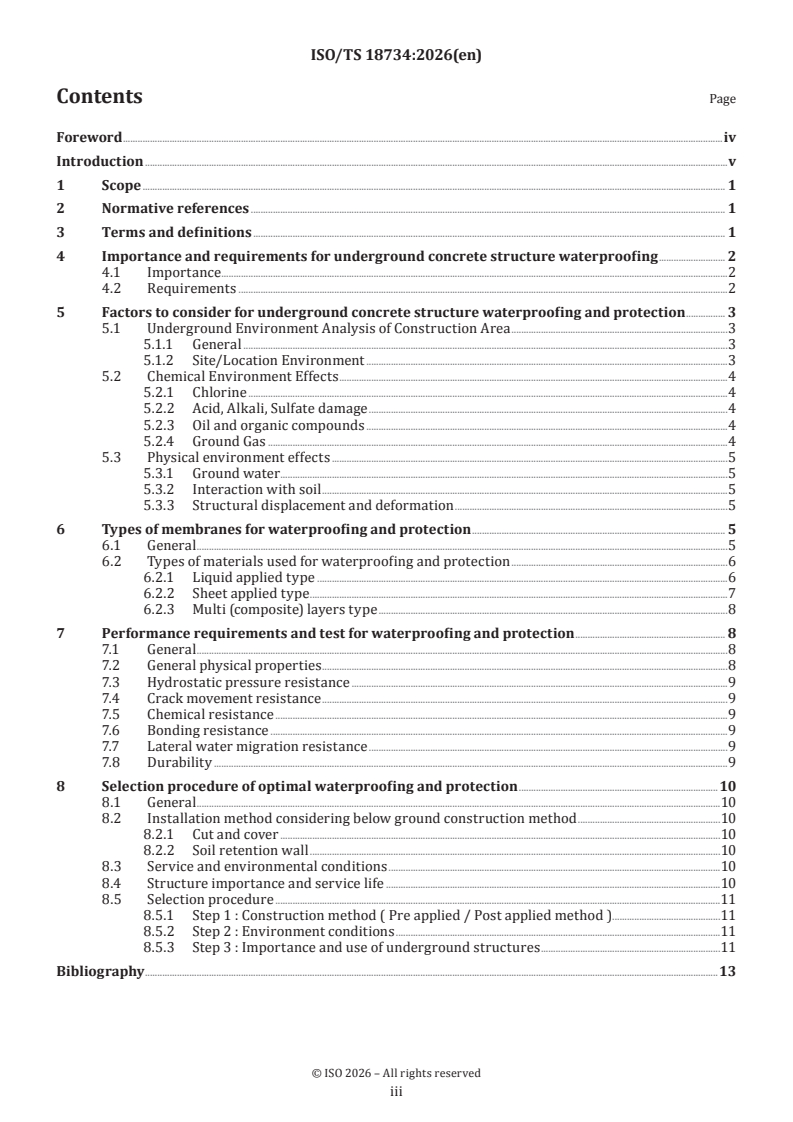
Contents Page
Foreword .iv
Introduction .v
1 Scope . 1
2 Normative references . 1
3 Terms and definitions . 1
4 Importance and requirements for underground concrete structure waterproofing . 2
4.1 Importance . .2
4.2 Requirements .2
5 Factors to consider for underground concrete structure waterproofing and protection . 3
5.1 Underground Environment Analysis of Construction Area .3
5.1.1 General .3
5.1.2 Site/Location Environment .3
5.2 Chemical Environment Effects .4
5.2.1 Chlorine .4
5.2.2 Acid, Alkali, Sulfate damage .4
5.2.3 Oil and organic compounds .4
5.2.4 Ground Gas .4
5.3 Physical environment effects .5
5.3.1 Ground water .5
5.3.2 Interaction with soil .5
5.3.3 Structural displacement and deformation .5
6 Types of membranes for waterproofing and protection . 5
6.1 General .5
6.2 Types of materials used for waterproofing and protection .6
6.2.1 Liquid applied type .6
6.2.2 Sheet applied type .7
6.2.3 Multi (composite) layers type .8
7 Performance requirements and test for waterproofing and protection . 8
7.1 General .8
7.2 General physical properties .8
7.3 Hydrostatic pressure resistance .9
7.4 Crack movement resistance .9
7.5 Chemical resistance .9
7.6 Bonding resistance .9
7.7 Lateral water migration resistance .9
7.8 Durability .9
8 Selection procedure of optimal waterproofing and protection .10
8.1 General .10
8.2 Installation method considering below ground construction method .10
8.2.1 Cut and cover .10
8.2.2 Soil retention wall .10
8.3 Service and environmental conditions .10
8.4 Structure importance and service life .10
8.5 Selection procedure .11
8.5.1 Step 1 : Construction method ( Pre applied / Post applied method ).11
8.5.2 Step 2 : Environment conditions .11
8.5.3 Step 3 : Importance and use of underground structures .11
Bibliography .13
iii
Foreword
ISO (the International Organization for Standardization) is a worldwide federation of national standards
bodies (ISO member bodies). The work of preparing International Standards is normally carried out through
ISO technical committees. Each member body interested in a subject for which a technical committee
has been established has the right to be represented on that committee. International organizations,
governmental and non-governmental, in liaison with ISO, also take part in the work. ISO collaborates closely
with the International Electrotechnical Commission (IEC) on all matters of electrotechnical standardization.
The procedures used to develop this document and those intended for its further maintenance are described
in the ISO/IEC Directives, Part 1. In particular, the different approval criteria needed for the different types
of ISO documents should be noted. This document was drafted in accordance with the editorial rules of the
ISO/IEC Directives, Part 2 (see www.iso.org/directives).
ISO draws attention to the possibility that the implementation of this document may involve the use of (a)
patent(s). ISO takes no position concerning the evidence, validity or applicability of any claimed patent
rights in respect thereof. As of the date of publication of this document, ISO had not received notice of (a)
patent(s) which may be required to implement this document. However, implementers are cautioned that
this may not represent the latest information, which may be obtained from the patent database available at
www.iso.org/patents. ISO shall not be held responsible for identifying any or all such patent rights.
Any trade name used in this document is information given for the convenience of users and does not
constitute an endorsement.
For an explanation of the voluntary nature of standards, the meaning of ISO specific terms and expressions
related to conformity assessment, as well as information about ISO's adherence to the World Trade
Organization (WTO) principles in the Technical Barriers to Trade (TBT), see www.iso.org/iso/foreword.html.
This document was prepared by Technical Committee ISO/TC 71, Concrete, reinforced concrete and pre
stressed concrete, Subcommittee SC 7, Maintenance and concrete structures.
Any feedback or questions on this document should be directed to the user’s national standards body. A
complete listing of these bodies can be found at www.iso.org/members.html.
iv
Introduction
This document presents the principles applicable to barriers used for waterproofing and protection on the
positive side (exterior side of concrete wall/floor) as a method of preventing hydrostatic penetration into
the negative space of underground concrete structures and protecting concrete structures against chemical
contaminants and gases to provide safety, and comfortable environment for users. Positive-side barriers can
generally be categorized into two categories: 1) post applied method (installation after concrete casting and
curing) and 2) pre applied method (installation before concrete casting and curing). In the past, post applied
methods were common: the barrier was installed on existing, cured concrete walls, in a similar way as what
was done in roofing. Pre applied methods were developed more recently. With the pre applied methods, the
barrier is applied on the formwork, shutter or lost formwork. Concrete is then cast directly on the barrier.
In buildings built with foundations extending below the groundwater surface, the surface of the wall in
contact with the soil must be protected from the groundwater. The groundwater, or some chemical from the
soil may enter the concrete of the underground structure, impairing its integrity, deteriorating the indoor
environment which may incur important remediation cost. In some cases, the groundwater is collected
and discharges into the sewage. However, continuous groundwater discharge may create social problems
caused by groundwater depletion and ground subsidence. In addition, modern structures frequently use
underground volume in a similar fashion as above ground volumes, including for human residence or
business activity, which requires an extremely high quality of environment. Underground waterproofing is
an effective countermeasure against such a situation.
In addition, if water from the ground is in direct contact with the reinforced concrete structure of the
basement, there is a possibility that moisture can reach and eventually corrode the reinforcing bars. In
beach areas, groundwater may contain chloride ions, which can further accelerate corrosion of reinforcing
bars. Therefore, waterproofing and protecting the reinforced concrete structure in the basement is also
useful to preserve the durability of the building.
Among the performances required for the basement exterior wall, the most important thing along with
the structural performance as a building is to prevent water from entering the basement exterior wall.
Therefore, the required performance of the outer basement waterproofing and protection layer used is the
first required performance to prevent water from entering the basement like the rooftop and outer wall
waterproofing.
Since it is an environment in contact with the surrounding ground containing groundwater for a long period
of time, it should be a material that is safe for concrete or groundwater in the surrounding area. Specifically,
it should not be eroded by chemicals or gases such as alkali, ground, salt and acid components contained
in the groundwater, and gases of concrete, that is, it should not or contaminate the surrounding ground or
groundwater with the elution component of the waterproofing and protection materials. In addition, for
long-term protection of underground concrete structures, the ability of the membrane to waterproof the
structure, to protect the structure, resist structural stresses, aging, and offer adequate chemical and gas
resistance are also required. Therefore, for external barriers of an underground structure, a waterproof
design should be performed in consideration of the construction method of the underground concrete
structure, the environmental conditions of the basement, the factors of concrete performance degradation,
and the performance required for the waterproofing and protection material.
v
Technical Specification ISO/TS 18734:2026(en)
Requirements and recommendations for elastic barriers,
waterproofing and protection of underground concrete
structures
1 Scope
This document intends to provide a guideline for barriers waterproofing and protection specific to the
protection against leakage and contamination underground conditions for underground concrete structures.
This document addresses the following topics in the coming sections.
a) Ambient and environmental conditions of underground concrete structures
b) Types of barriers used for waterproofing and protection
c) Performance requirement for waterproofing and protection
d) Performance evaluation for waterproofing and protection
e) Selection procedure of optimal waterproofing and protection
2 Normative references
There are no normative references in this document.
3 Terms and definitions
For the purposes of this document, the following terms and definitions apply.
ISO and IEC maintain terminology databases for use in standardization at the following addresses:
— ISO Online browsing platform: available at https:// www .iso .org/ obp
— IEC Electropedia: available at https:// www .electropedia .org/
3.1
groundwater
water in the ground outside the structure from any sources
3.2
hydrostatic pressure
pressure exerted by depth of water
3.3
waterproof
impervious to free water
Note 1 to entry: This can also be known as watertight.
3.4
waterproofing
application of waterproof/water-resisting materials
3.5
waterproofing system
materials and methods used to protect a structure from water ingress, and which might also provide
resistance to the diffusion of water vapour
3.6
leakage
flow rate of liquid (water) flowing through the concrete structure through a crack, hole, joint or weak
concrete spots (honeycomb)
3.7
pre applied method
method to install waterproofing on ground soils, basement lean concrete, soil retention walls, and
conventional structures before concrete casting and structure building
3.8
post applied method
method to install waterproofing on cured concrete and completed hardened structures
4 Importance and requirements for underground concrete structure waterproofing
4.1 Importance
Water ingress in a building enclosure can take place by below two mechanisms:
1) Liquid migration by permeation or capillary action.
2) Flow through cracks or holes in the structure by hydrostatic pressure.
Moreover, concrete is a highly durable material, but only under the condition that it is protected from water
and pollutants (chemicals, etc.). Aging (deterioration) occurs when concrete comes into continuous and
direct contact with these elements. Therefore, a high level of attention and care shall be given in vulnerable
sections such as the joint sections of concrete and appropriate waterproofing measures should be planned
for these defects at the design stage.
Leakage through construction/expansion joints, thru-wall penetrations, cracks, etc. from the soil (positive
side of concrete walls and floors) to the building enclosure (negative side) can lead to deterioration of the
indoor environment. This can reduce comfort in the underground indoor space, compromises the service
of appliances, create environmental risk, which also result in the reduction of property value and hygienic
problems such as mold and micro bacterial growth. Permanent, or occasional occupants of underground
concrete structures subject to continuous leakage can be exposed to health risks caused by air pollution,
mold and microbial inhalation, and exposition to groundwater containing harmful components. Water
leakage also triggers corrosion of reinforcing bars inside concrete structures, leading to spalling or
delamination of concrete, reduction of concrete strength, therefore reducing long-term durability and safety
of the entire structure.
A material shall therefore be installed on the concrete to prevent water ingress by permeation, capillary
action or vapor migration, as well as to bridge gaps and holes through which water could flow into the
building enclosure.
4.2 Requirements
The waterproofing material and protection shall be able to prevent exposition of the concrete to water,
ground gases, chemical contaminants to avoid premature degradation and to stop the ingress of water
through cracks and other defects for underground concrete structures. It shall therefore be a very low
permeability material, capable to elongate over a crack without tearing and to resist puncture by the
adjacent material.
Concrete has high watertightness itself, but water permeability coefficient varies greatly depending on the
conditions of the water cement ratio. The larger the water permeability coefficient, the easier water can
permeate (the higher the water permeability). In addition, joints and crack formation are inevitable during
construction, and at the construction site, joints, expansion joints, tie holes, cracks, other defects occurring
during the concrete construction process can just as easily occur. Due to these naturally occurring elements,
it is difficult to maintain complete watertightness with concrete alone.
Even if the water table is not expected to reach the concrete surface, waterproofing and protection is still
required for below ground concrete structures because protection is still required to prevent concrete
deterioration from ground gases, chemical contaminants such as hydrocarbons, salts, and other chemical
contaminants.
5 Factors to consider for underground concrete structure waterproofing and
protection
5.1 Underground Environment Analysis of Construction Area
5.1.1 General
Positive side of underground structures is affected by the chemicals produced by the interaction of
groundwater and soil mineral components, and the physical environment such as flow rate, settlement, and
vibration. Chemical environmental impact refers to the effect of chlorine ions, acid and alkali components,
sulphate ions, oil components, radon and methane gas in groundwater and soil on the durability and safety of
structures and waterproofing layers. Physical environmental impact refers to the effect of vibration caused
by contraction and expansion according to temperature change in the basement, groundwater pressure and
earth pressure action, differential subsidence, earthquake or vehicle load, etc. on the durability and safety
of the waterproof layer such as joints, cracks, joints, etc. Since these chemical and physical effects reduce
the performance of the materials used, concrete and waterproofing materials shall have a response force
in an eroded environment and shall have stability to resist long-term erosion. Therefore, in order to secure
durability stability and prevent leakage of underground structures, it is necessary to review the selection of
appropriate waterproofing materials and construction methods in the design stage in consideration of the
underground environment of the area to be constructed, and various necessary matters in the construction
process.
5.1.2 Site/Location Environment
In order to secure the safety of the waterproofing and protection layer installed on the outer surface of the
structure, the conditions of groundwater and soil in the area where the common structure is to be built
are reviewed in advance. This is because, depending on the construction area, the conditions of chemical
components contained in groundwater and soil, hydraulic conditions, and earth pressure conditions have a
large effect on concrete and waterproofing layers. Groundwater and soil conditions to be reviewed according
to the conditions of the planned construction area are shown in Table 1.
Table 1 — Underground water types and conditions outlined
Area Type Underground Water Condition, Status, Environment
In general, there are few harmful chemical components in the water of river areas formed inland, but
Riverside Areas
salt water can potentially be contained in rivers that are connected to the sea.
− −
Seawater Cl ions and SO4 ions are included in the coastal area, causing erosion of concrete, steel
Seaside Areas
and some waterproofing materials.
The hot spring water depends on the hydrogen ion concentration (pH): strong acidic spring (pH 2 or
less), acidic spring (pH 2-4 or less), weakly acidic spring (pH 4-6 or less), neutral spring (pH 6-7,5 or
Hot springs
less), weak alkaline spring (pH 7,5 to less than 8,5), alkaline spring ((pH less than 8,5 to 10), strong
Areas
− − −
alkaline spring (more than pH 10), HCO3 ions, Cl ions, SO4 ions, etc. exist in the hot spring water. It
causes erosion of concrete, steel, and some types of waterproofing materials.
In general, there are few chemical components in the groundwater and soil that adversely affect the
Mountain Areas waterproofing layer in the mountain areas, but water pressure of the groundwater descending from
the mountain is generally much higher than other areas.
Petrochemical plants, gas stations, and large oil tanks (military facilities) can flow out from places
Oil Storage
where gasoline, kerosene, diesel, etc. are installed, polluting groundwater and soil and damaging the
Areas
waterproofing layer.
Chemical water generated from mine development areas, landfill areas, waste concrete crushing plants,
Leaching Water
ready-mixed concrete plants, etc. can flow into the basement, contaminating groundwater and soil,
Drainage Area
and damaging the waterproofing layer.
5.2 Chemical Environment Effects
5.2.1 Chlorine
The penetration of chlorine ions presents in the groundwater and soil of the seashore has high influence
on the increase of corrosion risk in concrete reinforcing rebars. The aging of concrete structures due to
salt damage appears in a wide variety of forms, including corrosion of reinforcing bars, cracks of concrete,
peeling, delamination, and rupture of reinforcing bars, and may eventually lose its function as a structure
and lead to collapse. In addition, chlorine ions cause performance degradation such as deterioration of
surface, loss of watertightness, change of physical properties of concrete structures.
5.2.2 Acid, Alkali, Sulfate damage
Concrete underground structures are always in contact with soil and groundwater, and underground
structures in industrial or coastal areas are exposed to chemicals (such as acids, alkalis, salt water, calcium
hydroxide or carbon dioxide)
...