

ISO 5091-3:2023
(Main)Structural intervention of existing concrete structures using cementitious materials — Part 3: Bottom-surface (soffit) underlaying
General Information
- Abstract
This document specifies the standards for design and construction using the bottom-surface (soffit) underlaying method. Bottom-surface (soffit) underlaying is a method whereby reinforcing materials are placed on the bottom surface of the slabs or beams whose performance is lower than required and the improvement of durability, serviceability, safety and other performance of the members is achieved by the integrity between the reinforcing materials and existing members. This document specifies structural intervention of existing concrete structures using cementitious materials design and execution principles, and strategies for defects and on-going deterioration including, but not limited to: a) mechanical actions, e.g. fatigue, impact, overloading, movement caused by settlement, blast, vibration, and seismic actions; b) chemical and biological actions from environments, e.g. sulfate attack, alkali-aggregate reaction; c) physical actions, e.g. freeze–thaw, thermal cracking, moisture movement, salt crystallization, fire, and erosion; d) reinforcement corrosion; e) original construction defects that remained unaddressed from the time of construction.
- Status
- Published
- Publication Date
- 20-Jul-2023
- Technical Committee
- ISO/TC 71/SC 7 - Maintenance and repair of concrete structures
- Drafting Committee
- ISO/TC 71/SC 7 - Maintenance and repair of concrete structures
- Current Stage
- 6060 - International Standard published
- Start Date
- 21-Jul-2023
- Due Date
- 18-Jun-2023
- Completion Date
- 21-Jul-2023
Overview - ISO 5091-3:2023 (Bottom-surface / soffit underlaying)
ISO 5091-3:2023 is the international standard that defines design and execution principles for structural intervention of existing concrete members using cementitious materials applied to the bottom surface (soffit). It covers the method commonly called bottom-surface (soffit) underlaying, where a cementitious layer with embedded reinforcing materials is attached to the soffit of slabs, beams and similar members to restore or improve durability, serviceability and safety.
This part of the ISO 5091 series focuses on:
- investigation of the existing structure,
- intervention design and structural details,
- material selection (including polymer hydraulic cement mortar - PCM - and reinforcement options),
- actions and performance verification,
- construction, quality control, inspection, records and maintenance.
ISO 5091-3 is aligned with the umbrella guidance in ISO 16311 and complements ISO 5091-1, -2 and -4.
Key technical topics and requirements
- Investigation: Use of records and on-site inspection to assess deterioration, defects and causes before intervention.
- Intervention design: Structural planning, modelling and analysis to calculate design response values and verify safety, serviceability, durability and restorable condition.
- Materials: Guidance on cementitious underlaying materials (commonly PCM), reinforcing materials (reinforcing steel, welded wire mesh, FRP grid) and bonding products, with emphasis on characteristic/design material values.
- Actions considered: Mechanical (fatigue, impact, seismic, settlement), chemical/biological (sulfate attack, alkali-aggregate reaction), physical (freeze–thaw, thermal cracking, salt crystallization, fire, erosion), reinforcement corrosion and original construction defects.
- Structural details: Specification of soffit underlaying thickness, cover, spacing, joints, anchoring and securing methods.
- Construction and quality control: Surface preparation, assembly, mixing, application, curing, inspection and documentation requirements.
- Performance verification: Durability checks, failure and fatigue verification, serviceability (appearance, deformation) and restorability evaluations.
Practical applications and users
ISO 5091-3 is intended for practical use in repair and strengthening projects involving concrete decks, beams, tunnel linings, culverts, waterways and similar soffit-exposed members. Typical users include:
- structural designers and design consultants,
- contractors and specialist applicators,
- asset managers and owners,
- inspection and maintenance teams,
- civil and bridge engineers addressing fatigue, corrosion or environmental degradation.
Related standards
- ISO 5091 series (ISO 5091-1, -2, -3, -4) - unified framework for cementitious layer interventions.
- ISO 16311 (umbrella code) - general principles for intervention and maintenance of concrete structures.
Keywords: ISO 5091-3:2023, bottom-surface soffit underlaying, cementitious materials, PCM, structural intervention, concrete repair, reinforcing materials, performance verification, construction quality control.
Get Certified
Connect with accredited certification bodies for this standard

DIBt (Deutsches Institut für Bautechnik)
German Institute for Building Technology.
DIN CERTCO
DIN Group product certification.

Aboma Certification B.V.
Specialized in construction, metal, and transport sectors.
Sponsored listings
Frequently Asked Questions
ISO 5091-3:2023 is a standard published by the International Organization for Standardization (ISO). Its full title is "Structural intervention of existing concrete structures using cementitious materials — Part 3: Bottom-surface (soffit) underlaying". This standard covers: This document specifies the standards for design and construction using the bottom-surface (soffit) underlaying method. Bottom-surface (soffit) underlaying is a method whereby reinforcing materials are placed on the bottom surface of the slabs or beams whose performance is lower than required and the improvement of durability, serviceability, safety and other performance of the members is achieved by the integrity between the reinforcing materials and existing members. This document specifies structural intervention of existing concrete structures using cementitious materials design and execution principles, and strategies for defects and on-going deterioration including, but not limited to: a) mechanical actions, e.g. fatigue, impact, overloading, movement caused by settlement, blast, vibration, and seismic actions; b) chemical and biological actions from environments, e.g. sulfate attack, alkali-aggregate reaction; c) physical actions, e.g. freeze–thaw, thermal cracking, moisture movement, salt crystallization, fire, and erosion; d) reinforcement corrosion; e) original construction defects that remained unaddressed from the time of construction.
This document specifies the standards for design and construction using the bottom-surface (soffit) underlaying method. Bottom-surface (soffit) underlaying is a method whereby reinforcing materials are placed on the bottom surface of the slabs or beams whose performance is lower than required and the improvement of durability, serviceability, safety and other performance of the members is achieved by the integrity between the reinforcing materials and existing members. This document specifies structural intervention of existing concrete structures using cementitious materials design and execution principles, and strategies for defects and on-going deterioration including, but not limited to: a) mechanical actions, e.g. fatigue, impact, overloading, movement caused by settlement, blast, vibration, and seismic actions; b) chemical and biological actions from environments, e.g. sulfate attack, alkali-aggregate reaction; c) physical actions, e.g. freeze–thaw, thermal cracking, moisture movement, salt crystallization, fire, and erosion; d) reinforcement corrosion; e) original construction defects that remained unaddressed from the time of construction.
ISO 5091-3:2023 is classified under the following ICS (International Classification for Standards) categories: 91.080.40 - Concrete structures. The ICS classification helps identify the subject area and facilitates finding related standards.
ISO 5091-3:2023 is available in PDF format for immediate download after purchase. The document can be added to your cart and obtained through the secure checkout process. Digital delivery ensures instant access to the complete standard document.
Standards Content (Sample)
INTERNATIONAL ISO
STANDARD 5091-3
First edition
2023-07
Structural intervention of
existing concrete structures using
cementitious materials —
Part 3:
Bottom-surface (soffit) underlaying
Intervention structurelle sur les structures en béton existantes
utilisant des matériaux cimentaires —
Partie 3: Recouvrement de la surface inférieure (soffite)
Reference number
© ISO 2023
All rights reserved. Unless otherwise specified, or required in the context of its implementation, no part of this publication may
be reproduced or utilized otherwise in any form or by any means, electronic or mechanical, including photocopying, or posting on
the internet or an intranet, without prior written permission. Permission can be requested from either ISO at the address below
or ISO’s member body in the country of the requester.
ISO copyright office
CP 401 • Ch. de Blandonnet 8
CH-1214 Vernier, Geneva
Phone: +41 22 749 01 11
Email: copyright@iso.org
Website: www.iso.org
Published in Switzerland
ii
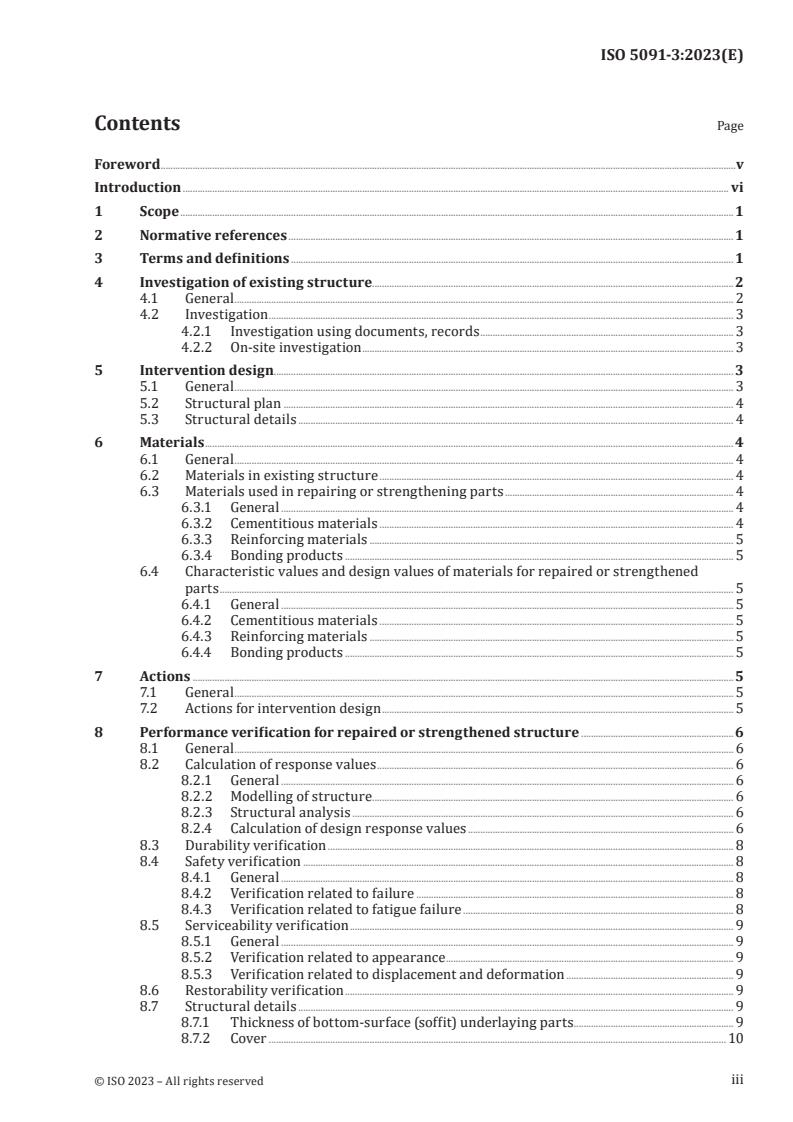
Contents Page
Foreword .v
Introduction . vi
1 Scope . 1
2 Normative references . 1
3 Terms and definitions . 1
4 Investigation of existing structure.2
4.1 General . 2
4.2 Investigation . 3
4.2.1 Investigation using documents, records . 3
4.2.2 On-site investigation . 3
5 Intervention design. 3
5.1 General . 3
5.2 Structural plan . 4
5.3 Structural details . 4
6 Materials . 4
6.1 General . 4
6.2 Materials in existing structure . 4
6.3 Materials used in repairing or strengthening parts . 4
6.3.1 General . 4
6.3.2 Cementitious materials . 4
6.3.3 Reinforcing materials . 5
6.3.4 Bonding products . 5
6.4 Characteristic values and design values of materials for repaired or strengthened
parts . 5
6.4.1 General . 5
6.4.2 Cementitious materials . 5
6.4.3 Reinforcing materials . 5
6.4.4 Bonding products . 5
7 Actions . 5
7.1 General . 5
7.2 Actions for intervention design . 5
8 Performance verification for repaired or strengthened structure .6
8.1 General . 6
8.2 Calculation of response values . 6
8.2.1 General . 6
8.2.2 Modelling of structure. 6
8.2.3 Structural analysis . 6
8.2.4 Calculation of design response values . 6
8.3 Durability verification . 8
8.4 Safety verification . 8
8.4.1 General . 8
8.4.2 Verification related to failure . 8
8.4.3 Verification related to fatigue failure . 8
8.5 Serviceability verification . 9
8.5.1 General . 9
8.5.2 Verification related to appearance . 9
8.5.3 Verification related to displacement and deformation . 9
8.6 Restorability verification . 9
8.7 Structural details . 9
8.7.1 Thickness of bottom-surface (soffit) underlaying parts. 9
8.7.2 Cover . 10
iii
8.7.3 Space between reinforcing materials . 10
8.7.4 Joints for reinforcing materials . 10
8.7.5 Anchoring and securing methods of reinforcing materials . 10
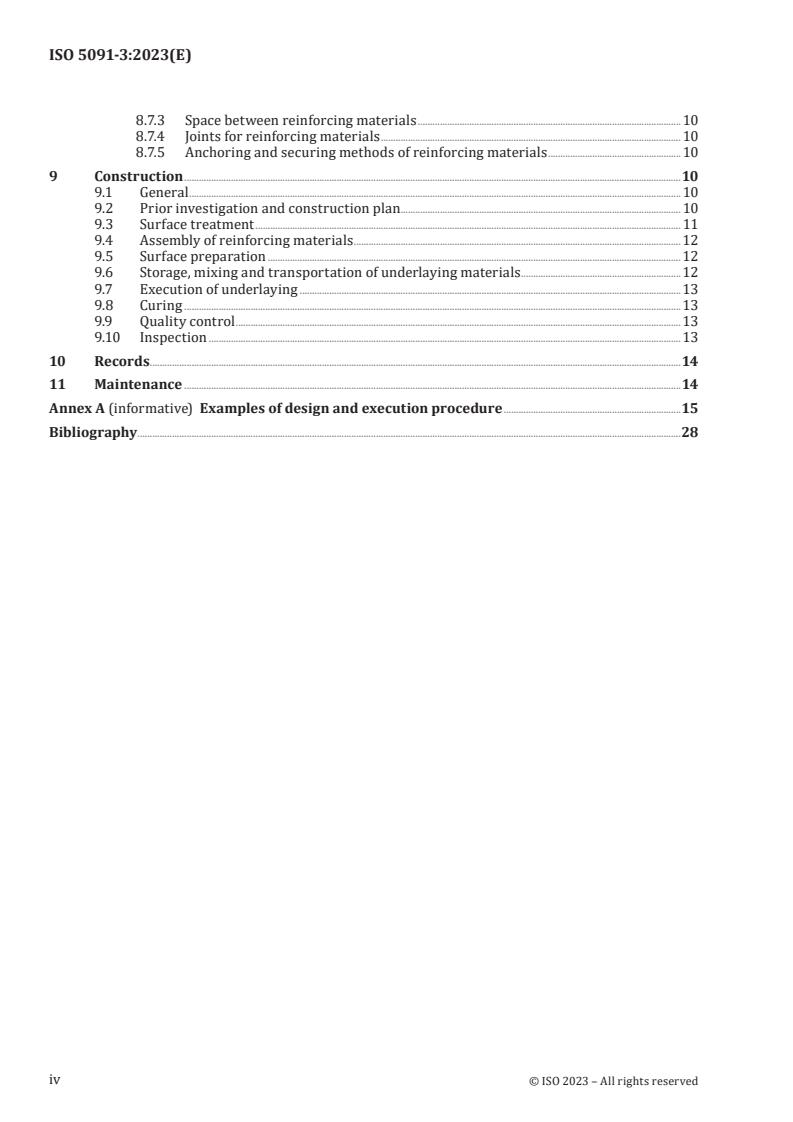
9 Construction .10
9.1 General . 10
9.2 Prior investigation and construction plan. 10
9.3 Surface treatment . 11
9.4 Assembly of reinforcing materials .12
9.5 Surface preparation . 12
9.6 Storage, mixing and transportation of underlaying materials .12
9.7 Execution of underlaying .13
9.8 Curing .13
9.9 Quality control . 13
9.10 Inspection . 13
10 Records . .14
11 Maintenance .14
Annex A (informative) Examples of design and execution procedure .15
Bibliography .28
iv
Foreword
ISO (the International Organization for Standardization) is a worldwide federation of national standards
bodies (ISO member bodies). The work of preparing International Standards is normally carried out
through ISO technical committees. Each member body interested in a subject for which a technical
committee has been established has the right to be represented on that committee. International
organizations, governmental and non-governmental, in liaison with ISO, also take part in the work.
ISO collaborates closely with the International Electrotechnical Commission (IEC) on all matters of
electrotechnical standardization.
The procedures used to develop this document and those intended for its further maintenance are
described in the ISO/IEC Directives, Part 1. In particular, the different approval criteria needed for the
different types of ISO document should be noted. This document was drafted in accordance with the
editorial rules of the ISO/IEC Directives, Part 2 (see www.iso.org/directives).
ISO draws attention to the possibility that the implementation of this document may involve the use
of (a) patent(s). ISO takes no position concerning the evidence, validity or applicability of any claimed
patent rights in respect thereof. As of the date of publication of this document, ISO had not received
notice of (a) patent(s) which may be required to implement this document. However, implementers are
cautioned that this may not represent the latest information, which may be obtained from the patent
database available at www.iso.org/patents. ISO shall not be held responsible for identifying any or all
such patent rights.
Any trade name used in this document is information given for the convenience of users and does not
constitute an endorsement.
For an explanation of the voluntary nature of standards, the meaning of ISO specific terms and
expressions related to conformity assessment, as well as information about ISO's adherence to
the World Trade Organization (WTO) principles in the Technical Barriers to Trade (TBT), see
www.iso.org/iso/foreword.html.
This document was prepared by Technical Committee ISO/TC 71, Concrete, reinforced concrete and pre-
stressed concrete, Subcommittee SC 7, Maintenance and repair of concrete structures.
A list of all parts in the ISO 5091 series can be found on the ISO website.
Any feedback or questions on this document should be directed to the user’s national standards body. A
complete listing of these bodies can be found at www.iso.org/members.html.
v
Introduction
As a repairing and strengthening method, attaching of cementitious material layer to surface of existing
concrete structures has been widely accepted. Since the cementitious layer does not have enough tensile
strength, tension reinforcement is generally placed in the cementitious layer. There are two types of
attaching way. For the first way, the cementitious layer is attached either on top surface or bottom
surface of horizontal concrete members, especially slabs, while, for the second way, the cementitious
layer is attached to jacket vertical concrete members, especially columns. There has not been any ISO
standard on design, execution, and maintenance for this method with attaching cementitious layer. The
ISO 5091 series serves as the first ISO standard for the intervention by attaching cementitious material
layer with tension reinforcement inside.
At the same time, the ISO 5091 series is the first ISO standard developed for a specific intervention
method, which conforms to the umbrella code, ISO 16311, especially ISO 16311-3 and ISO 16311-4.
The ISO 5091 series consists of four parts. ISO 5091-1 provides the issues common to all three parts,
while ISO 5091-2, 3 and 4 provide the issues specific to each attaching way of cementitious material
layers.
Generally, polymer hydraulic cement mortar (PCM) is used as the underlaying material. This is because
PCM bonds well with the existing members and has large tensile strain at cracking, and makes the
penetration of degradation factors less likely. As reinforcing materials, reinforcing steel, welded wire
mesh, FRP grid are used.
Bottom-surface (soffit) underlaying has evolved as a strengthening method for fatigue of RC decks.
drawing attention because of examples of applications like the one shown in Figure 1. The members that
are currently repaired or strengthened using this method include RC decks, tunnel linings, box culverts,
waterways and beams. In this document, the latest information about the design and construction of
the bottom-surface (soffit) underlaying method using underlaying materials has been collected and the
best possible standards are presented.
The ISO 5091 series can serve as a practical standard for construction industry, such as client, design
consultant and general contractor, to apply the structural intervention with externally attached
cementitious layer. Additional technical information, which is not provided explicitly in the ISO 5091
series, needs to be provided in each application case with consideration of the provisions of the ISO 5091
series.
vi
INTERNATIONAL STANDARD ISO 5091-3:2023(E)
Structural intervention of existing concrete structures
using cementitious materials —
Part 3:
Bottom-surface (soffit) underlaying
1 Scope
This document specifies the standards for design and construction using the bottom-surface (soffit)
underlaying method. Bottom-surface (soffit) underlaying is a method whereby reinforcing materials
are placed on the bottom surface of the slabs or beams whose performance is lower than required and
the improvement of durability, serviceability, safety and other performance of the members is achieved
by the integrity between the reinforcing materials and existing members.
This document specifies structural intervention of existing concrete structures using cementitious
materials design and execution principles, and strategies for defects and on-going deterioration
including, but not limited to:
a) mechanical actions, e.g. fatigue, impact, overloading, movement caused by settlement, blast,
vibration, and seismic actions;
b) chemical and biological actions from environments, e.g. sulfate attack, alkali-aggregate reaction;
c) physical actions, e.g. freeze–thaw, thermal cracking, moisture movement, salt crystallization, fire,
and erosion;
d) reinforcement corrosion;
e) original construction defects that remained unaddressed from the time of construction.
2 Normative references
The following documents are referred to in the text in such a way that some or all of their content
constitutes requirements of this document. For dated references, only the edition cited applies. For
undated references, the latest edition of the referenced document (including any amendments) applies.
ISO 5091-1:2023, Structural intervention of existing concrete structures using cementitious materials —
Part 1: General principles
ISO 22966, Execution of concrete structures
3 Terms and definitions
For the purposes of this document, the following terms and definitions apply.
ISO and IEC maintain terminology databases for use in standardization at the following addresses:
— ISO Online browsing platform: available at https:// www .iso .org/ obp
— IEC Electropedia: available at https:// www .electropedia .org/
3.1
bottom-surface (soffit) underlaying
method in which the thickness of the structural element associated with the bottom surface of the
existing concrete is increased using cementitious materials, which will generally be reinforced
Note 1 to entry: The technique enhances the performance (e.g. strength, stiffness) of the existing concrete
structure and is applicable to highway bridge decks, tunnel linings, box culverts/waterway structures, beams,
etc.
3.2
bonding product
material, such as a primer or adhesive, that is applied to bond concrete and mortar
Note 1 to entry: The grouting material for bonding concrete and reinforcing material is also included in this term.
3.3
filling material
material injected to fill the gap between a reinforcing material, such as intermediate penetrating tie,
and concrete
3.4
filling property
degree of filling of cracks and adhesion of crack filling material to substrate
3.5
reinforcing material
steel or FRP material used to sustain, restore or improve the mechanical performance of a structure
3.6
polymer hydraulic cement mortar
hydraulic composition made cementitious materials and fine aggregate modified by the addition of a
polymer
3.7
FRP grid
resin-impregnated FRP reinforcing materials formed into a grid shape
3.8
design response value
value of structural response obtained by numerical analysis on design process, such as sectional force
and deformation
3.9
design limit value
design value for quantified limit state on design process, such as strength of element, allowable crack
width
3.10
maintainability
ability of a structure to meet service objectives with a minimum expenditure of maintenance effort
under service conditions in which maintenance and repair are performed
4 Investigation of existing structure
4.1 General
The study of the existing structure for which to consider intervention using the bottom-surface (soffit)
underlaying method shall be as set forth in ISO 5091-1:2023, Clause 4.
4.2 Investigation
4.2.1 Investigation using documents, records
When the climatic conditions, environmental conditions and geographical conditions of the local
site are studied using documents, records, etc., the study shall be conducted in accordance with
ISO 5091-1:2023, 4.2.1.
4.2.2 On-site investigation
The on-site study on degradation, damage and initial defects of the existing concrete structure shall be
conducted in accordance with ISO 5091-1:2023, 4.2.2.
The work environment and other relevant conditions of the site shall be checked in advance.
5 Intervention design
5.1 General
When repairing or strengthening a concrete structure using bottom-surface (soffit) underlaying as
shown in Figure 1, it shall be verified by means of an appropriate method that the structure fulfils the
required performance for the required period. Also, the environment for the intervention construction,
constructability, post-intervention maintainability and economy shall be taken into consideration.
Key
1 pavement
2 RC deck
3 main girder
4 underlaying
5 distribution reinforcement
6 main reinforcement
7 bottom-surface (soffit) underlaying
Figure 1 — Example of application of bottom-surface (soffit) underlaying for deck
strengthening
5.2 Structural plan
The structural plan for a structure repaired or strengthened with bottom-surface (soffit) underlaying
shall be as set forth in ISO 5091-1:2023, 5.2. The repaired or strengthened structure shall fulfil the
required levels of durability, safety, serviceability and restorability throughout the design service life.
Also, the intervention shall be planned taking into consideration the causes of degradation and damage
of the existing members subject to bottom-surface (soffit) underlaying.
In flexural strengthening of existing members, the verification is mainly intended for serviceability,
safety, etc. In fatigue strengthening of bridge decks, the punching shear capacity of the decks is required
to be improved. In seismic strengthening of box culverts and tunnels, the verification is intended for
restorability.
5.3 Structural details
The structure of bottom-surface (soffit) underlaying shall ensure the integrity between the existing
and underlaying parts in the repaired or strengthened members to avoid brittle failure.
The structure of bottom-surface (soffit) underlaying shall ensure that reinforcing materials are
securely anchored to the existing parts to reduce the risk of peeling.
The structure of bottom-surface (soffit) underlaying shall prevent retention of water in the interface
between the existing and underlaying parts to avoid degradation of the interface or a decrease in
adhesion.
The reinforcing materials used for bottom-surface (soffit) underlaying shall have a certain level of
tensile stiffness that allows the reinforcing materials to behave with the existing parts as one. The
reinforcing materials used for bottom-surface (soffit) underlaying shall not have excessive tensile
stiffness against the existing parts.
If the tensile stiffness of the reinforcing materials is excessive, care shall be taken because the forces
transferred through the interface between the existing and underlaying parts as well as the anchoring
parts of the reinforcing materials become great, potentially leading to peeling or some other problem.
6 Materials
6.1 General
The materials used for bottom-surface (soffit) underlaying shall be of proven quality to ensure that the
required performance is fulfilled for a necessary period.
6.2 Materials in existing structure
The characteristic values of material strength, partial safety factor for materials and design values of
the materials in the existing structure that are used for the design shall be determined in accordance
with ISO 5091-1:2023, 6.2.
6.3 Materials used in repairing or strengthening parts
6.3.1 General
The quality of the materials used in the parts repaired or strengthened with bottom-surface (soffit)
underlaying shall be as set forth in ISO 5091-1:2023, 6.3.
6.3.2 Cementitious materials
The underlaying materials used for bottom-surface (soffit) underlaying shall have a bonding property
and durability sufficient to integrate the existing parts with added reinforcing materials.
Materials having Young's modulus and compressive strength that are the same as or similar to those of
the existing members are suitable.
The underlaying materials shall have performance equal to or greater than the resistance against
permeation of the existing members against environmental factors.
6.3.3 Reinforcing materials
Considering the performance requirements, reinforcing materials having appropriate tensile stiffness,
design tensile strength and durability shall be selected.
6.3.4 Bonding products
The bonding products used in the interface between the existing and underlaying parts shall ensure
the specified bonding property.
The bonding products shall prevent the degradation in the bonding property of the underlaying and
existing parts. The bonding products shall be those proven to be compatible with the materials used in
both the underlaying and existing parts and have sufficient durability.
6.4 Characteristic values and design values of materials for repaired or strengthened
parts
6.4.1 General
The characteristic values and design values of the materials used for bottom-surface (soffit) underlaying
shall be as set forth in ISO 5091-1:2023, 6.4.
6.4.2 Cementitious materials
The cementitious materials used for bottom-surface (soffit) underlaying shall be as set forth in
ISO 5091-1:2023, 6.4.2. The characteristic values of strength and other properties need to be determined
under the temperature condition appropriate for the usage environment.
6.4.3 Reinforcing materials
The reinforcing materials used for bottom-surface (soffit) underlaying shall be as set forth in
ISO 5091-1:2023, 6.4.3.
6.4.4 Bonding products
As the design value of the bonding product, the characteristic value of the bond strength obtained after
integrating interfaces between the existing part and the underlaying part and between underlaying
parts shall be used, instead of the characteristic value of the strength of the bonding product itself.
7 Actions
7.1 General
The actions used for performance verification of intervention using the bottom-surface (soffit)
underlaying method shall be as set forth in ISO 5091-1:2023, Clause 7.
7.2 Actions for intervention design
In the intervention design, the actions that can occur on the existing structure and repaired or
strengthened parts shall be considered in accordance with ISO 5091-1:2023, 7.2.
8 Performance verification for repaired or strengthened structure
8.1 General
The items to be verified for the concrete members repaired or strengthened with bottom-surface
(soffit) underlaying shall be established appropriately so as to fulfil the required performance of the
repaired or strengthened structure.
When calculating the design limit values for the repaired or strengthened members, the influence of
the cracks, strain, stress, corrosion factors that remain in the existing members shall be taken into
consideration.
The existing members have been subject to various actions from the time they are constructed
until they are repaired or strengthened, thus causing changes in them. These changes influence the
calculation of the design limit values for the strengthened members and shall therefore be taken into
consideration appropriately.
8.2 Calculation of response values
8.2.1 General
The response values of a structure repaired or strengthened with bottom-surface (soffit) underlaying
shall be calculated as set forth in ISO 5091-1:2023, 8.2.
8.2.2 Modelling of structure
A member repaired or strengthened with bottom-surface (soffit) underlaying may be modelled as a
beam or slab according to the shape and action direction through the use of finite element modelling or
modelling with linear element.
When an out-of-plain force acts on a slab repaired or strengthened with bottom-surface (soffit)
underlaying, the sectional force shall be in principle calculated with respect to two directions taking
into consideration the support conditions and the action points of loads.
In the case of finite element modelling, the constitutive law for the existing members take into
consideration the changes in the existing members. For the interface between the existing and
underlaying parts, an appropriate constitutive law shall be adopted according to the materials used.
In the case of modelling with structural stick model of beam and column elements s, in principle, the
skeleton curve shall be obtained using a fibre model or one proven through experiments or other means
shall be employed.
Since a member repaired or strengthened with bottom-surface (soffit) underlaying has a combination
of different material properties, such as existing reinforcing steel and reinforcing material or existing
concrete and underlaying material, the skeleton curve used for modelling with structural stick model of
beam and column elements should be obtained using a fibre model or through experiments.
8.2.3 Structural analysis
The structural analysis of a structure repaired or strengthened with bottom-surface (soffit) underlaying
shall be performed as set forth in ISO 5091-1:2023, 8.2.3.
8.2.4 Calculation of design response values
The design response values to be used for the verification of a structure repaired or strengthened with
bottom-surface (soffit) underlaying shall be calculated taking into consideration the responses of the
existing structure before intervention.
The permanent loads that have been exerted since before intervention shall be calculated as responses
on the existing section, and the permanent and variable loads that increase after intervention shall be
calculated as responses on the composite section of the existing and strengthened sections. Then, these
responses shall be totalled.
NOTE Figure 2 shows an example in which the existing stress of the existing members is calculated using
a fibre model. The responses to the loads acting on the strengthened members are calculated considering the
obtained strain as the residual strain.
Key
1 neutral axis
2 existing part
3 underlaying part
4 strain
5 response to preload
6 response to post-load
7 response after integration
Figure 2 — Strain when used after strengthening
The flexural crack width of a member repaired or strengthened with bottom-surface (soffit)
underlaying may be calculated using Formula (1). A.2 may be used for evaluating the crack spacing in
the underlaying part surface.
wS=⋅()εε− (1)
sf sc
where
w
is the crack width (mm);
S
is the crack spacing (mm);
sf
μ
is the average strain of reinforcing material between cracks;
s
μ
is the average strain between cracks on underlaying part surface.
c
The average strain between cracks may be calculated based on the hypotheses mentioned below.
a) The crack width of a member strengthened with bottom-surface (soffit) underlaying shall be
calculated using the average strain of the reinforcing material in the underlaying layer and the
average strain on the underlaying material surface. The average strain shall take into consideration
the effect of tension stiffening.
b) The influence of the crack widths resulting from underlaying material shrinkage, creep, etc. shall
be taken into consideration.
8.3 Durability verification
The durability of a structure repaired or strengthened with bottom-surface (soffit) underlaying shall
be verified as set forth in ISO 5091-1:2023, 8.3.
8.4 Safety verification
8.4.1 General
The safety of a member repaired or strengthened with bottom-surface (soffit) underlaying shall be
verified as set forth in ISO 5091-1:2023, 8.4.
8.4.2 Verification related to failure
8.4.2.1 General
The verification related to failure shall be generally performed with respect to axial force, bending
moment, shear force and torsion.
When calculating the design strength, it shall be checked that the integrity between the existing and
underlaying parts is ensured.
8.4.2.2 Verification related to bending moment and axial force
When subject to bending moment and axial force, the design capacity after the intervention can be
calculated in accordance with ISO 5091-1:2023, 8.4.1.2.
It shall be checked that the underlaying parts do not peel off near the cross-section under study when
the design load is acting. A.2 may be used for checking the peeling failure of the underlaying parts.
8.4.2.3 Verification related to shear force
a) The safety verification related to the shear force shall be performed taking into consideration the
type of member (e.g. beam, slab), boundary conditions of members, the application states of loads,
the direction of action of shear force and so forth.
b) The design shear capacity of beams and the design punching shear capacity of slabs that are
borne by concrete may be calculated taking into account the effect of the anchored reinforcing
materials placed in the underlaying parts. A.3 may be used for checking the design shear capacity
of beams and the design punching shear capacity of slabs strengthened with bottom surface (soffit)
underlaying.
If the reinforcing materials of the underlaying parts are not anchored at the edges, it shall be checked
that the peeling of the underlaying parts or splitting cracking of the covering concrete of the existing
parts does not occur at the edges under the action of the design load. A.4 may be used for checking the
peeling failure of the underlaying parts or the splitting cracking of the covering concrete of the existing
parts.
8.4.2.4 Verification related to torsional moment
If the action of torsional moment is not negligible, a safety study shall be performed by means of an
appropriate method.
8.4.3 Verification related to fatigue failure
The safety verification related to fatigue failure shall check flexural strength and shear capacity for
beams and flexural strength and punching shear capacity for slabs.
The safety verification related to fatigue peeling failure of underlaying materials shall be considered
by means of an appropriate method. A.5 may be used for checking the fatigue peeling failure of the
underlaying materials.
The verification related to fatigue failure shall be performed by conducting numerical analyses,
experiments and the other appropriate method to take into consideration the changes in responses
due to the movement of loads, when the influence of the movement of loads is not negligible. A.6 may be
used for checking the fatigue failure due to the movement of loads in the strengthened members.
8.5 Serviceability verification
8.5.1 General
The serviceability of a member repaired or strengthened with bottom-surface (soffit) underlaying shall
be verified as set forth in ISO 5091-1:2023, 8.5.
8.5.2 Verification related to appearance
The verification related to appearance shall be performed taking into consideration how frequently
the underlaying bottom surface is seen by users and the levels of uneasiness and unpleasantness that
cracks, dirt and other appearance problems give to users.
The verification related to appearance may be omitted for an underground or underwater structure
that is rarely seen by users or other third parties. In general, cracks that occur in a structure repaired
or strengthened with bottom-surface (soffit) underlaying are much smaller than 0,2 mm in width, and
the verification related to the crack width may be omitted.
8.5.3 Verification related to displacement and deformation
When the purpose of bottom-surface (soffit) underlaying is to increase the stiffness of members,
the verification shall be performed using displacement and deformation as indices to check that the
requirements for use are met.
While bottom-surface (soffit) underlaying is mainly aimed to improve the load-bearing capacity
and fatigue life of existing members, it should be checked that the required performance is fulfilled,
by using displacement and deformation as indices, when the method is also aimed at improvement
in stiffness. For example, in order to check that the functional performance requirements regarding
trafficability, which is the performance to provide a comfortable ride quality, and walkability, which
is the performance to provide a comfortable walking experience, of bridges and other structures are
met, it is advisable to establish appropriate limit values for deflection and bend angle of the members
strengthened with bottom-surface (soffit) underlaying.
8.6 Restorability verification
The restorability of a member repaired or strengthened with bottom-surface (soffit) underlaying shall
be verified as set forth in ISO 5091-1:2023, 8.6.
8.7 Structural details
8.7.1 Thickness of bottom-surface (soffit) underlaying parts
The thickness of the bottom-surface (soffit) underlaying parts shall be determined taking into
consideration the surface treatment and surface unevenness adjustment of existing members,
placement error of reinforcing materials, influence of covering thickness construction error and
integrity. An example of the construction section observed when bottom-surface (soffit) underlaying is
applied to bridge decks and shown in Annex A.
8.7.2 Cover
The covering thickness for bottom-surface (soffit) underlaying shall be equal to or greater than the
value that ensures the mechanical performance and durability required for the intervention using the
bottom-surface (soffit) underlaying method.
8.7.3 Space between reinforcing materials
The space between reinforcing materials shall be determined taking into consideration the filling
property of underlaying materials.
NOTE When reinforcing steel is used as reinforcing materials, the space between reinforcing steel bars
ranges from 50 mm to 100 mm for small-diameter and large-diameter bars.
8.7.4 Joints for reinforcing materials
When the reinforcing materials used in the underlaying parts have joints, it shall be ensured that stress
is transferred at the joint part without failure of the joint part.
When the specifications of the joints of reinforcing materials are not clearly indicated and reinforcing
steel is used as reinforcing materials, the joints shall meet the specifications of reinforcing steel joints
set forth in relevant standard specifications in each country.
8.7.5 Anchoring and securing methods of reinforcing materials
Reinforcing materials shall be anchored to the underlaying or existing parts to integrate the materials
with the parts.
Reinforcing materials shall be secured so that they sustain durability both during and after construction
and are not subject to deformation or vibration.
9 Construction
9.1 General
The construction for intervention with bottom-surface (soffit) underlaying shall be in principle
performed in accordance with the provisions set forth in ISO 5091-1:2023, Clause 9 as well as in this
clause. Bottom-surface (soffit) underlaying shall be in principle performed by applying underlaying
materials through either spraying or trowelling, and there are two spraying methods: wet spraying
and dry spraying. An example of the construction procedure for bottom-surface (soffit) underlaying is
shown in Annex A.
Engineers with sufficient knowledge and experience in the construction for bottom-surface (soffit)
underlaying shall be assigned to the site and the construction work shall be performed under the
direction of those engineers.
NOTE Particularly, the construction technique for spraying underlaying materials is important for ensuring
quality in bottom-surface (soffit) underlaying. It is desirable to assign engineers qualified through spraying
managing engineer qualification systems run by relevant organizations or qualified spraying technicians.
...