

ISO 5091-1:2023
(Main)Structural intervention of existing concrete structures using cementitious materials — Part 1: General principles
General Information
- Abstract
This document specifies the standards for design, construction and maintenance following completion of intervention to be applied for performing intervention work using cementitious materials to improve the performance of existing concrete structures. The intervention dealt with in this document is intended to restore, sustain or improve the mechanical performance of concrete structures. When the intervention is aimed at restoring or improving durability, reference should be made to relevant documents. This document covers the overlaying, underlaying and jacketing methods using cementitious materials. The intervention with cementitious materials is covered in ISO 16311-1, Clause 4.
- Status
- Published
- Publication Date
- 20-Jul-2023
- Technical Committee
- ISO/TC 71/SC 7 - Maintenance and repair of concrete structures
- Drafting Committee
- ISO/TC 71/SC 7 - Maintenance and repair of concrete structures
- Current Stage
- 6060 - International Standard published
- Start Date
- 21-Jul-2023
- Due Date
- 18-Jun-2023
- Completion Date
- 21-Jul-2023

Overview
ISO 5091-1:2023 sets forth the general principles and guidelines for the structural intervention of existing concrete structures using cementitious materials. Developed by the International Organization for Standardization (ISO), this document establishes internationally recognized standards for the design, execution, and maintenance of interventions that aim to restore, sustain, or improve the mechanical performance of concrete structures. It applies to overlaying, underlaying, and jacketing methods, ensuring interventions deliver effective and enduring results. The standard is particularly relevant to sectors focused on infrastructure rehabilitation, repair, and the extension of service life for concrete assets.
Key Topics
- Assessment of Existing Structures: Guidance on detailed investigation prior to intervention, including document review, site inspections, and understanding local conditions influencing materials and methods.
- Intervention Design: Requirements for developing a rational structural plan and detailed reinforcement strategies, taking into account integration with existing structures and long-term performance.
- Approved Methods: Coverage of overlaying (top-surface), underlaying (soffit), and jacketing techniques using cementitious materials, each suited to specific structural scenarios such as bridge decks, tunnels, and columns.
- Materials Selection: Description of quality requirements for cementitious materials, reinforcing materials, bonding products, and filling materials to ensure integrity and compatibility with existing structures.
- Performance Verification: Steps for verifying the effectiveness, safety, durability, and serviceability of interventions, including calculations and analysis to meet target performance levels.
- Execution and Quality Control: Best practices for planning, detailing, construction, and post-completion inspection, ensuring interventions are reliable and sustainable.
- Maintenance and Documentation: Procedures for ongoing maintenance, as well as requirements for keeping records to support the longevity of the repaired or strengthened structures.
Applications
ISO 5091-1:2023 is widely applicable across civil engineering and construction industries, specifically in:
- Infrastructure Rehabilitation: Bridges, tunnels, roadways, and public buildings that require structural upgrade or life extension through overlaying, underlaying, or jacketing with cementitious materials.
- Seismic Retrofit and Strengthening: Enhancing ductility, stiffness, or load-carrying capacity for structures in seismic zones, or increasing resilience against other specific loads.
- Asset Management Programs: Supporting asset owners, designers, and contractors in making informed decisions during repair and maintenance cycles to ensure compliance and optimize investments.
- Post-Repair Performance Verification: Ensuring repairs deliver required mechanical performance, minimize service interruptions, and address safety, durability, and maintainability concerns.
Related Standards
To ensure a holistic approach, ISO 5091-1:2023 should be used in conjunction with other key standards, such as:
- ISO 16311 Series: Comprehensive guidelines on maintenance, repair, design, and execution of repairs for concrete structures.
- ISO 19338: Guidelines for performance and assessment requirements for design standards on structural concrete.
- ISO 10406 Series: Testing methods for fibre-reinforced polymer (FRP) reinforcement of concrete.
- ISO 22966: Guidance for the execution of concrete structures, covering general construction practices.
- ISO 679: Relevant test methods for determining cement strength.
Practical Value
Implementing ISO 5091-1:2023 provides numerous practical benefits for stakeholders:
- Assures Quality and Consistency: Harmonizes intervention practices, ensuring high-quality, reliable, and durable results across projects.
- Risk Reduction: Supports comprehensive assessments and robust designs that mitigate future failures or degradation.
- Facilitates Compliance: Streamlines conformance with global best practices for concrete structural repairs.
- Enhances Asset Longevity: Promotes interventions that extend service life while supporting economic and environmental sustainability.
- Supports Innovation: Encourages the use of proven and emerging cementitious materials and reinforcement techniques suited to local demands.
Adopting ISO 5091-1:2023 is essential for anyone involved in the maintenance, repair, design, or management of concrete structures seeking to achieve international standards of safety and performance.
Relations
- Consolidated By
ISO 6591-1:2026 - Packaging — Dimensions and method of measurement — Part 1: Empty paper sacks - Effective Date
- 12-Oct-2024
Get Certified
Connect with accredited certification bodies for this standard

DIBt (Deutsches Institut für Bautechnik)
German Institute for Building Technology.
DIN CERTCO
DIN Group product certification.

Aboma Certification B.V.
Specialized in construction, metal, and transport sectors.
Sponsored listings
Frequently Asked Questions
ISO 5091-1:2023 is a standard published by the International Organization for Standardization (ISO). Its full title is "Structural intervention of existing concrete structures using cementitious materials — Part 1: General principles". This standard covers: This document specifies the standards for design, construction and maintenance following completion of intervention to be applied for performing intervention work using cementitious materials to improve the performance of existing concrete structures. The intervention dealt with in this document is intended to restore, sustain or improve the mechanical performance of concrete structures. When the intervention is aimed at restoring or improving durability, reference should be made to relevant documents. This document covers the overlaying, underlaying and jacketing methods using cementitious materials. The intervention with cementitious materials is covered in ISO 16311-1, Clause 4.
This document specifies the standards for design, construction and maintenance following completion of intervention to be applied for performing intervention work using cementitious materials to improve the performance of existing concrete structures. The intervention dealt with in this document is intended to restore, sustain or improve the mechanical performance of concrete structures. When the intervention is aimed at restoring or improving durability, reference should be made to relevant documents. This document covers the overlaying, underlaying and jacketing methods using cementitious materials. The intervention with cementitious materials is covered in ISO 16311-1, Clause 4.
ISO 5091-1:2023 is classified under the following ICS (International Classification for Standards) categories: 91.080.40 - Concrete structures. The ICS classification helps identify the subject area and facilitates finding related standards.
ISO 5091-1:2023 has the following relationships with other standards: It is inter standard links to ISO 6591-1:2026. Understanding these relationships helps ensure you are using the most current and applicable version of the standard.
ISO 5091-1:2023 is available in PDF format for immediate download after purchase. The document can be added to your cart and obtained through the secure checkout process. Digital delivery ensures instant access to the complete standard document.
Standards Content (Sample)
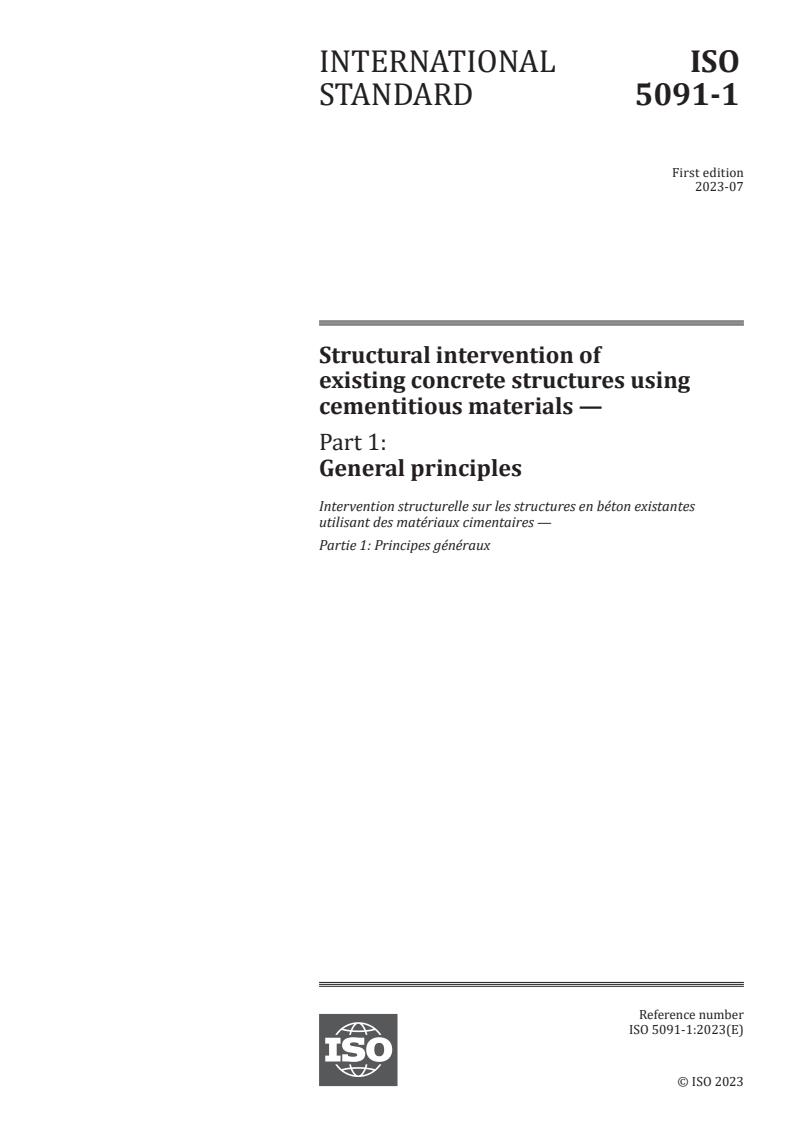
INTERNATIONAL ISO
STANDARD 5091-1
First edition
2023-07
Structural intervention of
existing concrete structures using
cementitious materials —
Part 1:
General principles
Intervention structurelle sur les structures en béton existantes
utilisant des matériaux cimentaires —
Partie 1: Principes généraux
Reference number
© ISO 2023
All rights reserved. Unless otherwise specified, or required in the context of its implementation, no part of this publication may
be reproduced or utilized otherwise in any form or by any means, electronic or mechanical, including photocopying, or posting on
the internet or an intranet, without prior written permission. Permission can be requested from either ISO at the address below
or ISO’s member body in the country of the requester.
ISO copyright office
CP 401 • Ch. de Blandonnet 8
CH-1214 Vernier, Geneva
Phone: +41 22 749 01 11
Email: copyright@iso.org
Website: www.iso.org
Published in Switzerland
ii
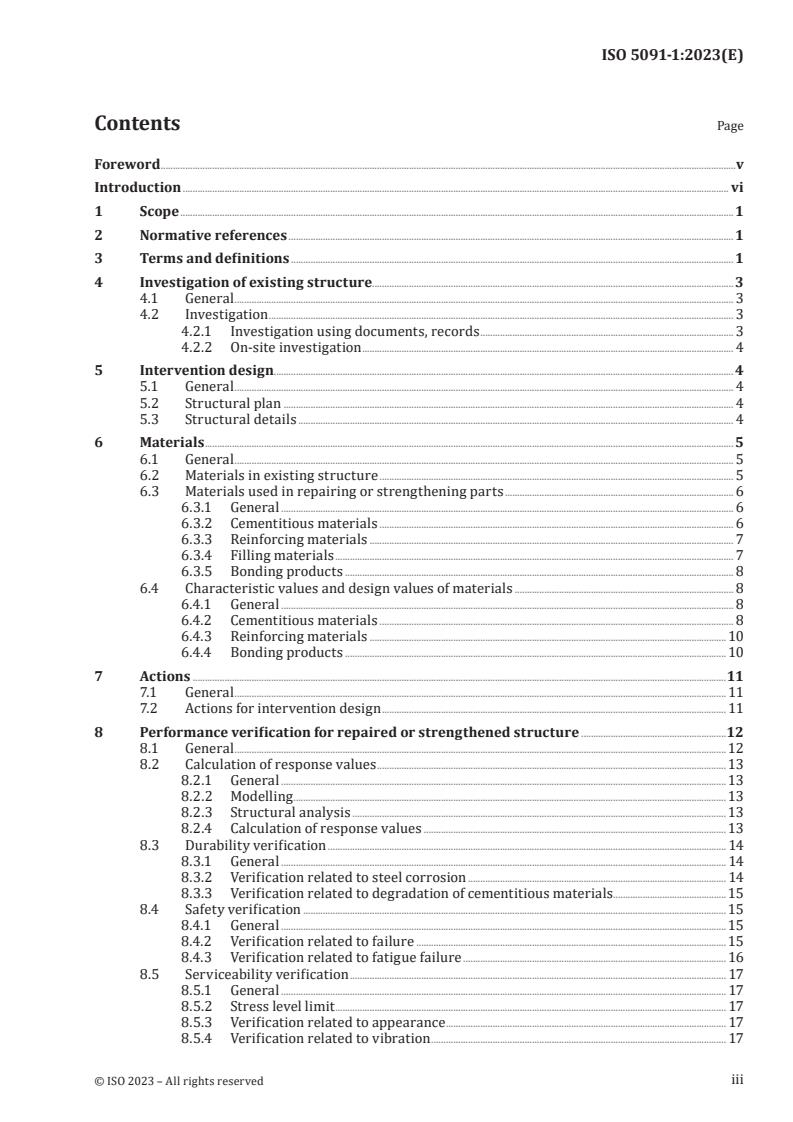
Contents Page
Foreword .v
Introduction . vi
1 Scope . 1
2 Normative references . 1
3 Terms and definitions . 1
4 Investigation of existing structure.3
4.1 General . 3
4.2 Investigation . 3
4.2.1 Investigation using documents, records . 3
4.2.2 On-site investigation . 4
5 Intervention design. 4
5.1 General . 4
5.2 Structural plan . 4
5.3 Structural details . 4
6 Materials . 5
6.1 General . 5
6.2 Materials in existing structure . 5
6.3 Materials used in repairing or strengthening parts . 6
6.3.1 General . 6
6.3.2 Cementitious materials . 6
6.3.3 Reinforcing materials . 7
6.3.4 Filling materials . 7
6.3.5 Bonding products . 8
6.4 Characteristic values and design values of materials . 8
6.4.1 General . 8
6.4.2 Cementitious materials . 8
6.4.3 Reinforcing materials . 10
6.4.4 Bonding products . 10
7 Actions .11
7.1 General . 11
7.2 Actions for intervention design . 11
8 Performance verification for repaired or strengthened structure .12
8.1 General .12
8.2 Calculation of response values . 13
8.2.1 General .13
8.2.2 Modelling . 13
8.2.3 Structural analysis . 13
8.2.4 Calculation of response values . 13
8.3 Durability verification . 14
8.3.1 General . 14
8.3.2 Verification related to steel corrosion . 14
8.3.3 Verification related to degradation of cementitious materials.15
8.4 Safety verification . 15
8.4.1 General .15
8.4.2 Verification related to failure . 15
8.4.3 Verification related to fatigue failure . 16
8.5 Serviceability verification . 17
8.5.1 General . 17
8.5.2 Stress level limit . 17
8.5.3 Verification related to appearance . 17
8.5.4 Verification related to vibration . 17
iii
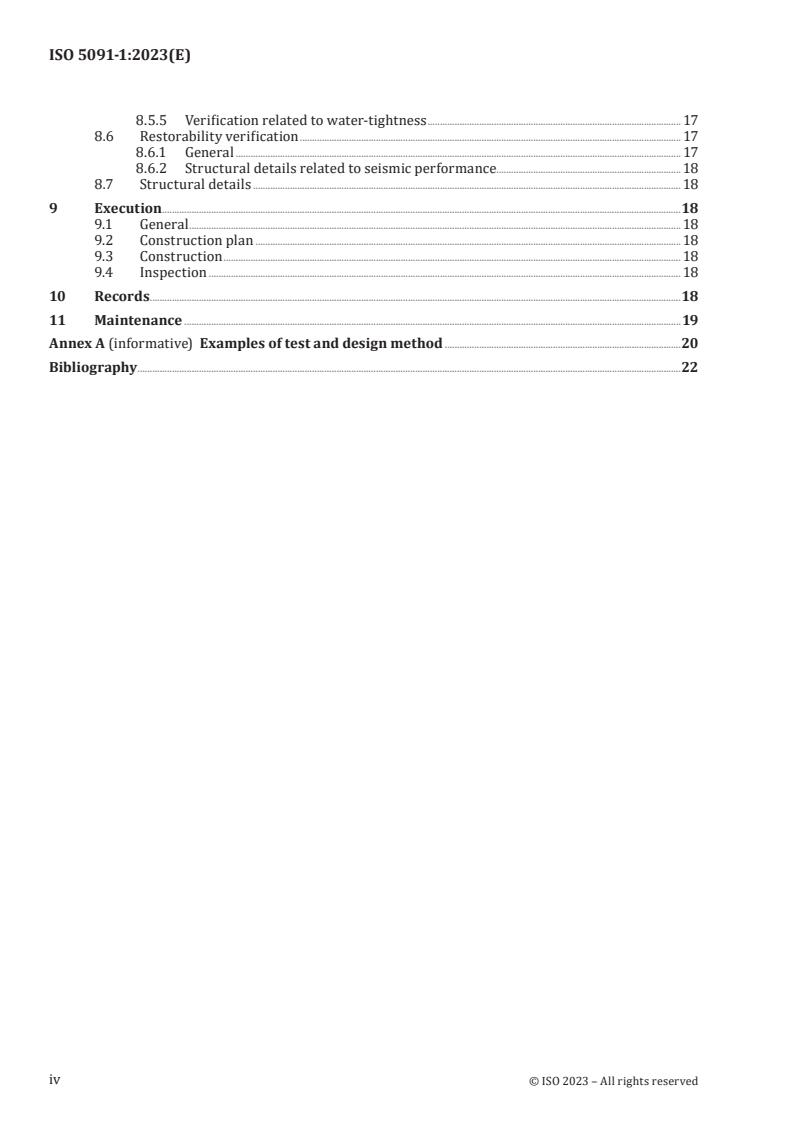
8.5.5 Verification related to water-tightness . 17
8.6 Restorability verification . 17
8.6.1 General . 17
8.6.2 Structural details related to seismic performance . 18
8.7 Structural details . 18
9 Execution .18
9.1 General . 18
9.2 Construction plan . 18
9.3 Construction . 18
9.4 Inspection . 18
10 Records . .18
11 Maintenance .19
Annex A (informative) Examples of test and design method .20
Bibliography .22
iv
Foreword
ISO (the International Organization for Standardization) is a worldwide federation of national standards
bodies (ISO member bodies). The work of preparing International Standards is normally carried out
through ISO technical committees. Each member body interested in a subject for which a technical
committee has been established has the right to be represented on that committee. International
organizations, governmental and non-governmental, in liaison with ISO, also take part in the work.
ISO collaborates closely with the International Electrotechnical Commission (IEC) on all matters of
electrotechnical standardization.
The procedures used to develop this document and those intended for its further maintenance are
described in the ISO/IEC Directives, Part 1. In particular, the different approval criteria needed for the
different types of ISO document should be noted. This document was drafted in accordance with the
editorial rules of the ISO/IEC Directives, Part 2 (see www.iso.org/directives).
ISO draws attention to the possibility that the implementation of this document may involve the use
of (a) patent(s). ISO takes no position concerning the evidence, validity or applicability of any claimed
patent rights in respect thereof. As of the date of publication of this document, ISO had not received
notice of (a) patent(s) which may be required to implement this document. However, implementers are
cautioned that this may not represent the latest information, which may be obtained from the patent
database available at www.iso.org/patents. ISO shall not be held responsible for identifying any or all
such patent rights.
Any trade name used in this document is information given for the convenience of users and does not
constitute an endorsement.
For an explanation of the voluntary nature of standards, the meaning of ISO specific terms and
expressions related to conformity assessment, as well as information about ISO's adherence to
the World Trade Organization (WTO) principles in the Technical Barriers to Trade (TBT), see
www.iso.org/iso/foreword.html.
This document was prepared by Technical Committee ISO/TC 71, Concrete, reinforced concrete and pre-
stressed concrete, Subcommittee SC 7, Maintenance and repair of concrete structures.
A list of all parts in the ISO 5091 series can be found on the ISO website.
Any feedback or questions on this document should be directed to the user’s national standards body. A
complete listing of these bodies can be found at www.iso.org/members.html.
v
Introduction
As a repairing and strengthening method, attaching of a cementitious material layer to surface of
existing concrete structures has been widely accepted. Since the cementitious layer does not have
enough tensile strength, tension reinforcement is generally placed in the cementitious layer. There are
two types of attaching. For the first way, the cementitious layer is attached either on the top surface
or bottom surface of horizontal concrete members, especially slabs, while, for the second way, the
cementitious layer is attached to jacket vertical concrete members, especially columns. There has
not been any ISO standard on design, execution and maintenance for this method with attaching a
cementitious layer. The ISO 5091 series serves as the first ISO standard for the intervention by attaching
a cementitious material layer with tension reinforcement inside.
At the same time, the ISO 5091 series is the first ISO standard developed for a specific intervention
method, which conforms to the umbrella code, ISO 16311, especially ISO 16311-3 and ISO 16311-4.
The ISO 5091 series consists of four parts. ISO 5091-1 provides the issues common to all three parts,
while ISO 5091-2, 3 and 4 provide the issues specific to each attaching way of cementitious material
layers.
The ISO 5091 series can serve as a practical standard for construction industry, such as client, design
consultant and general contractor, to apply the structural intervention with externally attached
cementitious layer. Additional technical information, which is not provided explicitly in the ISO 5091
series, needs to be provided in each application case with consideration of the provisions of the ISO 5091
series.
vi
INTERNATIONAL STANDARD ISO 5091-1:2023(E)
Structural intervention of existing concrete structures
using cementitious materials —
Part 1:
General principles
1 Scope
This document specifies the standards for design, construction and maintenance following completion
of intervention to be applied for performing intervention work using cementitious materials to improve
the performance of existing concrete structures. The intervention dealt with in this document is
intended to restore, sustain or improve the mechanical performance of concrete structures. When
the intervention is aimed at restoring or improving durability, reference should be made to relevant
documents.
This document covers the overlaying, underlaying and jacketing methods using cementitious materials.
The intervention with cementitious materials is covered in ISO 16311-1, Clause 4.
2 Normative references
The following documents are referred to in the text in such a way that some or all of their content
constitutes requirements of this document. For dated references, only the edition cited applies. For
undated references, the latest edition of the referenced document (including any amendments) applies.
ISO 16311-1:2014, Maintenance and repair of concrete structures — Part 1: General principles
ISO 16311-2, Maintenance and repair of concrete structures — Part 2: Assessment of existing concrete
structures
ISO 16311-3, Maintenance and repair of concrete structures — Part 3: Design of repairs and prevention
ISO 16311-4:2014, Maintenance and repair of concrete structures — Part 4: Execution of repairs and
prevention
ISO 19338, Performance and assessment requirements for design standards on structural concrete
ISO 10406-1, Fibre-reinforced polymer (FRP) reinforcement of concrete — Test methods — Part 1: FRP
bars and grids
ISO 10406-2, Fibre-reinforced polymer (FRP) reinforcement of concrete — Test methods — Part 2: FRP
sheets
ISO 10406-3, Fibre-reinforced polymer (FRP) reinforcement of concrete — Test methods — Part 3: CFRP
strips
ISO 22966, Execution of concrete structures
ISO 679, Cement — Test methods — Determination of strength
3 Terms and definitions
For the purposes of this document, the following terms and definitions apply.
ISO and IEC maintain terminology databases for use in standardization at the following addresses:
— ISO Online browsing platform: available at https:// www .iso .org/ obp
— IEC Electropedia: available at https:// www .electropedia .org/
3.1
top-surface overlaying
method in which the thickness of the structural element associated with the top surface of the existing
concrete members is increased using cementitious materials, which will generally be reinforced
Note 1 to entry: The technique enhances the performance (e.g. strength, stiffness) of the existing concrete
structure and is applicable to highway bridge decks, etc.
3.2
bottom-surface (soffit) underlaying
method in which the thickness of the structural element associated with the bottom surface of the
existing concrete is increased using cementitious materials, which will generally be reinforced
Note 1 to entry: The technique enhances the performance (e.g. strength, stiffness) of the existing concrete
structure and is applicable to highway bridge decks, tunnel linings, box culverts/waterway structures, beams,
etc.
3.3
jacketing
method in which additional cementitious materials and associated reinforcement are added to the
periphery of the existing concrete member to increase its strength, stiffness and/or ductility
Note 1 to entry: It is applicable to columns, bridge piers, rigid-frame pier beams, etc.
3.4
bonding product
material, such as a primer or adhesive, that is applied to bond concrete and mortar
Note 1 to entry: The grouting material for bonding concrete and reinforcing material is also included in this term.
3.5
filling material
material injected to fill the gap between a reinforcing material, such as intermediate penetrating tie,
and concrete
3.6
intermediate penetrating tie
reinforcing member, generally made of steel or fibre-reinforced polymer (FRP), that is installed inside
the drilled hole and glued into the concrete substrate to improve the ductility and shear strength of
bridge piers
3.7
very high early strength cement
type of cement with a typical mix proportion that develops a compressive strength as high as 20 N/
2 2
mm to 30 N/mm within 2 h to 3 h of placement
3.8
reinforcing material
steel or FRP material used to sustain, restore or improve the mechanical performance of a structure
3.9
polymer hydraulic cement mortar
hydraulic composition made cementitious materials and fine aggregate modified by the addition of a
polymer
3.10
overlaying material
cementitious material, potentially reinforced, added on the top surface of an existing concrete structure
for the purpose of making an intervention to enhance the performance of that structure
3.11
underlaying material
cementitious material, potentially reinforced, added on the bottom surface (soffit) of an existing
concrete structure for the purpose of making an intervention to enhance the performance of that
structure
3.12
design response value
value of structural response obtained by numerical analysis on design process, such as sectional force
and deformation
3.13
design limit value
design value for quantified limit state on design process, such as strength of element, allowable crack
width
3.14
cross section failure
loss or decrease of load carrying capacity of structural member due to the excessive action more than
which is more than cross sectional strength, such as flexure, shear and axial strength
3.15
maintainability
ability of a structure to meet service objectives with a minimum expenditure of maintenance effort
under service conditions in which maintenance and repair are performed
4 Investigation of existing structure
4.1 General
The existing structure for which intervention is to be considered shall be investigated in detail to
obtain the information necessary for intervention design and construction. The necessary information
for intervention is additional to and/or different from the information obtained from assessment of
existing structure as maintenance activities, which shall be obtained from ISO 13822 and ISO 16311-1
and ISO 16311-2.
4.2 Investigation
4.2.1 Investigation using documents, records
When an investigation is conducted using documents, records, etc., the climatic conditions,
environmental conditions, geographical conditions and other relevant conditions of the local site shall
be understood in detail from the following viewpoints:
— formulation of material and structural plans;
— formulation of a construction plan;
— maintenance following completion of intervention.
Generally, the workability and hardening characteristics of cementitious materials greatly change
depending on the construction environment, such as temperature. It is therefore necessary to take into
account the climate of the local site during the period when construction is planned to be performed.
Also, for intervention using cementitious materials, the restrictions of the local site regarding the
construction space as well as the carry-in and installation of materials and equipment needs to be
understood before a specific construction plan is formulated.
4.2.2 On-site investigation
On the site, an investigation shall be conducted to check degradation, damage and initial defects of the
existing concrete structure from the following viewpoints:
— securing of integrity between the existing parts and strengthening parts;
— prediction of durability and degradation after intervention.
In obtaining the expected effect of intervention using cementitious materials, integrity between the
repairing or strengthening parts and existing structure is important. For ensuring integrity, it is
necessary to take measures based on the understanding of degradation, such as carbonation of the
surface of the existing structure, damage such as cracks, splash or leakage of water, etc.
Degradation of a concrete structure after intervention progresses at a different rate depending on the
type of cause and degree of degradation. Therefore, before intervention is performed for a damaged
concrete structure, it is necessary to understand the cause and degree of degradation.
5 Intervention design
5.1 General
In intervention design, a rational structural plan shall be formulated, and structural details shall be
established based on that plan so that intervention restores the performance of the existing structure
to the required level and that the structure after intervention fulfils the required performance
throughout the remaining design service life. The required performance shall be determined according
to ISO 19338.
5.2 Structural plan
In the structural plan, the intervention method shall be selected, taking into consideration the
structural properties, materials, construction method, maintenance method, economy, etc., so as to
ensure that the structure after intervention fulfils the required performance throughout the design
service life.
When considering structural details, not only the design documents created at the time of new
construction but also the current condition of the existing structure identified through field
measurements and other activities shall be taken into consideration.
If a change has already occurred in the intervention target structure, it is necessary to consider an
appropriate measure to prevent the progress of the change from affecting the effect of intervention.
Ensuring compatibility between the existing parts and strengthening parts is particularly important
for preventing the structure after intervention from experiencing early performance degradation.
The intervention methods and materials are selected to ensure that maintenance work such as
inspections and performance evaluations can be efficiently conducted on the structure after
intervention. The costs required for corrective measures shall be minimized through the selection.
Changes that can occur in the structure after the intervention need be detected.
5.3 Structural details
The bonding method of reinforcing materials shall be selected appropriately to ensure that the
structure after intervention achieves the required level of performance.
In the verification of the serviceability and safety of the structure after intervention, it is assumed that
the existing parts and strengthening parts are integrated to resist external forces. A bonding method
that ensures sufficient integrity for the structure after intervention should be considered.
The reinforcing materials to be used and the structural properties of the strengthening parts shall
be selected so that the structure after intervention sustains the required load-carrying capacity and
stiffness.
Specifically, it should be carefully examined whether the weight of the strengthening part is transferred
to the existing structure or is borne by the strengthening part itself. It is important to set the stiffness
ratio of the existing parts and strengthening parts appropriately and to control the load sharing ratio
and resistance mechanism.
Care shall be taken to prevent the existing parts from being damaged or integrity from being impaired
by time-dependent deformation of reinforcing materials or bonding products such as creep occurring
in reinforcing materials or adhesive due to the stress of permanent action. Also, there are cases in
which the existing parts restrict the shrinkage of the strengthening parts and a thorough consideration
of indirect actions is necessary.
6 Materials
6.1 General
The materials used for intervention shall be of proven quality.
The quality of the materials used for intervention shall be checked using an appropriate method
according to their method of use and combination. The quality of the materials used for the existing
structure, as well as the quality of the materials used for intervention, and the design values of these
materials shall be determined as set forth in Clause 6. The properties of the materials in the existing
structure subject to intervention can be different from those assumed in the design phase at the
time of new construction due to the various factors in the construction phase as well as the load and
environmental actions during the service life. In strengthening design, the characteristic values of the
material properties and partial safety factors for materials of the existing concrete members shall be
determined appropriately considering this fact. Materials not specified herein may be used as long as
they fulfil the required performance in accordance with the intent of Clause 6.
6.2 Materials in existing structure
The design values of the materials in the existing structure shall be determined based on the results of
inspections.
The characteristic values of the physical properties of the materials in the existing structure shall take
into consideration the variations in measured values obtained through inspections and ensure that
most of the measured values do not fall below them. If the values of the material physical properties
can be determined based on the results of inspections separately from the characteristic values of the
material physical properties, those values may be used. In general, however, there are few sample test
values from inspections, which make it difficult to identify the distribution of test values. In this case,
therefore, an overall judgment of inspections is made to estimate the characteristic values of material
physical properties.
While the characteristic value of the tensile strength of steel is not thought to be dependent on time, the
tensile property changes as the cross-sectional area decrease. Here, it has been decided to reflect this
in design by taking into consideration the changes in the cross-sectional area of the steel used in the
existing structure. The other characteristic values related to steel need to be determined according to
the condition of corrosion, the history of previously applied stresses and so forth. If the steel has been
subjected to considerable corrosion or stresses exceeding the yield strength, it is noted that the bond
property, fatigue property, elongation characteristics, etc. have altered.
The partial safety factors for materials of the materials in the existing structure shall be determined in
accordance with the relevant standard which was applied for the design of existing structure when it
was constructed. However, if the properties of the materials in the existing structure are different from
those assumed at the time of new construction or the service conditions after intervention are different,
the partial safety factors for materials may be determined appropriately taking into consideration the
environmental conditions and other factors.
The characteristic value of the concrete in the existing structure is known from inspections, thus
resulting in less uncertainty. By considering this, the partial safety factors for materials can be reduced.
6.3 Materials used in repairing or strengthening parts
6.3.1 General
The quality of the materials used in repairing or strengthening parts can be indicated by the
compressive strength or tensile strength, as well as by other strength properties, Young's modulus and
other deformation properties and material properties such as thermal properties, durability and water-
tightness, as required for the performance verification. As for the strength properties and deformation
properties, the effect of the loading rate shall be taken into consideration as necessary. Table 1 provides
examples of types of materials used for intervention.
Table 1 — Examples of the types of materials used for intervention
Cementitious materials Reinforcing mate- Filling materials Bonding products
rials
— Normal-strength concrete — Reinforcing steel
— Non-shrink grout — Primer
— High-strength concrete — Prestressing steel
— Non-shrink mortar — Adhesive (resin-
— Fibre-reinforced mortar/— FRP reinforcing
based, cement-based)
concrete materials
— Expansive concrete
— Anchor
— Plasticized concrete
— Anchor grouting
— High-fluidity concrete
material
— Expansive concrete
— Polymer hydraulic cement
mortar/concrete
6.3.2 Cementitious materials
The quality of cementitious materials can be indicated by the compressive strength or tensile strength
required for the repaired or strengthened structure to exhibit its performance, as well as by other
strength properties, Young's modulus and other deformation properties and material properties such
as thermophysical properties and water-tightness. Particularly, consideration shall be given to the
integrity with the existing concrete members as well as to the property of bonding with reinforcing
materials and durability.
The quality requirements for these cementitious materials vary depending on the type and level of
performance required for the repaired or strengthened structure. Currently, the materials used for
overlaying, underlaying or jacketing differ depending on the target method, and the materials of the
appropriate types and quality are used.
It is necessary that cementitious materials shrink little, attain design strength quickly and have
excellent cracking resistance, flexural property and shear property. Also, they shall have excellent
fatigue resistance when used with top-surface overlaying or bottom-surface (soffit) underlaying
employed to strengthen bridge decks. With bottom-surface (soffit) underlaying, whereby cementitious
materials are applied to the bottom surface, these materials shall have particularly excellent bonding
strength to ensure integrity with existing concrete members.
Here, the generally used cementitious materials are described, but this is not meant to prevent the use
of other materials. In general, with top-surface overlaying, steel fibre-reinforced concrete using high
early strength cement, such as very high early strength cement or ultra-rapid hardening cement, is
used. With bottom-surface (soffit) underlaying, polymer hydraulic cement mortar with high bonding
strength is used. With reinforced concrete jacketing, because it is important to make sure no voids
are created between the overlaying parts and existing parts, plasticized concrete with a slump of
approximately 18 cm or high-workability concrete with slump flow greater than 550 mm is used, in
some cases, together with an expansive additive, which expands upon setting and hardening to reduce
shrinkage.
In principle, high-quality cementitious materials shall be selected, and an optimal mix proportion shall
be determined by performing trial mixing utilizing an appropriate mixing design method to minimize
the change in quality over time after hardening.
When appropriate testing and analysis have confirmed that the compressive strength and other
material properties of cementitious materials, which have been created with an appropriate mixing
design through the use of materials of proven quality will exhibit almost no change over time, the
material properties at the time of strengthening construction may be used as those for the verification.
With the overlaying, underlaying and jacketing methods, since cementitious materials are often placed
on the outer surface of the structure, protection or some other appropriate measure is taken to prevent
changes in the cementitious materials over time. When changes in the material properties over time
can be prevented through appropriate protection, the material properties at the time of strengthening
construction shall be used as those for the verification.
6.3.3 Reinforcing materials
The quality of reinforcing materials used together with cementitious materials shall be indicated by the
compressive strength or tensile strength required for the repaired or strengthened structure to exhibit
its performance, as well as by other strength properties, Young's modulus and other deformation
properties and material properties such as thermophysical properties.
Reinforcing materials include reinforcing steel materials, such as reinforcing steel used with
cementitious materials and prestressing steel, and bar- or grid-shaped FRP reinforcing materials. They
also include steel used to anchor and connect these materials.
The reinforcing steel materials need to fulfil the quality requirements outlined in the relevant
standards. The quality of the reinforcing steel materials is indicated by material properties including
strength properties such as compressive strength and tensile strength, fatigue strength and
deformation properties such as Young's modulus, Poisson’s ratio and the stress-strain relationship. The
reinforcing steel materials shall be checked to confirm that they possess mechanically reliable material
properties including strength, strain capacity, Young's modulus and coefficient of linear expansion. The
partial safety factors for materials of the reinforcing steel materials shall be determined taking into
consideration various factors including the purpose of use, design service life, load and environmental
conditions, construction and maintenance.
FRP reinforcing materials, which are made by encasing continuous fibres, such as aramid, glass and
carbon, with matrix resin can be used as a substitute for reinforcing steel and prestressing steel. The
difference in physical properties of FRP reinforcing materials depending on the type and amount of
fibre used, cross-sectional shape and surface condition should be considered.
6.3.4 Filling materials
The filling materials shall have the required fluidity and be able to attach the repairing or strengthening
members firmly to the existing concrete members. A test should be conducted in advance to determine
the mix proportion and other properties.
If the filling materials are required to transfer stress induced by the weight, live load and other actions
of members, they shall have sufficient strength to fulfil the required performance.
6.3.5 Bonding products
As the bonding products used to bond the repairing or strengthening members and existing concrete
members, those proven to meet the specified quality and performance requirements shall be selected.
The adhesive is necessary to shrink little when hardened and be of high quality in terms of water-
tightness, heat resistance, chemical resistance, etc. while ensuring the usable time required for
application. The bonding strength of an adhesive differs depending on the moisture state and
roughness of the bonded parts of the existing concrete members as well as on the environmental
conditions including temperature, humidity and wind. Therefore, these are taken into consideration
when selecting the material.
The integrity between the existing concrete members and repairing or strengthening members
depends not only on the specifications and quality of the bonding product itself, such as an adhesive or
anchor, but also on other factors including the strength of the existing concrete members and whether
or not there are cracks or vulnerable parts around those members. If it is determined that the specified
performance requirements cannot be met, there arises the need to consider restoring the existing
concrete members to a sound condition.
The bonding products that ensure integrity throughout the design service life shall be selected through
full consideration of the actions to be exerted on the repaired or strengthened structure and bonded
parts.
The requirements for the bonding products include being able to follow deformation, being not prone
to peeling and flaking, having a bonding property that changes little over time and being resistant to
the actions of degradation factors. As for resin-based adhesives, those excelling in energy absorption
until the deformation limit show better integrity in a long-term performance than those with higher
strength properties. However, it should be considered that their bonding strength and other physical
properties vary depending on temperature and its history.
6.4 Characteristic values and design values of materials
6.4.1 General
The characteristic values of the physical properties of the intervention materials shall take into
consideration the variations in test values of the material physical properties obtained using a specified
test method and ensure that the probability of the test values falling below them is at a specified level.
The partial safety factors for materials of the intervention materials shall be determined in accordance
with ISO 19338. If the partial safety factors for materials are specified separately for the material to be
used, those specified values may be adopted.
If standard values are specified, separately from the characteristic values of the material physical
properties, for use when construction is performed in accordance with Clause 7, the values obtained by
multiplying those standard values by the material modification factors may be used.
6.4.2 Cementitious materials
The characteristic values of cementitious materials shall be determined in accordance with ISO 679.
As for cementitious materials not covered by ISO 679, their characteristic values shall be determined
through appropriate testing.
In intervention construction, cementitious materials whose material properties are vastly different
from those of normal-strength concrete can be used from the viewpoints of the bonding with existing
concrete, crack suppression property and so on. In such a case, the characteristic values of the
----------------
...