


ISO/FDIS 29002
(Main)Industrial automation systems and integration — Exchange of characteristic data
Industrial automation systems and integration — Exchange of characteristic data
Systèmes d'automatisation industrielle et intégration — Échange de données caractéristiques
General Information
- Status
- Not Published
- Technical Committee
- ISO/TC 184/SC 4 - Industrial data
- Drafting Committee
- ISO/TC 184/SC 4 - Industrial data
- Current Stage
- 5020 - FDIS ballot initiated: 2 months. Proof sent to secretariat
- Start Date
- 02-Dec-2025
- Completion Date
- 02-Dec-2025
Relations
- Effective Date
- 02-Aug-2025
- Effective Date
- 02-Aug-2025
- Effective Date
- 02-Aug-2025
- Effective Date
- 02-Aug-2025
- Effective Date
- 02-Aug-2025
- Effective Date
- 02-Aug-2025
Overview
ISO/FDIS 29002 (FDIS 29002:2025) addresses the structured exchange of characteristic data used in industrial automation systems and integration. The standard defines foundational principles, basic datatypes, an identification scheme, concept-dictionary access and resolution services, exchange formats, query mechanisms and conformance requirements aimed at improving semantic interoperability and reliable data integration across engineering, procurement and operational environments.
This standard supports consistent representation and lookup of property and characteristic information, enabling systems from different vendors or domains to exchange and interpret characteristic data with reduced ambiguity.
Key Topics
- Fundamental principles - Concepts and objectives for exchanging characteristic data across systems and organizations.
- Basic datatypes - Standardized datatypes and an exchange file format to ensure consistent value representation.
- Identification scheme - A scheme for persistent identifiers (registration authority, data and version identifiers) to uniquely reference administered items and data elements.
- Concept dictionary access - Terminology reference model and mechanisms to access concept dictionaries that define terms and semantics used in characteristic data.
- Characteristic data exchange - File and message models for packaging characteristic information and value representations for transfer.
- Resolution services - Services to locate, retrieve and resolve concept dictionary entries (location, terminology, ontology services and interfaces).
- Query mechanisms - Models and patterns for querying characteristic data repositories and resolution services.
- Conformance - Defined conformance classes covering datatypes, identification scheme, dictionary access, exchange formats and query support.
Applications
ISO/FDIS 29002 is applicable where consistent exchange and interpretation of product, component or system characteristics is required. Typical uses include:
- Engineering data transfer between CAD/CAE, PLM and asset management systems.
- Procurement and parts information exchange between manufacturers and suppliers.
- Configuration management and digital twin data alignment.
- Semantic interoperability initiatives requiring resolvable concept dictionaries and stable identifiers.
Benefits for implementers include improved data quality, reduced manual mapping, clearer semantics for automated processes, and more efficient integration across the industrial automation value chain.
Related Standards
ISO/FDIS 29002 references and maps to other standards and models that support semantic interoperability and product data management. Relevant topic areas include:
- ISO standards covering part properties, data dictionaries and semantic models.
- Industry data exchange frameworks that reuse identification schemes and dictionary services.
For implementers, aligning ISO/FDIS 29002 with existing data dictionaries and registration authorities helps accelerate adoption and ensures consistent identifier management and service interactions.
For more details, review the standard's clauses on identification, concept dictionary models, resolution service interfaces and conformance classes to plan an interoperable implementation strategy.

ISO/FDIS 29002 - Industrial automation systems and integration — Exchange of characteristic data Released:18. 11. 2025
REDLINE ISO/FDIS 29002 - Industrial automation systems and integration — Exchange of characteristic data Released:18. 11. 2025
Frequently Asked Questions
ISO/FDIS 29002 is a draft published by the International Organization for Standardization (ISO). Its full title is "Industrial automation systems and integration — Exchange of characteristic data". This standard covers: Industrial automation systems and integration — Exchange of characteristic data
Industrial automation systems and integration — Exchange of characteristic data
ISO/FDIS 29002 is classified under the following ICS (International Classification for Standards) categories: 25.040.40 - Industrial process measurement and control. The ICS classification helps identify the subject area and facilitates finding related standards.
ISO/FDIS 29002 has the following relationships with other standards: It is inter standard links to ISO/TS 29002-31:2009, ISO/TS 29002-6:2010, ISO/TS 29002-4:2009, ISO/TS 29002-20:2010, ISO/TS 29002-5:2009, ISO/TS 29002-10:2009. Understanding these relationships helps ensure you are using the most current and applicable version of the standard.
ISO/FDIS 29002 is available in PDF format for immediate download after purchase. The document can be added to your cart and obtained through the secure checkout process. Digital delivery ensures instant access to the complete standard document.
Standards Content (Sample)
FINAL DRAFT
International
Standard
ISO/TC 184/SC 4
Industrial automation systems
Secretariat: ANSI
and integration — Exchange of
Voting begins on:
characteristic data
2025-12-02
Voting terminates on:
2026-01-27
RECIPIENTS OF THIS DRAFT ARE INVITED TO SUBMIT,
WITH THEIR COMMENTS, NOTIFICATION OF ANY
RELEVANT PATENT RIGHTS OF WHICH THEY ARE AWARE
AND TO PROVIDE SUPPOR TING DOCUMENTATION.
IN ADDITION TO THEIR EVALUATION AS
BEING ACCEPTABLE FOR INDUSTRIAL, TECHNO
LOGICAL, COMMERCIAL AND USER PURPOSES, DRAFT
INTERNATIONAL STANDARDS MAY ON OCCASION HAVE
TO BE CONSIDERED IN THE LIGHT OF THEIR POTENTIAL
TO BECOME STAN DARDS TO WHICH REFERENCE MAY BE
MADE IN NATIONAL REGULATIONS.
Reference number
FINAL DRAFT
International
Standard
ISO/TC 184/SC 4
Industrial automation systems
Secretariat: ANSI
and integration — Exchange of
Voting begins on:
characteristic data
Voting terminates on:
RECIPIENTS OF THIS DRAFT ARE INVITED TO SUBMIT,
WITH THEIR COMMENTS, NOTIFICATION OF ANY
RELEVANT PATENT RIGHTS OF WHICH THEY ARE AWARE
AND TO PROVIDE SUPPOR TING DOCUMENTATION.
© ISO 2025
IN ADDITION TO THEIR EVALUATION AS
All rights reserved. Unless otherwise specified, or required in the context of its implementation, no part of this publication may
BEING ACCEPTABLE FOR INDUSTRIAL, TECHNO
LOGICAL, COMMERCIAL AND USER PURPOSES, DRAFT
be reproduced or utilized otherwise in any form or by any means, electronic or mechanical, including photocopying, or posting on
INTERNATIONAL STANDARDS MAY ON OCCASION HAVE
the internet or an intranet, without prior written permission. Permission can be requested from either ISO at the address below
TO BE CONSIDERED IN THE LIGHT OF THEIR POTENTIAL
or ISO’s member body in the country of the requester.
TO BECOME STAN DARDS TO WHICH REFERENCE MAY BE
MADE IN NATIONAL REGULATIONS.
ISO copyright office
CP 401 • Ch. de Blandonnet 8
CH-1214 Vernier, Geneva
Phone: +41 22 749 01 11
Email: copyright@iso.org
Website: www.iso.org
Published in Switzerland Reference number
ii
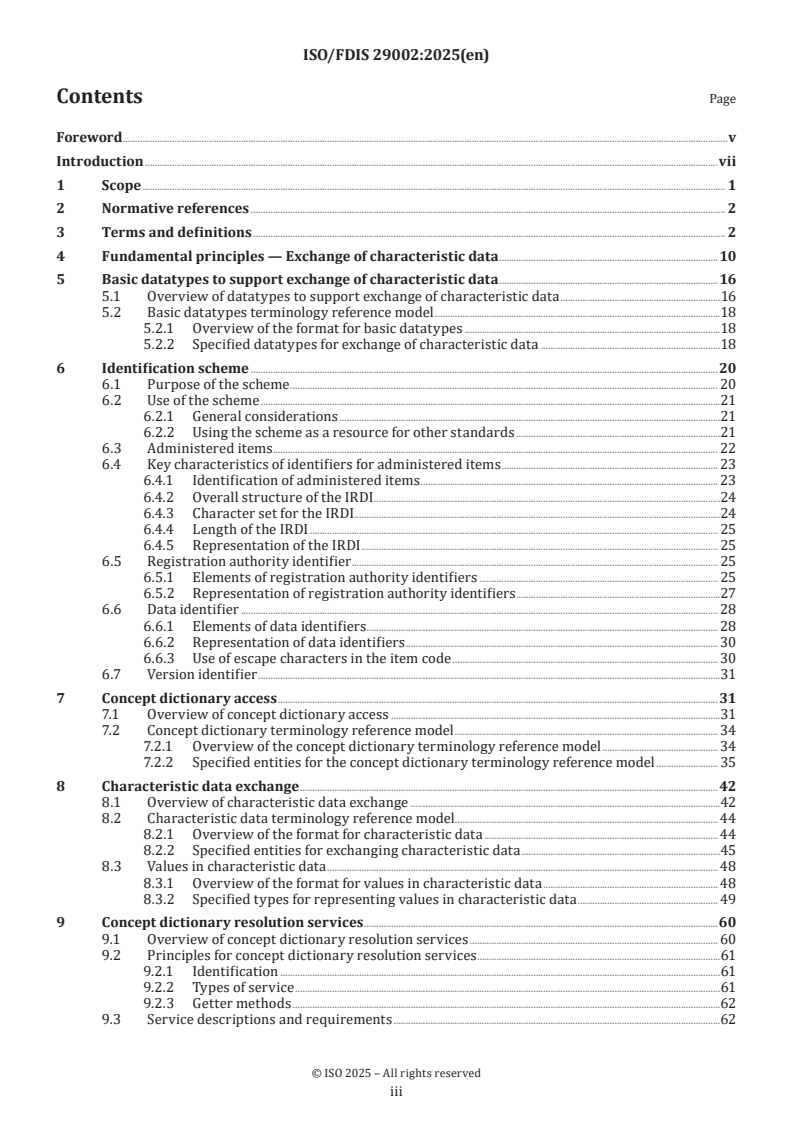
Contents Page
Foreword .v
Introduction .vii
1 Scope . 1
2 Normative references . 2
3 Terms and definitions . 2
4 Fundamental principles — Exchange of characteristic data .10
5 Basic datatypes to support exchange of characteristic data .16
5.1 Overview of datatypes to support exchange of characteristic data .16
5.2 Basic datatypes terminology reference model .18
5.2.1 Overview of the format for basic datatypes .18
5.2.2 Specified datatypes for exchange of characteristic data .18
6 Identification scheme .20
6.1 Purpose of the scheme . 20
6.2 Use of the scheme .21
6.2.1 General considerations .21
6.2.2 Using the scheme as a resource for other standards .21
6.3 Administered items . 22
6.4 Key characteristics of identifiers for administered items . 23
6.4.1 Identification of administered items . 23
6.4.2 Overall structure of the IRDI .24
6.4.3 Character set for the IRDI . . .24
6.4.4 Length of the IRDI . 25
6.4.5 Representation of the IRDI . 25
6.5 Registration authority identifier . 25
6.5.1 Elements of registration authority identifiers . 25
6.5.2 Representation of registration authority identifiers .27
6.6 Data identifier . 28
6.6.1 Elements of data identifiers. 28
6.6.2 Representation of data identifiers . 30
6.6.3 Use of escape characters in the item code . 30
6.7 Version identifier .31
7 Concept dictionary access .31
7.1 Overview of concept dictionary access .31
7.2 Concept dictionary terminology reference model . 34
7.2.1 Overview of the concept dictionary terminology reference model . 34
7.2.2 Specified entities for the concept dictionary terminology reference model . 35
8 Characteristic data exchange .42
8.1 Overview of characteristic data exchange .42
8.2 Characteristic data terminology reference model. 44
8.2.1 Overview of the format for characteristic data . 44
8.2.2 Specified entities for exchanging characteristic data .45
8.3 Values in characteristic data . 48
8.3.1 Overview of the format for values in characteristic data . 48
8.3.2 Specified types for representing values in characteristic data . 49
9 Concept dictionary resolution services .60
9.1 Overview of concept dictionary resolution services . 60
9.2 Principles for concept dictionary resolution services .61
9.2.1 Identification .61
9.2.2 Types of service .61
9.2.3 Getter methods .62
9.3 Service descriptions and requirements .62
iii
9.3.1 Location service .62
9.3.2 Terminology service . 63
9.3.3 Ontology service . 64
9.4 Data models for concept dictionary resolution services . 66
9.4.1 Overview of the data models for concept dictionary resolution services . 66
9.4.2 Core data model for concept dictionary resolution services .67
9.4.3 Location service data model . 69
9.4.4 Terminology service data model . 69
9.4.5 Ontology service data model . 73
9.5 Interface specifications .74
9.5.1 Overview of the interface specifications .74
9.5.2 Location service .74
9.5.3 Terminology service . 75
9.5.4 Ontology service . 83
9.6 Search patterns . 87
9.6.1 Search patterns general . 87
9.6.2 Search pattern for full text . 87
9.6.3 Search pattern wildcards . 88
10 Query for characteristic data .88
10.1 Overview of query for characteristic data . 88
10.2 Query for terminology reference model . 92
10.2.1 Overview of the format for query . . 92
10.2.2 Specified entities for query . 93
11 Conformance requirements .100
11.1 CC1: conformance requirement for basic datatypes . 100
11.2 CC2: conformance requirement for identification scheme. 100
11.3 CC3: conformance requirement for concept dictionary access . 100
11.4 CC4: conformance requirement for characteristic data exchange . 101
11.5 CC5: conformance requirement for concept dictionary resolution services . 101
11.6 CC6 and CC7: conformance requirements for query of characteristic data . 101
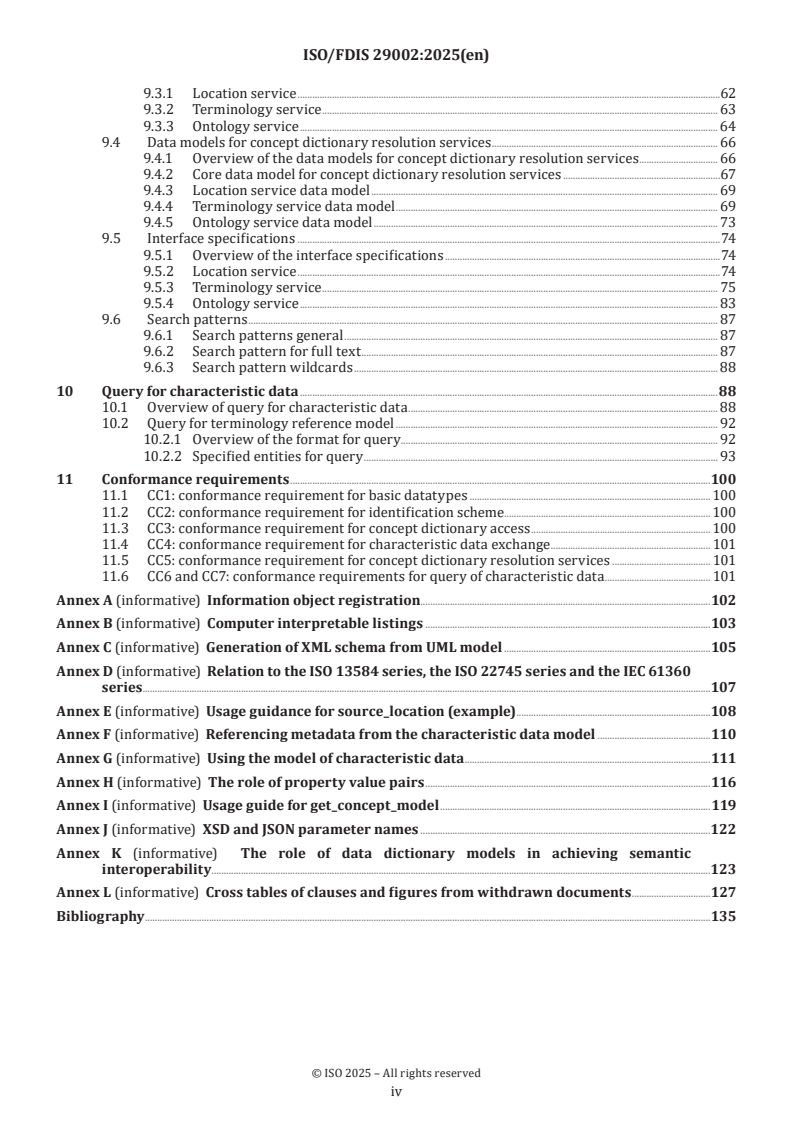
Annex A (informative) Information object registration.102
Annex B (informative) Computer interpretable listings .103
Annex C (informative) Generation of XML schema from UML model .105
Annex D (informative) Relation to the ISO 13584 series, the ISO 22745 series and the IEC 61360
series.107
Annex E (informative) Usage guidance for source_location (example) .108
Annex F (informative) Referencing metadata from the characteristic data model .110
Annex G (informative) Using the model of characteristic data .111
Annex H (informative) The role of property value pairs .116
Annex I (informative) Usage guide for get_concept_model .119
Annex J (informative) XSD and JSON parameter names .122
Annex K (informative) The role of data dictionary models in achieving semantic
interoperability . . .123
Annex L (informative) Cross tables of clauses and figures from withdrawn documents .127
Bibliography .135
iv
Foreword
ISO (the International Organization for Standardization) is a worldwide federation of national standards
bodies (ISO member bodies). The work of preparing International Standards is normally carried out through
ISO technical committees. Each member body interested in a subject for which a technical committee
has been established has the right to be represented on that committee. International organizations,
governmental and non-governmental, in liaison with ISO, also take part in the work. ISO collaborates closely
with the International Electrotechnical Commission (IEC) on all matters of electrotechnical standardization.
The procedures used to develop this document and those intended for its further maintenance are described
in the ISO/IEC Directives, Part 1. In particular, the different approval criteria needed for the different types
of ISO document should be noted. This document was drafted in accordance with the editorial rules of the
ISO/IEC Directives, Part 2 (see www.iso.org/directives).
ISO draws attention to the possibility that the implementation of this document may involve the use of (a)
patent(s). ISO takes no position concerning the evidence, validity or applicability of any claimed patent
rights in respect thereof. As of the date of publication of this document, ISO had not received notice of (a)
patent(s) which may be required to implement this document. However, implementers are cautioned that
this may not represent the latest information, which may be obtained from the patent database available at
www.iso.org/patents. ISO shall not be held responsible for identifying any or all such patent rights.
Any trade name used in this document is information given for the convenience of users and does not
constitute an endorsement.
For an explanation of the voluntary nature of standards, the meaning of ISO specific terms and expressions
related to conformity assessment, as well as information about ISO's adherence to the World Trade
Organization (WTO) principles in the Technical Barriers to Trade (TBT), see www.iso.org/iso/foreword.html.
This document was prepared by Technical Committee ISO/TC 184, Automation systems and integration,
Subcommittee SC 4, Industrial data.
This document cancels and replaces ISO/TS 29002-4:2009, ISO/TS 29002-5:2009, ISO/TS 29002-6:2010,
ISO/TS 29002-10:2009, ISO/TS 29002-20:2010 and ISO/TS 29002-31:2009, which have been technically
revised.
The main changes are as follows:
— the contents of ISO/TS 29002-4:2009 have been incorporated into Clause 5, Annex A, Annex B and
Annex C of this document. The conformance requirements are specified in Clause 11;
— the contents of ISO/TS 29002-5:2009 have been incorporated into Clause 6, Annex A, Annex B and
Annex D of this document. The conformance requirements are specified in Clause 11;
— the contents of ISO/TS 29002-6:2010 have been incorporated into Clause 7, Annex A, Annex B, Annex C
and Annex E of this document. The conformance requirements are specified in Clause 11;
— the contents of ISO/TS 29002-10:2009 have been incorporated into Clause 8, Annex A, Annex B, Annex F,
Annex G and Annex H of this document. The conformance requirements are specified in Clause 11;
— the contents of ISO/TS 29002-20:2010 have been incorporated into Clause 9, Annex A, Annex B and
Annex I of this document. The conformance requirements are specified in Clause 11;
— the contents of ISO/TS 29002-31:2009 have been incorporated into Clause 10, Annex A and Annex B of
this document. The conformance requirements are specified in Clause 11;
— provisions have been modified to allow the use of new technologies for the exchange of characteristic data;
— the operation of the location service has been clarified;
— an alternative process in the absence of any location service has been added;
— minor updates have been made to the identification scheme to allow for more flexible implementation;
v
— the notation style of the figures has been modified to ensure consistency and readability.
Any feedback or questions on this document should be directed to the user’s national standards body. A
complete listing of these bodies can be found at www.iso.org/members.html.
vi
Introduction
Characteristic data are a valuable asset across the industrial sector. These data describe the products and
services created, sold and used by organizations. Such data are most useful when organizations exchange
and share the data without loss of meaning. Being useful specifically involves improving decision making
regarding the described products and services.
Various international standards exist in the field of data that support exchange and sharing of characteristic
data. This support is provided by each standard specifying a capability to represent characteristic data. The
standards include the ISO 13399 series, the ISO 13584 series, the ISO 15926 series, the ISO 18101 series, the
[23] [30]
ISO 22745 series, the IEC 61360 series including the IEC Common Data Dictionary and the IEC 62656
[25]
series.
While each standard serves a distinct purpose within the wide range of use cases in the industrial sector,
the diversity also disrupts reuse of characteristic data across those use cases. Each standard does, however,
recognize a consistent theme: a concept dictionary provides the common ground on which organizations can
build coherent collections of characteristic data. Such dictionaries serve as a definitive, reusable external
reference describing the concepts that give meaning to characteristic data.
Some standards label a concept dictionary as a product ontology, but the core capabilities are the same.
The ontology service specified in this document can be used to retrieve representation forms including a
product ontology that conforms to ISO 13584-32 and an identification guide information that conforms to
ISO/TS 22745-30.
This document establishes the foundation for building interoperability between standards that specify a
capability to represent characteristic data. This foundation consists of elements including:
— conceptual information data models and exchange formats;
— a format for an identification scheme;
— an interface for retrieving information from a concept dictionary;
— capabilities for a location service, a terminology service and an ontology service;
— 20 schemas, in Extensible Markup Language (XML) and OpenAPI Specification (OAS) format (represented
in JavaScript Object Notation (JSON) (see Annex B for instructions on how to download electronic
versions of the schemas from the ISO website).
These elements can be used by organizations, either:
— as is, i.e. without any model-specific restrictions in combination with other standards including the
ISO 13584 series and the ISO 22745 series; or
— according to special adaptations that are defined by the respective standard to tailor the use of a format
or functionality to the specific requirements of that standard.
The data models, in particular, address the role of concepts in specifying the preferred common interpretation
of terminological items. This common interpretation establishes the items as being semantically equivalent.
These items are terms, abbreviations, definitions, graphical representations (images) and symbols. The
models enable organizations to combine items from different sources and to collate coherent collections
of characteristic data. These sources are typically ISO, IEC or other bodies that operate consensus-based
processes to perform terminology work.
In setting up a concept dictionary, organizations do not need to repeat the effort of developing the source
terminological items.
By establishing semantic equivalence, a concept dictionary can also function as a thesaurus. This function
can integrate communities who either use colloquial terms or different natural languages.
vii
The models also contain a concept equivalence relationship to support a further level of integration and data
retrieval. This relationship allows organizations to identify the equivalence of concepts that are represented
by pre-existing data records.
In this document, the model for a data dictionary and the format for an identification scheme each reflect
the respective requirement for such objects in the ISO 8000 series for data quality, as illustrated by the data
architecture in ISO 8000-1:2022, Figure 2.
By implementing this document, organizations will deliver the following benefits:
— even when they are familiar with a different term, users more readily identify the correct applicable
concept when they are creating new data records, reducing the risk of creating duplicate records;
— improvement in the quality of characteristic data;
— no loss of meaning when exchanging characteristic data;
— possibility for different parties to continue using different preferred terms locally for the same concept;
— interoperability between computer systems that perform processing of characteristic data;
— interoperability across all phases of the data and product life cycles.
NOTE See Annex K for information on the role of data dictionary models in achieving semantic interoperability.
viii
FINAL DRAFT International Standard ISO/FDIS 29002:2025(en)
Industrial automation systems and integration — Exchange of
characteristic data
1 Scope
This document provides a common resource that assists with the interoperability of characteristic data
between various industrial data standards, such as the ISO 13399 series, the ISO 13584 series, the ISO 15926
[23]
series, the ISO 18101 series, the ISO 22745 series, the IEC 61360 series including the IEC Common Data
[30] [25]
Dictionary and the IEC 62656 series .
This document specifies a set of resources that enable organizations to use concept dictionaries as the basis
for unambiguous exchange of characteristic data.
The following are within the scope of this document:
— fundamental principles for the exchange of characteristic data and for data dictionaries and ontologies;
— a conceptual model for basic entities and types;
— an exchange format for basic entities and types;
— data elements for identification of objects described by a concept dictionary, where those objects include
concepts and their associated concept information elements;
— syntax of an identifier of objects described by a concept dictionary;
— rules regarding compatibility of restricted schemas with this document;
— a conceptual model for dictionaries of concepts and their defining terminological data;
— an exchange format for terminological data that can be fetched via a concept dictionary resolution
service (CDRS);
— a conceptual model for characteristic data;
— an exchange format for characteristic data;
— a specification of a mechanism to resolve a unique concept identifier to its service provider;
— a specification of an identification scheme and identifier format for retrievable objects in a concept
dictionary;
— a specification of a mechanism to retrieve the terminological data associated with a concept and other objects
from the concept dictionary terminology reference model, given the identifier of the concept or object;
— a specification of a mechanism to search for concepts and other objects from the concept dictionary
terminology reference model, using a set of search patterns and parameters;
— a specification of a mechanism to retrieve the ontological description of a concept, given the identifier of
the concept;
[33] [34]
— Web Services Definition Language (WSDL) and Simple Object Access Protocol (SOAP) binding of
the specified services;
— a query for characteristic data of items that have a given supplier identification;
— a query for supplier identification of items that have a given set of characteristic data;
— a query for characteristic data and supplier identification of items that match a search expression;
— a query to supply missing characteristic data.
The formats in this document provide interoperability between implementations of the ISO 13584 series
and the ISO 22745 series. These formats also have more general applicability.
This document serves as a generic resource that can be restricted through implementation profiles by
standards that reference it. It can also be implemented without restriction.
The following is outside of the scope of this document:
— rules specific to the ISO 13584 series or the ISO 22745 series.
2 Normative references
The following documents are referred to in the text in such a way that some or all of their content constitutes
requirements of this document. For dated references, only the edition cited applies. For undated references,
the latest edition of the referenced document (including any amendments) applies.
ISO 4217, Codes for the representation of currencies
ISO/IEC 6523 (all parts), Information technology — Structure for the identification of organizations and
organization parts
3 Terms and definitions
For the purposes of this document, the following terms and definitions apply.
ISO and IEC maintain terminology databases for use in standardization at the following addresses:
— ISO Online browsing platform: available at https:// www .iso .org/ obp
— IEC Electropedia: available at https:// www .electropedia .org/
3.1
concept
unit of thought
EXAMPLE “automobile”, “colour”, “red” and “metre” are all concepts.
3.2
concept identifier
globally unique identifier of a concept (3.1)
Note 1 to entry: A concept dictionary (3.9) uses a concept identifier for each concept in the dictionary.
Note 2 to entry: Concept identifiers are the metadata that enable unambiguous exchange of characteristic data. This
document specifies the international registration data identifier (3.22) as the appropriate type of concept identifier to
achieve such exchange.
3.3
concept information element
object (3.12) for which data has been recorded as a contribution to the description of a concept (3.1)
EXAMPLE An image (3.5), a symbol, an abbreviation (3.6), a term (3.7), an identifier, a source document, the
location of a source document on the internet.
Note 1 to entry: Concepts and concept information elements are both recorded in a concept dictionary (3.9).
3.4
definition
representation of a concept (3.1) by an expression that describes it and differentiates it from related concepts
[SOURCE: ISO 1087:2019, 3.3.1]
3.5
image
representation of a concept (3.1), where the representation is primarily graphic
Note 1 to entry: An image can include text.
[SOURCE: ISO 22745-2:2010, 14.8]
3.6
abbreviation
designation that is formed by omitting parts from its full form and that represents the same concept (3.1)
Note 1 to entry: Abbreviations can be created by removing individual words, or can be acronyms, initialisms or clipped
terms (3.7).
3.7
term
verbal designation of a concept (3.1) in a specific domain and with a particular language
EXAMPLE “automobile”, “colour”, “red” and “metre” are all terms that designate concepts.
3.8
concept dictionary entry
description of a concept (3.1) containing, at a minimum, a concept identifier (3.2), a term (3.7) and a definition (3.4)
Note 1 to entry: The description can consist of just a term and definition, but it can also contain other concept
information elements (3.3).
3.9
concept dictionary
collection of concept dictionary entries (3.8) where the dictionary enables lookup by concept identifier (3.2)
3.10
administered item
item for which a concept dictionary (3.9) can contain data and can also record administrative information
Note 1 to entry: Administered items include concepts (3.1) and concept information elements (3.3).
3.11
concept equivalence
semantic equivalence
relation between designations in different natural languages representing the same concept (3.1)
Note 1 to entry: In terminological systems, two concepts are (semantically) equivalent if their domain of meaning
overlaps and their semantic definitions (3.4) are interpreted as identical.
Note 2 to entry: In the context of terminological resources, "equivalence" and "semantic equivalence" are often
considered as synonyms.
3.12
object
anything perceivable or conceivable
EXAMPLE The radial flow centrifugal pump with serial number AX52386 is an object. Its general structure is
defined by the radial flow centrifugal pump class (3.13).
Note 1 to entry: Objects can be material (e.g. “engine”, “sheet of paper”, “diamond”), immaterial (e.g. “conversion ratio”,
“project plan”) or imagined (e.g. “unicorn”, “scientific hypothesis”).
[SOURCE: ISO 1087:2019, 3.1.1, modified — Example has been added.]
3.13
class
abstraction of a set of similar objects (3.12)
3.14
property
quality or feature of an object (3.12)
[SOURCE: ISO 22745-2:2010, 2.2]
3.15
property value pair
instance of a specific value together with an identifier for a concept dictionary entry (3.8) that defines a
property (3.14)
Note 1 to entry: See Annex H for further information.
3.16
product ontology
model of product knowledge, made by a formal and consensual representation of the concepts (3.1) of a
product domain in terms of characterization classes (3.13), class relations and properties (3.14)
[30]
EXAMPLE 1 The IEC Common Data Dictionary, is a reference dictionary for electric components and, thus, is a
product ontology for electric components. This ontology conforms to the common dictionary model specified by the
[23]
ISO 13584 series and the IEC 61360 series.
EXAMPLE 2 A corporate reference dictionary is agreed upon by experts designated by management on behalf of
the organization.
Note 1 to entry: Product ontologies are based on a class-instance model that makes it possible to recognize and
to designate the sets of products, called characterization classes, that have a similar function (e.g. ball bearing,
capacitor), but also to discriminate within a class the various subsets of products, called instances, that are considered
as identical. ISO/IEC Guide 77-2 recommends using the rules defined in ISO 1087-1 when formulating designation and
definitions (3.4) of characterization classes. Instances have no definitions. They are designated by the class to which
they belong and a set of property value pairs (3.15).
Note 2 to entry: Ontologies are not concerned with words, but with concepts, independent of any particular language.
Note 3 to entry: Consensual means that the conceptualization is agreed upon in some community.
Note 4 to entry: The ISO/IEC 77 series recommends the ontology is formal by being machine interpretable, ensuring
some level of machine reasoning be possible over the ontology, e.g. consistency checking.
Note 5 to entry: Identified means that each ontology characterization class and property is associated with a globally
unique identifier, making it possible to reference this concept from any context.
Note 6 to entry: For a data model for ontology, the ISO/IEC 77 series recommends using the common dictionary model
specified by the ISO 13584 and IEC 61360 series. This dictionary mode is specified by ISO 13584-42 and IEC 61360-2.
Note 7 to entry: The ISO/IEC 77 series uses the term “reference dictionary for the domain” to indicate a product
ontology addressing a particular product domain and conforming to the common dictionary model specified by the
ISO 13584 and IEC 61360 series.
Note 8 to entry: ISO/IEC 19763-3:2020 defines an ontology as a “specification of concrete or abstract things, and
the relationships among them, in a prescribed domain of knowledge” and notes that it is recommended for these
specifications to be computer processable.
Note 9 to entry: ISO 13584-32:2010 specifies an XML schema for representing data according to the ISO 13584 series
data model. This enables the exchange of both ontologies conformant with the common ISO 13584 series/
IEC 61360 series model. Such an exchange context is called an "OntoML library".
Note 10 to entry: ISO/TS 29002-5 and ISO/TS 29002-10 are both listed as normative references in ISO 13584-32. The
content of ISO/TS 29002-5 is updated as Clause 6 of this document, and the content of ISO/TS 29002-10 is updated as
Clause 8 of this document.
[SOURCE: ISO/IEC Guide 77-2:2008, 2.17, modified — Examples and Notes 1 to 7 to entry have been refined.
Notes 8 to 10 to entry have been added.]
3.17
characteristic
unit of thought that corresponds to properties (3.14) that are common to a set of objects (3.12)
[SOURCE: ISO 22745-2:2010, 9.1]
3.18
characteristic data
description of an entity by the class (3.13) to which it belongs and a set of property (3.14) values
EXAMPLE 1 The item “Socket Head Hex Cap Screw — ISO 4762 Stainless Steel 316, M12 × 20 appears in a
manufacturer's catalogue. It can be described as:
— class: socket head hexagon cap screw;
— property values: [standard, ISO 4762]; [material specification, 316 Stainless Steel (Molybdenum content
2–3 % and nickel content 10–14 %)]; [diameter, 12,00 mm]; [thread pitch, 1,75 mm]; [length, 20,00 mm].
EXAMPLE 2 In actual characteristic data, the first element of each bracketed pair would be an identifier for a data
dictionary entry. In this example, the elements are shown decoded for clarity.
Note 1 to entry: The ISO 13584 series, the ISO 15926 series, the ISO 22745 series, the ISO 13399 series and this
document all specify the representation of characteristic data in their data models.
3.19
formal syntax
specification of the valid sentences of a formal language using a formal grammar
EXAMPLE 1 An Extensible Markup Language (XML) document type definition (DTD) is a formal syntax.
EXAMPLE 2 ISO 10303-21 contains a formal syntax in Wirth Syntax Notation (WSN) for ISO 10303 series physical files.
Note 1 to entry: A formal language is computer-interpretable.
Note 2 to entry: Formal grammars are usually Chomsky context-free grammars.
Note 3 to entry: Variants of Backus-Naur Form (BNF) such as Augmented Backus-Naur Form (ABNF) and Wirth Syntax
Notation (WSN) are often used to specify the syntax of computer programming languages and data languages.
[SOURCE: ISO 8000-2:2022, 3.9.1]
3.20
data specification
identification guide
IG
part ontology
rules for describing items belonging to a particular class (3.13) using entries from a concept dictionary (3.9)
and reference to a specific formal syntax (3.19)
Note 1 to entry: Identification guide (IG) is defined as a “data specification that is in the syntax specified in
ISO/TS 22745-30 and that uses concept identifiers (3.2) from an open technical dictionary”.
Note 2 to entry: An identification guide is sometime referred to as a “template of properties and rules”.
Note 3 to entry: Product ontology (3.16), part ontology and ontology are grouped as synonyms in ISO 13584-32:2010, 3.17.
EXAMPLE 1 An ISO/TS 22745-30 compliant identification guide is a data specification.
EXAMPLE 2 ISO 13584-501 defines a data specification.
[SOURCE: ISO 22745-2:2010, B.2.18, modified — Notes 1 to 3 to entry and admitted terms have been added.]
3.21
item of supply
class (3.13) of substitutable goods or services that fulfil a fit, form or function defined by a buyer
[SOURCE: ISO 22745-2:2010, 22.1]
3.22
international registration data identifier
IRDI
internationally unique identifier for an identified item in a concept dictionary (3.9)
3.23
registration authority
organization responsible for a concept dictionary (3.9)
3.24
registration authority identifier
identifier assigned to a registration authority (3.23)
3.25
issuing organization
IO
body that assumes responsibility for the administration of a specific organization identification scheme
[SOURCE: ISO/IEC 6523-2:2025, 3.1]
3.26
International Code Designator
ICD
data element used to uniquely identify an organization identification scheme
[SOURCE: ISO/IEC 6523-1:2023, 3.8]
3.27
organization identifier
identifier assigned to an organization within an organization identification scheme, and unique within
that scheme
[SOURCE: ISO/IEC 6523-1:2023, 3.10]
3.28
organization part identifier
OPI
identifier allocated to a particular organization part
[SOURCE: ISO/IEC 6523-1:2023, 3.11]
3.29
organization part identifier source
OPIS
data element used to specify the source for the organization part identifier (3.28)
[SOURCE: ISO/IEC 6523-1:2023, 3.12, modified — "indicator" has been removed from the end of the
preferred term.]
3.30
additional information
AI
data element used to distinguish between multiple dictionaries produce
...
Formatted
...
Style Definition
...
Style Definition
...
Style Definition
...
Style Definition
...
Style Definition
...
ISO/TC 184/SC 4/WG 13 Style Definition
...
Style Definition
...
Secretariat: ANSI
Style Definition
...
Date: 2025-0411-17
Style Definition
...
Style Definition
...
Style Definition
...
Style Definition
...
Style Definition
...
Style Definition
...
Industrial automation systems and integration — Exchange of
Style Definition
...
characteristic data
Style Definition
...
Style Definition
...
Style Definition
...
Style Definition
...
Style Definition
...
Style Definition
...
Style Definition
...
Style Definition
...
FDIS stage
Style Definition
...
Style Definition
...
Style Definition
...
Style Definition
...
Style Definition
...
Style Definition
...
Style Definition
...
Style Definition
...
Style Definition
...
Style Definition
...
Style Definition
...
Style Definition
...
Style Definition
...
Style Definition
...
Style Definition
...
Style Definition
...
Style Definition
...
Style Definition
...
Style Definition
...
Style Definition
...
Style Definition
...
Style Definition
...
Style Definition
...
Style Definition
...
Style Definition
...
Style Definition
...
Style Definition
...
Style Definition
...
Style Definition
...
Style Definition
...
Style Definition
...
Style Definition
...
Style Definition
...
St l D fi iti
ISO #####-#:####(X/FDIS 29002:2025(en) Formatted: Font: 11 pt, Bold
Formatted: Font: 11 pt, Bold
Formatted: HeaderCentered, Left, Space After: 0 pt,
Line spacing: single
Formatted: Default Paragraph Font
All rights reserved. Unless otherwise specified, or required in the context of its implementation, no part of this publication
may be reproduced or utilized otherwise in any form or by any means, electronic or mechanical, including photocopying, Formatted: Default Paragraph Font
or posting on the internet or an intranet, without prior written permission. Permission can be requested from either ISO
Formatted: No page break before, Adjust space
at the address below or ISO’s member body in the country of the requester.
between Latin and Asian text, Adjust space between
Asian text and numbers
ISO copyright office
Formatted: Adjust space between Latin and Asian text,
CP 401 • Ch. de Blandonnet 8
Adjust space between Asian text and numbers
CH-1214 Vernier, Geneva
Phone: + 41 22 749 01 11
Formatted: French (France)
EmailE-mail: copyright@iso.org
Formatted: French (France)
Website: www.iso.orgwww.iso.org
Formatted: French (France)
Published in Switzerland
Formatted: English (United Kingdom)
Formatted: English (United Kingdom)
Formatted: Font: 10 pt
Formatted: Font: 10 pt
Formatted: Font: 11 pt
Formatted: FooterPageRomanNumber, Space After: 0
pt, Line spacing: single
ii © ISO #### 2025 – All rights reserved
ii
Formatted: Font: 11 pt, Bold
Formatted: Font: Bold
Formatted: HeaderCentered, Left
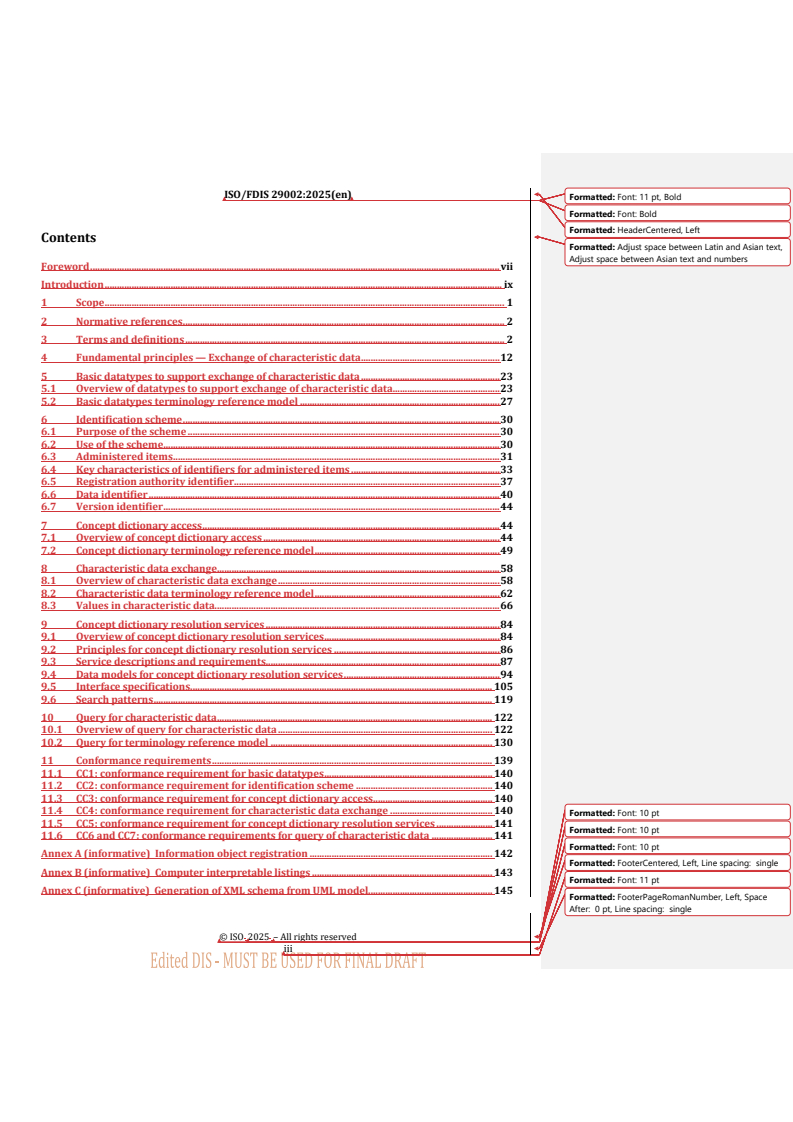
Contents
Formatted: Adjust space between Latin and Asian text,
Adjust space between Asian text and numbers
Foreword . vii
Introduction . ix
1 Scope . 1
2 Normative references . 2
3 Terms and definitions . 2
4 Fundamental principles — Exchange of characteristic data . 12
5 Basic datatypes to support exchange of characteristic data . 23
5.1 Overview of datatypes to support exchange of characteristic data. 23
5.2 Basic datatypes terminology reference model . 27
6 Identification scheme . 30
6.1 Purpose of the scheme . 30
6.2 Use of the scheme . 30
6.3 Administered items . 31
6.4 Key characteristics of identifiers for administered items . 33
6.5 Registration authority identifier . 37
6.6 Data identifier . 40
6.7 Version identifier . 44
7 Concept dictionary access . 44
7.1 Overview of concept dictionary access . 44
7.2 Concept dictionary terminology reference model . 49
8 Characteristic data exchange . 58
8.1 Overview of characteristic data exchange . 58
8.2 Characteristic data terminology reference model . 62
8.3 Values in characteristic data. 66
9 Concept dictionary resolution services . 84
9.1 Overview of concept dictionary resolution services . 84
9.2 Principles for concept dictionary resolution services . 86
9.3 Service descriptions and requirements. 87
9.4 Data models for concept dictionary resolution services . 94
9.5 Interface specifications. 105
9.6 Search patterns . 119
10 Query for characteristic data . 122
10.1 Overview of query for characteristic data . 122
10.2 Query for terminology reference model . 130
11 Conformance requirements . 139
11.1 CC1: conformance requirement for basic datatypes . 140
11.2 CC2: conformance requirement for identification scheme . 140
11.3 CC3: conformance requirement for concept dictionary access . 140
11.4 CC4: conformance requirement for characteristic data exchange . 140
Formatted: Font: 10 pt
11.5 CC5: conformance requirement for concept dictionary resolution services . 141
Formatted: Font: 10 pt
11.6 CC6 and CC7: conformance requirements for query of characteristic data . 141
Formatted: Font: 10 pt
Annex A (informative) Information object registration . 142
Formatted: FooterCentered, Left, Line spacing: single
Annex B (informative) Computer interpretable listings . 143
Formatted: Font: 11 pt
Annex C (informative) Generation of XML schema from UML model. 145
Formatted: FooterPageRomanNumber, Left, Space
After: 0 pt, Line spacing: single
© ISO 2025 – All rights reserved
iii
ISO #####-#:####(X/FDIS 29002:2025(en) Formatted: Font: 11 pt, Bold
Formatted: Font: 11 pt, Bold
Formatted: HeaderCentered, Left, Space After: 0 pt,
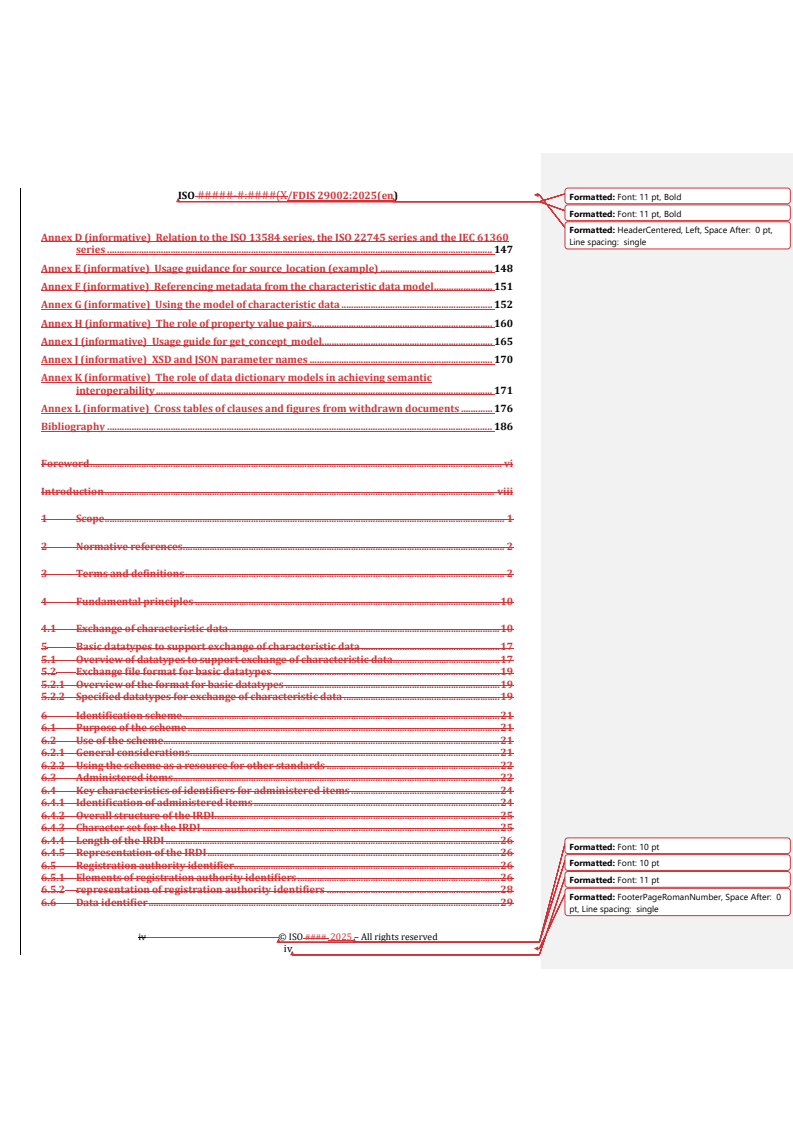
Annex D (informative) Relation to the ISO 13584 series, the ISO 22745 series and the IEC 61360
Line spacing: single
series . 147
Annex E (informative) Usage guidance for source_location (example) . 148
Annex F (informative) Referencing metadata from the characteristic data model . 151
Annex G (informative) Using the model of characteristic data . 152
Annex H (informative) The role of property value pairs . 160
Annex I (informative) Usage guide for get_concept_model. 165
Annex J (informative) XSD and JSON parameter names . 170
Annex K (informative) The role of data dictionary models in achieving semantic
interoperability . 171
Annex L (informative) Cross tables of clauses and figures from withdrawn documents . 176
Bibliography . 186
Foreword . vi
Introduction . viii
1 Scope . 1
2 Normative references . 2
3 Terms and definitions . 2
4 Fundamental principles . 10
4.1 Exchange of characteristic data . 10
5 Basic datatypes to support exchange of characteristic data . 17
5.1 Overview of datatypes to support exchange of characteristic data. 17
5.2 Exchange file format for basic datatypes . 19
5.2.1 Overview of the format for basic datatypes . 19
5.2.2 Specified datatypes for exchange of characteristic data . 19
6 Identification scheme . 21
6.1 Purpose of the scheme . 21
6.2 Use of the scheme . 21
6.2.1 General considerations . 21
6.2.2 Using the scheme as a resource for other standards . 22
6.3 Administered items . 22
6.4 Key characteristics of identifiers for administered items . 24
6.4.1 Identification of administered items . 24
6.4.2 Overall structure of the IRDI . 25
6.4.3 Character set for the IRDI . 25
6.4.4 Length of the IRDI . 26
Formatted: Font: 10 pt
6.4.5 Representation of the IRDI . 26
Formatted: Font: 10 pt
6.5 Registration authority identifier . 26
6.5.1 Elements of registration authority identifiers . 26
Formatted: Font: 11 pt
6.5.2 representation of registration authority identifiers . 28
Formatted: FooterPageRomanNumber, Space After: 0
6.6 Data identifier . 29
pt, Line spacing: single
iv © ISO #### 2025 – All rights reserved
iv
Formatted: Font: 11 pt, Bold
Formatted: Font: Bold
Formatted: HeaderCentered, Left
6.6.1 Elements of data identifiers . 29
6.6.2 Representation of data identifiers. 32
6.7 Version identifier . 32
7 Concept dictionary access . 33
7.1 Overview of concept dictionary access . 33
7.2 Concept dictionary terminology reference model . 35
7.2.1 Overview of the concept dictionary terminology reference model . 35
7.2.2 Specified entities for the concept dictionary terminology reference model . 36
8 Characteristic data exchange . 42
8.1 Overview of characteristic data exchange . 42
8.2 Exchange file format for characteristic data . 45
8.2.1 Overview of the format for characteristic data . 45
8.2.2 Specified entities for exchanging characteristic data . 45
8.3 Values in characteristic data. 48
8.3.1 Overview of the format for values in characteristic data . 48
8.3.2 Specified types for representing values in characteristic data . 48
9 Concept dictionary resolution services . 59
9.1 Overview of concept dictionary resolution services . 59
9.2 Principles for concept dictionary resolution services . 60
9.2.1 Identification . 60
9.2.2 Types of service . 60
9.2.3 Getter methods . 61
9.3 Service descriptions and requirements. 61
9.3.1 Location service . 61
9.3.2 Terminology service . 62
9.3.3 Ontology service . 64
9.4 Data models for concept dictionary resolution services . 66
9.4.1 Overview of the data models for concept dictionary resolution services . 66
9.4.2 Core data model for concept dictionary resolution services . 66
9.4.3 Location service data model . 68
9.4.4 Terminology service data model . 68
9.4.5 Ontology service data model . 72
9.5 Interface specifications. 72
9.5.1 Overview of the interface specifications . 72
9.5.2 Location service . 72
9.5.3 Terminology service . 73
9.5.4 Ontology service . 81
9.6 Search patterns . 84
9.6.1 Search patterns general. 84
9.6.2 Search pattern for full text . 85
9.6.3 Search pattern wildcards . 86
10 Query for characteristic data . 86
10.1 Overview of query for characteristic data . 86
10.2 Exchange file format for query . 90
10.2.1 Overview of the format for query . 90
Formatted: Font: 10 pt
10.2.2 Specified entities for query . 90
Formatted: Font: 10 pt
11 Conformance requirements . 97
Formatted: Font: 10 pt
11.1 CC1: conformance requirement for basic datatypes . 98
Formatted: FooterCentered, Left, Line spacing: single
11.2 CC2: conformance requirement for identification scheme . 98
11.3 CC3: conformance requirement for concept dictionary access . 98 Formatted: Font: 11 pt
11.4 CC4: conformance requirement for characteristic data exchange . 98
Formatted: FooterPageRomanNumber, Left, Space
11.5 CC5: conformance requirement for concept dictionary resolution services . 98
After: 0 pt, Line spacing: single
© ISO 2025 – All rights reserved
v
ISO #####-#:####(X/FDIS 29002:2025(en) Formatted: Font: 11 pt, Bold
Formatted: Font: 11 pt, Bold
Formatted: HeaderCentered, Left, Space After: 0 pt,
11.6 CC6 and CC7: conformance requirements for query of characteristic data . 98
Line spacing: single
Annex A (informative) Information object registration . 100
A.1 Document identification . 100
A.2 Document identification . 100
A.3 Schema identification . 100
Annex B (informative) Computer interpretable listings . 101
Annex C (informative) Generation of XML schema from UML model. 103
Annex D (informative) Relation to the ISO 13584, ISO 22745 and IEC 61360 series . 105
Annex E (informative) Usage guidance for source_location . 106
Annex F (informative) Referencing metadata from the characteristic data model . 108
Annex G (informative) Using the model of characteristic data . 109
G.1 Composite field . 109
G.2 Subitem property path . 110
G.3 Combination and one_of . 111
Annex H (informative) The role of property value pairs . 114
H.1 Property value pairs . 114
H.2 Use with other standards . 115
Annex I (informative) Usage guide for get_concept_model. 117
I.1 Overview of the example ontology . 117
I.2 Case 1 . 118
I.3 Case 2 . 118
I.4 Case 3 . 119
I.5 Case 4 . 119
Annex J (informative) XSD and JSON parameter names . 121
Annex K (informative) The role of data dictionary models in achieving semantic
interoperability . 122
Annex L (informative) Cross tables of clauses and figures from withdrawn documents . 127
Bibliography . 137
Formatted: Font: 10 pt
Formatted: Font: 10 pt
Formatted: Font: 11 pt
Formatted: FooterPageRomanNumber, Space After: 0
pt, Line spacing: single
vi © ISO #### 2025 – All rights reserved
vi
Formatted
...
Formatted: HeaderCentered, Left
Foreword Formatted: Adjust space between Latin and Asian text,
Adjust space between Asian text and numbers
ISO (the International Organization for Standardization) is a worldwide federation of national standards
bodies (ISO member bodies). The work of preparing International Standards is normally carried out through
ISO technical committees. Each member body interested in a subject for which a technical committee has been
established has the right to be represented on that committee. International organizations, governmental and
non-governmental, in liaison with ISO, also take part in the work. ISO collaborates closely with the
International Electrotechnical Commission (IEC) on all matters of electrotechnical standardization.
The procedures used to develop this document and those intended for its further maintenance are described
in the ISO/IEC Directives, Part 1. In particular, the different approval criteria needed for the different types of
ISO documentsdocument should be noted. This document was drafted in accordance with the editorial rules
of the ISO/IEC Directives, Part 2 (see www.iso.org/directives 2 (see www.iso.org/directives).
ISO draws attention to the possibility that the implementation of this document may involve the use of (a)
patent(s). ISO takes no position concerning the evidence, validity or applicability of any claimed patent rights
in respect thereof. As of the date of publication of this document, ISO had not received notice of (a) patent(s)
which may be required to implement this document. However, implementers are cautioned that this may not
represent the latest information, which may be obtained from the patent database available at
www.iso.org/patents.www.iso.org/patents. ISO shall not be held responsible for identifying any or all such
patent rights.
Any trade name used in this document is information given for the convenience of users and does not
constitute an endorsement.
For an explanation of the voluntary nature of standards, the meaning of ISO specific terms and expressions
related to conformity assessment, as well as information about ISO's adherence to the World Trade
Organization (WTO) principles in the Technical Barriers to Trade (TBT), see
www.iso.org/iso/foreword.htmlwww.iso.org/iso/foreword.html.
This document was prepared by Technical Committee ISO/TC 184, Automation systems and integration,
Subcommittee SC 4, Industrial data.
This document cancels and replaces ISO/TS 29002--4:2009, ISO/TS 29002--5:2009, ISO/TS 29002--6:2010,
Formatted
...
ISO/TS 29002--10:2009, ISO/TS 29002--20:2010 and ISO/TS 29002--31:2009, which have been technically
revised.
The main changes are as follows:
Formatted
...
— — the contents of ISO/TS 29002--4:2009 Industrial automation systems and integration — Exchange of
Formatted: Adjust space between Latin and Asian text,
characteristic data: — Basic entities and types, werehave been incorporated into Clause 5, Annex A,
Adjust space between Asian text and numbers, Tab
Annex B and Annex C of this document. The conformance requirements are specified in clauseClause 11;
stops: Not at 0.7 cm + 1.4 cm + 2.1 cm + 2.8 cm +
3.5 cm + 4.2 cm + 4.9 cm + 5.6 cm + 6.3 cm + 7 cm
— — the contents of ISO/TS 29002--5:2009 Industrial automation systems and integration — Exchange of
Formatted
characteristic data: — Identification scheme, werehave been incorporated into Clause 6, Annex A, Annex B
...
and Annex D of this document. The conformance requirements are specified in clauseClause 11;
Formatted
...
Formatted
...
— — the contents of ISO/TS 29002--6:2010 Industrial automation systems and integration — Exchange of
characteristic data: — Concept dictionary terminology reference model, werehave been incorporated into Formatted: Font: 10 pt
Clause 7, Annex A, Annex B, Annex C and Annex E of this document. The conformance requirements are
Formatted
...
specified in clauseClause 11;
Formatted: FooterCentered, Left, Line spacing: single
— — the contents of ISO/TS 29002--10:2009 Industrial automation systems and integration — Exchange of
Formatted: Font: 11 pt
characteristic data: — Characteristic data exchange format, werehave been incorporated into Clause 8,
Formatted: FooterPageRomanNumber, Left, Space
After: 0 pt, Line spacing: single
© ISO 2025 – All rights reserved
vii
ISO #####-#:####(X/FDIS 29002:2025(en) Formatted: Font: 11 pt, Bold
Formatted: Font: 11 pt, Bold
Formatted: HeaderCentered, Left, Space After: 0 pt,
Annex A, Annex B, Annex F, Annex G and Annex H of this document. The conformance requirements are
Line spacing: single
specified in clauseClause 11;
Formatted: Default Paragraph Font
— — the contents of ISO/TS 29002--20:2010 Industrial automation systems and integration — Exchange of
Formatted: Default Paragraph Font
characteristic data: — Concept dictionary resolution services, werehave been incorporated into Clause 9,
Formatted: Default Paragraph Font
Annex A, Annex B and Annex I of this document. The conformance requirements are specified in
Formatted: Default Paragraph Font
clauseClause 11;
Formatted: Default Paragraph Font
— — the contents of ISO/TS 29002--31:2009 Industrial automation systems and integration — Exchange of
Formatted: Default Paragraph Font
characteristic data: — Query for characteristic data, werehave been incorporated into Clause 10, Annex A
Formatted: Default Paragraph Font
and Annex B of this document. The conformance requirements are specified in clauseClause 11;
Formatted: Default Paragraph Font
— — change in provisions have been modified to allow the use of new technologies for the exchange of
Formatted: Default Paragraph Font
characteristic data;
Formatted: Default Paragraph Font
— — clarification regarding the operation of the location service has been clarified;
Formatted: Default Paragraph Font
Formatted: Default Paragraph Font
— — an alternative process in the absence of any location service has been added;
Formatted: Default Paragraph Font
— — minor updateupdates have been made to the identification scheme to allow for more flexible
Formatted: Default Paragraph Font
implementation;
Formatted: Default Paragraph Font
— — change inthe notation style of the figures has been modified to ensure consistency and readability.
Formatted: Default Paragraph Font
Formatted: Default Paragraph Font
Any feedback or questions on this document should be directed to the user’s national standards body. A
complete listing of these bodies can be found at www.iso.org/members.htmlwww.iso.org/members.html.
Formatted: Default Paragraph Font
Formatted: Default Paragraph Font
Formatted: Default Paragraph Font
Formatted: Default Paragraph Font
Formatted: Default Paragraph Font
Formatted: Default Paragraph Font
Formatted: Default Paragraph Font
Formatted: Default Paragraph Font
Formatted: Adjust space between Latin and Asian text,
Adjust space between Asian text and numbers
Formatted: Font: 10 pt
Formatted: Font: 10 pt
Formatted: Font: 11 pt
Formatted: FooterPageRomanNumber, Space After: 0
pt, Line spacing: single
viii © ISO #### 2025 – All rights reserved
viii
Formatted
...
Formatted
...
Formatted
...
Formatted
...
Formatted
...
Introduction
Formatted
...
Formatted
Characteristic data are a valuable asset across the industrial sector. These data describe the products and .
services created, sold and used by organizations. Such data are most useful when organizations exchange and
Formatted
...
share the data without loss of meaning. Being useful specifically involves improving decision making
Formatted
...
aboutregarding the described products and services.
Formatted
...
The portfolio of Various international standards includes various exist in the field of data standards that
Formatted
...
support exchange and sharing of characteristic data. This support is provided by each standard specifying a
Formatted
...
capability to represent characteristic data. The standards include the ISO 13399 series, the ISO 13584 series,
[23][ ]
the ISO 15926 series, the ISO 18101 series, the ISO 22745 series, the IEC 61360 series 23 including the IEC Formatted
...
[30][ ] [25] [ ]
Common Data Dictionary 30 and the IEC 62656 series . 25
Formatted
...
Formatted
While each standard serves a distinct purpose within the wide range of use cases in the industrial sector, the .
diversity also disrupts reuse of characteristic data across those use cases. Each standard does, however,
Formatted
...
recognize a consistent theme: a concept dictionary provides the common ground on which organizations can
Formatted
...
build coherent collections of characteristic data. Such dictionaries serve as a definitive, reusable external
Formatted
reference describing the concepts that give meaning to characteristic data. .
Formatted
...
Some standards label a concept dictionary as a product ontology, but the core capabilities are the same.
Formatted
...
The ontology service specified in this document can be used to retrieve representation forms including a Formatted
...
product ontology that conforms to ISO 13584-32 and an identification guide information that conforms to
Formatted
...
ISO/TS 22745-30.
Formatted
...
This document establishes the foundation for building interoperability between standards that specify a
Formatted
...
capability to represent characteristic data. This foundation consists of elements including:
Formatted
...
Formatted
— — conceptual information data models and exchange formats;
...
Formatted
...
— — a format for an identification scheme;
Formatted
...
— — an interface for retrieving information from a concept dictionary; Formatted
...
Formatted
...
— — capabilities for a location service, a terminology service and an ontology service;
Formatted
...
— — twenty20 schemas, in Extensible Markup Language (XML) and OpenAPI Specification (OAS) format
Formatted
...
(represented in JavaScript Object Notation (JSON) (see Annex BAnnex B for instructions on how to
Formatted
...
download electronic versions of the schemas from the ISO website).
Formatted
...
These elements can be used by organizations, either:
Formatted
...
Formatted
...
— — as is, that isi.e. without any model-specific restrictions in combination with other standards including
the ISO 13584 series and the ISO 22745 series; or
Formatted
...
Formatted
...
— — according to special adaptations that are defined by the respective standard to tailor the use of a
Formatted
format or functionality to the specific requirements of that standard. .
Formatted
...
The data models, in particular, address the role of concepts in specifying the preferred common interpretation
Formatted
...
of terminological items. This common interpretation establishes the items as being semantically equivalent.
These items are terms, abbreviations, definitions, graphical representations (images) and symbols. The Formatted
...
models enable organizations to combine items from different sources and to collate coherent collections of
Formatted
...
characteristic data. These sources are typically ISO, IEC or other bodies that operate consensus-based
Formatted
...
processes to perform terminology work.
Formatted
...
Formatted
...
© ISO 2025 – All rights reserved
Formatted
...
ix
ISO #####-#:####(X/FDIS 29002:2025(en) Formatted: Font: 11 pt, Bold
Formatted: Font: 11 pt, Bold
Formatted: HeaderCentered, Left, Space After: 0 pt,
In setting up a concept dictionary, organizations do not need to repeat the effort of developing the source
Line spacing: single
terminological items.
By establishing semantic equivalence, a concept dictionary can also function as a thesaurus. This function can
integrate communities who either use colloquial terms or different natural languages.
The models also contain a concept equivalence relationship to support a further level of integration and data
retrieval. This relationship allows organizations to identify the equivalence of concepts that are represented
by pre-existing data records.
In this document, the model for a data dictionary and the format for an identification scheme each reflect the
respective requirement for such objects in the ISO 8000 series for data quality, as illustrated by the data
Formatted: Default Paragraph Font
architecture in ISO 8000-1:2022, Figure 2.
Formatted: Default Paragraph Font
Formatted: Default Paragraph Font
By implementing this document, organizations will deliver the following benefits:
Formatted: Default Paragraph Font
— — even when they are familiar with a different term, users more readily identify the correct applicable
Formatted: Default Paragraph Font
concept when they are creating new data records, reducing the risk of creating duplicate records;
Formatted: Default Paragraph Font
— — improvingimprovement in the quality of characteristic data;
Formatted: Default Paragraph Font
Formatted: Default Paragraph Font
— — no loss of meaning when exchanging characteristic data;
Formatted: Adjust space between Latin and Asian text,
— — possibility for different parties being able to continue using different preferred terms locally for the
Adjust space between Asian text and numbers, Tab
same concept;
stops: Not at 0.7 cm + 1.4 cm + 2.1 cm + 2.8 cm +
3.5 cm + 4.2 cm + 4.9 cm + 5.6 cm + 6.3 cm + 7 cm
— — interoperability between computer systems that perform processing of characteristic data;
— — interoperability across all phases of the data and product life cycles.
NOTE See Annex K for information on the role of data dictionary models in achieving semantic interoperability.
Formatted: Font: 10 pt
Formatted: Font: 10 pt
Formatted: Font: 11 pt
Formatted: FooterPageRomanNumber, Space After: 0
pt, Line spacing: single
x © ISO #### 2025 – All rights reserved
x
DRAFT International Standard ISO/FDIS 29002:2025(en)
Formatted: Left
Formatted: Main Title 1, Adjust space between Latin
Industrial automation systems and integration — Exchange of
and Asian text, Adjust space between Asian text and
characteristic data
numbers
1 Scope
This document isprovides a common resource available to assistthat assists with the interoperability of
characteristic data between various industrial data standards, such as the ISO 13399 series, the ISO 13584
Formatted: Default Paragraph Font
[23][ ]
series, the ISO 15926 series, the ISO 18101 series, the ISO 22745 series, the IEC 61360 series 23 including
Formatted: Default Paragraph Font
[30][ ] [25] [ ]
the IEC Common Data Dictionary 30 and the IEC 62656 series . 25 .
Formatted: Default Paragraph Font
This document specifies a set of resources that enable organizations to use concept dictionaries as the basis
Formatted: Default Paragraph Font
for unambiguous exchange of characteristic data.
Formatted: Default Paragraph Font
The following are within the scope of this document: Formatted: Default Paragraph Font
Formatted: Default Paragraph Font
— — fundamental principles for the exchange of characteristic data and for data dictionaries and ontologies;
Formatted: Default Paragraph Font
— — a conceptual model for basic entities and types;
Formatted: Default Paragraph Font
Formatted: Default Paragraph Font
— — an exchange format for basic entities and types;
Formatted: Default Paragraph Font
— — data elements for identification of objects described by a concept dictionary, where those objects
Formatted: Default Paragraph Font
include concepts and their associated concept information elements;
Formatted: Default Paragraph Font
— — syntax of an identifier of objects described by a concept dictionary;
Formatted: Default Paragraph Font
Formatted: Default Paragraph Font
— — rules regarding compatibility of restricted schemas with this document;
Formatted: Default Paragraph Font
— — a conceptual model for dictionaries of concepts and their defining terminological data;
Formatted: Default Paragraph Font
Formatted: Default Paragraph Font
— — an exchange format for terminological data that can be fetched via a concept dictionary resolution
service (CDRS);
Formatted: Default Paragraph Font
Formatted: Default Paragraph Fon
...
Questions, Comments and Discussion
Ask us and Technical Secretary will try to provide an answer. You can facilitate discussion about the standard in here.
Loading comments...