

ISO 37500:2014
(Main)Guidance on outsourcing
General Information
- Abstract
ISO 37500:2014 covers the main phases, processes and governance aspects of outsourcing, independent of size and sectors of industry and commerce. It is intended to provide a good foundation to enable organizations to enter into, and continue to sustain, successful outsourcing arrangements throughout the contractual period. ISO 37500:2014 gives guidance on: · good outsourcing governance for the mutual benefit of client and provider; · flexibility of outsourcing arrangements, accommodating changing business requirements; · identifying risks involved with outsourcing; · enabling mutually beneficial collaborative relationships. ISO 37500:2014 can be tailored and extended to industry-specific needs to accommodate international, national and local laws and regulations (including those related to the environment, labour, health and safety), the size of the outsourcing arrangement and the type of industry sector. ISO 37500:2014 recognizes that the various stakeholders act separately in some phases of the outsourcing life cycle and together in others. It is not possible to exclusively allocate processes within the outsourcing life cycle to either client or provider. For each outsourcing arrangement, process responsibility is intended to be interpreted accordingly and tailored by the user. ISO 37500:2014 is intended to relate to any outsourcing relationship, whether outsourcing for the first time or not, using a single-provider or multi-provider model, or draft agreements based on services or outcomes. Processes mentioned in ISO 37500:2014 are intended to be tailored to fit the outsourcing strategy and maturity of the client and provider organizations. ISO 37500:2014 is intended to be used by outsourcing clients, providers and practitioners, such as: · decision makers and their empowered representatives; · all stakeholders engaged in facilitating the creation and/or management of outsourcing arrangements; · staff at all levels of experience in outsourcing.
- Status
- Published
- Publication Date
- 30-Oct-2014
- Technical Committee
- ISO/TC 286 - Collaborative business relationship management
- Drafting Committee
- ISO/TC 286 - Collaborative business relationship management
- Current Stage
- 9060 - Close of review
- Completion Date
- 02-Sep-2031
Buy Documents



ISO 37500:2014 - Guidance on outsourcing/31/2014

ISO 37500:2014 - Guidance on outsourcing/31/2014
Overview
ISO 37500:2014 - Guidance on outsourcing - is an international, industry‑independent guidance standard that describes the outsourcing life cycle, governance and good practices needed to create and sustain successful outsourcing arrangements. Applicable to any sector and organisation size, it covers four main phases: strategy analysis, initiation & selection, transition, and delivering value. The standard helps organizations identify business cases for outsourcing, select providers, transition services, manage contracts and govern ongoing service delivery.
Key topics and technical focus
ISO 37500:2014 provides structured guidance (not prescriptive requirements) on:
- Outsourcing life cycle: the four phases and typical outputs for each phase.
- Outsourcing governance: management structure, joint governance committees, roles and responsibilities, and cultural considerations.
- Strategy and business case: assessing which services are eligible for outsourcing, organizational impact and strategy definition.
- Initiation & selection: defining service requirements, sourcing models (single/multi‑provider), shortlisting, RFI/RFP guidance and agreement outlines.
- Transition planning: transition teams, knowledge transfer, people and asset migration, testing, pilot and handover.
- Service delivery and value: performance monitoring, issue resolution, change management, innovation, finance and relationship management.
- Risk and compliance: identifying and managing outsourcing risks, and tailoring arrangements to legal, labour, health, safety and environmental requirements.
- Toolkits/annexes: checklists and templates (business case, RFP, transition plan, risk checklist, exit lifecycle) to support practical implementation.
Practical applications
ISO 37500:2014 is intended to be used throughout the outsourcing lifecycle to:
- Support sourcing decisions (make vs. buy) and build robust business cases.
- Guide procurement and selection of service providers.
- Define contract structure and governance mechanisms for service agreements.
- Manage complex transitions (people, processes, IT assets) with reduced operational risk.
- Monitor service performance, drive continuous improvement and ensure value delivery.
- Tailor outsourcing models to accommodate changing business requirements and regulatory environments.
Who should use it
- Outsourcing clients and providers
- Decision makers and their empowered representatives
- Procurement, legal, HR, IT and service delivery managers
- Outsourcing practitioners and program teams
- Consultants advising on outsourcing strategy, governance or transitions
Related standards
ISO 37500:2014 is intended to be used alongside relevant management and compliance frameworks (for example, organisational quality, information security and regulatory standards), and can be tailored to meet national or industry‑specific legal and regulatory requirements.
Keywords: ISO 37500:2014, outsourcing guidance, outsourcing lifecycle, outsourcing governance, outsourcing risks, outsourcing transition, outsourcing strategy, service delivery.
Buy Documents
ISO 37500:2014 - Guidance on outsourcing/31/2014
ISO 37500:2014 - Guidance on outsourcing/31/2014
Get Certified
Connect with accredited certification bodies for this standard

Great Wall Tianjin Quality Assurance Center
Established 1993, first batch to receive national accreditation with IAF recognition.
Hong Kong Quality Assurance Agency (HKQAA)
Hong Kong's leading certification body.

Innovative Quality Certifications Pvt. Ltd. (IQCPL)
Known for integrity, providing ethical & impartial Assessment & Certification. CMMI Institute Partner.
Sponsored listings
Frequently Asked Questions
ISO 37500:2014 is a standard published by the International Organization for Standardization (ISO). Its full title is "Guidance on outsourcing". This standard covers: ISO 37500:2014 covers the main phases, processes and governance aspects of outsourcing, independent of size and sectors of industry and commerce. It is intended to provide a good foundation to enable organizations to enter into, and continue to sustain, successful outsourcing arrangements throughout the contractual period. ISO 37500:2014 gives guidance on: · good outsourcing governance for the mutual benefit of client and provider; · flexibility of outsourcing arrangements, accommodating changing business requirements; · identifying risks involved with outsourcing; · enabling mutually beneficial collaborative relationships. ISO 37500:2014 can be tailored and extended to industry-specific needs to accommodate international, national and local laws and regulations (including those related to the environment, labour, health and safety), the size of the outsourcing arrangement and the type of industry sector. ISO 37500:2014 recognizes that the various stakeholders act separately in some phases of the outsourcing life cycle and together in others. It is not possible to exclusively allocate processes within the outsourcing life cycle to either client or provider. For each outsourcing arrangement, process responsibility is intended to be interpreted accordingly and tailored by the user. ISO 37500:2014 is intended to relate to any outsourcing relationship, whether outsourcing for the first time or not, using a single-provider or multi-provider model, or draft agreements based on services or outcomes. Processes mentioned in ISO 37500:2014 are intended to be tailored to fit the outsourcing strategy and maturity of the client and provider organizations. ISO 37500:2014 is intended to be used by outsourcing clients, providers and practitioners, such as: · decision makers and their empowered representatives; · all stakeholders engaged in facilitating the creation and/or management of outsourcing arrangements; · staff at all levels of experience in outsourcing.
ISO 37500:2014 covers the main phases, processes and governance aspects of outsourcing, independent of size and sectors of industry and commerce. It is intended to provide a good foundation to enable organizations to enter into, and continue to sustain, successful outsourcing arrangements throughout the contractual period. ISO 37500:2014 gives guidance on: · good outsourcing governance for the mutual benefit of client and provider; · flexibility of outsourcing arrangements, accommodating changing business requirements; · identifying risks involved with outsourcing; · enabling mutually beneficial collaborative relationships. ISO 37500:2014 can be tailored and extended to industry-specific needs to accommodate international, national and local laws and regulations (including those related to the environment, labour, health and safety), the size of the outsourcing arrangement and the type of industry sector. ISO 37500:2014 recognizes that the various stakeholders act separately in some phases of the outsourcing life cycle and together in others. It is not possible to exclusively allocate processes within the outsourcing life cycle to either client or provider. For each outsourcing arrangement, process responsibility is intended to be interpreted accordingly and tailored by the user. ISO 37500:2014 is intended to relate to any outsourcing relationship, whether outsourcing for the first time or not, using a single-provider or multi-provider model, or draft agreements based on services or outcomes. Processes mentioned in ISO 37500:2014 are intended to be tailored to fit the outsourcing strategy and maturity of the client and provider organizations. ISO 37500:2014 is intended to be used by outsourcing clients, providers and practitioners, such as: · decision makers and their empowered representatives; · all stakeholders engaged in facilitating the creation and/or management of outsourcing arrangements; · staff at all levels of experience in outsourcing.
ISO 37500:2014 is classified under the following ICS (International Classification for Standards) categories: 03.080.01 - Services in general. The ICS classification helps identify the subject area and facilitates finding related standards.
ISO 37500:2014 is available in PDF format for immediate download after purchase. The document can be added to your cart and obtained through the secure checkout process. Digital delivery ensures instant access to the complete standard document.
Standards Content (Sample)
INTERNATIONAL ISO
STANDARD 37500
First edition
2014-11-01
Guidance on outsourcing
Lignes directrices relatives à l’externalisation
Reference number
©
ISO 2014
© ISO 2014
All rights reserved. Unless otherwise specified, no part of this publication may be reproduced or utilized otherwise in any form
or by any means, electronic or mechanical, including photocopying, or posting on the internet or an intranet, without prior
written permission. Permission can be requested from either ISO at the address below or ISO’s member body in the country of
the requester.
ISO copyright office
Case postale 56 • CH-1211 Geneva 20
Tel. + 41 22 749 01 11
Fax + 41 22 749 09 47
E-mail copyright@iso.org
Web www.iso.org
Published in Switzerland
ii © ISO 2014 – All rights reserved
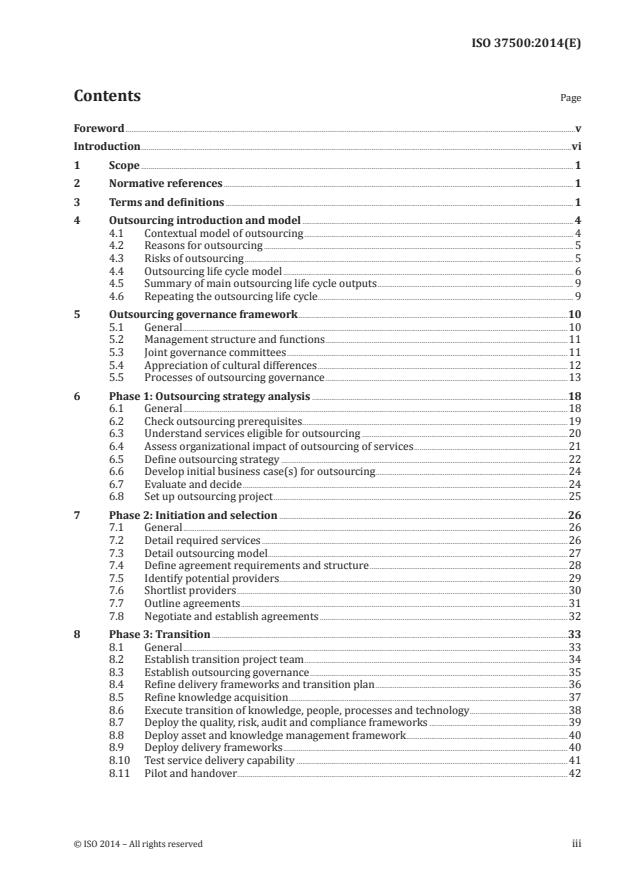
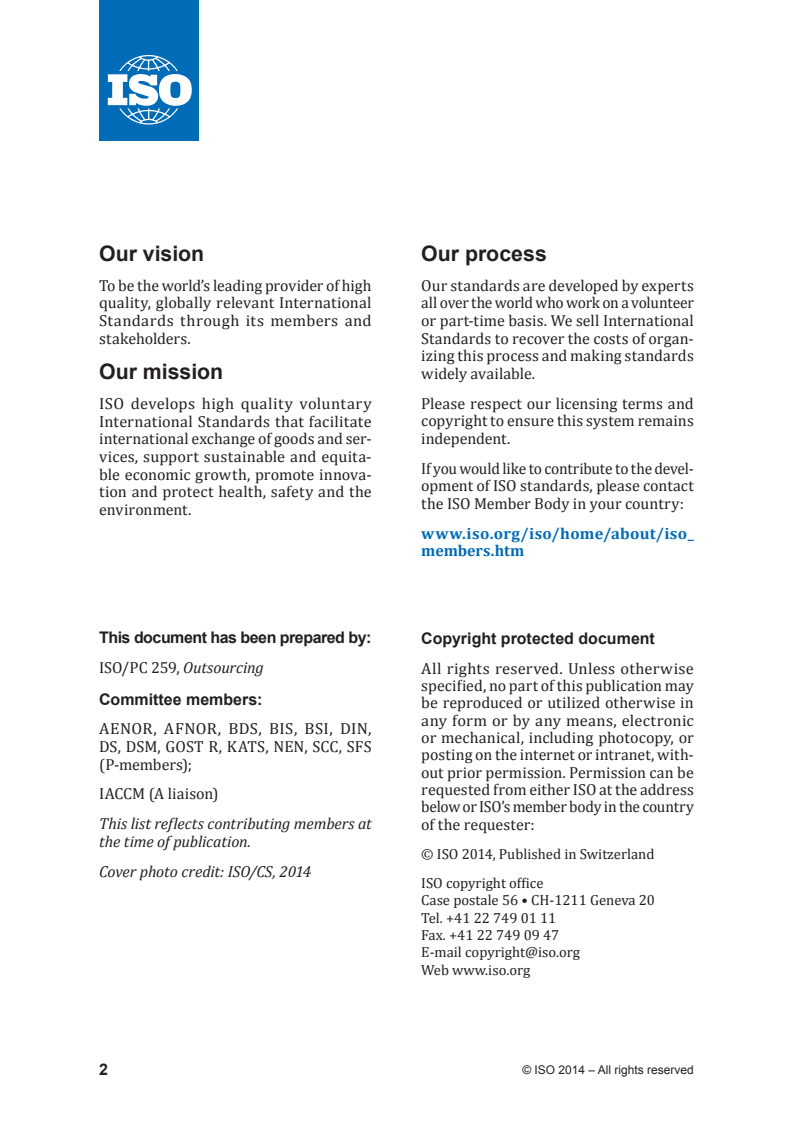
Contents Page
Foreword .v
Introduction .vi
1 Scope . 1
2 Normative references . 1
3 Terms and definitions . 1
4 Outsourcing introduction and model . 4
4.1 Contextual model of outsourcing . 4
4.2 Reasons for outsourcing . 5
4.3 Risks of outsourcing . 5
4.4 Outsourcing life cycle model . 6
4.5 Summary of main outsourcing life cycle outputs . 9
4.6 Repeating the outsourcing life cycle . 9
5 Outsourcing governance framework .10
5.1 General .10
5.2 Management structure and functions .11
5.3 Joint governance committees .11
5.4 Appreciation of cultural differences .12
5.5 Processes of outsourcing governance .13
6 Phase 1: Outsourcing strategy analysis .18
6.1 General .18
6.2 Check outsourcing prerequisites .19
6.3 Understand services eligible for outsourcing .20
6.4 Assess organizational impact of outsourcing of services .21
6.5 Define outsourcing strategy .22
6.6 Develop initial business case(s) for outsourcing .24
6.7 Evaluate and decide .24
6.8 Set up outsourcing project .25
7 Phase 2: Initiation and selection .26
7.1 General .26
7.2 Detail required services .26
7.3 Detail outsourcing model .27
7.4 Define agreement requirements and structure .28
7.5 Identify potential providers .29
7.6 Shortlist providers .30
7.7 Outline agreements .31
7.8 Negotiate and establish agreements .32
8 Phase 3: Transition .33
8.1 General .33
8.2 Establish transition project team .34
8.3 Establish outsourcing governance .35
8.4 Refine delivery frameworks and transition plan .36
8.5 Refine knowledge acquisition .37
8.6 Execute transition of knowledge, people, processes and technology .38
8.7 Deploy the quality, risk, audit and compliance frameworks .39
8.8 Deploy asset and knowledge management framework .40
8.9 Deploy delivery frameworks .40
8.10 Test service delivery capability .41
8.11 Pilot and handover.42
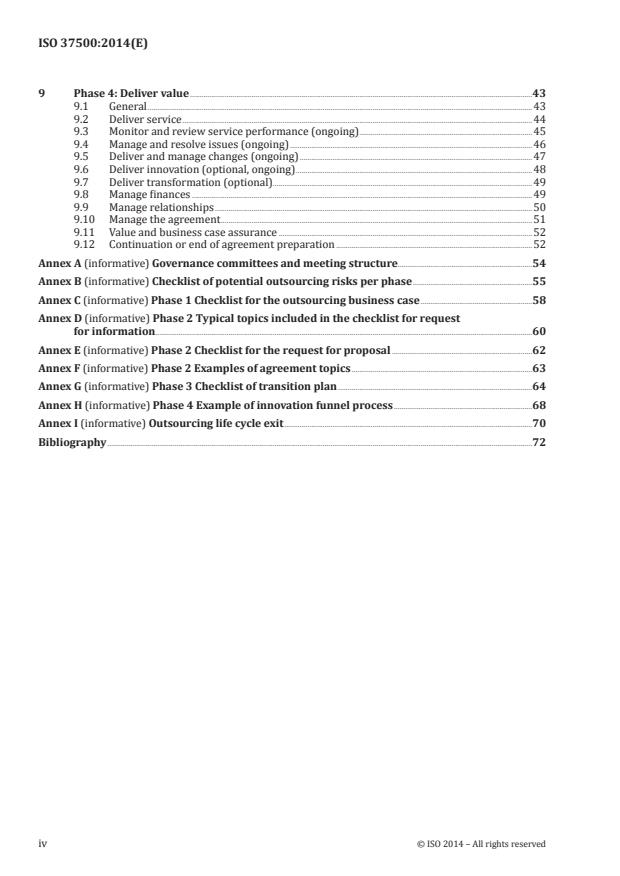
9 Phase 4: Deliver value .43
9.1 General .43
9.2 Deliver service .44
9.3 Monitor and review service performance (ongoing) .45
9.4 Manage and resolve issues (ongoing) .46
9.5 Deliver and manage changes (ongoing) .47
9.6 Deliver innovation (optional, ongoing) .48
9.7 Deliver transformation (optional).49
9.8 Manage finances .49
9.9 Manage relationships .50
9.10 Manage the agreement .51
9.11 Value and business case assurance .52
9.12 Continuation or end of agreement preparation .52
Annex A (informative) Governance committees and meeting structure.54
Annex B (informative) Checklist of potential outsourcing risks per phase .55
Annex C (informative) Phase 1 Checklist for the outsourcing business case .58
Annex D (informative) Phase 2 Typical topics included in the checklist for request
for information .60
Annex E (informative) Phase 2 Checklist for the request for proposal .62
Annex F (informative) Phase 2 Examples of agreement topics .63
Annex G (informative) Phase 3 Checklist of transition plan .64
Annex H (informative) Phase 4 Example of innovation funnel process .68
Annex I (informative) Outsourcing life cycle exit .70
Bibliography .72
iv © ISO 2014 – All rights reserved
Foreword
ISO (the International Organization for Standardization) is a worldwide federation of national standards
bodies (ISO member bodies). The work of preparing International Standards is normally carried out
through ISO technical committees. Each member body interested in a subject for which a technical
committee has been established has the right to be represented on that committee. International
organizations, governmental and non-governmental, in liaison with ISO, also take part in the work.
ISO collaborates closely with the International Electrotechnical Commission (IEC) on all matters of
electrotechnical standardization.
The procedures used to develop this document and those intended for its further maintenance are
described in the ISO/IEC Directives, Part 1. In particular the different approval criteria needed for the
different types of ISO documents should be noted. This document was drafted in accordance with the
editorial rules of the ISO/IEC Directives, Part 2 (see www.iso.org/directives).
Attention is drawn to the possibility that some of the elements of this document may be the subject of
patent rights. ISO shall not be held responsible for identifying any or all such patent rights. Details of
any patent rights identified during the development of the document will be in the Introduction and/or
on the ISO list of patent declarations received (see www.iso.org/patents).
Any trade name used in this document is information given for the convenience of users and does not
constitute an endorsement.
For an explanation on the meaning of ISO specific terms and expressions related to conformity
assessment, as well as information about ISO’s adherence to the WTO principles in the Technical Barriers
to Trade (TBT) see the following URL: Foreword - Supplementary information
The committee responsible for this document is Project Committee ISO/PC 259, Outsourcing.
Introduction
Around the globe, outsourcing is increasingly an opportunity to add value, tap into a resource base
and/or mitigate risk. This International Standard aims to provide general guidance for outsourcing for
any organization in any sector. It provides a vocabulary for outsourcing practitioners across all industry
sectors. It includes typical outsourcing concepts to improve the understanding of all stakeholders, by
providing a set of practices that can be used to manage the outsourcing life cycle.
Outsourcing is a business model for the delivery of a product or service to a client by a provider, as an
alternative to the provision of those products or services within the client organization, where:
— the outsourcing process is based on a sourcing decision (make or buy);
— resources can be transferred to the provider;
— the provider is responsible for delivering outsourced services for an agreed period of time;
— the services can be transferred from an existing provider to another;
— the client is accountable for the outsourced services and the provider is responsible for
performing them.
This International Standard starts with the precondition that an organization has already established a
sourcing strategy and concluded that outsourcing might be a beneficial approach.
Continuation or termination of an outsourcing arrangement forms an integral part of the outsourcing
life cycle. Continuation commences as long as the outsourcing business case is valid and the outsourcing
option is feasible within the sourcing portfolio. The decision to continue or terminate outsourcing as a
sourcing strategy option is an outcome from the sourcing process of the client and is outside the scope
of this International Standard.
This International Standard:
a) covers the entire outsourcing life cycle in four phases, as depicted in Figure 2, and provides
definitions for the terms, concepts, and processes that are considered good practice;
b) provides detailed guidance on the outsourcing life cycle, processes and their outputs;
c) provides a generic and industry independent foundation, which can be supplemented and tailored
to suit industry-specific requirements;
d) can be used before, during and after the decision is made to outsource;
e) aims to enable mutually beneficial collaborative relationships.
The description of each outsourcing phase provides information for the client side as well as the
provider side.
vi © ISO 2014 – All rights reserved
INTERNATIONAL STANDARD ISO 37500:2014(E)
Guidance on outsourcing
1 Scope
This International Standard covers the main phases, processes and governance aspects of outsourcing,
independent of size and sectors of industry and commerce. It is intended to provide a good foundation
to enable organizations to enter into, and continue to sustain, successful outsourcing arrangements
throughout the contractual period.
This International Standard gives guidance on:
— good outsourcing governance for the mutual benefit of client and provider;
— flexibility of outsourcing arrangements, accommodating changing business requirements;
— identifying risks involved with outsourcing;
— enabling mutually beneficial collaborative relationships.
This International Standard can be tailored and extended to industry-specific needs to accommodate
international, national and local laws and regulations (including those related to the environment,
labour, health and safety), the size of the outsourcing arrangement and the type of industry sector.
This International Standard recognizes that the various stakeholders act separately in some phases
of the outsourcing life cycle and together in others. It is not possible to exclusively allocate processes
within the outsourcing life cycle to either client or provider. For each outsourcing arrangement, process
responsibility is intended to be interpreted accordingly and tailored by the user.
This International Standard is intended to relate to any outsourcing relationship, whether outsourcing
for the first time or not, using a single-provider or multi-provider model, or draft agreements based on
services or outcomes. Processes mentioned in this International Standard are intended to be tailored to
fit the outsourcing strategy and maturity of the client and provider organizations.
This International Standard is intended to be used by outsourcing clients, providers and practitioners,
such as:
— decision makers and their empowered representatives;
— all stakeholders engaged in facilitating the creation and/or management of outsourcing
arrangements;
— staff at all levels of experience in outsourcing.
2 Normative references
There are no normative references.
3 Terms and definitions
For the purposes of this document, the following terms and definitions apply.
3.1
baseline
agreed reference value or set of values which can be derived from past experience, often used for
comparing with ongoing performance data, values and/or outcomes
3.2
business case
structured proposal for business improvement that functions as a decision package for decision-makers
Note 1 to entry: The business case should explain why outsourcing is required for the business and what the product
or service is going to be. It should include an outline of the return on investment (ROI), or a cost/benefit analysis,
the performance characteristics, major project risks and the opportunities. The business case addresses, at a high
level, the business needs that the outsourcing project seeks to meet. It includes the reasons for outsourcing, the
expected business benefits, the options considered with reasons for rejecting or carrying forward each option,
the expected costs of the outsourcing project, a gap analysis and the expected risks.
[SOURCE: ISO/TR 25104:2008, 3.3, modified]
3.3
client
individual or group of organizations entering into an agreement with a provider for products and
services for their own use
[SOURCE: ISO 24803:2007, 3.2, modified]
3.4
due diligence
detailed assessment of one or more business processes or production lines, culture, assets, liabilities,
intellectual property, judicial and financial situation in order to make the outsourcing decisions
3.5
framework
documented set of guidelines to create a common understanding of the ways of working
3.6
innovation
implementation of a new or significantly improved product (good or service), or process, new marketing
method, or new organizational method in business practices, workplace organization or external relations
[SOURCE: CEN/TS 16555-1:2013, 3.1]
3.7
innovation and transformation committee
joint management team that governs the process of managing innovation and transformation in the
outsourced processes in order to enhance delivered value
Note 1 to entry: The committee follows a mutually accepted procedure of evaluating the potential value impact,
assessing effort, risk, time to market and sharing of costs and rewards.
Note 2 to entry: The committee usually has representatives from the client and the provider.
3.8
knowledge acquisition
process of locating, collecting, and refining knowledge and converting it into a form that can be further
processed by a knowledge-based system
[SOURCE: ISO/IEC 2382-31:1997, 31.01.04]
3.9
knowledge transfer
structured process of imparting pre-existing or acquired information to a team or a person, to help
them attain a required level of proficiency in skill
Note 1 to entry: Knowledge transfer is not a synonym for training.
2 © ISO 2014 – All rights reserved
3.10
outsourcing
business model for the delivery of a product or services to a client by a provider
3.11
outsourcing arrangement
contractual arrangement between two or more organizations for the provision of specific services for a
fixed period of time, where one organization is the client for those services and the other organization
is the provider
3.12
outsourcing governance
joint set of structures and processes that are implemented to ensure effective leadership and
management, which enables an outsourcing arrangement to achieve its joint objectives within the
framework of agreed values
3.13
outsourcing governance framework
outline of guidelines and processes that enables continual monitoring and management of outsourcing
arrangements to sustain value delivery between client and provider
Note 1 to entry: In order to keep it relevant in a changing environment, the governing committee of the two
organizations may modify the governance framework occasionally.
3.14
outsourcing model
formalized concept of the scope of an outsourcing arrangement and how it is structured and carried out
3.15
provider
organization that offers a product or service to a client
Note 1 to entry: The term “provider” within this International Standard is used in a generic, singular fashion.
In practice, however, outsourcing arrangements may consist of many stakeholders or sub-contractors involved
in one outsourcing arrangement. Often they are supplemented by advisors and consultants facilitating the
outsourcing process.
3.16
responsibility matrix
chart that describes the participation by various roles in completing tasks or deliverables for an
outsourcing arrangement
3.17
retained organization
organizational units and/or employee roles, retained within the client organization, providing the client
interface for the provider
3.18
service
product
result of activities performed by the provider according to the agreed scope, service levels and client demands
Note 1 to entry: Depending on the industry sector, it may be appropriate to use the term “product” rather than
“service”. Each industry uses specific terminology. This is also true for the distinction of delivering a product or a
service. Theoretically, any product or service is in fact a hybrid of both worlds. In the interests of readability, only
the term “service” is used throughout this International Standard.
3.19
service catalogue
list of services that an organization provides to its clients or employees
Note 1 to entry: Each service within the catalogue typically includes a description of the service, timeframes or
service level agreements for fulfilling the service, who is entitled to request/view the service, costs (if any), and
how to fulfil the service.
3.20
service level agreement
SLA
documented agreement between the client and provider that identifies services and service targets,
including prerequisites for service levels and measures for performance
3.21
sourcing strategy
organization’s action plan to obtain products and services that are essential to run its business in the
most effective and efficient manner
3.22
standard operating procedure
SOP
authorized, documented procedure or set of procedures, work instructions and test instructions for
production and control
[SOURCE: ISO 15378:2011, 3.58]
3.23
transformation
process of profound and radical change that orients an organization in a new direction and takes it to an
entirely different level of effectiveness
Note 1 to entry: Unlike incremental change or continual improvement, transformation implies little or no
resemblance with the past configuration or structure.
3.24
transition
activities for migrating agreed upon knowledge, assets, liabilities, systems, processes and people from
the client to the provider in order to create desired delivery capability
3.25
value
quantifiable financial or non-financial gain
4 Outsourcing introduction and model
4.1 Contextual model of outsourcing
Organizations are complex systems, continually adapting to changes in their environment (see Figure 1).
They face many forms of pressure including those from ever-changing markets, political, social, economic
and technological factors. In order to survive, organizations need to constantly update their strategy
and realign to meet the demands from these complex challenges. They are in a state of constant flux,
adapting to the external changes and requirements. This may involve outsourcing arrangements. This
International Standard reflects the need to stay continuously aligned with the business and sourcing
strategy, building in the capability for change from the start of the outsourcing life cycle. This is done
not only by providing guidance in innovation, transformation and change, but also by providing a joint
outsourcing governance framework.
4 © ISO 2014 – All rights reserved
Figure 1 — Contextual model of outsourcing
It is common for organizations to have a business strategy and several functional strategies in order
to fulfil the overarching goals of the organization. By adding sourcing strategy in this process, the
organization is able to make a strategic choice on whether or not to have particular business functions
provided in-house or by an external organization.
4.2 Reasons for outsourcing
Outsourcing gives organizations several business opportunities. A client’s decision to outsource is typically
not driven by a single reason. The following list gives the main reasons why organizations outsource:
a) to manage costs;
b) strategy changes: sometimes an organization redefines its business on what to create internally and what
may be provided externally: processes formerly executed internally become eligible for outsourcing;
c) access capabilities that are not available in-house;
d) transfer risks: especially in volatile markets clients may transfer risks by increasing the share of
variable cost, e.g. by transferring assets and/or staff benefitting from flexibility and scalability on
the provider side.
4.3 Risks of outsourcing
Outsourcing has advantages but also carries a number of risks. The key risks vary from sector to sector.
Some of the risks may be present, but the impact of the risk differs for each service that is eligible for
outsourcing. Management should assess the presumed organizational value and risks before reaching
an informed outsourcing decision. The following key risks need to be considered within the outsourcing
life cycle in order to improve the chance of success.
a) Absence of a strategy: Outsourcing contributes a risk to the overall effectiveness of the organization
if no formal strategy and vision is set by the leadership of the client. Outsourcing should be a carefully
chosen strategy based on sound business decisions.
b) Poor understanding of environment dynamics: As explained in 4.1, an organization constantly
struggles to create equilibrium with its surroundings. In many cases this may affect the outsourcing
arrangement, forcing changes to be able to deliver value. Adaptability becomes more important
when dealing with outsourcing core processes, for example by adding innovation or change services
to the outsourcing agreements. Outsourcing governance, therefore, should be more important to
facilitate collaborative business relationships.
c) Blind focus on cost reduction: Although outsourcing can lead to substantial cost reduction,
an organization should pay attention to the overall impact and risks of outsourcing. By doing
this organizations can factor in issues that could occur, particularly those who are relatively
inexperienced in outsourcing and who often tend to focus too much on cost reduction. Organizations
tend to underestimate the set of outsourcing governance processes and the staff required to manage
the demand and integration as well as monitoring and steering of the provider. This often results in
an overly optimistic or unrealistic business case.
d) Underestimated business impact: outsourcing: Especially when it concerns core business processes,
can have a profound and unexpected effect on a client’s culture, work morale and business relationships.
Therefore, clear visible strategic leadership is required to guide the organizational change.
e) Poor cultural compatibility: An outsourcing arrangement generally covers a certain period. During this
period, client and provider should collaborate on different levels. If the organizational and management
culture differ significantly, conflicts and disputes are often managed in an ineffective manner. A client
should understand the work dynamics in order to be able to search for a suitable provider.
f) Poor understanding of the process: Transferring responsibility and control are key elements of
outsourcing. During an outsourcing arrangement, the client’s understanding of the process may fade.
People may change jobs and the provider may make changes to the process. Clear understanding of
the processes from start to finish is important for a successful start and the inevitable exit. Hence, it is
important to understand the arrangements around knowledge management and intellectual property.
g) Poor relationship management: Outsourcing is by definition a relationship between stakeholders
and the success of the relationship is the most fundamental factor in the success of the arrangement
for both stakeholders. A successful relationship should often ensure that problems, which will
inevitably arise in every arrangement, are able to be effectively addressed. A poor relationship may,
at worst, even result in the termination of what is a potentially successful collaboration.
4.4 Outsourcing life cycle model
In order to obtain the desired value and mitigate risks associated with outsourcing, this International
Standard provides a high-level, relatively easy-to-comprehend outsourcing model which aims to support
stakeholders to understand:
— the outsourcing life cycle and outsourcing governance;
— the joint processes (demand and supply) that the client and provider should establish, managing the
outsourcing arrangement;
— how they can ensure flexibility to changing business requirements;
— how they can ensure the delivery of desired value;
— how they can ensure collaborative business relationships.
6 © ISO 2014 – All rights reserved
4.4.1 Overview of the outsourcing life cycle model
4.4.1.1 General
Outsourcing governance is at the heart of the outsourcing life cycle model. Figure 2 highlights its
function in continuously monitoring, evaluating and directing all phases of the outsourcing life cycle.
Good governance practices are at the core of the outsourcing life cycle model.
Each of the four phases contains a set of processes which address:
a) its purpose;
b) main activities to be performed;
c) key success factors;
d) main inputs and outputs.
This set of processes can be tailored to meet the requirements of any outsourcing arrangement.
Each process within a phase is written in a similar fashion addressing the purpose of the process and
the main activities to be performed, the key success factors and the main inputs and outputs.
This subclause identifies, apart from several outsourcing governance practices, additional items that
contribute to good governance.
Figure 2 — Outsourcing life cycle model
4.4.1.2 Outsourcing governance
Outsourcing governance is at the heart of the outsourcing model. The outsourcing governance practices
are an enabler for effective strategic leadership of the outsourcing arrangement and the realization of
its desired value.
Within the outsourcing life cycle, governance involves the development of processes which bring together
the appropriate level of management from both the client and the provider(s) to work side by side on
an ongoing basis in order to maintain an optimal alignment of ambition and interest of all stakeholders
involved in the outsourcing relationship throughout the outsourcing life cycle.
4.4.1.3 Phase 1: Outsourcing strategy analysis
The first phase is “outsourcing strategy analysis”. The purpose of this phase is to initiate and evaluate
outsourcing opportunities and establish and maintain an outsourcing strategy that meets business
goals and requirements. Only then will the client be able to fully assess the value that outsourcing might
bring to their organization and the feasibility of the outsourcing options available. The nature of this
phase is predominantly client-based.
4.4.1.4 Phase 2: Initiation and selection
The second phase is “initiation and selection”. The purpose of this phase is to specify the requirements
for proposed services to outsource, to select adequate providers, and to successfully establish the
outsourcing agreements. It should be fully aligned with 4.4.1.3 with the governance practices being the
link between the processes and this being led and driven by senior management. In this phase the provider
proposes an outsourcing solution based on client requirements. Within this phase several frameworks
are to be identified and subsequently created in order to be able to deliver the services and manage the
outsourcing arrangement. The developed business case will be changed according to the experience
during transfer. If the business case imposes too much risk or uncertainty, the outsourcing process
could be stopped and information fed back to phase 1 for analysis of all outsourcing opportunities. If
risks are acceptable agreements should be signed, moving to the next phase. All decision documents are
submitted to the outsourcing governance processes for approval by senior management.
4.4.1.5 Phase 3: Transition
The third phase is “transition”. The purpose of this phase is to enable the provider to establish delivery
capabilities in their environment. These are used in phase 4 (“deliver value”). The transition may include
transfer of staff, assets and related change management procedures. The client and provider work
intensively together during the “pilot and handover” process. Thereby the provider is able to fulfil their
service delivery responsibility agreed with the client. After establishing the delivery and outsourcing
governance processes, these are tested in order to ensure that the processes are delivering the required
quality and performance. These tests should also demonstrate that the outsourcing governance
committees are provided with the adequate information. Governance committee members should be
trained and be formally committed to their roles and responsibilities.
By formal sign-off, the responsibility is transferred to the provider and residual risks are assessed and
accepted. The developed business case should be changed according to the experience during transfer.
A new business case baseline is set after incorporating all experience during transition. During the
“transition” phase it might become clear that outsourcing is more expensive and a viable business case
is not being achieved. Although difficult, abandonment of the outsourcing process should be considered.
This means that phase 1 is to be triggered, reassessing the outsourcing strategy benefits and creating a
decision document for the leadership.
4.4.1.6 Phase 4: Deliver value
The fourth phase is “deliver value”. The purpose of this phase is to ensure that both the client and
provider realize and sustain the value of the outsourcing arrangement according to the defined business
case and ambitions. In this phase the focus is predominantly on the provider and service provision is
monitored by the client. The name of this phase reflects the fact that value to the client or provider may
change over time and is not expressed in an agreement alone. When an agreement is made for a longer
period, alignment of ambitions and interest within outsourcing governance will trigger changes to be
made in “deliver value”.
Therefore, a diverse set of processes should be run in order to achieve results, ensure consistent
performance and improve where possible. In this phase some processes may not be required for
all outsourcing arrangements. For example processes such as “deliver innovation” and “deliver
8 © ISO 2014 – All rights reserved
transformation” may not be required in all cases. These processes are identified as complementary
processes. Those services ensure the capability to create and implement radical changes to the service
portfolio and meet changing client and market demands. This phase ends with preparation of the
contract evaluation which will be used in governance to assess the results.
When conducting an exit from the current outsourcing arrangement, 5.5.4.5 and Annex I provide
guidance on the different scenarios.
4.5 Summary of main outsourcing life cycle outputs
Each phase of the outsourcing life cycle provides for main outputs that are re-used in the next phase.
Apart from phase-specific outputs, the business case is one of the most important output documents
that exists in each phase of the outsourcing life cycle. The business case starts at the first phase by
creating the initial high-level business case. It includes both qualitative and quantitative aspects. In
the second phase the business case is detailed. If the business case does not show the required benefits
or indicates too much business risk, the outsourcing process should be re-evaluated or terminated.
During transition, the business case touches reality and should be fine-tuned and baselined to reflect
the possible value during the “deliver value” phase. During delivery, the business case should be updated
periodically so it incorporates the latest transformations, changes and improvement results. The
business case ultimately plays a vital role in evaluating the outsourcing arrangement and in making a
decision whether or not to continue.
The agreement is another important output of the outsourcing life cycle which documents the tangible,
rational elements of the arrangement. If conflict arises and escalates between client and provider, the
agreement plays a vital role in managing liability and/or mediation. However, significant conflicts should
be addressed through negotiation at the earliest possible stage. Therefore this International Standard
stipulates the importance of business relationship processes within outsourcing governance to create
a continuous alignment of ambitions and interests of all stakeholders, and to be resilient in resolving
business case setbacks and disputes.
2. Initiation and
selection
Detailed outsourcing model
Outsourcing strategy
Record of provider selection process
Initial business case
Selected provider
Decision document for
Signed outsourcing agreements
outsourcing
Detailed business case
Execution plan
Detailed risk assessment
Transition plan
Sourcing
1. Outsourcing
strategy
Outsourcing
3. Transition
strategy
governance
Exit
analysis
strategy
Monitor, evaluate and direct:
•Innovation, transformation
and change
Delivered service performance
Established delivery capability
•Delivery and relationship
Balanced demand and supply
Baselined business case
performance
Easily accessible managed current Formal sign off transfer
•Phase continuation or exit
joint knowledge
Problem solving
Analysis of the value delivered against goals,
expectations and the business case
Preparation to make continuation or exit
decision
4. Deliver value
Figure 3 — Main outputs of the outsourcing life cycle output model
4.6 Repeating the outsourcing life cycle
The end of phase 4 in the outsourcing life cycle model is often the beginning of phase 1 as the outsourcing
life cycle repeats. The next iteration of the outsourcing life cycle is depicted in Figure 2 by the arrow
from phase 4 to phase 1. The repeat of the outsourcing life cycle often occurs with the same client-
provider outsourcing relationship.
Repetition of the outsourcing life cycle will be influenced by many complex factors. Identifying these
factors, and interpretation of their impact, should occur during phase 4 and at the start of phase 1 (see
6.2). This is the role of the governance framework (see 5.5.4.2 and 5.5.4.5) relying on information from
the “continuation or end of agreement preparation” (see 9.12).
If the outsourcing life cycle continues in a second
...
ISO 37500
ISO 37500
Guidance on
outsourcing
First edition
2014-11-01
Our vision Our process
To be the world’s leading provider of high Our standards are developed by experts
quality, globally relevant International all over the world who work on a volunteer
Standards through its members and or part-time basis. We sell International
stakeholders. Standards to recover the costs of organ-
izing this process and making standards
Our mission widely available.
Please respect our licensing terms and
ISO develops high quality voluntary
copyright to ensure this system remains
International Standards that facilitate
international exchange of goods and ser- independent.
vices, support sustainable and equita-
If you would like to contribute to the devel-
ble economic growth, promote innova-
opment of ISO standards, please contact
tion and protect health, safety and the
the ISO Member Body in your country:
environment.
www.iso.org/iso/home/about/iso_
members.htm
This document has been prepared by:
ISO/PC 259, Outsourcing All rights reserved. Unless otherwise
specified, no part of this publication may
Committee members:
be reproduced or utilized otherwise in
any form or by any means, electronic
AENOR, AFNOR, BDS, BIS, BSI, DIN,
or mechanical, including photocopy, or
DS, DSM, GOST R, KATS, NEN, SCC, SFS
posting on the internet or intranet, with-
(P-members);
out prior permission. Permission can be
requested from either ISO at the address
IACCM (A liaison)
below or ISO’s member body in the country
This list reflects contributing members at of the requester:
the time of publication.
Cover photo credit: ISO/CS, 2014
ISO copyright office
Case postale 56 • CH-1211 Geneva 20
Tel. +41 22 749 01 11
Fax. +41 22 749 09 47
E-mail copyright@iso.org
Web www.iso.org
Executive summary
• Outsourcing is a business model which has been adopted across all industry
sectors around the globe.
• Outsourcing enables an organization to achieve business objectives, add value, tap
into a resource base and/or mitigate risk.
• The application of this guidance provides all the parties involved in outsourcing
with the assurance that business objectives can be achieved through utilization of
common governance and processes throughout the outsourcing lifecycle.
• This outsourcing guidance can help organizations to identify the business case for
outsourcing, select the most appropriate partner, transition to the new operating
model and make sure that value is delivered through effective governance from
the relationship.
• An outsourcing arrangement that meets business goals and requirements
throughout the outsourcing lifecycle can ensure effectiveness and efficiency for
the organization.
• The benefits of outsourcing can include managing costs, supporting business
strategy, accessing capabilities not available in-house, transfer of risks, increasing
development opportunities, obtaining flexibility and scalability.
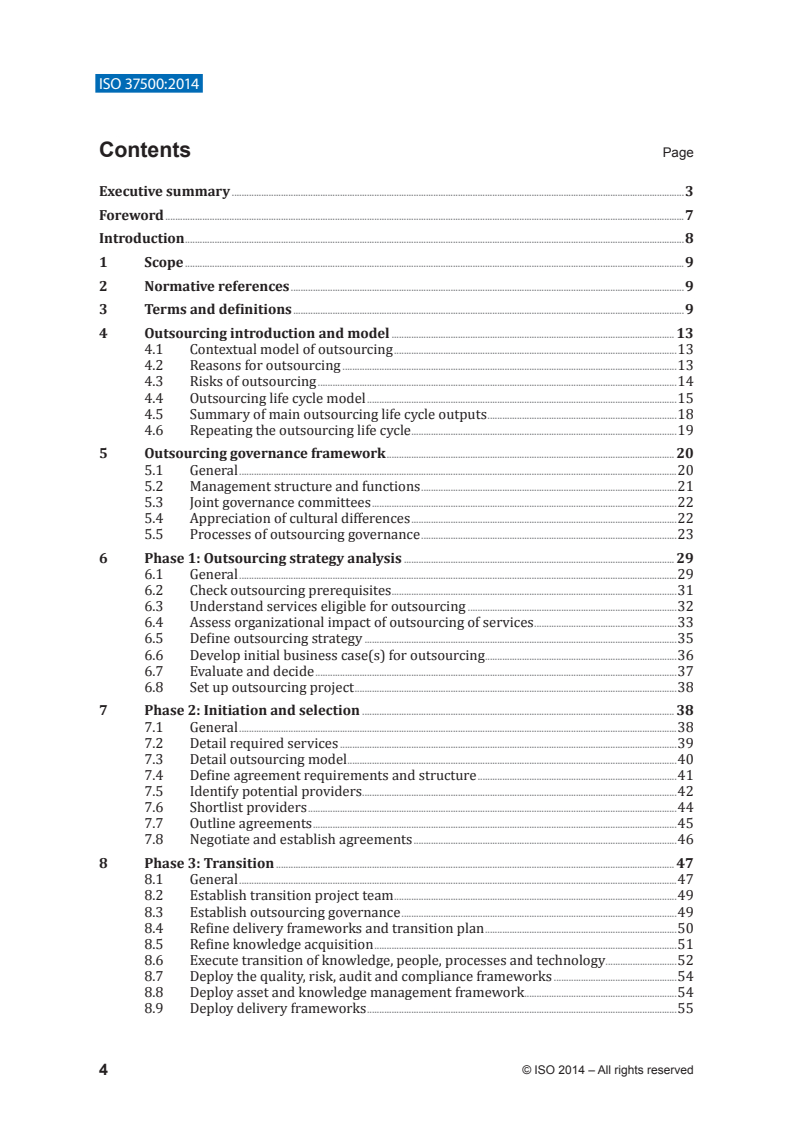
Contents Page
Executive summary .3
Foreword .7
Introduction .8
1 Scope .9
2 Normative references .9
3 Terms and definitions .9
4 Outsourcing introduction and model . 13
4.1 Contextual model of outsourcing .13
4.2 Reasons for outsourcing .13
4.3 Risks of outsourcing .14
4.4 Outsourcing life cycle model .15
4.5 Summary of main outsourcing life cycle outputs .18
4.6 Repeating the outsourcing life cycle .19
5 Outsourcing governance framework . 20
5.1 General .20
5.2 Management structure and functions .21
5.3 Joint governance committees .22
5.4 Appreciation of cultural differences .22
5.5 Processes of outsourcing governance .23
6 Phase 1: Outsourcing strategy analysis . 29
6.1 General .29
6.2 Check outsourcing prerequisites .31
6.3 Understand services eligible for outsourcing .32
6.4 Assess organizational impact of outsourcing of services .33
6.5 Define outsourcing strategy .35
6.6 Develop initial business case(s) for outsourcing .36
6.7 Evaluate and decide .37
6.8 Set up outsourcing project .38
7 Phase 2: Initiation and selection . 38
7.1 General .38
7.2 Detail required services .39
7.3 Detail outsourcing model .40
7.4 Define agreement requirements and structure .41
7.5 Identify potential providers .42
7.6 Shortlist providers .44
7.7 Outline agreements .45
7.8 Negotiate and establish agreements .46
8 Phase 3: Transition . 47
8.1 General .47
8.2 Establish transition project team .49
8.3 Establish outsourcing governance .49
8.4 Refine delivery frameworks and transition plan .50
8.5 Refine knowledge acquisition .51
8.6 Execute transition of knowledge, people, processes and technology .52
8.7 Deploy the quality, risk, audit and compliance frameworks .54
8.8 Deploy asset and knowledge management framework .54
8.9 Deploy delivery frameworks .55
8.10 Test service delivery capability .56
8.11 Pilot and handover.57
9 Phase 4: Deliver value . 58
9.1 General .58
9.2 Deliver service .60
9.3 Monitor and review service performance (ongoing) .61
9.4 Manage and resolve issues (ongoing) .62
9.5 Deliver and manage changes (ongoing) .63
9.6 Deliver innovation (optional, ongoing) .64
9.7 Deliver transformation (optional).65
9.8 Manage finances .66
9.9 Manage relationships .67
9.10 Manage the agreement .68
9.11 Value and business case assurance .69
9.12 Continuation or end of agreement preparation .70
Annex A (informative) Governance committees and meeting structure . 72
Annex B (informative) Checklist of potential outsourcing risks per phase . 74
Annex C (informative) Phase 1 Checklist for the outsourcing business case . 77
Annex D (informative) Phase 2 Typical topics included in the checklist for request for
information . 79
Annex E (informative) Phase 2 Checklist for the request for proposal . 81
Annex F (informative) Phase 2 Examples of agreement topics . 82
Annex G (informative) Phase 3 Checklist of transition plan . 83
Annex H (informative) Phase 4 Example of innovation funnel process . 87
Annex I (informative) Outsourcing life cycle exit . 89
Bibliography . 91
Foreword
ISO (the International Organization for Standardization) is a worldwide federation of
national standards bodies (ISO member bodies). The work of preparing International
Standards is normally carried out through ISO technical committees. Each member body
interested in a subject for which a technical committee has been established has the
right to be represented on that committee. International organizations, governmental
and non-governmental, in liaison with ISO, also take part in the work. ISO collaborates
closely with the International Electrotechnical Commission (IEC) on all matters of elec-
trotechnical standardization.
The procedures used to develop this document and those intended for its further main-
tenance are described in the ISO/IEC Directives, Part 1. In particular the different
approval criteria needed for the different types of ISO documents should be noted. This
document was drafted in accordance with the editorial rules of the ISO/IEC Directives,
Part 2 (see www.iso.org/directives).
Attention is drawn to the possibility that some of the elements of this document may be
the subject of patent rights. ISO shall not be held responsible for identifying any or all
such patent rights. Details of any patent rights identified during the development of the
document will be in the Introduction and/or on the ISO list of patent declarations received
(see www.iso.org/patents).
Any trade name used in this document is information given for the convenience of users
and does not constitute an endorsement.
For an explanation on the meaning of ISO specific terms and expressions related to con-
formity assessment, as well as information about ISO’s adherence to the WTO principles in
the Technical Barriers to Trade (TBT) see the following URL: Foreword - Supplementary
information
The committee responsible for this document is Project Committee ISO/PC 259, Outsourcing.
Introduction
Around the globe, outsourcing is increasingly an opportunity to add value, tap into a
resource base and/or mitigate risk. This International Standard aims to provide general
guidance for outsourcing for any organization in any sector. It provides a vocabulary
for outsourcing practitioners across all industry sectors. It includes typical outsourcing
concepts to improve the understanding of all stakeholders, by providing a set of practices
that can be used to manage the outsourcing life cycle.
Outsourcing is a business model for the delivery of a product or service to a client by a
provider, as an alternative to the provision of those products or services within the cli-
ent organization, where:
— the outsourcing process is based on a sourcing decision (make or buy);
— resources can be transferred to the provider;
— the provider is responsible for delivering outsourced services for an agreed period
of time;
— the services can be transferred from an existing provider to another;
— the client is accountable for the outsourced services and the provider is
responsible for performing them.
This International Standard starts with the precondition that an organization has already
established a sourcing strategy and concluded that outsourcing might be a beneficial
approach.
Continuation or termination of an outsourcing arrangement forms an integral part of the
outsourcing life cycle. Continuation commences as long as the outsourcing business case
is valid and the outsourcing option is feasible within the sourcing portfolio. The decision
to continue or terminate outsourcing as a sourcing strategy option is an outcome from
the sourcing process of the client and is outside the scope of this International Standard.
This International Standard:
a) covers the entire outsourcing life cycle in four phases, as depicted in Figure 2, and
provides definitions for the terms, concepts, and processes that are considered
good practice;
b) provides detailed guidance on the outsourcing life cycle, processes and their
outputs;
c) provides a generic and industry independent foundation, which can be
supplemented and tailored to suit industry-specific requirements;
d) can be used before, during and after the decision is made to outsource;
e) aims to enable mutually beneficial collaborative relationships.
The description of each outsourcing phase provides information for the client side as
well as the provider side.
1 Scope
This International Standard covers the main phases, processes and governance aspects of
outsourcing, independent of size and sectors of industry and commerce. It is intended to
provide a good foundation to enable organizations to enter into, and continue to sustain,
successful outsourcing arrangements throughout the contractual period.
This International Standard gives guidance on:
— good outsourcing governance for the mutual benefit of client and provider;
— flexibility of outsourcing arrangements, accommodating changing business
requirements;
— identifying risks involved with outsourcing;
— enabling mutually beneficial collaborative relationships.
This International Standard can be tailored and extended to industry-specific needs to
accommodate international, national and local laws and regulations (including those
related to the environment, labour, health and safety), the size of the outsourcing arrange-
ment and the type of industry sector.
This International Standard recognizes that the various stakeholders act separately
in some phases of the outsourcing life cycle and together in others. It is not possible to
exclusively allocate processes within the outsourcing life cycle to either client or provider.
For each outsourcing arrangement, process responsibility is intended to be interpreted
accordingly and tailored by the user.
This International Standard is intended to relate to any outsourcing relationship, whether
outsourcing for the first time or not, using a single-provider or multi-provider model, or
draft agreements based on services or outcomes. Processes mentioned in this International
Standard are intended to be tailored to fit the outsourcing strategy and maturity of the
client and provider organizations.
This International Standard is intended to be used by outsourcing clients, providers and
practitioners, such as:
— decision makers and their empowered representatives;
— all stakeholders engaged in facilitating the creation and/or management of
outsourcing arrangements;
— staff at all levels of experience in outsourcing.
2 Normative references
There are no normative references.
3 Terms and definitions
For the purposes of this document, the following terms and definitions apply.
3.1
baseline
agreed reference value or set of values which can be derived from past experience, often
used for comparing with ongoing performance data, values and/or outcomes
3.2
business case
structured proposal for business improvement that functions as a decision package for
decision-makers
Note 1 to entry: The business case should explain why outsourcing is required for the business
and what the product or service is going to be. It should include an outline of the return on
investment (ROI), or a cost/benefit analysis, the performance characteristics, major project risks
and the opportunities. The business case addresses, at a high level, the business needs that the
outsourcing project seeks to meet. It includes the reasons for outsourcing, the expected business
benefits, the options considered with reasons for rejecting or carrying forward each option, the
expected costs of the outsourcing project, a gap analysis and the expected risks.
[SOURCE: ISO/TR 25104:2008, 3.3, modified]
3.3
client
individual or group of organizations entering into an agreement with a provider for
products and services for their own use
[SOURCE: ISO 24803:2007, 3.2, modified]
3.4
due diligence
detailed assessment of one or more business processes or production lines, culture,
assets, liabilities, intellectual property, judicial and financial situation in order to make
the outsourcing decisions
3.5
framework
documented set of guidelines to create a common understanding of the ways of working
3.6
innovation
implementation of a new or significantly improved product (good or service), or process,
new marketing method, or new organizational method in business practices, workplace
organization or external relations
[SOURCE: CEN/TS 16555-1:2013, 3.1]
3.7
innovation and transformation committee
joint management team that governs the process of managing innovation and transfor-
mation in the outsourced processes in order to enhance delivered value
Note 1 to entry: The committee follows a mutually accepted procedure of evaluating the potential
value impact, assessing effort, risk, time to market and sharing of costs and rewards.
Note 2 to entry: The committee usually has representatives from the client and the provider.
3.8
knowledge acquisition
process of locating, collecting, and refining knowledge and converting it into a form that
can be further processed by a knowledge-based system
[SOURCE: ISO/IEC 2382-31:1997, 31.01.04]
3.9
knowledge transfer
structured process of imparting pre-existing or acquired information to a team or a
person, to help them attain a required level of proficiency in skill
Note 1 to entry: Knowledge transfer is not a synonym for training.
3.10
outsourcing
business model for the delivery of a product or services to a client by a provider
3.11
outsourcing arrangement
contractual arrangement between two or more organizations for the provision of specific
services for a fixed period of time, where one organization is the client for those services
and the other organization is the provider
3.12
outsourcing governance
joint set of structures and processes that are implemented to ensure effective leadership
and management, which enables an outsourcing arrangement to achieve its joint objec-
tives within the framework of agreed values
3.13
outsourcing governance framework
outline of guidelines and processes that enables continual monitoring and management
of outsourcing arrangements to sustain value delivery between client and provider
Note 1 to entry: In order to keep it relevant in a changing environment, the governing committee
of the two organizations may modify the governance framework occasionally.
3.14
outsourcing model
formalized concept of the scope of an outsourcing arrangement and how it is structured
and carried out
3.15
provider
organization that offers a product or service to a client
Note 1 to entry: The term “provider” within this International Standard is used in a generic, sin-
gular fashion. In practice, however, outsourcing arrangements may consist of many stakeholders
or sub-contractors involved in one outsourcing arrangement. Often they are supplemented by
advisors and consultants facilitating the outsourcing process.
3.16
responsibility matrix
chart that describes the participation by various roles in completing tasks or deliverables
for an outsourcing arrangement
3.17
retained organization
organizational units and/or employee roles, retained within the client organization,
providing the client interface for the provider
3.18
service
product
result of activities performed by the provider according to the agreed scope, service
levels and client demands
Note 1 to entry: Depending on the industry sector, it may be appropriate to use the term “product”
rather than “service”. Each industry uses specific terminology. This is also true for the distinc-
tion of delivering a product or a service. Theoretically, any product or service is in fact a hybrid
of both worlds. In the interests of readability, only the term “service” is used throughout this
International Standard.
3.19
service catalogue
list of services that an organization provides to its clients or employees
Note 1 to entry: Each service within the catalogue typically includes a description of the service,
timeframes or service level agreements for fulfilling the service, who is entitled to request/view
the service, costs (if any), and how to fulfil the service.
3.20
service level agreement
SLA
documented agreement between the client and provider that identifies services and
service targets, including prerequisites for service levels and measures for performance
3.21
sourcing strategy
organization’s action plan to obtain products and services that are essential to run its
business in the most effective and efficient manner
3.22
standard operating procedure
SOP
authorized, documented procedure or set of procedures, work instructions and test
instructions for production and control
[SOURCE: ISO 15378:2011, 3.58]
3.23
transformation
process of profound and radical change that orients an organization in a new direction
and takes it to an entirely different level of effectiveness
Note 1 to entry: Unlike incremental change or continual improvement, transformation implies
little or no resemblance with the past configuration or structure.
3.24
transition
activities for migrating agreed upon knowledge, assets, liabilities, systems, processes
and people from the client to the provider in order to create desired delivery capability
3.25
value
quantifiable financial or non-financial gain
4 Outsourcing introduction and model
4.1 Contextual model of outsourcing
Organizations are complex systems, continually adapting to changes in their environment
(see Figure 1). They face many forms of pressure including those from ever-changing
markets, political, social, economic and technological factors. In order to survive, organi-
zations need to constantly update their strategy and realign to meet the demands from
these complex challenges. They are in a state of constant flux, adapting to the external
changes and requirements. This may involve outsourcing arrangements. This International
Standard reflects the need to stay continuously aligned with the business and sourcing
strategy, building in the capability for change from the start of the outsourcing life cycle.
This is done not only by providing guidance in innovation, transformation and change,
but also by providing a joint outsourcing governance framework.
It is common for organizations to have a business strategy and several functional strategies
in order to fulfil the overarching goals of the organization. By adding sourcing strategy
in this process, the organization is able to make a strategic choice on whether or not to
have particular business functions provided in-house or by an external organization.
4.2 Reasons for outsourcing
Outsourcing gives organizations several business opportunities. A client’s decision to
outsource is typically not driven by a single reason. The following list gives the main
reasons why organizations outsource:
a) to manage costs;
b) strategy changes: sometimes an organization redefines its business on what
to create internally and what may be provided externally: processes formerly
executed internally become eligible for outsourcing;
c) access capabilities that are not available in-house;
Figure 1 — Contextual model of outsourcing
d) transfer risks: especially in volatile markets clients may transfer risks by
increasing the share of variable cost, e.g. by transferring assets and/or staff
benefitting from flexibility and scalability on the provider side.
4.3 Risks of outsourcing
Outsourcing has advantages but also carries a number of risks. The key risks vary from
sector to sector. Some of the risks may be present, but the impact of the risk differs for
each service that is eligible for outsourcing. Management should assess the presumed
organizational value and risks before reaching an informed outsourcing decision. The
following key risks need to be considered within the outsourcing life cycle in order to
improve the chance of success.
a) Absence of a strategy: Outsourcing contributes a risk to the overall effectiveness
of the organization if no formal strategy and vision is set by the leadership of the
client. Outsourcing should be a carefully chosen strategy based on sound business
decisions.
b) Poor understanding of environment dynamics: As explained in 4.1, an organization
constantly struggles to create equilibrium with its surroundings. In many cases
this may affect the outsourcing arrangement, forcing changes to be able to deliver
value. Adaptability becomes more important when dealing with outsourcing core
processes, for example by adding innovation or change services to the outsourcing
agreements. Outsourcing governance, therefore, should be more important to
facilitate collaborative business relationships.
c) Blind focus on cost reduction: Although outsourcing can lead to substantial cost
reduction, an organization should pay attention to the overall impact and risks
of outsourcing. By doing this organizations can factor in issues that could occur,
particularly those who are relatively inexperienced in outsourcing and who often
tend to focus too much on cost reduction. Organizations tend to underestimate
the set of outsourcing governance processes and the staff required to manage the
demand and integration as well as monitoring and steering of the provider. This
often results in an overly optimistic or unrealistic business case.
d) Underestimated business impact: outsourcing: Especially when it concerns core
business processes, can have a profound and unexpected effect on a client’s
culture, work morale and business relationships. Therefore, clear visible strategic
leadership is required to guide the organizational change.
e) Poor cultural compatibility: An outsourcing arrangement generally covers a
certain period. During this period, client and provider should collaborate on
different levels. If the organizational and management culture differ significantly,
conflicts and disputes are often managed in an ineffective manner. A client should
understand the work dynamics in order to be able to search for a suitable provider.
f) Poor understanding of the process: Transferring responsibility and control are
key elements of outsourcing. During an outsourcing arrangement, the client’s
understanding of the process may fade. People may change jobs and the provider
may make changes to the process. Clear understanding of the processes from start
to finish is important for a successful start and the inevitable exit. Hence, it is
important to understand the arrangements around knowledge management and
intellectual property.
g) Poor relationship management: Outsourcing is by definition a relationship
between stakeholders and the success of the relationship is the most fundamental
factor in the success of the arrangement for both stakeholders. A successful
relationship should often ensure that problems, which will inevitably arise in
every arrangement, are able to be effectively addressed. A poor relationship
may, at worst, even result in the termination of what is a potentially successful
collaboration.
4.4 Outsourcing life cycle model
In order to obtain the desired value and mitigate risks associated with outsourcing, this
International Standard provides a high-level, relatively easy-to-comprehend outsourcing
model which aims to support stakeholders to understand:
— the outsourcing life cycle and outsourcing governance;
— the joint processes (demand and supply) that the client and provider should
establish, managing the outsourcing arrangement;
— how they can ensure flexibility to changing business requirements;
— how they can ensure the delivery of desired value;
— how they can ensure collaborative business relationships.
4.4.1 Overview of the outsourcing life cycle model
4.4.1.1 General
Outsourcing governance is at the heart of the outsourcing life cycle model. Figure 2 high-
lights its function in continuously monitoring, evaluating and directing all phases of the
outsourcing life cycle. Good governance practices are at the core of the outsourcing life
cycle model.
Each of the four phases contains a set of processes which address:
a) its purpose;
b) main activities to be performed;
c) key success factors;
d) main inputs and outputs.
This set of processes can be tailored to meet the requirements of any outsourcing
arrangement.
Each process within a phase is written in a similar fashion addressing the purpose of the
process and the main activities to be performed, the key success factors and the main
inputs and outputs.
This subclause identifies, apart from several outsourcing governance practices, additional
items that contribute to good governance.
4.4.1.2 Outsourcing governance
Outsourcing governance is at the heart of the outsourcing model. The outsourcing gov-
ernance practices are an enabler for effective strategic leadership of the outsourcing
arrangement and the realization of its desired value.
Within the outsourcing life cycle, governance involves the development of processes
which bring together the appropriate level of management from both the client and the
provider(s) to work side by side on an ongoing basis in order to maintain an optimal align-
ment of ambition and interest of all stakeholders involved in the outsourcing relationship
throughout the outsourcing life cycle.
4.4.1.3 Phase 1: Outsourcing strategy analysis
The first phase is “outsourcing strategy analysis”. The purpose of this phase is to initiate
and evaluate outsourcing opportunities and establish and maintain an outsourcing strat-
egy that meets business goals and requirements. Only then will the client be able to fully
assess the value that outsourcing might bring to their organization and the feasibility of
the outsourcing options available. The nature of this phase is predominantly client-based.
4.4.1.4 Phase 2: Initiation and selection
The second phase is “initiation and selection”. The purpose of this phase is to specify the
requirements for proposed services to outsource, to select adequate providers, and to
Figure 2 — Outsourcing life cycle model
successfully establish the outsourcing agreements. It should be fully aligned with 4.4.1.3
with the governance practices being the link between the processes and this being led
and driven by senior management. In this phase the provider proposes an outsourcing
solution based on client requirements. Within this phase several frameworks are to be
identified and subsequently created in order to be able to deliver the services and manage
the outsourcing arrangement. The developed business case will be changed according
to the experience during transfer. If the business case imposes too much risk or uncer-
tainty, the outsourcing process could be stopped and information fed back to phase 1 for
analysis of all outsourcing opportunities. If risks are acceptable agreements should be
signed, moving to the next phase. All decision documents are submitted to the outsourc-
ing governance processes for approval by senior management.
4.4.1.5 Phase 3: Transition
The third phase is “transition”. The purpose of this phase is to enable the provider to
establish delivery capabilities in their environment. These are used in phase 4 (“deliver
value”). The transition may include transfer of staff, assets and related change manage-
ment procedures. The client and provider work intensively together during the “pilot
and handover” process. Thereby the provider is able to fulfil their service delivery
responsibility agreed with the client. After establishing the delivery and outsourcing
governance processes, these are tested in order to ensure that the processes are deliv-
ering the required quality and performance. These tests should also demonstrate that
the outsourcing governance committees are provided with the adequate information.
Governance committee members should be trained and be formally committed to their
roles and responsibilities.
By formal sign-off, the responsibility is transferred to the provider and residual risks are
assessed and accepted. The developed business case should be changed according to the
experience during transfer. A new business case baseline is set after incorporating all
experience during transition. During the “transition” phase it might become clear that
outsourcing is more expensive and a viable business case is not being achieved. Although
difficult, abandonment of the outsourcing process should be considered. This means that
phase 1 is to be triggered, reassessing the outsourcing strategy benefits and creating a
decision document for the leadership.
4.4.1.6 Phase 4: Deliver value
The fourth phase is “deliver value”. The purpose of this phase is to ensure that both the
client and provider realize and sustain the value of the outsourcing arrangement accord-
ing to the defined business case and ambitions. In this phase the focus is predominantly
on the provider and service provision is monitored by the client. The name of this phase
reflects the fact that value to the client or provider may change over time and is not
expressed in an agreement alone. When an agreement is made for a longer period, align-
ment of ambitions and interest within outsourcing governance will trigger changes to
be made in “deliver value”.
Therefore, a diverse set of processes should be run in order to achieve results, ensure
consistent performance and improve where possible. In this phase some processes may
not be required for all outsourcing arrangements. For example processes such as “deliver
innovation” and “deliver transformation” may not be required in all cases. These processes
are identified as complementary processes. Those services ensure the capability to cre-
ate and implement radical changes to the service portfolio and meet changing client and
market demands. This phase ends with preparation of the contract evaluation which will
be used in governance to assess the results.
When conducting an exit from the current outsourcing arrangement, 5.5.4.5 and Annex I
provide guidance on the different scenarios.
4.5 Summary of main outsourcing life cycle outputs
Each phase of the outsourcing life cycle provides for main outputs that are re-used in
the next phase.
Apart from phase-specific outputs, the business case is one of the most important out-
put documents that exists in each phase of the outsourcing life cycle. The business case
starts at the first phase by creating the initial high-level business case. It includes both
qualitative and quantitative aspects. In the second phase the business case is detailed.
If the business case does not show the required benefits or indicates too much business
risk, the outsourcing process should be re-evaluated or terminated. During transition, the
business case touches reality and should be fine-tuned and baselined to reflect the pos-
sible value during the “deliver value” phase. During delivery, the business case should be
updated periodically so it incorporates the latest transformations, changes and improve-
ment results. The business case ultimately plays a vital role in evaluating the outsourcing
arrangement and in making a decision whether or not to continue.
The agreement is another important output of the outsourcing life cycle which docu-
ments the tangible, rational elements of the arrangement. If conflict arises and escalates
between client and provider, the agreement plays a vital role in managing liability and/or
mediation. However, significant conflicts should be addressed through negotiation at the
earliest possible stage. Therefore this International Standard stipulates the importance
of business relationship processes within outsourcing governance to create a continuous
alignment of ambitions and interests of all stakeholders, and to be resilient in resolving
business case setbacks and disputes.
4.6 Repeating the outsourcing life cycle
The end of phase 4 in the outsourcing life cycle model is often the beginning of phase 1
2. Initiation and
selection
Detailed outsourcing model
Outsourcing strategy
Record of provider selection process
Initial business case
Selected provider
Decision document for
Signed outsourcing agreements
outsourcing
Detailed business case
Execution plan
Detailed risk assessment
Transition plan
Sourcing
1. Outsourcing
strategy
Outsourcing
3. Transition
strategy
governance
Exit
analysis
strategy
Monitor, evaluate and direct:
Innovation, transformation
and change
Delivered service performance Established delivery capability
Delivery and relationship
Balanced demand and supply Baselined business case
performance
Easily accessibl
...
INTERNATIONAL ISO
STANDARD 37500
First edition
2014-11-01
Guidance on outsourcing
Lignes directrices relatives à l’externalisation
Reference number
©
ISO 2014
© ISO 2014
All rights reserved. Unless otherwise specified, no part of this publication may be reproduced or utilized otherwise in any form
or by any means, electronic or mechanical, including photocopying, or posting on the internet or an intranet, without prior
written permission. Permission can be requested from either ISO at the address below or ISO’s member body in the country of
the requester.
ISO copyright office
Case postale 56 • CH-1211 Geneva 20
Tel. + 41 22 749 01 11
Fax + 41 22 749 09 47
E-mail copyright@iso.org
Web www.iso.org
Published in Switzerland
ii © ISO 2014 – All rights reserved
Contents Page
Foreword .v
Introduction .vi
1 Scope . 1
2 Normative references . 1
3 Terms and definitions . 1
4 Outsourcing introduction and model . 4
4.1 Contextual model of outsourcing . 4
4.2 Reasons for outsourcing . 5
4.3 Risks of outsourcing . 5
4.4 Outsourcing life cycle model . 6
4.5 Summary of main outsourcing life cycle outputs . 9
4.6 Repeating the outsourcing life cycle . 9
5 Outsourcing governance framework .10
5.1 General .10
5.2 Management structure and functions .11
5.3 Joint governance committees .11
5.4 Appreciation of cultural differences .12
5.5 Processes of outsourcing governance .13
6 Phase 1: Outsourcing strategy analysis .18
6.1 General .18
6.2 Check outsourcing prerequisites .19
6.3 Understand services eligible for outsourcing .20
6.4 Assess organizational impact of outsourcing of services .21
6.5 Define outsourcing strategy .22
6.6 Develop initial business case(s) for outsourcing .24
6.7 Evaluate and decide .24
6.8 Set up outsourcing project .25
7 Phase 2: Initiation and selection .26
7.1 General .26
7.2 Detail required services .26
7.3 Detail outsourcing model .27
7.4 Define agreement requirements and structure .28
7.5 Identify potential providers .29
7.6 Shortlist providers .30
7.7 Outline agreements .31
7.8 Negotiate and establish agreements .32
8 Phase 3: Transition .33
8.1 General .33
8.2 Establish transition project team .34
8.3 Establish outsourcing governance .35
8.4 Refine delivery frameworks and transition plan .36
8.5 Refine knowledge acquisition .37
8.6 Execute transition of knowledge, people, processes and technology .38
8.7 Deploy the quality, risk, audit and compliance frameworks .39
8.8 Deploy asset and knowledge management framework .40
8.9 Deploy delivery frameworks .40
8.10 Test service delivery capability .41
8.11 Pilot and handover.42
9 Phase 4: Deliver value .43
9.1 General .43
9.2 Deliver service .44
9.3 Monitor and review service performance (ongoing) .45
9.4 Manage and resolve issues (ongoing) .46
9.5 Deliver and manage changes (ongoing) .47
9.6 Deliver innovation (optional, ongoing) .48
9.7 Deliver transformation (optional).49
9.8 Manage finances .49
9.9 Manage relationships .50
9.10 Manage the agreement .51
9.11 Value and business case assurance .52
9.12 Continuation or end of agreement preparation .52
Annex A (informative) Governance committees and meeting structure.54
Annex B (informative) Checklist of potential outsourcing risks per phase .55
Annex C (informative) Phase 1 Checklist for the outsourcing business case .58
Annex D (informative) Phase 2 Typical topics included in the checklist for request
for information .60
Annex E (informative) Phase 2 Checklist for the request for proposal .62
Annex F (informative) Phase 2 Examples of agreement topics .63
Annex G (informative) Phase 3 Checklist of transition plan .64
Annex H (informative) Phase 4 Example of innovation funnel process .68
Annex I (informative) Outsourcing life cycle exit .70
Bibliography .72
iv © ISO 2014 – All rights reserved
Foreword
ISO (the International Organization for Standardization) is a worldwide federation of national standards
bodies (ISO member bodies). The work of preparing International Standards is normally carried out
through ISO technical committees. Each member body interested in a subject for which a technical
committee has been established has the right to be represented on that committee. International
organizations, governmental and non-governmental, in liaison with ISO, also take part in the work.
ISO collaborates closely with the International Electrotechnical Commission (IEC) on all matters of
electrotechnical standardization.
The procedures used to develop this document and those intended for its further maintenance are
described in the ISO/IEC Directives, Part 1. In particular the different approval criteria needed for the
different types of ISO documents should be noted. This document was drafted in accordance with the
editorial rules of the ISO/IEC Directives, Part 2 (see www.iso.org/directives).
Attention is drawn to the possibility that some of the elements of this document may be the subject of
patent rights. ISO shall not be held responsible for identifying any or all such patent rights. Details of
any patent rights identified during the development of the document will be in the Introduction and/or
on the ISO list of patent declarations received (see www.iso.org/patents).
Any trade name used in this document is information given for the convenience of users and does not
constitute an endorsement.
For an explanation on the meaning of ISO specific terms and expressions related to conformity
assessment, as well as information about ISO’s adherence to the WTO principles in the Technical Barriers
to Trade (TBT) see the following URL: Foreword - Supplementary information
The committee responsible for this document is Project Committee ISO/PC 259, Outsourcing.
Introduction
Around the globe, outsourcing is increasingly an opportunity to add value, tap into a resource base
and/or mitigate risk. This International Standard aims to provide general guidance for outsourcing for
any organization in any sector. It provides a vocabulary for outsourcing practitioners across all industry
sectors. It includes typical outsourcing concepts to improve the understanding of all stakeholders, by
providing a set of practices that can be used to manage the outsourcing life cycle.
Outsourcing is a business model for the delivery of a product or service to a client by a provider, as an
alternative to the provision of those products or services within the client organization, where:
— the outsourcing process is based on a sourcing decision (make or buy);
— resources can be transferred to the provider;
— the provider is responsible for delivering outsourced services for an agreed period of time;
— the services can be transferred from an existing provider to another;
— the client is accountable for the outsourced services and the provider is responsible for
performing them.
This International Standard starts with the precondition that an organization has already established a
sourcing strategy and concluded that outsourcing might be a beneficial approach.
Continuation or termination of an outsourcing arrangement forms an integral part of the outsourcing
life cycle. Continuation commences as long as the outsourcing business case is valid and the outsourcing
option is feasible within the sourcing portfolio. The decision to continue or terminate outsourcing as a
sourcing strategy option is an outcome from the sourcing process of the client and is outside the scope
of this International Standard.
This International Standard:
a) covers the entire outsourcing life cycle in four phases, as depicted in Figure 2, and provides
definitions for the terms, concepts, and processes that are considered good practice;
b) provides detailed guidance on the outsourcing life cycle, processes and their outputs;
c) provides a generic and industry independent foundation, which can be supplemented and tailored
to suit industry-specific requirements;
d) can be used before, during and after the decision is made to outsource;
e) aims to enable mutually beneficial collaborative relationships.
The description of each outsourcing phase provides information for the client side as well as the
provider side.
vi © ISO 2014 – All rights reserved
INTERNATIONAL STANDARD ISO 37500:2014(E)
Guidance on outsourcing
1 Scope
This International Standard covers the main phases, processes and governance aspects of outsourcing,
independent of size and sectors of industry and commerce. It is intended to provide a good foundation
to enable organizations to enter into, and continue to sustain, successful outsourcing arrangements
throughout the contractual period.
This International Standard gives guidance on:
— good outsourcing governance for the mutual benefit of client and provider;
— flexibility of outsourcing arrangements, accommodating changing business requirements;
— identifying risks involved with outsourcing;
— enabling mutually beneficial collaborative relationships.
This International Standard can be tailored and extended to industry-specific needs to accommodate
international, national and local laws and regulations (including those related to the environment,
labour, health and safety), the size of the outsourcing arrangement and the type of industry sector.
This International Standard recognizes that the various stakeholders act separately in some phases
of the outsourcing life cycle and together in others. It is not possible to exclusively allocate processes
within the outsourcing life cycle to either client or provider. For each outsourcing arrangement, process
responsibility is intended to be interpreted accordingly and tailored by the user.
This International Standard is intended to relate to any outsourcing relationship, whether outsourcing
for the first time or not, using a single-provider or multi-provider model, or draft agreements based on
services or outcomes. Processes mentioned in this International Standard are intended to be tailored to
fit the outsourcing strategy and maturity of the client and provider organizations.
This International Standard is intended to be used by outsourcing clients, providers and practitioners,
such as:
— decision makers and their empowered representatives;
— all stakeholders engaged in facilitating the creation and/or management of outsourcing
arrangements;
— staff at all levels of experience in outsourcing.
2 Normative references
There are no normative references.
3 Terms and definitions
For the purposes of this document, the following terms and definitions apply.
3.1
baseline
agreed reference value or set of values which can be derived from past experience, often used for
comparing with ongoing performance data, values and/or outcomes
3.2
business case
structured proposal for business improvement that functions as a decision package for decision-makers
Note 1 to entry: The business case should explain why outsourcing is required for the business and what the product
or service is going to be. It should include an outline of the return on investment (ROI), or a cost/benefit analysis,
the performance characteristics, major project risks and the opportunities. The business case addresses, at a high
level, the business needs that the outsourcing project seeks to meet. It includes the reasons for outsourcing, the
expected business benefits, the options considered with reasons for rejecting or carrying forward each option,
the expected costs of the outsourcing project, a gap analysis and the expected risks.
[SOURCE: ISO/TR 25104:2008, 3.3, modified]
3.3
client
individual or group of organizations entering into an agreement with a provider for products and
services for their own use
[SOURCE: ISO 24803:2007, 3.2, modified]
3.4
due diligence
detailed assessment of one or more business processes or production lines, culture, assets, liabilities,
intellectual property, judicial and financial situation in order to make the outsourcing decisions
3.5
framework
documented set of guidelines to create a common understanding of the ways of working
3.6
innovation
implementation of a new or significantly improved product (good or service), or process, new marketing
method, or new organizational method in business practices, workplace organization or external relations
[SOURCE: CEN/TS 16555-1:2013, 3.1]
3.7
innovation and transformation committee
joint management team that governs the process of managing innovation and transformation in the
outsourced processes in order to enhance delivered value
Note 1 to entry: The committee follows a mutually accepted procedure of evaluating the potential value impact,
assessing effort, risk, time to market and sharing of costs and rewards.
Note 2 to entry: The committee usually has representatives from the client and the provider.
3.8
knowledge acquisition
process of locating, collecting, and refining knowledge and converting it into a form that can be further
processed by a knowledge-based system
[SOURCE: ISO/IEC 2382-31:1997, 31.01.04]
3.9
knowledge transfer
structured process of imparting pre-existing or acquired information to a team or a person, to help
them attain a required level of proficiency in skill
Note 1 to entry: Knowledge transfer is not a synonym for training.
2 © ISO 2014 – All rights reserved
3.10
outsourcing
business model for the delivery of a product or services to a client by a provider
3.11
outsourcing arrangement
contractual arrangement between two or more organizations for the provision of specific services for a
fixed period of time, where one organization is the client for those services and the other organization
is the provider
3.12
outsourcing governance
joint set of structures and processes that are implemented to ensure effective leadership and
management, which enables an outsourcing arrangement to achieve its joint objectives within the
framework of agreed values
3.13
outsourcing governance framework
outline of guidelines and processes that enables continual monitoring and management of outsourcing
arrangements to sustain value delivery between client and provider
Note 1 to entry: In order to keep it relevant in a changing environment, the governing committee of the two
organizations may modify the governance framework occasionally.
3.14
outsourcing model
formalized concept of the scope of an outsourcing arrangement and how it is structured and carried out
3.15
provider
organization that offers a product or service to a client
Note 1 to entry: The term “provider” within this International Standard is used in a generic, singular fashion.
In practice, however, outsourcing arrangements may consist of many stakeholders or sub-contractors involved
in one outsourcing arrangement. Often they are supplemented by advisors and consultants facilitating the
outsourcing process.
3.16
responsibility matrix
chart that describes the participation by various roles in completing tasks or deliverables for an
outsourcing arrangement
3.17
retained organization
organizational units and/or employee roles, retained within the client organization, providing the client
interface for the provider
3.18
service
product
result of activities performed by the provider according to the agreed scope, service levels and client demands
Note 1 to entry: Depending on the industry sector, it may be appropriate to use the term “product” rather than
“service”. Each industry uses specific terminology. This is also true for the distinction of delivering a product or a
service. Theoretically, any product or service is in fact a hybrid of both worlds. In the interests of readability, only
the term “service” is used throughout this International Standard.
3.19
service catalogue
list of services that an organization provides to its clients or employees
Note 1 to entry: Each service within the catalogue typically includes a description of the service, timeframes or
service level agreements for fulfilling the service, who is entitled to request/view the service, costs (if any), and
how to fulfil the service.
3.20
service level agreement
SLA
documented agreement between the client and provider that identifies services and service targets,
including prerequisites for service levels and measures for performance
3.21
sourcing strategy
organization’s action plan to obtain products and services that are essential to run its business in the
most effective and efficient manner
3.22
standard operating procedure
SOP
authorized, documented procedure or set of procedures, work instructions and test instructions for
production and control
[SOURCE: ISO 15378:2011, 3.58]
3.23
transformation
process of profound and radical change that orients an organization in a new direction and takes it to an
entirely different level of effectiveness
Note 1 to entry: Unlike incremental change or continual improvement, transformation implies little or no
resemblance with the past configuration or structure.
3.24
transition
activities for migrating agreed upon knowledge, assets, liabilities, systems, processes and people from
the client to the provider in order to create desired delivery capability
3.25
value
quantifiable financial or non-financial gain
4 Outsourcing introduction and model
4.1 Contextual model of outsourcing
Organizations are complex systems, continually adapting to changes in their environment (see Figure 1).
They face many forms of pressure including those from ever-changing markets, political, social, economic
and technological factors. In order to survive, organizations need to constantly update their strategy
and realign to meet the demands from these complex challenges. They are in a state of constant flux,
adapting to the external changes and requirements. This may involve outsourcing arrangements. This
International Standard reflects the need to stay continuously aligned with the business and sourcing
strategy, building in the capability for change from the start of the outsourcing life cycle. This is done
not only by providing guidance in innovation, transformation and change, but also by providing a joint
outsourcing governance framework.
4 © ISO 2014 – All rights reserved
Figure 1 — Contextual model of outsourcing
It is common for organizations to have a business strategy and several functional strategies in order
to fulfil the overarching goals of the organization. By adding sourcing strategy in this process, the
organization is able to make a strategic choice on whether or not to have particular business functions
provided in-house or by an external organization.
4.2 Reasons for outsourcing
Outsourcing gives organizations several business opportunities. A client’s decision to outsource is typically
not driven by a single reason. The following list gives the main reasons why organizations outsource:
a) to manage costs;
b) strategy changes: sometimes an organization redefines its business on what to create internally and what
may be provided externally: processes formerly executed internally become eligible for outsourcing;
c) access capabilities that are not available in-house;
d) transfer risks: especially in volatile markets clients may transfer risks by increasing the share of
variable cost, e.g. by transferring assets and/or staff benefitting from flexibility and scalability on
the provider side.
4.3 Risks of outsourcing
Outsourcing has advantages but also carries a number of risks. The key risks vary from sector to sector.
Some of the risks may be present, but the impact of the risk differs for each service that is eligible for
outsourcing. Management should assess the presumed organizational value and risks before reaching
an informed outsourcing decision. The following key risks need to be considered within the outsourcing
life cycle in order to improve the chance of success.
a) Absence of a strategy: Outsourcing contributes a risk to the overall effectiveness of the organization
if no formal strategy and vision is set by the leadership of the client. Outsourcing should be a carefully
chosen strategy based on sound business decisions.
b) Poor understanding of environment dynamics: As explained in 4.1, an organization constantly
struggles to create equilibrium with its surroundings. In many cases this may affect the outsourcing
arrangement, forcing changes to be able to deliver value. Adaptability becomes more important
when dealing with outsourcing core processes, for example by adding innovation or change services
to the outsourcing agreements. Outsourcing governance, therefore, should be more important to
facilitate collaborative business relationships.
c) Blind focus on cost reduction: Although outsourcing can lead to substantial cost reduction,
an organization should pay attention to the overall impact and risks of outsourcing. By doing
this organizations can factor in issues that could occur, particularly those who are relatively
inexperienced in outsourcing and who often tend to focus too much on cost reduction. Organizations
tend to underestimate the set of outsourcing governance processes and the staff required to manage
the demand and integration as well as monitoring and steering of the provider. This often results in
an overly optimistic or unrealistic business case.
d) Underestimated business impact: outsourcing: Especially when it concerns core business processes,
can have a profound and unexpected effect on a client’s culture, work morale and business relationships.
Therefore, clear visible strategic leadership is required to guide the organizational change.
e) Poor cultural compatibility: An outsourcing arrangement generally covers a certain period. During this
period, client and provider should collaborate on different levels. If the organizational and management
culture differ significantly, conflicts and disputes are often managed in an ineffective manner. A client
should understand the work dynamics in order to be able to search for a suitable provider.
f) Poor understanding of the process: Transferring responsibility and control are key elements of
outsourcing. During an outsourcing arrangement, the client’s understanding of the process may fade.
People may change jobs and the provider may make changes to the process. Clear understanding of
the processes from start to finish is important for a successful start and the inevitable exit. Hence, it is
important to understand the arrangements around knowledge management and intellectual property.
g) Poor relationship management: Outsourcing is by definition a relationship between stakeholders
and the success of the relationship is the most fundamental factor in the success of the arrangement
for both stakeholders. A successful relationship should often ensure that problems, which will
inevitably arise in every arrangement, are able to be effectively addressed. A poor relationship may,
at worst, even result in the termination of what is a potentially successful collaboration.
4.4 Outsourcing life cycle model
In order to obtain the desired value and mitigate risks associated with outsourcing, this International
Standard provides a high-level, relatively easy-to-comprehend outsourcing model which aims to support
stakeholders to understand:
— the outsourcing life cycle and outsourcing governance;
— the joint processes (demand and supply) that the client and provider should establish, managing the
outsourcing arrangement;
— how they can ensure flexibility to changing business requirements;
— how they can ensure the delivery of desired value;
— how they can ensure collaborative business relationships.
6 © ISO 2014 – All rights reserved
4.4.1 Overview of the outsourcing life cycle model
4.4.1.1 General
Outsourcing governance is at the heart of the outsourcing life cycle model. Figure 2 highlights its
function in continuously monitoring, evaluating and directing all phases of the outsourcing life cycle.
Good governance practices are at the core of the outsourcing life cycle model.
Each of the four phases contains a set of processes which address:
a) its purpose;
b) main activities to be performed;
c) key success factors;
d) main inputs and outputs.
This set of processes can be tailored to meet the requirements of any outsourcing arrangement.
Each process within a phase is written in a similar fashion addressing the purpose of the process and
the main activities to be performed, the key success factors and the main inputs and outputs.
This subclause identifies, apart from several outsourcing governance practices, additional items that
contribute to good governance.
Figure 2 — Outsourcing life cycle model
4.4.1.2 Outsourcing governance
Outsourcing governance is at the heart of the outsourcing model. The outsourcing governance practices
are an enabler for effective strategic leadership of the outsourcing arrangement and the realization of
its desired value.
Within the outsourcing life cycle, governance involves the development of processes which bring together
the appropriate level of management from both the client and the provider(s) to work side by side on
an ongoing basis in order to maintain an optimal alignment of ambition and interest of all stakeholders
involved in the outsourcing relationship throughout the outsourcing life cycle.
4.4.1.3 Phase 1: Outsourcing strategy analysis
The first phase is “outsourcing strategy analysis”. The purpose of this phase is to initiate and evaluate
outsourcing opportunities and establish and maintain an outsourcing strategy that meets business
goals and requirements. Only then will the client be able to fully assess the value that outsourcing might
bring to their organization and the feasibility of the outsourcing options available. The nature of this
phase is predominantly client-based.
4.4.1.4 Phase 2: Initiation and selection
The second phase is “initiation and selection”. The purpose of this phase is to specify the requirements
for proposed services to outsource, to select adequate providers, and to successfully establish the
outsourcing agreements. It should be fully aligned with 4.4.1.3 with the governance practices being the
link between the processes and this being led and driven by senior management. In this phase the provider
proposes an outsourcing solution based on client requirements. Within this phase several frameworks
are to be identified and subsequently created in order to be able to deliver the services and manage the
outsourcing arrangement. The developed business case will be changed according to the experience
during transfer. If the business case imposes too much risk or uncertainty, the outsourcing process
could be stopped and information fed back to phase 1 for analysis of all outsourcing opportunities. If
risks are acceptable agreements should be signed, moving to the next phase. All decision documents are
submitted to the outsourcing governance processes for approval by senior management.
4.4.1.5 Phase 3: Transition
The third phase is “transition”. The purpose of this phase is to enable the provider to establish delivery
capabilities in their environment. These are used in phase 4 (“deliver value”). The transition may include
transfer of staff, assets and related change management procedures. The client and provider work
intensively together during the “pilot and handover” process. Thereby the provider is able to fulfil their
service delivery responsibility agreed with the client. After establishing the delivery and outsourcing
governance processes, these are tested in order to ensure that the processes are delivering the required
quality and performance. These tests should also demonstrate that the outsourcing governance
committees are provided with the adequate information. Governance committee members should be
trained and be formally committed to their roles and responsibilities.
By formal sign-off, the responsibility is transferred to the provider and residual risks are assessed and
accepted. The developed business case should be changed according to the experience during transfer.
A new business case baseline is set after incorporating all experience during transition. During the
“transition” phase it might become clear that outsourcing is more expensive and a viable business case
is not being achieved. Although difficult, abandonment of the outsourcing process should be considered.
This means that phase 1 is to be triggered, reassessing the outsourcing strategy benefits and creating a
decision document for the leadership.
4.4.1.6 Phase 4: Deliver value
The fourth phase is “deliver value”. The purpose of this phase is to ensure that both the client and
provider realize and sustain the value of the outsourcing arrangement according to the defined business
case and ambitions. In this phase the focus is predominantly on the provider and service provision is
monitored by the client. The name of this phase reflects the fact that value to the client or provider may
change over time and is not expressed in an agreement alone. When an agreement is made for a longer
period, alignment of ambitions and interest within outsourcing governance will trigger changes to be
made in “deliver value”.
Therefore, a diverse set of processes should be run in order to achieve results, ensure consistent
performance and improve where possible. In this phase some processes may not be required for
all outsourcing arrangements. For example processes such as “deliver innovation” and “deliver
8 © ISO 2014 – All rights reserved
transformation” may not be required in all cases. These processes are identified as complementary
processes. Those services ensure the capability to create and implement radical changes to the service
portfolio and meet changing client and market demands. This phase ends with preparation of the
contract evaluation which will be used in governance to assess the results.
When conducting an exit from the current outsourcing arrangement, 5.5.4.5 and Annex I provide
guidance on the different scenarios.
4.5 Summary of main outsourcing life cycle outputs
Each phase of the outsourcing life cycle provides for main outputs that are re-used in the next phase.
Apart from phase-specific outputs, the business case is one of the most important output documents
that exists in each phase of the outsourcing life cycle. The business case starts at the first phase by
creating the initial high-level business case. It includes both qualitative and quantitative aspects. In
the second phase the business case is detailed. If the business case does not show the required benefits
or indicates too much business risk, the outsourcing process should be re-evaluated or terminated.
During transition, the business case touches reality and should be fine-tuned and baselined to reflect
the possible value during the “deliver value” phase. During delivery, the business case should be updated
periodically so it incorporates the latest transformations, changes and improvement results. The
business case ultimately plays a vital role in evaluating the outsourcing arrangement and in making a
decision whether or not to continue.
The agreement is another important output of the outsourcing life cycle which documents the tangible,
rational elements of the arrangement. If conflict arises and escalates between client and provider, the
agreement plays a vital role in managing liability and/or mediation. However, significant conflicts should
be addressed through negotiation at the earliest possible stage. Therefore this International Standard
stipulates the importance of business relationship processes within outsourcing governance to create
a continuous alignment of ambitions and interests of all stakeholders, and to be resilient in resolving
business case setbacks and disputes.
2. Initiation and
selection
Detailed outsourcing model
Outsourcing strategy
Record of provider selection process
Initial business case
Selected provider
Decision document for
Signed outsourcing agreements
outsourcing
Detailed business case
Execution plan
Detailed risk assessment
Transition plan
Sourcing
1. Outsourcing
strategy
Outsourcing
3. Transition
strategy
governance
Exit
analysis
strategy
Monitor, evaluate and direct:
•Innovation, transformation
and change
Delivered service performance
Established delivery capability
•Delivery and relationship
Balanced demand and supply
Baselined business case
performance
Easily accessible managed current Formal sign off transfer
•Phase continuation or exit
joint knowledge
Problem solving
Analysis of the value delivered against goals,
expectations and the business case
Preparation to make continuation or exit
decision
4. Deliver value
Figure 3 — Main outputs of the outsourcing life cycle output model
4.6 Repeating the outsourcing life cycle
The end of phase 4 in the outsourcing life cycle model is often the beginning of phase 1 as the outsourcing
life cycle repeats. The next iteration of the outsourcing life cycle is depicted in Figure 2 by the arrow
from phase 4 to phase 1. The repeat of the outsourcing life cycle often occurs with the same client-
provider outsourcing relationship.
Repetition of the outsourcing life cycle will be influenced by many complex factors. Identifying these
factors, and interpretation of their impact, should occur during phase 4 and at the start of phase 1 (see
6.2). This is the role of the governance framework (see 5.5.4.2 and 5.5.4.5) relying on information from
the “continuation or end of agreement preparation” (see 9.12).
If the outsourcing life cycle continues in a second
...
ISO 37500
ISO 37500
Guidance on
outsourcing
First edition
2014-11-01
Our vision Our process
To be the world’s leading provider of high Our standards are developed by experts
quality, globally relevant International all over the world who work on a volunteer
Standards through its members and or part-time basis. We sell International
stakeholders. Standards to recover the costs of organ-
izing this process and making standards
Our mission widely available.
Please respect our licensing terms and
ISO develops high quality voluntary
copyright to ensure this system remains
International Standards that facilitate
international exchange of goods and ser- independent.
vices, support sustainable and equita-
If you would like to contribute to the devel-
ble economic growth, promote innova-
opment of ISO standards, please contact
tion and protect health, safety and the
the ISO Member Body in your country:
environment.
www.iso.org/iso/home/about/iso_
members.htm
This document has been prepared by:
ISO/PC 259, Outsourcing All rights reserved. Unless otherwise
specified, no part of this publication may
Committee members:
be reproduced or utilized otherwise in
any form or by any means, electronic
AENOR, AFNOR, BDS, BIS, BSI, DIN,
or mechanical, including photocopy, or
DS, DSM, GOST R, KATS, NEN, SCC, SFS
posting on the internet or intranet, with-
(P-members);
out prior permission. Permission can be
requested from either ISO at the address
IACCM (A liaison)
below or ISO’s member body in the country
This list reflects contributing members at of the requester:
the time of publication.
Cover photo credit: ISO/CS, 2014
ISO copyright office
Case postale 56 • CH-1211 Geneva 20
Tel. +41 22 749 01 11
Fax. +41 22 749 09 47
E-mail copyright@iso.org
Web www.iso.org
Executive summary
• Outsourcing is a business model which has been adopted across all industry
sectors around the globe.
• Outsourcing enables an organization to achieve business objectives, add value, tap
into a resource base and/or mitigate risk.
• The application of this guidance provides all the parties involved in outsourcing
with the assurance that business objectives can be achieved through utilization of
common governance and processes throughout the outsourcing lifecycle.
• This outsourcing guidance can help organizations to identify the business case for
outsourcing, select the most appropriate partner, transition to the new operating
model and make sure that value is delivered through effective governance from
the relationship.
• An outsourcing arrangement that meets business goals and requirements
throughout the outsourcing lifecycle can ensure effectiveness and efficiency for
the organization.
• The benefits of outsourcing can include managing costs, supporting business
strategy, accessing capabilities not available in-house, transfer of risks, increasing
development opportunities, obtaining flexibility and scalability.
Contents Page
Executive summary .3
Foreword .7
Introduction .8
1 Scope .9
2 Normative references .9
3 Terms and definitions .9
4 Outsourcing introduction and model . 13
4.1 Contextual model of outsourcing .13
4.2 Reasons for outsourcing .13
4.3 Risks of outsourcing .14
4.4 Outsourcing life cycle model .15
4.5 Summary of main outsourcing life cycle outputs .18
4.6 Repeating the outsourcing life cycle .19
5 Outsourcing governance framework . 20
5.1 General .20
5.2 Management structure and functions .21
5.3 Joint governance committees .22
5.4 Appreciation of cultural differences .22
5.5 Processes of outsourcing governance .23
6 Phase 1: Outsourcing strategy analysis . 29
6.1 General .29
6.2 Check outsourcing prerequisites .31
6.3 Understand services eligible for outsourcing .32
6.4 Assess organizational impact of outsourcing of services .33
6.5 Define outsourcing strategy .35
6.6 Develop initial business case(s) for outsourcing .36
6.7 Evaluate and decide .37
6.8 Set up outsourcing project .38
7 Phase 2: Initiation and selection . 38
7.1 General .38
7.2 Detail required services .39
7.3 Detail outsourcing model .40
7.4 Define agreement requirements and structure .41
7.5 Identify potential providers .42
7.6 Shortlist providers .44
7.7 Outline agreements .45
7.8 Negotiate and establish agreements .46
8 Phase 3: Transition . 47
8.1 General .47
8.2 Establish transition project team .49
8.3 Establish outsourcing governance .49
8.4 Refine delivery frameworks and transition plan .50
8.5 Refine knowledge acquisition .51
8.6 Execute transition of knowledge, people, processes and technology .52
8.7 Deploy the quality, risk, audit and compliance frameworks .54
8.8 Deploy asset and knowledge management framework .54
8.9 Deploy delivery frameworks .55
8.10 Test service delivery capability .56
8.11 Pilot and handover.57
9 Phase 4: Deliver value . 58
9.1 General .58
9.2 Deliver service .60
9.3 Monitor and review service performance (ongoing) .61
9.4 Manage and resolve issues (ongoing) .62
9.5 Deliver and manage changes (ongoing) .63
9.6 Deliver innovation (optional, ongoing) .64
9.7 Deliver transformation (optional).65
9.8 Manage finances .66
9.9 Manage relationships .67
9.10 Manage the agreement .68
9.11 Value and business case assurance .69
9.12 Continuation or end of agreement preparation .70
Annex A (informative) Governance committees and meeting structure . 72
Annex B (informative) Checklist of potential outsourcing risks per phase . 74
Annex C (informative) Phase 1 Checklist for the outsourcing business case . 77
Annex D (informative) Phase 2 Typical topics included in the checklist for request for
information . 79
Annex E (informative) Phase 2 Checklist for the request for proposal . 81
Annex F (informative) Phase 2 Examples of agreement topics . 82
Annex G (informative) Phase 3 Checklist of transition plan . 83
Annex H (informative) Phase 4 Example of innovation funnel process . 87
Annex I (informative) Outsourcing life cycle exit . 89
Bibliography . 91
Foreword
ISO (the International Organization for Standardization) is a worldwide federation of
national standards bodies (ISO member bodies). The work of preparing International
Standards is normally carried out through ISO technical committees. Each member body
interested in a subject for which a technical committee has been established has the
right to be represented on that committee. International organizations, governmental
and non-governmental, in liaison with ISO, also take part in the work. ISO collaborates
closely with the International Electrotechnical Commission (IEC) on all matters of elec-
trotechnical standardization.
The procedures used to develop this document and those intended for its further main-
tenance are described in the ISO/IEC Directives, Part 1. In particular the different
approval criteria needed for the different types of ISO documents should be noted. This
document was drafted in accordance with the editorial rules of the ISO/IEC Directives,
Part 2 (see www.iso.org/directives).
Attention is drawn to the possibility that some of the elements of this document may be
the subject of patent rights. ISO shall not be held responsible for identifying any or all
such patent rights. Details of any patent rights identified during the development of the
document will be in the Introduction and/or on the ISO list of patent declarations received
(see www.iso.org/patents).
Any trade name used in this document is information given for the convenience of users
and does not constitute an endorsement.
For an explanation on the meaning of ISO specific terms and expressions related to con-
formity assessment, as well as information about ISO’s adherence to the WTO principles in
the Technical Barriers to Trade (TBT) see the following URL: Foreword - Supplementary
information
The committee responsible for this document is Project Committee ISO/PC 259, Outsourcing.
Introduction
Around the globe, outsourcing is increasingly an opportunity to add value, tap into a
resource base and/or mitigate risk. This International Standard aims to provide general
guidance for outsourcing for any organization in any sector. It provides a vocabulary
for outsourcing practitioners across all industry sectors. It includes typical outsourcing
concepts to improve the understanding of all stakeholders, by providing a set of practices
that can be used to manage the outsourcing life cycle.
Outsourcing is a business model for the delivery of a product or service to a client by a
provider, as an alternative to the provision of those products or services within the cli-
ent organization, where:
— the outsourcing process is based on a sourcing decision (make or buy);
— resources can be transferred to the provider;
— the provider is responsible for delivering outsourced services for an agreed period
of time;
— the services can be transferred from an existing provider to another;
— the client is accountable for the outsourced services and the provider is
responsible for performing them.
This International Standard starts with the precondition that an organization has already
established a sourcing strategy and concluded that outsourcing might be a beneficial
approach.
Continuation or termination of an outsourcing arrangement forms an integral part of the
outsourcing life cycle. Continuation commences as long as the outsourcing business case
is valid and the outsourcing option is feasible within the sourcing portfolio. The decision
to continue or terminate outsourcing as a sourcing strategy option is an outcome from
the sourcing process of the client and is outside the scope of this International Standard.
This International Standard:
a) covers the entire outsourcing life cycle in four phases, as depicted in Figure 2, and
provides definitions for the terms, concepts, and processes that are considered
good practice;
b) provides detailed guidance on the outsourcing life cycle, processes and their
outputs;
c) provides a generic and industry independent foundation, which can be
supplemented and tailored to suit industry-specific requirements;
d) can be used before, during and after the decision is made to outsource;
e) aims to enable mutually beneficial collaborative relationships.
The description of each outsourcing phase provides information for the client side as
well as the provider side.
1 Scope
This International Standard covers the main phases, processes and governance aspects of
outsourcing, independent of size and sectors of industry and commerce. It is intended to
provide a good foundation to enable organizations to enter into, and continue to sustain,
successful outsourcing arrangements throughout the contractual period.
This International Standard gives guidance on:
— good outsourcing governance for the mutual benefit of client and provider;
— flexibility of outsourcing arrangements, accommodating changing business
requirements;
— identifying risks involved with outsourcing;
— enabling mutually beneficial collaborative relationships.
This International Standard can be tailored and extended to industry-specific needs to
accommodate international, national and local laws and regulations (including those
related to the environment, labour, health and safety), the size of the outsourcing arrange-
ment and the type of industry sector.
This International Standard recognizes that the various stakeholders act separately
in some phases of the outsourcing life cycle and together in others. It is not possible to
exclusively allocate processes within the outsourcing life cycle to either client or provider.
For each outsourcing arrangement, process responsibility is intended to be interpreted
accordingly and tailored by the user.
This International Standard is intended to relate to any outsourcing relationship, whether
outsourcing for the first time or not, using a single-provider or multi-provider model, or
draft agreements based on services or outcomes. Processes mentioned in this International
Standard are intended to be tailored to fit the outsourcing strategy and maturity of the
client and provider organizations.
This International Standard is intended to be used by outsourcing clients, providers and
practitioners, such as:
— decision makers and their empowered representatives;
— all stakeholders engaged in facilitating the creation and/or management of
outsourcing arrangements;
— staff at all levels of experience in outsourcing.
2 Normative references
There are no normative references.
3 Terms and definitions
For the purposes of this document, the following terms and definitions apply.
3.1
baseline
agreed reference value or set of values which can be derived from past experience, often
used for comparing with ongoing performance data, values and/or outcomes
3.2
business case
structured proposal for business improvement that functions as a decision package for
decision-makers
Note 1 to entry: The business case should explain why outsourcing is required for the business
and what the product or service is going to be. It should include an outline of the return on
investment (ROI), or a cost/benefit analysis, the performance characteristics, major project risks
and the opportunities. The business case addresses, at a high level, the business needs that the
outsourcing project seeks to meet. It includes the reasons for outsourcing, the expected business
benefits, the options considered with reasons for rejecting or carrying forward each option, the
expected costs of the outsourcing project, a gap analysis and the expected risks.
[SOURCE: ISO/TR 25104:2008, 3.3, modified]
3.3
client
individual or group of organizations entering into an agreement with a provider for
products and services for their own use
[SOURCE: ISO 24803:2007, 3.2, modified]
3.4
due diligence
detailed assessment of one or more business processes or production lines, culture,
assets, liabilities, intellectual property, judicial and financial situation in order to make
the outsourcing decisions
3.5
framework
documented set of guidelines to create a common understanding of the ways of working
3.6
innovation
implementation of a new or significantly improved product (good or service), or process,
new marketing method, or new organizational method in business practices, workplace
organization or external relations
[SOURCE: CEN/TS 16555-1:2013, 3.1]
3.7
innovation and transformation committee
joint management team that governs the process of managing innovation and transfor-
mation in the outsourced processes in order to enhance delivered value
Note 1 to entry: The committee follows a mutually accepted procedure of evaluating the potential
value impact, assessing effort, risk, time to market and sharing of costs and rewards.
Note 2 to entry: The committee usually has representatives from the client and the provider.
3.8
knowledge acquisition
process of locating, collecting, and refining knowledge and converting it into a form that
can be further processed by a knowledge-based system
[SOURCE: ISO/IEC 2382-31:1997, 31.01.04]
3.9
knowledge transfer
structured process of imparting pre-existing or acquired information to a team or a
person, to help them attain a required level of proficiency in skill
Note 1 to entry: Knowledge transfer is not a synonym for training.
3.10
outsourcing
business model for the delivery of a product or services to a client by a provider
3.11
outsourcing arrangement
contractual arrangement between two or more organizations for the provision of specific
services for a fixed period of time, where one organization is the client for those services
and the other organization is the provider
3.12
outsourcing governance
joint set of structures and processes that are implemented to ensure effective leadership
and management, which enables an outsourcing arrangement to achieve its joint objec-
tives within the framework of agreed values
3.13
outsourcing governance framework
outline of guidelines and processes that enables continual monitoring and management
of outsourcing arrangements to sustain value delivery between client and provider
Note 1 to entry: In order to keep it relevant in a changing environment, the governing committee
of the two organizations may modify the governance framework occasionally.
3.14
outsourcing model
formalized concept of the scope of an outsourcing arrangement and how it is structured
and carried out
3.15
provider
organization that offers a product or service to a client
Note 1 to entry: The term “provider” within this International Standard is used in a generic, sin-
gular fashion. In practice, however, outsourcing arrangements may consist of many stakeholders
or sub-contractors involved in one outsourcing arrangement. Often they are supplemented by
advisors and consultants facilitating the outsourcing process.
3.16
responsibility matrix
chart that describes the participation by various roles in completing tasks or deliverables
for an outsourcing arrangement
3.17
retained organization
organizational units and/or employee roles, retained within the client organization,
providing the client interface for the provider
3.18
service
product
result of activities performed by the provider according to the agreed scope, service
levels and client demands
Note 1 to entry: Depending on the industry sector, it may be appropriate to use the term “product”
rather than “service”. Each industry uses specific terminology. This is also true for the distinc-
tion of delivering a product or a service. Theoretically, any product or service is in fact a hybrid
of both worlds. In the interests of readability, only the term “service” is used throughout this
International Standard.
3.19
service catalogue
list of services that an organization provides to its clients or employees
Note 1 to entry: Each service within the catalogue typically includes a description of the service,
timeframes or service level agreements for fulfilling the service, who is entitled to request/view
the service, costs (if any), and how to fulfil the service.
3.20
service level agreement
SLA
documented agreement between the client and provider that identifies services and
service targets, including prerequisites for service levels and measures for performance
3.21
sourcing strategy
organization’s action plan to obtain products and services that are essential to run its
business in the most effective and efficient manner
3.22
standard operating procedure
SOP
authorized, documented procedure or set of procedures, work instructions and test
instructions for production and control
[SOURCE: ISO 15378:2011, 3.58]
3.23
transformation
process of profound and radical change that orients an organization in a new direction
and takes it to an entirely different level of effectiveness
Note 1 to entry: Unlike incremental change or continual improvement, transformation implies
little or no resemblance with the past configuration or structure.
3.24
transition
activities for migrating agreed upon knowledge, assets, liabilities, systems, processes
and people from the client to the provider in order to create desired delivery capability
3.25
value
quantifiable financial or non-financial gain
4 Outsourcing introduction and model
4.1 Contextual model of outsourcing
Organizations are complex systems, continually adapting to changes in their environment
(see Figure 1). They face many forms of pressure including those from ever-changing
markets, political, social, economic and technological factors. In order to survive, organi-
zations need to constantly update their strategy and realign to meet the demands from
these complex challenges. They are in a state of constant flux, adapting to the external
changes and requirements. This may involve outsourcing arrangements. This International
Standard reflects the need to stay continuously aligned with the business and sourcing
strategy, building in the capability for change from the start of the outsourcing life cycle.
This is done not only by providing guidance in innovation, transformation and change,
but also by providing a joint outsourcing governance framework.
It is common for organizations to have a business strategy and several functional strategies
in order to fulfil the overarching goals of the organization. By adding sourcing strategy
in this process, the organization is able to make a strategic choice on whether or not to
have particular business functions provided in-house or by an external organization.
4.2 Reasons for outsourcing
Outsourcing gives organizations several business opportunities. A client’s decision to
outsource is typically not driven by a single reason. The following list gives the main
reasons why organizations outsource:
a) to manage costs;
b) strategy changes: sometimes an organization redefines its business on what
to create internally and what may be provided externally: processes formerly
executed internally become eligible for outsourcing;
c) access capabilities that are not available in-house;
Figure 1 — Contextual model of outsourcing
d) transfer risks: especially in volatile markets clients may transfer risks by
increasing the share of variable cost, e.g. by transferring assets and/or staff
benefitting from flexibility and scalability on the provider side.
4.3 Risks of outsourcing
Outsourcing has advantages but also carries a number of risks. The key risks vary from
sector to sector. Some of the risks may be present, but the impact of the risk differs for
each service that is eligible for outsourcing. Management should assess the presumed
organizational value and risks before reaching an informed outsourcing decision. The
following key risks need to be considered within the outsourcing life cycle in order to
improve the chance of success.
a) Absence of a strategy: Outsourcing contributes a risk to the overall effectiveness
of the organization if no formal strategy and vision is set by the leadership of the
client. Outsourcing should be a carefully chosen strategy based on sound business
decisions.
b) Poor understanding of environment dynamics: As explained in 4.1, an organization
constantly struggles to create equilibrium with its surroundings. In many cases
this may affect the outsourcing arrangement, forcing changes to be able to deliver
value. Adaptability becomes more important when dealing with outsourcing core
processes, for example by adding innovation or change services to the outsourcing
agreements. Outsourcing governance, therefore, should be more important to
facilitate collaborative business relationships.
c) Blind focus on cost reduction: Although outsourcing can lead to substantial cost
reduction, an organization should pay attention to the overall impact and risks
of outsourcing. By doing this organizations can factor in issues that could occur,
particularly those who are relatively inexperienced in outsourcing and who often
tend to focus too much on cost reduction. Organizations tend to underestimate
the set of outsourcing governance processes and the staff required to manage the
demand and integration as well as monitoring and steering of the provider. This
often results in an overly optimistic or unrealistic business case.
d) Underestimated business impact: outsourcing: Especially when it concerns core
business processes, can have a profound and unexpected effect on a client’s
culture, work morale and business relationships. Therefore, clear visible strategic
leadership is required to guide the organizational change.
e) Poor cultural compatibility: An outsourcing arrangement generally covers a
certain period. During this period, client and provider should collaborate on
different levels. If the organizational and management culture differ significantly,
conflicts and disputes are often managed in an ineffective manner. A client should
understand the work dynamics in order to be able to search for a suitable provider.
f) Poor understanding of the process: Transferring responsibility and control are
key elements of outsourcing. During an outsourcing arrangement, the client’s
understanding of the process may fade. People may change jobs and the provider
may make changes to the process. Clear understanding of the processes from start
to finish is important for a successful start and the inevitable exit. Hence, it is
important to understand the arrangements around knowledge management and
intellectual property.
g) Poor relationship management: Outsourcing is by definition a relationship
between stakeholders and the success of the relationship is the most fundamental
factor in the success of the arrangement for both stakeholders. A successful
relationship should often ensure that problems, which will inevitably arise in
every arrangement, are able to be effectively addressed. A poor relationship
may, at worst, even result in the termination of what is a potentially successful
collaboration.
4.4 Outsourcing life cycle model
In order to obtain the desired value and mitigate risks associated with outsourcing, this
International Standard provides a high-level, relatively easy-to-comprehend outsourcing
model which aims to support stakeholders to understand:
— the outsourcing life cycle and outsourcing governance;
— the joint processes (demand and supply) that the client and provider should
establish, managing the outsourcing arrangement;
— how they can ensure flexibility to changing business requirements;
— how they can ensure the delivery of desired value;
— how they can ensure collaborative business relationships.
4.4.1 Overview of the outsourcing life cycle model
4.4.1.1 General
Outsourcing governance is at the heart of the outsourcing life cycle model. Figure 2 high-
lights its function in continuously monitoring, evaluating and directing all phases of the
outsourcing life cycle. Good governance practices are at the core of the outsourcing life
cycle model.
Each of the four phases contains a set of processes which address:
a) its purpose;
b) main activities to be performed;
c) key success factors;
d) main inputs and outputs.
This set of processes can be tailored to meet the requirements of any outsourcing
arrangement.
Each process within a phase is written in a similar fashion addressing the purpose of the
process and the main activities to be performed, the key success factors and the main
inputs and outputs.
This subclause identifies, apart from several outsourcing governance practices, additional
items that contribute to good governance.
4.4.1.2 Outsourcing governance
Outsourcing governance is at the heart of the outsourcing model. The outsourcing gov-
ernance practices are an enabler for effective strategic leadership of the outsourcing
arrangement and the realization of its desired value.
Within the outsourcing life cycle, governance involves the development of processes
which bring together the appropriate level of management from both the client and the
provider(s) to work side by side on an ongoing basis in order to maintain an optimal align-
ment of ambition and interest of all stakeholders involved in the outsourcing relationship
throughout the outsourcing life cycle.
4.4.1.3 Phase 1: Outsourcing strategy analysis
The first phase is “outsourcing strategy analysis”. The purpose of this phase is to initiate
and evaluate outsourcing opportunities and establish and maintain an outsourcing strat-
egy that meets business goals and requirements. Only then will the client be able to fully
assess the value that outsourcing might bring to their organization and the feasibility of
the outsourcing options available. The nature of this phase is predominantly client-based.
4.4.1.4 Phase 2: Initiation and selection
The second phase is “initiation and selection”. The purpose of this phase is to specify the
requirements for proposed services to outsource, to select adequate providers, and to
Figure 2 — Outsourcing life cycle model
successfully establish the outsourcing agreements. It should be fully aligned with 4.4.1.3
with the governance practices being the link between the processes and this being led
and driven by senior management. In this phase the provider proposes an outsourcing
solution based on client requirements. Within this phase several frameworks are to be
identified and subsequently created in order to be able to deliver the services and manage
the outsourcing arrangement. The developed business case will be changed according
to the experience during transfer. If the business case imposes too much risk or uncer-
tainty, the outsourcing process could be stopped and information fed back to phase 1 for
analysis of all outsourcing opportunities. If risks are acceptable agreements should be
signed, moving to the next phase. All decision documents are submitted to the outsourc-
ing governance processes for approval by senior management.
4.4.1.5 Phase 3: Transition
The third phase is “transition”. The purpose of this phase is to enable the provider to
establish delivery capabilities in their environment. These are used in phase 4 (“deliver
value”). The transition may include transfer of staff, assets and related change manage-
ment procedures. The client and provider work intensively together during the “pilot
and handover” process. Thereby the provider is able to fulfil their service delivery
responsibility agreed with the client. After establishing the delivery and outsourcing
governance processes, these are tested in order to ensure that the processes are deliv-
ering the required quality and performance. These tests should also demonstrate that
the outsourcing governance committees are provided with the adequate information.
Governance committee members should be trained and be formally committed to their
roles and responsibilities.
By formal sign-off, the responsibility is transferred to the provider and residual risks are
assessed and accepted. The developed business case should be changed according to the
experience during transfer. A new business case baseline is set after incorporating all
experience during transition. During the “transition” phase it might become clear that
outsourcing is more expensive and a viable business case is not being achieved. Although
difficult, abandonment of the outsourcing process should be considered. This means that
phase 1 is to be triggered, reassessing the outsourcing strategy benefits and creating a
decision document for the leadership.
4.4.1.6 Phase 4: Deliver value
The fourth phase is “deliver value”. The purpose of this phase is to ensure that both the
client and provider realize and sustain the value of the outsourcing arrangement accord-
ing to the defined business case and ambitions. In this phase the focus is predominantly
on the provider and service provision is monitored by the client. The name of this phase
reflects the fact that value to the client or provider may change over time and is not
expressed in an agreement alone. When an agreement is made for a longer period, align-
ment of ambitions and interest within outsourcing governance will trigger changes to
be made in “deliver value”.
Therefore, a diverse set of processes should be run in order to achieve results, ensure
consistent performance and improve where possible. In this phase some processes may
not be required for all outsourcing arrangements. For example processes such as “deliver
innovation” and “deliver transformation” may not be required in all cases. These processes
are identified as complementary processes. Those services ensure the capability to cre-
ate and implement radical changes to the service portfolio and meet changing client and
market demands. This phase ends with preparation of the contract evaluation which will
be used in governance to assess the results.
When conducting an exit from the current outsourcing arrangement, 5.5.4.5 and Annex I
provide guidance on the different scenarios.
4.5 Summary of main outsourcing life cycle outputs
Each phase of the outsourcing life cycle provides for main outputs that are re-used in
the next phase.
Apart from phase-specific outputs, the business case is one of the most important out-
put documents that exists in each phase of the outsourcing life cycle. The business case
starts at the first phase by creating the initial high-level business case. It includes both
qualitative and quantitative aspects. In the second phase the business case is detailed.
If the business case does not show the required benefits or indicates too much business
risk, the outsourcing process should be re-evaluated or terminated. During transition, the
business case touches reality and should be fine-tuned and baselined to reflect the pos-
sible value during the “deliver value” phase. During delivery, the business case should be
updated periodically so it incorporates the latest transformations, changes and improve-
ment results. The business case ultimately plays a vital role in evaluating the outsourcing
arrangement and in making a decision whether or not to continue.
The agreement is another important output of the outsourcing life cycle which docu-
ments the tangible, rational elements of the arrangement. If conflict arises and escalates
between client and provider, the agreement plays a vital role in managing liability and/or
mediation. However, significant conflicts should be addressed through negotiation at the
earliest possible stage. Therefore this International Standard stipulates the importance
of business relationship processes within outsourcing governance to create a continuous
alignment of ambitions and interests of all stakeholders, and to be resilient in resolving
business case setbacks and disputes.
4.6 Repeating the outsourcing life cycle
The end of phase 4 in the outsourcing life cycle model is often the beginning of phase 1
2. Initiation and
selection
Detailed outsourcing model
Outsourcing strategy
Record of provider selection process
Initial business case
Selected provider
Decision document for
Signed outsourcing agreements
outsourcing
Detailed business case
Execution plan
Detailed risk assessment
Transition plan
Sourcing
1. Outsourcing
strategy
Outsourcing
3. Transition
strategy
governance
Exit
analysis
strategy
Monitor, evaluate and direct:
Innovation, transformation
and change
Delivered service performance Established delivery capability
Delivery and relationship
Balanced demand and supply Baselined business case
performance
Easily accessibl
...