

ISO 18386:2025
(Main)Soil quality — Screening method for soil temperature — Measurement by infrared (IR) thermometer
General Information
- Abstract
This document specifies a method for quick measurement of soil temperature using an infrared (IR) thermometer. The method is applicable to a variety of technical fields, including geology, geotechnics, biology and agricultural sciences, as well as climate change studies and metrological investigation. Note The method designated in this document is recognized as a quick measurement in ISO 4974 and meets the definition of screening method as designated in ISO 12404:2021, 3.2.
- Status
- Published
- Publication Date
- 11-Jun-2025
- Technical Committee
- ISO/TC 190/SC 3 - Chemical and physical characterization
- Drafting Committee
- ISO/TC 190/SC 3 - Chemical and physical characterization
- Current Stage
- 6060 - International Standard published
- Start Date
- 12-Jun-2025
- Due Date
- 19-Sep-2025
- Completion Date
- 12-Jun-2025
Overview
ISO 18386:2025 defines a screening method for soil temperature measurement using an infrared (IR) thermometer. The standard positions IR detection as a quick, non-contact approach for soil temperature that complements more accurate conventional methods. It is intended for use across geology, geotechnics, biology, agricultural sciences, climate studies and metrological investigation, and is recognized within ISO 4974 as a quick measurement and as a screening method per ISO 12404:2021.
Key Topics
- Principle: IR thermometers estimate temperature from thermal (black‑body) radiation emitted by soil. A lens focuses IR radiation onto a detector, producing an electrical signal that is converted to temperature after ambient compensation.
- Advantages: Rapid, remote (non‑contact) readings; useful where probe placement is difficult or where speed and hygiene are priorities.
- Limitations: Readings can be affected by emissivity assumptions, IR attenuation, and reflected radiation from nearby hotter bodies; accuracy may be lower than contact thermometers.
- Apparatus (examples from the standard):
- Casing pipe with inner rod (commonly outer pipe i.d. 31 mm and inner rod o.d. 30 mm) to protect hole walls.
- Shock‑absorbing (low‑rebound) hammer or wooden head maul for inserting casing.
- Auger when hammer insertion is impractical.
- IR sensor/thermometer (typical working range noted in the standard: about –10 °C to 80 °C).
- Procedure highlights:
- Drill a protected hole using a casing pipe; remove inner rod to reveal the hole while leaving outer pipe in place.
- Apply IR detection either close to a target spot in the hole or from the top with appropriate focusing optics.
- Follow manufacturer guidance on emissivity settings and ambient compensation.
- Quality assurance: The document includes requirements for QA/QC and reporting to ensure consistent screening results.
Applications
ISO 18386:2025 is practical for field‑based, time‑efficient soil temperature surveys and screening campaigns where rapid spatial coverage is needed. Typical use cases:
- Quick assessment of soil temperature for agronomy (crop germination and growth context).
- Preliminary surveys in geology and geotechnics where many spots must be screened rapidly.
- Supporting climate change and greenhouse gas flux studies by providing temperature context for microbial activity estimations.
- Metrological investigations and situations where contact probes are impractical.
Benefits include reduced measurement time per spot, safer non‑contact operation, and easier logistics for large surveys. Users should weigh speed against the lower precision compared with contact thermometry.
Related Standards
- ISO 4974 - Guidance on measurement approaches for soil temperature (discusses quick vs conventional methods).
- ISO 12404:2021 - Definitions and guidance for screening methods.
- Relevant ISO/TC 190 publications and national guidance for soil quality and temperature measurement.
For implementation, consult the full ISO 18386:2025 text for procedural details, QA/QC requirements and test report templates.
Get Certified
Connect with accredited certification bodies for this standard

CIS Institut d.o.o.
Personal Protective Equipment (PPE) certification body. Notified Body NB-2890 for EU Regulation 2016/425 PPE.

Kiwa BDA Testing
Building and construction product certification.
Kmetijski inštitut Slovenije
Agricultural Institute of Slovenia. Soil testing, plant health, agricultural product analysis.
Sponsored listings
Frequently Asked Questions
ISO 18386:2025 is a standard published by the International Organization for Standardization (ISO). Its full title is "Soil quality — Screening method for soil temperature — Measurement by infrared (IR) thermometer". This standard covers: This document specifies a method for quick measurement of soil temperature using an infrared (IR) thermometer. The method is applicable to a variety of technical fields, including geology, geotechnics, biology and agricultural sciences, as well as climate change studies and metrological investigation. Note The method designated in this document is recognized as a quick measurement in ISO 4974 and meets the definition of screening method as designated in ISO 12404:2021, 3.2.
This document specifies a method for quick measurement of soil temperature using an infrared (IR) thermometer. The method is applicable to a variety of technical fields, including geology, geotechnics, biology and agricultural sciences, as well as climate change studies and metrological investigation. Note The method designated in this document is recognized as a quick measurement in ISO 4974 and meets the definition of screening method as designated in ISO 12404:2021, 3.2.
ISO 18386:2025 is classified under the following ICS (International Classification for Standards) categories: 13.080.05 - Examination of soils in general. The ICS classification helps identify the subject area and facilitates finding related standards.
ISO 18386:2025 is available in PDF format for immediate download after purchase. The document can be added to your cart and obtained through the secure checkout process. Digital delivery ensures instant access to the complete standard document.
Standards Content (Sample)
International
Standard
ISO 18386
First edition
Soil quality — Screening method for
2025-06
soil temperature — Measurement
by infrared (IR) thermometer
Qualité du sol — Méthode de criblage pour la température du sol
— Mesure par thermomètre infrarouge (IR)
Reference number
© ISO 2025
All rights reserved. Unless otherwise specified, or required in the context of its implementation, no part of this publication may
be reproduced or utilized otherwise in any form or by any means, electronic or mechanical, including photocopying, or posting on
the internet or an intranet, without prior written permission. Permission can be requested from either ISO at the address below
or ISO’s member body in the country of the requester.
ISO copyright office
CP 401 • Ch. de Blandonnet 8
CH-1214 Vernier, Geneva
Phone: +41 22 749 01 11
Email: copyright@iso.org
Website: www.iso.org
Published in Switzerland
ii
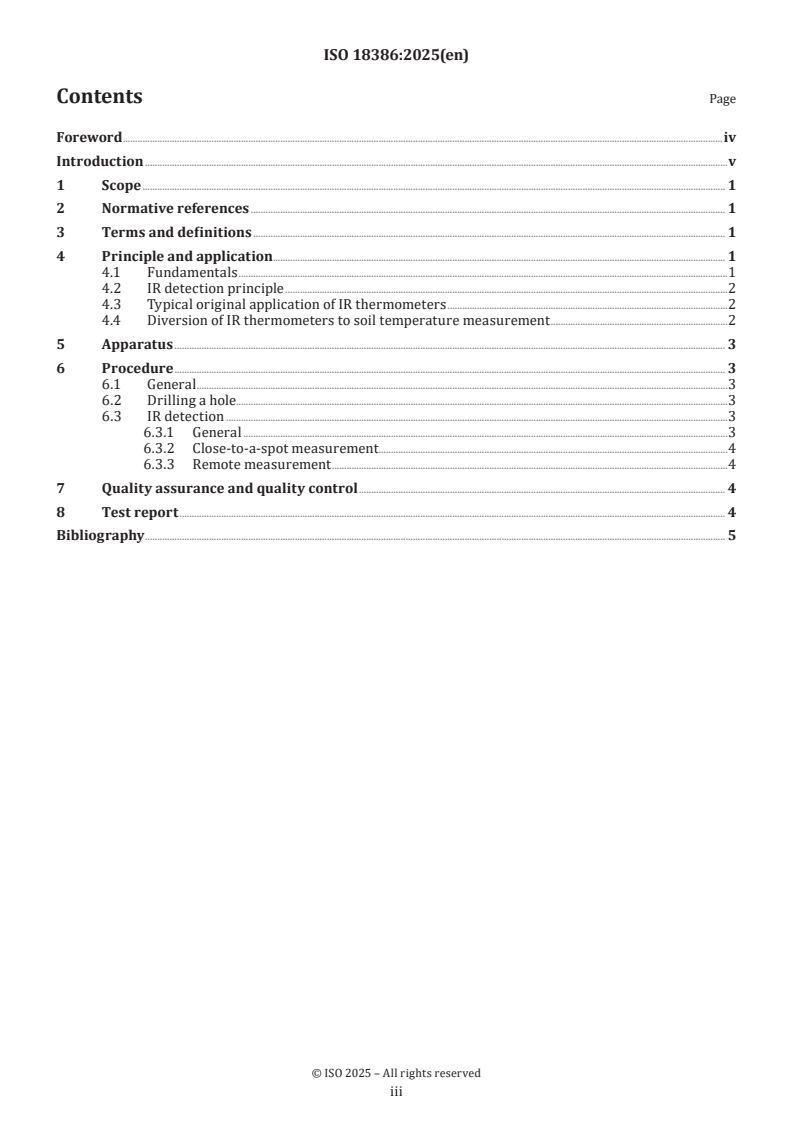
Contents Page
Foreword .iv
Introduction .v
1 Scope . 1
2 Normative references . 1
3 Terms and definitions . 1
4 Principle and application . . 1
4.1 Fundamentals .1
4.2 IR detection principle .2
4.3 Typical original application of IR thermometers .2
4.4 Diversion of IR thermometers to soil temperature measurement .2
5 Apparatus . 3
6 Procedure . 3
6.1 General .3
6.2 Drilling a hole.3
6.3 IR detection .3
6.3.1 General .3
6.3.2 Close-to-a-spot measurement . . .4
6.3.3 Remote measurement .4
7 Quality assurance and quality control . 4
8 Test report . 4
Bibliography . 5
iii
Foreword
ISO (the International Organization for Standardization) is a worldwide federation of national standards
bodies (ISO member bodies). The work of preparing International Standards is normally carried out through
ISO technical committees. Each member body interested in a subject for which a technical committee
has been established has the right to be represented on that committee. International organizations,
governmental and non-governmental, in liaison with ISO, also take part in the work. ISO collaborates closely
with the International Electrotechnical Commission (IEC) on all matters of electrotechnical standardization.
The procedures used to develop this document and those intended for its further maintenance are described
in the ISO/IEC Directives, Part 1. In particular, the different approval criteria needed for the different types
of ISO documents should be noted. This document was drafted in accordance with the editorial rules of the
ISO/IEC Directives, Part 2 (see www.iso.org/directives).
ISO draws attention to the possibility that the implementation of this document may involve the use of (a)
patent(s). ISO takes no position concerning the evidence, validity or applicability of any claimed patent
rights in respect thereof. As of the date of publication of this document, ISO had not received notice of (a)
patent(s) which may be required to implement this document. However, implementers are cautioned that
this may not represent the latest information, which may be obtained from the patent database available at
www.iso.org/patents. ISO shall not be held responsible for identifying any or all such patent rights.
Any trade name used in this document is information given for the convenience of users and does not
constitute an endorsement.
For an explanation of the voluntary nature of standards, the meaning of ISO specific terms and expressions
related to conformity assessment, as well as information about ISO’s adherence to the World Trade
Organization (WTO) principles in the Technical Barriers to Trade (TBT), see www.iso.org/iso/foreword.html.
This document was prepared by Technical Committee ISO/TC 190, Soil quality, Subcommittee SC 3, Chemical
and physical characterization.
Any feedback or questions on this document should be directed to the user’s national standards body. A
complete listing of these bodies can be found at www.iso.org/members.html.
iv
Introduction
Soil temperature gives useful information in the engineering and industrial fields, especially geology,
geotechnics, biology and agriculture. In recent years, climate change issues have been discussed globally,
including greenhouse gas emissions from soil. Microbial decomposition of organic matter contributes to
greenhouse gas emissions from soils, with the activity of the microbes and hence the rate or flux of these
emissions dependent on soil temperature. Hence the temperature of the soil can be an indirect indicator
of its risk of greenhouse gas emissions. Soil temperature directly affects the growth of plants. Optimum
temperatures or temperature ranges exist for plant germination, growth and ultimately yield.
The guidance document for measurement of soil temperature (ISO 4974) describes two approaches,
depending on the purpose of the investigation and the accuracy required. Conventional measurement is
applied where greater accuracy is needed, whereas quick measurements can be made (e.g. using an infrared
(IR) thermometer) where accuracy is not as critical, thus allowing to improve measurement efficiency (e.g.
measurement time per spot) in exchange for accuracy.
This document describes the principle of quick measurement for soil temperature applying infrared (IR)
detection, which is briefly introduced (without the measurement procedure descriptions) in ISO 4974 as one
of the soil temperature measurement methods. ISO 4974 contains general discussions about temperature
and its measurement principles, including what soil temperature is, why it is measured, by what kinds of
principles it can be measured and how measurement methods should be appropriately selected depending
on given soil temperature measurement purposes. This document describes the details of a specific soil
temperature measurement procedure using an IR thermometer and explains the measurement principle.
This method is positioned as one of the screening methods which have been developed under the concept
designated in ISO 12404, which is a general guidance document of screening methods.
v
International Standard ISO 18386:2025(en)
Soil quality — Screening method for soil temperature —
Measurement by infrared (IR) thermometer
1 Scope
This document specifies a method for quick measurement of soil temperature using an infrared (IR)
thermometer.
The method is applicable to a variety of technical fields, including geology, geotechnics, biology and
agricultural sciences, as well as climate change studies and metrological investigation.
NOTE The method designated in this document is recognized as a quick measurement in ISO 4974 and meets the
definition of screening method as designated in ISO 12404:2021, 3.2.
2 Normative references
There are no normative references in this document.
3 Terms and definitions
For the purposes of this document, the following terms and definitions apply.
ISO and IEC maintain terminology databases for use in standardization at the following addresses:
— ISO Online browsing platform: available at https:// www .iso .org/ obp
— IEC Electropedia: available at https:// www .electropedia .org/
3.1
soil temperature
temperature measured at a targeted spot in the soil or at the soil surface
Note 1 to entry: The temperature at a spot in the ground shallower than 300 mm is affected by the atmospheric
temperature. When mea
...