


ISO/PAS 22101-1:2022
(Main)Polyethylene reinforced with short glass fibres (PE-sGF) piping systems for industrial applications - Part 1: General
Polyethylene reinforced with short glass fibres (PE-sGF) piping systems for industrial applications - Part 1: General
This document specifies the general aspects of short glass fibre reinforced polyethylene (PE-sGF) piping systems, manufactured by the spiral cross winding method, which are used below ground for the conveyance of liquid fluids for the following industrial and agricultural uses: - chemical plants; - industrial sewerage engineering; - power engineering (cooling and general-purpose water supply); - agricultural production plants; - water treatment; - small hydraulic power plants (general-purpose water supply). In conjunction with the other parts of the ISO 22101 series, this document applies to PE-sGF pipes, fittings and their joints with each other, with other PE-sGF components, and to components from other materials intended for use under the following conditions: a) allowable operating pressure (PFA) up to and including 25 bar[1]; b) operating temperature of 20 °C as the reference temperature. NOTE For other operating temperatures, guidance is given in Annex A. Other application areas differing from those listed in the scope can be permitted if the requirements of this document and/or relevant national requirements are taken into account. Drinking water applications are outside the scope of this document. This document covers only PE-sGF using glass fibre with lengths comprised in the range between 3 mm and 5 mm. Components conforming to any of the documents listed in the Bibliography or to national standards, as applicable, can be used with components conforming to this document, provided that they conform to the requirements for joint dimensions and to the relevant requirements of this document. [1] 1 bar = 0,1 MPa = 105 Pa; 1 MPa = 1 N/mm2.
Systèmes de canalisations en polyéthylène renforcé de fibres de verre courtes (PE-sGF) pour les applications industrielles — Partie 1: Généralités
General Information
Overview
ISO/PAS 22101-1:2022 defines the general requirements for polyethylene reinforced with short glass fibres (PE‑sGF) piping systems intended for industrial and agricultural fluid conveyance. It covers PE‑sGF components manufactured by the spiral cross winding method and sets the basic material, geometric and service-condition parameters for pipes, fittings and joints used mainly below ground. The standard is part of the ISO 22101 series and is intended to be used alongside Parts addressing pipes, fittings and system fitness-for-purpose.
Key topics and technical requirements
- Material system: Requirements for PE compounds, short glass fibres (glass fibre length range specified), and coupling agents used to produce a PE‑sGF compound.
- Manufacture: Applies to pipes produced by the spiral cross winding method; geometric characteristics and production-specific parameters are defined (e.g., integrated socket and spigot fusion joints).
- Operating limits:
- Allowable operating pressure (PFA) up to and including 25 bar.
- Reference temperature of 20 °C (guidance for other operating temperatures is provided in an informative annex).
- Sizes and construction: Typical applicability to nominal inside diameters in the industrial range (document indicates applicability to pipes with ID from ~200 mm to 2000 mm).
- Compatibility and joints: Specifies joint dimension and compatibility requirements for PE‑sGF components used with other PE‑sGF parts or with components of other materials.
- Scope exclusions: Drinking water applications are excluded.
- Testing and classification: References relevant test methods (tensile, impact, density, fibre content/length, long‑term strength, ring stiffness, etc.) and defines terms such as SIDR, pipe series and wall thickness tolerances.
Practical applications and users
PE‑sGF piping systems standardized by ISO/PAS 22101-1 are targeted at industrial and agricultural fluid systems where higher stiffness and mechanical performance are required compared with unreinforced PE. Typical applications include:
- Chemical plants and process piping
- Industrial sewerage systems
- Power‑plant cooling and general water supply
- Agricultural production facilities
- Water treatment and related infrastructure
- Small hydraulic power plants (general-purpose water supply)
Primary users:
- Pipe and fittings manufacturers
- System designers and project engineers
- Procurement/specification writers for industrial plants
- Civil and mechanical contractors installing buried piping
- Test laboratories and conformity assessors
Related standards
ISO/PAS 22101-1 is intended to be used with other parts of the ISO 22101 series (e.g., Parts 2, 3 and 5). It also references established test and dimensional standards such as:
- ISO 4065 (pipe dimensions/SIDR conventions)
- ISO 11922‑1 (dimensions and tolerances)
- ISO 9969 / ISO 13967 (ring stiffness)
- Various ISO plastics test methods (ISO 527, ISO 1133, ISO 179‑1, ISO 22314)
Keywords: ISO/PAS 22101-1:2022, PE-sGF, polyethylene reinforced with short glass fibres, spiral cross winding, industrial piping systems, allowable operating pressure 25 bar, pipe fittings joints.
Standards Content (Sample)
DRAFT INTERNATIONAL STANDARD
ISO/DIS 22101-1
ISO/TC 138/SC 3 Secretariat: UNI
Voting begins on: Voting terminates on:
2020-07-22 2020-10-14
Polyethylene reinforced with short glass fibres (PE-sGF)
piping systems for industrial applications —
Part 1:
General
ICS: 23.040.01
THIS DOCUMENT IS A DRAFT CIRCULATED
FOR COMMENT AND APPROVAL. IT IS
THEREFORE SUBJECT TO CHANGE AND MAY
NOT BE REFERRED TO AS AN INTERNATIONAL
STANDARD UNTIL PUBLISHED AS SUCH.
IN ADDITION TO THEIR EVALUATION AS
BEING ACCEPTABLE FOR INDUSTRIAL,
This document is circulated as received from the committee secretariat.
TECHNOLOGICAL, COMMERCIAL AND
USER PURPOSES, DRAFT INTERNATIONAL
STANDARDS MAY ON OCCASION HAVE TO
BE CONSIDERED IN THE LIGHT OF THEIR
POTENTIAL TO BECOME STANDARDS TO
WHICH REFERENCE MAY BE MADE IN
Reference number
NATIONAL REGULATIONS.
ISO/DIS 22101-1:2020(E)
RECIPIENTS OF THIS DRAFT ARE INVITED
TO SUBMIT, WITH THEIR COMMENTS,
NOTIFICATION OF ANY RELEVANT PATENT
RIGHTS OF WHICH THEY ARE AWARE AND TO
©
PROVIDE SUPPORTING DOCUMENTATION. ISO 2020
ISO/DIS 22101-1:2020(E)
© ISO 2020
All rights reserved. Unless otherwise specified, or required in the context of its implementation, no part of this publication may
be reproduced or utilized otherwise in any form or by any means, electronic or mechanical, including photocopying, or posting
on the internet or an intranet, without prior written permission. Permission can be requested from either ISO at the address
below or ISO’s member body in the country of the requester.
ISO copyright office
CP 401 • Ch. de Blandonnet 8
CH-1214 Vernier, Geneva
Phone: +41 22 749 01 11
Fax: +41 22 749 09 47
Email: copyright@iso.org
Website: www.iso.org
Published in Switzerland
ii © ISO 2020 – All rights reserved
ISO/DIS 22101-1:2020(E)
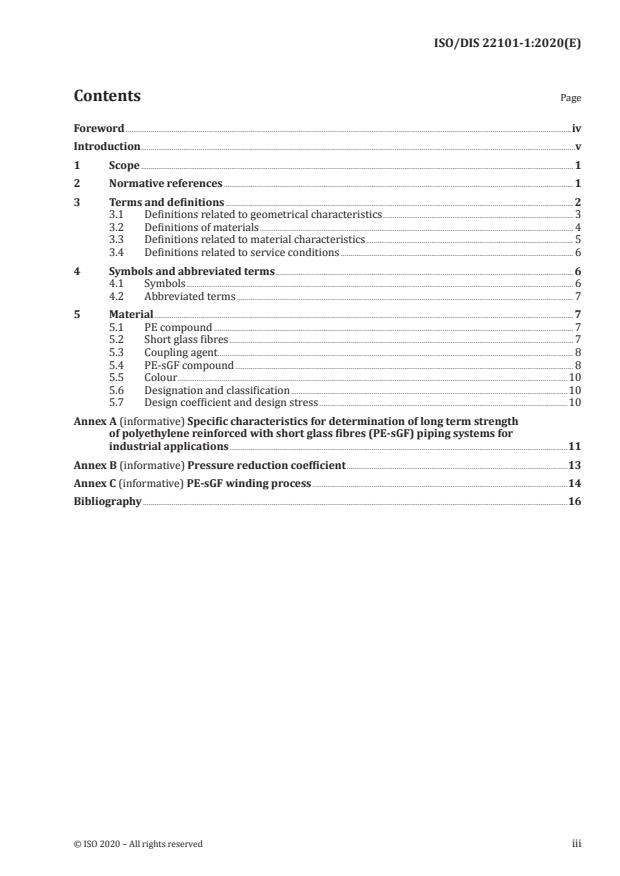
Contents Page
Foreword .iv
Introduction .v
1 Scope . 1
2 Normative references . 1
3 Terms and definitions . 2
3.1 Definitions related to geometrical characteristics . 3
3.2 Definitions of materials . 4
3.3 Definitions related to material characteristics . 5
3.4 Definitions related to service conditions . 6
4 Symbols and abbreviated terms . 6
4.1 Symbols . 6
4.2 Abbreviated terms . 7
5 Material . 7
5.1 PE compound . 7
5.2 Short glass fibres . 7
5.3 Coupling agent . 8
5.4 PE-sGF compound . 8
5.5 Colour .10
5.6 Designation and classification .10
5.7 Design coefficient and design stress .10
Annex A (informative) Specific characteristics for determination of long term strength
of polyethylene reinforced with short glass fibres (PE-sGF) piping systems for
industrial applications .11
Annex B (informative) Pressure reduction coefficient .13
Annex C (informative) PE-sGF winding process .14
Bibliography .16
ISO/DIS 22101-1:2020(E)
Foreword
ISO (the International Organization for Standardization) is a worldwide federation of national standards
bodies (ISO member bodies). The work of preparing International Standards is normally carried out
through ISO technical committees. Each member body interested in a subject for which a technical
committee has been established has the right to be represented on that committee. International
organizations, governmental and non-governmental, in liaison with ISO, also take part in the work.
ISO collaborates closely with the International Electrotechnical Commission (IEC) on all matters of
electrotechnical standardization.
The procedures used to develop this document and those intended for its further maintenance are
described in the ISO/IEC Directives, Part 1. In particular, the different approval criteria needed for the
different types of ISO documents should be noted. This document was drafted in accordance with the
editorial rules of the ISO/IEC Directives, Part 2 (see www .iso .org/ directives).
Attention is drawn to the possibility that some of the elements of this document may be the subject of
patent rights. ISO shall not be held responsible for identifying any or all such patent rights. Details of
any patent rights identified during the development of the document will be in the Introduction and/or
on the ISO list of patent declarations received (see www .iso .org/ patents).
Any trade name used in this document is information given for the convenience of users and does not
constitute an endorsement.
For an explanation of the voluntary nature of standards, the meaning of ISO specific terms and
expressions related to conformity assessment, as well as information about ISO's adherence to the
World Trade Organization (WTO) principles in the Technical Barriers to Trade (TBT), see www .iso .org/
iso/ foreword .html.
This document was prepared by Technical Committee ISO/TC 138, Plastics pipes, fittings and valves for
the transport of fluids, Subcommittee SC 03, Plastics pipes and fittings for industrial applications.
ISO 22101 consists of the following parts, under the general title Polyethylene reinforced with short glass
fibres (PE-sGF) piping systems for industrial applications
Part 1: General
Part 2: Pipes
Part 3: Fittings
Part 5: Fitness for purpose of the system
Any feedback or questions on this document should be directed to the user’s national standards body. A
complete listing of these bodies can be found at www .iso .org/ members .html.
iv © ISO 2020 – All rights reserved
ISO/DIS 22101-1:2020(E)
Introduction
The pipe systems which consist of pipes produced by adding short glass fibres into high density
polyethylene resins are called polyethylene reinforced with short glass fibres (PE-sGF) piping systems.
The physical and mechanical properties are influenced by short glass fibre orientation. This document
is applicable to pipe inside diameter from 200 mm to 2000 mm with integrated socket and spigot
fusion joint.
The technology of production of PE-sGF pipes is completely different than the traditional one, used
during the PE pipes extrusion, for this reason this document makes reference to SIDR. To prevent the
confusion, the parameter SDR, commonly used for PE products, has been deleted from the document.
The PE-sGF system is intended to be used for general purpose fluids supply (e.g.: chemical plants,
industrial sewerage engineering, power plants, agricultural production plants, water treatment).
For the material subject of this document the mechanical performances are obtained on the basis of
standards dedicated to thermoplastics, the geometrical characteristics are defined exclusively for this
material in analogy to ISO 4065 [1].
DRAFT INTERNATIONAL STANDARD ISO/DIS 22101-1:2020(E)
Polyethylene reinforced with short glass fibres (PE-sGF)
piping systems for industrial applications —
Part 1:
General
1 Scope
This International Standard specifies the general aspects of short glass fibre reinforced polyethylene
(PE-sGF) piping systems manufactured by spiral cross winding method used in above and below
ground for the conveyance of fluids for industrial and agricultural use shown below:
— Chemical plant;
— Industrial sewerage engineering;
— Power engineering (cooling and general-purpose water supply );
— Agricultural production plants;
— Water treatment;
— Small hydraulic power plant (general-purpose water supply);
In conjunction with the other parts of ISO 22101, it applies to PE-sGF pipes, fittings and their joints with
each other, with other PE-sGF components, and to components from other materials intended for use
under the following conditions:
a) allowable operating pressure (PFA) up to and including 25 bar;
b) operating temperature of 20°C as the reference temperature.
NOTE 1 For other operating temperature, guidance is given in Annex B
NOTE 2 If needed, national regulations for specific applications (e.g. water treatment) apply. This standard is
not applicable to drinking water application.
Other application areas are permitted if the requirements of this International Standard and/or
applicable national requirements are fulfilled.
National regulations in respect of fire behaviour and explosion risk are applicable. This document is
covering only PE-sGF using glass fibre with lengths comprised in the range between 2 and 5 mm.
Components conforming to any of the product standards listed in the bibliography or with national
standards, as applicable, may be used with components conforming to this International Standard,
provided that they conform to the requirements for joint dimensions and to the relevant requirements
of this International Standard.
2 Normative references
The following documents, in whole or in part, are normatively referenced in this document and are
indispensable for its application. For dated references, only the edition cited applies. For undated
references, the latest edition of the referenced document (including any amendments) applies.
ISO 3, Preferred numbers — Series of preferred numbers
ISO/DIS 22101-1:2020(E)
ISO 179-1, Plastics — Determination of Charpy impact properties — Part 1: Non-instrumented impact test
ISO 497, Guide to the choice of series of preferred numbers and of series containing more rounded values of
preferred numbers
ISO 527-1, Plastics — Determination of tensile properties — Part 1: General principles
ISO 1133-1, Plastics — Determination of the melt mass-flow rate (MFR) and melt volume-flow rate (MVR)
of thermoplastics — Part 1: Standard method
ISO 1183-1, Plastics — Methods for determining the density of non-cellular plastics — Part 1: Immersion
method, liquid pycnometer method and titration method
ISO 1183-2, Plastics — Methods for determining the density of non-cellular plastics — Part 2: Density
gradient column method
ISO 1887, Textile glass — Determination of combustible-matter content
ISO 1888, Textile glass — Staple fibres or filaments — Determination of average diameter
ISO 2078, Textile glass — Yarns — Designation
ISO 3344, Reinforcement products — Determination of moisture content
ISO 4427-1, Plastics piping systems for water supply and for drainage and sewerage under pressure —
Polyethylene (PE) — Part 1: General
ISO 6259-1, Thermoplastics pipes — Determination of tensile properties — Part 1: General test method
ISO 6259-3, Thermoplastics pipes — Determination of tensile properties — Part 3: Polyolefin pipes
ISO 7510, Plastics piping systems — Glass-reinforced plastics (GRP) components — Determination of the
amounts of constituents
ISO 11357-6, Plastics — Differential scanning calorimetry (DSC) — Part 6: Determination of oxidation
induction time (isothermal OIT) and oxidation induction temperature (dynamic OIT)
ISO 11922-1, Thermoplastics pipes for the conveyance of fluids — Dimensions and tolerances — Part 1:
Metric series
ISO 13479, Polyolefin pipes for the conveyance of fluids — Determination of resistance to crack
propagation — Test method for slow crack growth on notched pipes
ISO 15512, Plastics — Determination of water content
ISO 16770, Plastics — Determination of environmental stress cracking (ESC) of polyethylene — Full-notch
creep test (FNCT)
ISO 22314, Plastics — Glass-fibre-reinforced products — Determination of fibre length
3 Terms and definitions
For the purposes of this International Standard, the following definitions apply.
ISO and IEC maintain terminological databases for use in standardization at the following addresses:
— ISO Online browsing platform: available at https:// www .iso .org/ obp
— IEC Electropedia: available at http:// www .electropedia .org/
2 © ISO 2020 – All rights reserved
ISO/DIS 22101-1:2020(E)
3.1 Definitions related to geometrical characteristics
3.1.1
out-of-roundness
difference between the maximum and the minimum inside diameters in the same cross-section of a
pipe or spigot
3.1.2
nominal wall thickness
e
n
numerical designation of the wall thickness of a component, which is a convenient round number,
approximately equal to the manufacturing dimension in millimetres (mm), corresponding to the
minimum wall thickness, e
min
3.1.3
wall thickness at any point
e
measured wall thickness at any point around the circumference of a component, rounded up to the
nearest 0,1 mm
3.1.4
pipe series
S
i
dimensionless number for pipe designation conforming the following formula:
SIDR+1
S
i=
Note 1 to entry: The relationship between the pipe series, S , and the standard inside dimension ratio, SIDR, is
i
given by the following formula as derived from ISO 4065.
3.1.5
standard inside dimension ratio
SIDR
ratio of the nominal inside diameter, d , of a pipe to its nominal wall thickness, e
i n
Note 1 to entry: The standard inside dimension ratio SIDR and the pipe series S are related as shown in the
formula :
SIDR=−21S
i
3.1.6
nominal size
DN/ID
numerical designation of the size of a component related to the inside diameter, other than a component
designated by a thread size, which is a convenient round number, approximately equal to the
manufacturing dimension in millimetres (mm)
3.1.7
nominal inside diameter
d
in
specified inside diameter, in millimetres, assigned to a nominal size DN/ID
3.1.8
inside diameter at any point
d
i
value of the measurement of the inside diameter through its cross-section at any point of the pipe,
except the socket, rounded to the next greater 0,1 mm
ISO/DIS 22101-1:2020(E)
3.1.9
mean inside diameter
d
im
value of the measurement of the inner circumference of the pipe in any cross section, except the socket,
divided by π (= 3,142), rounded to the next greater 0,1 mm
3.1.10
ring stiffness
mechanical characteristic of a pipe or fitting which is a measure of the resistance to ring deflection
under an external force as determined in accordance with ISO 9969 (for pipes) and ISO 13967 (for
fittings)
3.1.11
ring stiffness class
SN
numerical designation of the ring stiffness of the pipe or fitting which is a convenient round number,
indicating the minimum required ring stiffness of the pipe or fitting
3.1.12
minimum wall thickness at any point
e
min
minimum value of the wall thickness at any point around the circumference of a component as specified
3.1.13
maximum wall thickness at any point
e
max
maximum value of the wall thickness at any point around the circumference of a component as specified
3.1.14
mean wall thickness
e
m
arithmetic mean of a number of measurements regularly spaced around the circumference of the
compo
...
PUBLICLY ISO/PAS
AVAILABLE 22101-1
SPECIFICATION
First edition
2022-06
Polyethylene reinforced with short
glass fibres (PE-sGF) piping systems
for industrial applications —
Part 1:
General
Systèmes de canalisations en polyéthylène renforcé de fibres de verre
courtes (PE-sGF) pour les applications industrielles —
Partie 1: Généralités
Reference number
© ISO 2022
All rights reserved. Unless otherwise specified, or required in the context of its implementation, no part of this publication may
be reproduced or utilized otherwise in any form or by any means, electronic or mechanical, including photocopying, or posting on
the internet or an intranet, without prior written permission. Permission can be requested from either ISO at the address below
or ISO’s member body in the country of the requester.
ISO copyright office
CP 401 • Ch. de Blandonnet 8
CH-1214 Vernier, Geneva
Phone: +41 22 749 01 11
Email: copyright@iso.org
Website: www.iso.org
Published in Switzerland
ii
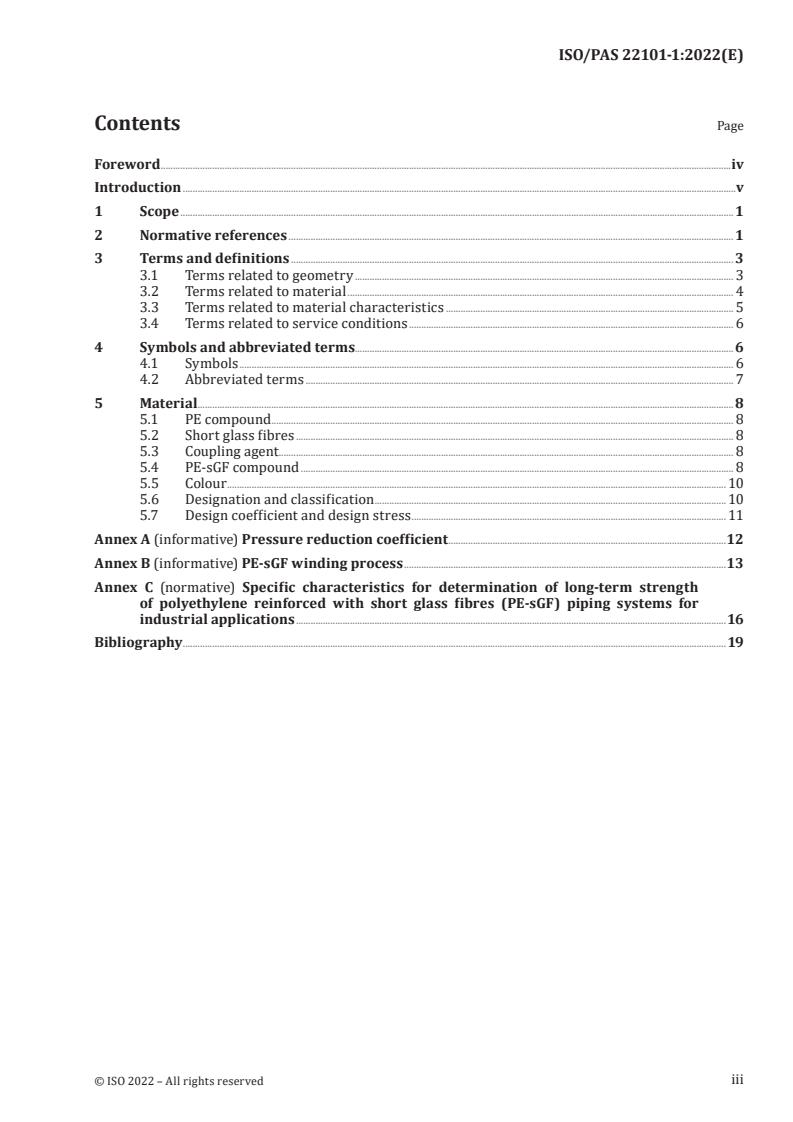
Contents Page
Foreword .iv
Introduction .v
1 Scope . 1
2 Normative references . 1
3 Terms and definitions . 3
3.1 Terms related to geometry . 3
3.2 Terms related to material . 4
3.3 Terms related to material characteristics . 5
3.4 Terms related to service conditions . 6
4 Symbols and abbreviated terms.6
4.1 Symbols . 6
4.2 Abbreviated terms . 7
5 Material. 8
5.1 PE compound. 8
5.2 Short glass fibres . 8
5.3 Coupling agent . . 8
5.4 PE-sGF compound . 8
5.5 Colour . 10
5.6 Designation and classification . 10
5.7 Design coefficient and design stress . 11
Annex A (informative) Pressure reduction coefficient .12
Annex B (informative) PE-sGF winding process .13
Annex C (normative) Specific characteristics for determination of long-term strength
of polyethylene reinforced with short glass fibres (PE-sGF) piping systems for
industrial applications .16
Bibliography .19
iii
Foreword
ISO (the International Organization for Standardization) is a worldwide federation of national standards
bodies (ISO member bodies). The work of preparing International Standards is normally carried out
through ISO technical committees. Each member body interested in a subject for which a technical
committee has been established has the right to be represented on that committee. International
organizations, governmental and non-governmental, in liaison with ISO, also take part in the work.
ISO collaborates closely with the International Electrotechnical Commission (IEC) on all matters of
electrotechnical standardization.
The procedures used to develop this document and those intended for its further maintenance are
described in the ISO/IEC Directives, Part 1. In particular, the different approval criteria needed for the
different types of ISO documents should be noted. This document was drafted in accordance with the
editorial rules of the ISO/IEC Directives, Part 2 (see www.iso.org/directives).
Attention is drawn to the possibility that some of the elements of this document may be the subject of
patent rights. ISO shall not be held responsible for identifying any or all such patent rights. Details of
any patent rights identified during the development of the document will be in the Introduction and/or
on the ISO list of patent declarations received (see www.iso.org/patents).
Any trade name used in this document is information given for the convenience of users and does not
constitute an endorsement.
For an explanation of the voluntary nature of standards, the meaning of ISO specific terms and
expressions related to conformity assessment, as well as information about ISO's adherence to
the World Trade Organization (WTO) principles in the Technical Barriers to Trade (TBT), see
www.iso.org/iso/foreword.html.
This document was prepared by Technical Committee ISO/TC 138, Plastics pipes, fittings and valves for
the transport of fluids, Subcommittee SC 3, Polyethylene reinforced with short glass fibres (PE-sGF) piping
systems for industrial applications.
A list of all parts in the ISO 22101 series can be found on the ISO website.
Any feedback or questions on this document should be directed to the user’s national standards body. A
complete listing of these bodies can be found at www.iso.org/members.html.
iv
Introduction
Polyethylene reinforced with short glass fibres (PE-sGF) piping systems are pipe systems which consist
of pipes produced by adding short glass fibres into high density polyethylene resins. Their physical and
mechanical properties are influenced by short glass fibre orientation.
The technology of production of PE-sGF pipes is completely different from that traditionally used during
PE pipes extrusion. For this reason, this document makes reference to standard inside diameter ratio
(SIDR) sized pipe. To prevent the confusion, the standard dimension radio (SDR) size pipe, commonly
used for PE products, is not used in this document.
The PE-sGF system is intended to be used for general purpose liquid fluids supply (e.g. chemical plants,
industrial sewerage engineering, power plants, agricultural production plants, water treatment).
For the material subject of this document, the mechanical performances are obtained on the basis of
International Standards dedicated to thermoplastics. The geometrical characteristics are defined
exclusively for this material in line with ISO 3 and ISO 4065.
v
PUBLICLY AVAILABLE SPECIFICATION ISO/PAS 22101-1:2022(E)
Polyethylene reinforced with short glass fibres (PE-sGF)
piping systems for industrial applications —
Part 1:
General
1 Scope
This document specifies the general aspects of short glass fibre reinforced polyethylene (PE-sGF)
piping systems, manufactured by the spiral cross winding method, which are used below ground for
the conveyance of liquid fluids for the following industrial and agricultural uses:
— chemical plants;
— industrial sewerage engineering;
— power engineering (cooling and general-purpose water supply);
— agricultural production plants;
— water treatment;
— small hydraulic power plants (general-purpose water supply).
In conjunction with the other parts of the ISO 22101 series, this document applies to PE-sGF pipes,
fittings and their joints with each other, with other PE-sGF components, and to components from other
materials intended for use under the following conditions:
1)
a) allowable operating pressure (PFA) up to and including 25 bar ;
b) operating temperature of 20 °C as the reference temperature.
NOTE For other operating temperatures, guidance is given in Annex A.
Other application areas differing from those listed in the scope can be permitted if the requirements
of this document and/or relevant national requirements are taken into account. Drinking water
applications are outside the scope of this document.
This document covers only PE-sGF using glass fibre with lengths comprised in the range between 3 mm
and 5 mm.
Components conforming to any of the documents listed in the Bibliography or to national standards, as
applicable, can be used with components conforming to this document, provided that they conform to
the requirements for joint dimensions and to the relevant requirements of this document.
2 Normative references
The following documents are referred to in the text in such a way that some or all of their content
constitutes requirements of this document. For dated references, only the edition cited applies. For
undated references, the latest edition of the referenced document (including any amendments) applies.
ISO 179-1, Plastics — Determination of Charpy impact properties — Part 1: Non-instrumented impact test
5 2
1) 1 bar = 0,1 MPa = 10 Pa; 1 MPa = 1 N/mm .
ISO 527-1, Plastics — Determination of tensile properties — Part 1: General principles
ISO 1133-1, Plastics — Determination of the melt mass-flow rate (MFR) and melt volume-flow rate (MVR)
of thermoplastics — Part 1: Standard method
ISO 1167-1, Thermoplastics pipes, fittings and assemblies for the conveyance of fluids — Determination of
the resistance to internal pressure — Part 1: General method
ISO 1167-2, Thermoplastics pipes, fittings and assemblies for the conveyance of fluids — Determination of
the resistance to internal pressure — Part 2: Preparation of pipe test pieces
ISO 1183-1, Plastics — Methods for determining the density of non-cellular plastics — Part 1: Immersion
method, liquid pycnometer method and titration method
ISO 1183-2, Plastics — Methods for determining the density of non-cellular plastics — Part 2: Density
gradient column method
ISO 1887, Textile glass — Determination of combustible-matter content
ISO 1888, Textile glass — Staple fibres or filaments — Determination of average diameter
ISO 2078, Textile glass — Yarns — Designation
ISO 3344, Reinforcement products — Determination of moisture content
ISO 4427-1, Plastics piping systems for water supply and for drainage and sewerage under pressure —
Polyethylene (PE) — Part 1: General
ISO 6259-1, Thermoplastics pipes — Determination of tensile properties — Part 1: General test method
ISO 6259-3, Thermoplastics pipes — Determination of tensile properties — Part 3: Polyolefin pipes
ISO 7510, Plastics piping systems — Glass-reinforced plastics (GRP) components — Determination of the
amounts of constituents
ISO 9080, Plastics piping and ducting systems — Determination of the long-term hydrostatic strength of
thermoplastics materials in pipe form by extrapolation
ISO 9969, Thermoplastics pipes — Determination of ring stiffness
ISO 11357-6, Plastics — Differential scanning calorimetry (DSC) — Part 6: Determination of oxidation
induction time (isothermal OIT) and oxidation induction temperature (dynamic OIT)
ISO 12162, Thermoplastics materials for pipes and fittings for pressure applications — Classification,
designation and design coefficient
ISO 13479, Polyolefin pipes for the conveyance of fluids — Determination of resistance to crack propagation
— Test method for slow crack growth on notched pipes
ISO 13967, Thermoplastics fittings — Determination of ring stiffness
ISO 15512, Plastics — Determination of water content
ISO 15853, Thermoplastics materials — Preparation of tubular test pieces for the determination of the
hydrostatic strength of materials used for injection moulding
ISO 16770, Plastics — Determination of environmental stress cracking (ESC) of polyethylene — Full-notch
creep test (FNCT)
ISO 22314, Plastics — Glass-fibre-reinforced products — Determination of fibre length
3 Terms and definitions
For the purposes of this document, the following terms and definitions apply.
ISO and IEC maintain terminology databases for use in standardization at the following addresses:
— ISO Online browsing platform: available at https:// www .iso .org/ obp
— IEC Electropedia: available at https:// www .electropedia .org/
3.1 Terms related to geometry
3.1.1
nominal wall thickness
e
n
numerical designation of the wall thickness of a component, which is a convenient round number,
approximately equal to the manufacturing dimension in millimetres, corresponding to the minimum
wall thickness, e
min
3.1.2
wall thickness at any point
e
measured wall thickness at any point around the circumference of a component, rounded up to the
nearest 0,1 mm
3.1.3
mean wall thickness
e
m
arithmetic mean of a number of measurements regularly spaced around the circumference of the
component in the same cross-section of the component, including the measured minimum and the
measured maximum values of the wall thickness
3.1.4
pipe series
S
i
dimensionless number for pipe designation in accordance with the following formula:
R +1
SID
S =
i
where R is the standard inside dimension ratio (SIDR), and S is the pipe designation
SID i
Note 1 to entry: The relationship between the pipe series, S , and the standard inside dimension ratio (SIDR), is
i
given in 3.1.5.
3.1.5
standard inside dimension ratio
SIDR
R
SID
ratio of the nominal inside diameter, d , of a pipe to its nominal wall thickness, e
i n
Note 1 to entry: The standard inside dimension ratio (SIDR) and the pipe series, S , are related as shown in the
i
following formula, where R is the SIDR:
SID
RS=−21
SID i
3.1.6
nominal size
DN/ID
numerical designation of the size of a component related to the inside diameter, other than a component
designated by a thread size, which is a convenient round number, approximately equal to the
manufacturing dimension in millimetres
3.1.7
nominal inside diameter
d
in
specified inside diameter, in millimetres, assigned to a nominal size, DN/ID
3.1.8
inside diameter at any point
d
i
value of the measurement of the inside diameter through its cross-section at any point of the pipe,
except the socket, rounded to the next greater 0,1 mm
3.1.9
mean inside diameter
d
im
value of the measurement of the inner circumference of the pipe in any cross-section, except the socket,
divided by π (= 3,142), rounded to the next greater 0,1 mm
3.1.10
ring stiffness
mechanical characteristic of a pipe or fitting which is a measure of the resistance to ring deflection
under an external force
Note 1 to entry: For the purposes of this document, the external force shall be determined in accordance with
ISO 9969 (for pipes) and ISO 13967 (for fittings).
3.2 Terms related to material
3.2.1
virgin material
material in a form such as granules that has not been subjected to use or processing other than that
required for its manufacture and to which no reprocessable or recyclable materials have been added
3.2.2
PE-sGF compound
compound (compound, short glass fibre and coupling agent) from which the pipes and fittings are
produced
Note 1 to entry: This material is made by adding to the PE compound glass fibre and those additives necessary
for the manufacture and end use of the products, in accordance with the requirements of the applicable part of
this document.
3.2.3
short glass fibre
chopped glass fibre with a low length to diameter aspect ratio
Note 1 to entry: Short glass fibres used for the production of PE-sGF compound can be either alumina-boro-
silicate glass or alumina-talco-silicate glass in the form of chopped strands.
3.2.4
coupling agent
substance used in small proportions to increase the adhesion to specific substrates
3.3 Terms related to material characteristics
3.3.1
lower confidence limit of the predicted hydrostatic strength
σ
LPL
quantity, with the dimensions of stress, which represents the 97,5 % lower confidence limit of the
predicted hydrostatic strength at a temperature and time.
Note 1 to entry: It is expressed in megapascals (MPa).
3.3.2
minimum required strength
MRS
F
r,min
value of the lower confidence limit σ at 20 °C and 50 years rounded down to the next value in the R10
LPL
series as defined in ISO 3 when σ is less than 20 MPa or down to the next value in the R20 series as
LPL
defined in ISO 3 when σ is greater than or equal to 20 MPa
LPL
Note 1 to entry: The minimum required strength is expressed in m
...
Frequently Asked Questions
ISO/PAS 22101-1:2022 is a technical specification published by the International Organization for Standardization (ISO). Its full title is "Polyethylene reinforced with short glass fibres (PE-sGF) piping systems for industrial applications - Part 1: General". This standard covers: This document specifies the general aspects of short glass fibre reinforced polyethylene (PE-sGF) piping systems, manufactured by the spiral cross winding method, which are used below ground for the conveyance of liquid fluids for the following industrial and agricultural uses: - chemical plants; - industrial sewerage engineering; - power engineering (cooling and general-purpose water supply); - agricultural production plants; - water treatment; - small hydraulic power plants (general-purpose water supply). In conjunction with the other parts of the ISO 22101 series, this document applies to PE-sGF pipes, fittings and their joints with each other, with other PE-sGF components, and to components from other materials intended for use under the following conditions: a) allowable operating pressure (PFA) up to and including 25 bar[1]; b) operating temperature of 20 °C as the reference temperature. NOTE For other operating temperatures, guidance is given in Annex A. Other application areas differing from those listed in the scope can be permitted if the requirements of this document and/or relevant national requirements are taken into account. Drinking water applications are outside the scope of this document. This document covers only PE-sGF using glass fibre with lengths comprised in the range between 3 mm and 5 mm. Components conforming to any of the documents listed in the Bibliography or to national standards, as applicable, can be used with components conforming to this document, provided that they conform to the requirements for joint dimensions and to the relevant requirements of this document. [1] 1 bar = 0,1 MPa = 105 Pa; 1 MPa = 1 N/mm2.
This document specifies the general aspects of short glass fibre reinforced polyethylene (PE-sGF) piping systems, manufactured by the spiral cross winding method, which are used below ground for the conveyance of liquid fluids for the following industrial and agricultural uses: - chemical plants; - industrial sewerage engineering; - power engineering (cooling and general-purpose water supply); - agricultural production plants; - water treatment; - small hydraulic power plants (general-purpose water supply). In conjunction with the other parts of the ISO 22101 series, this document applies to PE-sGF pipes, fittings and their joints with each other, with other PE-sGF components, and to components from other materials intended for use under the following conditions: a) allowable operating pressure (PFA) up to and including 25 bar[1]; b) operating temperature of 20 °C as the reference temperature. NOTE For other operating temperatures, guidance is given in Annex A. Other application areas differing from those listed in the scope can be permitted if the requirements of this document and/or relevant national requirements are taken into account. Drinking water applications are outside the scope of this document. This document covers only PE-sGF using glass fibre with lengths comprised in the range between 3 mm and 5 mm. Components conforming to any of the documents listed in the Bibliography or to national standards, as applicable, can be used with components conforming to this document, provided that they conform to the requirements for joint dimensions and to the relevant requirements of this document. [1] 1 bar = 0,1 MPa = 105 Pa; 1 MPa = 1 N/mm2.
ISO/PAS 22101-1:2022 is classified under the following ICS (International Classification for Standards) categories: 23.040.01 - Pipeline components and pipelines in general. The ICS classification helps identify the subject area and facilitates finding related standards.
You can purchase ISO/PAS 22101-1:2022 directly from iTeh Standards. The document is available in PDF format and is delivered instantly after payment. Add the standard to your cart and complete the secure checkout process. iTeh Standards is an authorized distributor of ISO standards.
記事タイトル:ISO/PAS 22101-1:2022 - 短繊維ガラス強化ポリエチレン(PE-sGF)パイピングシステム(産業用)- 第1部:一般 記事内容:本文書は、スパイラルクロスワインディング法によって製造される短繊維ガラス強化ポリエチレン(PE-sGF)パイピングシステムの一般的な側面を特定しています。これらのシステムは地下で使用され、液体流体の輸送に用いられます。産業および農業用途としては、化学プラント、産業排水処理、電力エンジニアリング(冷却および一般的な水供給)、農業生産プラント、水処理、小規模水力発電所(一般的な水供給)などがあります。この文書はISO 22101シリーズの他のパートと組み合わせることで、PE-sGFパイプ、継手、およびそれらの各部品と、他のPE-sGFコンポーネント、および他の材料製のコンポーネントに適用されます。以下の条件下で使用することを前提としています:a)許容運転圧力(PFA)が25バール以下であること[1]、b)参照温度として20℃の運転温度です。なお、その他の運転温度については、付録Aにガイダンスが示されています。本文書の範囲には含まれていない他の応用分野については、本文書および/または関連する国内要件を考慮することで許可される場合があります。飲料水の応用は、本文書の範囲外です。また、本文書は長さが3mmから5mmのガラス繊維を使用するPE-sGFにのみ適用されます。文献目録に掲載された文書または該当する国内標準に適合する部品は、この文書に適合する条件(継手寸法の要件など)と関連する要件を満たしている場合、この文書に適合する部品と共に使用することができます。[1] 1バール=0.1 MPa=105 Pa;1 MPa=1N/mm2。
ISO/PAS 22101-1:2022 is a document that outlines the general aspects of polyethylene reinforced with short glass fibres (PE-sGF) piping systems for industrial applications. These piping systems are manufactured using the spiral cross winding method and are designed to be used underground for the conveyance of liquid fluids in various industries such as chemical plants, industrial sewerage engineering, power engineering, agricultural production plants, water treatment, and small hydraulic power plants. The document applies to PE-sGF pipes, fittings, and joints for use under certain conditions, including an allowable operating pressure of up to 25 bar and an operating temperature of 20 °C. It should be noted that this document does not cover drinking water applications and only includes PE-sGF with glass fibres ranging from 3 mm to 5 mm in length. Components from other standards can be used with components conforming to this document as long as they meet the requirements for joint dimensions and relevant specifications.
記事のタイトル:ISO/PAS 22101-1:2022 - 短繊維ガラス強化ポリエチレン(PE-sGF)配管システムの産業応用に関する一般について 記事の内容:この文書は、らせん交巻法で製造される短繊維ガラス強化ポリエチレン(PE-sGF)配管システムの一般的な側面を規定しています。これらの配管システムは、化学プラント、産業排水工学、電力工学(冷却および一般用水供給)、農業生産プラント、水処理、小規模水力発電所(一般用水供給)など、以下の産業および農業用途で地下で使用されることを目的としています。この文書は、ISO 22101シリーズの他の部分と組み合わせて、PE-sGFパイプ、フィッティング、およびそれらの継手に適用され、それらが他のPE-sGFコンポーネントと、および他の材料のコンポーネントとの間の接続に適している場合に使用されます。次の条件下での使用が想定されています:a) 許容運転圧力(PFA)は25バール以下[1];b) 参照温度としての20℃での運転温度。ただし、その他のスコープに含まれない応用分野は、本文書の要件および/または関連する国内要件を考慮することで許可される場合があります。本文書は、飲料水の応用は対象外とし、短繊維ガラスの長さが3mmから5mmの範囲に収まるPE-sGFに限定しています。参考文献にリストされている文書または国内標準に適合するコンポーネントは、本文書の関節寸法の要件および関連要件を満たす場合、本文書に準拠するコンポーネントと共に使用することができます。[1] 1バール=0.1MPa=105Pa;1MPa=1N/mm2。
ISO/PAS 22101-1:2022 is a document that outlines the specifications for polyethylene reinforced with short glass fibres (PE-sGF) piping systems used in industrial applications. The document focuses on the general aspects of these piping systems, which are manufactured using the spiral cross winding method and are designed for below-ground use. Some of the industrial and agricultural uses for these systems include chemical plants, industrial sewerage engineering, power engineering, agricultural production plants, water treatment, and small hydraulic power plants. The document applies to PE-sGF pipes, fittings, and their joints, as well as other components intended for use under specific conditions, such as an allowable operating pressure of up to 25 bar and an operating temperature of 20 °C. The document also provides guidance for other operating temperatures. Drinking water applications are not covered by this document. Additionally, the document specifies that the length of the glass fibre used should be between 3 mm and 5 mm. Components from other standards can be used in conjunction with components conforming to this document as long as they meet the requirements for joint dimensions and relevant specifications.
제목: ISO/PAS 22101-1:2022 - 단유리섬유로 강화된 폴리에틸렌(PE-sGF) 파이프 시스템 (제1부: 일반) 내용: 이 문서는 나선식 교차 감기 방법으로 제조되는 단유리섬유로 강화된 폴리에틸렌(PE-sGF) 파이프 시스템의 일반 측면을 규정한다. 이 파이프 시스템은 다음과 같은 산업 및 농업용 용도를 위해 지하에서 액체 유체를 운반하기 위해 사용된다: - 화학 공장; - 산업 폐수 공학; - 전력 공학 (냉각 및 일반용 수 공급); - 농업 생산 공장; - 수처리; - 소형 수력 발전소 (일반용 수 공급). ISO 22101 시리즈의 다른 부분과 함께, 이 문서는 PE-sGF 파이프, 피팅 및 서로의 연결부분, 다른 PE-sGF 구성 요소와 함께 사용하기 위한 것이며, 다음 조건 하에서 사용하기 위한 것이다: a) 허용 작동 압력(PFA) 최대 25바[1]; b) 참조 온도로서의 20°C 작동 온도. 기타 스코프에 나열되지 않은 응용 분야는 해당 문서 요구 사항 및/또는 관련 국가 요구 사항을 고려할 경우 허용될 수 있다. 이 문서는 음용수 응용 분야를 다루지 않는다. 이 문서는 유리섬유 길이가 3mm에서 5mm 사이인 PE-sGF만 다룬다. 서지에 나열된 문서 또는 해당 국가 표준을 준수하는 구성 요소는 이 문서의 연결 부분 요구 사항과 관련 요구 사항을 충족하는 한, 이 문서와 함께 사용될 수 있다. [1] 1바 = 0.1MPa = 105Pa; 1MPa = 1N/mm2.
기사 제목: ISO/PAS 22101-1:2022 - 단면유리섬유로 강화된 폴리에틸렌(PE-sGF) 적용 산업용 배관 시스템 - 제1부: 일반 기사 내용: 이 문서는 나선형 교차감기 방법으로 제조되는 단면유리섬유로 강화된 폴리에틸렌(PE-sGF) 배관 시스템의 일반 측면을 명시한다. 이러한 시스템은 지하에서 액체 유체를 운반하기 위해 다음과 같은 산업 및 농업용으로 사용된다: - 화학 공장, - 산업 하수도 공학, - 발전 공학(냉각 및 일반용 수 공급), - 농산물 생산 공장, - 수처리, - 소형 수력 발전소(일반용 수 공급). 이 문서는 ISO 22101 시리즈의 다른 부분과 함께, PE-sGF 파이프, 피팅 및 그들의 연결부에 적용된다. 그리고 다른 PE-sGF 구성 요소와, 다른 재료로 만들어진 구성 요소에도 해당된다. 사용 조건은 다음과 같다: a) 허용 작동 압력(PFA)은 25 bar를 포함하여 이하여야 한다[1]. b) 참조 온도로서의 20 °C의 운영 온도. 참고로, 다른 운영 온도에 대해서는 부록 A에서 안내를 제공한다. 범위에 나열되지 않은 다른 응용 분야는 해당 문서의 요구사항과/또는 관련 국가 요구사항을 고려할 경우 허용할 수 있다. 이 문서는 음료수 응용 분야를 다루지 않는다. 이 문서는 길이가 3mm에서 5mm 사이에 있는 유리섬유를 사용한 PE-sGF에만 해당한다. 서지에 열거된 문서나 해당 국가 표준을 준수하는 구성 요소는 이 문서의 관련 요구사항과 연결 부분에 대한 요구사항을 준수한다면, 이 문서를 준수하는 구성 요소와 함께 사용할 수 있다. [1] 1 bar = 0.1 MPa = 105 Pa; 1 MPa = 1 N/mm2.
Questions, Comments and Discussion
Ask us and Technical Secretary will try to provide an answer. You can facilitate discussion about the standard in here.
Loading comments...