

ISO/TS 5660-4:2016
(Main)Reaction-to-fire tests — Heat release, smoke production and mass loss rate — Part 4: Measurement of low levels of heat release
General Information
- Abstract
ISO/TS 5660-4:2016 specifies a method for evaluating materials and products that produce low levels of heat release when exposed to high irradiance levels typical of fully developed fires. It differs from ISO 5660‑1 by prescribing items such as specific specimen size, specimen holder, specimen orientation, volumetric flow rate for O2 analyses and irradiance levels at which testing is conducted. The test method described in this document is intended for use on products and materials that contain only small amounts of combustible elements, e.g. test specimens that yield a total heat release of 0,75 MJ/m2 to 15 MJ/m2.
- Status
- Published
- Publication Date
- 07-Dec-2016
- Technical Committee
- ISO/TC 92/SC 1 - Fire initiation and growth
- Drafting Committee
- ISO/TC 92/SC 1/WG 5 - Small and bench scale fire test methods
- Current Stage
- 9093 - International Standard confirmed
- Start Date
- 16-Jan-2024
- Completion Date
- 29-Aug-2026
Buy Documents

ISO/TS 5660-4:2016 - Reaction-to-fire tests — Heat release, smoke production and mass loss rate — Part 4: Measurement of low levels of heat release Released:12/8/2016

ISO/TS 5660-4:2016 - Reaction-to-fire tests — Heat release, smoke production and mass loss rate — Part 4: Measurement of low levels of heat release/8/2016
Overview
ISO/TS 5660-4:2016 - Reaction-to-fire tests - Part 4: Measurement of low levels of heat release - specifies a cone-calorimeter based method for evaluating materials and products that produce low levels of heat release when exposed to high irradiance typical of fully developed fires. The technical specification is targeted at specimens that yield a total heat release of about 0.75 MJ/m² to 15 MJ/m² and complements ISO 5660‑1 by prescribing specimen size, holder, orientation, volumetric flow for O2 analysis and the irradiance conditions for testing.
This method uses the oxygen-consumption principle (heat release calculated from measured O2 depletion) and provides standardized procedures for apparatus, calibration, test environment, data collection and reporting.
Key Topics and Requirements
- Scope and suitability: Intended for products with only small amounts of combustible elements; not suitable for materials with moderate-to-high heat release (those are covered by ISO 5660‑1).
- Apparatus and setup: Cone-shaped radiant electrical heater, radiation shield, specimen holder and retainer frame, weighing device, exhaust duct and flow metering, gas sampling and oxygen analyser, heat flux meters, calibration burner, and data acquisition system.
- Specimen preparation: Defined specimen construction, conditioning and wrapping rules to ensure repeatable low-level heat-release measurements.
- Test conditions: Prescribed irradiance levels, specimen orientation and volumetric flow rates for O2 analysis to reliably capture low heat-release behavior under high radiant flux.
- Calibration and accuracy: Procedures for initial and operating calibrations (weighing response, oxygen analyser delay/noise/drift, heat flux meter calibration and calibration burner checks) and guidance on measurement linearity and limits.
- Data and calculations: Calculation methods for heat release rate by oxygen consumption, mass loss rate, exhaust mass flow, and reporting of test limitations.
- Safety: Warnings about high temperatures, combustion products and the need to pre-screen specimens (e.g., small 100 × 100 mm test per ISO 5660‑1) to avoid hazardous conditions.
Applications and Users
ISO/TS 5660-4:2016 is used by:
- Fire test laboratories for standardized measurement of low heat-release materials.
- Manufacturers and product developers assessing low-combustibility finishes, insulation, coatings, and composites.
- Fire safety engineers and consultants for fire performance data to inform risk assessments and engineering designs.
- Regulators and certification bodies for conformity assessment, product classification and regulatory compliance.
- Research institutions studying combustion behavior and material flame retardance at low heat-release regimes.
Keywords: ISO/TS 5660-4:2016, reaction-to-fire tests, heat release, cone calorimeter, low levels of heat release, oxygen consumption, smoke production, mass loss rate, irradiance.
Related Standards
- ISO 5660-1:2015 - Heat release rate (cone calorimeter method)
- ISO 5660-3 - Guidance on measurement
- ISO 291 and ISO 554 - Conditioning and standard atmospheres for testing
Buy Documents
ISO/TS 5660-4:2016 - Reaction-to-fire tests — Heat release, smoke production and mass loss rate — Part 4: Measurement of low levels of heat release Released:12/8/2016
ISO/TS 5660-4:2016 - Reaction-to-fire tests — Heat release, smoke production and mass loss rate — Part 4: Measurement of low levels of heat release/8/2016
Get Certified
Connect with accredited certification bodies for this standard

CIS Institut d.o.o.
Personal Protective Equipment (PPE) certification body. Notified Body NB-2890 for EU Regulation 2016/425 PPE.

Kiwa BDA Testing
Building and construction product certification.
Kmetijski inštitut Slovenije
Agricultural Institute of Slovenia. Soil testing, plant health, agricultural product analysis.
Sponsored listings
Frequently Asked Questions
ISO/TS 5660-4:2016 is a technical specification published by the International Organization for Standardization (ISO). Its full title is "Reaction-to-fire tests — Heat release, smoke production and mass loss rate — Part 4: Measurement of low levels of heat release". This standard covers: ISO/TS 5660-4:2016 specifies a method for evaluating materials and products that produce low levels of heat release when exposed to high irradiance levels typical of fully developed fires. It differs from ISO 5660‑1 by prescribing items such as specific specimen size, specimen holder, specimen orientation, volumetric flow rate for O2 analyses and irradiance levels at which testing is conducted. The test method described in this document is intended for use on products and materials that contain only small amounts of combustible elements, e.g. test specimens that yield a total heat release of 0,75 MJ/m2 to 15 MJ/m2.
ISO/TS 5660-4:2016 specifies a method for evaluating materials and products that produce low levels of heat release when exposed to high irradiance levels typical of fully developed fires. It differs from ISO 5660‑1 by prescribing items such as specific specimen size, specimen holder, specimen orientation, volumetric flow rate for O2 analyses and irradiance levels at which testing is conducted. The test method described in this document is intended for use on products and materials that contain only small amounts of combustible elements, e.g. test specimens that yield a total heat release of 0,75 MJ/m2 to 15 MJ/m2.
ISO/TS 5660-4:2016 is classified under the following ICS (International Classification for Standards) categories: 13.220.50 - Fire-resistance of building materials and elements. The ICS classification helps identify the subject area and facilitates finding related standards.
ISO/TS 5660-4:2016 is available in PDF format for immediate download after purchase. The document can be added to your cart and obtained through the secure checkout process. Digital delivery ensures instant access to the complete standard document.
Standards Content (Sample)
TECHNICAL ISO/TS
SPECIFICATION 5660-4
First edition
2016-12-15
Reaction-to-fire tests — Heat release,
smoke production and mass loss
rate —
Part 4:
Measurement of low levels of heat
release
Essais de réaction au feu — Débit calorifique, taux de dégagement de
fumée et taux de perte de masse —
Partie 4: Mesurage du débit calorifique pour la détermination des bas
niveaux de combustibilité
Reference number
©
ISO 2016
© ISO 2016, Published in Switzerland
All rights reserved. Unless otherwise specified, no part of this publication may be reproduced or utilized otherwise in any form
or by any means, electronic or mechanical, including photocopying, or posting on the internet or an intranet, without prior
written permission. Permission can be requested from either ISO at the address below or ISO’s member body in the country of
the requester.
ISO copyright office
Ch. de Blandonnet 8 • CP 401
CH-1214 Vernier, Geneva, Switzerland
Tel. +41 22 749 01 11
Fax +41 22 749 09 47
copyright@iso.org
www.iso.org
ii © ISO 2016 – All rights reserved
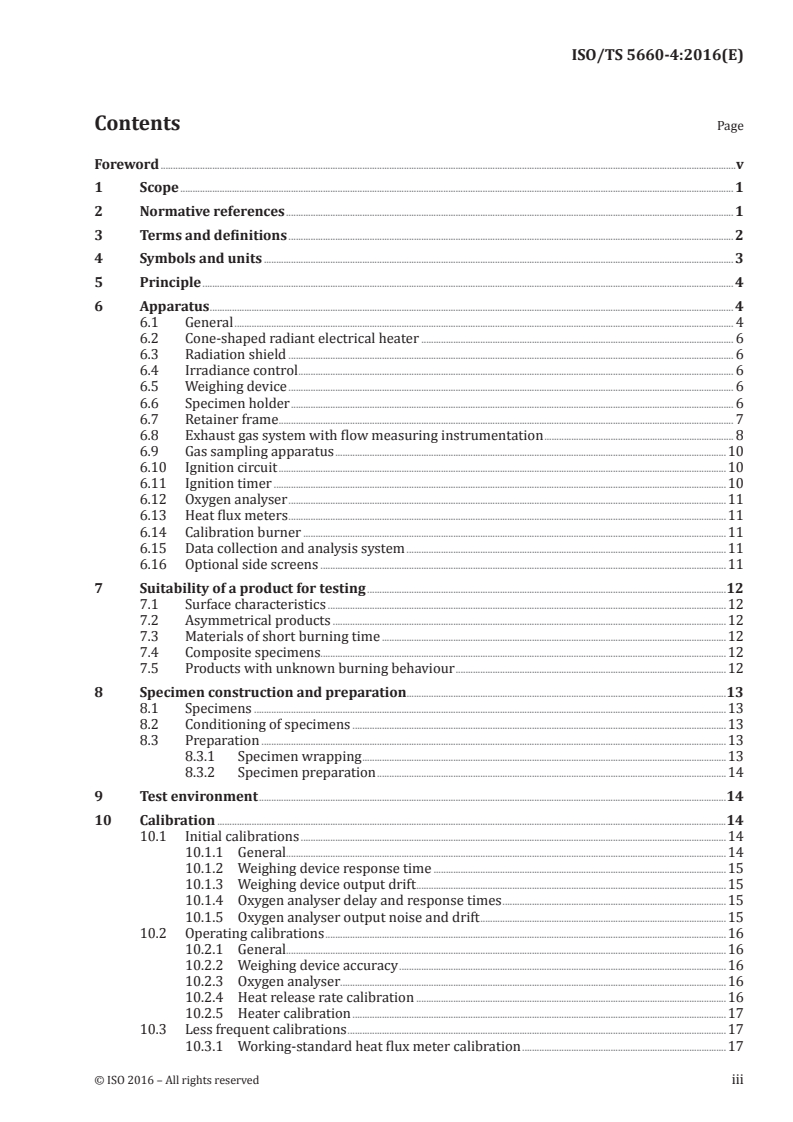
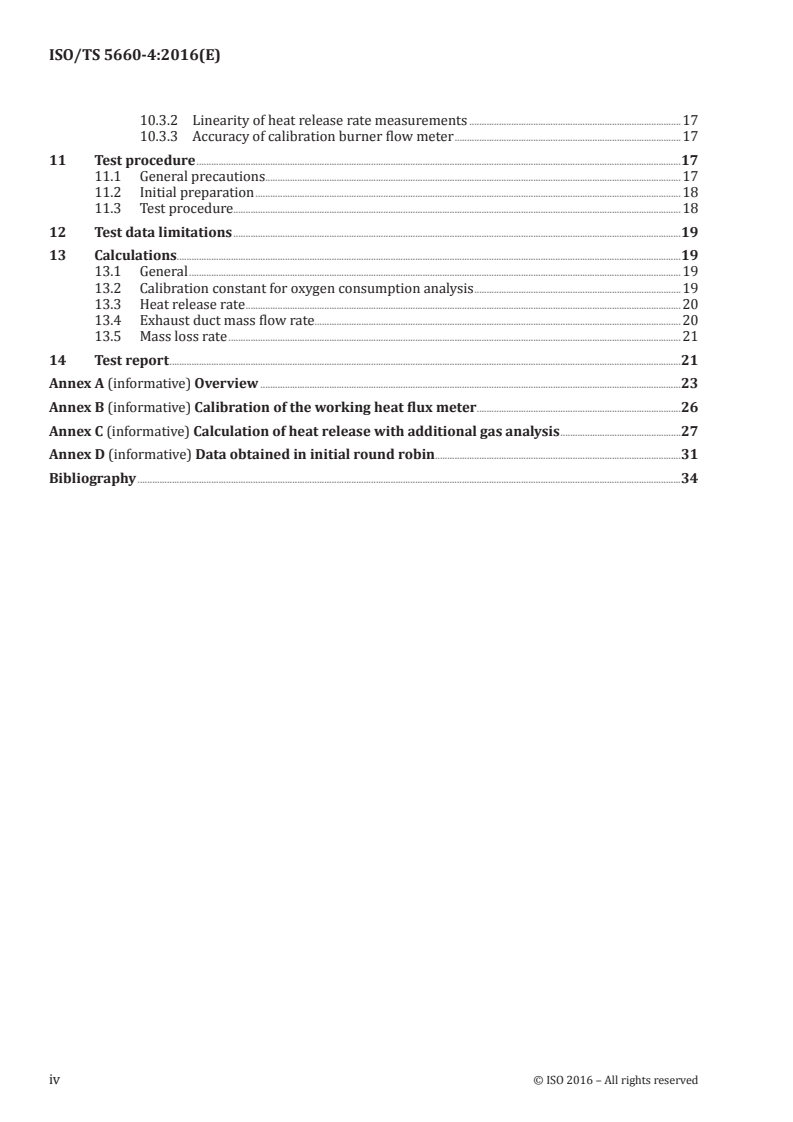
Contents Page
Foreword .v
1 Scope . 1
2 Normative references . 1
3 Terms and definitions . 2
4 Symbols and units .3
5 Principle .4
6 Apparatus .4
6.1 General . 4
6.2 Cone-shaped radiant electrical heater . 6
6.3 Radiation shield . 6
6.4 Irradiance control . 6
6.5 Weighing device . 6
6.6 Specimen holder . 6
6.7 Retainer frame . 7
6.8 Exhaust gas system with flow measuring instrumentation . 8
6.9 Gas sampling apparatus .10
6.10 Ignition circuit .10
6.11 Ignition timer .10
6.12 Oxygen analyser .11
6.13 Heat flux meters .11
6.14 Calibration burner .11
6.15 Data collection and analysis system .11
6.16 Optional side screens .11
7 Suitability of a product for testing .12
7.1 Surface characteristics .12
7.2 Asymmetrical products .12
7.3 Materials of short burning time .12
7.4 Composite specimens.12
7.5 Products with unknown burning behaviour .12
8 Specimen construction and preparation.13
8.1 Specimens .13
8.2 Conditioning of specimens .13
8.3 Preparation .13
8.3.1 Specimen wrapping .13
8.3.2 Specimen preparation .14
9 Test environment .14
10 Calibration .14
10.1 Initial calibrations .14
10.1.1 General.14
10.1.2 Weighing device response time .15
10.1.3 Weighing device output drift .15
10.1.4 Oxygen analyser delay and response times .15
10.1.5 Oxygen analyser output noise and drift .15
10.2 Operating calibrations .16
10.2.1 General.16
10.2.2 Weighing device accuracy .16
10.2.3 Oxygen analyser.16
10.2.4 Heat release rate calibration .16
10.2.5 Heater calibration .17
10.3 Less frequent calibrations .17
10.3.1 Working-standard heat flux meter calibration .17
10.3.2 Linearity of heat release rate measurements .17
10.3.3 Accuracy of calibration burner flow meter .17
11 Test procedure .17
11.1 General precautions . .17
11.2 Initial preparation .18
11.3 Test procedure .18
12 Test data limitations .19
13 Calculations.19
13.1 General .19
13.2 Calibration constant for oxygen consumption analysis .19
13.3 Heat release rate .20
13.4 Exhaust duct mass flow rate.20
13.5 Mass loss rate .21
14 Test report .21
Annex A (informative) Overview .23
Annex B (informative) Calibration of the working heat flux meter .26
Annex C (informative) Calculation of heat release with additional gas analysis .27
Annex D (informative) Data obtained in initial round robin.31
Bibliography .34
iv © ISO 2016 – All rights reserved
Foreword
ISO (the International Organization for Standardization) is a worldwide federation of national standards
bodies (ISO member bodies). The work of preparing International Standards is normally carried out
through ISO technical committees. Each member body interested in a subject for which a technical
committee has been established has the right to be represented on that committee. International
organizations, governmental and non-governmental, in liaison with ISO, also take part in the work.
ISO collaborates closely with the International Electrotechnical Commission (IEC) on all matters of
electrotechnical standardization.
The procedures used to develop this document and those intended for its further maintenance are
described in the ISO/IEC Directives, Part 1. In particular the different approval criteria needed for the
different types of ISO documents should be noted. This document was drafted in accordance with the
editorial rules of the ISO/IEC Directives, Part 2 (see www.iso.org/directives).
Attention is drawn to the possibility that some of the elements of this document may be the subject of
patent rights. ISO shall not be held responsible for identifying any or all such patent rights. Details of
any patent rights identified during the development of the document will be in the Introduction and/or
on the ISO list of patent declarations received (see www.iso.org/patents).
Any trade name used in this document is information given for the convenience of users and does not
constitute an endorsement.
For an explanation on the meaning of ISO specific terms and expressions related to conformity assessment,
as well as information about ISO’s adherence to the World Trade Organization (WTO) principles in the
Technical Barriers to Trade (TBT) see the following URL: www.iso.org/iso/foreword.html.
The committee responsible for this document is ISO/TC 92, Fire safety, Subcommittee SC 1, Fire initiation
and growth.
A list of all parts in the ISO 5660 series can be found on the ISO website.
TECHNICAL SPECIFICATION ISO/TS 5660-4:2016(E)
Reaction-to-fire tests — Heat release, smoke production
and mass loss rate —
Part 4:
Measurement of low levels of heat release
WARNING — The test procedures involve high temperatures and combustion processes.
Therefore, hazards can exist for burns, ignition of extraneous objects or clothing, and for
inhalation of combustion products. The operator should use protective gloves for insertion and
removal of test specimens. Neither the cone heater nor the associated fixtures should be touched
while hot except with the use of protective gloves.
Materials containing volatile organic substances or decomposition products, or large amounts
of moisture may produce violent releases of combustible gases or water vapour during testing.
Materials with high release rates normally tested in ISO 5660-1 would give dangerous conditions
if tested in this apparatus. To ensure this does not happen, specimens shall first be tested at the
smaller 100 × 100 mm ISO 5660-1 specimen size to check approximate heat release rates before
proceeding.
1 Scope
This document specifies a method for evaluating materials and products that produce low levels of heat
release when exposed to high irradiance levels typical of fully developed fires. It differs from ISO 5660-1
by prescribing items such as specific specimen size, specimen holder, specimen orientation, volumetric
flow rate for O analyses and irradiance levels at which testing is conducted.
The test method described in this document is intended for use on products and materials that contain
only small amounts of combustible elements, e.g. test specimens that yield a total heat release of
2 2
0,75 MJ/m to 15 MJ/m .
NOTE 1 The test method for specimens that yield moderate to high total heat release is described in
ISO 5660-1. The information obtained from this test method in this document can also be used for fire safety
engineering purposes.
NOTE 2 As in ISO 5660-1, the heat release rates are not measured directly and absolute but are theoretically
calculated using the empirically derived constant of proportionality that links heat released and measured
oxygen consumed.
2 Normative references
The following documents are referred to in text in such a way that some or all of their content
constitutes requirements of this document. For dated references, only the edition cited applies. For
undated references, the latest edition of the referenced document (including any amendments) applies.
ISO 291, Plastics — Standard atmospheres for conditioning and testing
ISO 554, Standard atmospheres for conditioning and/or testing — Specifications
ISO 5660-1:2015, Reaction-to-fire tests — Heat release, smoke production and mass loss rate — Part 1:
Heat release rate (cone calorimeter method)
ISO 5660-3, Reaction-to-fire tests — Heat release, smoke production and mass loss rate — Part 3: Guidance
on measurement
ISO/TR 14697, Reaction-to-fire tests — Guidance on the choice of substrates for building and transport
products
ISO 14934-2, Fire tests — Calibration and use of heat flux meters — Part 2: Primary calibration methods
ISO 14934-3:2012, Fire tests — Calibration and use of heat flux meters — Part 3: Secondary calibration
method
3 Terms and definitions
For the purposes of this document, the terms and definitions given in ISO 13943, and the following apply.
ISO and IEC maintain terminological databases for use in standardization at the following addresses:
— IEC Electropedia: available at http://www.electropedia.org/
— ISO Online browsing platform: available at http://www.iso.org/obp
3.1
emissivity
ratio of the radiation emitted by a radiant source to the radiation that would be emitted by a black body
radiant source at the same temperature
Note 1 to entry: Emissivity is dimensionless.
[SOURCE: ISO 13943:2008, 4.75]
3.2
flashing
existence of flame on or over the surface of the specimen for periods of less than 1 s
3.3
ignition
onset of sustained flaming (3.10)
3.4
irradiance
quotient of the radiant flux incident on an infinitesimal element of surface
containing the point, and the area of that element
Note 1 to entry: Convective heating is minimized in the horizontal specimen orientation. For this reason, the
term “irradiance” is used instead of “heat flux” throughout this document as it best indicates the essentially
radiative mode of heat transfer.
3.5
material
single substance or uniformly dispersed mixture
EXAMPLE Metal, stone, timber, concrete, mineral fibre and polymers.
3.6
orientation
plane in which the exposed face of the specimen is located during testing
3.7
oxygen consumption principle
proportional relationship between the mass of oxygen consumed during combustion and the heat
released
3.8
product
material, composite or assembly about which information is required
2 © ISO 2016 – All rights reserved
3.9
specimen
representative piece of the product that is tested together with any substrate or treatment
Note 1 to entry: For certain types of product, for example products that contain an air gap or joints, it might not
be possible to prepare a specimen that is representative of the end-use conditions; see Clause 7.
3.10
sustained flaming
existence of flame on or over the surface of the specimen for periods of over 10 s
3.11
transitory flaming
existence of flame on or over the surface of the specimen for periods of between 1 and 10 s
4 Symbols and units
For the purposes of this document, the following symbols apply.
Symbol Designations Unit
2 2
A initially exposed surface area of the specimen, 0,020 7 m m
s
1/2 1/2 1/2
C orifice flow meter calibration constant m g K
−1
Δh net heat of combustion kJ g
c
−1
Δh effective net heat of combustion MJ·kg
c,eff
m mass of the specimen g
Δm total mass loss g
m mass of the specimen at the end of the test g
f
m mass of the specimen at sustained flaming g
s
−2 −1
average mass loss rate per unit area between 10 % and 90 % of mass loss g·m ·s
m
A,10−90
m mass of the specimen at 10 % of total mass loss G
m mass of the specimen at 90 % of total mass loss G
−1
mass change rate of the specimen g·s
m
−1
mass flow rate in exhaust duct kg s
m
e
Δp orifice meter pressure differential Pa
heat release rate kW
q
−2
heat release rate per unit area kW m
q
A
−2
maximum value of the heat release rate per unit area kW m
q
A,max
−2
average heat release rate per unit area over the period starting at kW m
q
A,180
t and ending 180 s later
ig
−2
average heat release rate per unit area over the period starting at kW m
q
A,300 t and ending 300 s later
ig
−2
Q total heat released per unit area during the entire test MJ m
A,tot
r stoichiometric oxygen/fuel mass ratio 1
o
t time s
t delay time of the oxygen analyser s
d
t time to ignition (onset of sustained flaming) s
ig
Δt sampling time interval s
Symbol Designations Unit
t time at 10 % of total mass loss s
t time at 90 % of total mass loss s
T absolute temperature of gas at the orifice meter K
e
oxygen analyser reading, mole fraction of oxygen 1
X
O
initial value of oxygen analyser reading 1
X
O
oxygen analyser reading, before delay time correction 1
−1
X
O
ε emissivity
5 Principle
The measurement of the heat release rate and total heat release is used to quantify the test specimen’s
ability to ignite and contribute heat to the fire. It is based on the observation that, generally, the net heat
of combustion of a material is directly related to the quantity of oxygen required for its combustion.
This relationship is such that approximately 13,1 × 10 kJ of heat are released per 1,0 kg of oxygen
consumed. Optionally, additional measurements of carbon dioxide and carbon monoxide can be made
and used in calculation of heat release. The apparatus procedures and calculation methods described
in Annex C are then applicable.
−2
Specimens are exposed in ambient air conditions, while being subjected to an irradiance of 50 kW·m
in the presence of a spark ignition source. Alternatively, testing may be conducted at an exposure of
−2
75 kW·m . The changes in oxygen, O , concentration of gases and exhaust gas mass flow rate are
monitored and, from these data, the heat release is calculated. Additionally, the time to sustained
flaming is observed and mass-loss rate is measured.
In this document, the heat release is measured from the moment the specimen is subjected to the
radiant thermal exposure of a conical heater and is continued for 20 min. The primary measurements
are oxygen concentration and exhaust-gas mass flow rate. Provision is also made for the time to
sustained flaming. This test method is used to evaluate specimens in a horizontal orientation under an
external irradiance.
In order to measure heat release of materials or products that produce low levels of heat release
when exposed to high irradiances typical of fully developed fires, this part differs from ISO 5660-1
by prescribing a larger specimen size (150 mm × 150 mm), a 50 % lower exhaust gas volumetric flow
rate, direct connection between the plenum and heater to ensure collection of all the combustion gases,
more stringent specifications for the oxygen analyser to improve accuracy, and a specified irradiance
level at which to conduct testing. This document is designed to test samples with peak heat release
2 2 2
of <200 kW/m and total heat release of 0,75 MJ/m to 15 MJ/m .
PMMA is typically used to check the general operation of a cone calorimeter in ISO 5660-1. PMMA shall
not be used with this test method as the heat release rate is too high.
6 Apparatus
6.1 General
The apparatus shall be set up as shown in Figure 1, with the individual components as described in
detail in 6.2 to 6.6.
4 © ISO 2016 – All rights reserved
Key
1 pressure ports 8 spark plug
2 orifice plates 9 vertical connection
3 thermocouple (located on stock centreline) 10 blower motor
4 plenum with extension piece 11 retainer frame and specimen
5 blower 12 specimen holder
6 heater 13 weighing device
7 gas sampling probe 14 expansion flange
Figure 1 — Apparatus
6.2 Cone-shaped radiant electrical heater
The specimen shall be irradiated using a heater similar to that used in ISO 5660-1 but larger in dimension
and constructed such that it be capable of producing irradiance on the surface of the specimen of up to
80 kW m . The irradiance shall be uniform within the central 100 mm × 100 mm area of the exposed
specimen surface, to within ±2 %, and to ±3 % over the entire specimen surface.
The irradiance from the heater shall be maintained at a preset level by controlling the average
temperature of three thermocouples (type K stainless steel-sheathed thermocouples have been
proven suitable but Inconel or other high-performance materials are also acceptable), symmetrically
disposed and in contact with, but not welded to, the heater element, either 3,0 mm outside diameter
sheathed thermocouples with exposed hot junction or 1,0 mm to 1,6 mm outside diameter sheathed
thermocouples with unexposed hot junction shall be used.
NOTE A heater having a total length of 12 m, lower outer diameter of 350 mm and top outer diameter of
150 mm with a power input of 15 kW has been found suitable.
6.3 Radiation shield
The cone heater shall be provided with a removable radiation shield to protect the specimen from the
irradiance prior to the start of a test. The shield shall be made of non-combustible material, with a total
thickness not exceeding 12 mm. The shield shall be one of the following, either:
a) water-cooled and coated with a durable matte black finish of surface emissivity, ε, equal to
0,95 ± 0,05;
b) not water-cooled, either metal with a reflective top surface or ceramic in order to minimize
radiation transfer.
The shield shall be equipped with a handle or other suitable means for quick insertion and removal. The
cone heater base plate shall be equipped with a mechanism for moving the shield into position.
6.4 Irradiance control
The irradiance control system shall be properly tuned so that it maintains the average temperature of
the heater thermocouples during the calibration described in 10.2.5 at the preset level to within ±10 °C.
6.5 Weighing device
The weighing device shall have an accuracy of ±0,1 g or better, measured according to the calibration
procedure described in 10.2.2. The weighing device shall be capable of measuring the mass of
specimens of at least 2,0 kg. The weighing device shall have a 10 % to 90 % response time of 4 s or less,
as determined according to the calibration described in 10.1.3. The output of the weighing device shall
not drift by more than 1 g over a 30 min period, as determined with the calibration described in 10.1.4.
6.6 Specimen holder
The specimen holder shall be as shown in Figure 2. The specimen holder shall have the shape of a square
pan with an outside dimension of (156 ± 1) mm × (156 ± 1) mm at the top, and a depth of (25 ± 1) mm.
The holder shall be constructed of stainless steel with a thickness of (2,4 ± 0,15) mm. It shall include a
handle to facilitate insertion and removal, and a mechanism to ensure central location of the specimen
under the heater and proper alignment with the weighing device. The bottom of the holder shall be lined
with a layer of low density (nominal density of 65 kg/m ) refractory fibre blanket with a thickness of at
least 13 mm. The distance between the bottom surface of the cone heater and the top of the specimen
shall be adjusted to be (25 ± 1) mm.
6 © ISO 2016 – All rights reserved
All dimensions in mm
Key
1 stainless (mill smooth)
2 spot weld, four corners
3 2,4 ± 0,15mm stainless steel
Figure 2 — Specimen holder
6.7 Retainer frame
The frame shall be constructed of stainless steel with a thickness of (1,9 ± 0,1) mm, in the shape of a box
with an inside dimension of (161 ± 1) mm and a height of (54 ± 1) mm. The opening for the specimen
face shall be (144,0 ± 0,5) mm square as shown in Figure 3. The retainer frame shall have an appropriate
means to secure it to the specimen holder with the specimen in position.
Key
1 1,9 ± 0,1 mm stainless steel
2 M4 screws (4 pcs)
Figure 3 — Retainer frame
6.8 Exhaust gas system with flow measuring instrumentation
The exhaust gas system shall consist of a centrifugal exhaust fan rated for the operating temperatures,
intake and exhaust ducts for the fan, and an orifice plate flow meter (see Figure 1). The exhaust system
shall be capable of developing flows up to 0,018 m /s, under standard conditions of temperature and
pressure. The recommended location of the fan is indicated on Figure 4. As an alternative, it is acceptable
to locate the fan further downstream and to have the measuring orifice before the fan, provided that
the requirements described in the remainder of this clause are fulfilled.
A restrictive orifice with an internal diameter of (57 ± 3) mm shall be located between the hood and the
duct to promote mixing.
8 © ISO 2016 – All rights reserved
A gas sampling ring probe (sample holes face blower) sampler shall be located in the fan intake duct
for gas sampling, (685 ± 15) mm from the plenum (see Figure 4). The gas sampling ring probe (sample
holes face blower) shall contain 12 small holes with a diameter of (2,2 ± 0,1) mm, to average the stream
composition, with the holes facing away from the flow to avoid clogging with soot.
The temperature of the gas stream shall be measured using a 1,0 mm to 1,6 mm outside diameter
sheathed-junction thermocouple or a 3 mm outside diameter exposed-junction thermocouple positioned
in the exhaust stack on the centreline and (100 ± 5) mm upstream from the measuring orifice plate.
The mass flow rate shall be determined by measuring the differential pressure across a sharp edge
orifice (internal diameter (57 ± 3) mm, thickness (1,6 ± 0,3) mm) in the exhaust stack, at least 350 mm
downstream from the fan, if the latter is located as shown on Figure 4. The fan shall be located as
indicated in Figure 5.
NOTE As an alternative, the fan can be located further downstream and the measuring orifice located before
the fan.
The exhaust system shall be checked for proper operation before testing and shall discharge into a
building exhaust system with adequate capacity. Provision shall be made for collecting and venting any
combustion products that shall for whatever reason fail to be collected by the normal exhaust system
of the apparatus.
Key
1 gas sampling ring probe 5 gas sampling ring probe (sample holes face blower)
2 thermocouple 6 fan
3 plenum with extension piece 7 vertical connection
4 orifice plate
Figure 4 — Exhaust system
6.9 Gas sampling apparatus
Gas sampling apparatus incorporates a pump, filters to prevent entry of soot, facilities for removing
most of the moisture, a by-pass system set to divert all flow except that required for the gas analysers, a
further moisture trap and a trap for CO removal.
A schematic view of an example of the gas sampling apparatus is shown in Figure 5. Other arrangements
which satisfy the requirements may be used. The transport delay time of the oxygen analyser, t , shall
d
be determined according to 10.1.5, and shall not exceed 60 s.
NOTE If an (optional) CO analyser is used, the equations to calculate the heat release rate can be different
from those for the standard case (see Clause 13 and Annex C).
Key
1 gas sampling ring probe (sample holes face blower) 5 moisture trap
2 particulate filter 6 CO removal trap
3 cold trap and drain (optional) 7 flow controls
4 pump 8 oxygen analysers
a
To optional CO and CO analysers.
b
Waste.
c
Alternative position for waste.
Figure 5 — Gas sampling and measurement system
6.10 Ignition circuit
An external ignition source shall be provided by a spark generated by a spark plug powered from a
10 kV transformer or an equivalent spark igniter. The spark plug shall have a gap of (3,0 ± 0,5) mm. The
electrode length and location of the spark plug shall be such that the spark gap is located (13 ± 2) mm
above the centre of the specimen.
6.11 Ignition timer
The ignition timer shall be capable of recording elapsed time to the nearest second and shall be accurate
to within 1 s in 1 h.
10 © ISO 2016 – All rights reserved
6.12 Oxygen analyser
The oxygen analyser shall be of the paramagnetic type, with a range of at least 0 % oxygen to 25 %
oxygen. The analyser shall exhibit a drift of not more than 30 μl/l drift of oxygen over a period of
30 min, and a noise of not more than 30 μl/l of oxygen during this 30 min period, as measured according
to 10.1.5. Since oxygen analysers are sensitive to stream pressures, the stream pressure shall be
regulated (upstream of the analyser) to minimize flow fluctuations, and the readings from the analyser
compensated with an absolute pressure transducer to allow for atmospheric pressure variations. The
analyser and the absolute pressure transducer shall be located in an isothermal environment.
The temperature of the environment shall be maintained to within 2 °C of a preset value between 30 °C
and 70 °C. The oxygen analyser shall have a 10 % to 90 % of full-scale response time of less than 12 s, as
measured according to 10.1.4.
6.13 Heat flux meters
The working heat flux meter shall be used to calibrate the heater (see 10.2.4). It shall be positioned at a
location equivalent to the centre of the specimen face during this calibration.
The heat-flux meter shall be of the Schmidt-Boelter (thermopile) type with a design range of (100 ± 0)
−2
kW·m and a diameter of approximately 12,5 mm. The sensing surface shall be coated with a durable
matte black finish of surface emissivity, ε, equal to 0,95 ± 0,05. The heat-flux meter shall be water-cooled.
The water temperature should be kept above the dew point of the ambient air to avoid condensation of
water on the sensing surface of the heat flux meter.
Radiation shall not pass through any window before reaching the sensing surface. The instrument shall
be robust, simple to set up and use, and stable in calibration. The instrument shall have an accuracy of
within ±3 % and a repeatability to within ±0,5 %.
The working-standard heat flux meter shall be calibrated according to ISO 14934-3. The secondary-
standard heat flux meter shall be calibrated according to ISO 14934-2.
6.14 Calibration burner
The calibration burner shall be constructed from tube with a square or circular orifice with an area
of (500 ± 100) mm covered with wire gauze through which the methane diffuses. The tube shall be
packed with refractory fibre to improve uniformity of flow. The calibration burner shall be connected
to a metered supply of methane of at least 99,5 % purity. The accuracy of the flow meter shall be ±2 % of
the readout corresponding to a heat release rate of 1 kW. The accuracy verification shall be performed
according to 10.3.3.
6.15 Data collection and analysis system
The data collection and analysis system shall have facilities for recording the output from the oxygen
analyser, the orifice meter, the thermocouples and the weighing device. The data collection system
shall have an accuracy corresponding to at least 50 μl/l of oxygen for the oxygen channel, 0,5 °C for
the temperature measuring channels, 0,01 % of full-scale instrument output for all other instrument
channels, and at least 0,1 % for time. The system shall be capable of recording data every second. The
system shall be capable of storing minimum of 720 data per parameter. The raw data recorded for each
test shall be stored so that they can be recovered and used to check the accuracy of the software.
6.16 Optional side screens
WARNING — Attention is drawn to the fact that precautions should be taken to protect the
operator if the screens form an enclosure because there is a possible explosion hazard when
the instrument is not operated under conditions prescribed by this document, in particular for
experiments in oxygen enriched atmosphere. If an explosion hazard exists, proper precautions
should be taken to protect the operator, e.g. by installing an explosion vent facing away from the
operator.
For operational or safety reasons, the heater and sample holder may be guarded with side screens.
However, it shall be demonstrated that the presence of the screens does not affect the ignition time and
heat release rate measurements.
7 Suitability of a product for testing
7.1 Surface characteristics
A product, having one of the following properties, is suitable for testing:
a) an essentially flat exposed surface;
NOTE An essentially flat surface is considered to be a surface whose irregularity from a plane does not
exceed ±1 mm.
b) a surface irregularity that is evenly distributed over the exposed surface, provided that
1) at least 50 % of the surface of a representative 225 mm area lies within a depth of 10 mm from
a plane taken across the highest points on the exposed surface, or
2) for surfaces containing cracks, fissures or holes not exceeding 8 mm in width or 10 mm in
depth, the total area of such cracks, fissures or holes at the surface does not exceed 30 % of a
representative 225 mm area of the exposed surface.
When an exposed surface does not meet the requirements of either 7.1 a) or 7.1 b), the product shall
be tested in a modified form complying as nearly as possible with the requirements given in 7.1. The
test report shall state that the product has been tested in a modified form, and clearly describe the
modification.
7.2 Asymmetrical products
A product submitted for this test can have faces which differ or can contain laminations of different
materials arranged in a different order in relation to the two faces. If either of the faces can be exposed
in use within a room, cavity or void, then both faces shall be tested.
7.3 Materials of short burning time
For specimens of short burning time (3 min or less), the heat release rate measurements shall be taken
at not more than 2 s intervals. For longer burning times, 5 s intervals may be used.
7.4 Composite specimens
Composite specimens shall be considered suitable for testing, provided they are prepared as specified
in 8.3 and are exposed in a manner typical of end use conditions.
7.5 Products with unknown burning behaviour
This document is designed to test samples with peak heat release of < 200kW/m and total heat release
2 2
of 0,75 MJ/m to 15 MJ/m . If there is no previous experience in testing the product and it is not known
what the peak and total heat release rate is at the given test conditions, the product shall first be tested
in accordance with ISO 5660-1.
12 © ISO 2016 – All rights reserved
8 Specimen construction and preparation
8.1 Specimens
8.1.1 Unless otherwise specified, a minimum of three specimens shall be tested at each level of
irradiance selected and for each different exposed surface.
8.1.2 The specimens shall be representative of the product and shall be square with sides
measuring 150 mm.
−2
8.1.3 Products with normal thickness of 50 mm or less shall be tested using their full thickness.
8.1.4 For products with a normal thickness greater than 50 mm, the requisite specimens shall be
obtained by cutting away the unexposed face to reduce the thickness to 50 mm.
8.1.5 When cutting specimens from products with irregular surfaces, the highest point on the surface
shall be arranged to occur at the centre of the specimen.
8.1.6 Assemblies shall be tested as specified in 8.1.3 or 8.1.4, whichever is appropriate.
Where thin materials or composites are used in the fabrication of an assembly, the nature of any
underlying construction can significantly affect the ignition and burning characteristics of the exposed
surface. The influence of the underlying layers should be understood and care taken to ensure that the
test result obtained on any assembly is relevant to its use in practice.
When the product is a material or composite which would normally be attached to a well-defined
substrate, it shall be tested in conjunction with that substrate using the recommended fixing technique,
for example bonded with the appropriate adhesive or mechanically fixed. In the absence of a unique
or well-defined substrate, an appropriate substrate for testing shall be selected in accordance with
ISO/TR 14697.
8.1.7 Products that are thinner than 6 mm shall be tested with a substrate representative of end-use
conditions, such that the total specimen thickness is 6 mm or more.
8.2 Conditioning of specimens
Before the test, specimens shall be conditioned to constant mass at a temperature of (23 ± 2) °C, and a
relative humidity of (50 ± 5) % in accordance with ISO 554.
Constant mass shall be con
...
TECHNICAL ISO/TS
SPECIFICATION 5660-4
First edition
2016-12-15
Reaction-to-fire tests — Heat release,
smoke production and mass loss
rate —
Part 4:
Measurement of low levels of heat
release
Essais de réaction au feu — Débit calorifique, taux de dégagement de
fumée et taux de perte de masse —
Partie 4: Mesurage du débit calorifique pour la détermination des bas
niveaux de combustibilité
Reference number
©
ISO 2016
© ISO 2016, Published in Switzerland
All rights reserved. Unless otherwise specified, no part of this publication may be reproduced or utilized otherwise in any form
or by any means, electronic or mechanical, including photocopying, or posting on the internet or an intranet, without prior
written permission. Permission can be requested from either ISO at the address below or ISO’s member body in the country of
the requester.
ISO copyright office
Ch. de Blandonnet 8 • CP 401
CH-1214 Vernier, Geneva, Switzerland
Tel. +41 22 749 01 11
Fax +41 22 749 09 47
copyright@iso.org
www.iso.org
ii © ISO 2016 – All rights reserved
Contents Page
Foreword .v
1 Scope . 1
2 Normative references . 1
3 Terms and definitions . 2
4 Symbols and units .3
5 Principle .4
6 Apparatus .4
6.1 General . 4
6.2 Cone-shaped radiant electrical heater . 6
6.3 Radiation shield . 6
6.4 Irradiance control . 6
6.5 Weighing device . 6
6.6 Specimen holder . 6
6.7 Retainer frame . 7
6.8 Exhaust gas system with flow measuring instrumentation . 8
6.9 Gas sampling apparatus .10
6.10 Ignition circuit .10
6.11 Ignition timer .10
6.12 Oxygen analyser .11
6.13 Heat flux meters .11
6.14 Calibration burner .11
6.15 Data collection and analysis system .11
6.16 Optional side screens .11
7 Suitability of a product for testing .12
7.1 Surface characteristics .12
7.2 Asymmetrical products .12
7.3 Materials of short burning time .12
7.4 Composite specimens.12
7.5 Products with unknown burning behaviour .12
8 Specimen construction and preparation.13
8.1 Specimens .13
8.2 Conditioning of specimens .13
8.3 Preparation .13
8.3.1 Specimen wrapping .13
8.3.2 Specimen preparation .14
9 Test environment .14
10 Calibration .14
10.1 Initial calibrations .14
10.1.1 General.14
10.1.2 Weighing device response time .15
10.1.3 Weighing device output drift .15
10.1.4 Oxygen analyser delay and response times .15
10.1.5 Oxygen analyser output noise and drift .15
10.2 Operating calibrations .16
10.2.1 General.16
10.2.2 Weighing device accuracy .16
10.2.3 Oxygen analyser.16
10.2.4 Heat release rate calibration .16
10.2.5 Heater calibration .17
10.3 Less frequent calibrations .17
10.3.1 Working-standard heat flux meter calibration .17
10.3.2 Linearity of heat release rate measurements .17
10.3.3 Accuracy of calibration burner flow meter .17
11 Test procedure .17
11.1 General precautions . .17
11.2 Initial preparation .18
11.3 Test procedure .18
12 Test data limitations .19
13 Calculations.19
13.1 General .19
13.2 Calibration constant for oxygen consumption analysis .19
13.3 Heat release rate .20
13.4 Exhaust duct mass flow rate.20
13.5 Mass loss rate .21
14 Test report .21
Annex A (informative) Overview .23
Annex B (informative) Calibration of the working heat flux meter .26
Annex C (informative) Calculation of heat release with additional gas analysis .27
Annex D (informative) Data obtained in initial round robin.31
Bibliography .34
iv © ISO 2016 – All rights reserved
Foreword
ISO (the International Organization for Standardization) is a worldwide federation of national standards
bodies (ISO member bodies). The work of preparing International Standards is normally carried out
through ISO technical committees. Each member body interested in a subject for which a technical
committee has been established has the right to be represented on that committee. International
organizations, governmental and non-governmental, in liaison with ISO, also take part in the work.
ISO collaborates closely with the International Electrotechnical Commission (IEC) on all matters of
electrotechnical standardization.
The procedures used to develop this document and those intended for its further maintenance are
described in the ISO/IEC Directives, Part 1. In particular the different approval criteria needed for the
different types of ISO documents should be noted. This document was drafted in accordance with the
editorial rules of the ISO/IEC Directives, Part 2 (see www.iso.org/directives).
Attention is drawn to the possibility that some of the elements of this document may be the subject of
patent rights. ISO shall not be held responsible for identifying any or all such patent rights. Details of
any patent rights identified during the development of the document will be in the Introduction and/or
on the ISO list of patent declarations received (see www.iso.org/patents).
Any trade name used in this document is information given for the convenience of users and does not
constitute an endorsement.
For an explanation on the meaning of ISO specific terms and expressions related to conformity assessment,
as well as information about ISO’s adherence to the World Trade Organization (WTO) principles in the
Technical Barriers to Trade (TBT) see the following URL: www.iso.org/iso/foreword.html.
The committee responsible for this document is ISO/TC 92, Fire safety, Subcommittee SC 1, Fire initiation
and growth.
A list of all parts in the ISO 5660 series can be found on the ISO website.
TECHNICAL SPECIFICATION ISO/TS 5660-4:2016(E)
Reaction-to-fire tests — Heat release, smoke production
and mass loss rate —
Part 4:
Measurement of low levels of heat release
WARNING — The test procedures involve high temperatures and combustion processes.
Therefore, hazards can exist for burns, ignition of extraneous objects or clothing, and for
inhalation of combustion products. The operator should use protective gloves for insertion and
removal of test specimens. Neither the cone heater nor the associated fixtures should be touched
while hot except with the use of protective gloves.
Materials containing volatile organic substances or decomposition products, or large amounts
of moisture may produce violent releases of combustible gases or water vapour during testing.
Materials with high release rates normally tested in ISO 5660-1 would give dangerous conditions
if tested in this apparatus. To ensure this does not happen, specimens shall first be tested at the
smaller 100 × 100 mm ISO 5660-1 specimen size to check approximate heat release rates before
proceeding.
1 Scope
This document specifies a method for evaluating materials and products that produce low levels of heat
release when exposed to high irradiance levels typical of fully developed fires. It differs from ISO 5660-1
by prescribing items such as specific specimen size, specimen holder, specimen orientation, volumetric
flow rate for O analyses and irradiance levels at which testing is conducted.
The test method described in this document is intended for use on products and materials that contain
only small amounts of combustible elements, e.g. test specimens that yield a total heat release of
2 2
0,75 MJ/m to 15 MJ/m .
NOTE 1 The test method for specimens that yield moderate to high total heat release is described in
ISO 5660-1. The information obtained from this test method in this document can also be used for fire safety
engineering purposes.
NOTE 2 As in ISO 5660-1, the heat release rates are not measured directly and absolute but are theoretically
calculated using the empirically derived constant of proportionality that links heat released and measured
oxygen consumed.
2 Normative references
The following documents are referred to in text in such a way that some or all of their content
constitutes requirements of this document. For dated references, only the edition cited applies. For
undated references, the latest edition of the referenced document (including any amendments) applies.
ISO 291, Plastics — Standard atmospheres for conditioning and testing
ISO 554, Standard atmospheres for conditioning and/or testing — Specifications
ISO 5660-1:2015, Reaction-to-fire tests — Heat release, smoke production and mass loss rate — Part 1:
Heat release rate (cone calorimeter method)
ISO 5660-3, Reaction-to-fire tests — Heat release, smoke production and mass loss rate — Part 3: Guidance
on measurement
ISO/TR 14697, Reaction-to-fire tests — Guidance on the choice of substrates for building and transport
products
ISO 14934-2, Fire tests — Calibration and use of heat flux meters — Part 2: Primary calibration methods
ISO 14934-3:2012, Fire tests — Calibration and use of heat flux meters — Part 3: Secondary calibration
method
3 Terms and definitions
For the purposes of this document, the terms and definitions given in ISO 13943, and the following apply.
ISO and IEC maintain terminological databases for use in standardization at the following addresses:
— IEC Electropedia: available at http://www.electropedia.org/
— ISO Online browsing platform: available at http://www.iso.org/obp
3.1
emissivity
ratio of the radiation emitted by a radiant source to the radiation that would be emitted by a black body
radiant source at the same temperature
Note 1 to entry: Emissivity is dimensionless.
[SOURCE: ISO 13943:2008, 4.75]
3.2
flashing
existence of flame on or over the surface of the specimen for periods of less than 1 s
3.3
ignition
onset of sustained flaming (3.10)
3.4
irradiance
quotient of the radiant flux incident on an infinitesimal element of surface
containing the point, and the area of that element
Note 1 to entry: Convective heating is minimized in the horizontal specimen orientation. For this reason, the
term “irradiance” is used instead of “heat flux” throughout this document as it best indicates the essentially
radiative mode of heat transfer.
3.5
material
single substance or uniformly dispersed mixture
EXAMPLE Metal, stone, timber, concrete, mineral fibre and polymers.
3.6
orientation
plane in which the exposed face of the specimen is located during testing
3.7
oxygen consumption principle
proportional relationship between the mass of oxygen consumed during combustion and the heat
released
3.8
product
material, composite or assembly about which information is required
2 © ISO 2016 – All rights reserved
3.9
specimen
representative piece of the product that is tested together with any substrate or treatment
Note 1 to entry: For certain types of product, for example products that contain an air gap or joints, it might not
be possible to prepare a specimen that is representative of the end-use conditions; see Clause 7.
3.10
sustained flaming
existence of flame on or over the surface of the specimen for periods of over 10 s
3.11
transitory flaming
existence of flame on or over the surface of the specimen for periods of between 1 and 10 s
4 Symbols and units
For the purposes of this document, the following symbols apply.
Symbol Designations Unit
2 2
A initially exposed surface area of the specimen, 0,020 7 m m
s
1/2 1/2 1/2
C orifice flow meter calibration constant m g K
−1
Δh net heat of combustion kJ g
c
−1
Δh effective net heat of combustion MJ·kg
c,eff
m mass of the specimen g
Δm total mass loss g
m mass of the specimen at the end of the test g
f
m mass of the specimen at sustained flaming g
s
−2 −1
average mass loss rate per unit area between 10 % and 90 % of mass loss g·m ·s
m
A,10−90
m mass of the specimen at 10 % of total mass loss G
m mass of the specimen at 90 % of total mass loss G
−1
mass change rate of the specimen g·s
m
−1
mass flow rate in exhaust duct kg s
m
e
Δp orifice meter pressure differential Pa
heat release rate kW
q
−2
heat release rate per unit area kW m
q
A
−2
maximum value of the heat release rate per unit area kW m
q
A,max
−2
average heat release rate per unit area over the period starting at kW m
q
A,180
t and ending 180 s later
ig
−2
average heat release rate per unit area over the period starting at kW m
q
A,300 t and ending 300 s later
ig
−2
Q total heat released per unit area during the entire test MJ m
A,tot
r stoichiometric oxygen/fuel mass ratio 1
o
t time s
t delay time of the oxygen analyser s
d
t time to ignition (onset of sustained flaming) s
ig
Δt sampling time interval s
Symbol Designations Unit
t time at 10 % of total mass loss s
t time at 90 % of total mass loss s
T absolute temperature of gas at the orifice meter K
e
oxygen analyser reading, mole fraction of oxygen 1
X
O
initial value of oxygen analyser reading 1
X
O
oxygen analyser reading, before delay time correction 1
−1
X
O
ε emissivity
5 Principle
The measurement of the heat release rate and total heat release is used to quantify the test specimen’s
ability to ignite and contribute heat to the fire. It is based on the observation that, generally, the net heat
of combustion of a material is directly related to the quantity of oxygen required for its combustion.
This relationship is such that approximately 13,1 × 10 kJ of heat are released per 1,0 kg of oxygen
consumed. Optionally, additional measurements of carbon dioxide and carbon monoxide can be made
and used in calculation of heat release. The apparatus procedures and calculation methods described
in Annex C are then applicable.
−2
Specimens are exposed in ambient air conditions, while being subjected to an irradiance of 50 kW·m
in the presence of a spark ignition source. Alternatively, testing may be conducted at an exposure of
−2
75 kW·m . The changes in oxygen, O , concentration of gases and exhaust gas mass flow rate are
monitored and, from these data, the heat release is calculated. Additionally, the time to sustained
flaming is observed and mass-loss rate is measured.
In this document, the heat release is measured from the moment the specimen is subjected to the
radiant thermal exposure of a conical heater and is continued for 20 min. The primary measurements
are oxygen concentration and exhaust-gas mass flow rate. Provision is also made for the time to
sustained flaming. This test method is used to evaluate specimens in a horizontal orientation under an
external irradiance.
In order to measure heat release of materials or products that produce low levels of heat release
when exposed to high irradiances typical of fully developed fires, this part differs from ISO 5660-1
by prescribing a larger specimen size (150 mm × 150 mm), a 50 % lower exhaust gas volumetric flow
rate, direct connection between the plenum and heater to ensure collection of all the combustion gases,
more stringent specifications for the oxygen analyser to improve accuracy, and a specified irradiance
level at which to conduct testing. This document is designed to test samples with peak heat release
2 2 2
of <200 kW/m and total heat release of 0,75 MJ/m to 15 MJ/m .
PMMA is typically used to check the general operation of a cone calorimeter in ISO 5660-1. PMMA shall
not be used with this test method as the heat release rate is too high.
6 Apparatus
6.1 General
The apparatus shall be set up as shown in Figure 1, with the individual components as described in
detail in 6.2 to 6.6.
4 © ISO 2016 – All rights reserved
Key
1 pressure ports 8 spark plug
2 orifice plates 9 vertical connection
3 thermocouple (located on stock centreline) 10 blower motor
4 plenum with extension piece 11 retainer frame and specimen
5 blower 12 specimen holder
6 heater 13 weighing device
7 gas sampling probe 14 expansion flange
Figure 1 — Apparatus
6.2 Cone-shaped radiant electrical heater
The specimen shall be irradiated using a heater similar to that used in ISO 5660-1 but larger in dimension
and constructed such that it be capable of producing irradiance on the surface of the specimen of up to
80 kW m . The irradiance shall be uniform within the central 100 mm × 100 mm area of the exposed
specimen surface, to within ±2 %, and to ±3 % over the entire specimen surface.
The irradiance from the heater shall be maintained at a preset level by controlling the average
temperature of three thermocouples (type K stainless steel-sheathed thermocouples have been
proven suitable but Inconel or other high-performance materials are also acceptable), symmetrically
disposed and in contact with, but not welded to, the heater element, either 3,0 mm outside diameter
sheathed thermocouples with exposed hot junction or 1,0 mm to 1,6 mm outside diameter sheathed
thermocouples with unexposed hot junction shall be used.
NOTE A heater having a total length of 12 m, lower outer diameter of 350 mm and top outer diameter of
150 mm with a power input of 15 kW has been found suitable.
6.3 Radiation shield
The cone heater shall be provided with a removable radiation shield to protect the specimen from the
irradiance prior to the start of a test. The shield shall be made of non-combustible material, with a total
thickness not exceeding 12 mm. The shield shall be one of the following, either:
a) water-cooled and coated with a durable matte black finish of surface emissivity, ε, equal to
0,95 ± 0,05;
b) not water-cooled, either metal with a reflective top surface or ceramic in order to minimize
radiation transfer.
The shield shall be equipped with a handle or other suitable means for quick insertion and removal. The
cone heater base plate shall be equipped with a mechanism for moving the shield into position.
6.4 Irradiance control
The irradiance control system shall be properly tuned so that it maintains the average temperature of
the heater thermocouples during the calibration described in 10.2.5 at the preset level to within ±10 °C.
6.5 Weighing device
The weighing device shall have an accuracy of ±0,1 g or better, measured according to the calibration
procedure described in 10.2.2. The weighing device shall be capable of measuring the mass of
specimens of at least 2,0 kg. The weighing device shall have a 10 % to 90 % response time of 4 s or less,
as determined according to the calibration described in 10.1.3. The output of the weighing device shall
not drift by more than 1 g over a 30 min period, as determined with the calibration described in 10.1.4.
6.6 Specimen holder
The specimen holder shall be as shown in Figure 2. The specimen holder shall have the shape of a square
pan with an outside dimension of (156 ± 1) mm × (156 ± 1) mm at the top, and a depth of (25 ± 1) mm.
The holder shall be constructed of stainless steel with a thickness of (2,4 ± 0,15) mm. It shall include a
handle to facilitate insertion and removal, and a mechanism to ensure central location of the specimen
under the heater and proper alignment with the weighing device. The bottom of the holder shall be lined
with a layer of low density (nominal density of 65 kg/m ) refractory fibre blanket with a thickness of at
least 13 mm. The distance between the bottom surface of the cone heater and the top of the specimen
shall be adjusted to be (25 ± 1) mm.
6 © ISO 2016 – All rights reserved
All dimensions in mm
Key
1 stainless (mill smooth)
2 spot weld, four corners
3 2,4 ± 0,15mm stainless steel
Figure 2 — Specimen holder
6.7 Retainer frame
The frame shall be constructed of stainless steel with a thickness of (1,9 ± 0,1) mm, in the shape of a box
with an inside dimension of (161 ± 1) mm and a height of (54 ± 1) mm. The opening for the specimen
face shall be (144,0 ± 0,5) mm square as shown in Figure 3. The retainer frame shall have an appropriate
means to secure it to the specimen holder with the specimen in position.
Key
1 1,9 ± 0,1 mm stainless steel
2 M4 screws (4 pcs)
Figure 3 — Retainer frame
6.8 Exhaust gas system with flow measuring instrumentation
The exhaust gas system shall consist of a centrifugal exhaust fan rated for the operating temperatures,
intake and exhaust ducts for the fan, and an orifice plate flow meter (see Figure 1). The exhaust system
shall be capable of developing flows up to 0,018 m /s, under standard conditions of temperature and
pressure. The recommended location of the fan is indicated on Figure 4. As an alternative, it is acceptable
to locate the fan further downstream and to have the measuring orifice before the fan, provided that
the requirements described in the remainder of this clause are fulfilled.
A restrictive orifice with an internal diameter of (57 ± 3) mm shall be located between the hood and the
duct to promote mixing.
8 © ISO 2016 – All rights reserved
A gas sampling ring probe (sample holes face blower) sampler shall be located in the fan intake duct
for gas sampling, (685 ± 15) mm from the plenum (see Figure 4). The gas sampling ring probe (sample
holes face blower) shall contain 12 small holes with a diameter of (2,2 ± 0,1) mm, to average the stream
composition, with the holes facing away from the flow to avoid clogging with soot.
The temperature of the gas stream shall be measured using a 1,0 mm to 1,6 mm outside diameter
sheathed-junction thermocouple or a 3 mm outside diameter exposed-junction thermocouple positioned
in the exhaust stack on the centreline and (100 ± 5) mm upstream from the measuring orifice plate.
The mass flow rate shall be determined by measuring the differential pressure across a sharp edge
orifice (internal diameter (57 ± 3) mm, thickness (1,6 ± 0,3) mm) in the exhaust stack, at least 350 mm
downstream from the fan, if the latter is located as shown on Figure 4. The fan shall be located as
indicated in Figure 5.
NOTE As an alternative, the fan can be located further downstream and the measuring orifice located before
the fan.
The exhaust system shall be checked for proper operation before testing and shall discharge into a
building exhaust system with adequate capacity. Provision shall be made for collecting and venting any
combustion products that shall for whatever reason fail to be collected by the normal exhaust system
of the apparatus.
Key
1 gas sampling ring probe 5 gas sampling ring probe (sample holes face blower)
2 thermocouple 6 fan
3 plenum with extension piece 7 vertical connection
4 orifice plate
Figure 4 — Exhaust system
6.9 Gas sampling apparatus
Gas sampling apparatus incorporates a pump, filters to prevent entry of soot, facilities for removing
most of the moisture, a by-pass system set to divert all flow except that required for the gas analysers, a
further moisture trap and a trap for CO removal.
A schematic view of an example of the gas sampling apparatus is shown in Figure 5. Other arrangements
which satisfy the requirements may be used. The transport delay time of the oxygen analyser, t , shall
d
be determined according to 10.1.5, and shall not exceed 60 s.
NOTE If an (optional) CO analyser is used, the equations to calculate the heat release rate can be different
from those for the standard case (see Clause 13 and Annex C).
Key
1 gas sampling ring probe (sample holes face blower) 5 moisture trap
2 particulate filter 6 CO removal trap
3 cold trap and drain (optional) 7 flow controls
4 pump 8 oxygen analysers
a
To optional CO and CO analysers.
b
Waste.
c
Alternative position for waste.
Figure 5 — Gas sampling and measurement system
6.10 Ignition circuit
An external ignition source shall be provided by a spark generated by a spark plug powered from a
10 kV transformer or an equivalent spark igniter. The spark plug shall have a gap of (3,0 ± 0,5) mm. The
electrode length and location of the spark plug shall be such that the spark gap is located (13 ± 2) mm
above the centre of the specimen.
6.11 Ignition timer
The ignition timer shall be capable of recording elapsed time to the nearest second and shall be accurate
to within 1 s in 1 h.
10 © ISO 2016 – All rights reserved
6.12 Oxygen analyser
The oxygen analyser shall be of the paramagnetic type, with a range of at least 0 % oxygen to 25 %
oxygen. The analyser shall exhibit a drift of not more than 30 μl/l drift of oxygen over a period of
30 min, and a noise of not more than 30 μl/l of oxygen during this 30 min period, as measured according
to 10.1.5. Since oxygen analysers are sensitive to stream pressures, the stream pressure shall be
regulated (upstream of the analyser) to minimize flow fluctuations, and the readings from the analyser
compensated with an absolute pressure transducer to allow for atmospheric pressure variations. The
analyser and the absolute pressure transducer shall be located in an isothermal environment.
The temperature of the environment shall be maintained to within 2 °C of a preset value between 30 °C
and 70 °C. The oxygen analyser shall have a 10 % to 90 % of full-scale response time of less than 12 s, as
measured according to 10.1.4.
6.13 Heat flux meters
The working heat flux meter shall be used to calibrate the heater (see 10.2.4). It shall be positioned at a
location equivalent to the centre of the specimen face during this calibration.
The heat-flux meter shall be of the Schmidt-Boelter (thermopile) type with a design range of (100 ± 0)
−2
kW·m and a diameter of approximately 12,5 mm. The sensing surface shall be coated with a durable
matte black finish of surface emissivity, ε, equal to 0,95 ± 0,05. The heat-flux meter shall be water-cooled.
The water temperature should be kept above the dew point of the ambient air to avoid condensation of
water on the sensing surface of the heat flux meter.
Radiation shall not pass through any window before reaching the sensing surface. The instrument shall
be robust, simple to set up and use, and stable in calibration. The instrument shall have an accuracy of
within ±3 % and a repeatability to within ±0,5 %.
The working-standard heat flux meter shall be calibrated according to ISO 14934-3. The secondary-
standard heat flux meter shall be calibrated according to ISO 14934-2.
6.14 Calibration burner
The calibration burner shall be constructed from tube with a square or circular orifice with an area
of (500 ± 100) mm covered with wire gauze through which the methane diffuses. The tube shall be
packed with refractory fibre to improve uniformity of flow. The calibration burner shall be connected
to a metered supply of methane of at least 99,5 % purity. The accuracy of the flow meter shall be ±2 % of
the readout corresponding to a heat release rate of 1 kW. The accuracy verification shall be performed
according to 10.3.3.
6.15 Data collection and analysis system
The data collection and analysis system shall have facilities for recording the output from the oxygen
analyser, the orifice meter, the thermocouples and the weighing device. The data collection system
shall have an accuracy corresponding to at least 50 μl/l of oxygen for the oxygen channel, 0,5 °C for
the temperature measuring channels, 0,01 % of full-scale instrument output for all other instrument
channels, and at least 0,1 % for time. The system shall be capable of recording data every second. The
system shall be capable of storing minimum of 720 data per parameter. The raw data recorded for each
test shall be stored so that they can be recovered and used to check the accuracy of the software.
6.16 Optional side screens
WARNING — Attention is drawn to the fact that precautions should be taken to protect the
operator if the screens form an enclosure because there is a possible explosion hazard when
the instrument is not operated under conditions prescribed by this document, in particular for
experiments in oxygen enriched atmosphere. If an explosion hazard exists, proper precautions
should be taken to protect the operator, e.g. by installing an explosion vent facing away from the
operator.
For operational or safety reasons, the heater and sample holder may be guarded with side screens.
However, it shall be demonstrated that the presence of the screens does not affect the ignition time and
heat release rate measurements.
7 Suitability of a product for testing
7.1 Surface characteristics
A product, having one of the following properties, is suitable for testing:
a) an essentially flat exposed surface;
NOTE An essentially flat surface is considered to be a surface whose irregularity from a plane does not
exceed ±1 mm.
b) a surface irregularity that is evenly distributed over the exposed surface, provided that
1) at least 50 % of the surface of a representative 225 mm area lies within a depth of 10 mm from
a plane taken across the highest points on the exposed surface, or
2) for surfaces containing cracks, fissures or holes not exceeding 8 mm in width or 10 mm in
depth, the total area of such cracks, fissures or holes at the surface does not exceed 30 % of a
representative 225 mm area of the exposed surface.
When an exposed surface does not meet the requirements of either 7.1 a) or 7.1 b), the product shall
be tested in a modified form complying as nearly as possible with the requirements given in 7.1. The
test report shall state that the product has been tested in a modified form, and clearly describe the
modification.
7.2 Asymmetrical products
A product submitted for this test can have faces which differ or can contain laminations of different
materials arranged in a different order in relation to the two faces. If either of the faces can be exposed
in use within a room, cavity or void, then both faces shall be tested.
7.3 Materials of short burning time
For specimens of short burning time (3 min or less), the heat release rate measurements shall be taken
at not more than 2 s intervals. For longer burning times, 5 s intervals may be used.
7.4 Composite specimens
Composite specimens shall be considered suitable for testing, provided they are prepared as specified
in 8.3 and are exposed in a manner typical of end use conditions.
7.5 Products with unknown burning behaviour
This document is designed to test samples with peak heat release of < 200kW/m and total heat release
2 2
of 0,75 MJ/m to 15 MJ/m . If there is no previous experience in testing the product and it is not known
what the peak and total heat release rate is at the given test conditions, the product shall first be tested
in accordance with ISO 5660-1.
12 © ISO 2016 – All rights reserved
8 Specimen construction and preparation
8.1 Specimens
8.1.1 Unless otherwise specified, a minimum of three specimens shall be tested at each level of
irradiance selected and for each different exposed surface.
8.1.2 The specimens shall be representative of the product and shall be square with sides
measuring 150 mm.
−2
8.1.3 Products with normal thickness of 50 mm or less shall be tested using their full thickness.
8.1.4 For products with a normal thickness greater than 50 mm, the requisite specimens shall be
obtained by cutting away the unexposed face to reduce the thickness to 50 mm.
8.1.5 When cutting specimens from products with irregular surfaces, the highest point on the surface
shall be arranged to occur at the centre of the specimen.
8.1.6 Assemblies shall be tested as specified in 8.1.3 or 8.1.4, whichever is appropriate.
Where thin materials or composites are used in the fabrication of an assembly, the nature of any
underlying construction can significantly affect the ignition and burning characteristics of the exposed
surface. The influence of the underlying layers should be understood and care taken to ensure that the
test result obtained on any assembly is relevant to its use in practice.
When the product is a material or composite which would normally be attached to a well-defined
substrate, it shall be tested in conjunction with that substrate using the recommended fixing technique,
for example bonded with the appropriate adhesive or mechanically fixed. In the absence of a unique
or well-defined substrate, an appropriate substrate for testing shall be selected in accordance with
ISO/TR 14697.
8.1.7 Products that are thinner than 6 mm shall be tested with a substrate representative of end-use
conditions, such that the total specimen thickness is 6 mm or more.
8.2 Conditioning of specimens
Before the test, specimens shall be conditioned to constant mass at a temperature of (23 ± 2) °C, and a
relative humidity of (50 ± 5) % in accordance with ISO 554.
Constant mass shall be con
...