

ISO 8562:2022
(Main)Cycles — Stem wedge angle
General Information
- Abstract
This document specifies the stem wedge angle intended to ensure a secure assembly between the handlebar stem and the fork stem. NOTE The wedge angle has the same function as the angle of the expander cone.
- Status
- Published
- Publication Date
- 23-Feb-2022
- Technical Committee
- ISO/TC 149 - Cycles
- Drafting Committee
- ISO/TC 149 - Cycles
- Current Stage
- 6060 - International Standard published
- Start Date
- 24-Feb-2022
- Due Date
- 07-Aug-2022
- Completion Date
- 24-Feb-2022
Overview
ISO 8562:2022 defines the required stem wedge angle for bicycle stems to ensure a secure mechanical connection between the handlebar stem and the fork stem. The document sets a nominal angle α = 36° with a maximum tolerance of ±1° and clarifies assembly conditions referencing applicable safety test standards. This second edition replaces ISO 8562:1990 and adds the angle tolerance and updated normative references.
Key Topics
- Stem wedge angle requirement: The nominal wedge angle is specified as 36° with a tolerance of ±1°, intended to provide consistent engagement equivalent to an expander cone angle.
- Function: The wedge angle performs the same role as the angle of the expander cone, ensuring secure clamping of the stem within the fork steerer.
- Assembly conditions: Assembly with the expander bolt tightened in accordance with the manufacturer's instructions must comply with the steering and assembly provisions of ISO 4210-2:2015 and the steering test methods of ISO 4210-5:2014.
- Edition changes: The 2022 edition introduced an explicit tolerance to the angle and updated references to related ISO standards.
Applications
This standard is directly applicable to manufacturers, designers, test laboratories and conformity assessors working with bicycle steering components. Practical uses include:
- Ensuring component interoperability between handlebar stems and fork steerer assemblies.
- Supporting design specifications for stems and expander cones where predictable wedge engagement is required.
- Guiding assembly instructions and torque/installation practices to meet ISO 4210 safety test requirements.
- Helping test labs verify that assembled stems meet the steering performance and safety criteria referenced by ISO 4210.
Benefits of adhering to ISO 8562:2022 include improved rider safety, reduced risk of slippage or loosening, and clearer compatibility requirements for component suppliers.
Related Standards
- ISO 4210-2:2015 - Cycles - Safety requirements for bicycles (city, trekking, young adult, mountain and racing bicycles): referenced for assembly and steering requirements (clauses 4.7.3 and 4.7.6).
- ISO 4210-5:2014 - Cycles - Safety requirements for bicycles - Steering test methods: referenced for steering test methods (clauses 4.2, 4.4 and 4.6).
For manufacturers and conformity assessors, ISO 8562:2022 should be used together with ISO 4210 series guidance to document assembly procedures, perform required tests, and demonstrate compliance. For full technical and legal use, consult the published ISO 8562:2022 document and national standards bodies for licensing and implementation details.
Relations
- Effective Date
- 23-Apr-2020
Get Certified
Connect with accredited certification bodies for this standard

TÜV Rheinland
TÜV Rheinland is a leading international provider of technical services.

TÜV SÜD
TÜV SÜD is a trusted partner of choice for safety, security and sustainability solutions.

DEKRA Certification Inc.
DEKRA US certification services.
Sponsored listings
Frequently Asked Questions
ISO 8562:2022 is a standard published by the International Organization for Standardization (ISO). Its full title is "Cycles — Stem wedge angle". This standard covers: This document specifies the stem wedge angle intended to ensure a secure assembly between the handlebar stem and the fork stem. NOTE The wedge angle has the same function as the angle of the expander cone.
This document specifies the stem wedge angle intended to ensure a secure assembly between the handlebar stem and the fork stem. NOTE The wedge angle has the same function as the angle of the expander cone.
ISO 8562:2022 is classified under the following ICS (International Classification for Standards) categories: 43.150 - Cycles. The ICS classification helps identify the subject area and facilitates finding related standards.
ISO 8562:2022 has the following relationships with other standards: It is inter standard links to ISO 8562:1990. Understanding these relationships helps ensure you are using the most current and applicable version of the standard.
ISO 8562:2022 is available in PDF format for immediate download after purchase. The document can be added to your cart and obtained through the secure checkout process. Digital delivery ensures instant access to the complete standard document.
Standards Content (Sample)
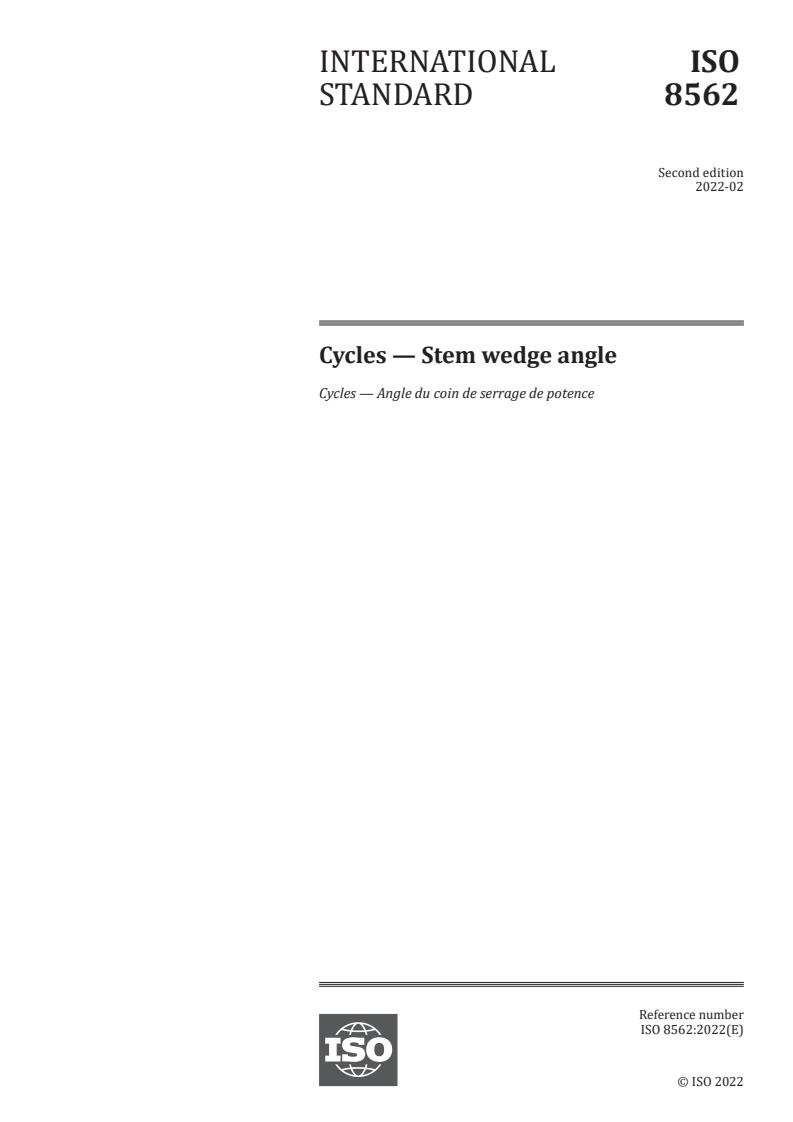
INTERNATIONAL ISO
STANDARD 8562
Second edition
2022-02
Cycles — Stem wedge angle
Cycles — Angle du coin de serrage de potence
Reference number
© ISO 2022
All rights reserved. Unless otherwise specified, or required in the context of its implementation, no part of this publication may
be reproduced or utilized otherwise in any form or by any means, electronic or mechanical, including photocopying, or posting on
the internet or an intranet, without prior written permission. Permission can be requested from either ISO at the address below
or ISO’s member body in the country of the requester.
ISO copyright office
CP 401 • Ch. de Blandonnet 8
CH-1214 Vernier, Geneva
Phone: +41 22 749 01 11
Email: copyright@iso.org
Website: www.iso.org
Published in Switzerland
ii
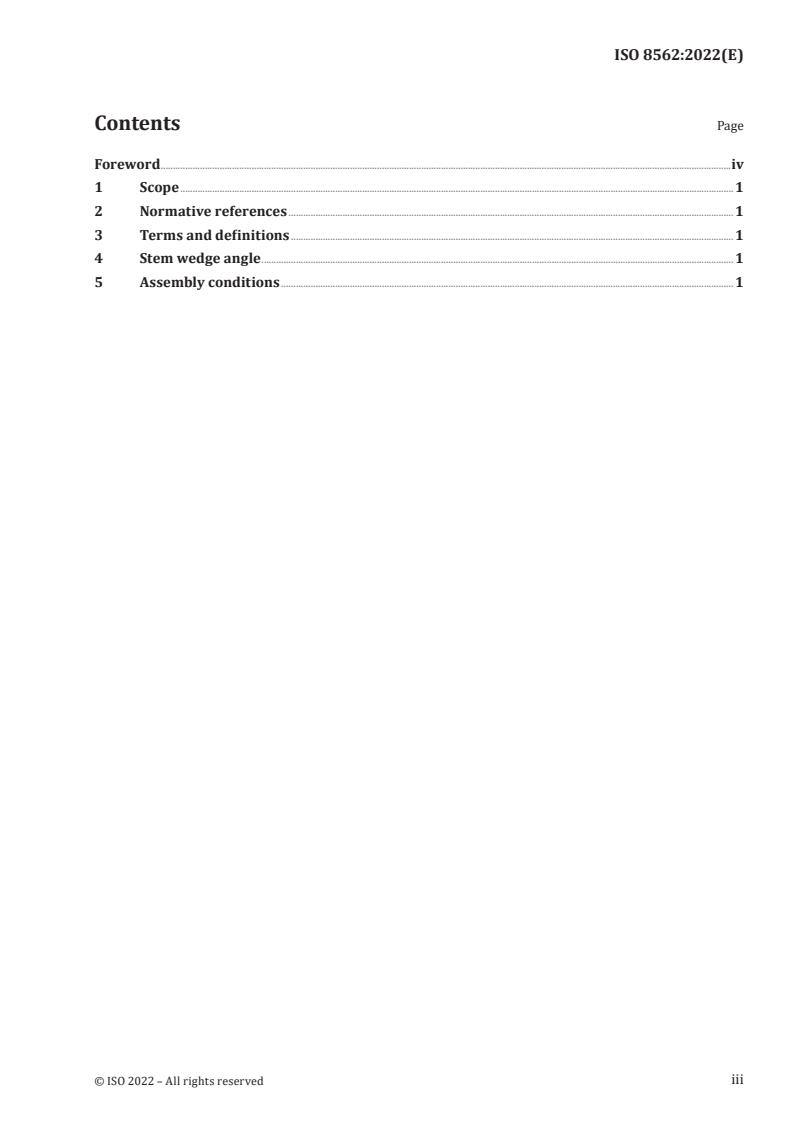
Contents Page
Foreword .iv
1 Scope . 1
2 Normative references . 1
3 Terms and definitions . 1
4 Stem wedge angle . 1
5 Assembly conditions . 1
iii
Foreword
ISO (the International Organization for Standardization) is a worldwide federation of national standards
bodies (ISO member bodies). The work of preparing International Standards is normally carried out
through ISO technical committees. Each member body interested in a subject for which a technical
committee has been established has the right to be represented on that committee. International
organizations, governmental and non-governmental, in liaison with ISO, also take part in the work.
ISO collaborates closely with the International Electrotechnical Commission (IEC) on all matters of
electrotechnical standardization.
The procedures used to develop this document and those intended for its further maintenance are
described in the ISO/IEC Directives, Part 1. In particular, the different approval criteria needed for the
different types of ISO documents should be noted. This document wa
...