

ISO 6699:2016
(Main)Cycles — Handlebar centre and stem dimensions
General Information
- Abstract
ISO 6699:2016 specifies the dimensions and tolerances to ensure secure assembly between the stem and the handlebar centre of a bicycle. It is applicable for bicycles intended for use on public roads, and on which the saddle can be adjusted to provide a saddle height of 635 mm or more. It is not applicable for specialized types of bicycle, such as tradesmen's delivery bicycles, tandems, toy bicycles and bicycles designed and equipped for use in sanctioned competitive events.
- Status
- Published
- Publication Date
- 04-Aug-2016
- Technical Committee
- ISO/TC 149 - Cycles
- Drafting Committee
- ISO/TC 149 - Cycles
- Current Stage
- 9093 - International Standard confirmed
- Start Date
- 18-Jul-2022
- Completion Date
- 29-Aug-2026
Buy Documents
ISO 6699:2016 - Cycles -- Handlebar centre and stem dimensions
ISO 6699:2016 - Cycles — Handlebar centre and stem dimensions/5/2016
Overview
ISO 6699:2016 - "Cycles - Handlebar centre and stem dimensions" defines the dimensional interfaces and tolerances between a bicycle handlebar centre and the stem clamp to ensure a secure mechanical assembly. The standard applies to bicycles intended for use on public roads where the saddle can be set to a height of 635 mm or more, and excludes specialized types (e.g., tandems, toy bicycles, tradesmen’s delivery bikes and race-only machines). ISO 6699 helps manufacturers, designers and conformity assessors achieve reliable fit, interchangeability and safety at the stem/handlebar interface.
Key topics and requirements
- Dimensional limits: The standard specifies common handlebar external diameters and matching stem clamp internal diameters (typical sizes include 22.2, 25.4, 26.0, 31.8 and 35.0 mm).
- Tolerances and tabled values: Table 1 in ISO 6699 provides the acceptable dimensions and tolerances for these clamp interfaces to ensure proper fit and clamping action.
- Measurement method: Stem clamp internal diameter can be checked using a tube of the corresponding external diameter to verify compliance.
- Assembly conditions: Assembly must meet the requirements of ISO 4210-2:2015 (see clause 4.7) - including tightening the clamping bolt to the manufacturer’s recommended torque and verifying secure clamping under those conditions.
- Manufacturing note: The standard recognizes certain manufacturing methods (e.g., hydroforming) may require alternative dimensional allowances; manufacturers should follow the guidance given for those processes.
Applications and who uses it
ISO 6699 is practical for:
- Bicycle and component manufacturers (handlebars, stems) to design compatible, interchangeable products.
- Product designers and mechanical engineers ensuring correct clamp fit and rider safety.
- Quality control and inspection teams for dimensional verification during production.
- Test laboratories and conformity assessors referencing assembly requirements in safety testing.
- Purchasing and aftermarket parts suppliers to confirm compatibility across brands.
By standardizing the handlebar/stem interface, ISO 6699 reduces fitment failures, improves rider safety and simplifies aftermarket compatibility decisions.
Related standards
- ISO 4210-2:2015 - Safety requirements for bicycles (city, trekking, mountain, racing) - referenced for assembly and testing criteria.
- ISO/TC 149 (Cycles) is the technical committee responsible for this document.
Keywords: ISO 6699, handlebar dimensions, stem clamp, bicycle handlebar, tolerances, bicycle safety, ISO 4210.
Relations
- Effective Date
- 28-Sep-2013
Buy Documents
ISO 6699:2016 - Cycles -- Handlebar centre and stem dimensions
ISO 6699:2016 - Cycles — Handlebar centre and stem dimensions/5/2016
Get Certified
Connect with accredited certification bodies for this standard

TÜV Rheinland
TÜV Rheinland is a leading international provider of technical services.

TÜV SÜD
TÜV SÜD is a trusted partner of choice for safety, security and sustainability solutions.

DEKRA Certification Inc.
DEKRA US certification services.
Sponsored listings
Frequently Asked Questions
ISO 6699:2016 is a standard published by the International Organization for Standardization (ISO). Its full title is "Cycles — Handlebar centre and stem dimensions". This standard covers: ISO 6699:2016 specifies the dimensions and tolerances to ensure secure assembly between the stem and the handlebar centre of a bicycle. It is applicable for bicycles intended for use on public roads, and on which the saddle can be adjusted to provide a saddle height of 635 mm or more. It is not applicable for specialized types of bicycle, such as tradesmen's delivery bicycles, tandems, toy bicycles and bicycles designed and equipped for use in sanctioned competitive events.
ISO 6699:2016 specifies the dimensions and tolerances to ensure secure assembly between the stem and the handlebar centre of a bicycle. It is applicable for bicycles intended for use on public roads, and on which the saddle can be adjusted to provide a saddle height of 635 mm or more. It is not applicable for specialized types of bicycle, such as tradesmen's delivery bicycles, tandems, toy bicycles and bicycles designed and equipped for use in sanctioned competitive events.
ISO 6699:2016 is classified under the following ICS (International Classification for Standards) categories: 43.150 - Cycles. The ICS classification helps identify the subject area and facilitates finding related standards.
ISO 6699:2016 has the following relationships with other standards: It is inter standard links to ISO 6699:1990. Understanding these relationships helps ensure you are using the most current and applicable version of the standard.
ISO 6699:2016 is available in PDF format for immediate download after purchase. The document can be added to your cart and obtained through the secure checkout process. Digital delivery ensures instant access to the complete standard document.
Standards Content (Sample)
INTERNATIONAL ISO
STANDARD 6699
Second edition
2016-08-15
Cycles — Handlebar centre and stem
dimensions
Cycles — Dimensions du centre du guidon et de la potence
Reference number
©
ISO 2016
© ISO 2016, Published in Switzerland
All rights reserved. Unless otherwise specified, no part of this publication may be reproduced or utilized otherwise in any form
or by any means, electronic or mechanical, including photocopying, or posting on the internet or an intranet, without prior
written permission. Permission can be requested from either ISO at the address below or ISO’s member body in the country of
the requester.
ISO copyright office
Ch. de Blandonnet 8 • CP 401
CH-1214 Vernier, Geneva, Switzerland
Tel. +41 22 749 01 11
Fax +41 22 749 09 47
copyright@iso.org
www.iso.org
ii © ISO 2016 – All rights reserved
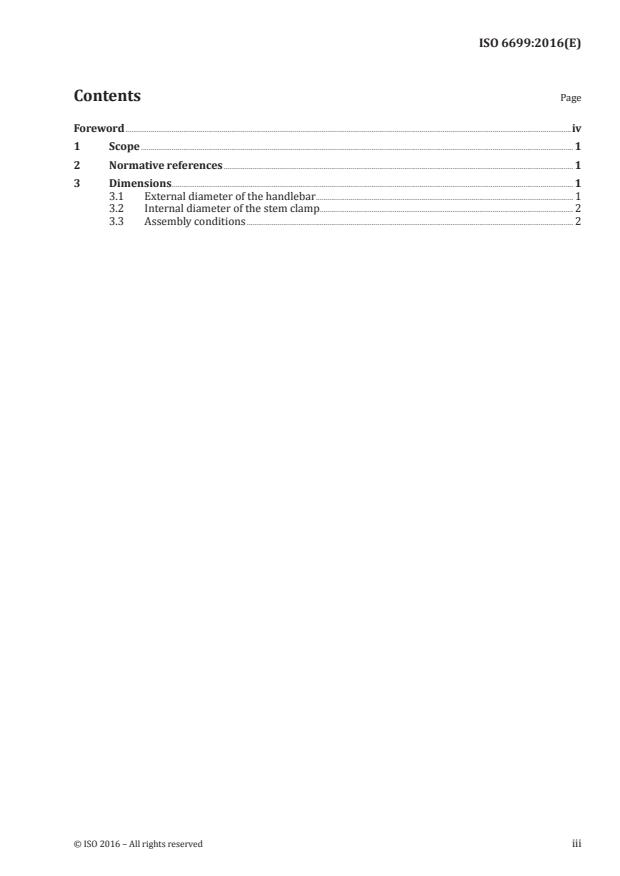
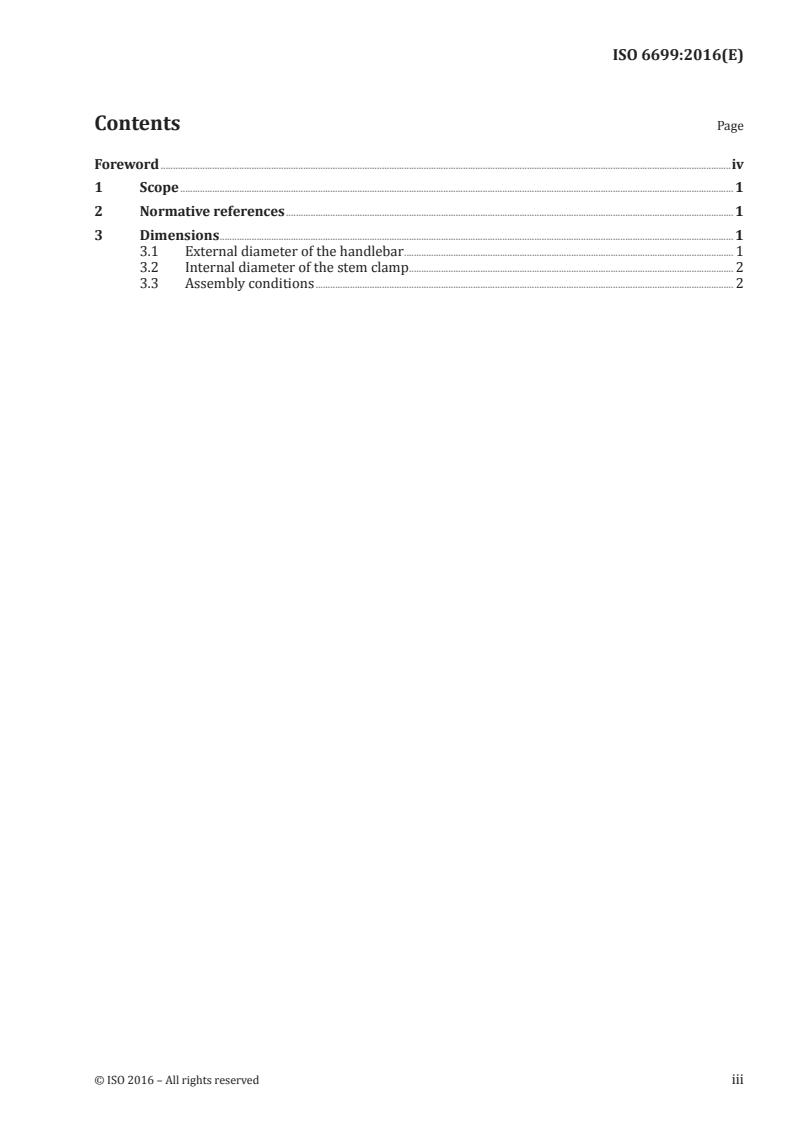
Contents Page
Foreword .iv
1 Scope . 1
2 Normative references . 1
3 Dimensions . 1
3.1 External diameter of the handlebar . 1
3.2 Internal diameter of the stem clamp . 2
3.3 Assembly conditions . 2
Foreword
ISO (the International Organization for Standardization) is a worldwide federation of national standards
bodies (ISO member bodies). The work of preparing International Standards is normally carried out
through ISO technical committees. Each member body interested in a subject for which a technical
committee has been established has the right to be represented on that committee. International
organizations, governmental and non-governmental, in liaison with ISO, also take part in the work.
ISO collaborates closely with the International Electrotechnical Commission (IEC) on all matters of
electrotechnical standardization.
The procedures used to develop this document and those intended for its further maintenance are
described in the ISO/IEC Directives, Part 1. In particular the different approval criteria needed for the
different types of ISO documents should be noted. This document was drafted in accordance with the
editorial rules of the ISO/IEC Directives, Part 2 (see www.iso.org/directives).
Attention is drawn to the possibility that some of the elements of this document may be the subject of
patent rights. ISO shall not
...
INTERNATIONAL ISO
STANDARD 6699
Second edition
2016-08-15
Cycles — Handlebar centre and stem
dimensions
Cycles — Dimensions du centre du guidon et de la potence
Reference number
©
ISO 2016
© ISO 2016, Published in Switzerland
All rights reserved. Unless otherwise specified, no part of this publication may be reproduced or utilized otherwise in any form
or by any means, electronic or mechanical, including photocopying, or posting on the internet or an intranet, without prior
written permission. Permission can be requested from either ISO at the address below or ISO’s member body in the country of
the requester.
ISO copyright office
Ch. de Blandonnet 8 • CP 401
CH-1214 Vernier, Geneva, Switzerland
Tel. +41 22 749 01 11
Fax +41 22 749 09 47
copyright@iso.org
www.iso.org
ii © ISO 2016 – All rights reserved
Contents Page
Foreword .iv
1 Scope . 1
2 Normative references . 1
3 Dimensions . 1
3.1 External diameter of the handlebar . 1
3.2 Internal diameter of the stem clamp . 2
3.3 Assembly conditions . 2
Foreword
ISO (the International Organization for Standardization) is a worldwide federation of national standards
bodies (ISO member bodies). The work of preparing International Standards is normally carried out
through ISO technical committees. Each member body interested in a subject for which a technical
committee has been established has the right to be represented on that committee. International
organizations, governmental and non-governmental, in liaison with ISO, also take part in the work.
ISO collaborates closely with the International Electrotechnical Commission (IEC) on all matters of
electrotechnical standardization.
The procedures used to develop this document and those intended for its further maintenance are
described in the ISO/IEC Directives, Part 1. In particular the different approval criteria needed for the
different types of ISO documents should be noted. This document was drafted in accordance with the
editorial rules of the ISO/IEC Directives, Part 2 (see www.iso.org/directives).
Attention is drawn to the possibility that some of the elements of this document may be the subject of
patent rights. ISO shall not
...