


ISO 501:2012
(Main)Hard coal — Determination of the crucible swelling number
Hard coal — Determination of the crucible swelling number
ISO 501:2012 specifies a method for determining the swelling properties of hard coal when heated in a covered crucible. The "crucible swelling number" (CSN) is also known as the "free swelling index" (FSI).
Houille — Détermination de l'indice de gonflement au creuset
General Information
- Status
- Published
- Publication Date
- 15-Aug-2012
- Technical Committee
- ISO/TC 27/SC 5 - Methods of analysis
- Drafting Committee
- ISO/TC 27/SC 5/WG 10 - Plastic properties of coal
- Current Stage
- 9599 - Withdrawal of International Standard
- Start Date
- 01-May-2025
- Completion Date
- 12-Feb-2026
Relations
- Effective Date
- 09-Feb-2026
- Effective Date
- 09-Feb-2026
- Effective Date
- 27-May-2023
- Effective Date
- 07-Nov-2009
Overview
ISO 501:2012 specifies a standardized laboratory method to determine the crucible swelling number (CSN) - also known as the free swelling index (FSI) - of hard coal. The method measures the swelling properties of a 1 g coal sample heated in a covered silica crucible under controlled time and temperature conditions. The shape and strength of the resulting coke button are compared with standard profiles to assign a CSN value that characterizes coal coking/swelling behaviour.
Key topics and requirements
- Scope: Test for swelling properties of hard coal when heated in a covered crucible (CSN / FSI).
- Sample preparation:
- Use general analysis test sample prepared per ISO 13909-4 and ISO 18283.
- Grind sample to pass a 212 μm sieve; avoid over‑pulverization.
- Perform test within 24 hours of preparation to avoid oxidation; equilibrate moisture with lab atmosphere.
- Apparatus:
- Specified silica crucible and lid (dimensions, mass and capacity defined).
- Pierced lid for thermocouple, silica triangle support, draught shield, burner (Teclu/Meker or electrical alternative), sheathed thermocouple, 500 g weight and sight tube for profile comparison.
- Heating profile:
- Standard heating to reach 800 °C ±10 °C in 1.5 min and 820 °C ±5 °C in 2.5 min (gas burner conditions adjusted accordingly).
- Procedure:
- Weigh 1.00–1.01 g of sample, tamp level, cover with lid, heat until volatile flame dies (minimum 2.5 min), cool and remove residue.
- Evaluate residue: non‑coherent = CSN 0; non‑swollen but strong/weak buttons = 1 or 1/2; swollen buttons matched to standard profiles (1.5–9 or >9).
- Perform tests in triplicate (or up to 5/10 per reproducibility rules) and follow averaging rules; report mean to the nearest 1/2 unit.
- Precision:
- Repeatability: for three determinations the range should not exceed 0.5 unit; for five determinations not exceed 1 unit.
- Reproducibility: means between different laboratories should not differ by more than specified precision (see Clause 9/Table 1).
- Safety: Standard warns about hazardous materials and operations; users must adopt appropriate safety practices.
Applications and users
- Used by coal testing laboratories, coke producers, metallurgical and steel industry quality control, power utilities and research organisations to:
- Assess coal suitability for coke production and metallurgical processes.
- Classify coals by swelling/coking behaviour for blend design.
- Support procurement, quality assurance and compliance testing.
- Valuable for engineers, lab managers, coal analysts and standards/QA personnel.
Related standards
- ISO 13909-4 - Hard coal and coke - Mechanical sampling - Part 4: Preparation of test samples
- ISO 18283 - Hard coal and coke - Manual sampling
Keywords: ISO 501:2012, crucible swelling number, CSN, free swelling index, hard coal, coal testing, swelling properties, covered crucible, coal analysis.

Get Certified
Connect with accredited certification bodies for this standard

Bureau Veritas Chile
Bureau Veritas certification services in Chile.
Bureau Veritas Peru
Bureau Veritas certification services in Peru.
BVQI Peru
Bureau Veritas certification in Peru.
Sponsored listings
Frequently Asked Questions
ISO 501:2012 is a standard published by the International Organization for Standardization (ISO). Its full title is "Hard coal — Determination of the crucible swelling number". This standard covers: ISO 501:2012 specifies a method for determining the swelling properties of hard coal when heated in a covered crucible. The "crucible swelling number" (CSN) is also known as the "free swelling index" (FSI).
ISO 501:2012 specifies a method for determining the swelling properties of hard coal when heated in a covered crucible. The "crucible swelling number" (CSN) is also known as the "free swelling index" (FSI).
ISO 501:2012 is classified under the following ICS (International Classification for Standards) categories: 73.040 - Coals. The ICS classification helps identify the subject area and facilitates finding related standards.
ISO 501:2012 has the following relationships with other standards: It is inter standard links to EN 16510-1:2018, EN 16510-1:2022, ISO 501:2025, ISO 501:2003. Understanding these relationships helps ensure you are using the most current and applicable version of the standard.
ISO 501:2012 is available in PDF format for immediate download after purchase. The document can be added to your cart and obtained through the secure checkout process. Digital delivery ensures instant access to the complete standard document.
Standards Content (Sample)
INTERNATIONAL ISO
STANDARD 501
Fourth edition
2012-09-01
Hard coal — Determination of the
crucible swelling number
Houille — Détermination de l’indice de gonflement au creuset
Reference number
©
ISO 2012
© ISO 2012
All rights reserved. Unless otherwise specified, no part of this publication may be reproduced or utilized in any form or by any
means, electronic or mechanical, including photocopying and microfilm, without permission in writing from either ISO at the
address below or ISO’s member body in the country of the requester.
ISO copyright office
Case postale 56 • CH-1211 Geneva 20
Tel. + 41 22 749 01 11
Fax + 41 22 749 09 47
E-mail copyright@iso.org
Web www.iso.org
Published in Switzerland
ii © ISO 2012 – All rights reserved
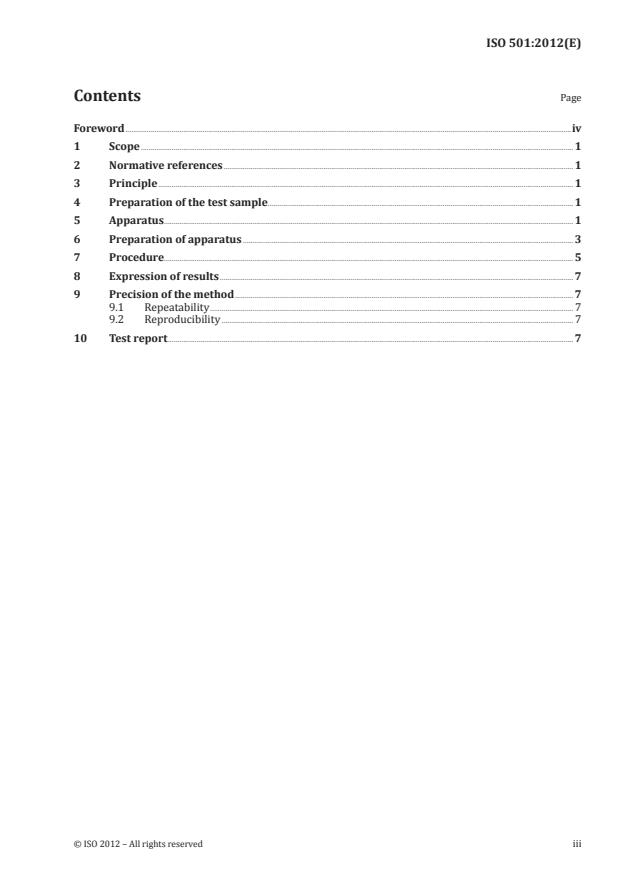
Contents Page
Foreword .iv
1 Scope . 1
2 Normative references . 1
3 Principle . 1
4 Preparation of the test sample . 1
5 Apparatus . 1
6 Preparation of apparatus . 3
7 Procedure. 5
8 Expression of results . 7
9 Precision of the method . 7
9.1 Repeatability . 7
9.2 Reproducibility . 7
10 Test report . 7
Foreword
ISO (the International Organization for Standardization) is a worldwide federation of national standards
bodies (ISO member bodies). The work of preparing International Standards is normally carried out
through ISO technical committees. Each member body interested in a subject for which a technical
committee has been established has the right to be represented on that committee. International
organizations, governmental and non-governmental, in liaison with ISO, also take part in the work.
ISO collaborates closely with the International Electrotechnical Commission (IEC) on all matters of
electrotechnical standardization.
International Standards are drafted in accordance with the rules given in the ISO/IEC Directives, Part 2.
The main task of technical committees is to prepare International Standards. Draft International
Standards adopted by the technical committees are circulated to the member bodies for voting.
Publication as an International Standard requires approval by at least 75 % of the member bodies
casting a vote.
Attention is drawn to the possibility that some of the elements of this document may be the subject of
patent rights. ISO shall not be held responsible for identifying any or all such patent rights.
ISO 501 was prepared by Technical Committee ISO/TC 27, Solid mineral fuels, Subcommittee SC 5,
Methods of analysis.
This fourth edition cancels and replaces the third edition (ISO 501:2003), which has been technically revised.
iv © ISO 2012 – All rights reserved
INTERNATIONAL STANDARD ISO 501:2012(E)
Hard coal — Determination of the crucible swelling number
WARNING — Use of this International Standard can involve hazardous materials, operations
and equipment. This International Standard does not purport to address all of the safety issues
associated with its use. It is the responsibility of the user of this International Standard to
establish appropriate safety and health practices and determine the applicability of regulatory
limitations prior to use.
1 Scope
This International Standard specifies a method for determining the swelling properties of hard coal
when heated in a covered crucible.
NOTE The “crucible swelling number” (CSN) is also known as the “free swelling index” (FSI).
2 Normative references
The following referenced documents are indispensable for the application of this document. For dated
references, only the edition cited applies. For undated references, the latest edition of the referenced
document (including any amendments) applies.
ISO 13909-4, Hard coal and coke — Mechanical sampling — Part 4: Coal — Preparation of test samples
ISO 18283, Hard coal and coke — Manual sampling
3 Principle
A sample of coal is heated in a covered crucible under standard conditions of time and temperature. The
shape of the coke button obtained is classified by comparison with the outlines of a set of standard profiles.
4 Preparation of the test sample
The test sample shall be the general analysis test sample prepared in accordance with ISO 13909-4
and ISO 18283. Ensure that the moisture content of the sample is in equilibrium with the laboratory
atmosphere, exposing it, if necessary, in a thin layer for the minimum time required to achieve equilibrium.
The sample used for the crucible swelling number (CSN) test should be ground to pass a 212 μm sieve.
Avoid very fine grinding, as CSN can be adversely affected with pulverization level. Once the sample is
prepared to this size specification, the test should be performed within 24 h in order to avoid oxidation
and a potentially misleading CSN result.
5 Apparatus
5.1 Crucible and lid (see Figure 1): silica crucible, squat form, and silica lid with ring handle.
The crucible shall conform to the following specifications:
External height: 26 ± 1,0 mm
External diameter at top: 41 ± 1,0 mm
Internal diameter at base: 14 ± 3,0 mm
Mass: 12 ± 1,0 g
Capacity: 16 ml to 17,5 ml
Dimensions in millimetres
Key
1 flat surface required
2 lid
3 crucible
Figure 1 — Crucible with lid for swelling test
2 © ISO 2012 – All rights reserved
5.2 Pierced silica lid (see Figure 2), similar to that described in 5.1 but with a 6 mm hole through
which the thermocouple (5.7) can pass.
Dimensions in millimetres
Figure 2 — Pierced crucible lid
5.3 Triangle, consisting of silica tubing of 6 mm to 6,5 mm external diamete
...
Questions, Comments and Discussion
Ask us and Technical Secretary will try to provide an answer. You can facilitate discussion about the standard in here.
Loading comments...