

ISO 7404-5:2025
(Main)Coal — Methods for petrographic analysis — Part 5: Method of determining microscopically the reflectance of vitrinite
General Information
- Abstract
This document specifies the methods for determining the reflectance of vitrinite of coals microscopically on polished surfaces, immersed in oil. The methods are applicable to coals from single seams or coal blends covering the whole range of low-, medium- and high-rank coal. Vitrinite reflectance measurements can be used to characterize the components within blends. Measures can be taken to correct for the vitrinite percentage within each of the components of the blend or to determine the proportion of components in a blend, particularly when the components have dissimilar vitrinite contents. This method necessitates the identification of vitrinite by the analyst. Reflectance measurements on vitrinite, obtained by interpreting the results from an automated system, are outside the scope of this document.
- Status
- Published
- Publication Date
- 26-Oct-2025
- Technical Committee
- ISO/TC 27/SC 5 - Methods of analysis
- Drafting Committee
- ISO/TC 27/SC 5 - Methods of analysis
- Current Stage
- 6060 - International Standard published
- Start Date
- 27-Oct-2025
- Due Date
- 20-May-2026
- Completion Date
- 27-Oct-2025


Overview
ISO 7404-5:2025 - "Coal - Methods for petrographic analysis - Part 5: Method of determining microscopically the reflectance of vitrinite" specifies a microscope-based procedure to measure vitrinite reflectance on well‑polished coal surfaces immersed in oil. The method is applicable across the full range of low-, medium- and high‑rank coals and to single‑seam coals or coal blends. Measurements are performed at 546 nm and compared against calibrated reflectance standards. Automated interpretation of reflectance data is explicitly outside the scope.
Key topics and technical requirements
- Measurement principle: Near‑normal incidence light reflected from vitrinite in oil is measured (photomultiplier or equivalent) at 546 nm and compared with standards.
- Immersion medium: Non‑drying, non‑corrosive oil with refractive index 1.5180 ± 0.0004 at 23 °C and 546 nm; avoid old or contaminated oil.
- Calibration standards: Use at least two polished, durable, isotropic standards with well‑spaced reflectances; additional standards needed for reflectance > 2.0%.
- Measurement types: Supports maximum and random reflectance determinations - the chosen type must be reported.
- Sample preparation & apparatus: Polished surfaces and optical alignment as described; see ISO 7404-2 for sample preparation procedures.
- Quality checks: Procedures for apparatus stability, linearity, parasitic reflections and calibration verification are specified.
- Analyst identification: Vitrinite must be identified by the analyst; results derived solely from automated interpretation are excluded.
- Reporting & precision: Requirements for reporting results, repeatability and reproducibility data, and test reporting are included.
Applications and users
Practical uses of ISO 7404-5:2025:
- Determination of coal rank for geological or technical classification.
- Characterization of coal blends, including correction for vitrinite content or estimation of component proportions when components differ in vitrinite reflectance.
- Quality control in coal production, trading and transport (cargo characterization).
- Feedstock assessment for coking, combustion, gasification and coal conversion processes.
- Research and accreditation (e.g., ICCP Single Coal Accreditation Program) for petrographers and analytical laboratories.
Typical users:
- Coal petrologists and petrographic laboratories
- Power and steel industry quality/control teams
- Coal traders and commodity analysts
- Academic and geological researchers
Related standards
- ISO 7404 series (petrographic methods)
- ISO 7404-1 (Vocabulary)
- ISO 7404-2 (Sample preparation)
Keywords: ISO 7404-5:2025, vitrinite reflectance, coal petrographic analysis, immersion oil, reflectance standards, coal rank, coal blends, photomultiplier, polished surfaces.
Relations
- Effective Date
- 27-May-2023
Get Certified
Connect with accredited certification bodies for this standard

Bureau Veritas Chile
Bureau Veritas certification services in Chile.
Bureau Veritas Peru
Bureau Veritas certification services in Peru.
BVQI Peru
Bureau Veritas certification in Peru.
Sponsored listings
Frequently Asked Questions
ISO 7404-5:2025 is a standard published by the International Organization for Standardization (ISO). Its full title is "Coal — Methods for petrographic analysis — Part 5: Method of determining microscopically the reflectance of vitrinite". This standard covers: This document specifies the methods for determining the reflectance of vitrinite of coals microscopically on polished surfaces, immersed in oil. The methods are applicable to coals from single seams or coal blends covering the whole range of low-, medium- and high-rank coal. Vitrinite reflectance measurements can be used to characterize the components within blends. Measures can be taken to correct for the vitrinite percentage within each of the components of the blend or to determine the proportion of components in a blend, particularly when the components have dissimilar vitrinite contents. This method necessitates the identification of vitrinite by the analyst. Reflectance measurements on vitrinite, obtained by interpreting the results from an automated system, are outside the scope of this document.
This document specifies the methods for determining the reflectance of vitrinite of coals microscopically on polished surfaces, immersed in oil. The methods are applicable to coals from single seams or coal blends covering the whole range of low-, medium- and high-rank coal. Vitrinite reflectance measurements can be used to characterize the components within blends. Measures can be taken to correct for the vitrinite percentage within each of the components of the blend or to determine the proportion of components in a blend, particularly when the components have dissimilar vitrinite contents. This method necessitates the identification of vitrinite by the analyst. Reflectance measurements on vitrinite, obtained by interpreting the results from an automated system, are outside the scope of this document.
ISO 7404-5:2025 is classified under the following ICS (International Classification for Standards) categories: 73.040 - Coals. The ICS classification helps identify the subject area and facilitates finding related standards.
ISO 7404-5:2025 has the following relationships with other standards: It is inter standard links to ISO 7404-5:2009. Understanding these relationships helps ensure you are using the most current and applicable version of the standard.
ISO 7404-5:2025 is available in PDF format for immediate download after purchase. The document can be added to your cart and obtained through the secure checkout process. Digital delivery ensures instant access to the complete standard document.
Standards Content (Sample)
International
Standard
ISO 7404-5
Fourth edition
Coal — Methods for petrographic
2025-10
analysis —
Part 5:
Method of determining
microscopically the reflectance of
vitrinite
Charbon — Méthodes d'analyse pétrographique —
Partie 5: Méthode de détermination au microscope du pouvoir
réflecteur de la vitrinite
Reference number
© ISO 2025
All rights reserved. Unless otherwise specified, or required in the context of its implementation, no part of this publication may
be reproduced or utilized otherwise in any form or by any means, electronic or mechanical, including photocopying, or posting on
the internet or an intranet, without prior written permission. Permission can be requested from either ISO at the address below
or ISO’s member body in the country of the requester.
ISO copyright office
CP 401 • Ch. de Blandonnet 8
CH-1214 Vernier, Geneva
Phone: +41 22 749 01 11
Email: copyright@iso.org
Website: www.iso.org
Published in Switzerland
ii
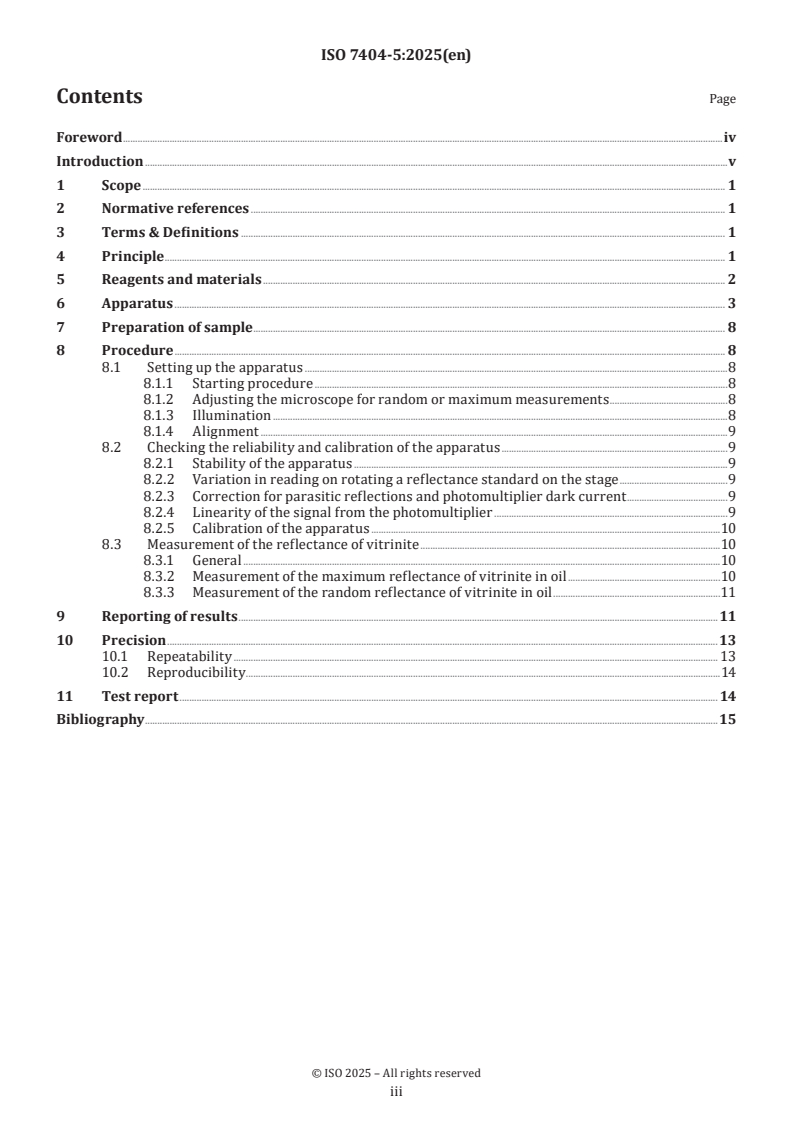
Contents Page
Foreword .iv
Introduction .v
1 Scope . 1
2 Normative references . 1
3 Terms & Definitions . 1
4 Principle . 1
5 Reagents and materials . 2
6 Apparatus . 3
7 Preparation of sample . 8
8 Procedure . 8
8.1 Setting up the apparatus .8
8.1.1 Starting procedure .8
8.1.2 Adjusting the microscope for random or maximum measurements .8
8.1.3 Illumination .8
8.1.4 Alignment .9
8.2 Checking the reliability and calibration of the apparatus .9
8.2.1 Stability of the apparatus .9
8.2.2 Variation in reading on rotating a reflectance standard on the stage .9
8.2.3 Correction for parasitic reflections and photomultiplier dark current .9
8.2.4 Linearity of the signal from the photomultiplier .9
8.2.5 Calibration of the apparatus .10
8.3 Measurement of the reflectance of vitrinite .10
8.3.1 General .10
8.3.2 Measurement of the maximum reflectance of vitrinite in oil .10
8.3.3 Measurement of the random reflectance of vitrinite in oil .11
9 Reporting of results .11
10 Precision .13
10.1 Repeatability . 13
10.2 Reproducibility .14
11 Test report . 14
Bibliography .15
iii
Foreword
ISO (the International Organization for Standardization) is a worldwide federation of national standards
bodies (ISO member bodies). The work of preparing International Standards is normally carried out through
ISO technical committees. Each member body interested in a subject for which a technical committee
has been established has the right to be represented on that committee. International organizations,
governmental and non-governmental, in liaison with ISO, also take part in the work. ISO collaborates closely
with the International Electrotechnical Commission (IEC) on all matters of electrotechnical standardization.
The procedures used to develop this document and those intended for its further maintenance are described
in the ISO/IEC Directives, Part 1. In particular, the different approval criteria needed for the different types
of ISO document should be noted. This document was drafted in accordance with the editorial rules of the
ISO/IEC Directives, Part 2 (see www.iso.org/directives).
ISO draws attention to the possibility that the implementation of this document may involve the use of (a)
patent(s). ISO takes no position concerning the evidence, validity or applicability of any claimed patent
rights in respect thereof. As of the date of publication of this document, ISO had not received notice of (a)
patent(s) which may be required to implement this document. However, implementers are cautioned that
this may not represent the latest information, which may be obtained from the patent database available at
www.iso.org/patents. ISO shall not be held responsible for identifying any or all such patent rights.
Any trade name used in this document is information given for the convenience of users and does not
constitute an endorsement.
For an explanation of the voluntary nature of standards, the meaning of ISO specific terms and expressions
related to conformity assessment, as well as information about ISO's adherence to the World Trade
Organization (WTO) principles in the Technical Barriers to Trade (TBT), see www.iso.org/iso/foreword.html.
This document was prepared by Technical Committee ISO/TC 27, Coal and coke, Subcommittee SC 5, Methods
of analysis.
This fourth edition cancels and replaces the third edition (ISO 7404-5:2009), which has been technically
revised.
The main changes are as follows:
— input from the International Committee for Coal and Organic Petrology (ICCP) has been added.
A list of all parts in the ISO 7404 series can be found on the ISO website.
Any feedback or questions on this document should be directed to the user’s national standards body. A
complete listing of these bodies can be found at www.iso.org/members.html.
iv
Introduction
Petrographic analyses have been recognized internationally as important in the context of the genesis,
vertical and lateral variation, continuity, metamorphism and usage of coal. The International Committee
for Coal and Organic Petrology (ICCP) has made recommendations concerning nomenclature and analytical
[1][2][3][4][5][6]
methods and has described in detail the characteristics of a wide range of coals . This document
incorporates many useful comments made by members of the ICCP and by member bodies of ISO/TC 27.
Petrographic analyses of a single coal provide information about the rank, the maceral and microlithotype
compositions and the distribution of minerals in the coal. The reflectance of vitrinite is a useful measure
of coal rank and the distribution of the reflectance of vitrinite in a coal blend, together with a maceral
group analysis, can provide information about the rank and type of the coal and important chemical and
technological properties of the blend.
The ISO 7404 series is concerned with the methods of petrographic analysis currently employed in
characterizing coal in the context of its technological or geological use, or both. It establishes a system for
petrographic analysis.
[7]
The method of determining the reflectance of vitrinite is applicable for low-, medium- and high-rank coals .
The properties of a given coal are determined by the proportions and associations of the macerals and
minerals present and by the rank of the coal. The reflectance of the vitrinite in the coal can be used as an
indicator of rank, independent of the petrographic composition. Vitrinite reflectance increases progressively
with rank. The reflectance of vitrinite has various other applications, such as the characterization of bulk
samples and cargoes. For coal blends, the measurement of the vitrinite reflectance profile can permit the
identification of the component coals and permit the estimation of the relative abundance of the component
coals within the blend.
The reflectance of the macerals of the vitrinite group can vary significantly in a single coal seam and therefore
the value of the reflectance obtained depends also on the choice of the macerals used for measurement.
Reflectance measurements are made on one or more of the macerals of vitrinite. Consequently, a vital step in
the measurement of vitrinite reflectance is the identification of vitrinite and its various macerals or maceral
[1]
varieties. For this purpose, reference can be made to ISO 7404-1, the ICCP handbook and subsequent ICCP
[2][5]
authored journal articles .
[2]
For rank determination of single-seam coals, normally the reflectance of collotelinite (ulminite B in
[5]
lignites, the equivalent of low-rank B and C ) is determined. In cases where collotelinite (or in low-rank
coals, ulminite B) is not present in sufficient amounts, reflectance analysis on other vitrinite macerals
is performed. Reflectance analysis on various vitrinite macerals can also be applied for technological
purposes and to coal blends; see 8.3.1. The reflectance value obtained also depends on whether maximum
or random reflectance measurements are made, so it is necessary to specify the type of measurement.
All of these analysis procedures are applicable to single-coal seams or to blends providing that adequate
(see 8.3.1) reflectance measurements are made in compliance with an unbiased sampling procedure on a
representative sample.
For vitrinite reflectance analysis, the ICCP regularly run the Single Coal Accreditation Program (SCAP) for
accrediting petrologists in the analysis of single seam coals.
NOTE As the ISO 7404 series covers coals of all rank, the term “vitrinite” as used in this document includes
vitrinite as well as huminite. Reference can be made to ISO 7404-1 for details. The equivalent to collotelinite in lignites
is ulminite B. Reflectance measurement on lignites is performed on huminite.
v
International Standard ISO 7404-5:2025(en)
Coal — Methods for petrographic analysis —
Part 5:
Method of determining microscopically the reflectance of
vitrinite
1 Scope
This document specifies the methods for determining the reflectance of vitrinite of coals microscopically
on polished surfaces, immersed in oil. The methods are applicable to coals from single seams or coal blends
covering the whole range of low-, medium- and high-rank coal.
Vitrinite reflectance measurements can be used to characterize the components within blends. Measures
can be taken to correct for the vitrinite percentage within each of the components of the blend or to
determine the proportion of components in a blend, particularly when the components have dissimilar
vitrinite contents. This method necessitates the identification of vitrinite by the analyst.
Reflectance measurements on vitrinite, obtained by interpreting the results from an automated system, are
outside the scope of this document.
2 Normative references
The following documents are referred to in the text in such a way that some or all of their content constitutes
requirements of this document. For dated references, only the edition cited applies. For undated references,
the latest edition of the referenced document (including any amendments) applies.
ISO 7404-1, Coal — Methods for petrographic analysis — Part 1: Vocabulary
ISO 7404-2, Coal — Methods for petrographic analysis — Part 2: Methods of preparing coal samples
3 Terms & Definitions
For the purposes of this document, the terms and definitions given in ISO 7404-1 apply.
ISO and IEC maintain terminology databases for use in standardization at the following addresses:
— ISO Online browsing platform: available at https:// www .iso .org/ obp
— IEC Electropedia: available at https:// www .electropedia .org/
4 Principle
The intensity of light reflected at near-normal incidence from a specified area of well-polished vitrinite
under oil immersion, measured at 546 nm using a photomultiplier (or similar device), is compared with the
intensity of light reflected under identical conditions from several standards of known reflectance. Different
vitrinite particles within a single-coal seam invariably differ slightly from one another in optical properties.
Therefore, an adequate number (see 8.3.1) of readings on different particles is taken to ensure that the
results are representative of the coal or coal blend.
5 Reagents and materials
5.1 Immersion medium, non-drying, non-corrosive type, with a refractive index of 1,518 0 ± 0,000 4 at
23 °C and a wavelength of 546 nm.
To avoid any impact of oxidation and contamination of the immersion medium on the measurement of
reflectance, medium from a bottle opened more than one year ago shall not be used.
Preference should be given to medium of natural origin as the properties of synthetic mediums degrade
more quickly.
In attempts to produce mediums that are chemically and physically stable, toxic compounds such as
polychlorinated bi-phenyls were used in some older products. Some more recent mediums have been
associated with allergies. The composition of the medium should, therefore, be checked to ensure that no
toxic or other undesirable properties are associated with it.
5.2 Calibration standards
5.2.1 Reflectance standards, consisting of polished surfaces of materials that:
a) are isotropic (or basal sections of uniaxial minerals);
b) are durable and resistant to corrosion;
c) have a reflectance that is stable over a long period;
d) are free from inclusions, grain boundaries, discontinuities, internal flaws and fractures;
e) have negligibly low absorptance.
To avoid significant amounts of light other than that reflected from the top surface returning to the objective,
the body of the standard shall be either thicker than 5 mm or wedge-shaped. The lower surface shall be
matte if it makes an angle of less than 10° with the upper polished surface. The sides shall be shielded
from external light. The reflectance of the standards shall be of an order similar to that of the coal being
measured. Use at least two such standards with well-spaced reflectances. If a coal with a reflectance greater
than 2,0 % is being measured, use one or more additional standards with reflectance greater than 2,0 %.
NOTE For measuring a vitrinite reflectance of about 1,0 %, a standard with reflectance below and a standard
with reflectance above 1 % are used.
An ICCP interlaboratory exercise on reflectance standards demonstrated that variations between standards
[8]
of nominally identical reflectance can be significant ; since then, the ICCP has offered the calibration of
standards against ICCP master standards. Table 1 gives approximate mean values for reflectance standards
or reflectance ranges as found between different standards in common use, as calibrated against an ICCP
Master Standard.
It is necessary that standards be carefully cleaned to avoid scratching the polished surface. If solvents
are used to remove old oil, it is necessary to take care that the evaporation of the solvent does not leave a
residue on the surface of the standard. Tarnishing can also occur with some standard materials, particularly
glasses. When the surface becomes scratched, or when comparison with the other standards shows that the
reflectance value has changed, polishing is necessary.
5.2.2 Calculation of reflectance standards
[3]
Some sources recommend calculating the reflectance, R, of a standard as given in Formula (1):
2 22
nn−1,518 + α
()
R= ×100 (1)
2 22
()nn+1,518 + α
where
R is the calculated reflectance of the standard in %;
n is the known refractive index of the standard material at a wavelength of 546 nm;
1,518 is the refractive index of the immersion medium at 546 nm and 23 °C;
α is the known absorptance of the standard material at a wavelength of 546 nm;
100 is the conversion factor from a factor of dimension one to percent, in %.
2 2
The absorptance, α, is included only if it is significant; otherwise α equals zero and α n equals zero. In this
case the reflectance, R, of a standard is given in Formula (2)
n −1,518
()
R= ×100 (2)
()n +1,518
However, the refractive index of the border phase is different from that of the interior of the standard.
Consequently, solid reflectance reference materials should always be individually calibrated against a
standard of known reflectance; see 5.2.1.
Table 1 — Reflectance standards in common use
Designation Reflectance
%
Optical glasses 0,32 to 1,70
Spinel ≈ 0,42
Leucosaphire ≈ 0,59
Yttrium aluminium garnet (YAG) 0,895 to 0,916
Gadolinium gallium garnet (GGG) 1,60 to 1,80
Diamond ≈ 5,3
Silicon carbide ≈ 7,80
See also 5.2.1.
5.2.3 Zero standard
A suitable non-reflecting standard consists of a coal or opaque resin block with a hole about 5 mm in
diameter and 5 mm deep drilled in its upper surface and filled with immersion oil. Alternatively, optical
glasses of refractive index lower than that of the immersion oil may be used.
6 Apparatus
6.1 Reflected light microscope, with photometer (or similar device), containing the following elements
(key item numbers refer to Figure 1, which shows the optical parts of a typical reflectance-measuring
microscope):
NOTE 1 The component parts might not always be in the same sequence as shown in Figure 1 to Figure 4.
a) light source (key item 1), with a stable output; a quartz halogen lamp with a rating of 100 W is required;
NOTE 2 LED light sources can be used provided that they meet similar requirements.
b) polarizer (key item 5), either a sheet or prism polarizer (used if maximum reflectance is determined);
c) light-controlling apertures, consisting of two variable diaphragms, one of which is focused on the
back focal plane of the objective (illuminator aperture, key item 3) and the other on the surface of the
specimen (field stop; key item 6); it shall be possible to centre both diaphragms on the optical axis of the
microscope system;
d) vertical illuminator (key item 8), Berek prism, simple coated glass plate or Smith illuminator (a combined
mirror and glass plate);
NOTE 3 Typical light paths are shown in Figures 2 to 4.
e) objective (key item 9), strain-free, designed for use with polarized light (for maximum reflectance
analysis).
Magnifications higher than those achieved by the commonly used 32× to 50× objectives require
numerical apertures that decrease the depth of focus to an extent that is undesirable and should,
therefore, be avoided where possible;
f) eyepieces (key item 12), one or two viewing eyepieces (oculars), one of which is fitted with crosshairs
that can be scaled;
NOTE 4 An additional ocular (key item 13) can be necessary in the light path leading to the photomultiplier.
g) microscope tube, with the following features:
1) measuring aperture (key item 14), which restricts the light reaching the photomultiplier to that
reflected from an area of the specimen (key item 10) less than 80 µm and that can be aligned with
the crosshairs in the viewing eyepiece (key item 12);
2) means of optically isolating the viewing eyepieces from the light pa
...