

ISO 1928:2025
(Main)Coal and coke — Determination of gross calorific value
General Information
- Abstract
This document specifies a method for the determination of the gross calorific value of coal and coke at constant volume and at the reference temperature of 25 °C in a combustion vessel calorimeter calibrated by combustion of certified benzoic acid. The result obtained is the gross calorific value of the analysis sample at constant volume with all the water of the combustion products as liquid water. In practice, fuel is burned at constant (atmospheric) pressure and the water is not condensed but is removed as vapour with the flue gases. Under these conditions, the operative heat of combustion is the net calorific value of the fuel at constant pressure. The net calorific value at constant volume can also be used; formulae are given for calculating both values. General principles and procedures for the calibrations and the fuel tests are specified in the main text, whereas those pertaining to the use of a particular type of calorimetric instrument are described in Annexes A to C. Annex D contains checklists for performing calibration and fuel tests using specified types of calorimeters. Annex E gives examples illustrating some of the calculations. Annex F provides guidance around safe use, maintenance and testing of the calorimeter combustion vessel. NOTE Descriptors: solid fuels, coal, coke, tests, determination, calorific value, rules of calculation, calorimetry.
- Status
- Published
- Publication Date
- 12-Aug-2025
- Technical Committee
- ISO/TC 27/SC 5 - Methods of analysis
- Drafting Committee
- ISO/TC 27/SC 5 - Methods of analysis
- Current Stage
- 6060 - International Standard published
- Start Date
- 13-Aug-2025
- Due Date
- 20-May-2026
- Completion Date
- 13-Aug-2025

Overview
ISO 1928:2025 - "Coal and coke - Determination of gross calorific value" specifies a standardized laboratory method for measuring the gross calorific value (higher heating value) of coal and coke. The method uses a combustion-vessel calorimeter at constant volume with a reference temperature of 25 °C, and requires calibration by combustion of certified benzoic acid. Results are reported as the gross calorific value of the analysis sample with combustion water returned to liquid form. The standard also gives procedures and formulae to convert to net calorific values (constant volume and constant pressure).
Key technical topics and requirements
- Scope and principle
- Determination of gross calorific value at constant volume; explanation of net calorific value in practical (atmospheric) combustion conditions.
- Calibration
- Calibration of the calorimeter using certified benzoic acid; calculation of effective heat capacity and valid working range.
- Apparatus and reagents
- Requirements for calorimetric instruments and specified reagents (benzoic acid as calibrant).
- Sample preparation and test procedure
- Preparation of the analysis sample; assembly and operation of the combustion vessel calorimeter; measurement and correction of temperature rise.
- Calculations and reporting
- Formulae for gross and net calorific values, expression of results, and procedures to calculate values on different bases.
- Instrument-specific guidance
- Annex A–C: procedures for adiabatic, isoperibol/static-jacket, and automated calorimeters.
- Checklists, examples, and safety
- Annex D: checklists for test design and procedures; Annex E: worked calculation examples; Annex F: guidance on safe use, maintenance, and testing of combustion vessels.
- Precision
- Clauses on repeatability and reproducibility limits for laboratory measurements.
Note: The document contains an explicit safety warning regarding the risk of explosion or blow-out of combustion vessels - strict adherence to the specified provisions is required.
Applications and who uses it
ISO 1928:2025 is applied by:
- Analytical laboratories performing fuel quality testing
- Coal and coke producers and traders for product specification and contractual testing
- Power generation and steel industry quality/control departments
- Regulatory agencies and certification bodies setting energy content standards
- Research institutions studying fuel combustion and energy balance
Practical benefits include consistent, traceable calorific value measurements, comparability across labs, and validated procedures for instrument calibration and safe operation.
Related standards (if applicable)
The standard references related instruments and analysis standards such as:
- ISO 651, ISO 652 (calorimeter thermometers)
- ISO 687 (moisture in coke)
- Other referenced test-method standards cited within ISO 1928:2025
Keywords: ISO 1928:2025, gross calorific value, coal, coke, calorimeter, benzoic acid calibration, net calorific value, combustion vessel, calorimetry, fuel testing, laboratory standard.
Relations
- Effective Date
- 27-May-2023
Get Certified
Connect with accredited certification bodies for this standard

Element Materials Technology
Materials testing and product certification.

ABS Group Brazil
ABS Group certification services in Brazil.

ABS Quality Evaluations Inc.
American Bureau of Shipping quality certification.
Sponsored listings
Frequently Asked Questions
ISO 1928:2025 is a standard published by the International Organization for Standardization (ISO). Its full title is "Coal and coke — Determination of gross calorific value". This standard covers: This document specifies a method for the determination of the gross calorific value of coal and coke at constant volume and at the reference temperature of 25 °C in a combustion vessel calorimeter calibrated by combustion of certified benzoic acid. The result obtained is the gross calorific value of the analysis sample at constant volume with all the water of the combustion products as liquid water. In practice, fuel is burned at constant (atmospheric) pressure and the water is not condensed but is removed as vapour with the flue gases. Under these conditions, the operative heat of combustion is the net calorific value of the fuel at constant pressure. The net calorific value at constant volume can also be used; formulae are given for calculating both values. General principles and procedures for the calibrations and the fuel tests are specified in the main text, whereas those pertaining to the use of a particular type of calorimetric instrument are described in Annexes A to C. Annex D contains checklists for performing calibration and fuel tests using specified types of calorimeters. Annex E gives examples illustrating some of the calculations. Annex F provides guidance around safe use, maintenance and testing of the calorimeter combustion vessel. NOTE Descriptors: solid fuels, coal, coke, tests, determination, calorific value, rules of calculation, calorimetry.
This document specifies a method for the determination of the gross calorific value of coal and coke at constant volume and at the reference temperature of 25 °C in a combustion vessel calorimeter calibrated by combustion of certified benzoic acid. The result obtained is the gross calorific value of the analysis sample at constant volume with all the water of the combustion products as liquid water. In practice, fuel is burned at constant (atmospheric) pressure and the water is not condensed but is removed as vapour with the flue gases. Under these conditions, the operative heat of combustion is the net calorific value of the fuel at constant pressure. The net calorific value at constant volume can also be used; formulae are given for calculating both values. General principles and procedures for the calibrations and the fuel tests are specified in the main text, whereas those pertaining to the use of a particular type of calorimetric instrument are described in Annexes A to C. Annex D contains checklists for performing calibration and fuel tests using specified types of calorimeters. Annex E gives examples illustrating some of the calculations. Annex F provides guidance around safe use, maintenance and testing of the calorimeter combustion vessel. NOTE Descriptors: solid fuels, coal, coke, tests, determination, calorific value, rules of calculation, calorimetry.
ISO 1928:2025 is classified under the following ICS (International Classification for Standards) categories: 73.040 - Coals; 75.160.10 - Solid fuels. The ICS classification helps identify the subject area and facilitates finding related standards.
ISO 1928:2025 has the following relationships with other standards: It is inter standard links to ISO 1928:2020. Understanding these relationships helps ensure you are using the most current and applicable version of the standard.
ISO 1928:2025 is available in PDF format for immediate download after purchase. The document can be added to your cart and obtained through the secure checkout process. Digital delivery ensures instant access to the complete standard document.
Standards Content (Sample)
International
Standard
ISO 1928
Fifth edition
Coal and coke — Determination of
2025-08
gross calorific value
Charbon et coke — Détermination du pouvoir calorifique
supérieur
Reference number
© ISO 2025
All rights reserved. Unless otherwise specified, or required in the context of its implementation, no part of this publication may
be reproduced or utilized otherwise in any form or by any means, electronic or mechanical, including photocopying, or posting on
the internet or an intranet, without prior written permission. Permission can be requested from either ISO at the address below
or ISO’s member body in the country of the requester.
ISO copyright office
CP 401 • Ch. de Blandonnet 8
CH-1214 Vernier, Geneva
Phone: +41 22 749 01 11
Email: copyright@iso.org
Website: www.iso.org
Published in Switzerland
ii
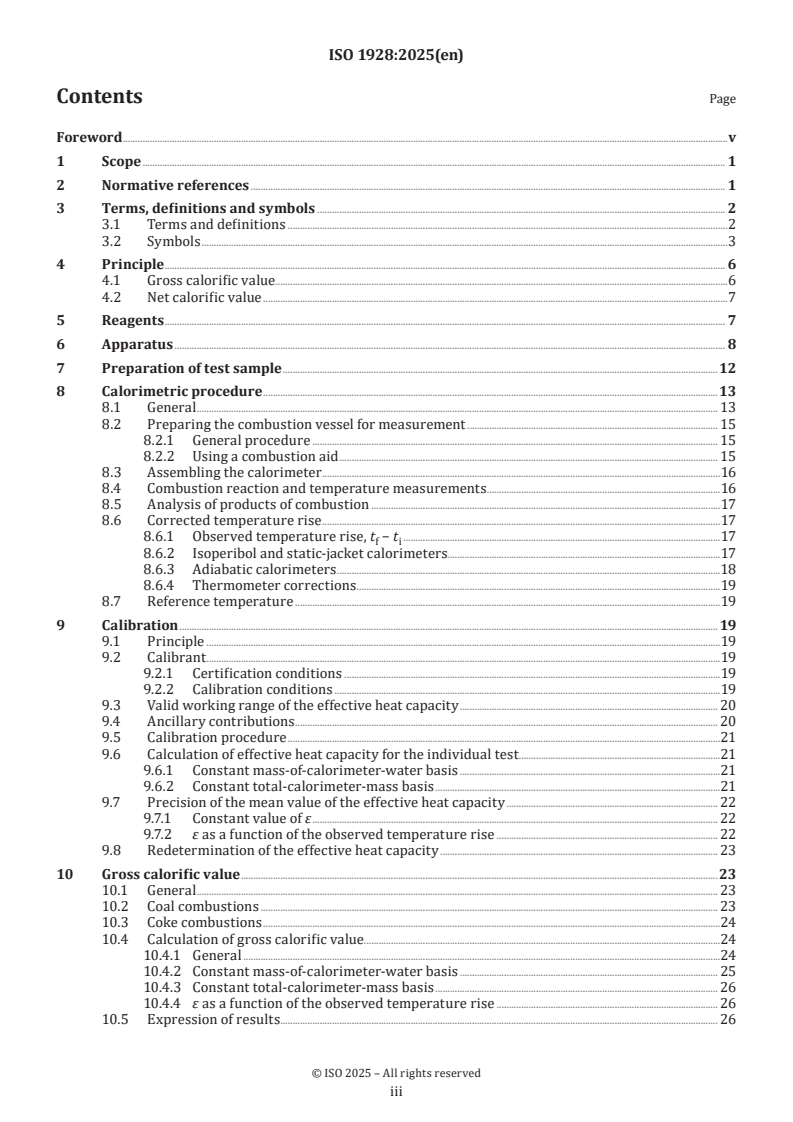
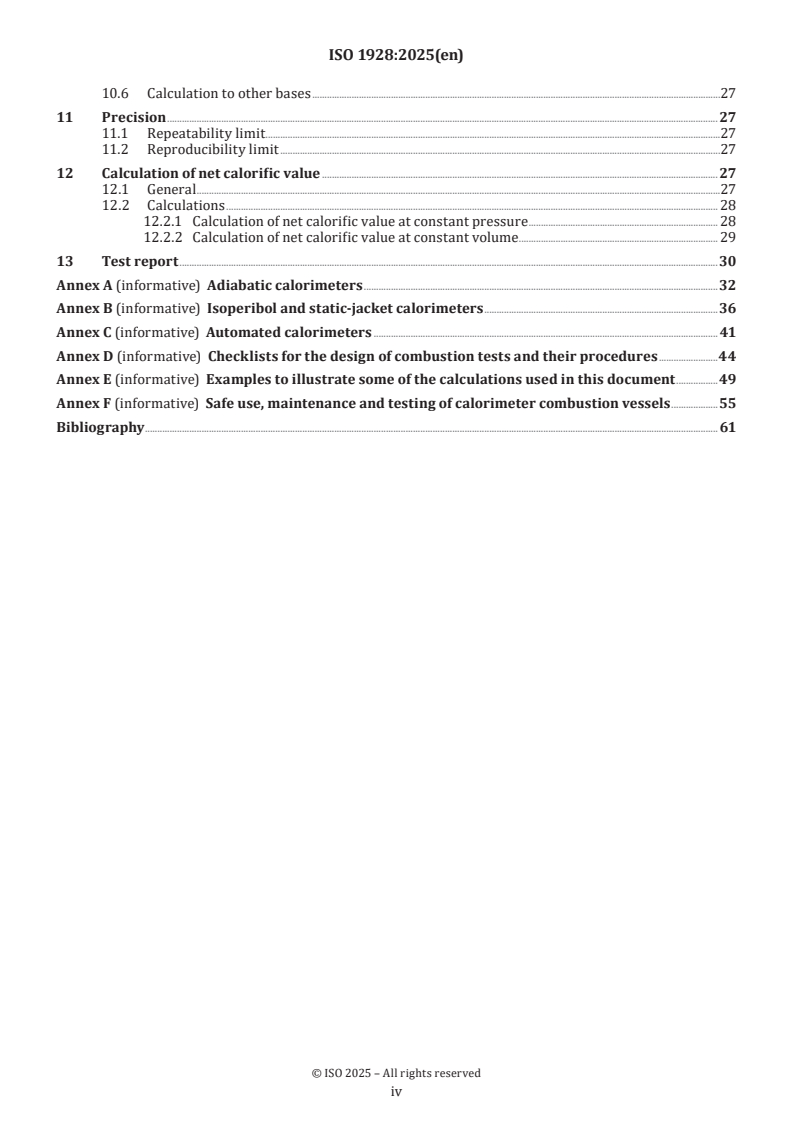
Contents Page
Foreword .v
1 Scope . 1
2 Normative references . 1
3 Terms, definitions and symbols . 2
3.1 Terms and definitions .2
3.2 Symbols .3
4 Principle . 6
4.1 Gross calorific value .6
4.2 Net calorific value .7
5 Reagents . 7
6 Apparatus . 8
7 Preparation of test sample .12
8 Calorimetric procedure .13
8.1 General . 13
8.2 Preparing the combustion vessel for measurement . 15
8.2.1 General procedure . 15
8.2.2 Using a combustion aid . 15
8.3 Assembling the calorimeter .16
8.4 Combustion reaction and temperature measurements .16
8.5 Analysis of products of combustion .17
8.6 Corrected temperature rise .17
8.6.1 Observed temperature rise, t − t .17
f i
8.6.2 Isoperibol and static-jacket calorimeters.17
8.6.3 Adiabatic calorimeters .18
8.6.4 Thermometer corrections . .19
8.7 Reference temperature .19
9 Calibration . 19
9.1 Principle .19
9.2 Calibrant .19
9.2.1 Certification conditions .19
9.2.2 Calibration conditions .19
9.3 Valid working range of the effective heat capacity . 20
9.4 Ancillary contributions . 20
9.5 Calibration procedure .21
9.6 Calculation of effective heat capacity for the individual test .21
9.6.1 Constant mass-of-calorimeter-water basis .21
9.6.2 Constant total-calorimeter-mass basis .21
9.7 Precision of the mean value of the effective heat capacity . 22
9.7.1 Constant value of ε . 22
9.7.2 ε as a function of the observed temperature rise . 22
9.8 Redetermination of the effective heat capacity . 23
10 Gross calorific value .23
10.1 General . 23
10.2 Coal combustions . 23
10.3 Coke combustions .24
10.4 Calculation of gross calorific value.24
10.4.1 General .24
10.4.2 Constant mass-of-calorimeter-water basis . 25
10.4.3 Constant total-calorimeter-mass basis . 26
10.4.4 ε as a function of the observed temperature rise . 26
10.5 Expression of results . 26
iii
10.6 Calculation to other bases .27
11 Precision .27
11.1 Repeatability limit .27
11.2 Reproducibility limit .27
12 Calculation of net calorific value .27
12.1 General .27
12.2 Calculations . 28
12.2.1 Calculation of net calorific value at constant pressure . 28
12.2.2 Calculation of net calorific value at constant volume . 29
13 Test report .30
Annex A (informative) Adiabatic calorimeters .32
Annex B (informative) Isoperibol and static-jacket calorimeters .36
Annex C (informative) Automated calorimeters . 41
Annex D (informative) Checklists for the design of combustion tests and their procedures .44
Annex E (informative) Examples to illustrate some of the calculations used in this document .49
Annex F (informative) Safe use, maintenance and testing of calorimeter combustion vessels .55
Bibliography . 61
iv
Foreword
ISO (the International Organization for Standardization) is a worldwide federation of national standards
bodies (ISO member bodies). The work of preparing International Standards is normally carried out through
ISO technical committees. Each member body interested in a subject for which a technical committee
has been established has the right to be represented on that committee. International organizations,
governmental and non-governmental, in liaison with ISO, also take part in the work. ISO collaborates closely
with the International Electrotechnical Commission (IEC) on all matters of electrotechnical standardization.
The procedures used to develop this document and those intended for its further maintenance are described
in the ISO/IEC Directives, Part 1. In particular, the different approval criteria needed for the different types
of ISO document should be noted. This document was drafted in accordance with the editorial rules of the
ISO/IEC Directives, Part 2 (see www.iso.org/directives).
ISO draws attention to the possibility that the implementation of this document may involve the use of (a)
patent(s). ISO takes no position concerning the evidence, validity or applicability of any claimed patent
rights in respect thereof. As of the date of publication of this document, ISO had not received notice of (a)
patent(s) which may be required to implement this document. However, implementers are cautioned that
this may not represent the latest information, which may be obtained from the patent database available at
www.iso.org/patents. ISO shall not be held responsible for identifying any or all such patent rights.
Any trade name used in this document is information given for the convenience of users and does not
constitute an endorsement.
For an explanation of the voluntary nature of standards, the meaning of ISO specific terms and expressions
related to conformity assessment, as well as information about ISO's adherence to the World Trade
Organization (WTO) principles in the Technical Barriers to Trade (TBT), see www.iso.org/iso/foreword.html.
This document was prepared by Technical Committee ISO/TC 27, Coal and coke, Subcommittee SC 5, Methods
of analysis.
This fifth edition cancels and replaces the fourth edition (ISO 1928:2020), which has been technically
revised.
The main changes are as follows:
— title changed from solid mineral fuels to coal and coke;
— updated symbols within formulae;
— allowance for alternative material for calorimeter can;
— expanded on some derivations and added units of measure to some equations;
— removed ambiguity around crucible masses;
— specified the analysis sample;
— more concise wording around the use of a combustion aid and determining a correction value;
— warnings now included in body of text;
— the addition of alternate ignition methods.
Any feedback or questions on this document shall be directed to the user’s national standards body. A
complete listing of these bodies can be found at www.iso.org/members.html.
v
International Standard ISO 1928:2025(en)
Coal and coke — Determination of gross calorific value
WARNING — Strict adherence to all of the provisions specified in this document is needed to ensure
against explosive rupture of the combustion vessel, or a blow-out, provided that the combustion
vessel is of proper design and construction and in good mechanical condition.
1 Scope
This document specifies a method for the determination of the gross calorific value of coal and coke at
constant volume and at the reference temperature of 25 °C in a combustion vessel calorimeter calibrated by
combustion of certified benzoic acid.
The result obtained is the gross calorific value of the analysis sample at constant volume with all the water
of the combustion products as liquid water. In practice, fuel is burned at constant (atmospheric) pressure
and the water is not condensed but is removed as vapour with the flue gases. Under these conditions, the
operative heat of combustion is the net calorific value of the fuel at constant pressure. The net calorific value
at constant volume can also be used; formulae are given for calculating both values.
General principles and procedures for the calibrations and the fuel tests are specified in the main text,
whereas those pertaining to the use of a particular type of calorimetric instrument are described in
Annexes A to C. Annex D contains checklists for performing calibration and fuel tests using specified types
of calorimeters. Annex E gives examples illustrating some of the calculations. Annex F provides guidance
around safe use, maintenance and testing of the calorimeter combustion vessel.
NOTE Descriptors: solid fuels, coal, coke, tests, determination, calorific value, rules of calculation, calorimetry.
2 Normative references
The following documents are referred to in the text in such a way that some or all of their content constitutes
requirements of this document. For dated references, only the edition cited applies. For undated references,
the latest edition of the referenced document (including any amendments) applies.
1)
ISO 651:1975, Solid-stem calorimeter thermometers
1)
ISO 652:1975, Enclosed-scale calorimeter thermometers
ISO 687, Coke — Determination of moisture in the general analysis test sample
1)
ISO 1770:1981, Solid-stem general purpose thermometers
1)
ISO 1771:1981, Enclosed-scale general purpose thermometers
ISO 5068-2, Brown coals and lignites — Determination of moisture — Part 2: Indirect gravimetric method for
moisture in the analysis sample
ISO 11722, Solid mineral fuels — Hard coal — Determination of moisture in the general analysis test sample by
drying in nitrogen
ISO 13909-4, Hard coal and coke — Mechanical sampling — Part 4: Preparation of test samples of coal
ISO 17247, Coal and coke — Ultimate analysis
ISO 18283, Coal and coke — Manual sampling
1) Withdrawn.
3 Terms, definitions and symbols
3.1 Terms and definitions
For the purposes of this document, the following terms and definitions apply.
ISO and IEC maintain terminology databases for use in standardization at the following addresses:
— ISO Online browsing platform: available at https:// www .iso .org/ obp
— IEC Electropedia: available at https:// www .electropedia .org/
3.1.1
gross calorific value at constant volume
absolute value of the specific energy of combustion for unit mass of a solid fuel burned in oxygen in a
calorimetric combustion vessel under the conditions specified
Note 1 to entry: The products of combustion are assumed to consist of gaseous oxygen, nitrogen, carbon dioxide and
sulfur dioxide, of liquid water (in equilibrium with its vapour) saturated with carbon dioxide under the conditions of
the combustion vessel reaction, and of solid ash, all at the reference temperature.
Note 2 to entry: Gross calorific value is expressed in units of joules/gram.
3.1.2
gross calorific value at constant pressure
absolute value of the specific energy of combustion, for unit mass of a solid fuel burned in oxygen at constant
pressure, instead of constant volume in a calorimetric combustion vessel
Note 1 to entry: The hydrogen in the fuel, reacting with gaseous oxygen to give liquid water, causes a decrease in the
volume of the system. When the fuel carbon reacts with gaseous oxygen, an equal volume of gaseous carbon dioxide is
formed and, hence, no change in volume occurs in combustion of the carbon. The oxygen and nitrogen in the fuel both
give rise to an increase in volume.
3.1.3
net calorific value at constant volume
absolute value of the specific energy of combustion, for unit mass of a solid fuel burned in oxygen under
conditions of constant volume and such that all the water of the reaction products remains as water vapour
(in a hypothetical state at 0,1 MPa), the other products being as for the gross calorific value, all at the
reference temperature (3.1.8)
3.1.4
net calorific value at constant pressure
absolute value of the specific heat (enthalpy) of combustion, for unit mass of the fuel burned in oxygen at
constant pressure under such conditions that all the water of the reaction products remains as water vapour
(at 0,1 MPa), the other products being as for the gross calorific value, all at the reference temperature (3.1.8)
3.1.5
adiabatic calorimeter
calorimeter that has a rapidly changing jacket temperature
Note 1 to entry: The inner calorimeter chamber and the jacket exchange no energy because the water temperature in
both is identical during the test. The water in the external jacket is heated or cooled to match the temperature change
in the calorimeter proper.
3.1.6
isoperibol calorimeter
calorimeter that has a jacket of uniform and constant temperature
Note 1 to entry: These calorimeters have the inner chamber surrounded by a water jacket in which the temperature
is maintained at ambient temperature. The outer jacket acts like a thermostat and the thermal conductivity of the
interspace between the two chambers is kept as small as possible.
3.1.7
aneroid calorimeter
calorimeter system without fluid, where the calorimeter can, stirrer and water are replaced by a metal block
and the combustion vessel itself constitutes the calorimeter
Note 1 to entry: Characteristically, these calorimeters have a small heat capacity, leading to large changes in
temperature. Therefore, smaller masses of sample are used. A calorimeter of this kind requires more frequent
calibrations.
3.1.8
reference temperature
international reference temperature for thermochemistry, 25 °C
Note 1 to entry: The temperature dependence of the calorific value of coal or coke is small, about 1 J/(g·K).
3.1.9
effective heat capacity of the calorimeter
amount of energy required to cause unit change in temperature of the calorimeter
3.1.10
corrected temperature rise
change in calorimeter temperature caused solely by the processes taking place within the combustion vessel
Note 1 to entry: The change in temperature can be expressed in terms of other units: resistance of a platinum or
thermistor thermometer, frequency of a quartz crystal resonator, etc., provided that a functional relationship is
established between this quantity and a change in temperature. The effective heat capacity of the calorimeter can be
expressed in units of energy per such an arbitrary unit. Criteria for the required linearity and closeness in conditions
between calibrations and fuel tests are given in 9.3.
3.2 Symbols
c specific heat capacity of water at constant pressure
p,aq
c specific heat capacity of the sample
p,s
c dt heat capacity times the temperature change
p
c specific heat capacity of the crucible
p,cr
ΔC is the difference in heat capacity (m × c ) of the crucible used in the calibrations and that used
cr p,cr
in combustion of the fuel
dq
heat flow into the calorimeter
dT
(dt/dτ) the initial drift rate
i
G specific rate constant, which is evaluated from the time-temperature measurements of the rating
periods, the fore- and the after-period
g drift rate (dt/dτ) in the rating periods
g final drift rate (drift rate in the after-period)
f
g initial drift rate (drift rate in the fore-period)
i
K is the Newton’s law cooling constant
l length of ignition wire (fuse)
wire
L is the latent heat of vaporization of water at 25 °C and constant pressure (43 988 J/mol)
L is the latent heat of vaporization at 25 °C and constant pressure of the water present in the analysis
s
sample and formed from the hydrogen in it
M moisture in the analysis sample
m mass of combustion vessel water
aq
M total moisture mass fraction of the fuel for which the calculation is required
T
m mass of benzoic acid
ba
m mass of crucible
cr
m mass of sample
s
m mass of wire (fuse)
fuse
m mass of fuel sample burned
m mass of combustion aid
p initial pressure of oxygen
O
P power of stirring
st
Q contribution from combustion of the fuse
fuse
Q contribution from oxidation of the ignition wire
ign
Q contribution from formation of nitric acid (from liquid water and gaseous nitrogen and oxygen)
N
Q correction for taking the sulfur from the aqueous sulfuric acid in the combustion vessel to gaseous
S
sulfur dioxide
q gross calorific value at constant pressure of the dry (moisture-free) fuel
p,gr,d
q net calorific value at constant pressure for air-dried fuel with moisture mass fraction
p,net,M
q net calorific value at constant pressure of the dry (moisture-free) fuel
p,net,d
q
net calorific value at constant pressure of the fuel with moisture mass fraction M
p,net,M
T
T
q certified gross calorific value at constant volume for benzoic acid
V,ba
q gross calorific value at constant volume of the fuel as analysed
V,gr
q gross calorific value at constant volume of the dry (moisture-free) fuel
V,gr,d
q gross calorific value at constant volume of the fuel with moisture mass fraction M
V,gr,m T
q net calorific value at constant volume
V,net
q net calorific value at constant volume of the dry (moisture-free) fuel
V,net,d
q net calorific value at constant volume for air-dried fuel with moisture mass fraction
V,net,M
q
net calorific value at constant volume of the fuel with moisture mass fraction M
V ,net,M
T
T
q gross calorific value at constant volume of a combustion aid
V,2
R the universal gas constant, equal to 8,315 J/mol K
T the reference temperature for calorific value, i.e. 298,15 K (25 °C)
Δn contraction in volume of the gaseous phase for the combustion reaction, expressed in terms
g
of moles per gram of sample, on an air-dried basis
t calorimeter temperature
t the correction of 1 applied after the ignition of the sample
Δm heat capacity from the mass of the crucible
cr
Δt heat-leak correction, which is the contribution from the heat exchange
ex
t final temperature of the main period (equal to the reference temperature)
f
τ time, a minutes after the end of the main period
a
t
temperature, a minutes after the end of the main period
f+τ
a
t − t observed temperature rise
f i
Δt observed temperature rise
t initial temperature of the main period (at the time of firing the charge)
i
t thermostat (jacket) temperature
j
t − t thermal head
j
t successive temperature readings, taken at 1 min intervals during the main period
k
t the integrated mean temperature
m
t is equal to t and is the temperature at the beginning of the main period
0 i
t is the temperature reading, taken during the main period, at the nth one-minute interval,
n
t (= t ) being the reading taken at the end
n f
t mean temperature in the after-period
mf
t mean temperature in the fore-period
mi
t temperature at the time τ ,
x x
t is the temperature that the calorimeter eventually attains if left running for an extend-
∞
ed period of time, which is the asymptotic temperature of an isoperibol calorimeter
(at “infinite” time)
t reference temperature
ref
V is the volume of the barium hydroxide solution used
V is the volume, of the hydrochloric acid solution used
V volume of combustion vessel water, may be substituted, as appropriate, for m
aq, aq
V combustion vessel volume
cv
W the work done against the atmosphere when the water is expanded at constant pressure to vapour
at 25 °C
W Δn multiplied by RT to interpret the volume change in terms of the associated work done by the
2 g
atmosphere to maintain constant pressure
w hydrogen mass fraction of the sample less the hydrogen contained in the moisture mass fraction
H
w hydrogen, mass fraction of the moisture-free fuel (includes the hydrogen from the water of hy-
H,d
dration of the mineral matter as well as hydrogen in the coal substance)
w nitrogen, mass fraction of the moisture-free fuel
N,d
w oxygen, mass fraction of the moisture-free fuel
O,d
w the volatile-matter mass fraction of the sample with moisture mass fraction, M
V T
w the ash mass fraction of the sample with moisture mass fraction, M
A T
ε effective heat capacity of the calorimeter
ˆ
ε
best estimate (corresponds to “mean” value) of ε from linear regression of ε as a function of the
observed temperature rise (t − t )
f i
ε effective heat capacity of calorimeter on a “total-calorimeter-mass” basis
*
ε mean effective heat capacity of the calorimeter based on n determinations of ε
n
ε effective heat capacity of hypothetical calorimeter with no crucible in the combustion vessel
O
ε mean effective heat capacity of the calorimeter based on n determinations of ε
O,n O
θ corrected temperature rise
τ time
Δτ length of the main period
τ time at the end of the main period
f
τ time at the beginning of the main period
i
τ Dickinson extrapolation time
x
4 Principle
4.1 Gross calorific value
A measured portion of the general analysis sample is burned in high-pressure oxygen in a combustion
vessel calorimeter under specified conditions. The effective heat capacity of the calorimeter is determined
in calibration tests by combustion of certified benzoic acid under similar conditions, accounted for in the
certificate. The corrected temperature rise is established from observations of temperature before, during,
and after the combustion reaction takes place. The duration and frequency of the temperature observations
depend on the type of calorimeter used. Water is added to the combustion vessel initially to give a saturated
vapour phase prior to combustion, thereby allowing all the water formed from the hydrogen and moisture
in the sample to be regarded as liquid water.
The gross calorific value is calculated from the corrected temperature rise and the effective heat capacity
of the calorimeter, with allowances made for contributions from ignition energy, combustion of the fuse(s)
and for thermal effects from side reactions such as the formation of nitric acid. Furthermore, a correction is
applied to account for the difference in energy between the aqueous sulfuric acid formed in the combustion
vessel reaction and gaseous sulfur dioxide, i.e. the required reaction product of sulfur in the fuel.
4.2 Net calorific value
The net calorific value at constant volume and the net calorific value at constant pressure of the fuel are
obtained by calculation from the gross calorific value at constant volume determined on the analysis sample.
The calculation of the net calorific value at constant volume requires information about the moisture and
hydrogen mass fractions of the analysis sample. In principle, the calculation of the net calorific value at
constant pressure also requires information about the oxygen and nitrogen mass fractions of the sample.
5 Reagents
5.1 Oxygen, at a pressure high enough to fill the combustion vessel to 3 MPa, pure, with an assay of at
least 99,5 % volume fraction, and free from combustible matter. The use of oxygen made by the electrolytic
process is not permitted as it can contain up to 4 % volume fraction of hydrogen.
5.2 Fuse.
5.2.1 Ignition wire, of nickel-chromium 0,16 mm to 0,20 mm in diameter, platinum 0,05 mm to 0,10 mm
in diameter, or another suitable conducting wire with well characterized thermal behaviour during
combustion.
5.2.2 Cotton fuse, of white cellulose cotton, or equivalent, if required; see 8.2.1.
5.3 Crucible lining material, for use in aiding total combustion of coke, anthracite, high ash coal and
other less reactive fuels.
5.3.1 Paste, of fused aluminosilicate cement passing a 63 µm test sieve and suitable for use up to a
temperature of 1 400 °C, mixed with water.
5.3.2 Aluminium oxide, fused, of analytical reagent quality, passing a 180 µm test sieve and retained on a
106 µm test sieve.
5.3.3 Silica fibre disk, an ash-free, silica-fibre.
5.4 Standard volumetric solutions and indicators, only for use when analysis of final combustion vessel
solutions is required.
5.4.1 Barium hydroxide solution, c[Ba(OH) ] = 0,05 mol/l, prepared by dissolving 15,8 g of barium
hydroxide, Ba(OH) ·8H O, in about 1 l of hot water in a large flask.
2 2
Stopper the flask and allow the solution to stand for two days or until all the barium carbonate has completely
settled out. Decant or siphon off the clear solution through a fine-grained (slow flowrate) filter paper into
a storage bottle fitted with a soda-lime guard tube to prevent ingress of carbon dioxide. Standardize the
solution against 0,1 mol/l hydrochloric acid solution (5.4.4) using phenolphthalein solution (5.4.6) as an
indicator.
5.4.2 Sodium carbonate solution, c(Na CO ) = 0,05 mol/l, prepared by dissolving 5,3 g of anhydrous
2 3
sodium carbonate, Na CO , dried for 30 min at 260 °C to 270 °C, but not exceeding 270 °C, in water. Transfer
2 3
the resulting solution quantitatively to a 1 l volumetric flask and make up to volume with water.
5.4.3 Sodium hydroxide solution, c(NaOH) = 0,1 mol/l, prepared from a standard concentrated
volumetric solution as directed by the manufacturer.
Alternatively, prepare from anhydrous sodium hydroxide by dissolving 4,0 g of sodium hydroxide, NaOH, in
water; transfer the resulting solution to a 1 l volumetric flask and make up to volume with water.
Standardize the resulting solution against 0,1 mol/l hydrochloric acid solution (5.4.4) using phenolphthalein
solution (5.4.6) as an indicator.
5.4.4 Hydrochloric acid solution, c(HCl) = 0,1 mol/l, prepared from a standard concentrated volumetric
solution, as directed by the manufacturer.
Alternatively, prepare by diluting 9 ml of hydrochloric acid (ρ = 1,18 g/ml) to 1 l with water. Standardize the
resulting solution against anhydrous sodium carbonate or against sodium carbonate solution (5.4.2) using a
screened indicator solution (5.4.5).
5.4.5 Methyl orange indicator, screened, 1 g/l solution.
Dissolve 0,25 g of methyl orange and 0,15 g of xylene cyanole FF in 50 ml of 95 % volume fraction ethanol
and dilute to 250 ml with water.
5.4.6 Phenolphthalein, 10 g/l solution.
Dissolve 2,5 g of phenolphthalein in 250 ml of 95 % volume fraction ethanol or 2,5 g of the water-soluble salt
of phenolphthalein in 250 ml of water.
5.4.7 Water, deionised, distilled or water of equivalent purity, with a specific conductivity not higher than
0,2 mS/m at 25 °C.
5.5 Benzoic acid, of calorimetric-standard quality, certified by a recognized standardizing authority (or
with unambiguously traceable certification).
Benzoic acid is the sole substance used for calibration of an oxygen-combustion vessel calorimeter. For
the purpose of checking the overall reliability of the calorimetric measurements, test substances, e.g.
n-dodecane, are used. Test substances are used mainly to prove that certain characteristics of a sample,
e.g. burning rate or chemical composition, do not introduce bias in the results. A test substance shall have a
certified purity and a well-established energy of combustion.
The benzoic acid is burned in the form of pellets. The benzoic acid is normally used without drying or any
treatment other than pelletizing; consult the sample certificate. The benzoic acid does not absorb moisture
from the atmosphere at a relative humidity below 90 %, but it still shall be stored in a moisture-free
environment (desiccator) until use.
The benzoic acid shall be used as close to certification conditions as is feasible; significant departures from
these conditions shall be accounted for in accordance with the directions in the certificate. The energy of
combustion of the benzoic acid, as defined by the certificate for the conditions utilized, shall be adopted in
calculating the effective heat capacity of the calorimeter; see 9.2.
6 Apparatus
6.1 General
The calorimeter (see Figure 1), consists of the assembled combustion vessel, the calorimeter can (with
or without a lid), the calorimeter stirrer, water, temperature sensor and leads with connectors inside the
calorimeter can required for ignition of the sample or as part of temperature measurement or control
circuits. During measurements, the calorimeter is enclosed in a thermostat. The manner in which the
thermostat temperature is controlled defines the working principle of the instrument and, hence, the
strategy for evaluating the corrected temperature rise.
In aneroid systems (systems without a fluid), the calorimeter can, stirrer and water are replaced by a metal
block. The combustion vessel itself constitutes the calorimeter in some aneroid systems.
In combustion calorimetric instruments with a high degree of automation, especially in the evaluation of the
results, the calorimeter is, in a few cases, not as well defined as the traditional, classical-type calorimeter.
Using such an automated calorimeter is, however, within the scope of this document as long as the basic
requirements are met with respect to calibration conditions, comparability between calibration and fuel
tests, ratio of sample mass to combustion vessel volume, oxygen pressure, combustion vessel liquid, reference
temperature of the measurements and accuracy of the results. A printout of some specified parameters from
the individual measurements is essential. Details are given in Annex C.
Equipment, adequate for determinations of calorific value in accordance with this document, is specified below.
6.2 Calorimeter with thermostat.
6.2.1 Combustion vessel, capable of withstanding safely the pressures developed during combustion; see
Figure 1.
The design shall permit complete recovery of all liquid products. The material of construction shall resist
corrosion by the acids produced in the combustion of coal and coke. A suitable internal volume of the
combustion vessel is from 250 ml to 350 ml.
Combustion vessel parts shall be inspected regularly for wear and corrosion; particular attention shall
be paid to the condition of the threads of the main closure. Manufacturers’ instructions and any local
regulations regarding the safe handling and use of the combustion vessel shall be observed. When more
than one combustion vessel of the same design is used, it is imperative to use each combustion vessel as
a complete unit. Colour coding is best for each unique unit identification. Swapping of parts can lead to a
serious accident.
Key
1 thermostat lid
2 ignition leads
3 thermometer
4 calorimeter can
5 thermostat
6 stirrer
7 combustion vessel
Figure 1 — Classical-type combustion-vessel calorimeter with thermostat
6.2.2 Calorimeter can, made of highly polished metal on the outside or alternatively made of plastic as
per manufacturers specification, capable of holding an amount of water sufficient to completely cover the
flat upper surface of the combustion vessel while the water is being stirred.
The can material shall not impact on the thermal conductivity from the calorimeter can to the water jacket
or precision of the test.
A lid generally helps reduce evaporation of calorimeter water but, unless it is in good thermal contact with
the can, it lags behind in temperature during combustion, giving rise to undefined heat exchange with the
thermostat and a prolonged main period.
6.2.3 Stirrer, working at constant speed.
The stirrer shaft shall have a low-heat-conduction or a low-mass section below the cover of the surrounding
thermostat to minimize transmission of heat to or from the system or both. This is of particular importance
when the stirrer shaft is in direct contact with the stirrer motor. When a lid is used for the calorimeter can,
this section of the shaft shall be above the lid.
The rate of stirring for a stirred-water-type calorimeter shall be large enough to make sure that hot spots
do not develop during the rapid part of the change in temperature of the calorimeter. A rate of stirring such
that the length of the main period can be limited to 10 min or less is usually adequate; see Annexes A and B.
6.2.4 Thermostat (water jacket), completely surrounding the calorimeter, with an air gap of approximately
10 mm separating calorimeter and thermostat.
The mass of water of a thermostat intended for isothermal operation shall be sufficiently large to outbalance
thermal disturbances from the outside. The temperature shall be controlled to within ±0,1 K or better
throughout the test. A passive constant temperature (“static”) thermostat shall have a heat capacity large
enough to restrict the change in temperature of its water. Criteria for satisfactory behaviour of this type of
water jacket are given in Annex B.
NOTE 1 For an insulated metal static jacket, satisfactory properties are usually ensured by making a wide annular
jacket with a capacity for water of at least 12,5 l.
NOTE 2 Calorimeters surrounded by insulating material, creating a thermal barrier, are regarded as static-jacket
calorimeters.
When the thermostat (water jacket) is required to follow closely the temperature of the calorimeter, it
shall be of low mass and preferably have immersion heaters. Energy shall be supplied at a rate sufficient
to maintain the temperature of the water in the thermostat to within 0,1 K of that of the calorimeter water
after the charge has been fired. When in a steady state at 25 °C, the calculated mean drift in temperature of
the calorimeter shall not exceed 0,000 5 K/min; see A.3.2.
6.2.5 Temperature-measuring instrument, capable of indicating temperature with a resolution of at least
0,001 K so th
...