


ISO/IEC 9594-3:2001
(Main)Information technology — Open Systems Interconnection — The Directory: Abstract service definition — Part 3:
Information technology — Open Systems Interconnection — The Directory: Abstract service definition — Part 3:
ISO/IEC 9594-3:2001 defines in an abstract way the externally visible service provided by the Directory, including bind and unbind operations, read operations, search operations, modify operations and errors.
Technologies de l'information — Interconnexion de systèmes ouverts (OSI) — L'annuaire: Définition du service abstrait — Partie 3:
General Information
- Status
- Withdrawn
- Publication Date
- 14-Dec-2001
- Withdrawal Date
- 14-Dec-2001
- Drafting Committee
- ISO/IEC JTC 1/SC 6/WG 7 - Network, transport and future network
- Current Stage
- 9599 - Withdrawal of International Standard
- Start Date
- 02-Nov-2009
- Completion Date
- 12-Feb-2026
Relations
- Effective Date
- 16-Oct-2025
- Effective Date
- 16-Oct-2025
- Effective Date
- 15-Apr-2008
- Effective Date
- 15-Apr-2008
ISO/IEC 9594-3:2001 - Information technology -- Open Systems Interconnection -- The Directory: Abstract service definition
ISO/IEC 9594-3:2001 - Technologies de l'information -- Interconnexion de systemes ouverts (OSI) -- L'annuaire: Définition du service abstrait
Get Certified
Connect with accredited certification bodies for this standard

BSI Group
BSI (British Standards Institution) is the business standards company that helps organizations make excellence a habit.

NYCE
Mexican standards and certification body.
Sponsored listings
Frequently Asked Questions
ISO/IEC 9594-3:2001 is a standard published by the International Organization for Standardization (ISO). Its full title is "Information technology — Open Systems Interconnection — The Directory: Abstract service definition — Part 3:". This standard covers: ISO/IEC 9594-3:2001 defines in an abstract way the externally visible service provided by the Directory, including bind and unbind operations, read operations, search operations, modify operations and errors.
ISO/IEC 9594-3:2001 defines in an abstract way the externally visible service provided by the Directory, including bind and unbind operations, read operations, search operations, modify operations and errors.
ISO/IEC 9594-3:2001 is classified under the following ICS (International Classification for Standards) categories: 35.100.70 - Application layer. The ICS classification helps identify the subject area and facilitates finding related standards.
ISO/IEC 9594-3:2001 has the following relationships with other standards: It is inter standard links to ISO/IEC 9594-3:1998/Cor 2:2002, ISO/IEC 9594-3:1998/Cor 1:2002, ISO/IEC 9594-3:2005, ISO/IEC 9594-3:1998. Understanding these relationships helps ensure you are using the most current and applicable version of the standard.
ISO/IEC 9594-3:2001 is available in PDF format for immediate download after purchase. The document can be added to your cart and obtained through the secure checkout process. Digital delivery ensures instant access to the complete standard document.
Standards Content (Sample)
INTERNATIONAL ISO/IEC
STANDARD 9594-3
Fourth edition
2001-12-15
Information technology — Open Systems
Interconnection — The Directory: Abstract
service definition
Technologies de l'information — Interconnexion de systèmes ouverts
(OSI) — L'annuaire: Définitions du service abstrait
Reference number
©
ISO/IEC 2001
PDF disclaimer
This PDF file may contain embedded typefaces. In accordance with Adobe's licensing policy, this file may be printed or viewed but shall not
be edited unless the typefaces which are embedded are licensed to and installed on the computer performing the editing. In downloading this
file, parties accept therein the responsibility of not infringing Adobe's licensing policy. The ISO Central Secretariat accepts no liability in this
area.
Adobe is a trademark of Adobe Systems Incorporated.
Details of the software products used to create this PDF file can be found in the General Info relative to the file; the PDF-creation parameters
were optimized for printing. Every care has been taken to ensure that the file is suitable for use by ISO member bodies. In the unlikely event
that a problem relating to it is found, please inform the Central Secretariat at the address given below.
© ISO/IEC 2001
All rights reserved. Unless otherwise specified, no part of this publication may be reproduced or utilized in any form or by any means, electronic
or mechanical, including photocopying and microfilm, without permission in writing from either ISO at the address below or ISO's member body
in the country of the requester.
ISO copyright office
Case postale 56 • CH-1211 Geneva 20
Tel. + 41 22 749 01 11
Fax + 41 22 749 09 47
E-mail copyright@iso.ch
Web www.iso.ch
Published by ISO in 2002
Printed in Switzerland
ii © ISO/IEC 2001 – All rights reserved
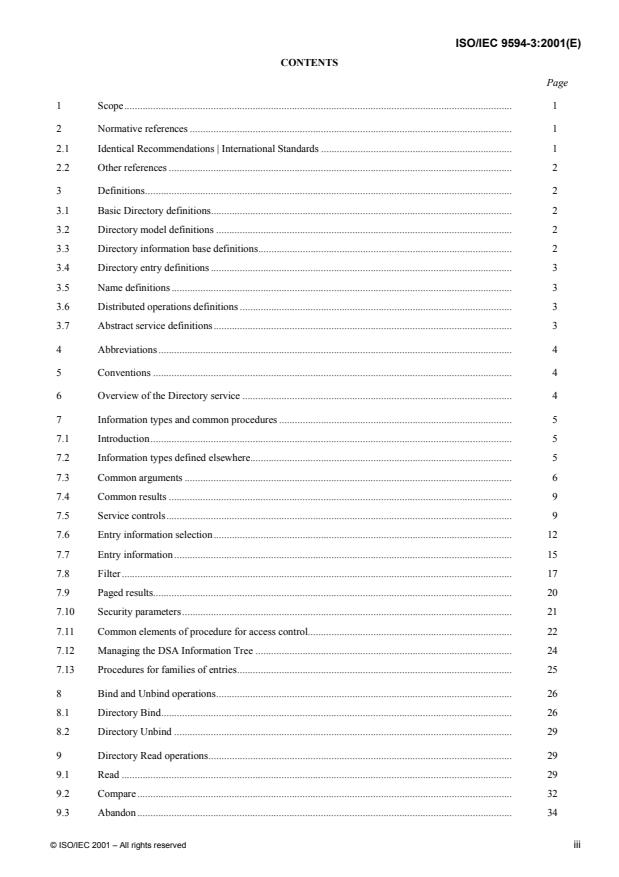
CONTENTS
Page
1 Scope. 1
2 Normative references. 1
2.1 Identical Recommendations | International Standards . 1
2.2 Other references. 2
3 Definitions. 2
3.1 Basic Directory definitions. 2
3.2 Directory model definitions . 2
3.3 Directory information base definitions. 2
3.4 Directory entry definitions . 3
3.5 Name definitions. 3
3.6 Distributed operations definitions. 3
3.7 Abstract service definitions. 3
4 Abbreviations. 4
5 Conventions. 4
6 Overview of the Directory service . 4
7 Information types and common procedures . 5
7.1 Introduction. 5
7.2 Information types defined elsewhere. 5
7.3 Common arguments. 6
7.4 Common results. 9
7.5 Service controls. 9
7.6 Entry information selection. 12
7.7 Entry information. 15
7.8 Filter. 17
7.9 Paged results. 20
7.10 Security parameters. 21
7.11 Common elements of procedure for access control. 22
7.12 Managing the DSA Information Tree . 24
7.13 Procedures for families of entries. 25
8 Bind and Unbind operations. 26
8.1 Directory Bind. 26
8.2 Directory Unbind. 29
9 Directory Read operations. 29
9.1 Read. 29
9.2 Compare. 32
9.3 Abandon. 34
iii
© ISO/IEC 2001 – All rights reserved
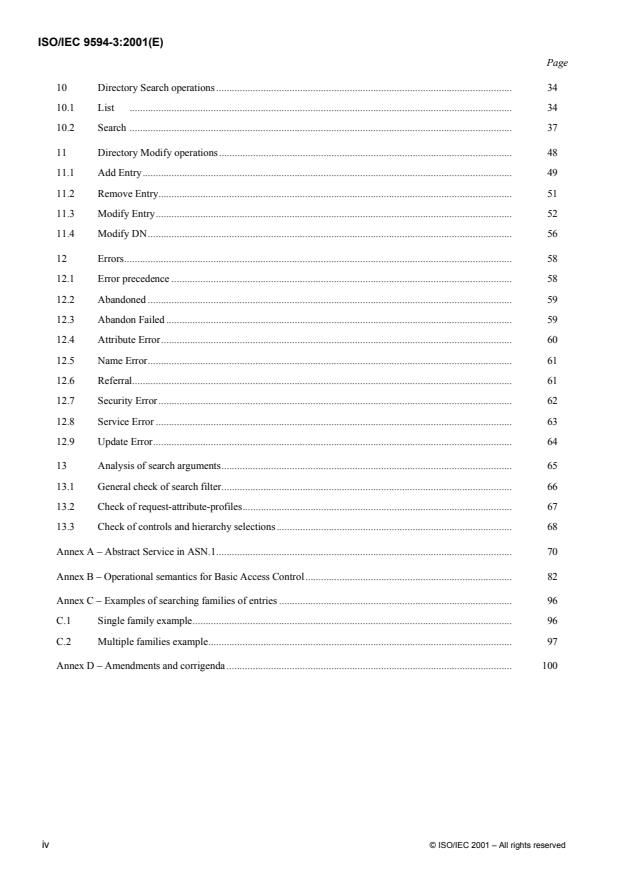
Page
10 Directory Search operations. 34
10.1 List . 34
10.2 Search . 37
11 Directory Modify operations. 48
11.1 Add Entry. 49
11.2 Remove Entry. 51
11.3 Modify Entry. 52
11.4 Modify DN. 56
12 Errors. 58
12.1 Error precedence. 58
12.2 Abandoned. 59
12.3 Abandon Failed. 59
12.4 Attribute Error. 60
12.5 Name Error. 61
12.6 Referral. 61
12.7 Security Error. 62
12.8 Service Error. 63
12.9 Update Error. 64
13 Analysis of search arguments. 65
13.1 General check of search filter. 66
13.2 Check of request-attribute-profiles. 67
13.3 Check of controls and hierarchy selections. 68
Annex A – Abstract Service in ASN.1. 70
Annex B – Operational semantics for Basic Access Control. 82
Annex C – Examples of searching families of entries . 96
C.1 Single family example. 96
C.2 Multiple families example. 97
Annex D – Amendments and corrigenda . 100
iv © ISO/IEC 2001 – All rights reserved
Foreword
ISO (the International Organization for Standardization) and IEC (the International Electrotechnical Commission)
form the specialized system for worldwide standardization. National bodies that are members of ISO or IEC
participate in the development of International Standards through technical committees established by the
respective organization to deal with particular fields of technical activity. ISO and IEC technical committees
collaborate in fields of mutual interest. Other international organizations, governmental and non-governmental, in
liaison with ISO and IEC, also take part in the work. In the field of information technology, ISO and IEC have
established a joint technical committee, ISO/IEC JTC 1.
International Standards are drafted in accordance with the rules given in the ISO/IEC Directives, Part 3.
The main task of the joint technical committee is to prepare International Standards. Draft International Standards
adopted by the joint technical committee are circulated to national bodies for voting. Publication as an International
Standard requires approval by at least 75 % of the national bodies casting a vote.
Attention is drawn to the possibility that some of the elements of this part of ISO/IEC 9594 may be the subject of
patent rights. ISO and IEC shall not be held responsible for identifying any or all such patent rights.
Users and implementors should note the existence of a “defect resolution” procedure in ISO/IEC JTC 1 to identify
and correct errors in International Standards through the publication of Technical Corrigenda. Identical corrections
are made to the corresponding ITU-T Recommendations through Corrigenda and may also be made in the form of
Implementors' Guides. Details of Technical Corrigenda to International Standards are available on the ISO website;
published Technical Corrigenda can be obtained via the ISO webstore or from the ISO and IEC national bodies.
Corrigenda and Implementors' Guides to ITU-T Recommendations can be obtained from the ITU-T website.
ISO/IEC 9594-3 was prepared by Joint Technical Committee ISO/IEC JTC 1, Information technology,
Subcommittee SC 6, Telecommunications and information exchange between systems, in collaboration with ITU-T.
The identical text is published as ITU-T Rec. X.511.
This fourth edition of ISO/IEC 9594-3 constitutes a technical revision of the third edition
(ISO/IEC 9594-3:1998), which is provisionally retained in order to support implementations based on the third
edition. This edition also incorporates Corrigendum 1:2002.
ISO/IEC 9594 consists of the following parts, under the general title Information technology — Open Systems
Interconnection — The Directory:
— Part 1: Overview of concepts, models and services
— Part 2: Models
— Part 3: Abstract service definition
— Part 4: Procedures for distributed operation
— Part 5: Protocol specifications
— Part 6: Selected attribute types
— Part 7: Selected object classes
— Part 8: Public-key and attribute certificate frameworks
— Part 9: Replication
— Part 10: Use of systems management for administration of the Directory
Annex A forms a normative part of this part of ISO/IEC 9594. Annexes B, C and D are for information only.
v
© ISO/IEC 2001 – All rights reserved
Introduction
This Recommendation | International Standard, together with the other Recommendations | International Standards, has
been produced to facilitate the interconnection of information processing systems to provide directory services. A set of
such systems, together with the directory information that they hold, can be viewed as an integrated whole, called the
Directory. The information held by the Directory, collectively known as the Directory Information Base (DIB), is
typically used to facilitate communication between, with or about objects such as application entities, people, terminals,
and distribution lists.
The Directory plays a significant role in Open Systems Interconnection, whose aim is to allow, with a minimum of
technical agreement outside of the interconnection standards themselves, the interconnection of information processing
systems:
• from different manufacturers;
• under different managements;
• of different levels of complexity; and
• of different ages.
This Recommendation | International Standard defines the capabilities provided by the Directory to its users.
This fourth edition technically revises and enhances, but does not replace, the third edition of this Recommendation |
International Standard. Implementations may still claim conformance to the third edition. However, at some point, the
third edition will not be supported (i.e. reported defects will no longer be resolved). It is recommended that
implementations conform to this fourth edition as soon as possible.
This fourth edition specifies version 1 and version 2 of the Directory protocols.
The first and second editions specified only version 1. Most of the services and protocols specified in this edition are
designed to function under version 1. However, some enhanced services and protocols, e.g. signed errors, will not
function unless all Directory entities involved in the operation have negotiated version 2. Whichever version has been
negotiated, differences between the services and between the protocols defined in the four editions, except for those
specifically assigned to version 2, are accommodated using the rules of extensibility defined in this edition of ITU-T
Rec. X.519 | ISO/IEC 9594-5.
Annex A, which is an integral part of this Recommendation | International Standard, provides the ASN.1 module for the
Directory abstract service.
Annex B, which is not an integral part of this Recommendation | International Standard, provides charts that describe the
semantics associated with Basic Access Control as it applies to the processing of a Directory operation.
Annex C, which is not an integral part of this Recommendation | International Standard, gives examples of the use of
families of entries.
Annex D, which is not an integral part of this Recommendation | International Standard, lists the amendments and defect
reports that have been incorporated to form this edition of this Recommendation | International Standard.
vi © ISO/IEC 2001 – All rights reserved
INTERNATIONAL STANDARD
ISO/IEC 9594-3 : 2001 (E)
ITU-T Rec. X.511 (2001 E)
ITU-T RECOMMENDATION
Information technology – Open Systems Interconnection –
The Directory: Abstract service definition
1 Scope
This Recommendation | International Standard defines in an abstract way the externally visible service provided by the
Directory.
This Recommendation | International Standard does not specify individual implementations or products.
2 Normative references
The following Recommendations and International Standards contain provisions which, through reference in this text,
constitute provisions of this Recommendation | International Standard. At the time of publication, the editions indicated
were valid. All Recommendations and Standards are subject to revision, and parties to agreements based on this
Recommendation | International Standard are encouraged to investigate the possibility of applying the most recent
edition of the Recommendations and Standards listed below. Members of IEC and ISO maintain registers of currently
valid International Standards. The Telecommunication Standardization Bureau of the ITU maintains a list of currently
valid ITU-T Recommendations.
2.1 Identical Recommendations | International Standards
– ITU-T Recommendation X.200 (1994) | ISO/IEC 7498-1:1994, Information technology – Open Systems
Interconnection – Basic Reference Model: The Basic Model.
– ITU-T Recommendation X.500 (2001) | ISO/IEC 9594-1:2001, Information technology – Open Systems
Interconnection – The Directory: Overview of concepts, models and services.
– ITU-T Recommendation X.501 (2001) | ISO/IEC 9594-2:2001, Information technology – Open Systems
Interconnection – The Directory: Models.
– ITU-T Recommendation X.509 (2000) | ISO/IEC 9594-8:2001, Information technology – Open Systems
Interconnection – The Directory: Public-key and attribute certificate frameworks.
– ITU-T Recommendation X.518 (2001) | ISO/IEC 9594-4:2001, Information technology – Open Systems
Interconnection – The Directory: Procedures for distributed operation.
– ITU-T Recommendation X.519 (2001) | ISO/IEC 9594-5:2001, Information technology – Open Systems
Interconnection – The Directory: Protocol specifications.
– ITU-T Recommendation X.520 (2001) | ISO/IEC 9594-6:2001, Information technology – Open Systems
Interconnection – The Directory: Selected attribute types.
– ITU-T Recommendation X.521 (2001) | ISO/IEC 9594-7:2001, Information technology – Open Systems
Interconnection – The Directory: Selected object classes.
– ITU-T Recommendation X.525 (2001) | ISO/IEC 9594-9:2001, Information technology – Open Systems
Interconnection – The Directory: Replication.
– ITU-T Recommendation X.530 (2001) | ISO/IEC 9594-10:2001, Information technology – Open Systems
Interconnection – The Directory: Use of systems management for administration of the Directory.
– ITU-T Recommendation X.680 (1997) | ISO/IEC 8824-1:1998, Information technology – Abstract Syntax
Notation One (ASN.1): Specification of basic notation.
– ITU-T Recommendation X.681 (1997) | ISO/IEC 8824-2:1998, Information technology – Abstract Syntax
Notation One (ASN.1): Information object specification.
ITU-T X.511 (02/2001 E) 1
– ITU-T Recommendation X.682 (1997) | ISO/IEC 8824-3:1998, Information technology – Abstract Syntax
Notation One (ASN.1): Constraint specification.
– ITU-T Recommendation X.683 (1997) | ISO/IEC 8824-4:1998, Information technology – Abstract Syntax
Notation One (ASN.1): Parameterization of ASN.1 specifications.
– ITU-T Recommendation X.880 (1994) | ISO/IEC 13712-1:1995, Information technology – Remote
Operations: Concepts, model and notation.
– ITU-T Recommendation X.881 (1994) | ISO/IEC 13712-2:1995, Information technology – Remote
Operations: OSI realizations – Remote Operations Service Element (ROSE) service definition.
2.2 Other references
– RFC 2025 (1996), The Simple Public-Key GSS-API Mechanism (SPKM).
3 Definitions
For the purposes of this Recommendation | International Standard, the following definitions apply.
3.1 Basic Directory definitions
The following terms are defined in ITU-T Rec. X.500 | ISO/IEC 9594-1:
a) Directory;
b) Directory Information Base;
c) (Directory) User.
3.2 Directory model definitions
The following terms are defined in ITU-T Rec. X.501 | ISO/IEC 9594-2:
a) Directory System Agent;
b) Directory User Agent.
3.3 Directory information base definitions
The following terms are defined in ITU-T Rec. X.501 | ISO/IEC 9594-2:
a) alias entry;
b) Directory Information Tree;
c) (Directory) entry;
d) immediate superior;
e) immediately superior entry/object;
f) object;
g) object class;
h) object entry;
i) subordinate;
j) superior;
k) ancestor;
l) family (of entries);
m) compound entry.
2 ITU-T X.511 (02/2001 E)
3.4 Directory entry definitions
The following terms are defined in ITU-T Rec. X.501 | ISO/IEC 9594-2:
a) attribute;
b) attribute type;
c) attribute value;
d) attribute value assertion;
e) context;
f) context type;
g) context value;
h) operational attribute;
i) user attribute;
j) matching rule.
3.5 Name definitions
The following terms are defined in ITU-T Rec. X.501 | ISO/IEC 9594-2:
a) alias, alias name;
b) distinguished name;
c) (directory) name;
d) purported name;
e) relative distinguished name.
3.6 Distributed operations definitions
The following terms are defined in ITU-T Rec. X.518 | ISO/IEC 9594-4:
a) chaining;
b) referral.
3.7 Abstract service definitions
For the purposes of this Recommendation | International Standard, the following definitions apply.
3.7.1 additional search: A search that starts from joinBaseObject as specified by the originator in the search
request.
3.7.2 contributing member: A family member within a compound entry, which made a contribution to either a
Read, Search or Modify Entry operation.
3.7.3 explicitly unmarked entry: An entry or a family member that is excluded from the SearchResult according
to a specification given in a control attribute referenced by the governing-search-rule.
3.7.4 family grouping: A set of members of a compound attribute that are grouped together for the purpose of
operation evaluation.
3.7.5 filter: An assertion about the presence or value of certain attributes of an entry in order to limit the scope of a
search.
3.7.6 originator: The user that originated an operation.
3.7.7 participation member: A family member that is either a contributing member or is a member of a family
grouping that as a whole matched a search filter.
3.7.8 primary search: The search that starts from baseObject as specified by the originator in the search request.
ITU-T X.511 (02/2001 E) 3
3.7.9 relaxation: A progressive modification of the behaviour of a filter during a search operation so as to achieve
more matched entries if too few are received, or fewer matched entries if too many are received.
3.7.10 service controls: Parameters conveyed as part of an operation, which constrain various aspects of its
performance.
3.7.11 strand: A family grouping comprising all the members in a path from a leaf family member up to the ancestor
inclusive. A family member will reside in as many strands as there are leaf family members below it (as immediate or
non-immediate subordinates).
4 Abbreviations
For the purposes of this Recommendation | International Standard, the following abbreviations apply.
AVA Attribute Value Assertion
DIB Directory Information Base
DIT Directory Information Tree
DMD Directory Management Domain
DSA Directory System Agent
DUA Directory User Agent
RDN Relative Distinguished Name
5 Conventions
With minor exceptions, this Directory Specification has been prepared according to the "Rules for presentation of ITU-T
| ISO/IEC common text" in the Guide for ITU-T and ISO/IEC JTC 1 Cooperation, October 1996.
The term "Directory Specification" (as in "this Directory Specification") shall be taken to mean this Recommendation |
International Standard. The term "Directory Specifications" shall be taken to mean the X.500-series Recommendations
and all parts of ISO/IEC 9594.
This Directory Specification uses the term "1988 edition systems" to refer to systems conforming to the first edition of
the Directory Specifications, i.e. the 1988 edition of the series of CCITT X.500 Recommendations and the ISO/IEC
9594:1990 edition. This Directory Specification uses the term "1993 edition systems" to refer to systems conforming to
the second (1993) edition of the Directory Specifications, i.e. the 1993 edition of the series of ITU-T X.500
Recommendations and the ISO/IEC 9594:1995 edition. This Directory Specification uses the term "1997 edition
systems" to refer to systems conforming to the third edition of the Directory Specifications, i.e. the 1997 edition of the
series of ITU-T X.500 Recommendations and the ISO/IEC 9594:1998 edition. This Directory Specification uses the term
"4th edition systems" to refer to systems conforming to this fourth edition of the Directory Specifications, i.e. the 2001
editions of ITU-T X.500, X.501, X.511, X.518, X.519, X.520, X.521, X.525, and X.530, the 2000 edition of ITU-T
X.509, and parts 1-10 of the ISO/IEC 9594:2001 edition.
This Directory Specification presents ASN.1 notation in the bold Helvetica typeface. When ASN.1 types and values are
referenced in normal text, they are differentiated from normal text by presenting them in the bold Helvetica, 9 point
typeface. The names of procedures, typically referenced when specifying the semantics of processing, are differentiated
from normal text by displaying them in bold Times. Access control permissions are presented in italicized Times.
If the items in a list are numbered (as opposed to using "–" or letters), then the items shall be considered steps in a
procedure.
This Directory Specification defines directory operations using the Remote Operation notation defined in
ITU-T Rec. X.880 | ISO/IEC 13712-1.
6 Overview of the Directory service
As described in ITU-T Rec. X.501 | ISO/IEC 9594-2, the services of the Directory are provided through access points to
DUAs, each acting on behalf of a user. These concepts are depicted in Figure 1. Through an access point, the Directory
provides service to its users by means of a number of Directory operations.
4 ITU-T X.511 (02/2001 E)
Access Point
Directory
The
DUA
user Directory
TISO3050-94
Figure 1 – Access to the Directory
The Directory operations are of three different kinds:
a) Directory Read operations, which interrogate a single Directory entry;
b) Directory Search operations, which interrogate potentially several Directory entries; and
c) Directory Modify operations.
The Directory Read operations, the Directory Search operations and the Directory Modify operations are specified in
clauses 9, 10, and 11, respectively. Conformance to Directory operations is specified in ITU-T Rec. X.519 |
ISO/IEC 9594-5.
7 Information types and common procedures
7.1 Introduction
This clause identifies, and in some cases defines, a number of information types which are subsequently used in the
definition of Directory operations. The information types concerned are those which are common to more than one
operation, are likely to be in the future, or which are sufficiently complex or self-contained as to merit being defined
separately from the operation which uses them.
Several of the information types used in the definition of the Directory Service are actually defined elsewhere.
Subclause 7.2 identifies these types and indicates the source of their definition. Each of the subclauses (7.3 through 7.10)
identifies and defines an information type.
This clause also specifies some common elements of procedure that apply to most or all of the Directory operations.
7.2 Information types defined elsewhere
The following information types are defined in ITU-T Rec. X.501 | ISO/IEC 9594-2:
a) Attribute;
b) AttributeType;
c) AttributeValue;
d) AttributeValueAssertion;
e) Context;
f) ContextAssertion;
g) DistinguishedName;
h) Name;
i) OPTIONALLY-PROTECTED;
j) OPTIONALLY-PROTECTED-SEQ;
k) RelativeDistinguishedName.
The following information type is defined in ITU-T Rec. X.520 | ISO/IEC 9594-6:
a) PresentationAddress.
ITU-T X.511 (02/2001 E) 5
The following information types are defined in ITU-T Rec. X.509 | ISO/IEC 9594-8:
a) Certificate;
b) SIGNED;
c) CertificationPath.
The following information types are defined in ITU-T Rec. X.880 | ISO/IEC 13712-1:
a) InvokeId.
The following information types are defined in ITU-T Rec. X.518 | ISO/IEC 9594-4:
a) OperationProgress;
b) ContinuationReference.
7.3 Common arguments
The CommonArguments information may be present to qualify the invocation of each operation that the Directory can
perform.
CommonArguments ::= SET {
serviceControls [30] ServiceControls DEFAULT { },
securityParameters [29] SecurityParameters OPTIONAL,
requestor [28] DistinguishedName OPTIONAL,
operationProgress [27] OperationProgress
DEFAULT { nameResolutionPhase notStarted },
aliasedRDNs [26] INTEGER OPTIONAL,
criticalExtensions [25] BIT STRING OPTIONAL,
referenceType [24] ReferenceType OPTIONAL,
entryOnly [23] BOOLEAN DEFAULT TRUE,
nameResolveOnMaster [21] BOOLEAN DEFAULT FALSE,
operationContexts [20] ContextSelection OPTIONAL,
familyGrouping [19] FamilyGrouping DEFAULT entryOnly }
The ServiceControls component is specified in 7.5. Its absence is deemed equivalent to there being an empty set of
controls.
The SecurityParameters component is specified in 7.10. If the argument of the operation is to be signed by the
requestor, the SecurityParameters component shall be included in the argument. The absence of the
SecurityParameters component is deemed equivalent to an empty set.
The requestor Distinguished Name identifies the originator of a particular operation. It holds the name of the user as
identified at the time of binding to the Directory. It may be required when the request is to be signed (see 7.10), and shall
hold the name of the user who initiated the request.
NOTE 1 – Where a user has alternative distinguished names differentiated by context, the name used as the value of requestor
shall be the primary distinguished name where known. Otherwise, authentication and access control based on the value of
requestor may not work as desired.
The operationProgress, referenceType, entryOnly, exclusions and nameResolveOnMaster components are defined
in ITU-T Rec. X.518 | ISO/IEC 9594-4. They are supplied by a DUA either:
a) when acting on a continuation reference returned by a DSA in response to an earlier operation, and their
values are copied by the DUA from the continuation reference; or
b) when the DUA represents an administrative user that is managing the DSA Information Tree and the
manageDSAIT option is set in the service controls.
The aliasedRDNs component indicates to the DSA that the object component of the operation was created by the
dereferencing of an alias on an earlier operation attempt. The integer value indicates the number of RDNs in the name
that came from dereferencing the alias. (The value would have been set in the referral response of the previous
operation.)
NOTE 2 – This component is provided for compatibility with 1988 edition implementations of the Directory. DUAs (and DSAs)
implemented according to later editions of the Directory Specifications shall always omit this parameter from the
CommonArguments of a subsequent request. In this way, the Directory will not signal an error if aliases dereference to further
aliases.
6 ITU-T X.511 (02/2001 E)
The operationContexts component supplies a set of context assertions which are applied to attribute value assertions
and entry information selection made within this operation, which do not otherwise contain context assertions for the
same attribute type and context type. If operationContexts is not present or does not address a particular attribute type
or context type, then default context assertions shall be applied by the DSA as described in 7.6.1 and in 8.8.2.2 and 12.8
of ITU-T Rec. X.501 | ISO/IEC 9594-2. If allContexts is chosen, then all contexts for all attribute types are valid and
context defaults that might have been supplied by the DSA are overridden. (ContextSelection is defined in 7.6).
familyGrouping is used to describe which family members should be selected for processing by a given operation. It is
described more fully in 7.3.2.
7.3.1 Critical extensions
The criticalExtensions component provides a mechanism to list a set of extensions that are critical to the performance of
a Directory operation. If the originator of the extended operation wishes to indicate that the operation shall be performed
with one or more extensions (i.e. that performing the operation without these extensions is not acceptable), it does so by
setting the criticalExtensions bit(s) which corresponds to the extension(s). If the Directory, or some part of it, is unable
to perform a critical extension, it returns an indication of unavailableCriticalExtension (as a serviceError or
PartialOutcomeQualifier). If the Directory is unable to perform an extension that is not critical, it ignores the presence
of the extension.
These Directory Specifications define a number of extensions. The extensions take such forms as additional numbered
bits in a BIT STRING, or additional components of a SET or SEQUENCE, and are ignored by 1988 edition systems.
Each such extension is assigned an integer identifier, which is the number of the bit that may be set in
criticalExtensions. If the criticality of an extension is defined to be critical, the DUA shall set the corresponding bit in
criticalExtensions. If the defined criticality is non-critical, the DUA may or may not set the corresponding bit in
criticalExtensions.
The extensions, their identifiers, the operations in which they are permitted, the recommended criticality, and the clauses
in which they are defined are shown in Table 1.
Table 1 – Extensions
Defined
Extension Identifier Operations Criticality
(subclauses)
subentries 1 All Non-critical 17.5
copyShallDo 2 Read, Compare, List, Search Non-critical 17.5
attribute size limit 3 Read, Search Non-critical 17.5
extraAttributes 4 Read, Search Non-critical 17.6
modifyRightsRequest 5 Read Non-critical 19.1
pagedResultsRequest 6 List, Search Non-critical 10.1
matchedValuesOnly 7 Search Non-critical 10.2
extendedFilter 8 Search Non-critical 10.2
targetSystem 9 Add Entry Critical 11.1
useAliasOnUpdate 10 Add Entry, Remove Entry, Modify Entry Critical 11.1
newSuperior 11 Modify DN Critical 11.4
manageDSAIT 12 All Critical 7.5, 7.13
useContexts 13 Read, Compare, List, Search, Add Entry, Non-critical 7.6, 7.8
Modify Entry, Modify DN
partialNameResolution 14 Read, Search Non-critical 7.5
overspecFilter 15 Search Non-critical 10.1.3 f)
selectionOnModify 16 Modify Entry Non-critical 11.3.2
Security parameters – 17 All Non-critical 7.10
Response
Security parameters – 18 All Non-critical 7.10
Operation code
ITU-T X.511 (02/2001 E) 7
Table 1 – Extensions (concluded)
Defined
Extension Identifier Operations Criticality
(subclauses)
Security parameters – 19 All Non-critical 7.10
Attribute certification path
Security parameters – Error 20 All Non-critical 7.10
Protection
SPKM Credentials 21 Directory Bind (Note 3) 8.1.1
Bind token – Response 22 Directory Bind Non-critical 8.1.1
Bind token – Bind Int. Alg, 23 Directory Bind Non-critical 8.1.1
Bind Int Key, Conf Alg and
Conf Key Info
Bind token – DIRQOP 24 Directory Bind Non-critical 8.1.1
Service administration 25 Read, Search, ModifyEntry Critical 10.2.2, 13,
clause 16 of
ITU-T
Rec. X.501 |
ISO/IEC
9594-2
entryCount 26 Search Non-critical 10.1.3
hierarchySelection 27 Search Non-critical 7.5
relaxation 28 Search Non-critical 7.8
familyGrouping 29 7.3.2, 7.8.3
Compare, Non-critical &
Search, Non-critical 9.2.2
RemoveEntry Critical 10.2
11.2.2
familyReturn 30 7.6.4, 7.7.1
Read, Non-critical &
Search, Non-critical 9.1.3
ModifyEntry Non-critical 10.2.3
11.3.3
dnAttributes 31 Search Non-critical 10.2.2
NOTE 1 – The first extension is given the identifier 1 and corresponds to bit 1 of the BIT STRING. Bit 0 of the BIT STRING is
not used.
NOTE 2 – Use of encrypted or signed and encrypted security transformation or any protection on errors or results to Add Entry,
Remove Entry, Modify Entry, Modify DN requires version 2 or higher of the protocol.
NOTE 3 – Use of GULS SESE (see ITU-T Rec. X.519 | ISO/IEC 9594-5) to exchange credentials requires version 2 or higher and
an application context which includes GULS SESE.
NOTE 4 – The SPKM credentials extension shall be critical unless used in associations established using version 2 or higher.
7.3.2 Family grouping
Family grouping allows a single family member, several family members or all family members of a compound entry, to
be grouped together for joint consideration prior to operation evaluation. These semantics can then be applied to the
following operations (as indicated in the descriptions below): Compare (to define the scope within which the compared
attribute might lie), Search (to define the groupings for which filtering might take place), Remove Entry (to define the
groupings for removal). The following ASN.1 is used to select members of a family:
FamilyGrouping ::= ENUMERATED {
entryOnly (1),
compoundEntry (2),
strands (3),
multiStrand (4) }
8 ITU-T X.511 (02/2001 E)
entryOnly means that the specific family member selected by the operation is to be considered in the group. This is the
default value, and ensures backward compatibility with previous editions of the Directory Specifications.
compoundEntry means that the complete compound entry selected by the operation is to be considered as a unit by
combining all the attributes. For Remove Entry operations, it is only applicable when the object name specified is that of
an ancestor of a compound entry, and it causes all family members to be removed by the same operation (subject to
access control).
strands means that all the strands associated with the family member are to be selected by the operation. This option is
not valid for the Remove Entry operation. For the Search operation, individual strands are considered for filter purposes.
If the combined set of attributes of one or more strands matches the filter, the compound entry is said to match the filter.
If the base object is a child member, only those strands that go through the base object are considered. For Compare
operations, all the attributes from all the family members in all the strands to which the entry belongs are to be used in
the comparison.
multiStrand is only applicable to the Search operation, and qualifies the matching rule for filtering on family
information. It is ignored for other operations. It specifies that one strand from each family within a compound entry is to
be considered at one time, but in all combinations. multiStrand is not applicable if the base object is a child family
member, in which this case multiStrand shall be ignored and entryOnly shall be substituted.
7.4 Common results
The CommonResults or CommonResultsSeq information is present to qualify the result of each retrieval operation
that the Directory can perform. In addition, it is present in any returned error.
CommonResults ::= SET {
securityParameters [30] SecurityParameters OPTIONAL,
performer [29] DistinguishedName OPTIONAL,
aliasDereferenced [28] BOOLEAN DEFAULT FALSE,
notification [27] SEQUENCE SIZE (1.MAX) OF Attribute OPTIONAL }
CommonResultsSeq ::= SEQUENCE {
securityParameters [30] SecurityParameters OPTIONAL,
performer [29] DistinguishedName OPTIONAL,
aliasDereferenced [28] BOOLEAN DEFAULT FALSE,
notification [27] SEQUENCE SIZE (1.MAX) OF Attribute OPTIONAL }
NOTE – CommonResults and CommonResultsSeq consist of the same components. The former is used when included in set
types by the COMPONENT OF type, while the latter is used similarly in sequence types.
The SecurityParameters component is specified in 7.10. If the result is to be signed by the Directory, the
SecurityParameters component shall be included in the result. The absence of the SecurityParameters component is
deemed equivalent to an empty set.
The performer Distinguished Name identifies the performer of a particular operation. It may be required when the result
is to be signed (see 7.10) and shall hold the name of the DSA that signed the result.
The aliasDereferenced component is set to TRUE when the purported name of an object or base object which is the
target of the operation included any aliases which were dereferenced.
The notification component shall be used to qualify returned result and error APDUs, for example providing more
precise error information. Standard notification attributes are defined in 5.12 of ITU-T Rec. X.520 | ISO/IEC 9594-6.
Such notification attributes are not necessarily stored in directory entries.
7.5 Service controls
A ServiceControls parameter contains the controls, if any, that are to direct or constrain the provision of the service.
ServiceControls ::= SET {
options [0] ServiceControlOptions DEFAULT { },
priority [1] INTEGER { low (0), medium (1), high (2) } DEFAULT medium,
timeLimit [2] INTEGER OPTIONAL,
sizeLimit [3] INTEGER OPTIONAL,
scopeOfReferral [4] INTEGER { dmd(0), country(1) } OPTIONAL,
attributeSizeLim
...
NORME ISO/CEI
INTERNATIONALE 9594-3
Quatrième édition
2001-12-15
Technologies de l'information —
Interconnexion de systèmes ouverts
(OSI) — L'annuaire: Définition du service
abstrait
Information technology — Open Systems Interconnection — The
Directory: Abstract service definition
Numéro de référence
ISO/CEI 9594-3:2001(F)
©
ISO/CEI 2001
ISO/CEI 9594-3:2001(F)
PDF – Exonération de responsabilité
Le présent fichier PDF peut contenir des polices de caractères intégrées. Conformément aux conditions de licence d'Adobe, ce fichier
peut être imprimé ou visualisé, mais ne doit pas être modifié à moins que l'ordinateur employé à cet effet ne bénéficie d'une licence
autorisant l'utilisation de ces polices et que celles-ci y soient installées. Lors du téléchargement de ce fichier, les parties concernées
acceptent de fait la responsabilité de ne pas enfreindre les conditions de licence d'Adobe. Le Secrétariat central de l'ISO décline toute
responsabilité en la matière.
Adobe est une marque déposée d'Adobe Systems Incorporated.
Les détails relatifs aux produits logiciels utilisés pour la création du présent fichier PDF sont disponibles dans la rubrique General Info
du fichier; les paramètres de création PDF ont été optimisés pour l'impression. Toutes les mesures ont été prises pour garantir
l'exploitation de ce fichier par les comités membres de l'ISO. Dans le cas peu probable où surviendrait un problème d'utilisation,
veuillez en informer le Secrétariat central à l'adresse donnée ci-dessous.
© ISO/CEI 2001
Droits de reproduction réservés. Sauf prescription différente, aucune partie de cette publication ne peut être reproduite ni utilisée sous
quelque forme que ce soit et par aucun procédé, électronique ou mécanique, y compris la photocopie et les microfilms, sans l'accord écrit
de l'ISO à l'adresse ci-après ou du comité membre de l'ISO dans le pays du demandeur.
ISO copyright office
Case postale 56 • CH-1211 Geneva 20
Tel. + 41 22 749 01 11
Fax. + 41 22 749 09 47
E-mail copyright@iso.org
Web www.iso.org
Publié par l'ISO en 2002
Version française parue en 2002
Publié en Suisse
ii © ISO/CEI 2001 — Tous droits réservés
ISO/CEI 9594-3:2001(F)
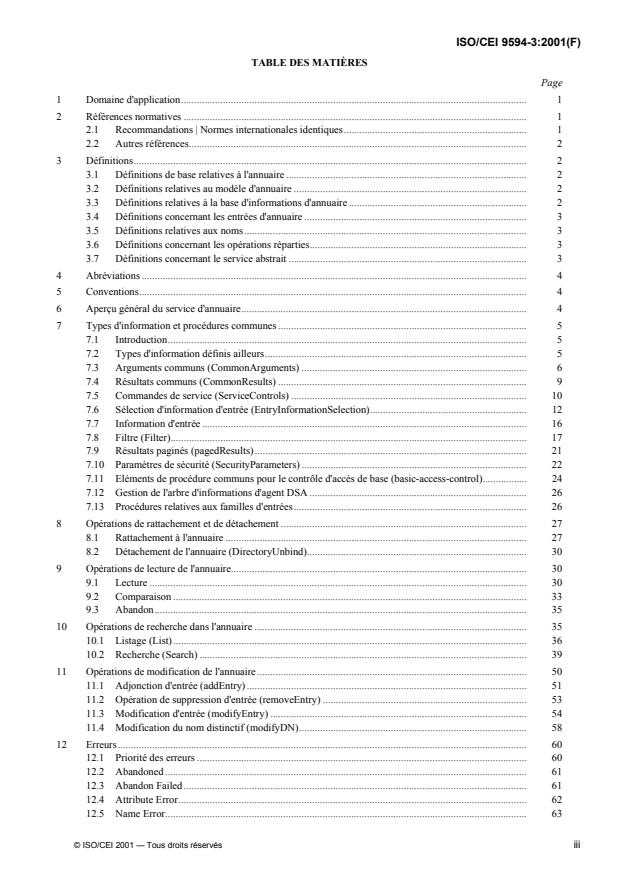
TABLE DES MATIÈRES
Page
1 Domaine d'application. 1
2 Références normatives . 1
2.1 Recommandations | Normes internationales identiques. 1
2.2 Autres références. 2
3 Définitions. 2
3.1 Définitions de base relatives à l'annuaire . 2
3.2 Définitions relatives au modèle d'annuaire . 2
3.3 Définitions relatives à la base d'informations d'annuaire . 2
3.4 Définitions concernant les entrées d'annuaire . 3
3.5 Définitions relatives aux noms. 3
3.6 Définitions concernant les opérations réparties. 3
3.7 Définitions concernant le service abstrait . 3
4 Abréviations . 4
5 Conventions. 4
6 Aperçu général du service d'annuaire. 4
7 Types d'information et procédures communes . 5
7.1 Introduction. 5
7.2 Types d'information définis ailleurs. 5
7.3 Arguments communs (CommonArguments) . 6
7.4 Résultats communs (CommonResults) . 9
7.5 Commandes de service (ServiceControls) . 10
7.6 Sélection d'information d'entrée (EntryInformationSelection). 12
7.7 Information d'entrée . 16
7.8 Filtre (Filter). 17
7.9 Résultats paginés (pagedResults). 21
7.10 Paramètres de sécurité (SecurityParameters) . 22
7.11 Eléments de procédure communs pour le contrôle d'accès de base (basic-access-control). 24
7.12 Gestion de l'arbre d'informations d'agent DSA . 26
7.13 Procédures relatives aux familles d'entrées. 26
8 Opérations de rattachement et de détachement . 27
8.1 Rattachement à l'annuaire . 27
8.2 Détachement de l'annuaire (DirectoryUnbind). 30
9 Opérations de lecture de l'annuaire. 30
9.1 Lecture . 30
9.2 Comparaison . 33
9.3 Abandon. 35
10 Opérations de recherche dans l'annuaire . 35
10.1 Listage (List). 36
10.2 Recherche (Search) . 39
11 Opérations de modification de l'annuaire. 50
11.1 Adjonction d'entrée (addEntry). 51
11.2 Opération de suppression d'entrée (removeEntry) . 53
11.3 Modification d'entrée (modifyEntry) . 54
11.4 Modification du nom distinctif (modifyDN). 58
12 Erreurs. 60
12.1 Priorité des erreurs . 60
12.2 Abandoned . 61
12.3 Abandon Failed. 61
12.4 Attribute Error. 62
12.5 Name Error. 63
© ISO/CEI 2001 — Tous droits réservés iii
ISO/CEI 9594-3:2001(F)
Page
12.6 Referral (renvoi de référence) . 63
12.7 Security Error. 64
12.8 Service Error . 65
12.9 Update Error. 66
13 Analyse des arguments de l'opération de recherche . 67
13.1 Vérification globale du filtre de recherche. 68
13.2 Vérification des profils request-attribute-profiles . 69
13.3 Vérification des commandes et de la sélection hiérarchique. 71
13.4 Vérification de l'utilisation de la concordance . 71
Annexe A – Service abstrait en ASN.1. 73
Annexe B – Sémantique opérationnelle pour le contrôle d'accès de base . 85
Annexe C – Sémantique opérationnelle pour le contrôle d'accès de base . 99
C.1 Exemple de famille unique. 99
C.2 Exemple de plusieurs familles . 100
Annexe D – Amendements et corrigenda . 103
iv © ISO/CEI 2001 — Tous droits réservés
ISO/CEI 9594-3:2001(F)
Avant-propos
L'ISO (Organisation internationale de normalisation) et la CEI (Commission électrotechnique internationale)
forment le système spécialisé de la normalisation mondiale. Les organismes nationaux membres de l'ISO ou
de la CEI participent au développement de Normes internationales par l'intermédiaire des comités techniques
créés par l'organisation concernée afin de s'occuper des domaines particuliers de l'activité technique. Les
comités techniques de l'ISO et de la CEI collaborent dans des domaines d'intérêt commun. D'autres
organisations internationales, gouvernementales et non gouvernementales, en liaison avec l'ISO et la CEI
participent également aux travaux. Dans le domaine des technologies de l'information, l'ISO et la CEI ont créé
un comité technique mixte, l'ISO/CEI JTC 1.
Les Normes internationales sont rédigées conformément aux règles données dans les Directives ISO/CEI,
Partie 3.
La tâche principale du comité technique mixte est d'élaborer les Normes internationales. Les projets de
Normes internationales adoptés par le comité technique mixte sont soumis aux organismes nationaux pour
vote. Leur publication comme Normes internationales requiert l'approbation de 75 % au moins des
organismes nationaux votants.
L'attention est appelée sur le fait que certains des éléments de la présente partie de l'ISO/CEI 9594 peuvent
faire l'objet de droits de propriété intellectuelle ou de droits analogues. L'ISO et la CEI ne sauraient être
tenues pour responsables de ne pas avoir identifié de tels droits de propriété et averti de leur existence.
Il convient que ceux qui utilisent et ceux qui mettent en application des normes notent l'existence d'une
procédure de «résolution de défaut» dans l'ISO/CEI JTC 1, pour identifier et corriger des erreurs éventuelles
dans les Normes internationales, par la publication de Rectificatifs techniques. Des corrections identiques ont
lieu pour les Recommandations UIT-T correspondantes à travers des Corrigenda, et peuvent aussi se
présenter sous la forme de Guides de mise en application. Les détails concernant les Rectificatifs techniques
aux Normes internationales sont disponibles sur le site Web de l'ISO; les Rectificatifs techniques publiés
peuvent être obtenus sur le site Web de l'ISO ou auprès des comités membres de l'ISO et de la CEI. Les
Corrigenda et Guides de mise en application aux Recommandations UIT-T peuvent être obtenus sur le site
Web de l'UIT-T.
L'ISO/CEI 9594-3 a été élaborée par le comité technique mixte ISO/CEI JTC 1, Technologies de l'information,
sous-comité SC 6, Téléinformatique, en collaboration avec l'UIT-T. Le texte identique est publié en tant que
Rec. UIT-T X.511.
La quatrième édition de l'ISO/CEI 9594-3 constitue une révision technique de la troisième édition
(ISO/CEI 9594-3:1998), qui est provisoirement retenue afin de soutenir les mises en application basées sur la
troisième édition.
L'ISO/CEI 9594 comprend les parties suivantes, présentées sous le titre général Technologies de
l'information — Interconnexion de systèmes ouverts (OSI) — L'annuaire:
Partie 1: Aperçu général des concepts, modèles et services
Partie 2: Les modèles
Partie 3: Définition du service abstrait
Partie 4: Procédures pour le fonctionnement réparti
Partie 5: Spécification du protocole
© ISO/CEI 2001 — Tous droits réservés v
ISO/CEI 9594-3:2001(F)
Partie 6: Types d'attributs sélectionnés
Partie 7: Classes d'objets sélectionnées
Partie 8: Cadre général des certificats de clé publique et d'attribut
Partie 9: Duplication
Partie 10: Utilisation de la gestion-systèmes pour l'administration de l'annuaire
L'annexe A constitue un élément normatif de la présente partie de l'ISO/CEI 9594. Les annexes B, C et D sont
données uniquement à titre d'information.
vi © ISO/CEI 2001 — Tous droits réservés
ISO/CEI 9594-3:2001(F)
Introduction
La présente Recommandation | Norme internationale a été élaborée, ainsi que d'autres Recommandations | Normes
internationales, pour faciliter l’interconnexion des systèmes de traitement de l’information et permettre ainsi d’assurer
des se rvices d'annuaire. L’ensemble de tous ces systèmes, avec les informations d'annuaire qu’ils contiennent, peut être
considéré comme un tout intégré, appelé annuaire. Les informations de l'annuaire, appelées collectivement base
d’informations d'annuaire (DIB), sont généralement utilisées pour faciliter la communication entre, avec ou à propos
d'objets tels que des entités d’application, des personnes, des terminaux et des listes de distribution.
L'annuaire joue un rôle important dans l’interconnexion des systèmes ouverts, dont le but est de permettre, moyennant un
minimum d’accords techniques en dehors des normes d’interconnexion proprement dites, l’interconnexion des systèmes
de traitement de l’information:
• provenant de divers fabricants;
• gérés différemment;
• de niveaux de complexité différents;
• de générations différentes.
La présente Recommandation | Norme internationale définit les capacités fournies par l'annuaire à ses utilisateurs.
Cette quatrième édition révise techniquement et améliore, mais ne remplace pas, la troisième édition de la présente
Recommandation | Norme internationale. Les implémentations peuvent encore revendiquer la conformité à la troisième
édition mais celle-ci finira par ne plus être prise en compte (c'est-à-dire que les erreurs signalées ne seront plus
corrigées). Il est recommandé que les implémentations se conforment, dès que possible, à la présente quatrième édition.
Cette quatrième édition spécifie les versions 1 et 2 des protocoles de l'annuaire.
Les première et deuxième éditions ne spécifiaient que la version 1. La plupart des services et protocoles spécifiés dans la
présente édition sont conçus pour fonctionner selon la version 1. Certains services et protocoles améliorés, par exemple
les erreurs signées, ne fonctionneront cependant pas avant que toutes les entités d'annuaire mises en jeu dans
l’exploitation aient négocié la version 2. Quelle que soit la version négociée, on a traité les différences entre les services
et entre les protocoles définis dans les quatre éditions, à l'exception de ceux qui sont définis dans la version 2, en utilisant
les règles d’extensibilité définies dans l’édition actuelle de la Rec. UIT-T X.519 | ISO/CEI 9594-5.
L'Annexe A, qui fait partie intégrante de la présente Recommandation | Norme internationale, présente le module ASN.1
pour le service abstrait d'annuaire.
L'Annexe B, qui ne fait pas partie intégrante de la présente Recommandation | Norme internationale, présente des organi-
grammes qui décrivent la sémantique associée au contrôle d'accès de base dans la mesure où elle s'applique au traitement
d'une opération d'annuaire.
L'Annexe C, qui ne fait pas partie intégrante de la présente Recommandation | Norme internationale donne des exemples
de l'emploi des familles d'entrées.
L'Annexe D, qui ne fait pas partie intégrante de la présente Recommandation | Norme internationale, énumère les modifi-
cations et les relevés d'erreurs qui ont été incorporés pour former l'édition de la présente Recommandation | Norme
internationale.
© ISO/CEI 2001 — Tous droits réservés vii
ISO/CEI 9594-3:2001 (F)
NORME INTERNATIONALE
RECOMMANDATION UIT-T
Technologies de l'information – Interconnexion des systèmes ouverts –
L'annuaire: définition du service abstrait
1 Domaine d'application
La présente Recommandation | Norme internationale définit de façon abstraite le service, visible de l'extérieur, que
fournit l'annuaire.
La présente Recommandation | Norme internationale ne spécifie ni implémentations, ni produits individuels.
2 Références normatives
Les Recommandations et Normes internationales suivantes contiennent des dispositions qui, par suite de la référence qui
y est faite, constituent des dispositions valables pour la présente Recommandation | Norme internationale. Au moment de
la publication, les éditions indiquées étaient en vigueur. Toutes Recommandations et Normes sont sujettes à révision et
les parties prenantes aux accords fondés sur la présente Recommandation | Norme internationale sont invitées à
rechercher la possibilité d'appliquer les éditions les plus récentes des Recommandations et Normes indiquées ci-après.
Les membres de la CEI et de l'ISO possèdent le registre des Normes internationales en vigueur. Le Bureau de la
normalisation des télécommunications de l'UIT tient à jour une liste des Recommandations de l'UIT-T en vigueur.
2.1 Recommandations | Normes internationales identiques
– Recommandation UIT-T X.200 (1994) | ISO/CEI 7498-1:1994, Technologies de l'information –
Interconnexion des systèmes ouverts – Modèle de référence de base: le modèle de référence de base.
– Recommandation UIT-T X.500 (2001) | ISO/CEI 9594-1:2001, Technologies de l'information –
Interconnexion des systèmes ouverts – L'annuaire: aperçu général des concepts, modèles et services.
– Recommandation UIT-T X.501 (2001) | ISO/CEI 9594-2:2001, Technologies de l'information –
Interconnexion des systèmes ouverts – L'annuaire: les modèles.
– Recommandation UIT-T X.509 (2000) | ISO/CEI 9594-8:2001, Technologies de l'information –
Interconnexion des systèmes ouverts – L'annuaire: cadre général des certificats de clé publique et
d'attribut.
– Recommandation UIT-T X.518 (2001) | ISO/CEI 9594-4:2001, Technologies de l'information –
Interconnexion des systèmes ouverts – L'annuaire: procédures pour le fonctionnement réparti.
– Recommandation UIT-T X.519 (2001) | ISO/CEI 9594-5:2001, Technologies de l'information –
Interconnexion des systèmes ouverts – L'annuaire: spécifications du protocole.
– Recommandation UIT-T X.520 (2001) | ISO/CEI 9594-6:2001, Technologies de l'information –
Interconnexion des systèmes ouverts – L'annuaire: types d'attributs sélectionnés.
– Recommandation UIT-T X.521 (2001) | ISO/CEI 9594-7:2001, Technologies de l'information –
Interconnexion des systèmes ouverts – L'annuaire: classes d'objets sélectionnées.
– Recommandation UIT-T X.525 (2001) | ISO/CEI 9594-9:2001, Technologies de l'information –
Interconnexion des systèmes ouverts – L'annuaire: duplication.
– Recommandation UIT-T X.530 (2001) | ISO/CEI 9594-10:2001, Technologies de l'information –
Interconnexion des systèmes ouverts – L'annuaire: utilisation de la gestion-systèmes pour
l'administration de l'annuaire.
– Recommandation UIT-T X.680 (1997) | ISO/CEI 8824-1:1998, Technologies de l'information – Notation
de syntaxe abstraite numéro un: spécification de la notation de base.
Rec. UIT-T X.511 (02/2001 F) 1
ISO/CEI 9594-3:2001 (F)
– Recommandation UIT-T X.681 (1997) | ISO/CEI 8824-2:1998, Technologies de l'information – Notation
de syntaxe abstraite numéro un: spécification des objets informationnels.
– Recommandation UIT-T X.682 (1997) | ISO/CEI 8824-3:1998, Technologies de l'information – Notation
de syntaxe abstraite numéro un: spécification des contraintes.
– Recommandation UIT-T X.683 (1997) | ISO/CEI 8824-4:1998, Technologies de l'information – Notation
de syntaxe abstraite numéro un: paramétrage des spécifications de la notation de syntaxe abstraite
numéro un.
– Recommandation UIT-T X.880 (1994) | ISO/CEI 13712-1:1995, Technologies de l'information –
Opérations distantes: concepts, modèle et notation.
– Recommandation UIT-T X.881 (1994) | ISO/CEI 13712-2:1995, Technologies de l'information –
Opérations distantes: réalisations OSI – Définition du service de l'élément de service d'opérations
distantes.
2.2 Autres références
– RFC 2025 (1996), The Simple Public-Key GSS-API Mechanism (SPKM).
3 Définitions
Pour les besoins de la présente Recommandation | Norme internationale, les définitions suivantes s'appliquent:
3.1 Définitions de base relatives à l'annuaire
Les termes suivants sont définis dans la Rec. UIT-T X.500 | ISO/CEI 9594-1:
a) annuaire;
b) base d'informations d'annuaire;
c) utilisateur (d'annuaire).
3.2 Définitions relatives au modèle d'annuaire
Les termes suivants sont définis dans la Rec. UIT-T X.501 | ISO/CEI 9594-2:
a) agent de système d'annuaire;
b) agent utilisateur d'annuaire.
3.3 Définitions relatives à la base d'informations d'annuaire
Les termes suivants sont définis dans la Rec. UIT-T X.501 | ISO/CEI 9594-2:
a) entrée pseudonyme (alias);
b) arbre d'informations d'annuaire;
c) entrée (d'annuaire);
d) supérieur immédiat;
e) entrée/objet immédiatement supérieur;
f) objet;
g) classe d'objets;
h) entrée d'objet;
i) subordonné;
j) supérieur;
k) ascendant;
l) famille (d'entrées);
m) entrée composée.
2 Rec. UIT-T X.511 (02/2001 F)
ISO/CEI 9594-3:2001 (F)
3.4 Définitions concernant les entrées d'annuaire
Les termes suivants sont définis dans la Rec. UIT-T X.501 | ISO/CEI 9594-2:
a) attribut;
b) type d'attribut;
c) valeur d'attribut;
d) assertion de valeur d'attribut;
e) contexte;
f) type de contexte;
g) valeur de contexte;
h) attribut opérationnel;
i) attribut utilisateur;
j) règle de correspondance.
3.5 Définitions relatives aux noms
Les termes suivants sont définis dans la Rec. UIT-T X.501 | ISO/CEI 9594-2:
a) pseudonyme;
b) nom distinctif;
c) nom (d'annuaire);
d) nom allégué;
e) nom distinctif relatif.
3.6 Définitions concernant les opérations réparties
Les termes suivants sont définis dans la Rec. UIT-T X.518 | ISO/CEI 9594-4:
a) chaînage;
b) renvoi de référence.
3.7 Définitions concernant le service abstrait
Pour les besoins de la présente Recommandation | Norme internationale, les définitions suivantes s'appliquent:
3.7.1 recherche additionnelle: recherche à partir de l'objet JoinBaseObject tel que spécifié par l'expéditeur dans la
demande search.
3.7.2 membre contributeur: membre de la famille dans une entrée composée qui a contribué à une opération de
lecture, de recherche ou de modification d'entrée.
3.7.3 entrée explicitement non marquée: entrée ou membre de la famille qui est exclu du résultat de l'opération de
recherche SearchResult en vertu d'une spécification donnée dans un attribut de commande référencé par la règle
governing-search-rule.
3.7.4 groupement familial: ensemble de membres d'un attribut composé qui sont regroupés pour les besoins d'une
évaluation des opérations.
3.7.5 filtre: assertion relative à la présence ou à la valeur de certains attributs d'une entrée et destinée à limiter le
domaine d'application d'une recherche.
3.7.6 expéditeur: utilisateur qui est à l'origine d'une opération.
3.7.7 membre participant: membre de la famille qui est soit un membre contributeur soit un membre d'un
groupement familial qui dans son ensemble concorde avec un filtre de recherche.
3.7.8 recherche initiale: recherche qui débute à partir de l'objet de base baseObject comme l'a spécifié l'expéditeur
dans la demande de recherche.
3.7.9 assouplissement: modification progressive du comportement d'un filtre au cours d'une opération de recherche
de manière à obtenir plus de résultats lorsque trop peu sont reçus, ou moins de résultats lorsque trop sont reçus.
Rec. UIT-T X.511 (02/2001 F) 3
ISO/CEI 9594-3:2001 (F)
3.7.10 commandes de service: paramètres transmis dans le cadre d'une opération qui limitent certains aspects de ses
performances.
3.7.11 branche: groupement familial comprenant tous les membres dans un conduit, du membre de la famille feuille
jusqu'à l'ascendant compris. Un membre de la famille résidera dans autant de branches qu'il y aura de membres de la
famille feuilles sous lui (en tant que subordonnés immédiats ou non).
4 Abréviations
Pour les besoins de la présente Recommandation | Norme internationale, les abréviations suivantes sont utilisées:
AVA Assertion de valeur d'attribut (attribute value assertion)
DIB Base d'informations d'annuaire (directory information base)
DIT Arbre d'information d'annuaire (directory information tree)
DMD Domaine de gestion d'annuaire (directory management domain)
DSA Agent de système d'annuaire (directory system agent)
DUA Agent d'utilisateur d'annuaire (directory user agent)
RDN Nom distinctif relatif (relative distinguished name)
5 Conventions
A quelques exceptions mineures près, la présente Spécification d'annuaire a été élaborée conformément aux "Règles de
présentation des textes communs UIT-T | ISO/CEI" qui figurent dans le Guide pour la coopération entre l'UIT-T et
l'ISO/CEI JTC 1, octobre 1996.
Le terme "Spécification d'annuaire" (comme dans "la présente Spécification d'annuaire") s'entend selon l'acception de la
présente Recommandation | Norme internationale. Le terme "Spécifications d'annuaire" s'entend selon l'acception de
toutes les Recommandations de la série X.500 et toutes les parties de l'ISO/CEI 9594.
La présente Spécification d'annuaire utilise le terme "systèmes de l'édition 1988" pour désigner les systèmes conformes à
la première édition (1988) des Spécifications d'annuaire, c'est-à-dire à l'édition 1988 des Recommandations de la
série X.500 du CCITT et de l'ISO/CEI 9594:1990. La présente Spécification d'annuaire utilise le terme "systèmes de
l'édition 1993" pour désigner les systèmes conformes à la deuxième édition (1993) des Spécifications d'annuaire,
c'est-à-dire à l'édition 1993 des Recommandations UIT-T de la série X.500 et de l'ISO/CEI 9594:1995. La présente
Spécification d'annuaire utilise le terme "systèmes de l'édition 1997" pour désigner les systèmes conformes à la troisième
édition des Spécifications d'annuaire, c'est-à-dire à l'édition 1997 des Recommandations UIT-T de la série X.500 et de
e
l'ISO/CEI 9594:1998. La présente Spécification d'annuaire utilise le terme "systèmes de la 4 édition" pour désigner les
systèmes conformes à la présente quatrième édition des Spécifications d'annuaire, c'est-à-dire aux éditions 2001 des
Rec. UIT-T X.500, X.501, X.511, X.518, X.519, X.520, X.521, X.525 et X.530, à l'édition 2000 de la Rec. UIT-T X.509
et aux parties 1 à 10 de l'ISO/CEI 9594:2001.
Cette Spécification d'annuaire présente la notation ASN.1 en caractères gras de la police Helvetica. Lorsque des types et
des valeurs ASN.1 sont cités dans le texte normal, ils en sont différenciés par leur présentation en caractères gras
Helvetica à 9 points. Les noms des procédures, normalement cités lors de la spécification des sémantèmes de traitement,
sont différenciés du texte normal par une présentation en caractères gras de la police Times. Les autorisations de contrôle
d'accès sont présentées en caractères italiques de la police Times.
Si, dans une liste, les points sont numérotés (au lieu d'utiliser des tirets ou des lettres), ils sont considérés comme des
étapes d'une procédure.
La présente Spécification d'annuaire définit des opérations d'annuaire au moyen de la notation des opérations distantes
définie dans la Rec. UIT-T X.880 | ISO/CEI 13712-1.
6 Aperçu général du service d'annuaire
Les services d'annuaire décrits dans la Rec. UIT-T X.501 | ISO/CEI 9594-2 sont fournis au moyen de points d'accès à des
agents DUA, chaque agent DUA agissant au nom d'un utilisateur. La Figure 1 illustre ces concepts. L'annuaire offre des
services à ses utilisateurs par l'intermédiaire d'un point d'accès, en exécutant un certain nombre d'opérations d'annuaire.
4 Rec. UIT-T X.511 (02/2001 F)
ISO/CEI 9594-3:2001 (F)
Point d'accès
Utilisateur
DUA
L'annuaire
d'annuaire
TISO3050-94
Figure 1 – Accès à l'annuaire
On distingue trois types d'opérations:
a) les opérations de lecture de l'annuaire, qui consistent à interroger une seule entrée d'annuaire;
b) les opérations de recherche dans l'annuaire, qui consistent à interroger éventuellement plusieurs entrées
d'annuaire;
c) les opérations de modification de l'annuaire.
Les opérations de lecture de l'annuaire, de recherche dans l'annuaire et de modification de l'annuaire sont spécifiées
respectivement aux articles 9, 10 et 11. La conformité avec les opérations d'annuaire est spécifiée dans la
Rec. UIT-T X.519 | ISO/CEI 9594-5.
7 Types d'information et procédures communes
7.1 Introduction
Le présent article identifie et, dans certains cas, définit plusieurs types d'information qui seront par la suite utilisés pour
définir des opérations d'annuaire. Ces types d'information désignent ceux qui sont communs à plusieurs opérations, ou
qui le seront probablement dans l'avenir, ou ceux qui sont suffisamment complexes ou autonomes pour justifier une
définition indépendante de l'opération qui les utilise.
Plusieurs types d'information utilisés dans la définition du service d'annuaire se trouvent en fait définis ailleurs. Ces types
d'information sont identifiés au § 7.2 qui indique aussi la source de leur définition. Chacun des autres paragraphes (7.3 à
7.10) identifie et définit un type d'information.
Le présent article spécifie aussi certains éléments de procédure communs qui s'appliquent à la plupart ou à la totalité des
opérations d'annuaire.
7.2 Types d'information définis ailleurs
Les types d'information suivants sont définis dans la Rec. UIT-T X.501 | ISO/CEI 9594-2:
a) Attribute;
b) AttributeType;
c) AttributeValue;
d) AttributeValueAssertion;
e) Context;
f) ContextAssertion;
g) DistinguishedName;
h) Name;
i) OPTIONALLY-PROTECTED;
j) OPTIONALLY-PROTECTED-SEQ;
k) RelativeDistinguishedName.
Rec. UIT-T X.511 (02/2001 F) 5
ISO/CEI 9594-3:2001 (F)
Le type d'information suivant est défini dans la Rec. UIT-T X.520 | ISO/CEI 9594-6:
a) PresentationAddress.
Les types d'information suivants sont définis dans la Rec. UIT-T X.509 | ISO/CEI 9594-8:
a) Certificate;
b) SIGNED;
c) CertificationPath.
Le type d'information suivant est défini dans la Rec. UIT-T X.880 | ISO/CEI 13712-1:
a) InvokeId.
Les types d'information suivants sont définis dans la Rec. UIT-T X.518 | ISO/CEI 9594-4:
a) OperationProgress;
b) ContinuationReference.
7.3 Arguments communs (CommonArguments)
L'information CommonArguments peut être présente pour accompagner l'invocation de chaque opération que l'annuaire
peut accomplir.
CommonArguments ::= SET {
serviceControls [30] ServiceControls DEFAULT { },
securityParameters [29] SecurityParameters OPTIONAL,
requestor [28] DistinguishedName OPTIONAL,
operationProgress [27] OperationProgress
DEFAULT { nameResolutionPhase notStarted },
aliasedRDNs [26] INTEGER OPTIONAL,
criticalExtensions [25] BIT STRING OPTIONAL,
referenceType [24] ReferenceType OPTIONAL,
entryOnly [23] BOOLEAN DEFAULT TRUE,
nameResolveOnMaster [21] BOOLEAN DEFAULT FALSE,
operationContexts [20] ContextSelection OPTIONAL,
familyGrouping [19] FamilyGrouping DEFAULT entryOnly }
Le composant ServiceControls est spécifié au § 7.5. Son absence est jugée équivalente à l'existence d'un ensemble de
commandes vide.
Le composant SecurityParameters est spécifié au § 7.10. Si l'argument de l'opération doit être signé par le demandeur,
le composant SecurityParameters doit être inclus dans cet argument. L'absence de ce composant est jugée équivalente à
un ensemble vide.
Le nom distinctif requestor identifie le demandeur d'une opération donnée. Il contient le nom de l'utilisateur identifié au
moment du rattachement à l'annuaire. Il peut être nécessaire lorsque la demande doit être signée (voir § 7.10) et il doit
contenir le nom de l'utilisateur qui est à l'origine de la demande.
NOTE 1 – Lorsqu'un utilisateur possède des variantes nominatives distinctives qui sont différenciées par le contexte, le nom utilisé
comme valeur du paramètre requestor doit être le nom distinctif primaire, si on le connaît. Sinon, l'authentification et le contrôle
d'accès fondés sur la valeur du paramètre requestor peuvent ne pas fonctionner comme on le souhaite.
Les paramètres operationProgress, referenceType, entryOnly, exclusions et nameResolveOnMaster sont définis
dans la Rec. UIT-T X.518 | ISO/CEI 9594-4. Ils sont fournis par un agent DUA:
a) soit lors du traitement d'une référence de continuation retournée par un agent DSA en réponse à une
opération antérieure et leurs valeurs sont copiées par l'agent DUA d'après la référence de continuation;
b) soit lorsque l'agent DUA représente un utilisateur administratif qui gère l'arbre d'information de
l'agent DSA et lorsque l'option manageDSAIT est activée dans les commandes de service.
Le paramètre aliasedRDNs indique à l'agent DSA que le paramètre object de l'opération a été créé par déréférenciation
d'un alias lors d'une tentative d'opération précédente. La valeur d'entier indique le nombre de noms RDN contenus dans
le nom provenant du déréférencement de l'alias. (La valeur aura été fixée dans la réponse de renvoi de référence de
l'opération précédente.)
NOTE 2 – Ce paramètre est fourni pour assurer la compatibilité avec les implémentations de l'annuaire selon l'édition 1988. Les
agents DUA (et DSA) implémentés selon des éditions postérieures des Spécifications d'annuaire ne mentionneront jamais ce
paramètre dans l'information CommonArguments d'une demande ultérieure. Cela permettra à l'annuaire de ne pas signaler
d'erreur lorsque des alias déréférenceront d'autres alias.
6 Rec. UIT-T X.511 (02/2001 F)
ISO/CEI 9594-3:2001 (F)
Le paramètre operationContexts fournit un ensemble d'assertions contextuelles qui sont appliquées aux assertions de
valeur d'attribut et une sélection d'informations d'entrée faite dans le cadre de cette opération. Cet ensemble ne contient
par ailleurs aucune assertion contextuelle pour les mêmes types d'attribut et de contexte. Si le paramètre
operationContexts n'est pas présent ou ne vise pas un type particulier d'attribut ou de contexte, les assertions
contextuelles par défaut doivent être appliquées par l'agent DSA comme décrit au § 7.6.1 et aux § 8.8.2.2 et 12.8 de la
Rec. UIT-T X.501 | ISO/CEI 9594-2. Si le paramètre allcontexts est choisi, tous les contextes sont applicables à tous les
types d'attribut et les valeurs contextuelles par défaut qui pourraient avoir été fournies par l'agent DSA sont outrepassées.
(Le composant ContextSelection est défini au § 7.6.)
Le paramètre familyGrouping sert à décrire quels membres de la famille doivent être sélectionnés pour le traitement
d'une opération donnée. Il est décrit de manière plus complète dans le § 7.3.2.
7.3.1 Extensions critiques (criticalExtensions)
Le paramètre criticalExtensions fournit un mécanisme permettant d'énumérer un ensemble d'extensions qui sont
critiques pour l'exécution d'une opération d'annuaire. Si le demandeur de l'opération étendue veut indiquer que
l'opération doit être exécutée avec une ou plusieurs extensions (c'est-à-dire que l'exécution de l'opération sans ces
extensions n'est pas acceptable), il positionne le ou les bits criticalExtensions qui correspondent à une ou plusieurs de
ces extensions critiques. Si l'annuaire, ou une partie de l'annuaire, ne peut pas réaliser une extension critique, il renvoie
une indication unavailableCriticalExtension (comme cause d'une erreur de type ServiceError ou comme valeur d'un
qualificateur de type PartialOutcomeQualifier). Si l'annuaire ne peut pas effectuer une extension non critique, il ne tient
pas compte de la présence de l'extension.
Les présentes Spécifications d'annuaire définissent un certain nombre d'extensions. Ces extensions peuvent prendre la
forme de bits supplémentaires numérotés dans une chaîne binaire de type BIT STRING ou de paramètres
supplémentaires d'un type SET ou SEQUENCE. Elles ne sont pas prises en considération dans les systèmes conformes à
l'édition 1988. Chacune de ces extensions est accompagnée d'un entier identificateur correspondant au numéro du bit qui
peut être sélectionné dans criticalExtensions. Si la criticité d'une extension est vérifiée, l'agent DUA doit sélectionner le
bit correspondant dans le paramètre criticalExtensions. Si la criticité définie n'est pas vérifiée, l'agent DUA peut
sélectionner ou ne pas sélectionner le bit correspondant dans le paramètre criticalExtensions.
Les extensions, leurs identificateurs, les opérations au cours desquelles elles sont permises, la criticité recommandée
ainsi que les articles où ils sont définis sont indiqués dans le Tableau 1.
Tableau 1 – Extensions
Définition
Extension Identificateur Opérations Criticité
(paragraphe)
subentries 11 Toutes non critique 17.5
copyShallDo 12 Lecture, comparaison, listage, recherche non critique 17.5
attribute size limit 13 Lecture, recherche non critique 17.5
extraAttributes 14 Lecture, recherche non critique 17.6
modifyRightsRequest 15 Lecture non critique 19.1
pagedResultsRequest 16 Listage, recherche non critique 10.1
matchedValuesOnly 17 Recherche non critique 10.2
extendedFilter 18 Recherche non critique 10.2
targetSystem 19 Adjonction d'entrée critique 11.1
useAliasOnUpdate 10 Adjonction d'entrée, suppression d'entrée, critique 11.1
modification d'entrée
newSuperior 11 Modification de nom distinctif critique 11.4
manageDSAIT 12 Toutes critique 7.5, 7.13
useContexts 13 Lecture, comparaison, listage, recherche, non critique 7.6, 7.8
adjonction d'entrée, modification d'entrée,
modification de nom distinctif
partialNameResolution 14 Lecture, recherche non critique 7.5
overspecFilter 15 Recherche non critique 10.1.3 f)
selectionOnModify 16 Modification d'entrée non critique 11.3.2
Rec. UIT-T X.511 (02/2001 F) 7
ISO/CEI 9594-3:2001 (F)
Tableau 1 – Extensions (fin)
Définition
Extension Identificateur Opérations Criticité
(paragraphe)
Paramètres de sécurité – 17 Toutes non critique 7.10
Réponse
Paramètres de sécurité – 18 Toutes non critique 7.10
Code d'opération
Paramètres de sécurité – 19 Toutes non critique 7.10
Itinéraire de certification
d'attribut
Paramètres de sécurité – 20 Toutes non critique 7.10
Protection d'erreur
Justificatifs d'identité 21 Rattachement d'annuaire (Note 3) 8.1.1
SPKM
Jeton de rattachement – 22 Rattachement d'annuaire non critique 8.1.1
Réponse
Jeton de rattachement – 23 Rattachement d'annuaire non critique 8.1.1
Algorithme int. de ratt., clé
int. de ratt., algor. de conf.
et inform. de clé de conf.
Jeton de rattachement – 24 Rattachement d'annuaire non critique 8.1.1
DIRQOP
Administration de service 25 Lecture, recherche, modification d'entrée critique 10.2.2, 13,
article 16 de la
Rec.
UIT-T X.501 |
ISO/CEI
9594-2
EntryCount 26 Recherche non critique 10.1.3
HierarchySelection 27 Recherche non critique 7.5
Relaxation 28 Recherche non critique 7.8
FamilyGrouping 29 7.3.2, 7.8.3 et
Comparaison, non critique 9.2.2
recherche, non critique 10.2
suppression d'entrée critique 11.2.2
FamilyReturn 30 7.6.4, 7.7.1 et
Lecture, non critique 9.1.3
recherche, non critique 10.2.3
modification d'entrée non critique 11.3.3
DnAttributes 31 Recherche non critique 10.2.2
NOTE 1 – La première extension reçoit l'identificateur 1 et correspond au bit 1 de BIT STRING, dont le bit 0 n'est pas utilisé.
NOTE 2 – La version 2 ou plus du protocole est nécessaire pour effectuer une transformation de sécurité sur des données chiffrées
ou signées et chiffrées, ou pour assurer une protection contre les erreurs ou résultats aux opérations Add Entry, Remove Entry,
Modify Entry, Modify DN.
NOTE 3 – L'utilisation des éléments de service d'échanges pour la sécurité (SESE) du système GULS (voir la Rec. UIT-T X.519 |
ISO/CEI 9594-5) afin d'échanger des justificatifs d'identité nécessite la version 2 ou plus ainsi qu'un contexte d'application
comprenant des éléments SESE du système GULS.
NOTE 4 – L'extension relative aux justificatifs d'identité du modèle SPKM doit être étiquetée comme étant critique, sauf si elle est
utilisée dans des associations établies au moyen de la version 2 ou plus.
8 Rec. UIT-T X.511 (02/2001 F)
ISO/CEI 9594-3:2001 (F)
7.3.2 Groupement familial
Le groupement familial permet de regrouper une seule entrée, plusieurs entrées ou toutes les entrées d'une entrée
composée afin de les examiner ensemble avant une évaluation des opérations. Cette sémantique peut ensuite être
appliquée aux opérations suivantes
...
Questions, Comments and Discussion
Ask us and Technical Secretary will try to provide an answer. You can facilitate discussion about the standard in here.
Loading comments...