


ISO/IEC 9594-3:1998/Cor 1:2002
(Corrigendum)Information technology — Open Systems Interconnection — The Directory: Abstract service definition — Part 3: — Technical Corrigendum 1
Information technology — Open Systems Interconnection — The Directory: Abstract service definition — Part 3: — Technical Corrigendum 1
Technologies de l'information — Interconnexion de systèmes ouverts (OSI) — L'annuaire: Définitions du service abstrait — Partie 3: — Rectificatif technique 1
General Information
- Status
- Withdrawn
- Publication Date
- 03-Apr-2002
- Withdrawal Date
- 03-Apr-2002
- Drafting Committee
- ISO/IEC JTC 1/SC 6/WG 7 - Network, transport and future network
- Current Stage
- 9599 - Withdrawal of International Standard
- Start Date
- 21-May-2007
- Completion Date
- 12-Feb-2026
Relations
- Effective Date
- 06-Jun-2022
- Effective Date
- 16-Oct-2025
- Effective Date
- 15-Apr-2008


Get Certified
Connect with accredited certification bodies for this standard

BSI Group
BSI (British Standards Institution) is the business standards company that helps organizations make excellence a habit.

NYCE
Mexican standards and certification body.
Sponsored listings
Frequently Asked Questions
ISO/IEC 9594-3:1998/Cor 1:2002 is a standard published by the International Organization for Standardization (ISO). Its full title is "Information technology — Open Systems Interconnection — The Directory: Abstract service definition — Part 3: — Technical Corrigendum 1". This standard covers: Information technology — Open Systems Interconnection — The Directory: Abstract service definition — Part 3: — Technical Corrigendum 1
Information technology — Open Systems Interconnection — The Directory: Abstract service definition — Part 3: — Technical Corrigendum 1
ISO/IEC 9594-3:1998/Cor 1:2002 is classified under the following ICS (International Classification for Standards) categories: 35.100.70 - Application layer. The ICS classification helps identify the subject area and facilitates finding related standards.
ISO/IEC 9594-3:1998/Cor 1:2002 has the following relationships with other standards: It is inter standard links to ISO/IEC 9594-3:1998, ISO/IEC 9594-3:2001; is excused to ISO/IEC 9594-3:1998. Understanding these relationships helps ensure you are using the most current and applicable version of the standard.
ISO/IEC 9594-3:1998/Cor 1:2002 is available in PDF format for immediate download after purchase. The document can be added to your cart and obtained through the secure checkout process. Digital delivery ensures instant access to the complete standard document.
Standards Content (Sample)
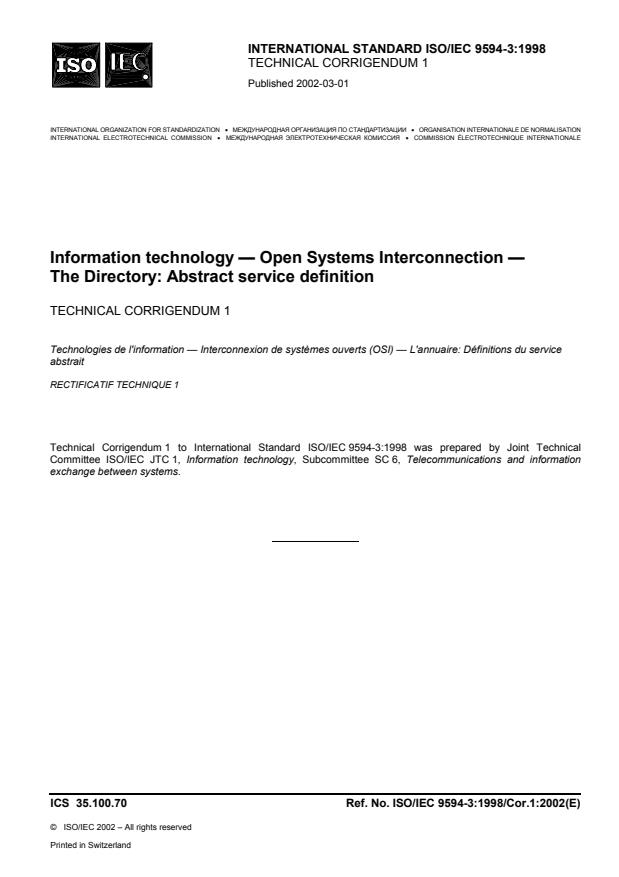
INTERNATIONAL STANDARD ISO/IEC 9594-3:1998
TECHNICAL CORRIGENDUM 1
Published 2002-03-01
INTERNATIONAL ORGANIZATION FOR STANDARDIZATION • МЕЖДУНАРОДНАЯ ОРГАНИЗАЦИЯ ПО СТАНДАРТИЗАЦИИ • ORGANISATION INTERNATIONALE DE NORMALISATION
INTERNATIONAL ELECTROTECHNICAL COMMISSION • МЕЖДУНАРОДНАЯ ЭЛЕКТРОТЕХНИЧЕСКАЯ КОМИССИЯ • COMMISSION ÉLECTROTECHNIQUE INTERNATIONALE
Information technology — Open Systems Interconnection —
The Directory: Abstract service definition
TECHNICAL CORRIGENDUM 1
Technologies de l'information — Interconnexion de systèmes ouverts (OSI) — L'annuaire: Définitions du service
abstrait
RECTIFICATIF TECHNIQUE 1
Technical Corrigendum 1 to International Standard ISO/IEC 9594-3:1998 was prepared by Joint Technical
Committee ISO/IEC JTC 1, Information technology, Subcommittee SC 6, Telecommunications and information
exchange between systems.
ICS 35.100.70 Ref. No. ISO/IEC 9594-3:1998/Cor.1:2002(E)
© ISO/IEC 2002 – All rights reserved
Printed in Switzerland
ISO/IEC 9594-3:1998/Cor.1:2002 (E)
INTERNATIONAL STANDARD
ITU-T RECOMMENDATION
INFORMATION TECHNOLOGY – OPEN SYSTEMS INTERCONNECTION –
THE DIRECTORY: ABSTRACT SERVICE DEFINITION
TECHNICAL CORRIGENDUM 1
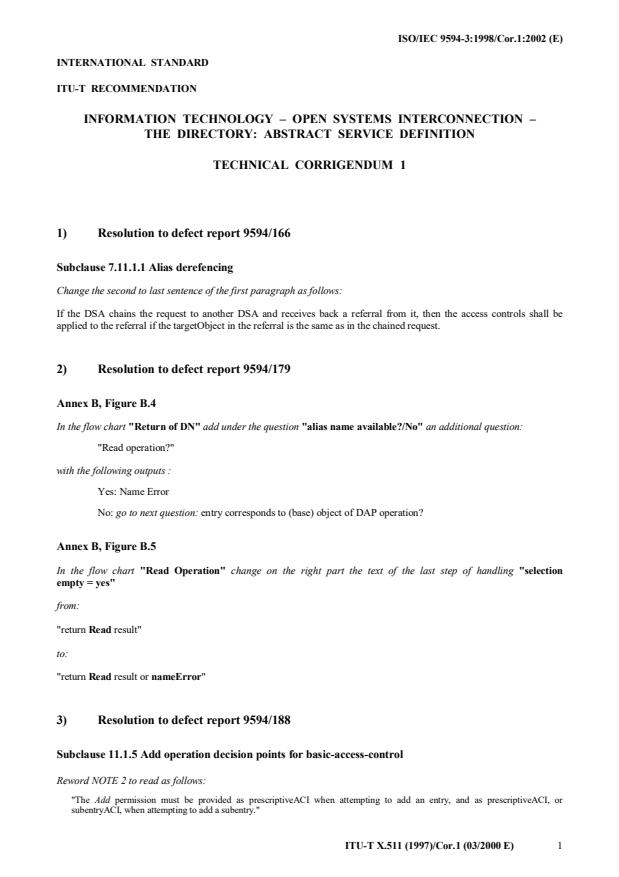
1) Resolution to defect report 9594/166
Subclause 7.11.1.1 Alias derefencing
Change the second to last sentence of the first paragraph as follows:
If the DSA chains the request to another DSA and receives back a referral from it, then the access controls shall be
applied to the referral if the targetObject in the referral is the same as in the chained request.
2) Resolution to defect report 9594/179
Annex B, Figure B.4
In the flow chart "Return of DN" add under the question "alias name available?/No" an additional question:
"Read operation?"
with the following outputs :
Yes: Name Error
No: go to next question: entry corresponds to (base) object of DAP operation?
Annex B, Figure B.5
In the flow chart "Read Operation" change on the right part the text of the last step of handling "selection
empty = yes"
from:
"return Read result"
to:
"return Read result or nameError"
3) Resolution to defect report 9594/188
Subclause 11.1.5 Add operation decision points for basic-access-control
Reword NOTE 2toread asfollows:
"The Add permission must be provided as prescriptiveACI when attempting to add an entry, and as prescriptiveACI, or
subentryACI, when attempting to add a subentry."
ITU-T X.511 (1997)/Cor.1 (03/2000 E) 1
ISO/IEC 9594-3:1998/Cor.1:2002 (E)
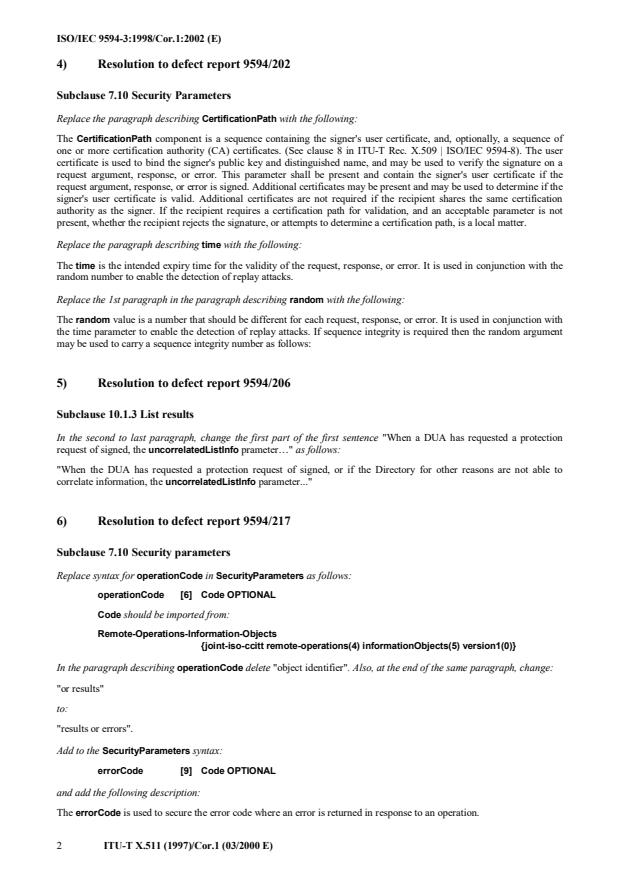
4) Resolution to defect report 9594/202
Subclause 7.10 Security Parameters
Replace the paragraph describing CertificationPath with the following:
The CertificationPath component is a sequence containing the signer's user certificate, and, optionally, a sequence of
one or more certification authority (CA) certificates. (See clause 8 in ITU-T Rec. X.509 | ISO/IEC 9594-8). The user
certificate is used to bind the signer's public key and distinguished name, and may be used to verify the signature on a
request argument, response, or error. This parameter shall be present and contain the signer's user certificate if the
request argument, response, or error is signed. Additional certificates may be present and may be used to determine if the
signer's user certificate is valid. Additional certificates are not required if the recipient shares the same certification
authority as the signer. If the recipient requires a certification path for validation, and an acceptable parameter is not
present, whether the recipient rejects the signature, or attempts to determine a certification path, is a local matter.
Replace the paragraph describing time with the following:
The time is the intended expiry time for the validity of the request, response, or error. It is used in conjunction with the
random number to enable the detection of replay attacks.
Replace the 1st paragraph in the paragraph describing
...
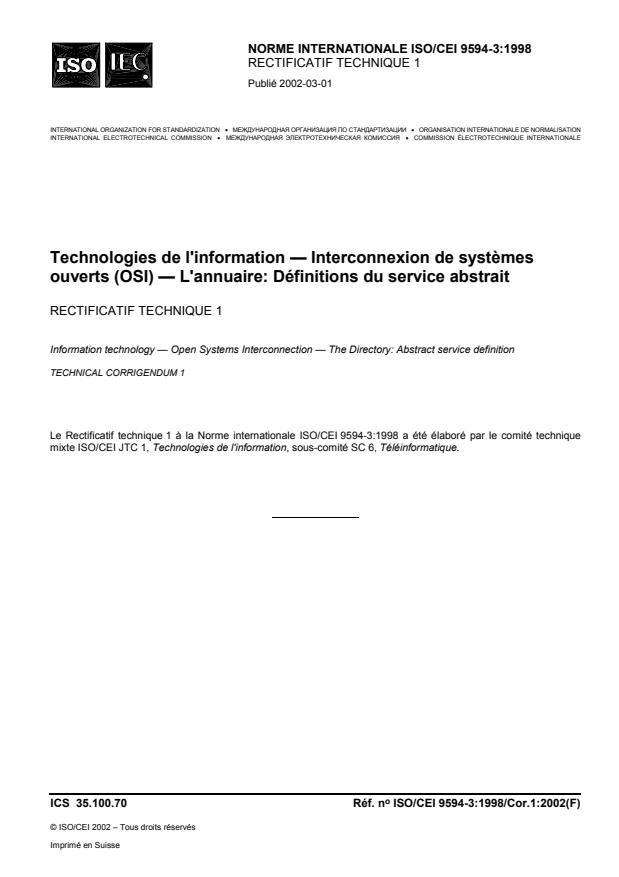
NORME INTERNATIONALE ISO/CEI 9594-3:1998
RECTIFICATIF TECHNIQUE 1
Publié 2002-03-01
INTERNATIONAL ORGANIZATION FOR STANDARDIZATION • МЕЖДУНАРОДНАЯ ОРГАНИЗАЦИЯ ПО СТАНДАРТИЗАЦИИ • ORGANISATION INTERNATIONALE DE NORMALISATION
INTERNATIONAL ELECTROTECHNICAL COMMISSION • МЕЖДУНАРОДНАЯ ЭЛЕКТРОТЕХНИЧЕСКАЯ КОМИССИЯ • COMMISSION ÉLECTROTECHNIQUE INTERNATIONALE
Technologies de l'information — Interconnexion de systèmes
ouverts (OSI) — L'annuaire: Définitions du service abstrait
RECTIFICATIF TECHNIQUE 1
Information technology — Open Systems Interconnection — The Directory: Abstract service definition
TECHNICAL CORRIGENDUM 1
Le Rectificatif technique 1 à la Norme internationale ISO/CEI 9594-3:1998 a été élaboré par le comité technique
mixte ISO/CEI JTC 1, Technologies de l'information, sous-comité SC 6, Téléinformatique.
o
ICS 35.100.70 Réf. n ISO/CEI 9594-3:1998/Cor.1:2002(F)
© ISO/CEI 2002 – Tous droits réservés
Imprimé en Suisse
ISO/CEI 9594-3:1998/Cor.1:2002 (F)
NORME INTERNATIONALE
RECOMMANDATION UIT-T
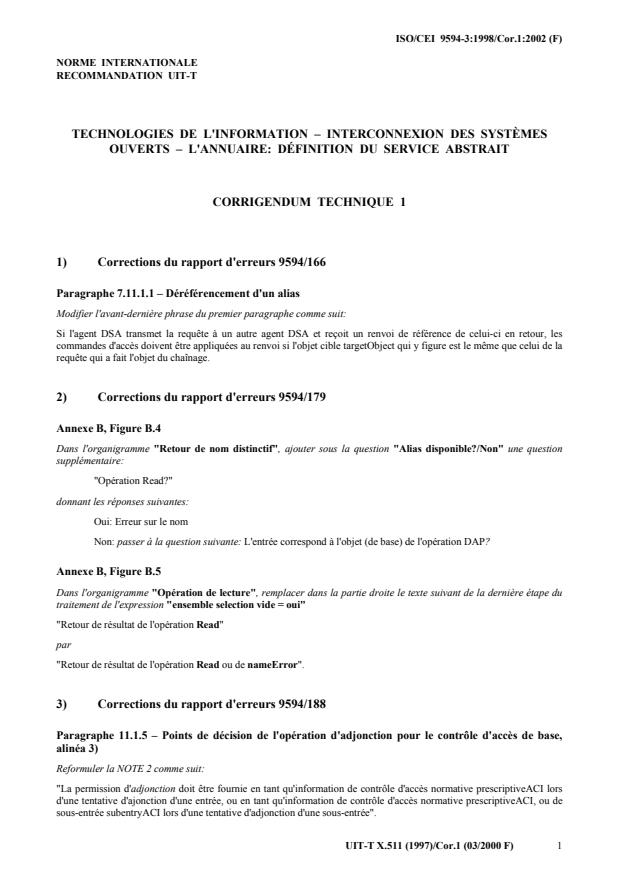
TECHNOLOGIES DE L'INFORMATION – INTERCONNEXION DES SYSTÈMES
OUVERTS – L'ANNUAIRE: DÉFINITION DU SERVICE ABSTRAIT
CORRIGENDUM TECHNIQUE 1
1) Corrections du rapport d'erreurs 9594/166
Paragraphe 7.11.1.1 – Déréférencement d'un alias
Modifier l'avant-dernière phrase du premier paragraphe comme suit:
Si l'agent DSA transmet la requête à un autre agent DSA et reçoit un renvoi de référence de celui-ci en retour, les
commandes d'accès doivent être appliquées au renvoi si l'objet cible targetObject qui y figure est le même que celui de la
requête qui a fait l'objet du chaînage.
2) Corrections du rapport d'erreurs 9594/179
Annexe B, Figure B.4
Dans l'organigramme "Retour de nom distinctif", ajouter sous la question "Alias disponible?/Non" une question
supplémentaire:
"Opération Read?"
donnant les réponses suivantes:
Oui: Erreur sur le nom
Non: passer à la question suivante: L'entrée correspond à l'objet (de base) de l'opération DAP?
Annexe B, Figure B.5
Dans l'organigramme "Opération de lecture", remplacer dans la partie droite le texte suivant de la dernière étape du
traitement de l'expression "ensemble selection vide = oui"
"Retour de résultat de l'opération Read"
par
"Retour de résultat de l'opération Read ou de nameError".
3) Corrections du rapport d'erreurs 9594/188
Paragraphe 11.1.5 – Points de décision de l'opération d'adjonction pour le contrôle d'accès de base,
alinéa 3)
Reformuler la NOTE 2 comme suit:
"La permission d'adjonction doit être fournie en tant qu'information de contrôle d'accès normative prescriptiveACI lors
d'une tentative d'ajonction d'une entrée, ou en tant qu'information de contrôle d'accès normative prescriptiveACI, ou de
sous-entrée subentryACI lors d'une tentative d'adjonction d'une sous-entrée".
UIT-T X.511 (1997)/Cor.1 (03/2000 F) 1
ISO/CEI 9594-3:1998/Cor.1:2002 (F)
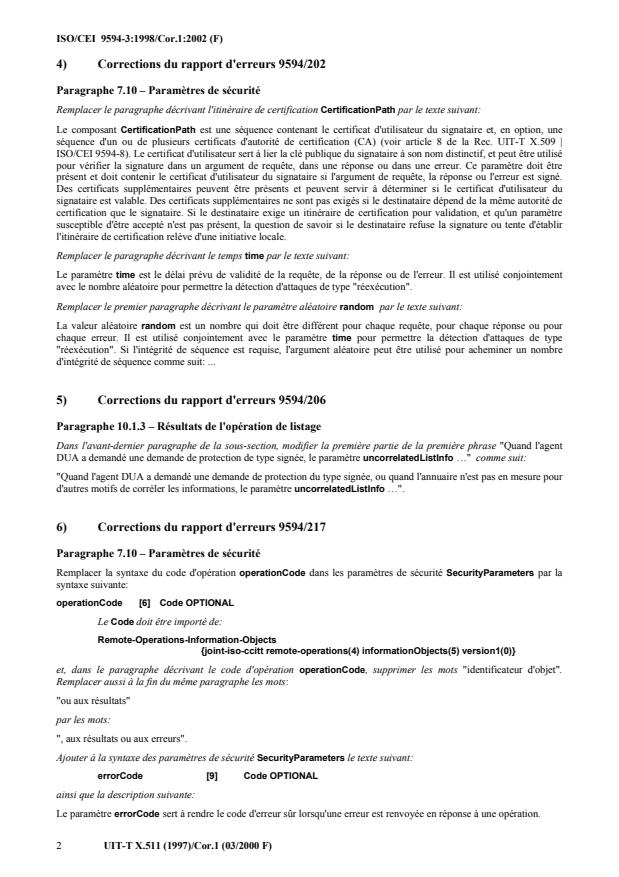
4) Corrections du rapport d'erreurs 9594/202
Paragraphe 7.10 – Paramètres de sécurité
Remplacer le paragraphe décrivant l'itinéraire de certification CertificationPath par le texte suivant:
Le composant CertificationPath est une séquence contenant le certificat d'utilisateur du signataire et, en option, une
séquence d'un ou de plusieurs certificats d'autorité de certification (CA) (voir article 8 de la Rec. UIT-T X.509 |
ISO/CEI 9594-8). Le certificat d'utilisateur sert à lier la clé publique du signataire à son nom distinctif, et peut être utilisé
pour vérifier la signature dans un argument de requête, dans une réponse ou dans une erreur. Ce paramètre doit être
présent et doit contenir le certificat d'utilisateur du signataire si l'argument de requête, la réponse ou l'erreur est signé.
Des certificats supplémentaires peuvent être présents et peuvent servir à déterminer si le certificat d'utilisateur du
signataire est valable. Des certificats supplémentaires ne sont pas exigés si le destinataire dépend de la même autorité de
certification que le signataire. Si le destinataire exige un itinéraire de certification pour validation, et qu'un paramètre
susceptible d'être accepté n'est pas présent, la question de savoir si le destinataire refuse la signature ou tente d'établir
l'itinéraire de certification relève d'une initiative locale.
Remplacer le paragraphe décrivant le temps time par le texte suivant:
Le paramètre time est le délai prévu de validité de la requête, de la réponse ou de l'erreur. Il est utilisé conjointement
avec le nombre aléatoire pour permettre la détection d'attaques de type "réexécution".
Remplacer le premier paragraphe décrivant le paramètre aléatoire random par le texte suivant:
La valeur aléatoire random est un nombre qui doit être différent pour chaque requête, pour chaque réponse ou pour
chaque erreu
...
Questions, Comments and Discussion
Ask us and Technical Secretary will try to provide an answer. You can facilitate discussion about the standard in here.
Loading comments...