

ISO/IEC 9594-3:2020/Amd 1:2025
(Amendment)Information technology — Open systems interconnection — Part 3: The Directory: Abstract service definition — Amendment 1: Miscellaneous enhancements
General Information
- Abstract
- Status
- Published
- Publication Date
- 15-May-2025
- Drafting Committee
- ISO/IEC JTC 1/SC 6/WG 10 - Directory, ASN.1 and Registration
- Current Stage
- 6060 - International Standard published
- Start Date
- 16-May-2025
- Due Date
- 21-Jun-2025
- Completion Date
- 16-May-2025
Overview
ISO/IEC 9594-3:2020/Amd 1:2025 is an amendment to the international standard for information technology, specifically addressing Open Systems Interconnection (OSI) and its Directory abstract service definition. This amendment, titled Miscellaneous Enhancements, introduces updates to facilitate the clear separation between cybersecurity ASN.1 modules and directory ASN.1 modules. Developed collaboratively by ISO, IEC, and ITU-T, this amendment reflects the ongoing maintenance and modernization of vital directory service interfaces used globally in telecommunications and IT systems.
Key Topics
This amendment focuses on the following significant enhancements:
- Separation of ASN.1 Modules: Clarifies and updates ASN.1 import sections, promoting a distinct separation between cybersecurity-related modules and core directory modules.
- Maintenance of Compatibility: Ensures ongoing compatibility with earlier versions of directory and security specifications (such as ITU-T Recommendations X.501, X.509, and others) through precise updates to module imports and definitions.
- Alignment with International Recommendations: Incorporates changes harmonized with ITU-T X.511 (2019) Amendment 1, mirroring global best practices for IT directory services.
Key technical aspects in this amendment address the structure and organization of imports within directory service modules, benefiting both implementers and organizations aiming for robust, up-to-date directory services.
Applications
ISO/IEC 9594-3:2020/Amd 1:2025 is integral for organizations and professionals involved in:
- Directory Services Implementation: IT architects and systems integrators can utilize the enhanced abstract service definition for more modular and secure deployment of directory services.
- Telecommunications Infrastructure: Operators and vendors ensure their directory components are interoperable and aligned with the latest international standards.
- Cybersecurity Integration: By separating cybersecurity and directory modules, IT security professionals can more efficiently manage and audit security components within directory services.
- Software Development: Developers building LDAP and X.500-compliant applications benefit from clearer module interfaces and enhanced maintainability.
- Conformance Testing and Verification: Laboratories and quality assurance teams apply these enhancements when validating systems for standards compliance.
Related Standards
ISO/IEC 9594-3:2020/Amd 1:2025 is closely connected with a set of IEEE, ISO, IEC, and ITU-T standards addressing directory services and open system interconnection, including:
- ISO/IEC 9594-2: Directory - Models (ITU-T X.501)
- ISO/IEC 9594-4: Directory - Procedures for distributed operation (ITU-T X.518)
- ISO/IEC 9594-5: Directory - Protocol specifications (ITU-T X.519)
- ISO/IEC 9594-6: Directory - Selected attribute types (ITU-T X.520)
- ISO/IEC 9594-8: Directory - Public-key and attribute certificate frameworks (ITU-T X.509)
- ISO/IEC 9594-9: Directory - Replication (ITU-T X.525)
- IETF RFC 4511: Lightweight Directory Access Protocol (LDAP)
- IETF RFC 2025: The Simple Public Key Mechanism (SPKM)
- ITU-T Recommendations X.500 Series: Directory standardization foundational documents
Keeping informed of these related standards facilitates best practices, interoperability, and compliance across a range of directory and security service implementations.
Keywords: ISO/IEC 9594-3:2020/Amd 1:2025, Directory abstract service, ASN.1 modules, cybersecurity, open systems interconnection, OSI, ITU-T X.511, directory services standard, LDAP, X.500, telecom standards, information technology standards, directory interoperability.
Relations
- Effective Date
- 23-Dec-2023
Get Certified
Connect with accredited certification bodies for this standard

BSI Group
BSI (British Standards Institution) is the business standards company that helps organizations make excellence a habit.

NYCE
Mexican standards and certification body.
Sponsored listings
Frequently Asked Questions
ISO/IEC 9594-3:2020/Amd 1:2025 is a standard published by the International Organization for Standardization (ISO). Its full title is "Information technology — Open systems interconnection — Part 3: The Directory: Abstract service definition — Amendment 1: Miscellaneous enhancements". This standard covers: Information technology — Open systems interconnection — Part 3: The Directory: Abstract service definition — Amendment 1: Miscellaneous enhancements
Information technology — Open systems interconnection — Part 3: The Directory: Abstract service definition — Amendment 1: Miscellaneous enhancements
ISO/IEC 9594-3:2020/Amd 1:2025 is classified under the following ICS (International Classification for Standards) categories: 35.100.70 - Application layer. The ICS classification helps identify the subject area and facilitates finding related standards.
ISO/IEC 9594-3:2020/Amd 1:2025 has the following relationships with other standards: It is inter standard links to ISO/IEC 9594-3:2020. Understanding these relationships helps ensure you are using the most current and applicable version of the standard.
ISO/IEC 9594-3:2020/Amd 1:2025 is available in PDF format for immediate download after purchase. The document can be added to your cart and obtained through the secure checkout process. Digital delivery ensures instant access to the complete standard document.
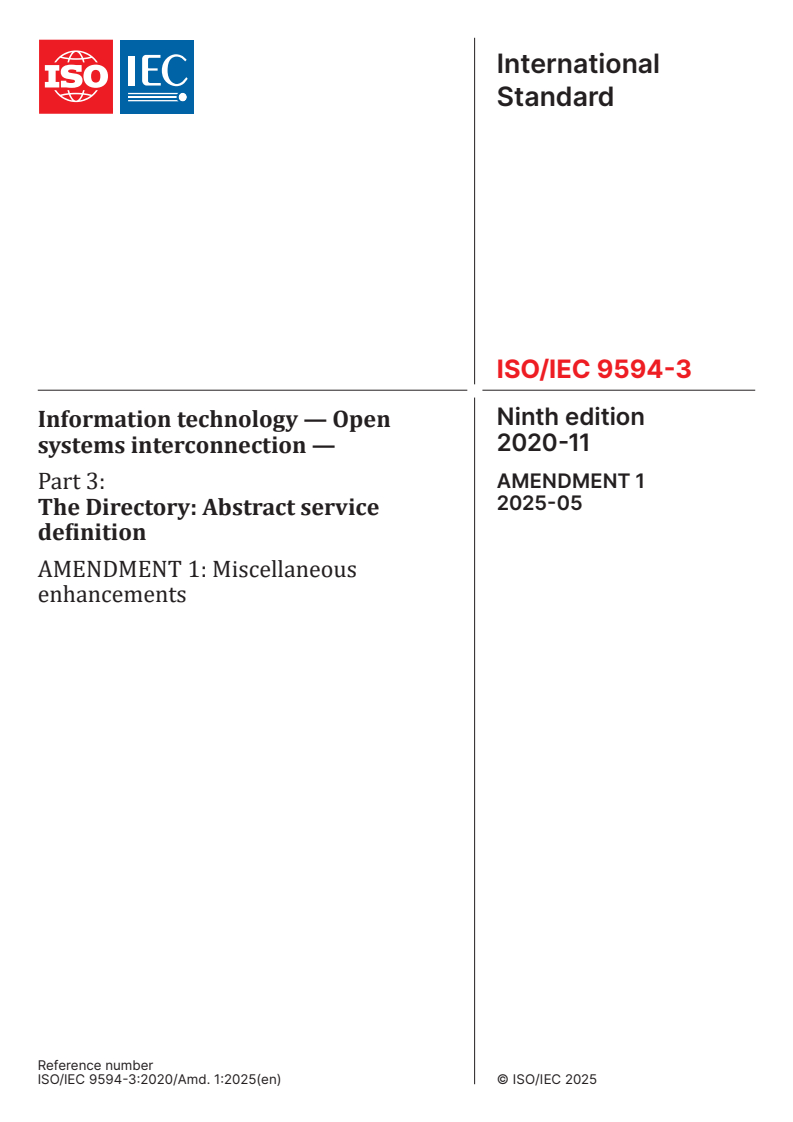
Standards Content (Sample)
International
Standard
ISO/IEC 9594-3
Ninth edition
Information technology — Open
2020-11
systems interconnection —
AMENDMENT 1
Part 3:
2025-05
The Directory: Abstract service
definition
AMENDMENT 1: Miscellaneous
enhancements
Reference number
ISO/IEC 9594-3:2020/Amd. 1:2025(en) © ISO/IEC 2025
ISO/IEC 9594-3:2020/Amd. 1:2025(en)
© ISO/IEC 2025
All rights reserved. Unless otherwise specified, or required in the context of its implementation, no part of this publication may
be reproduced or utilized otherwise in any form or by any means, electronic or mechanical, including photocopying, or posting on
the internet or an intranet, without prior written permission. Permission can be requested from either ISO at the address below
or ISO’s member body in the country of the requester.
ISO copyright office
CP 401 • Ch. de Blandonnet 8
CH-1214 Vernier, Geneva
Phone: +41 22 749 01 11
Email: copyright@iso.org
Website: www.iso.org
Published in Switzerland
© ISO/IEC 2025 – All rights reserved
ii
ISO/IEC 9594-3:2020/Amd. 1:2025(en)
Foreword
ISO (the International Organization for Standardization) and IEC (the International Electrotechnical
Commission) form the specialized system for worldwide standardization. National bodies that are
members of ISO or IEC participate in the development of International Standards through technical
committees established by the respective organization to deal with particular fields of technical activity.
ISO and IEC technical committees collaborate in fields of mutual interest. Other international
organizations, governmental and non-governmental, in liaison with ISO and IEC, also take part in the
work.
The procedures used to develop this document and those intended for its further maintenance are
described in the ISO/IEC Directives, Part 1. In particular, the different approval criteria needed for the
different types of document should be noted.
ISO and IEC draw attention to the possibility that the implementation of this document may involve the
use of (a) patent(s). ISO and IEC take no position concerning the evidence, validity or applicability of any
claimed patent rights in respect thereof. As of the date of publication of this document, ISO and IEC had
not received notice of (a) patent(s) which may be required to implement this document. However,
implementers are cautioned that this may not represent the latest information, which may be obtained
from the patent database available at www.iso.org/patents and https://patents.iec.ch. ISO and IEC shall
not be held responsible for identifying any or all such patent rights.
Any trade name used in this document is information given for the convenience of users and does not
constitute an endorsement.
For an explanation of the voluntary nature of standards, the meaning of ISO specific terms and
expressions related to conformity assessment, as well as information about ISO's adherence to the
World Trade Organization (WTO) principles in the Technical Barriers to Trade (TBT)
see www.iso.org/iso/foreword.html. In the IEC, see www.iec.ch/understanding-standards.
This document was prepared by ITU-T as ITU-T X.511 (2019) Amd. 1 (10/2024) and drafted in
accordance with its editorial rules, in collaboration with Joint Technical Committee ISO/IEC JTC 1,
Information technology, Subcommittee SC 6, Telecommunications and information exchange between
systems.
A list of all parts in the ISO/IEC 9594 series can be found on the ISO and IEC websites.
Any feedback or questions on this document should be directed to the user’s national standards body.
A complete listing of these bodies can be found at www.iso.org/members.html and
www.iec.ch/national-committees.
Rec. ITU-T X.511 (2019) Amd. 1 (10/2024)
© ISO/IEC 2025 – All rights reserved
iii
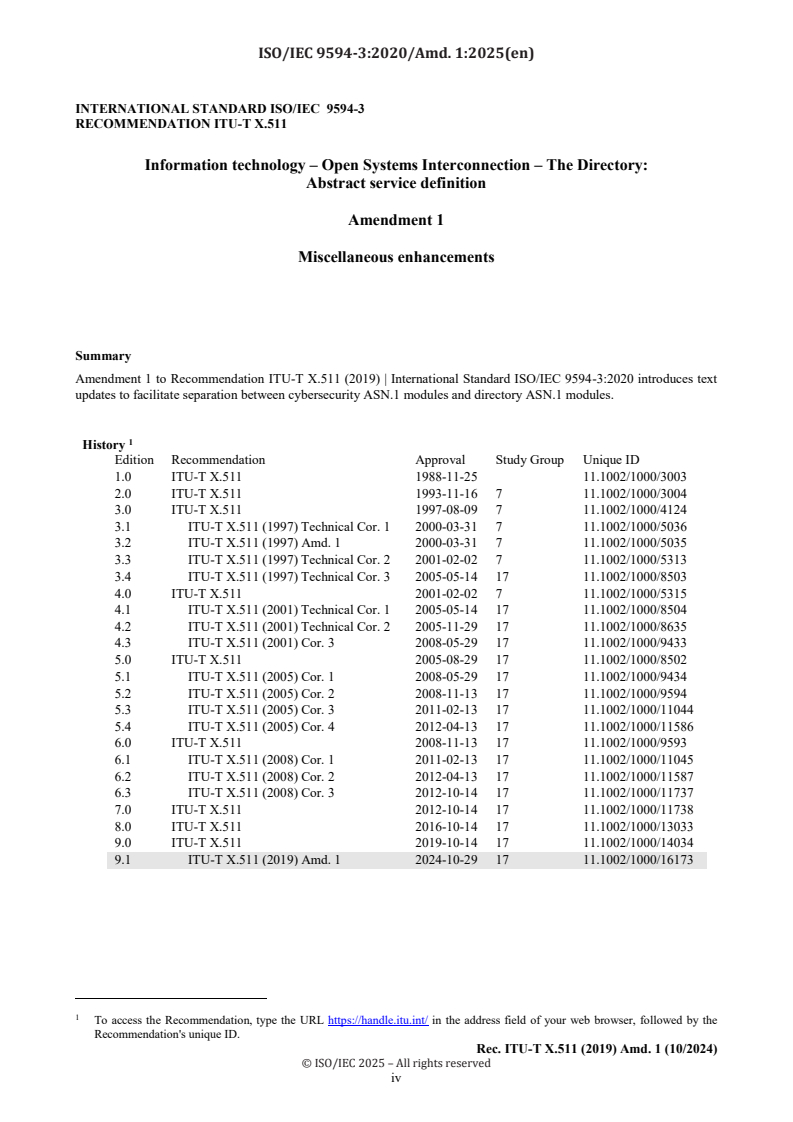
ISO/IEC 9594-3:2020/Amd. 1:2025(en)
INTERNATIONAL STANDARD ISO/IEC 9594-3
RECOMMENDATION ITU-T X.511
Information technology – Open Systems Interconnection – The Directory:
Abstract service definition
Amendment 1
Miscellaneous enhancements
Summary
Amendment 1 to Recommendation ITU-T X.511 (2019) | International Standard ISO/IEC 9594-3:2020 introduces text
updates to facilitate separation between cybersecurity ASN.1 modules and directory ASN.1 modules.
History
Edition Recommendation Approval Study Group Unique ID
1.0 ITU-T X.511 1988-11-25 11.1002/1000/3003
2.0 ITU-T X.511 1993-11-16 7 11.1002/1000/3004
3.0 ITU-T X.511 1997-08-09 7 11.1002/1000/4124
3.1 ITU-T X.511 (1997) Technical Cor. 1 2000-03-31 7 11.1002/1000/5036
3.2 ITU-T X.511 (1997) Amd. 1 2000-03-31 7 11.1002/1000/5035
3.3 ITU-T X.511 (1997) Technical Cor. 2 2001-02-02 7 11.1002/1000/5313
3.4 ITU-T X.511 (1997) Technical Cor. 3 2005-05-14 17 11.1002/1000/8503
4.0 ITU-T X.511 2001-02-02 7 11.1002/1000/5315
4.1 ITU-T X.511 (2001) Technical Cor. 1 2005-05-14 17 11.1002/1000/8504
4.2 ITU-T X.511 (2001) Technical Cor. 2 2005-11-29 17 11.1002/1000/8635
4.3 ITU-T X.511 (2001) Cor. 3 2008-05-29 17 11.1002/1000/9433
5.0 ITU-T X.511 2005-08-29 17 11.1002/1000/8502
5.1 ITU-T X.511 (2005) Cor. 1 2008-05-29 17 11.1002/1000/9434
5.2 ITU-T X.511 (2005) Cor. 2 2008-11-13 17 11.1002/1000/9594
5.3 ITU-T X.511 (2005) Cor. 3 2011-02-13 17 11.1002/1000/11044
5.4 ITU-T X.511 (2005) Cor. 4 2012-04-13 17 11.1002/1000/11586
6.0 ITU-T X.511 2008-11-13 17 11.1002/1000/9593
6.1 ITU-T X.511 (2008) Cor. 1 2011-02-13 17 11.1002/1000/11045
6.2 ITU-T X.511 (2008) Cor. 2 2012-04-13 17 11.1002/1000/11587
6.3 ITU-T X.511 (2008) Cor. 3 2012-10-14 17 11.1002/1000/11737
7.0 ITU-T X.511 2012-10-14 17 11.1002/1000/11738
8.0 ITU-T X.511 2016-10-14 17 11.1002/1000/13033
9.0 ITU-T X.511 2019-10-14 17 11.1002/1000/14034
9.1 ITU-T X.511 (2019) Amd. 1 2024-10-29 17 11.1002/1000/16173
To access the Recommendation, type the URL https://handle.itu.int/ in the address field of your web browser, followed by the
Recommendation's unique ID.
Rec. ITU-T X.511 (2019) Amd. 1 (10/2024)
© ISO/IEC 2025 – All rights reserved
iv
ISO/IEC 9594-3:2020/Amd. 1:2025(en)
FOREWORD
The International Telecommunication Union (ITU) is the United Nations specialized agency in the field of
telecommunications, and information and communication technologies (ICTs). The ITU Telecommunication
Standardization Sector (ITU-T) is a permanent organ of ITU. ITU-T is responsible for studying technical,
operating and tariff questions and issuing Recommendations on them with a view to standardizing
telecommunications on a worldwide basis.
The World Telecommunication Standardization Assembly (WTSA), which meets every four years, establishes
the topics for study by the ITU-T study groups which, in turn, produce Recommendations on these topics.
The approval of ITU-T Recommendations is covered by the procedure laid down in WTSA Resolution 1.
In some areas of information technology
...