

ISO/IEC 9594-8:2020/Amd 1:2025
(Amendment)Information technology — Open systems interconnection — Part 8: The Directory: Public-key and attribute certificate frameworks — Amendment 1: Miscellaneous enhancements
General Information
- Abstract
- Status
- Published
- Publication Date
- 18-May-2025
- Drafting Committee
- ISO/IEC JTC 1/SC 6/WG 10 - Directory, ASN.1 and Registration
- Current Stage
- 6060 - International Standard published
- Start Date
- 19-May-2025
- Due Date
- 22-Dec-2025
- Completion Date
- 19-May-2025
Buy Documents
ISO/IEC 9594-8:2020/Amd 1:2025 - Information technology — Open systems interconnection — Part 8: The Directory: Public-key and attribute certificate frameworks — Amendment 1: Miscellaneous enhancements Released:5/19/2025
Overview
ISO/IEC 9594-8:2020/Amd 1:2025 is an important international standard titled Information technology - Open systems interconnection - Part 8: The Directory: Public-key and attribute certificate frameworks - Amendment 1: Miscellaneous enhancements. Published under ISO and IEC in May 2025, this amendment introduces enhancements aimed at improving the framework for public-key infrastructures and attribute certificates within directory services.
This amendment focuses on facilitating clearer separation between cybersecurity ASN.1 modules and directory ASN.1 modules, which is critical for maintaining modularity and interoperability in complex security systems. The update primarily affects the ASN.1 specifications and modules related to certificate frameworks under the ISO/IEC 9594 series.
Key Topics
Sequence Number Attribute Addition:
A new attribute typesequenceNumberhas been added. This attribute holds non-negative integer values to represent sequence numbers useful for naming directory entries that store public-key or attribute certificates.ASN.1 Module Refinements:
The amendment updates the import sections of critical ASN.1 modules including:- Authentication Framework module
- Certificate Extensions module
- Attribute Certificate Framework module
- Algorithm Object Identifiers module
- Extension Attributes module
These refinements improve the structure and interoperability of ASN.1 definitions used in public-key and certificate management.
Modular Separation:
Enhancements emphasize the logical and functional separation between cybersecurity-related ASN.1 modules and directory service-specific ASN.1 modules to reduce complexity and improve clarity in implementation.Compliance and Patent Considerations:
While compliance with this standard is voluntary, mandatory provisions ensure interoperability. Implementers should be aware that patented technologies might be involved, and are encouraged to consult the ISO patent database as outlined in the documentation.
Applications
Public Key Infrastructure (PKI) Enhancements:
Organizations managing PKI can leverage the refined ASN.1 modules and new attribute types to maintain more precise certificate directories, supporting security processes such as certificate issuance, revocation, and validation.Directory Services in Open Systems:
The amendment is particularly useful for IT environments using directory services to manage user identities, certificates, and attributes in distributed and heterogeneous systems.Telecommunications and Information Exchange:
Telecommunications operators and IT service providers relying on ISO/IEC 9594 standards benefit from these miscellaneous enhancements in ensuring secure and consistent management of certificate frameworks.Security Module Development:
Developers and architects designing security frameworks and ASN.1 specifications can utilize this amendment for improved modular design, enabling easier updates and maintenance.
Related Standards
ISO/IEC 9594 Series:
Part 8 Amendment 1 complements previous editions of ISO/IEC 9594, which collectively define the directory services and related public-key and attribute certification frameworks for Open Systems Interconnection (OSI).ITU-T X.509 Recommendations:
The amendment aligns with ITU-T X.509 (2019) recommendations, reflecting ongoing collaboration between ISO, IEC, and ITU in standardizing certificate and security frameworks.ISO/IEC 9594-2 (X.501):
This standard defines directory information frameworks and is closely related, especially concerning directory objects and attribute types used with certificates.ASN.1 notation standards:
Improvements to ASN.1 module organization in this amendment ensure better compliance with ASN.1 syntax and semantics standards, facilitating interoperability across systems.
Keywords: ISO/IEC 9594-8 amendment, public-key certificate framework, attribute certificate, ASN.1 modules, directory services, cybersecurity ASN.1 separation, sequence number attribute, ITU-T X.509, open systems interconnection, PKI enhancements, certificate management standards.
Relations
- Effective Date
- 23-Dec-2023
Buy Documents
ISO/IEC 9594-8:2020/Amd 1:2025 - Information technology — Open systems interconnection — Part 8: The Directory: Public-key and attribute certificate frameworks — Amendment 1: Miscellaneous enhancements Released:5/19/2025
Get Certified
Connect with accredited certification bodies for this standard

BSI Group
BSI (British Standards Institution) is the business standards company that helps organizations make excellence a habit.

NYCE
Mexican standards and certification body.
Sponsored listings
Frequently Asked Questions
ISO/IEC 9594-8:2020/Amd 1:2025 is a standard published by the International Organization for Standardization (ISO). Its full title is "Information technology — Open systems interconnection — Part 8: The Directory: Public-key and attribute certificate frameworks — Amendment 1: Miscellaneous enhancements". This standard covers: Information technology — Open systems interconnection — Part 8: The Directory: Public-key and attribute certificate frameworks — Amendment 1: Miscellaneous enhancements
Information technology — Open systems interconnection — Part 8: The Directory: Public-key and attribute certificate frameworks — Amendment 1: Miscellaneous enhancements
ISO/IEC 9594-8:2020/Amd 1:2025 is classified under the following ICS (International Classification for Standards) categories: 35.100.70 - Application layer. The ICS classification helps identify the subject area and facilitates finding related standards.
ISO/IEC 9594-8:2020/Amd 1:2025 has the following relationships with other standards: It is inter standard links to ISO/IEC 9594-8:2020. Understanding these relationships helps ensure you are using the most current and applicable version of the standard.
ISO/IEC 9594-8:2020/Amd 1:2025 is available in PDF format for immediate download after purchase. The document can be added to your cart and obtained through the secure checkout process. Digital delivery ensures instant access to the complete standard document.
Standards Content (Sample)
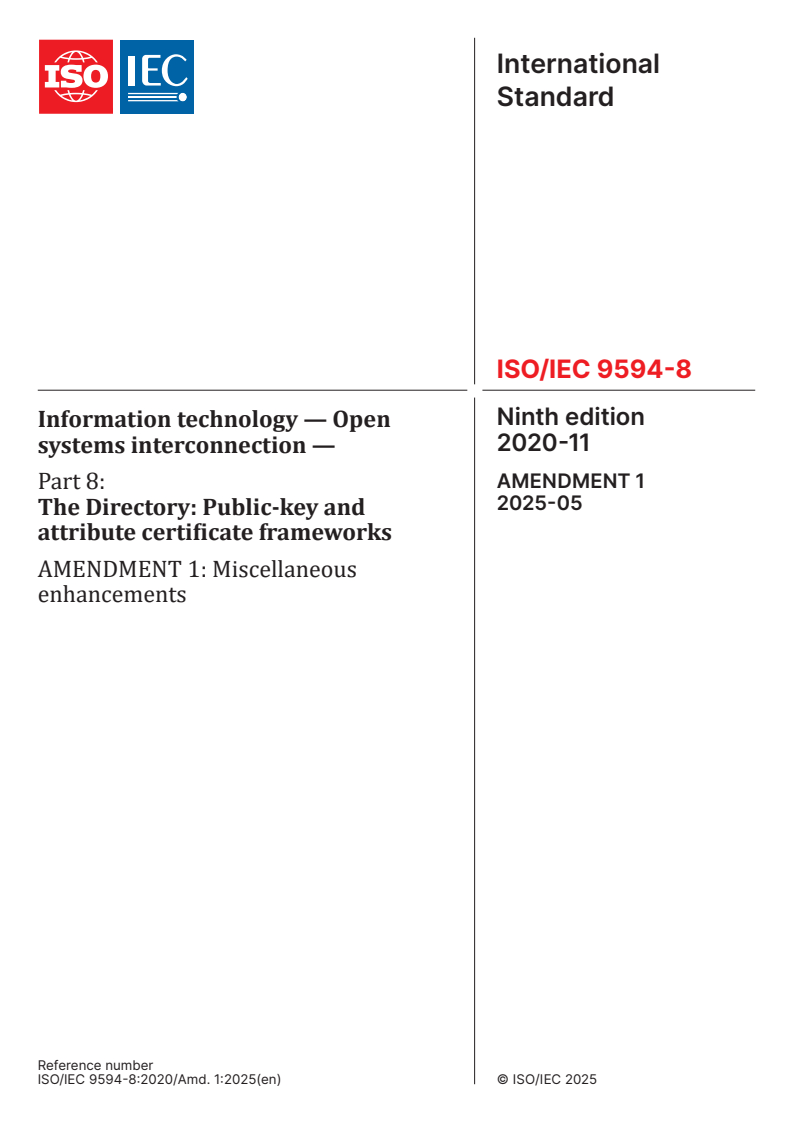
International
Standard
ISO/IEC 9594-8
Ninth edition
Information technology — Open
2020-11
systems interconnection —
AMENDMENT 1
Part 8:
2025-05
The Directory: Public-key and
attribute certificate frameworks
AMENDMENT 1: Miscellaneous
enhancements
Reference number
ISO/IEC 9594-8:2020/Amd. 1:2025(en) © ISO/IEC 2025
ISO/IEC 9594-8:2020/Amd. 1:2025(en)
© ISO/IEC 2025
All rights reserved. Unless otherwise specified, or required in the context of its implementation, no part of this publication may
be reproduced or utilized otherwise in any form or by any means, electronic or mechanical, including photocopying, or posting on
the internet or an intranet, without prior written permission. Permission can be requested from either ISO at the address below
or ISO’s member body in the country of the requester.
ISO copyright office
CP 401 • Ch. de Blandonnet 8
CH-1214 Vernier, Geneva
Phone: +41 22 749 01 11
Email: copyright@iso.org
Website: www.iso.org
Published in Switzerland
© ISO/IEC 2025 – All rights reserved
ii
ISO/IEC 9594-8:2020/Amd. 1:2025(en)
Foreword
ISO (the International Organization for Standardization) and IEC (the International Electrotechnical
Commission) form the specialized system for worldwide standardization. National bodies that are
members of ISO or IEC participate in the development of International Standards through technical
committees established by the respective organization to deal with particular fields of technical activity.
ISO and IEC technical committees collaborate in fields of mutual interest. Other international
organizations, governmental and non-governmental, in liaison with ISO and IEC, also take part in the
work.
The procedures used to develop this document and those intended for its further maintenance are
described in the ISO/IEC Directives, Part 1. In particular, the different approval criteria needed for the
different types of document should be noted.
ISO and IEC draw attention to the possibility that the implementation of this document may involve the
use of (a) patent(s). ISO and IEC take no position concerning the evidence, validity or applicability of any
claimed patent rights in respect thereof. As of the date of publication of this document, ISO and IEC had
not received notice of (a) patent(s) which may be required to implement this document. However,
implementers are cautioned that this may not represent the latest information, which may be obtained
from the patent database available at www.iso.org/patents and https://patents.iec.ch. ISO and IEC shall
not be held responsible for identifying any or all such patent rights.
Any trade name used in this document is information given for the convenience of users and does not
constitute an endorsement.
For an explanation of the voluntary nature of standards, the meaning of ISO specific terms and
expressions related to conformity assessment, as well as information about ISO's adherence to the
World Trade Organization (WTO) principles in the Technical Barriers to Trade (TBT)
see www.iso.org/iso/foreword.html. In the IEC, see www.iec.ch/understanding-standards.
This document was prepared by ITU-T as ITU-T X.509 (2019) Amd. 1 (10/2024) and drafted in
accordance with its editorial rules, in collaboration with Joint Technical Committee ISO/IEC JTC 1,
Information technology, Subcommittee SC 6, Telecommunications and information exchange
between systems.
A list of all parts in the ISO/IEC 9594 series can be found on the ISO and IEC websites.
Any feedback or questions on this document should be directed to the user’s national standards body.
A complete listing of these bodies can be found at www.iso.org/members.html and
www.iec.ch/national-committees.
Rec. ITU-T X.509 (2019) Amd. 1 (10/2024)
© ISO/IEC 2025 – All rights reserved
iii
ISO/IEC 9594-8:2020/Amd. 1:2025(en)
INTERNATIONAL STANDARD ISO/IEC 9594-8
RECOMMENDATION ITU-T X.509
Information technology – Open Systems Interconnection – The Directory: Public-key and
attribute certificate frameworks
Amendment 1
Miscellaneous enhancements
Summary
Recommendation ITU-T X.509 (2019) | International Standard ISO/IEC 9594-8:2020, Amendment 1 introduces text
updates to facilitate separation between cybersecurity ASN.1 modules and directory ASN.1 modules.
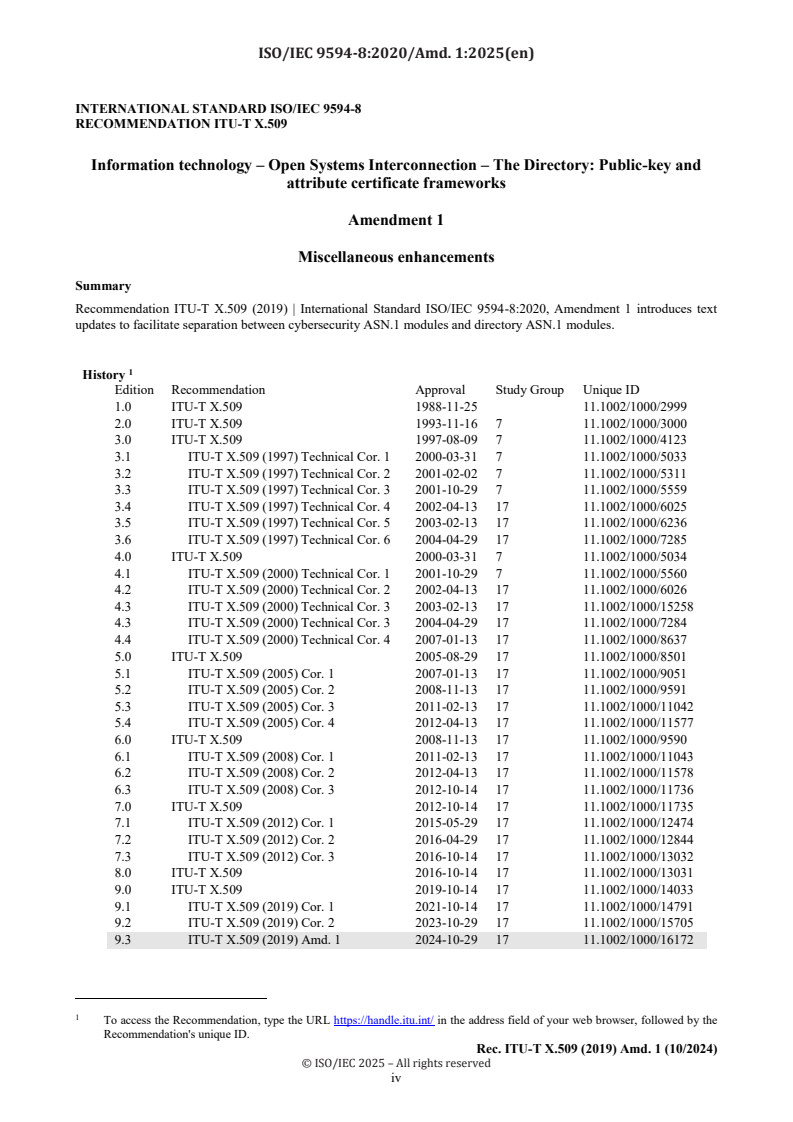
History
Edition Recommendation Approval Study Group Unique ID
1.0 ITU-T X.509 1988-11-25 11.1002/1000/2999
2.0 ITU-T X.509 1993-11-16 7 11.1002/1000/3000
3.0 ITU-T X.509 1997-08-09 7 11.1002/1000/4123
3.1 ITU-T X.509 (1997) Technical Cor. 1 2000-03-31 7 11.1002/1000/5033
3.2 ITU-T X.509 (1997) Technical Cor. 2 2001-02-02 7 11.1002/1000/5311
3.3 ITU-T X.509 (1997) Technical Cor. 3 2001-10-29 7 11.1002/1000/5559
3.4 ITU-T X.509 (1997) Technical Cor. 4 2002-04-13 17 11.1002/1000/6025
3.5 ITU-T X.509 (1997) Technical Cor. 5 2003-02-13 17 11.1002/1000/6236
3.6 ITU-T X.509 (1997) Technical Cor. 6 2004-04-29 17 11.1002/1000/7285
4.0 ITU-T X.509 2000-03-31 7 11.1002/1000/5034
4.1 ITU-T X.509 (2000) Technical Cor. 1 2001-10-29 7 11.1002/1000/5560
4.2 ITU-T X.509 (2000) Technical Cor. 2 2002-04-13 17 11.1002/1000/6026
4.3 ITU-T X.509 (2000) Technical Cor. 3 2003-02-13 17 11.1002/1000/15258
4.3 ITU-T X.509 (2000) Technical Cor. 3 2004-04-29 17 11.1002/1000/7284
4.4 ITU-T X.509 (2000) Technical Cor. 4 2007-01-13 17 11.1002/1000/8637
5.0 ITU-T X.509 2005-08-29 17 11.1002/1000/8501
5.1 ITU-T X.509 (2005) Cor. 1 2007-01-13 17 11.1002/1000/9051
5.2 ITU-T X.509 (2005) Cor. 2 2008-11-13 17 11.1002/1000/9591
5.3 ITU-T X.509 (2005) Cor. 3 2011-02-13 17 11.1002/1000/11042
5.4 ITU-T X.509 (2005) Cor. 4 2012-04-13 17 11.1002/1000/11577
6.0 ITU-T X.509 2008-11-13 17 11.1002/1000/9590
6.1 ITU-T X.509 (2008) Cor. 1 2011-02-13 17 11.1002/1000/11043
6.2 ITU-T X.509 (2008) Cor. 2 2012-04-13 17 11.1002/1000/11578
6.3 ITU-T X.509 (2008) Cor. 3 2012-10-14 17 11.1002/1000/11736
7.0 ITU-T X.509 2012-10-14 17 11.1002/1000/11735
7.1 ITU-T X.509 (2012) Cor. 1 2015-05-29 17 11.1002/1000/12474
7.2 ITU-T X.509 (2012) Cor. 2 2016-04-29 17 11.1002/1000/12844
7.3 ITU-T X.509 (2012) Cor. 3 2016-10-14 17 11.1002/1000/13032
8.0 ITU-T X.509 2016-10-14 17 11.1002/1000/13031
9.0 ITU-T X.509 2019-10-14 17 11.1002/1000/14033
9.1 ITU-T X.509 (2019) Cor. 1 2021-10-14 17 11.1002/1000/14791
9.2 ITU-T X.509 (2019) Cor. 2 2023-10-29 17 11.1002/1000/15705
9.3 ITU-T X.509 (2019) Amd. 1 2024-10-29 17 11.1002/1000/16172
To access the Recommendation, type the URL https://handle.itu.int/ in the address field of your web browser, followed by the
Recommendation's unique ID.
Rec. ITU-T X.509 (2019) Amd. 1 (10/2024)
© ISO/IEC 2025 – All rights reserved
iv
ISO/IEC 9594-8:2020/Amd. 1:2025(en)
FOREWORD
The International Telecommunication Union (ITU) is the United Nations specialized agency in the field of
telecommunications, and information and communication technologies (ICTs). The ITU Telecommunication
Standardization Sector (ITU-T) is a permanent organ of ITU. ITU-T is responsible for studying technical,
operating and tariff questions and issuing Recommendations on them with a view to standardizing
telecommunications on a worldwide basis.
The World Telecommunication Standardization Assembly (WTSA), which meets every four years, establishes
the topics for study by the ITU-T study groups which, in turn, produce Recommendations on these topics.
The approval of ITU-T Recommendations is covered by the procedure laid down in WTSA Resolution 1.
In some areas of information technology which fall within ITU-T's purview, the necessary standards are
prepared on a collaborative basis with ISO and IEC.
NOTE
In this Recommendation, the expression "Administration" is used for conciseness to indicate both a
telecommunication administration and a recognized operating agency.
Compliance with this Recommendation is voluntary. However, the Recommendation may contain certain
mandatory provisions (to ensure, e.g., interoperability or applicability) and compliance with the
Recommendation is achieved when all of these mandatory provisions are met. The words "shall" or some other
obligatory language such as "must" and the negative equivalents are used to express requirements. The use of
such words does not suggest that compliance with the Recommendation is required of any party.
INTELLECTUAL PROPERTY RIGHTS
ITU draws attention to the possibility that the practice or implementation of this Recommendation may involve
the use of a claimed Intellectual Property Right. ITU takes no position concerning the evidence, validity or
applicability of claimed Intellectual Property Rights, whether asserted by ITU members or others outside of
the Recommendation development process.
As of the date of approval of this Recommendation, ITU had not received notice of intellectual property,
protected by patents/software copyrights, which may be required to implement this Recommendation.
However, implementers are cautioned that this may not represent the latest information and are therefore
strongly urged to consult the appropriate ITU-T databases available via the ITU-T website at
https://www.itu.int/ITU-T/ipr/.
ITU 2025
All rights reserved. No part of this publication may be reproduced, by any means whatsoever, without the prior
written permission of ITU.
Rec. ITU-T X.509 (2019) Amd. 1 (10/2024)
© ISO/IEC 2025 – All rights reserved
v
ISO/IEC 9594-8:2020/Amd. 1:2025(en)
CONTENTS
Page
1) Clause 13.2.13 . 1
2) Annex A, clause A.1 . 1
3) Annex A, clause A.2 . 2
4) Annex A, clause A.3 . 3
5) Annex B . 3
6) Annex C, clause C.2 . 4
7) Annex D . 5
Rec. ITU
...