

ISO 4141-2:2019
(Main)Road vehicles — Multi-core connecting cables — Part 2: Test methods and requirements for high performance sheathed cables
General Information
- Abstract
This document specifies the test methods and requirements for high performance sheathed multi-core cables for the connection of towing and towed vehicles, suitable for a temperature range of class A and class B, defined in ISO 6722‑1:2011, Table 1.
- Status
- Published
- Publication Date
- 31-Mar-2019
- Current Stage
- 9092 - International Standard to be revised
- Start Date
- 23-Jul-2025
- Completion Date
- 29-Aug-2026
Buy Documents


ISO 4141-2:2019 - Road vehicles -- Multi-core connecting cables
ISO 4141-2:2019 - Road vehicles — Multi-core connecting cables — Part 2: Test methods and requirements for high performance sheathed cables/1/2019
Overview
ISO 4141-2:2019 specifies test methods and requirements for high-performance sheathed multi-core connecting cables used to link towing and towed road vehicles. The standard targets cables rated to temperature classes A and B (see ISO 6722-1) and augments the baseline tests in ISO 4141-1 with more stringent conditions and additional checks for coiled cable designs.
This part of ISO 4141 focuses on practical durability and functional performance under mechanical, thermal and chemical stress - essential for cable reliability in towing applications.
Key Topics
General requirements: High-performance sheathed multi-core cables are subject to ISO 4141-1 requirements plus the additional or modified test conditions specified in Clause 5 of ISO 4141-2.
Mechanical tests:
- Impact: performed per ISO 4141-1 but at a freezing temperature of -20 ± 2 °C.
- Cyclic bending: similar to ISO 4141-1 but increased to 10 000 cycles.
Pressure and thermal tests: Pressure at high temperature is carried out according to ISO 14572, applying requirements for high-performance cables.
Fluid compatibility of the sheath:
- Representative fluids and conditions include ethanol (168 h), dilute sulphuric (battery) acid (48 h, density 1.275 g/cm³), lubrication oil No.1 (168 h, ISO 1817) and 50% zinc chloride solution (168 h).
- Requirement: the sheath shall show no evidence of fracture or cracking after exposure.
Coiled cable-specific tests (Clause 6):
- Elongation by cable weight: extended coil length must not exceed twice the initial block length.
- Cyclic extension: two sequences - 200 000 cycles to working length and 20 000 cycles to maximum admitted extension; test frequency (10 ± 5) cycles/min and conductor monitoring with (5 ± 0.5) A. No conductor breakage and no sheath cracking allowed.
- Restoring force: after conditioning, restoring force when extended to max admitted length shall not exceed 250 N.
- Cable sag limits: specified maxima vary by class and conditioning step (examples: 400 mm, 450/550 mm, 650 mm depending on the measurement stage).
- Permanent elongation: percentage limits are specified per conditioning step (e.g., Class A/Class B limits: 30/30 %, 35/40 %, 40/50 %, 50/65 % across stages).
- Class B peak-temperature sag: maximum sag after peak temperature cycles shall not exceed 750 mm.
Applications
This standard is used by cable manufacturers, automotive component testers and vehicle OEMs to:
- Verify mechanical and environmental durability of towing and coiled connection cables.
- Demonstrate compliance for product acceptance, procurement and design validation.
- Guide material selection for sheaths to resist chemicals, temperature and repeated flexing.
Related Standards
- ISO 4141-1 - Basic-performance sheathed cables (test methods and requirements)
- ISO 4141-3 - Construction, dimensions and marking of unscreened sheathed cables
- ISO 6722-1 - Single-core cable temperature classes and dimensions
- ISO 14572 - Round sheathed cables (pressure and high-temperature test methods)
- ISO 1817 - Rubber: determination of effect of liquids
For implementation details and exact test setups, refer to the full ISO 4141-2:2019 text and the referenced standards.
Relations
- Effective Date
- 04-Nov-2015
Buy Documents
ISO 4141-2:2019 - Road vehicles -- Multi-core connecting cables
ISO 4141-2:2019 - Road vehicles — Multi-core connecting cables — Part 2: Test methods and requirements for high performance sheathed cables/1/2019
Get Certified
Connect with accredited certification bodies for this standard

TÜV Rheinland
TÜV Rheinland is a leading international provider of technical services.

TÜV SÜD
TÜV SÜD is a trusted partner of choice for safety, security and sustainability solutions.

DEKRA Certification Inc.
DEKRA US certification services.
Sponsored listings
Frequently Asked Questions
ISO 4141-2:2019 is a standard published by the International Organization for Standardization (ISO). Its full title is "Road vehicles — Multi-core connecting cables — Part 2: Test methods and requirements for high performance sheathed cables". This standard covers: This document specifies the test methods and requirements for high performance sheathed multi-core cables for the connection of towing and towed vehicles, suitable for a temperature range of class A and class B, defined in ISO 6722‑1:2011, Table 1.
This document specifies the test methods and requirements for high performance sheathed multi-core cables for the connection of towing and towed vehicles, suitable for a temperature range of class A and class B, defined in ISO 6722‑1:2011, Table 1.
ISO 4141-2:2019 is classified under the following ICS (International Classification for Standards) categories: 43.040.10 - Electrical and electronic equipment. The ICS classification helps identify the subject area and facilitates finding related standards.
ISO 4141-2:2019 has the following relationships with other standards: It is inter standard links to ISO 4141-2:2006. Understanding these relationships helps ensure you are using the most current and applicable version of the standard.
ISO 4141-2:2019 is available in PDF format for immediate download after purchase. The document can be added to your cart and obtained through the secure checkout process. Digital delivery ensures instant access to the complete standard document.
Standards Content (Sample)
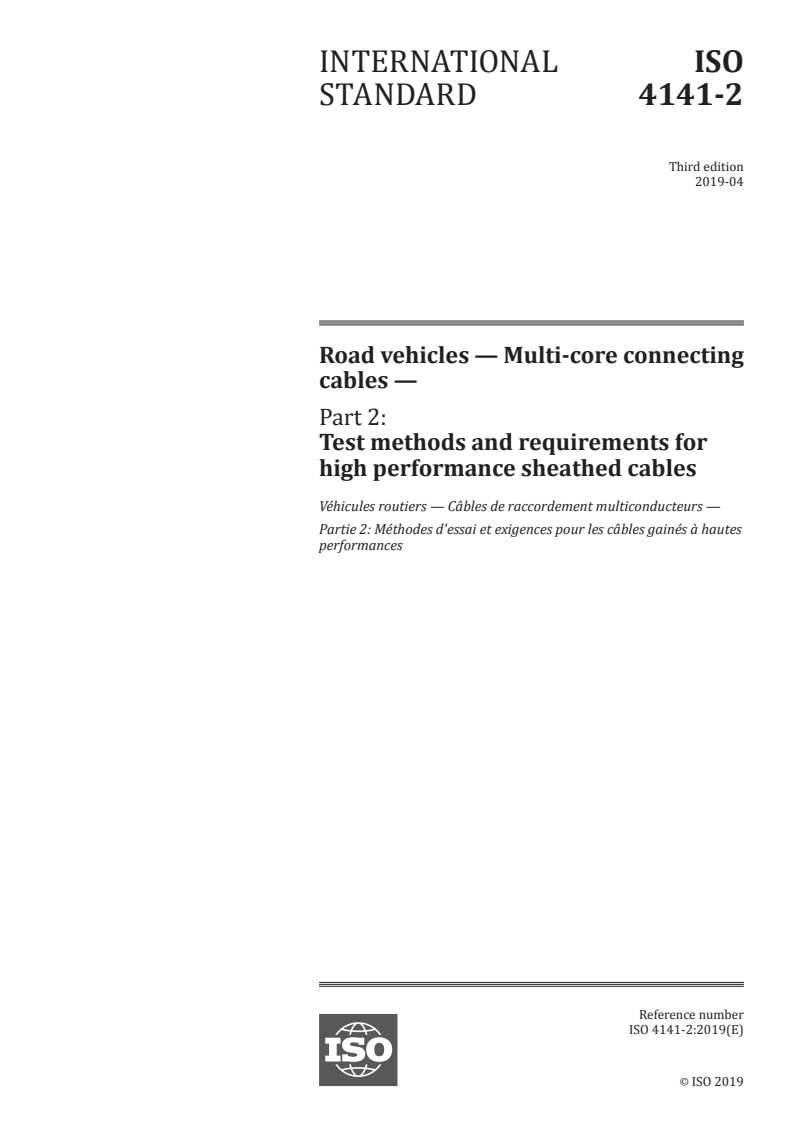
INTERNATIONAL ISO
STANDARD 4141-2
Third edition
2019-04
Road vehicles — Multi-core connecting
cables —
Part 2:
Test methods and requirements for
high performance sheathed cables
Véhicules routiers — Câbles de raccordement multiconducteurs —
Partie 2: Méthodes d'essai et exigences pour les câbles gainés à hautes
performances
Reference number
©
ISO 2019
© ISO 2019
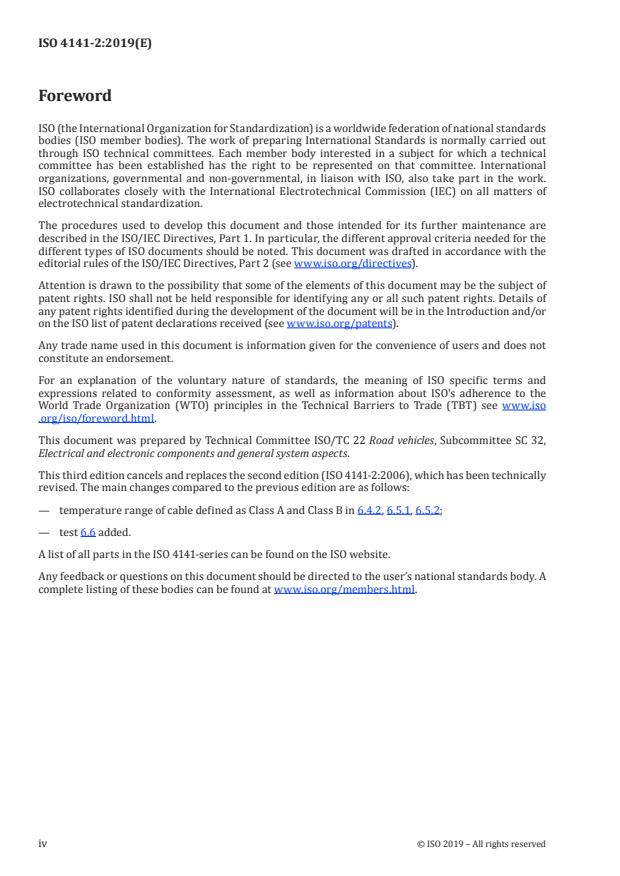
All rights reserved. Unless otherwise specified, or required in the context of its implementation, no part of this publication may
be reproduced or utilized otherwise in any form or by any means, electronic or mechanical, including photocopying, or posting
on the internet or an intranet, without prior written permission. Permission can be requested from either ISO at the address
below or ISO’s member body in the country of the requester.
ISO copyright office
CP 401 • Ch. de Blandonnet 8
CH-1214 Vernier, Geneva
Phone: +41 22 749 01 11
Fax: +41 22 749 09 47
Email: copyright@iso.org
Website: www.iso.org
Published in Switzerland
ii © ISO 2019 – All rights reserved
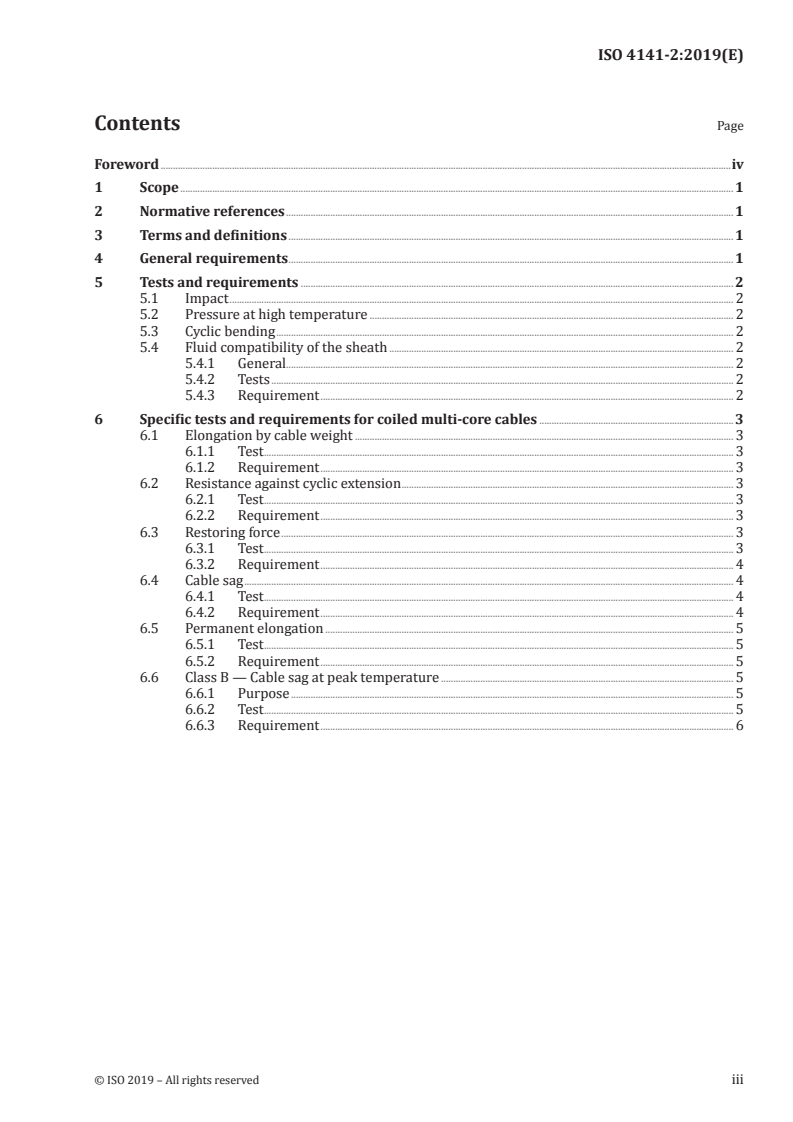
Contents Page
Foreword .iv
1 Scope . 1
2 Normative references . 1
3 Terms and definitions . 1
4 General requirements . 1
5 Tests and requirements . 2
5.1 Impact . 2
5.2 Pressure at high temperature . 2
5.3 Cyclic bending . 2
5.4 Fluid compatibility of the sheath . 2
5.4.1 General. 2
5.4.2 Tests . 2
5.4.3 Requirement . 2
6 Specific tests and requirements for coiled multi-core cables . 3
6.1 Elongation by cable weight . 3
6.1.1 Test . 3
6.1.2 Requirement . 3
6.2 Resistance against cyclic extension . 3
6.2.1 Test . 3
6.2.2 Requirement . 3
6.3 Restoring force . 3
6.3.1 Test . 3
6.3.2 Requirement . 4
6.4 Cable sag . 4
6.4.1 Test . 4
6.4.2 Requirement . 4
6.5 Permanent elongation . 5
6.5.1 Test . 5
6.5.2 Requirement . 5
6.6 Class B — Cable sag at peak temperature . 5
6.6.1 Purpose . 5
6.6.2 Test . 5
6.6.3 Requirement . 6
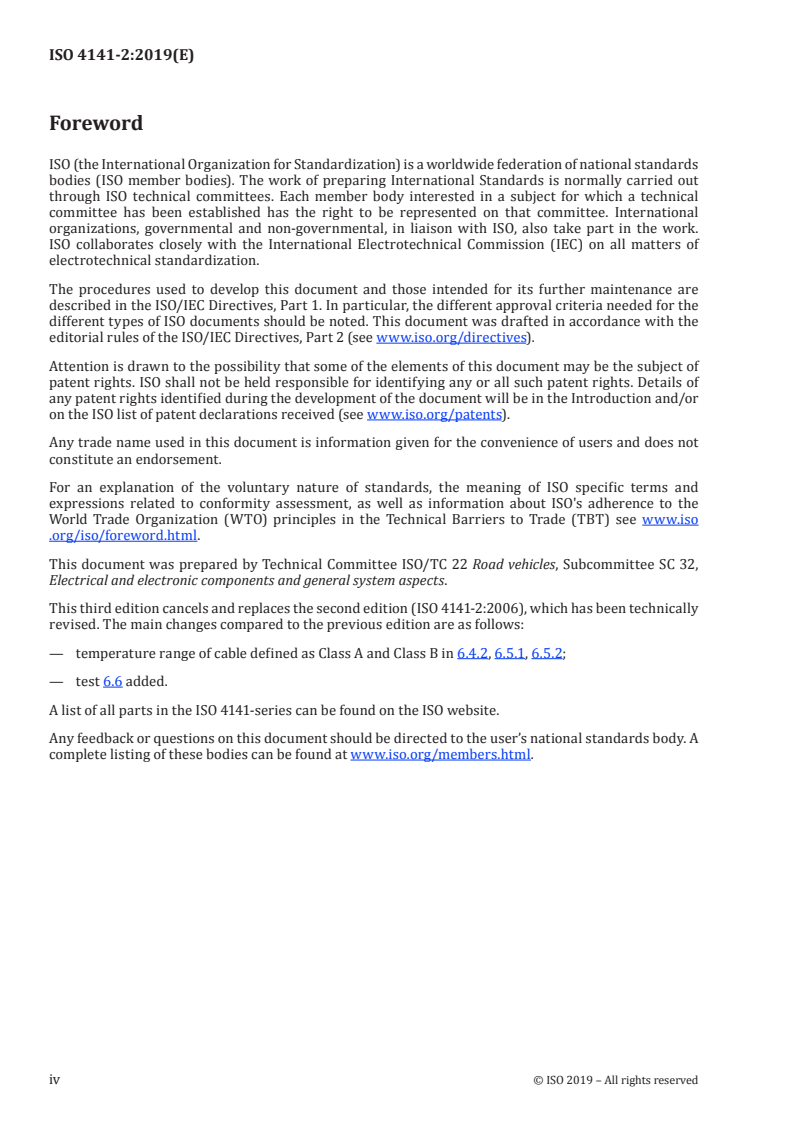
Foreword
ISO (the International Organization for Standardization) is a worldwide federation of national standards
bodies (ISO member bodies). The work of preparing International Standards is normally carried out
through ISO technical committees. Each member body interested in a subject for which a technical
committee has been established has the right to be represented on that committee. International
organizations, governmental and non-governmental, in liaison with ISO, also take part in the work.
ISO collaborates closely with the International Electrotechnical Commission (IEC) on all matters of
electrotechnical standardization.
The procedures used to develop this document and those intended for its further maintenance are
described in the ISO/IEC Directives, Part 1. In particular, the different approval criteria needed for the
different types of ISO documents should be noted. This document was drafted in accordance with the
editorial rules of the ISO/IEC Directives, Part 2 (see www .iso .org/directives).
Attention is drawn to the possibility that some of the elements of this document may be the subject of
patent rights. ISO shall not be held responsible for identifying any or all such patent rights. Details of
any patent rights identified during the development of the document will be in the Introduction and/or
on the ISO list of patent declarations received (see www .iso .org/patents).
Any trade name used in this document is information given for the convenience of users and does not
constitute an endorsement.
For an explanation of the voluntary nature of standards, the meaning of ISO specific terms and
expressions related to conformity assessment, as well as information about ISO's adherence to the
World Trade Organization (WTO) principles in the Technical Barriers to Trade (TBT) see www .iso
.org/iso/foreword .html.
This document was prepared by Technical Committee ISO/TC 22 Road vehicles, Subcommittee SC 32,
Electrical and electronic components and general system aspects.
This thi
...
INTERNATIONAL ISO
STANDARD 4141-2
Third edition
2019-04
Road vehicles — Multi-core connecting
cables —
Part 2:
Test methods and requirements for
high performance sheathed cables
Véhicules routiers — Câbles de raccordement multiconducteurs —
Partie 2: Méthodes d'essai et exigences pour les câbles gainés à hautes
performances
Reference number
©
ISO 2019
© ISO 2019
All rights reserved. Unless otherwise specified, or required in the context of its implementation, no part of this publication may
be reproduced or utilized otherwise in any form or by any means, electronic or mechanical, including photocopying, or posting
on the internet or an intranet, without prior written permission. Permission can be requested from either ISO at the address
below or ISO’s member body in the country of the requester.
ISO copyright office
CP 401 • Ch. de Blandonnet 8
CH-1214 Vernier, Geneva
Phone: +41 22 749 01 11
Fax: +41 22 749 09 47
Email: copyright@iso.org
Website: www.iso.org
Published in Switzerland
ii © ISO 2019 – All rights reserved
Contents Page
Foreword .iv
1 Scope . 1
2 Normative references . 1
3 Terms and definitions . 1
4 General requirements . 1
5 Tests and requirements . 2
5.1 Impact . 2
5.2 Pressure at high temperature . 2
5.3 Cyclic bending . 2
5.4 Fluid compatibility of the sheath . 2
5.4.1 General. 2
5.4.2 Tests . 2
5.4.3 Requirement . 2
6 Specific tests and requirements for coiled multi-core cables . 3
6.1 Elongation by cable weight . 3
6.1.1 Test . 3
6.1.2 Requirement . 3
6.2 Resistance against cyclic extension . 3
6.2.1 Test . 3
6.2.2 Requirement . 3
6.3 Restoring force . 3
6.3.1 Test . 3
6.3.2 Requirement . 4
6.4 Cable sag . 4
6.4.1 Test . 4
6.4.2 Requirement . 4
6.5 Permanent elongation . 5
6.5.1 Test . 5
6.5.2 Requirement . 5
6.6 Class B — Cable sag at peak temperature . 5
6.6.1 Purpose . 5
6.6.2 Test . 5
6.6.3 Requirement . 6
Foreword
ISO (the International Organization for Standardization) is a worldwide federation of national standards
bodies (ISO member bodies). The work of preparing International Standards is normally carried out
through ISO technical committees. Each member body interested in a subject for which a technical
committee has been established has the right to be represented on that committee. International
organizations, governmental and non-governmental, in liaison with ISO, also take part in the work.
ISO collaborates closely with the International Electrotechnical Commission (IEC) on all matters of
electrotechnical standardization.
The procedures used to develop this document and those intended for its further maintenance are
described in the ISO/IEC Directives, Part 1. In particular, the different approval criteria needed for the
different types of ISO documents should be noted. This document was drafted in accordance with the
editorial rules of the ISO/IEC Directives, Part 2 (see www .iso .org/directives).
Attention is drawn to the possibility that some of the elements of this document may be the subject of
patent rights. ISO shall not be held responsible for identifying any or all such patent rights. Details of
any patent rights identified during the development of the document will be in the Introduction and/or
on the ISO list of patent declarations received (see www .iso .org/patents).
Any trade name used in this document is information given for the convenience of users and does not
constitute an endorsement.
For an explanation of the voluntary nature of standards, the meaning of ISO specific terms and
expressions related to conformity assessment, as well as information about ISO's adherence to the
World Trade Organization (WTO) principles in the Technical Barriers to Trade (TBT) see www .iso
.org/iso/foreword .html.
This document was prepared by Technical Committee ISO/TC 22 Road vehicles, Subcommittee SC 32,
Electrical and electronic components and general system aspects.
This thi
...