


ISO/FDIS 14001
(Main)Environmental management systems — Requirements with guidance for use
Environmental management systems — Requirements with guidance for use
ISO 14001 specifies the requirements for an environmental management system that an organization can use to enhance its environmental performance. ISO 14001 is intended for use by an organization seeking to manage its environmental responsibilities in a systematic manner that contributes to the environmental pillar of sustainability. ISO 14001 helps an organization achieve the intended outcomes of its environmental management system, which provide value for the environment, the organization itself and interested parties. Consistent with the organization's environmental policy, the intended outcomes of an environmental management system include: · enhancement of environmental performance; · fulfilment of compliance obligations; · achievement of environmental objectives. ISO 14001 is applicable to any organization, regardless of size, type and nature, and applies to the environmental aspects of its activities, products and services that the organization determines it can either control or influence considering a life cycle perspective. ISO 14001 does not state specific environmental performance criteria. ISO 14001 can be used in whole or in part to systematically improve environmental management. Claims of conformity to ISO 14001, however, are not acceptable unless all its requirements are incorporated into an organization's environmental management system and fulfilled without exclusion. Note: This is a consolidated version, which means the amendment will be published as a new version. This approach was chosen to enhance readability and improve the overall user experience.
Systèmes de management environnemental — Exigences et lignes directrices pour son utilisation
ISO 14001 spécifie les exigences relatives à un système de management environnemental pouvant être utilisé par un organisme pour améliorer sa performance environnementale. La présente Norme internationale est destinée à être utilisée par les organismes souhaitant gérer leurs responsabilités environnementales d'une manière systématique qui contribue au pilier environnemental du développement durable. ISO 14001 permet d'aider un organisme à obtenir les résultats escomptés de son système de management environnemental, lesquels constituent une valeur ajoutée pour l'environnement, pour l'organisme lui-même et pour les parties intéressées. En cohérence avec la politique environnementale de l'organisme, les résultats escomptés d'un système de management environnemental incluent: - l'amélioration de la performance environnementale; - le respect des obligations de conformité; - la réalisation des objectifs environnementaux. ISO 14001 est applicable aux organismes de toutes tailles, de tous types et de toutes natures, et s'applique aux aspects environnementaux de ses activités, produits et services que l'organisme détermine et qu'il a les moyens soit de maîtriser, soit d'influencer en prenant en considération une perspective de cycle de vie. La présente Norme internationale n'établit pas de critères spécifiques de performance environnementale. ISO 14001 peut être utilisée en totalité ou en partie pour améliorer de façon systématique le management environnemental. Les déclarations de conformité à la présente Norme internationale ne sont cependant pas acceptables à moins que toutes ses exigences soient intégrées dans le système de management environnemental d'un organisme et soient satisfaites, sans exclusion.
General Information
- Status
- Not Published
- Technical Committee
- ISO/TC 207/SC 1 - Environmental management systems
- Current Stage
- 5020 - FDIS ballot initiated: 2 months. Proof sent to secretariat
- Start Date
- 05-Jan-2026
- Completion Date
- 05-Jan-2026
Relations
- Consolidates
prEN ISO 14001 - Environmental management systems - Requirements with guidance for use (ISO/FDIS 14001:2026) - Effective Date
- 12-Feb-2026
- Effective Date
- 21-Jun-2025
- Effective Date
- 21-Jun-2025
Overview
ISO/FDIS 14001 specifies requirements and guidance for an environmental management system (EMS) that organizations can use to enhance environmental performance. Applicable to any organization regardless of size, type or nature, ISO/FDIS 14001 focuses on systematic management of environmental responsibilities in support of the environmental pillar of sustainability. The standard helps organizations achieve intended outcomes such as enhanced environmental performance, fulfilment of compliance obligations, and the achievement of environmental objectives. This consolidated edition (fourth edition) replaces ISO 14001:2015 and incorporates Amendment ISO 14001:2015/Amd 1:2024 to improve readability and user experience.
Key Topics
- Context of the organization: understanding internal and external factors and the needs and expectations of interested parties that influence the EMS.
- Leadership and commitment: top management responsibilities, environmental policy, roles and authorities.
- Planning: addressing risks and opportunities, defining environmental objectives, and planning changes.
- Support and operation: resource allocation, competence, awareness, communication, and documented information.
- Operational control and emergency preparedness: planning and controlling operations that can impact the environment and responding to incidents.
- Performance evaluation and improvement: monitoring, measurement, internal audit, management review, corrective action, and continual improvement.
Important cross-cutting themes include a life cycle perspective, risk-based thinking, and alignment with the Plan-Do-Check-Act (PDCA) model to drive continual improvement.
Applications
ISO/FDIS 14001 is intended for organizations seeking to:
- Systematically manage environmental aspects of their activities, products and services that they can control or influence.
- Improve environmental performance without prescribing specific performance criteria.
- Demonstrate to stakeholders that an effective EMS is in place, including customers, regulators and the public.
- Integrate environmental governance with business processes and other management systems (e.g., quality, health and safety).
Practical benefits include clearer compliance management, reduced environmental risk, improved resource efficiency, and potential operational and market advantages from stronger environmental stewardship.
Related Standards
- ISO 14002 series - guidance on applying the ISO 14001 framework to specific environmental topics.
- ISO 14004 - implementation guidance for environmental management systems.
- ISO/IEC Directives, Part 1 and Part 2 - editorial and development rules for ISO management system standards.
For implementers, Annex A of ISO/FDIS 14001 provides informative guidance to aid correct interpretation. Organizations should consult their national standards body or ISO for access, licensing, and any patent considerations related to implementation.

ISO/FDIS 14001 - Environmental management systems — Requirements with guidance for use Released:11. 12. 2025
REDLINE ISO/FDIS 14001 - Environmental management systems — Requirements with guidance for use Released:11. 12. 2025

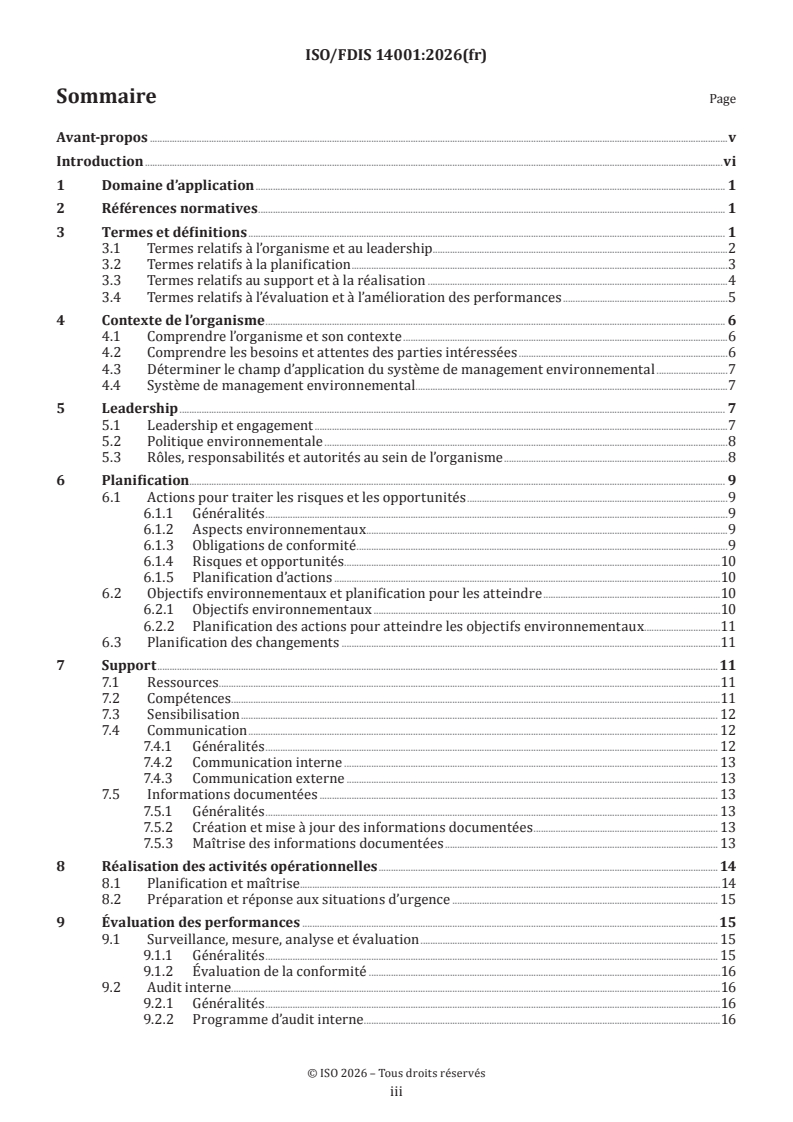

ISO/FDIS 14001 - Systèmes de management environnemental — Exigences et lignes directrices pour son utilisation Released:23. 01. 2026
Get Certified
Connect with accredited certification bodies for this standard

BSI Group
BSI (British Standards Institution) is the business standards company that helps organizations make excellence a habit.

Bureau Veritas
Bureau Veritas is a world leader in laboratory testing, inspection and certification services.

DNV
DNV is an independent assurance and risk management provider.
Sponsored listings
Frequently Asked Questions
ISO/FDIS 14001 is a draft published by the International Organization for Standardization (ISO). Its full title is "Environmental management systems — Requirements with guidance for use". This standard covers: ISO 14001 specifies the requirements for an environmental management system that an organization can use to enhance its environmental performance. ISO 14001 is intended for use by an organization seeking to manage its environmental responsibilities in a systematic manner that contributes to the environmental pillar of sustainability. ISO 14001 helps an organization achieve the intended outcomes of its environmental management system, which provide value for the environment, the organization itself and interested parties. Consistent with the organization's environmental policy, the intended outcomes of an environmental management system include: · enhancement of environmental performance; · fulfilment of compliance obligations; · achievement of environmental objectives. ISO 14001 is applicable to any organization, regardless of size, type and nature, and applies to the environmental aspects of its activities, products and services that the organization determines it can either control or influence considering a life cycle perspective. ISO 14001 does not state specific environmental performance criteria. ISO 14001 can be used in whole or in part to systematically improve environmental management. Claims of conformity to ISO 14001, however, are not acceptable unless all its requirements are incorporated into an organization's environmental management system and fulfilled without exclusion. Note: This is a consolidated version, which means the amendment will be published as a new version. This approach was chosen to enhance readability and improve the overall user experience.
ISO 14001 specifies the requirements for an environmental management system that an organization can use to enhance its environmental performance. ISO 14001 is intended for use by an organization seeking to manage its environmental responsibilities in a systematic manner that contributes to the environmental pillar of sustainability. ISO 14001 helps an organization achieve the intended outcomes of its environmental management system, which provide value for the environment, the organization itself and interested parties. Consistent with the organization's environmental policy, the intended outcomes of an environmental management system include: · enhancement of environmental performance; · fulfilment of compliance obligations; · achievement of environmental objectives. ISO 14001 is applicable to any organization, regardless of size, type and nature, and applies to the environmental aspects of its activities, products and services that the organization determines it can either control or influence considering a life cycle perspective. ISO 14001 does not state specific environmental performance criteria. ISO 14001 can be used in whole or in part to systematically improve environmental management. Claims of conformity to ISO 14001, however, are not acceptable unless all its requirements are incorporated into an organization's environmental management system and fulfilled without exclusion. Note: This is a consolidated version, which means the amendment will be published as a new version. This approach was chosen to enhance readability and improve the overall user experience.
ISO/FDIS 14001 is classified under the following ICS (International Classification for Standards) categories: 03.100.70 - Management systems; 13.020.10 - Environmental management. The ICS classification helps identify the subject area and facilitates finding related standards.
ISO/FDIS 14001 has the following relationships with other standards: It is inter standard links to prEN ISO 14001, ISO 14001:2015, ISO 14001:2015/Amd 1:2024. Understanding these relationships helps ensure you are using the most current and applicable version of the standard.
ISO/FDIS 14001 is available in PDF format for immediate download after purchase. The document can be added to your cart and obtained through the secure checkout process. Digital delivery ensures instant access to the complete standard document.
Standards Content (Sample)
FINAL DRAFT
International
Standard
ISO/TC 207/SC 1
Environmental management
Secretariat: BSI
systems — Requirements with
Voting begins on:
guidance for use
2026-01-05
Systèmes de management environnemental — Exigences et lignes
Voting terminates on:
directrices pour son utilisation
2026-03-02
RECIPIENTS OF THIS DRAFT ARE INVITED TO SUBMIT,
WITH THEIR COMMENTS, NOTIFICATION OF ANY
RELEVANT PATENT RIGHTS OF WHICH THEY ARE AWARE
AND TO PROVIDE SUPPOR TING DOCUMENTATION.
IN ADDITION TO THEIR EVALUATION AS
BEING ACCEPTABLE FOR INDUSTRIAL, TECHNO
ISO/CEN PARALLEL PROCESSING LOGICAL, COMMERCIAL AND USER PURPOSES, DRAFT
INTERNATIONAL STANDARDS MAY ON OCCASION HAVE
TO BE CONSIDERED IN THE LIGHT OF THEIR POTENTIAL
TO BECOME STAN DARDS TO WHICH REFERENCE MAY BE
MADE IN NATIONAL REGULATIONS.
Reference number
FINAL DRAFT
International
Standard
ISO/TC 207/SC 1
Environmental management
Secretariat: BSI
systems — Requirements with
Voting begins on:
guidance for use
2026-01-05
Systèmes de management environnemental — Exigences et lignes
Voting terminates on:
directrices pour son utilisation
2026-03-02
RECIPIENTS OF THIS DRAFT ARE INVITED TO SUBMIT,
WITH THEIR COMMENTS, NOTIFICATION OF ANY
RELEVANT PATENT RIGHTS OF WHICH THEY ARE AWARE
AND TO PROVIDE SUPPOR TING DOCUMENTATION.
© ISO 2026
IN ADDITION TO THEIR EVALUATION AS
All rights reserved. Unless otherwise specified, or required in the context of its implementation, no part of this publication may
BEING ACCEPTABLE FOR INDUSTRIAL, TECHNO
ISO/CEN PARALLEL PROCESSING
LOGICAL, COMMERCIAL AND USER PURPOSES, DRAFT
be reproduced or utilized otherwise in any form or by any means, electronic or mechanical, including photocopying, or posting on
INTERNATIONAL STANDARDS MAY ON OCCASION HAVE
the internet or an intranet, without prior written permission. Permission can be requested from either ISO at the address below
TO BE CONSIDERED IN THE LIGHT OF THEIR POTENTIAL
or ISO’s member body in the country of the requester.
TO BECOME STAN DARDS TO WHICH REFERENCE MAY BE
MADE IN NATIONAL REGULATIONS.
ISO copyright office
CP 401 • Ch. de Blandonnet 8
CH-1214 Vernier, Geneva
Phone: +41 22 749 01 11
Email: copyright@iso.org
Website: www.iso.org
Published in Switzerland Reference number
ii
Contents Page
Foreword .v
Introduction .vi
1 Scope . 1
2 Normative references . 1
3 Terms and definitions . 1
3.1 Terms related to organization and leadership .1
3.2 Terms related to planning .3
3.3 Terms related to support and operation .4
3.4 Terms related to performance evaluation and improvement.5
4 Context of the organization . 6
4.1 Understanding the organization and its context .6
4.2 Understanding the needs and expectations of interested parties .6
4.3 Determining the scope of the environmental management system .6
4.4 Environmental management system .7
5 Leadership . 7
5.1 Leadership and commitment .7
5.2 Environmental policy .7
5.3 Roles, responsibilities and authorities .8
6 Planning . 8
6.1 Actions to address risks and opportunities .8
6.1.1 General .8
6.1.2 Environmental aspects .8
6.1.3 Compliance obligations .9
6.1.4 Risks and opportunities .9
6.1.5 Planning action .9
6.2 Environmental objectives and planning to achieve them .10
6.2.1 Environmental objectives .10
6.2.2 Planning actions to achieve environmental objectives.10
6.3 Planning of changes .10
7 Support .11
7.1 Resources .11
7.2 Competence .11
7.3 Awareness .11
7.4 Communication .11
7.4.1 General .11
7.4.2 Internal communication . 12
7.4.3 External communication . 12
7.5 Documented information . 12
7.5.1 General . 12
7.5.2 Creating and updating documented information . 12
7.5.3 Control of documented information . 13
8 Operation .13
8.1 Operational planning and control . 13
8.2 Emergency preparedness and response .14
9 Performance evaluation . 14
9.1 Monitoring, measurement, analysis, and evaluation .14
9.1.1 General .14
9.1.2 Evaluation of compliance . 15
9.2 Internal audit . 15
9.2.1 General . 15
9.2.2 Internal audit programme . 15
iii
9.3 Management review . 15
9.3.1 General . 15
9.3.2 Management review inputs .16
9.3.3 Management review results .16
10 Improvement .16
10.1 Continual improvement .16
10.2 Nonconformity and corrective action .17
Annex A (informative) Guidance on the use of this document .18
Bibliography .36
Index .37
iv
Foreword
ISO (the International Organization for Standardization) is a worldwide federation of national standards
bodies (ISO member bodies). The work of preparing International Standards is normally carried out through
ISO technical committees. Each member body interested in a subject for which a technical committee
has been established has the right to be represented on that committee. International organizations,
governmental and non-governmental, in liaison with ISO, also take part in the work. ISO collaborates closely
with the International Electrotechnical Commission (IEC) on all matters of electrotechnical standardization.
The procedures used to develop this document and those intended for its further maintenance are described
in the ISO/IEC Directives, Part 1. In particular, the different approval criteria needed for the different types
of ISO document should be noted. This document was drafted in accordance with the editorial rules of the
ISO/IEC Directives, Part 2 (see www.iso.org/directives).
ISO draws attention to the possibility that the implementation of this document may involve the use of (a)
patent(s). ISO takes no position concerning the evidence, validity or applicability of any claimed patent
rights in respect thereof. As of the date of publication of this document, ISO had not received notice of (a)
patent(s) which may be required to implement this document. However, implementers are cautioned that
this may not represent the latest information, which may be obtained from the patent database available at
www.iso.org/patents. ISO shall not be held responsible for identifying any or all such patent rights.
Any trade name used in this document is information given for the convenience of users and does not
constitute an endorsement.
For an explanation of the voluntary nature of standards, the meaning of ISO specific terms and expressions
related to conformity assessment, as well as information about ISO’s adherence to the World Trade
Organization (WTO) principles in the Technical Barriers to Trade (TBT), see www.iso.org/iso/foreword.html.
This document was prepared by Technical Committee ISO/TC 207, Environmental management,
Subcommittee SC 1, Environmental management systems, in collaboration with the European Committee for
Standardization (CEN) Technical Committee, in accordance with the Agreement on technical cooperation
between ISO and CEN (Vienna Agreement).
This fourth edition cancels and replaces the third edition (ISO 14001:2015), which has been technically
revised. It also incorporates the Amendment ISO 14001:2015/Amd 1:2024.
The main changes are as follows:
a) incorporation of latest ISO requirements for management system standards as appropriate;
b) clarification of requirements associated with key topics.
Any feedback or questions on this document should be directed to the user’s national standards body. A
complete listing of these bodies can be found at www.iso.org/members.html.
v
Introduction
0.1 Background
Achieving a balance between the environment, society and the economy is considered essential to meet the
needs of the present without compromising the ability of future generations to meet their needs. Sustainable
development as a goal is achieved by balancing the three pillars of sustainability.
Societal expectations for sustainable development, transparency and accountability have evolved with
increasingly stringent legislation, growing pressures on the environment from pollution, inefficient use of
resources, improper waste management, climate change, degradation of ecosystems and loss of biodiversity.
Undermining the environment can carry financial, social and business consequences, not just environmental
implications.
These expectations have led organizations to adopt a systematic approach to environmental management by
implementing environmental management systems with the aim of contributing to the environmental pillar
of sustainability. As a result, organizations are better positioned to respond to the needs and expectations of
interested parties and to meet the organization’s compliance obligations.
0.2 Aim of an environmental management system
This document provides organizations with a framework to protect the environment and respond to
changing environmental conditions in balance with socio-economic needs. It specifies requirements that
enable an organization to achieve the intended outcomes it sets for its environmental management system.
A systematic approach to environmental management provides top management with information to build
success over the long term and create options for contributing to sustainable development by:
— protecting the environment by preventing or mitigating adverse environmental impacts;
— mitigating the potential adverse effect of environmental conditions on the organization;
— assisting the organization to meet its compliance obligations;
— enhancing environmental performance;
— controlling or influencing the way the organization’s products and services are designed, manufactured,
distributed, consumed and disposed by using a life cycle perspective that prevents adverse environmental
impacts from being unintentionally shifted elsewhere within the life cycle;
— achieving financial and operational benefits that result from implementing environmentally sound
alternatives that strengthen the organization’s market position;
— communicating environmental information to relevant interested parties.
0.3 Success factors
The success of an environmental management system depends on commitment from all levels and functions
of the organization, led by top management. Organizations can leverage opportunities to prevent or mitigate
adverse environmental impacts and enhance beneficial environmental impacts, particularly those with
strategic and competitive implications. Top management can effectively address its risks and opportunities
by integrating environmental management into the organization’s business processes, strategic direction
and decision-making, aligning them with other business priorities, and incorporating environmental
governance into its overall management system. Demonstration of successful implementation of this
document can be used to assure interested parties that an effective environmental management system is
in place. Adoption of this document, however, will not in itself guarantee optimal environmental outcomes.
Application of this document can differ from one organization to another due to the context of the
organization. Two organizations can carry out similar activities but can have different compliance
obligations, commitments in their environmental policy, environmental technologies and environmental
performance goals, yet both can conform to the requirements of this document.
vi
The level of detail and complexity of the environmental management system will vary depending on the
context of the organization, the scope of its environmental management system, its compliance obligations,
and the nature of its activities, products and services, including its environmental aspects and associated
environmental impacts.
0.4 Plan-Do-Check-Act model
The basis for the approach underlying an environmental management system is founded on the concept
of Plan-Do-Check-Act (PDCA). The PDCA model provides an iterative process used by organizations to
achieve continual improvement. It can be applied to an environmental management system and to each of its
individual elements. It is briefly described as follows:
— Plan: establish environmental objectives and processes necessary to deliver results in accordance with
the organization’s environmental policy.
— Do: implement the processes as planned.
— Check: monitor and measure processes against the environmental policy, including its commitments,
environmental objectives and operating criteria, and report the results.
— Act: take actions to continually improve.
Figure 1 shows how the framework used in this document can be integrated into a PDCA model, which can
help new and existing users to understand the importance of a systems approach.
Figure 1 — Relationship between PDCA and the framework in this document
0.5 Contents of this document
This document conforms to ISO requirements for management system standards. These requirements
include a harmonized structure, identical core text, and common terms with core definitions, designed to
benefit users implementing multiple ISO management system standards.
vii
This document does not include requirements specific to other management systems, such as those for
quality, occupational health and safety, energy or financial management. However, this document enables an
organization to use a common approach and risk-based thinking to integrate its environmental management
system with the requirements of other management systems.
This document contains the requirements used to assess conformity. An organization that wishes to
demonstrate conformity with this document can do so by:
— making a self-determination and self-declaration; or
— seeking confirmation of its conformance by parties having an interest in the organization, such as
customers; or
— seeking confirmation of its self-declaration by a party external to the organization; or
— seeking certification/registration of its environmental management system by an external organization.
Annex A provides explanatory information to prevent misinterpretation of the requirements of this
document. Guidance on applying the ISO 14001 framework to specific environmental topic areas is addressed
in the ISO 14002 series. Implementation guidance on environmental management systems is included in
ISO 14004.
Clause A.3 provides further insight on specific words and phrases used in this document to enhance the
understanding of concepts that are relevant to an environmental management system.
viii
FINAL DRAFT International Standard ISO/FDIS 14001:2026(en)
Environmental management systems — Requirements with
guidance for use
1 Scope
This document specifies the requirements for an environmental management system that an organization
can use to enhance its environmental performance. It is intended for use by an organization seeking to
manage its environmental responsibilities in a systematic manner that contributes to the environmental
pillar of sustainability.
This document helps an organization to achieve the intended outcomes of its environmental management
system, which provide value for the environment, the organization itself and interested parties. The
intended outcomes of an environmental management system include:
— enhancing environmental performance;
— meeting compliance obligations;
— achieving environmental objectives.
This document is applicable to any organization, regardless of size, type and nature, and applies to the
environmental aspects of its activities, products and services that the organization determines it can either
control or influence considering a life cycle perspective. This document does not state specific environmental
performance criteria.
This document can be used in whole or in part to systematically improve environmental management. Claims
of conformity to this document, however, are not acceptable unless all its requirements are incorporated
into an organization’s environmental management system and fulfilled without exclusion.
2 Normative references
There are no normative references in this document.
3 Terms and definitions
For the purposes of this document, the following terms and definitions apply.
ISO and IEC maintain terminology databases for use in standardization at the following addresses:
— ISO Online browsing platform: available at https:// www .iso .org/ obp
— IEC Electropedia: available at https:// www .electropedia .org/
3.1 Terms related to organization and leadership
3.1.1
management system
set of interrelated or interacting elements of an organization (3.1.5) to establish policies (3.1.3) and objectives
(3.2.5) as well as processes (3.3.4) to achieve those objectives
Note 1 to entry: A management system can address a single discipline or several disciplines.
EXAMPLE Quality, environment, occupational health and safety, energy or financial management.
Note 2 to entry: The management system elements include the organization’s structure, roles and responsibilities,
planning and operation.
Note 3 to entry: The scope of a management system can include the whole of the organization, specific and identified
functions of the organization, specific and identified sections of the organization, or one or more functions across a
group of organizations.
3.1.2
environmental management system
part of the management system (3.1.1) used to manage environmental aspects (3.2.2), meet compliance
obligations (3.2.9), and address risks and opportunities (3.2.10)
Note 1 to entry: The environmental management system elements include: context of the organization (Clause 4),
leadership (Clause 5), planning (Clause 6), support (Clause 7), operation (Clause 8), performance evaluation (Clause 9)
and improvement (Clause 10).
3.1.3
policy
intentions and direction of an organization (3.1.5) as formally expressed by its top management (3.1.6)
3.1.4
environmental policy
policy (3.1.3) related to environmental performance (3.4.11)
3.1.5
organization
person or group of people that has its own functions with responsibilities, authorities and relationships to
achieve its objectives (3.2.5)
Note 1 to entry: The concept of organization includes, but is not limited to, sole-trader, company, corporation, firm,
enterprise, authority, partnership, charity or institution, or part or combination thereof, whether incorporated or not,
public or private.
Note 2 to entry: If the organization is part of a larger entity, the term “organization” refers only to the part of the larger
entity that is within the scope of the environmental management system (3.1.2).
3.1.6
top management
person or group of people who directs and controls an organization (3.1.5) at the highest level
Note 1 to entry: Top management has the power to delegate authority and provide resources within the organization.
Note 2 to entry: If the scope of the management system (3.1.1) covers only part of an organization, then top management
refers to those who direct and control that part of the organization.
3.1.7
interested party (preferred term)
stakeholder (admitted term)
person or organization (3.1.5) that can affect, be affected by, or perceive itself to be affected by a decision or
activity
EXAMPLE Customers, communities, suppliers, regulators, non-governmental organizations, investors and
employees.
Note 1 to entry: To “perceive itself to be affected” means the perception has been made known to the organization.
3.2 Terms related to planning
3.2.1
environment
surroundings in which an organization (3.1.5) operates, including air, water, land, natural resources, flora,
fauna, humans and their interrelationships
Note 1 to entry: Surroundings can extend from within an organization to the local, regional and global system.
Note 2 to entry: Surroundings can be described in terms of biodiversity, ecosystems, climate or other characteristics.
3.2.2
environmental aspect
element of an organization’s (3.1.5) activities or products or services that interacts or can interact with the
environment (3.2.1)
Note 1 to entry: An environmental aspect can cause (an) environmental impact(s) (3.2.4). A significant environmental
aspect is one that has or can have one or more significant environmental impact(s).
Note 2 to entry: Significant environmental aspects are determined by the organization applying established criteria.
3.2.3
environmental condition
state or characteristic of the environment (3.2.1) as determined at a certain point in time
3.2.4
environmental impact
change to the environment (3.2.1), whether adverse or beneficial, wholly or partially resulting from an
organization’s (3.1.5) environmental aspects (3.2.2)
3.2.5
objective
result to be achieved
Note 1 to entry: An objective can be strategic, tactical, or operational.
Note 2 to entry: Objectives can relate to different disciplines (such as finance, health and safety, and environment
(3.2.1)). They can be, for example, organization-wide or specific to a project, product, service or process (3.3.4).
Note 3 to entry: An objective can be expressed in other ways, e.g. as an intended result, as a purpose, as an operational
criterion, as an environmental objective (3.2.6), or by the use of other words with similar meaning (e.g. aim, goal, or
target).
Note 4 to entry: In the context of environmental management systems (3.1.2), environmental objectives are set by the
organization (3.1.5), consistent with the environmental policy (3.1.4), to achieve specific results.
3.2.6
environmental objective
objective (3.2.5) set by the organization (3.1.5) consistent with its environmental policy (3.1.4)
3.2.7
prevention of pollution
use of processes (3.3.4), practices, techniques, materials, products, services or energy to avoid, reduce or
control (separately or in combination) the creation, emission or discharge of any type of pollutant or waste,
in order to reduce adverse environmental impacts (3.2.4)
Note 1 to entry: Prevention of pollution can include source reduction or elimination; process, product or service
changes; efficient use of resources; material and energy substitution; reuse; recovery; recycling; reclamation; or
treatment.
3.2.8
requirement
need or expectation that is stated, generally implied or obligatory
Note 1 to entry: “Generally implied” means that it is custom or common practice for the organization (3.1.5) and
interested parties (3.1.7) that the need or expectation under consideration is implied.
Note 2 to entry: A specified requirement is one that is stated, e.g. in documented information (3.3.2).
3.2.9
compliance obligations (preferred term)
legal requirements and other requirements (admitted term)
legal requirements (3.2.8) that an organization (3.1.5) has to comply with and other requirements that an
organization has to or chooses to comply with
Note 1 to entry: Compliance obligations are related to the environmental management system (3.1.2).
Note 2 to entry: Compliance obligations can arise from mandatory requirements, such as applicable laws and
regulations, or voluntary commitments, such as organizational and industry standards, contractual relationships,
codes of practice and agreements with community groups, non-governmental organizations, or other interested
parties (3.1.7).
3.2.10
risks and opportunities
potential adverse effects (i.e. risks) and potential beneficial effects (i.e. opportunities)
3.3 Terms related to support and operation
3.3.1
competence
ability to apply knowledge and skills to achieve intended results
3.3.2
documented information
information required to be controlled and maintained by an organization (3.1.5) and the medium on which
it is contained
Note 1 to entry: Documented information can be in any format and media and from any source.
Note 2 to entry: Documented information can refer to:
— the management system (3.1.1), including related processes (3.3.4);
— information created in order for the organization to operate (documentation);
— evidence of results achieved (records).
3.3.3
life cycle
consecutive and interlinked stages of a product (or service) system, from raw material acquisition or
generation from natural resources to final disposal
Note 1 to entry: The life cycle stages include acquisition of raw materials, design, production, transportation/ delivery,
use, end-of-life treatment and final disposal.
[SOURCE: ISO 14044:2006, 3.1, modified ― “(or service)” added to the definition. Note 1 to entry added.]
3.3.4
process
set of interrelated or interacting activities that uses or transforms inputs to deliver a result
Note 1 to entry: Whether the result of a process is called an output, a product or a service depends on the context of
the reference.
Note 2 to entry: A process can be documented or not.
3.4 Terms related to performance evaluation and improvement
3.4.1
audit
systematic and independent process (3.3.4) for obtaining evidence and evaluating it objectively to determine
the extent to which the audit criteria are fulfilled
Note 1 to entry: An audit can be an internal audit (first party) or an external audit (second party or third party), and it
can be a combined audit (combining two or more disciplines).
Note 2 to entry: An internal audit is conducted by the organization (3.1.5) itself, or by an external party on its behalf.
Note 3 to entry: “Audit evidence” and “audit criteria” are defined in ISO 19011.
Note 4 to entry: Independence can be demonstrated by the freedom from responsibility for the activity being audited
or freedom from bias and conflict of interest.
3.4.2
conformity
fulfilment of a requirement (3.2.8)
3.4.3
nonconformity
non-fulfilment of a requirement (3.2.8)
Note 1 to entry: Nonconformity relates to requirements in this document and additional environmental management
system (3.1.2) requirements that an organization (3.1.5) establishes for itself.
3.4.4
corrective action
action to eliminate the cause(s) of a nonconformity (3.4.3) and to prevent recurrence
3.4.5
continual improvement
recurring activity to enhance performance (3.4.10)
Note 1 to entry: Enhancing performance relates to the use of the environmental management system (3.1.2) to enhance
environmental performance (3.4.11) consistent with the organization’s (3.1.5) environmental policy (3.1.4).
Note 2 to entry: The activity does not have to take place in all areas simultaneously, or without interruption.
3.4.6
effectiveness
extent to which planned activities are realized and planned results are achieved
3.4.7
indicator
quantitative, qualitative or binary variable that can be measured or described, representing the status of
operations, management, conditions or impacts
[SOURCE: ISO 14031:2021, 3.4.1]
3.4.8
monitoring
determining the status of a system, a process (3.3.4) or an activity
Note 1 to entry: To determine the status, there can be a need to check, supervise or critically observe.
3.4.9
measurement
process (3.3.4) to determine a value
3.4.10
performance
measurable result
Note 1 to entry: Performance can relate either to quantitative or qualitative findings.
Note 2 to entry: Performance can relate to managing activities, processes (3.3.4), products, services, systems or
organizations (3.1.5).
3.4.11
environmental performance
performance (3.4.10) related to the management of environmental aspects (3.2.2)
Note 1 to entry: For an environmental management system (3.1.2), results can be measured against the organization’s
(3.1.5) environmental policy (3.1.4), environmental objectives (3.2.6) or other criteria, using indicators (3.4.7).
4 Context of the organization
4.1 Understanding the organization and its context
The organization shall determine external and internal issues that are relevant to its purpose and that affect
its ability to achieve the intended outcomes of its environmental management system.
These issues shall include environmental conditions being affected by the organization or capable of affecting
the organization, such as pollution levels, availability of natural resources, climate change, biodiversity or
ecosystem health (see A.4.1).
4.2 Understanding the needs and expectations of interested parties
The organization shall determine:
a) the interested parties that are relevant to the environmental management system;
b) the relevant needs and expectations (i.e. requirements) of these interested parties;
c) which of these needs and expectations become its compliance obligations (see 6.1.3) and will be
addressed through the environmental management system.
NOTE 1 Relevant interested parties can have needs and expectations related to environmental conditions, such as
pollution levels, availability of natural resources, climate change, biodiversity or ecosystem health.
NOTE 2 The relevant needs and expectations of interested parties, other than legal requirements, become a
compliance obligation when the organization decides to comply with them.
4.3 Determining the scope of the environmental management system
The organization shall determine the boundaries and applicability of the environmental management
system to establish its scope.
When determining this scope, the organization shall consider:
a) the external and internal issues referred to in 4.1;
b) the compliance obligations referred to in 4.2;
c) its organizational units, functions and physical boundaries;
d) its activities, products and services;
e) its authority and ability to exercise control and influence, over the life cycle of its activities, products
and services.
Once the scope is defined, all activities, products and services of the organization within that scope shall be
included in the environmental management system.
The scope shall be available as documented information and shall be available to interested parties.
4.4 Environmental management system
To achieve the intended outcomes, including enhancing its environmental performance, the organization
shall establish, implement, maintain and continually improve an environmental management system,
including the processes needed and their interactions, in accordance with the requirements of this document.
The organization shall consider the knowledge gained in 4.1 and 4.2 when establishing and maintaining the
environmental management system.
5 Leadership
5.1 Leadership and commitment
Top management shall demonstrate leadership and commitment with respect to the environmental
management system by:
a) taking accountability for the effectiveness of the environmental management system;
b) ensuring that the environmental policy and environmental objectives are established and are compatible
with the strategic direction and the context of the organization;
c) ensuring the integration of the environmental management system requirements into the organization’s
business processes;
NOTE Reference to “business” in this document can be interpreted broadly to mean those activities that are
core to the purpose(s) of the organization’s existence.
d) ensuring that the resources needed for the environmental management system are available;
e) communicating the importance of effective environmental management and of conforming to the
environmental management system requirements;
f) ensuring that the environmental management system achieves its intended outcomes;
g) directing and supporting persons to contribute to the effectiveness of the environmental management
system;
h) promoting continual improvement;
i) supporting other relevant roles to demonstrate their leadership as it applies to their areas of
responsibility.
5.2 Environmental policy
Top management shall establish, implement and maintain an environmental policy that, within the defined
scope of its environmental management system:
a) is appropriate to the purpose and context of the organization, including the nature, scale and
environmental impacts of its activities, products and services;
b) provides a framework for setting environmental objectives;
c) includes a commitment to the protection of the environment, including prevention of pollution and other
specific commitment(s) relevant to the context of the organization;
NOTE Other specific commitment(s) to protect the environment can include: preservation or conservation
of natural resources; sustainable resource use; climate change mitigation and adaptation; or protection of
biodiversity and ecosystems.
d) includes a commitment to meet its compliance obligations;
e) includes a commitment to continual improvement of the environmental management system to enhance
environmental performance.
The environmental policy shall:
— be available as documented information;
— be communicated within the organization;
— be available to interested parties.
5.3 Roles, responsibilities and authorities
Top management shall ensure that the responsibilities and authorities for relevant roles are assigned and
communicated within the organization.
Top management shall assign the responsibility and authority for:
a) ensuring that the environmental management system conforms to the requirements of this document;
b) reporting on the performance of the environmental management system, including environmental
performance, to top management.
6 Planning
6.1 Actions to address risks and opportunities
6.1.1 General
The organization shall establish, implement and maintain (a) process(es) needed to meet the requirements
in 6.
...
ISO/TC 207/SC 1/WG 15
Secretariat: BSI
Date: 2025-11-712-10
Environmental management systems — Requirements with guidance
for use
Systèmes de management environnemental — Exigences et lignes directrices pour son utilisation
FDIS stage
All rights reserved. Unless otherwise specified, or required in the context of its implementation, no part of this
publication may be reproduced or utilized otherwise in any form or by any means, electronic or mechanical,
including photocopying, or posting on the internet or an intranet, without prior written permission. Permission
can be requested from either ISO at the address below or ISO’s member body in the country of the requester.
ISO copyright office
CP 401 • Ch. de Blandonnet 8
CH-1214 Vernier, Geneva
Phone: + 41 22 749 01 11
E-mail: copyright@iso.org
Website: www.iso.org
Published in Switzerland
ii
Contents
Foreword . iv
Introduction . v
1 Scope . 1
2 Normative references . 1
3 Terms and definitions . 1
3.1 Terms related to organization and leadership . 1
3.2 Terms related to planning . 3
3.3 Terms related to support and operation . 4
3.4 Terms related to performance evaluation and improvement . 5
4 Context of the organization . 7
4.1 Understanding the organization and its context . 7
4.2 Understanding the needs and expectations of interested parties . 7
4.3 Determining the scope of the environmental management system . 7
4.4 Environmental management system . 8
5 Leadership . 8
5.1 Leadership and commitment . 8
5.2 Environmental policy . 8
5.3 Roles, responsibilities and authorities . 9
6 Planning . 9
6.1 Actions to address risks and opportunities . 9
6.2 Environmental objectives and planning to achieve them . 11
6.3 Planning of changes . 12
7 Support . 12
7.1 Resources . 12
7.2 Competence . 12
7.3 Awareness . 13
7.4 Communication . 13
7.5 Documented information . 14
8 Operation . 15
8.1 Operational planning and control . 15
8.2 Emergency preparedness and response . 16
9 Performance evaluation . 16
9.1 Monitoring, measurement, analysis, and evaluation . 16
9.2 Internal audit . 17
9.3 Management review . 18
10 Improvement . 19
10.1 Continual improvement . 19
10.2 Nonconformity and corrective action . 19
Annex A (informative) Guidance on the use of this document . 21
Bibliography . 42
iii
Foreword
ISO (the International Organization for Standardization) is a worldwide federation of national standards
bodies (ISO member bodies). The work of preparing International Standards is normally carried out
through ISO technical committees. Each member body interested in a subject for which a technical
committee has been established has the right to be represented on that committee. International
organizations, governmental and non-governmental, in liaison with ISO, also take part in the work. ISO
collaborates closely with the International Electrotechnical Commission (IEC) on all matters of
electrotechnical standardization.
The procedures used to develop this document and those intended for its further maintenance are
described in the ISO/IEC Directives, Part 1. In particular, the different approval criteria needed for the
different types of ISO documentsdocument should be noted. This document was drafted in accordance
with the editorial rules of the ISO/IEC Directives, Part 2 (see www.iso.org/directives).
ISO draws attention to the possibility that the implementation of this document may involve the use of
(a) patent(s). ISO takes no position concerning the evidence, validity or applicability of any claimed
patent rights in respect thereof. As of the date of publication of this document, ISO had not received
notice of (a) patent(s) which may be required to implement this document. However, implementers are
cautioned that this may not represent the latest information, which may be obtained from the patent
database available at www.iso.org/patents. ISO shall not be held responsible for identifying any or all
such patent rights.
Any trade name used in this document is information given for the convenience of users and does not
constitute an endorsement.
For an explanation of the voluntary nature of standards, the meaning of ISO specific terms and
expressions related to conformity assessment, as well as information about ISO’s adherence to the
World Trade Organization (WTO) principles in the Technical Barriers to Trade (TBT), (see
www.iso.org/iso/foreword.html).
This document was prepared by Technical Committee ISO/TC 207, Environmental management,
Subcommittee SC 1, Environmental management systems., in collaboration with the European
Committee for Standardization (CEN) Technical Committee, in accordance with the Agreement on
technical cooperation between ISO and CEN (Vienna Agreement).
This fourth edition cancels and replaces the third edition (ISO 14001:2015), which has been technically
revised. It also incorporates the Amendment ISO 14001:2015/Amd 1:2024.
The main changes are as follows:
a) Incorporationincorporation of latest ISO requirements for management system standards as
appropriate.;
b) Clarificationclarification of requirements associated with key topics.
Any feedback or questions on this document should be directed to the user’s national standards body.
A complete listing of these bodies can be found at www.iso.org/members.html.
iv
Introduction
0.1 Background
Achieving a balance between the environment, society and the economy is considered essential to meet
the needs of the present without compromising the ability of future generations to meet their needs.
Sustainable development as a goal is achieved by balancing the three pillars of sustainability.
Societal expectations for sustainable development, transparency and accountability have evolved with
increasingly stringent legislation, growing pressures on the environment from pollution, inefficient use
of resources, improper waste management, climate change, degradation of ecosystems and loss of
biodiversity. Undermining the environment can carry financial, social and business consequences, not
just environmental implications.
These expectations have led organizations to adopt a systematic approach to environmental
management by implementing environmental management systems with the aim of contributing to the
environmental pillar of sustainability. As a result, organizations are better positioned to respond to the
needs and expectations of interested parties and to meet the organization’s compliance obligations.
0.2 Aim of an environmental management system
This document provides organizations with a framework to protect the environment and respond to
changing environmental conditions in balance with socio-economic needs. It specifies requirements that
enable an organization to achieve the intended outcomes it sets for its environmental management
system.
A systematic approach to environmental management provides top management with information to
build success over the long term and create options for contributing to sustainable development by:
— protecting the environment by preventing or mitigating adverse environmental impacts;
— mitigating the potential adverse effect of environmental conditions on the organization;
— assisting the organization to meet its compliance obligations;
— enhancing environmental performance;
— controlling or influencing the way the organization’s products and services are designed,
manufactured, distributed, consumed and disposed by using a life cycle perspective that prevents
adverse environmental impacts from being unintentionally shifted elsewhere within the life cycle;
— achieving financial and operational benefits that resultsresult from implementing environmentally
sound alternatives that strengthen the organization’s market position;
— communicating environmental information to relevant interested parties.
0.3 Success factors
The success of an environmental management system depends on commitment from all levels and
functions of the organization, led by top management. Organizations can leverage opportunities to
prevent or mitigate adverse environmental impacts and enhance beneficial environmental impacts,
particularly those with strategic and competitive implications. Top management can effectively address
its risks and opportunities by integrating environmental management into the organization’s business
processes, strategic direction and decision-making, aligning them with other business priorities, and
v
incorporating environmental governance into its overall management system. Demonstration of
successful implementation of this document can be used to assure interested parties that an effective
environmental management system is in place. Adoption of this document, however, will not in itself
guarantee optimal environmental outcomes.
Application of this document can differ from one organization to another due to the context of the
organization. Two organizations can carry out similar activities but can have different compliance
obligations, commitments in their environmental policy, environmental technologies and
environmental performance goals, yet both can conform to the requirements of this document.
The level of detail and complexity of the environmental management system will vary depending on the
context of the organization, the scope of its environmental management system, its compliance
obligations, and the nature of its activities, products and services, including its environmental aspects
and associated environmental impacts.
0.4 Plan-Do-Check-Act model
The basis for the approach underlying an environmental management system is founded on the concept
of Plan-Do-Check-Act (PDCA). The PDCA model provides an iterative process used by organizations to
achieve continual improvement. It can be applied to an environmental management system and to each
of its individual elements. It is briefly described as follows.:
— Plan: establish environmental objectives and processes necessary to deliver results in accordance
with the organization’s environmental policy.
— Do: implement the processes as planned.
— Check: monitor and measure processes against the environmental policy, including its
commitments, environmental objectives and operating criteria, and report the results.
— Act: take actions to continually improve.
Figure 1 shows how the framework used in this document can be integrated into a PDCA model, which
can help new and existing users to understand the importance of a systems approach.
vi
Figure 1 — Relationship between PDCA and the framework in this document
vii
0.5 Contents of this document
This document conforms to ISO’sISO requirements for management system standards. These
requirements include a harmonized structure, identical core text, and common terms with core
definitions, designed to benefit users implementing multiple ISO management system standards.
This document does not include requirements specific to other management systems, such as those for
quality, occupational health and safety, energy or financial management. However, this document
enables an organization to use a common approach and risk-based thinking to integrate its
environmental management system with the requirements of other management systems.
This document contains the requirements used to assess conformity. An organization that wishes to
demonstrate conformity with this document can do so by:
— making a self-determination and self-declaration,; or
— seeking confirmation of its conformance by parties having an interest in the organization, such as
customers,; or
— seeking confirmation of its self-declaration by a party external to the organization,; or
— seeking certification/registration of its environmental management system by an external
organization.
Annex A provides explanatory information to prevent misinterpretation of the requirements of this
document. Guidance on applying the ISO 14001 framework to specific environmental topic areas is
addressed in the ISO 14002 series. Implementation guidance on environmental management systems is
included in ISO 14004.
Clause A.3 provides further insight on specific words and phrases used in this document to enhance the
understanding of concepts that are relevant to an environmental management system.
The terms and definitions in Clause 3 are arranged in conceptual order, with an alphabetical index
provided at the end of this document.
viii
Environmental management systems — Requirements with
guidance for use
1 Scope
This document specifies the requirements for an environmental management system that an
organization can use to enhance its environmental performance. It is intended for use by an organization
seeking to manage its environmental responsibilities in a systematic manner that contributes to the
environmental pillar of sustainability.
This document helps an organization to achieve the intended outcomes of its environmental management
system, which provide value for the environment, the organization itself and interested parties. The
intended outcomes of an environmental management system include:
— enhancing environmental performance;
— meeting compliance obligations;
— achieving environmental objectives.
This document is applicable to any organization, regardless of size, type and nature, and applies to the
environmental aspects of its activities, products and services that the organization determines it can
either control or influence considering a life cycle perspective. This document does not state specific
environmental performance criteria.
This document can be used in whole or in part to systematically improve environmental management.
Claims of conformity to this document, however, are not acceptable unless all its requirements are
incorporated into an organization’s environmental management system and fulfilled without exclusion.
2 Normative references
There are no normative references in this document.
3 Terms and definitions
For the purposes of this document, the following terms and definitions apply.
ISO and IEC maintain terminology databases for use in standardization at the following addresses:
— ISO Online browsing platform: available at https://www.iso.org/obp
— IEC Electropedia: available at https://www.electropedia.org/
3.1 Terms related to organization and leadership
3.1.1
management system
set of interrelated or interacting elements of an organization (3.1.5) to establish policies (3.1.3) and
objectives (3.2.5) as well as processes (3.3.4) to achieve those objectives
Note 1 to entry: A management system can address a single discipline or several disciplines.
EXAMPLE : Quality, environment, occupational health and safety, energy, or financial management.
Note 2 to entry: The management system elements include the organization’s structure, roles and responsibilities,
planning and operation.
Note 3 to entry: The scope of a management system can include the whole of the organization, specific and identified
functions of the organization, specific and identified sections of the organization, or one or more functions across a
group of organizations.
3.1.2
environmental management system
part of the management system (3.1.1) used to manage environmental aspects (3.2.2), meet compliance
obligations (3.2.9), and address risks and opportunities (3.2.10)
Note 1 to entry: The environmental management system elements include: Contextcontext of the
Organizationorganization (Clause 4), Leadershipleadership (Clause 5), Planningplanning (Clause 6),
Supportsupport (Clause 7), Operationoperation (Clause 8), Performance Evaluationperformance evaluation
(Clause 9), and Improvementimprovement (Clause 10).
3.1.3
policy
intentions and direction of an organization (3.1.5) as formally expressed by its top management (3.1.6)
3.1.4
environmental policy
policy (3.1.3) related to environmental performance (3.4.11)
3.1.5
organization
person or group of people that has its own functions with responsibilities, authorities and relationships
to achieve its objectives (3.2.5)
Note 1 to entry: The concept of organization includes, but is not limited to, sole-trader, company, corporation, firm,
enterprise, authority, partnership, charity or institution, or part or combination thereof, whether incorporated or
not, public or private.
Note 2 to entry: If the organization is part of a larger entity, the term “organization” refers only to the part of the
larger entity that is within the scope of the environmental management system (3.1.2).
3.1.6
top management
person or group of people who directs and controls an organization (3.1.5) at the highest level
Note 1 to entry: Top management has the power to delegate authority and provide resources within the
organization.
Note 2 to entry: If the scope of the management system (3.1.1) covers only part of an organization, then top
management refers to those who direct and control that part of the organization.
3.1.7
interested party (preferred term)
stakeholder (admitted term)
person or organization (3.1.5) that can affect, be affected by, or perceive itself to be affected by a decision
or activity
EXAMPLE : Customers, communities, suppliers, regulators, non-governmental organizations, investors and
employees.
Note 1 to entry: To “perceive itself to be affected” means the perception has been made known to the organization.
3.2 Terms related to planning
3.2.1
environment
surroundings in which an organization (3.1.5) operates, including air, water, land, natural resources,
flora, fauna, humans and their interrelationships
Note 1 to entry: Surroundings can extend from within an organization to the local, regional and global system.
Note 2 to entry: Surroundings can be described in terms of biodiversity, ecosystems, climate or other
characteristics.
3.2.2
environmental aspect
element of an organization’s (3.1.5) activities or products or services that interacts or can interact with
the environment (3.2.1)
Note 1 to entry: An environmental aspect can cause (an) environmental impact(s) (3.2.4). A significant
environmental aspect is one that has or can have one or more significant environmental impact(s).
Note 2 to entry: Significant environmental aspects are determined by the organization applying established criteria.
3.2.3
environmental condition
state or characteristic of the environment (3.2.1) as determined at a certain point in time
3.2.4
environmental impact
change to the environment (3.2.1), whether adverse or beneficial, wholly or partially resulting from an
organization’s (3.1.43.1.5) environmental aspects (3.2.2)
3.2.5
objective
result to be achieved
Note 1 to entry: An objective can be strategic, tactical, or operational.
Note 2 to entry: Objectives can relate to different disciplines (such as finance, health and safety, and
environmentenvironment (3.2.1)). They can be, for example, organization-wide, or specific to a project, product,
service or process (3.3.4).
Note 3 to entry: An objective can be expressed in other ways, e.g. as an intended result, as a purpose, as an
operational criterion, as an environmental objective (3.2.6), or by the use of other words with similar meaning (e.g.
aim, goal, or target).
Note 4 to entry: In the context of environmentalenvironmental management systems (3.1.13.1.2), environmental
objectives are set by the organization (3.1.5), consistent with the environmentalenvironmental policy (3.1.33.1.4),
to achieve specific results.
3.2.6
environmental objective
objective (3.2.5) set by the organization (3.1.5) consistent with its environmental policy (3.1.4)
3.2.7
prevention of pollution
use of processes (3.3.4), practices, techniques, materials, products, services or energy to avoid, reduce or
control (separately or in combination) the creation, emission or discharge of any type of pollutant or
waste, in order to reduce adverse environmental impacts (3.2.4)
Note 1 to entry: Prevention of pollution can include source reduction or elimination; process, product or service
changes; efficient use of resources; material and energy substitution; reuse; recovery; recycling; reclamation; or
treatment.
3.2.8
requirement
need or expectation that is stated, generally implied or obligatory
Note 1 to entry: “Generally implied” means that it is custom or common practice for the organization (3.1.5) and
interested parties (3.1.7) that the need or expectation under consideration is implied.
Note 2 to entry: A specified requirement is one that is stated, e.g. in documented information (3.3.2).
3.2.9
compliance obligations (preferred term)
legal requirements and other requirements (admitted term)
legal requirements (3.2.8) that an organization (3.1.5) has to comply with and other requirements that an
organization has to or chooses to comply with
Note 1 to entry: Compliance obligations are related to the environmental management system (3.1.2).
Note 2 to entry: Compliance obligations can arise from mandatory requirements, such as applicable laws and
regulations, or voluntary commitments, such as organizational and industry standards, contractual relationships,
codes of practice and agreements with community groups, non-governmental organizations, or other interested
partiesinterested parties (3.1.7).
3.2.10
risks and opportunities
potential adverse effects (i.e. risks) and potential beneficial effects (i.e. opportunities)
3.3 Terms related to support and operation
3.3.1
competence
ability to apply knowledge and skills to achieve intended results
3.3.2
documented information
information required to be controlled and maintained by an organization (3.1.5) and the medium on
which it is contained
Note 1 to entry: Documented information can be in any format and media and from any source.
Note 2 to entry: Documented information can refer to:
— the management system (3.1.1), including related processes (3.3.4);
— information created in order for the organization to operate (documentation);
— evidence of results achieved (records).
3.3.3
life cycle
consecutive and interlinked stages of a product (or service) system, from raw material acquisition or
generation from natural resources to final disposal
Note 1 to entry: The life cycle stages include acquisition of raw materials, design, production, transportation/
delivery, use, end-of-life treatment and final disposal.
[SOURCE: ISO 14044:2006, 3.1, modified ― The words “(or service)” have been added to the definition
and. Note 1 to entry has been added.]
3.3.4
process
set of interrelated or interacting activities that uses or transforms inputs to deliver a result
Note 1 to entry: Whether the result of a process is called an output, a product or a service depends on the context of
the reference.
Note 2 to entry: A process can be documented or not.
3.4 Terms related to performance evaluation and improvement
3.4.1
audit
systematic and independent process (3.3.4) for obtaining evidence and evaluating it objectively to
determine the extent to which the audit criteria are fulfilled
Note 1 to entry: An audit can be an internal audit (first party) or an external audit (second party or third party), and
it can be a combined audit (combining two or more disciplines).
Note 2 to entry: An internal audit is conducted by the organization (3.1.5) itself, or by an external party on its behalf.
Note 3 to entry: “Audit evidence” and “audit criteria” are defined in ISO 19011.
Note 4 to entry: Independence can be demonstrated by the freedom from responsibility for the activity being
audited or freedom from bias and conflict of interest.
3.4.2
conformity
fulfilment of a requirement (3.2.8)
3.4.3
nonconformity
non-fulfilment of a requirement (3.2.8)
Note 1 to entry: Nonconformity relates to requirements in this document and additional environmental
management system (3.1.2) requirements that an organization (3.1.5) establishes for itself.
3.4.4
corrective action
action to eliminate the cause(s) of a nonconformity (3.4.3) and to prevent recurrence
3.4.5
continual improvement
recurring activity to enhance performance (3.4.10)
Note 1 to entry: Enhancing performance relates to the use of the environmental management system (3.1.2) to
enhance environmental performance (3.4.11) consistent with the organization’s (3.1.5) environmental policy (3.1.4).
Note 2 to entry: The activity does not have to take place in all areas simultaneously, or without interruption.
3.4.6
effectiveness
extent to which planned activities are realized and planned results are achieved
3.4.7
indicator
quantitative, qualitative or binary variable that can be measured or described, representing the status of
operations, management, conditions or impacts
[SOURCE: ISO 14031:2021, 3.4.1]
3.4.8
monitoring
determining the status of a system, a process (3.3.4) or an activity
Note 1 to entry: To determine the status, there can be a need to check, supervise or critically observe.
3.4.9
measurement
process (3.3.4) to determine a value
3.4.10
performance
measurable result
Note 1 to entry: Performance can relate either to quantitative or qualitative findings.
Note 2 to entry: Performance can relate to managing activities, processes (3.3.4), products, services, systems or
organizations (3.1.5).
3.4.11
environmental performance
performance (3.4.10) related to the management of environmental aspects (3.2.2)
Note 1 to entry: For an environmental management system (3.1.2), results can be measured against the
organization’s (3.1.5) environmental policy (3.1.4), environmental objectives (3.2.6) or other criteria, using indicators
(3.4.7).
4 Context of the organization
4.1 Understanding the organization and its context
The organization shall determine external and internal issues that are relevant to its purpose and that
affect its ability to achieve the intended outcomes of its environmental management system.
These issues shall include environmental conditions being affected by the organization or capable of
affecting the organization, such as pollution levels, availability of natural resources, climate change,
biodiversity or ecosystem health (see A.4.1).
4.2 Understanding the needs and expectations of interested parties
The organization shall determine:
a) the interested parties that are relevant to the environmental management system;
b) the relevant needs and expectations (i.e. requirements) of these interested parties;
c) which of these needs and expectations become its compliance obligations (see 6.1.3) and will be
addressed through the environmental management system.
NOTE 1 Relevant interested parties can have needs and expectations related to environmental conditions, such
as pollution levels, availability of natural resources, climate change, biodiversity or ecosystem health.
NOTE 2 The relevant needs and expectations of interested parties, other than legal requirements, become a
compliance obligation when the organization decides to comply with them.
4.3 Determining the scope of the environmental management system
The organization shall determine the boundaries and applicability of the environmental management
system to establish its scope.
When determining this scope, the organization shall consider:
a) the external and internal issues referred to in 4.1;
b) the compliance obligations referred to in 4.2;
c) its organizational units, functions and physical boundaries;
d) its activities, products and services;
e) its authority and ability to exercise control and influence, over the life cycle of its activities, products
and services.
Once the scope is defined, all activities, products and services of the organization within that scope shall
be included in the environmental management system.
The scope shall be available as documented information and shall be available to interested parties.
4.4 Environmental management system
To achieve the intended outcomes, including enhancing its environmental performance, the organization
shall establish, implement, maintain and continually improve an environmental management system,
including the processes needed and their interactions, in accordance with the requirements of this
document.
The organization shall consider the knowledge gained in 4.1 and 4.2 when establishing and maintaining
the environmental management system.
5 Leadership
5.1 Leadership and commitment
Top management shall demonstrate leadership and commitment with respect to the environmental
management system by:
a) taking accountability for the effectiveness of the environmental management system;
b) ensuring that the environmental policy and environmental objectives are established and are
compatible with the strategic direction and the context of the organization;
c) ensuring the integration of the environmental management system requirements into the
organization’s business processes;
NOTE Reference to “business” in this document can be interpreted broadly to mean those activities that
are core to the purpose(s) of the organization’s existence.
d) ensuring that the resources needed for the environmental management system are available;
e) communicating the importance of effective environmental management and of conforming to the
environmental management system requirements;
f) ensuring that the environmental management system achieves its intended outcomes;
g) directing and supporting persons to contribute to the effectiveness of the environmental
management system;
h) promoting continual improvement;
i) supporting other relevant roles to demonstrate their leadership as it applies to their areas of
responsibility.
5.2 Environmental policy
Top management shall establish, implement and maintain an environmental policy that, within the
defined scope of its environmental management system:
a) is appropriate to the purpose and context of the organization, including the nature, scale and
environmental impacts of its activities, products and services;
b) provides a framework for setting environmental objectives;
c) includes a commitment to the protection of the environment, including prevention of pollution and
other specific commitment(s) relevant to the context of the organization;
NOTE Other specific commitment(s) to protect the environment can include: preservation or conservation
of natural resources; sustainable resource use; climate change mitigation and adaptation; or protection of
biodiversity and ecosystems.
d) includes a commitment to meet its compliance obligations;
e) includes a commitment to continual improvement of the environmental management system to
enhance environmental performance.
The environmental policy shall:
— be available as documented information;
— be communicated within the organization;
— be available to interested parties.
5.3 Roles, responsibilities and authorities
Top management shall ensure that the responsibilities and authorities for relevant roles are assigned and
communicated within the organization.
Top management shall assign the responsibility and authority for:
a) ensuring that the environmental management system conforms to the requirements of this
document;
b) reporting on the performance of the environmental management system, including environmental
performance, to top management.
6 Planning
6.1 Actions to address risks and opportunities
6.1.1 General
The organization shall establish, implement and maintain (a) process(es) needed to meet the
requirements in 6.1.2 to 6.1.5.
The process(es) for 6.1.2 to 6.1.5 shall be available as documented information to the extent necessary to
have confidence they are carried out as planned.
6.1.2 Environmental aspects
Within the defined scope of the environmental management system, the organization shall determine the
environmental aspects of its activities, products and services that it can control and those that it can
influence, and their associated environmental impacts, considering a life cycle perspective.
NOTE 1 A life cycle perspective includes consideration of the environmental aspects and impacts at each life cycle
stage. The life cycle stages include acquisition of raw materials, design, production, transportation/delivery, use,
end-of-life treatment and final disposal.
The organization shall determine potential emergency situations (see 8.2), including those that can have
an environmental impact.
When determining environmental aspects, the organization shall take into account:
a) normal and abnormal conditions;
b) change, including planned or new developments, and new or modified activities, products and
services (see 6.3);
c) potential emergency situations.
The organization shall determine those aspects that have or can have a significant environmental impact,
i.e. significant environmental aspects, by using established criteria.
NOTE 2 Significant environmental aspects can result in risks and opportunities associated with either adverse
or beneficial environmental impacts.
The organization shall communicate its significant environmental aspects among the various levels and
functions of the organization, as appropriate.
The following shall be available as documented information:
— environmental aspects and associated environmental impacts;
— criteria used to determine its significant environmental aspects;
— significant environmental aspects.
6.1.3 Compliance obligations
The organization shall:
a) determine and have access to the compliance obligations related to its environmental aspects;
b) determine how these compliance obligations apply to the organization;
c) take these compliance obligations into account when establishing, implementing, maintaining and
continually improving its environmental management system.
NOTE Compliance obligations can result in risks and opportunities to the organization.
The compliance obligations shall be available as documented information.
6.1.4 Risks and opportunities
When planning for the environmental management system, the organization shall consider:
a) the external and internal issues referred to in 4.1;
b) the relevant needs and expectations (i.e. requirements) of interested parties referred to in 4.2;
c) the scope of its environmental management system referred to in 4.3;
and determine the risks and opportunities to the organization related to its environmental aspects (see
6.1.2), compliance obligations (see 6.1.3) and other issues and requirements, if any, identified in 4.1 and
4.2, that need to be addressed to:
— give assurance that the environmental management system can achieve its intended outcomes;
— prevent, or reduce, undesired effects, including the potential for external environmental conditions
to affect the organization;
— achieve continual improvement.
The risks and opportunities that need to be addressed shall be available as documented information.
6.1.5 Planning action
The organization shall plan:
a) to take actions to address its:
1) significant environmental aspects determined in 6.1.2;
2) compliance obligations determined in 6.1.3;
3) risks and opportunities determined in 6.1.4;
b) how to:
1) implement the actions into its environmental management system processes (see 6.2, Clause 7,
Clause 8 and 9.1), or integrate the actions into other business processes;
2) evaluate the effectiveness of these actions (see 9.1).
When planning these actions, the organization shall consider its technological options and its financial,
operational and business requirements.
6.2 Environmental objectives and planning to achieve them
6.2.1 Environmental objectives
The organization shall establish environmental objectives at relevant functions and levels, taking into
account the organization’s significant environmental aspects and related compliance obligations, and
considering its risks and opportunities.
The environmental objectives shall be:
a) consistent with the environmental policy;
b) measurable (if practicable);
c) monitored;
d) communicated;
e) updated as appropriate;
f) available as documented information.
6.2.2 Planning actions to achieve environmental objectives
When planning how to achieve its environmental objectives, the organization shall determine:
a) what will be done;
b) what resources will be required;
c) who will be responsible;
d) when it will be completed;
e) how the results will be evaluated, including indicators for monitoring progress toward achievement
of its measurable environmental objectives (see 9.1.1).
The organization shall consider how actions to achieve its environmental objectives can be integrated
into the organization’s business processes.
6.3 Planning of changes
When the organization determines the need for changes that affect or can affect the environmental
management system, the changes shall be carried out in a planned manner. The changes shall be managed
to ensure that the organization can achieve the intended outcomes of its environmental management
system.
NOTE 1 The need for change to the environmental management system can arise from internal or external
sources. See A.6.3 for examples.
NOTE 2 Managing change is addressed in various requirements in this document. See A.6.3 for examples.
7 Support
7.1 Resources
The organization shall determine and provide the resources needed for the establishment,
implementation, maintenance and continual improvement of the environmental management system.
7.2 Competence
The organization shall:
a) determine the necessary competence of person(s) doing work under its control that affects its
environmental performance and its ability to meet its compliance obligations;
b) ensure that these persons are competent on the basis of appropriate education, training, or
experience;
c) determine training needs associated with its environmental aspects and its environmental
management system;
d) where applicable, take actions to acquire the necessary competence, and evaluate the effectiveness
of the actions taken.
NOTE Applicable actions can include, for example: the provision of training to, the m
...
PROJET FINAL
Norme
internationale
ISO/TC 207/SC 1
Systèmes de management
Secrétariat: BSI
environnemental — Exigences
Début de vote:
et lignes directrices pour son
2026-01-05
utilisation
Vote clos le:
2026-03-02
Environmental management systems — Requirements with
guidance for use
LES DESTINATAIRES DU PRÉSENT PROJET SONT
INVITÉS À PRÉSENTER, AVEC LEURS OBSERVATIONS,
NOTIFICATION DES DROITS DE PROPRIÉTÉ DONT ILS
AURAIENT ÉVENTUELLEMENT CONNAISSANCE ET À
FOURNIR UNE DOCUMENTATION EXPLICATIVE.
OUTRE LE FAIT D’ÊTRE EXAMINÉS POUR
ÉTABLIR S’ILS SONT ACCEPTABLES À DES FINS
INDUSTRIELLES, TECHNOLOGIQUES ET COM-MERCIALES,
AINSI QUE DU POINT DE VUE DES UTILISATEURS, LES
PROJETS DE NORMES
TRAITEMENT PARALLÈLE ISO/CEN
INTERNATIONALES DOIVENT PARFOIS ÊTRE CONSIDÉRÉS
DU POINT DE VUE DE LEUR POSSI BILITÉ DE DEVENIR DES
NORMES POUVANT
SERVIR DE RÉFÉRENCE DANS LA RÉGLEMENTATION
NATIONALE.
Numéro de référence
PROJET FINAL
Norme
internationale
ISO/TC 207/SC 1
Systèmes de management
Secrétariat: BSI
environnemental — Exigences
Début de vote:
et lignes directrices pour son
2026-01-05
utilisation
Vote clos le:
2026-03-02
Environmental management systems — Requirements with
guidance for use
LES DESTINATAIRES DU PRÉSENT PROJET SONT
INVITÉS À PRÉSENTER, AVEC LEURS OBSERVATIONS,
NOTIFICATION DES DROITS DE PROPRIÉTÉ DONT ILS
AURAIENT ÉVENTUELLEMENT CONNAISSANCE ET À
FOURNIR UNE DOCUMENTATION EXPLICATIVE.
DOCUMENT PROTÉGÉ PAR COPYRIGHT
OUTRE LE FAIT D’ÊTRE EXAMINÉS POUR
ÉTABLIR S’ILS SONT ACCEPTABLES À DES FINS
© ISO 2026 INDUSTRIELLES, TECHNOLOGIQUES ET COM-MERCIALES,
AINSI QUE DU POINT DE VUE DES UTILISATEURS, LES
Tous droits réservés. Sauf prescription différente ou nécessité dans le contexte de sa mise en œuvre, aucune partie de cette
PROJETS DE NORMES
TRAITEMENT PARALLÈLE ISO/CEN
INTERNATIONALES DOIVENT PARFOIS ÊTRE CONSIDÉRÉS
publication ne peut être reproduite ni utilisée sous quelque forme que ce soit et par aucun procédé, électronique ou mécanique,
DU POINT DE VUE DE LEUR POSSI BILITÉ DE DEVENIR DES
y compris la photocopie, ou la diffusion sur l’internet ou sur un intranet, sans autorisation écrite préalable. Une autorisation peut
NORMES POUVANT
être demandée à l’ISO à l’adresse ci-après ou au comité membre de l’ISO dans le pays du demandeur.
SERVIR DE RÉFÉRENCE DANS LA RÉGLEMENTATION
NATIONALE.
ISO copyright office
Case postale 401 • Ch. de Blandonnet 8
CH-1214 Vernier, Genève
Tél.: +41 22 749 01 11
E-mail: copyright@iso.org
Web: www.iso.org
Publié en Suisse Numéro de référence
ii
Sommaire Page
Avant-propos .v
Introduction .vi
1 Domaine d’application . 1
2 Références normatives . 1
3 Termes et définitions . 1
3.1 Termes relatifs à l’organisme et au leadership . .2
3.2 Termes relatifs à la planification .3
3.3 Termes relatifs au support et à la réalisation .4
3.4 Termes relatifs à l’évaluation et à l’amélioration des performances .5
4 Contexte de l’organisme . 6
4.1 Comprendre l’organisme et son contexte .6
4.2 Comprendre les besoins et attentes des parties intéressées .6
4.3 Déterminer le champ d’application du système de management environnemental .7
4.4 Système de management environnemental.7
5 Leadership . 7
5.1 Leadership et engagement .7
5.2 Politique environnementale .8
5.3 Rôles, responsabilités et autorités au sein de l’organisme .8
6 Planification. 9
6.1 Actions pour traiter les risques et les opportunités .9
6.1.1 Généralités .9
6.1.2 Aspects environnementaux .9
6.1.3 Obligations de conformité .9
6.1.4 Risques et opportunités .10
6.1.5 Planification d’actions .10
6.2 Objectifs environnementaux et planification pour les atteindre .10
6.2.1 Objectifs environnementaux .10
6.2.2 Planification des actions pour atteindre les objectifs environnementaux .11
6.3 Planification des changements .11
7 Support .11
7.1 Ressources .11
7.2 Compétences . . .11
7.3 Sensibilisation . 12
7.4 Communication . 12
7.4.1 Généralités . 12
7.4.2 Communication interne . 13
7.4.3 Communication externe . 13
7.5 Informations documentées . 13
7.5.1 Généralités . 13
7.5.2 Création et mise à jour des informations documentées . 13
7.5.3 Maîtrise des informations documentées . 13
8 Réalisation des activités opérationnelles . 14
8.1 Planification et maîtrise . .14
8.2 Préparation et réponse aux situations d’urgence . 15
9 Évaluation des performances .15
9.1 Surveillance, mesure, analyse et évaluation . 15
9.1.1 Généralités . 15
9.1.2 Évaluation de la conformité .16
9.2 Audit interne . .16
9.2.1 Généralités .16
9.2.2 Programme d’audit interne .16
iii
9.3 Revue de direction .17
9.3.1 Généralités .17
9.3.2 Éléments d’entrée de la revue de direction .17
9.3.3 Résultats de la revue de direction .17
10 Amélioration .18
10.1 Amélioration continue .18
10.2 Non-conformité et action corrective .18
Annexe A (informative) Lignes directrices pour l’utilisation du présent document . 19
Bibliographie .39
Index .40
iv
Avant-propos
L’ISO (Organisation internationale de normalisation) est une fédération mondiale d’organismes nationaux
de normalisation (comités membres de l’ISO). L’élaboration des Normes internationales est en général
confiée aux comités techniques de l’ISO. Chaque comité membre intéressé par une étude a le droit de faire
partie du comité technique créé à cet effet. Les organisations internationales, gouvernementales et non
gouvernementales, en liaison avec l’ISO participent également aux travaux. L’ISO collabore étroitement avec
la Commission électrotechnique internationale (IEC) en ce qui concerne la normalisation électrotechnique.
Les procédures utilisées pour élaborer le présent document et celles destinées à sa mise à jour sont
décrites dans les Directives ISO/IEC, Partie 1. Il convient, en particulier, de prendre note des différents
critères d’approbation requis pour les différents types de documents ISO. Le présent document
a été rédigé conformément aux règles de rédaction données dans les Directives ISO/IEC, Partie 2
(voir www.iso.org/directives).
L’ISO attire l’attention sur le fait que la mise en application du présent document peut entraîner l’utilisation
d’un ou de plusieurs brevets. L’ISO ne prend pas position quant à la preuve, à la validité et à l’applicabilité de
tout droit de brevet revendiqué à cet égard. À la date de publication du présent document, l’ISO n’avait pas
reçu notification qu’un ou plusieurs brevets pouvaient être nécessaires à sa mise en application. Toutefois,
il y a lieu d’avertir les responsables de la mise en application du présent document que des informations
plus récentes sont susceptibles de figurer dans la base de données de brevets, disponible à l’adresse
www.iso.org/brevets. L’ISO ne saurait être tenue pour responsable de ne pas avoir identifié de tels droits de
propriété et averti de leur existence.
Les appellations commerciales éventuellement mentionnées dans le présent document sont données pour
information, par souci de commodité, à l’intention des utilisateurs et ne sauraient constituer un engagement.
Pour une explication de la nature volontaire des normes, la signification des termes et expressions
spécifiques de l’ISO liés à l’évaluation de la conformité, ou pour toute information au sujet de l’adhésion de
l’ISO aux principes de l’Organisation mondiale du commerce (OMC) concernant les obstacles techniques au
commerce (OTC), voir www.iso.org/avant-propos.
Le présent document a été élaboré par le comité technique ISO/TC 207, Management environnemental,
sous-comité SC 1, Systèmes de management environnemental, en collaboration avec le Comité européen de
normalisation (CEN), conformément à l’Accord de coopération technique entre l’ISO et le CEN (Accord de
Vienne).
Cette quatrième édition annule et remplace la deuxième édition (ISO 14001:2015), qui a fait l’objet d’une
révision technique. Elle incorpore également l’Amendement ISO 14001:2015/Amd 1:2024.
Les principales modifications sont les suivantes:
a) intégration des dernières exigences de l’ISO relatives aux normes de systèmes de management, suivant
le cas;
b) clarification des exigences associées aux principales thématiques.
Il convient que l’utilisateur adresse tout retour d’information ou toute question concernant le présent
document à l’organisme national de normalisation de son pays. Une liste exhaustive desdits organismes se
trouve à l’adresse www.iso.org/fr/members.html.
v
Introduction
0.1 Contexte
Atteindre un équilibre entre l’environnement, la société et l’économie s’avère essentiel pour un
développement qui répond aux besoins du présent sans compromettre la capacité des générations futures à
répondre aux leurs. Le développement durable en tant que finalité repose sur l’équilibre de ces trois piliers.
Les attentes sociétales pour le développement durable, la transparence et la responsabilité ont évolué
avec un renforcement législatif et l’accroissement des pressions sur l’environnement dues à la pollution, à
l’utilisation inefficace des ressources, à la gestion inappropriée des déchets, au changement climatique, à la
dégradation des écosystèmes et à la perte de biodiversité. La dégradation de l’environnement peut avoir des
conséquences financières, sociales et économiques, et pas seulement environnementales.
Ces attentes ont conduit les organismes à adopter une approche systémique du management environnemental
par la mise en œuvre de systèmes de management environnementaux dans le but de contribuer au pilier
environnemental du développement durable. Par conséquent, les organismes sont plus à même de répondre
aux besoins et attentes des parties intéressées et de remplir leurs obligations de conformité.
0.2 Objectif d’un système de management environnemental
Le présent document fournit un cadre aux organismes afin de protéger l’environnement et de répondre à
l’évolution des conditions environnementales en tenant compte des besoins socio-économiques. Il spécifie
des exigences permettant à un organisme d’obtenir les résultats attendus qu’il a fixés pour son système de
management environnemental.
Une approche systémique du management environnemental fournit à la direction des informations
permettant de réussir sur le long terme et de créer des options pour contribuer au développement durable
en:
— protégeant l’environnement par l’élimination ou l’atténuation des impacts environnementaux négatifs;
— limitant l’effet négatif potentiel des conditions environnementales sur l’organisme;
— aidant l’organisme à remplir ses obligations de conformité;
— renforçant la performance environnementale;
— maîtrisant ou influençant la manière dont les produits et services de l’organisme sont conçus, fabriqués,
distribués, consommés et éliminés en adoptant une perspective de cycle de vie afin d’éviter que des
impacts environnementaux négatifs ne se reportent involontairement dans d’autres phases du cycle de
vie;
— réalisant des bénéfices financiers et opérationnels résultant de la mise en œuvre d’alternatives
respectueuses de l’environnement qui renforcent la position de l’organisme sur le marché;
— communiquant des informations environnementales aux parties intéressées pertinentes.
0.3 Facteurs de succès
Le succès d’un système de management environnemental est lié à l’engagement à tous les niveaux et fonctions
de l’organisme, sous l’impulsion de la direction. Les organismes peuvent augmenter les opportunités
d’éliminer ou d’atténuer les impacts environnementaux négatifs et de renforcer les impacts environnementaux
bénéfiques, en particulier ceux ayant des implications d’ordre stratégique et concurrentiel. La direction
peut traiter efficacement ses risques et opportunités en intégrant le management environnemental dans les
processus métier, l’orientation stratégique et les prises de décision de l’organisme, en les alignant sur d’autres
priorités liées au métier de l’organisme, et en intégrant la gouvernance environnementale dans son système
de management global. La démonstration de la mise en œuvre avec succès du présent document peut être
utilisée pour donner l’assurance aux parties intéressées qu’un système de management environnemental
efficace est en place. Cependant, l’adoption du présent document ne garantira pas, à elle seule, des résultats
environnementaux optimaux.
vi
L’application du présent document peut différer d’un organisme à l’autre selon son contexte. Deux organismes
peuvent exercer des activités similaires mais avoir des obligations de conformité, des engagements en
matière de politique environnementale, des technologies environnementales et des objectifs de performance
environnementale différents, tout en pouvant se conformer chacun aux exigences du présent document.
Le niveau de détail et de complexité du système de management environnemental variera selon le contexte
de l’organisme, le champ d’application de son système de management environnemental, ses obligations de
conformité et la nature de ses activités, produits et services, y compris ses aspects environnementaux et
impacts environnementaux associés.
0.4 Modèle PDCA: Planifier-Réaliser-Vérifier-Agir
L’approche qui sous-tend un système de management environnemental repose sur le concept de Planifier-
Réaliser-Vérifier-Agir (Plan-Do-Check-Act, PDCA). Le modèle PDCA propose un processus itératif utilisé par
les organismes pour assurer une amélioration continue. Il peut être appliqué à un système de management
environnemental et à chacun de ses éléments individuels. Il est brièvement décrit comme suit:
— planifier: établir les objectifs environnementaux et les processus nécessaires à l’obtention de résultats
en accord avec la politique environnementale de l’organisme;
— réaliser: mettre en œuvre les processus planifiés;
— vérifier: surveiller et mesurer les processus par rapport à la politique environnementale, y compris
les engagements, les objectifs environnementaux et les critères opérationnels, et rendre compte des
résultats;
— agir: mener des actions en vue d’une amélioration continue.
La Figure 1 montre comment le cadre utilisé dans le présent document peut être intégré dans un modèle
PDCA, ce qui peut aider les utilisateurs nouveaux et existants à comprendre l’importance d’une approche
systémique.
Figure 1 — Relations entre le modèle PDCA et le cadre décrit dans le présent document
vii
0.5 Contenu du présent document
Le présent document se conforme aux exigences de l’ISO relatives aux normes de systèmes de management.
Ces exigences reposent sur une structure harmonisée, un texte de base identique et des termes communs
avec des définitions de base, élaborés à l’attention des utilisateurs mettant en œuvre plusieurs normes ISO
de systèmes de management.
Le présent document ne contient pas d’exigences spécifiques à d’autres systèmes de management, tels que
ceux relatifs au management de la qualité, de la santé et la sécurité au travail, de l’énergie ou au management
financier. Le présent document permet cependant à un organisme d’employer une approche commune et un
même raisonnement fondé sur le risque pour intégrer son système de management environnemental aux
exigences d’autres systèmes de management.
Le présent document contient les exigences permettant d’évaluer la conformité. Un organisme souhaitant
démontrer la conformité au présent document peut le faire en:
— réalisant une auto-évaluation et une auto-déclaration; ou
— recherchant la confirmation de sa conformité par des parties ayant un intérêt pour l’organisme, telles
que les clients; ou
— recherchant la confirmation de son auto-déclaration par une partie externe à l’organisme; ou
— recherchant la certification/enregistrement de son système de management environnemental par un
organisme externe.
L’Annexe A fournit des informations explicatives visant à éviter une interprétation erronée des exigences du
présent document. Des recommandations relatives à l’application du cadre de l’ISO 14001 à des thématiques
environnementales données sont abordées dans la série ISO 14002. Un guide de mise en œuvre relatif aux
systèmes de management environnementaux est inclus dans l’ISO 14004.
L’Article A.3 fournit un éclairage supplémentaire concernant des termes et expressions spécifiques utilisés
dans le présent document afin d’améliorer la compréhension des concepts pertinents en matière de système
de management environnemental.
viii
PROJET FINAL Norme internationale ISO/FDIS 14001:2026(fr)
Systèmes de management environnemental — Exigences et
lignes directrices pour son utilisation
1 Domaine d’application
Le présent document spécifie les exigences relatives à un système de management environnemental pouvant
être utilisé par un organisme pour améliorer sa performance environnementale. Il est destiné à être utilisé
par les organismes souhaitant gérer leurs responsabilités environnementales d’une manière systématique
en contribuant au pilier environnemental du développement durable.
Le présent document permet d’aider un organisme à obtenir les résultats attendus de son système
de management environnemental, lesquels constituent une valeur ajoutée pour l’environnement,
pour l’organisme lui-même et pour les parties intéressées. Les résultats attendus d’un système de
management environnemental incluent:
— l’amélioration de la performance environnementale;
— le respect des obligations de conformité;
— la réalisation des objectifs environnementaux.
Le présent document est applicable aux organismes de toutes tailles, de tous types et de toutes natures, et
s’applique aux aspects environnementaux de ses activités, produits et services que l’organisme détermine et
qu’il a les moyens soit de maîtriser, soit d’influencer en prenant en considération une perspective de cycle de
vie. Le présent document n’établit pas de critères spécifiques de performance environnementale.
Le présent document peut être utilisé en totalité ou en partie pour améliorer de façon systématique le
management environnemental. Les déclarations de conformité au présent document ne sont cependant
pas acceptables à moins que toutes ses exigences soient intégrées dans le système de management
environnemental d’un organisme et soient satisfaites, sans exclusion.
2 Références normatives
Le présent document ne contient aucune référence normative.
3 Termes et définitions
Pour les besoins du présent document, les termes et définitions suivants s’appliquent.
L’ISO et l’IEC tiennent à jour des bases de données terminologiques destinées à être utilisées en normalisation,
consultables aux adresses suivantes:
— ISO Online browsing platform: disponible à l’adresse https:// www .iso .org/ obp
— IEC Electropedia: disponible à l’adresse https:// www .electropedia .org/
3.1 Termes relatifs à l’organisme et au leadership
3.1.1
système de management
ensemble d’éléments corrélés ou en interaction d’un organisme (3.1.5) utilisés pour établir des politiques
(3.1.3) et des objectifs (3.2.5), ainsi que des processus (3.3.4) de façon à atteindre ces objectifs
Note 1 à l'article: Un système de management peut aborder un seul ou plusieurs domaines.
EXEMPLE Qualité, environnement, santé et sécurité au travail, énergie ou management financier.
Note 2 à l'article: Les éléments du système de management comprennent la structure, les rôles et responsabilités, la
planification et le fonctionnement de l’organisme.
Note 3 à l'article: Le champ d’application d’un système de management peut comprendre l’ensemble de l’organisme,
des fonctions ou des sections spécifiques et identifiées de l’organisme, ou une ou plusieurs fonctions dans un groupe
d’organismes.
3.1.2
système de management environnemental
composante du système de management (3.1.1) utilisée pour gérer les aspects environnementaux (3.2.2),
remplir les obligations de conformité (3.2.9) et traiter les risques et opportunités (3.2.10)
Note 1 à l'article: Le système de management environnemental comprend les éléments suivants: contexte de
l’organisme (Article 4), leadership (Article 5), planification (Article 6), support (Article 7), réalisation des activités
opérationnelles (Article 8), évaluation des performances (Article 9) et amélioration (Article 10).
3.1.3
politique
intentions et orientation d’un organisme (3.1.5) telles qu’elles sont officiellement formulées par sa direction
(3.1.6)
3.1.4
politique environnementale
politique (3.1.3) en matière de performance environnementale (3.4.11)
3.1.5
organisme
personne ou groupe de personnes ayant ses propres fonctions, avec des responsabilités, des autorités et des
relations lui permettant d’atteindre ses objectifs (3.2.5)
Note 1 à l'article: Le concept d’organisme englobe, sans s’y limiter, les travailleurs indépendants, les compagnies,
les sociétés, les firmes, les entreprises, les administrations, les partenariats, les organisations caritatives ou les
institutions, ou bien une partie ou une combinaison des entités précédemment mentionnées, qu’il s’agisse d’une
personne morale ou non, de droit public ou privé.
Note 2 à l'article: Si l’organisme fait partie d’une plus grande entité, le terme “organisme” fait uniquement référence
à la partie de cette entité qui est comprise dans le champ d’application du système de management environnemental
(3.1.2).
3.1.6
direction
personne ou groupe de personnes qui oriente et dirige un organisme (3.1.5) au plus haut niveau
Note 1 à l'article: La direction a le pouvoir de déléguer son autorité et de fournir des ressources au sein de l’organisme.
Note 2 à l'article: Si le champ d’application du système de management (3.1.1) ne couvre qu’une partie de l’organisme,
alors “direction” fait référence à ceux qui orientent et dirigent cette partie de l’organisme.
3.1.7
partie intéressée (terme privilégié)
partie prenante (terme toléré)
personne ou organisme (3.1.5) qui peut soit influer sur une décision ou une activité, soit être influencé(e) ou
se sentir influencé(e) par une décision ou une activité
EXEMPLE Clients, collectivités, fournisseurs, régulateurs, organismes non gouvernementaux, investisseurs et
employés.
Note 1 à l'article: “Se sentir influencé(e)” signifie que le point de vue a été porté à la connaissance de l’organisme.
3.2 Termes relatifs à la planification
3.2.1
environnement
milieu dans lequel un organisme (3.1.5) fonctionne, incluant l’air, l’eau, le sol, les ressources naturelles, la
flore, la faune, les êtres humains et leurs interrelations
Note 1 à l'article: Le milieu peut s’étendre de l’intérieur de l’organisme au système local, régional et mondial.
Note 2 à l'article: Le milieu peut être décrit en termes de biodiversité, d’écosystèmes, de climat ou autres
caractéristiques.
3.2.2
aspect environnemental
élément des activités, produits ou services d’un organisme (3.1.5) interagissant ou susceptible d’interactions
avec l’environnement (3.2.1)
Note 1 à l'article: Un aspect environnemental peut causer un ou plusieurs impacts environnementaux (3.2.4).
Un aspect environnemental significatif est un aspect environnemental qui a ou peut avoir un ou plusieurs impacts
environnementaux significatifs.
Note 2 à l'article: Les aspects environnementaux significatifs sont déterminés par l’organisme en utilisant des critères
établis.
3.2.3
condition environnementale
état ou caractéristique de l’environnement (3.2.1) tel que déterminé à un moment donné
3.2.4
impact environnemental
modification de l’environnement (3.2.1), négative ou bénéfique, résultant totalement ou partiellement des
aspects environnementaux (3.2.2) d’un organisme (3.1.5)
3.2.5
objectif
résultat à atteindre
Note 1 à l'article: Un objectif peut être stratégique, tactique ou opérationnel.
Note 2 à l'article: Les objectifs peuvent se rapporter à plusieurs domaines (tels que la finance, la santé et la sécurité, et
l’environnement (3.2.1)). Ils peuvent, par exemple, concerner tout l’organisme ou bien un projet, un produit, un service
ou un processus (3.3.4).
Note 3 à l'article: Il est possible qu’un objectif soit exprimé de différentes manières, par exemple par un résultat
attendu, une finalité, un critère opérationnel, un objectif environnemental (3.2.6), ou par l’utilisation d’autres termes
ayant la même signification (par exemple ambition, but ou cible).
Note 4 à l'article: Dans le contexte des systèmes de management environnemental (3.1.2), les objectifs environnementaux
sont fixés par l’organisme (3.1.5) en cohérence avec sa politique environnementale (3.1.4) et en vue d’obtenir des
résultats précis.
3.2.6
objectif environnemental
objectif (3.2.5) fixé par l’organisme (3.1.5) en cohérence avec sa politique environnementale (3.1.4)
3.2.7
prévention de la pollution
utilisation de processus (3.3.4), pratiques, techniques, matériaux, produits, services ou énergie pour éviter,
réduire ou maîtriser (séparément ou par combinaison) la création, l’émission ou le rejet de tout type de
polluant ou déchet, afin de réduire les impacts environnementaux (3.2.4) négatifs
Note 1 à l'article: La prévention de la pollution peut inclure la réduction ou l’élimination à la source; les modifications
de processus, produits ou services; l’utilisation efficace des ressources; la substitution de matériaux et d’énergie; la
réutilisation; la récupération; le recyclage; la réhabilitation; le traitement.
3.2.8
exigence
besoin ou attente formulé(e), généralement implicite ou obligatoire
Note 1 à l'article: “Généralement implicite” signifie qu’il est habituel ou courant, pour l’organisme (3.1.5) et les parties
intéressées (3.1.7), que le besoin ou l’attente en question soit implicite.
Note 2 à l'article: Une exigence spécifiée est une exigence qui est formulée, par exemple dans des informations
documentées (3.3.2).
3.2.9
obligations de conformité (terme privilégié)
exigences légales et autres exigences (terme toléré)
exigences légales (3.2.8) auxquelles un organisme (3.1.5) doit se conformer et autres exigences auxquelles un
organisme doit ou choisit de se conformer
Note 1 à l'article: Les obligations de conformité sont liées au système de management environnemental (3.1.2).
Note 2 à l'article: Les obligations de conformité peuvent provenir d’exigences obligatoires, telles que la législation et la
réglementation applicables, ou d’engagements volontaires tels que des normes organisationnelles et sectorielles, des
relations contractuelles, des codes de conduite ainsi que des accords passés avec des communautés, des organisations
non gouvernementales ou d’autres parties intéressées (3.1.7).
3.2.10
risques et opportunités
effets négatifs potentiels (c’est-à-dire risques) et effets bénéfiques potentiels (c’est-à-dire opportunités)
3.3 Termes relatifs au support et à la réalisation
3.3.1
compétence
aptitude à mettre en pratique des connaissances et des savoir-faire pour obtenir les résultats attendus
3.3.2
information documentée
information devant être maîtrisée et tenue à jour par un organisme (3.1.5) ainsi que le support sur lequel elle
est disponible
Note 1 à l'article: Les informations documentées peuvent se présenter sous n’importe quels format et support et
peuvent provenir de n’importe quelle source.
Note 2 à l'article: “Information documentée” peut renvoyer:
— au système de management (3.1.1), y compris les processus (3.3.4) connexes;
— aux informations créées en vue du fonctionnement de l’organisme (documentation);
— aux preuves des résultats atteints (enregistrements).
3.3.3
cycle de vie
phases consécutives et liées d’un système de produits (ou de services), de l’acquisition des matières
premières ou de la génération des ressources naturelles à l’élimination finale
Note 1 à l'article: Les phases du cycle de vie incluent l’acquisition des matières premières, la conception, la production,
le transport/la livraison, l’utilisation, le traitement en fin de vie et l’élimination finale.
[SOURCE: ISO 14044:2006, 3.1, modifié ― Ajout de “(ou de services)” dans la définition. Ajout de la Note 1 à
l’article.]
3.3.4
processus
ensemble d’activités corrélées ou en interaction qui utilise ou transforme des éléments d’entrée pour
produire un résultat
Note 1 à l'article: La désignation du résultat d’un processus comme “élément de sortie”, “produit” ou “service” dépend
du contexte de référence.
Note 2 à l'article: Un processus peut être documenté ou non.
3.4 Termes relatifs à l’évaluation et à l’amélioration des performances
3.4.1
audit
processus (3.3.4) systématique et indépendant visant à obtenir des preuves et à les évaluer de manière
objective pour déterminer dans quelle mesure les critères d’audit sont satisfaits
Note 1 à l'article: Un audit peut être interne (de première partie) ou externe (de seconde ou tierce partie), et il peut être
un audit combiné (s’il combine au moins deux domaines).
Note 2 à l'article: Un audit interne est conduit par l’organisme (3.1.5) lui-même ou par une partie externe pour le
compte de celui-ci.
Note 3 à l'article: Les termes “preuves d’audit” et “critères d’audit” sont définis dans l’ISO 19011.
Note 4 à l'article: L’indépendance peut être démontrée par l’absence de responsabilité dans l’activité auditée ou
l’absence de biais et de conflit d’intérêt.
3.4.2
conformité
satisfaction d’une exigence (3.2.8)
3.4.3
non-conformité
non-satisfaction d’une exigence (3.2.8)
Note 1 à l'article: La non-conformité se rapporte aux exigences du présent document et aux autres exigences relatives
au système de management environnemental (3.1.2) qu’un organisme (3.1.5) établit pour lui-même.
3.4.4
action corrective
action visant à éliminer la ou les causes d’une non-conformité (3.4.3) et à prévenir sa récurrence
3.4.5
amélioration continue
activité récurrente menée pour améliorer les performances (3.4.10)
Note 1 à l'article: L’amélioration des performances concerne l’utilisation du système de management environnemental
(3.1.2) afin d’obtenir l’amélioration de la performance environnementale (3.4.11) en cohérence avec la politique
environnementale (3.1.4) de l’organisme (3.1.5).
Note 2 à l'article: Il n’est pas nécessaire que l’activité se déroule dans tous les domaines simultanément, ni sans
interruption.
3.4.6
efficacité
niveau de réalisation des activités planifiées et des résultats attendus
3.4.7
indicateur
variable quantitative, qualitative ou binaire qui peut être mesurée ou décrite, représentant le statut des
opérations, du management, des conditions ou des impacts
[SOURCE: ISO 14031:2021, 3.4.1]
3.4.8
surveillance
détermination de l’état d’un système, d’un processus (3.3.4) ou d’une activité
Note 1 à l'article: Pour déterminer cet état, il peut être nécessaire de vérifier, de superviser ou d’observer d’un point de
vue critique.
3.4.9
mesure
mesurage
processus (3.3.4) visant à déterminer une valeur
3.4.10
performance
résultat mesurable
Note 1 à l'article: Les performances peuvent se rapporter à des résultats quantitatifs ou qualitatifs.
Note 2 à l'article: Les performances peuvent concerner le management d’activités, de processus (3.3.4), de produits, de
services, de systèmes ou d’organismes (3.1.5).
3.4.11
performance environnementale
performance (3.4.10) liée au management des aspects environnementaux (3.2.2)
Note 1 à l'article: Pour un système de management environnemental (3.1.2), les résultats peuvent être mesurés
par rapport à la politique environnementale (3.1.4) de l’organisme (3.1.5), aux objectifs environnementaux (3.2.6) ou à
d’autres critères, au moyen d’indicateurs (3.4.7).
4 Contexte de l’organisme
4.1 Comprendre l’organisme et son contexte
L’organisme doit déterminer les enjeux internes et externes pertinents par rapport à sa finalité et qui ont une
incidence sur sa capacité à atteindre les résultats attendus de son système de management environnemental.
Ces enjeux doivent inclure les conditions environnementales affectées par l’organisme ou susceptibles
d’affecter l’organisme, telles que les niveaux de pollution, la disponibilité des ressources naturelles,
le changement climatique, la biodiversité ou la santé de l’écosystème (voir A.4.1).
4.2 Comprendre les besoins et attentes des parties intéressées
L’organisme doit déterminer:
a) les parties intéressées qui sont concernées par le système de management environnemental;
b) les besoins et attentes pertinents (c’est-à-dire les exigences) de ces parties intéressées;
c) lesquels de ces besoins et attentes deviennent ses obligations de conformité (voir 6.1.3) et seront traités
par le système de management environnemental.
NOTE 1 Les parties intéressées concernées peuvent avoir des besoins et attentes associés aux conditions
environnementales, telles que les niveaux de pollution, la disponibilité des ressources naturelles, le changement
climatique, la biodiversité ou la santé de l’écosystème.
NOTE 2 Les besoins et attentes pertinents des parties intéressées, autres que les exigences légales, deviennent une
obligation de conformité dès lors que l’organisme décide de s’y conformer.
4.3 Déterminer le champ d’application du système de management environnemental
L’organisme doit déterminer les limites et l’applicabilité du système de management environnemental, afin
d’en déterminer le champ d’application.
Ce faisant, l’organisme doit prendre en considération:
a) les enjeux internes et externes auxquels il est fait référence en 4.1;
b) les obligations de conformité auxquelles il est fait référence en 4.2;
c) ses unités organisationnelles, fonctions et limites physiques;
d) ses activités, produits et services;
e) son autorité et sa capacité de maîtrise et d’influence, tout au long du cycle de vie de ses activités, produits
et services.
Une fois le champ d’application défini, l’ensemble des activités, produits et services de l’organisme compris
dans ce champ d’application doit être inclus dans le système de management environnemental.
Le champ d’application doit être disponible sous la forme d’une information documentée et doit être
disponible pour les parties intéressées.
...
Questions, Comments and Discussion
Ask us and Technical Secretary will try to provide an answer. You can facilitate discussion about the standard in here.
Loading comments...