

ISO 32212:2026
(Main)Sustainable finance — Net zero transition planning for financial institutions
- Abstract
This document specifies requirements and recommendations for strategic transition planning by financial institutions, designed to protect and enhance value by supporting institutions’ response and contribution to a global net zero and climate-resilient economy. The requirements and recommendations are designed to enable financial institutions to develop and maintain transition planning objectives and targets that advance the temperature and resilience goals of the Paris Agreement[23], and establish robust policies and processes to integrate these into their financial activities. This document is applicable to any financial institution, regardless of size, type and geographic location, with a particular focus on banking, insurance and investment institutions. Its provisions are applied in the context of the institution’s particular business model. NOTE 1 Some considerations specific to particular institution types are included in guidance notes. Additional guidance on product attributes specific to different types of financial institution can be found in Annex A. This document is applicable to all financial activities (including lending, insurance, asset owner investing, asset manager investing and capital market activities) that the institution determines it can either control or influence, using a life cycle perspective (e.g. those described in 7.2.2). It can also be applicable to relevant financial activities within real economy institutions and emerging financial institution types, many of which leverage digital technologies and can be subject to different or bespoke regulatory frameworks (e.g. decentralized finance (DeFi) platforms). NOTE 2 This document is intended for global application, recognizing that some financial institutions, including those in some emerging market and developing economies (EMDEs), can face constraints in the local enabling regulatory environment and data availability. It therefore seeks to ensure flexibility and proportionality in application, as appropriate. NOTE 3 Documents on asset management developed by ISO/TC 251, including ISO 55000[18], ISO 55001[19] and detailed guidance in ISO 55002[20], can be useful for financial institution asset management activity, particularly as it relates to alignment of asset management with business objectives (e.g. those related to transition planning).
- Status
- Published
- Publication Date
- 03-Jun-2026
- Technical Committee
- ISO/TC 322 - Sustainable finance
- Drafting Committee
- ISO/TC 322/WG 4 - Financial institutions transition planning
- Current Stage
- 6060 - International Standard published - 60 Publication
- Start Date
- 04-Jun-2026
- Due Date
- 22-Jul-2026
- Completion Date
- 22-Jul-2026
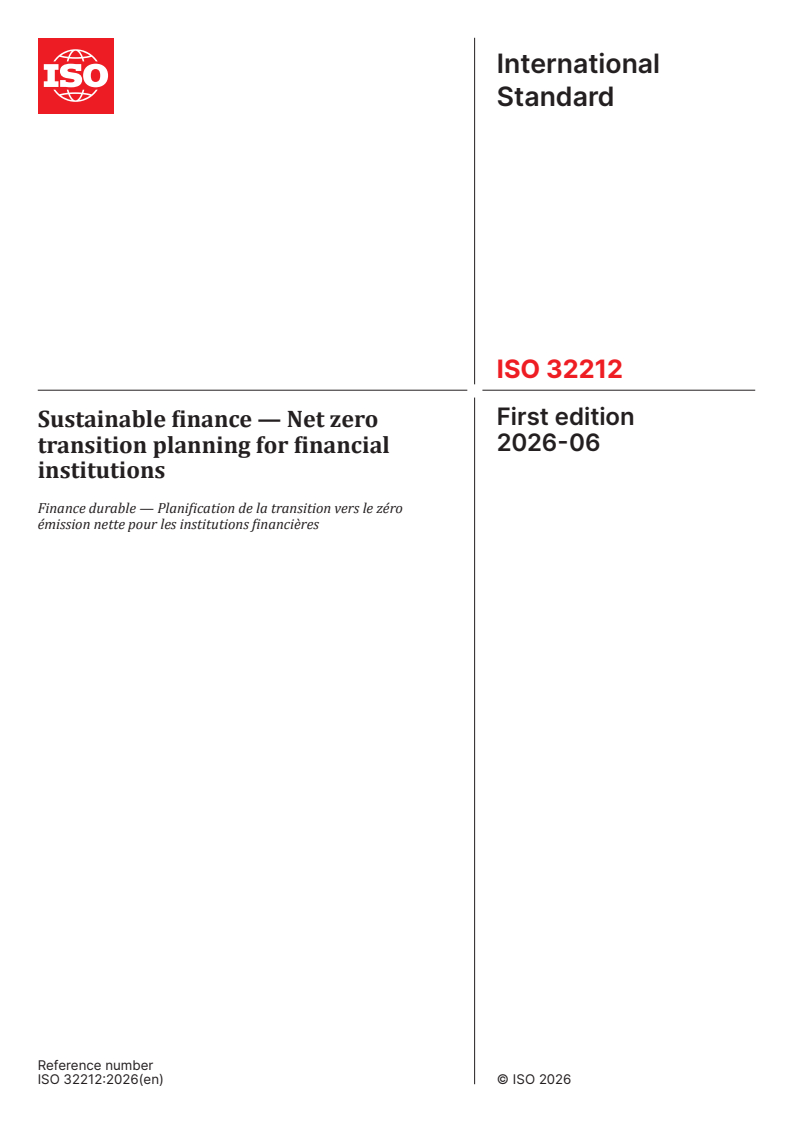

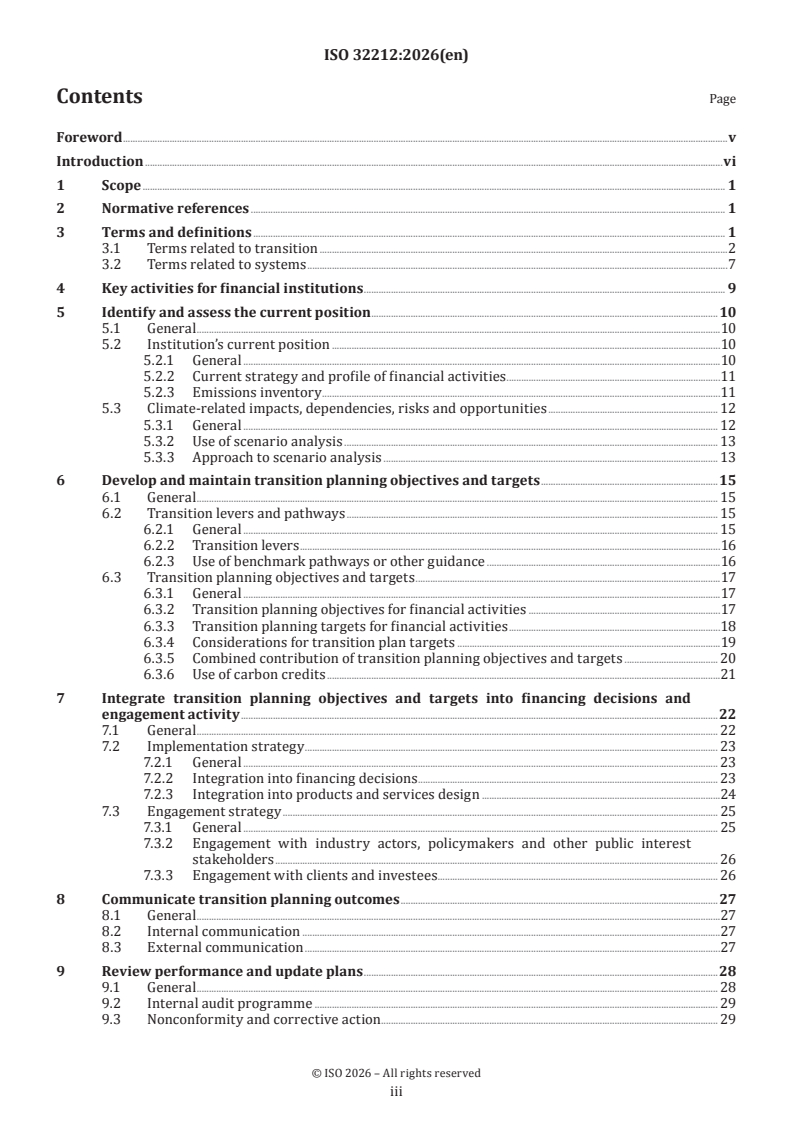
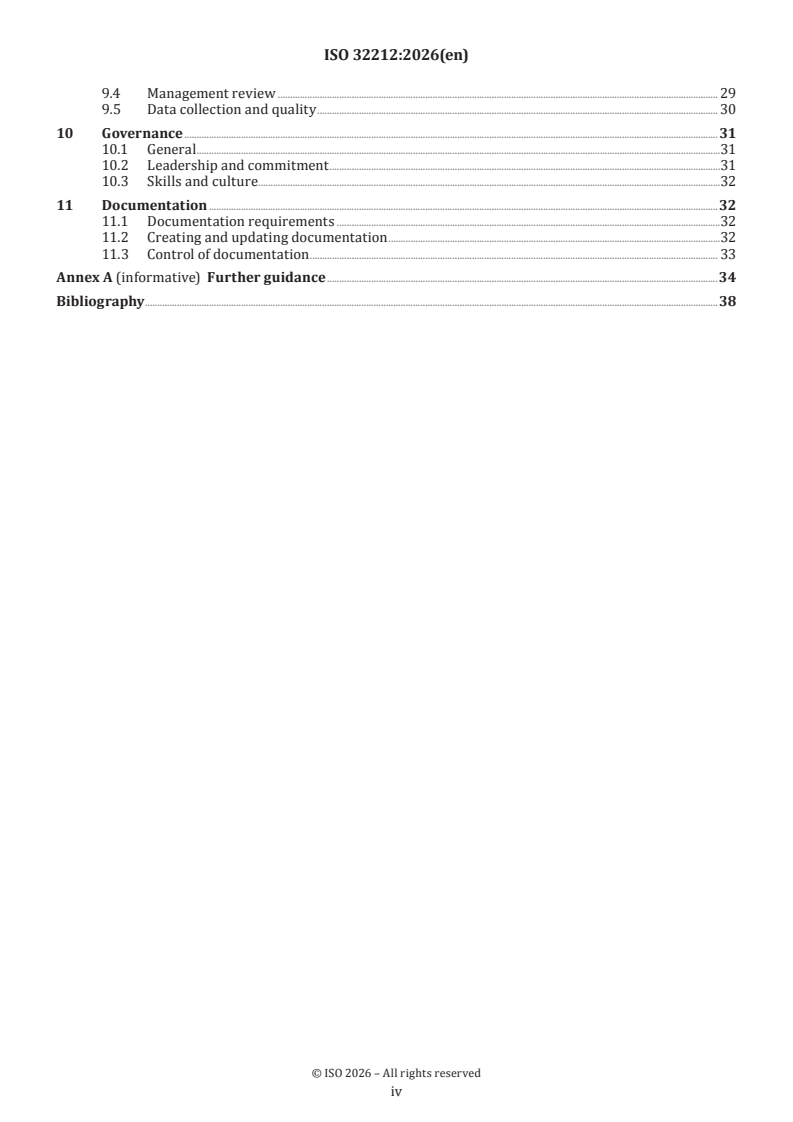
ISO 32212:2026 is an International Standard from ISO on sustainable finance for financial institutions. It specifies requirements and recommendations for strategic net zero transition planning, including how institutions develop transition planning objectives and targets and integrate them into their financial activities. The standard is written for financial institutions of any size, type and location, with particular relevance to banking, insurance and investment institutions.
What does ISO 32212:2026 specify?
ISO 32212:2026 specifies a planning framework for financial institutions that want to align financial activities with a global net zero and climate-resilient economy. It focuses on the institution’s own strategy, governance, policies and processes, rather than on operational emissions alone.
The standard applies to financial activities that the institution can control or influence, using a life cycle perspective. These include lending, insurance, asset owner investing, asset manager investing and capital market activities. It also allows for application in real economy institutions and emerging financial institution types, including decentralized finance (DeFi) platforms, where relevant.
Clause 4 presents the document as a recurring planning cycle: assess the current position, set transition objectives and targets, integrate them into decisions and engagement, communicate outcomes, review performance and update plans. Clauses 10 and 11 apply across that cycle, covering governance and documentation. Annex A is informative and gives further guidance.
What are the key requirements of ISO 32212:2026?
ISO 32212:2026 is built around an iterative process. The standard expects a financial institution to understand its current position, set transition objectives and targets, integrate them into core activities, communicate results, and keep reviewing and improving the plan.
Clause 5 - identify and assess the current position
ISO 32212:2026 expects the institution to identify and assess its current position, including an emissions baseline and a forward-looking analysis of climate-related risks and opportunities. This includes considering impacts and dependencies, not just direct exposures.
In practice, this means the institution should understand where climate risk and opportunity arise in its portfolio, business model and sector coverage. Clause 5 also addresses the use of scenario analysis, so the institution can test how different plausible future states could affect its activities.
Clause 6 - develop and maintain objectives and targets
ISO 32212:2026 requires transition planning objectives and targets that reflect the institution’s circumstances and its assessed risks and opportunities. The objectives and targets are meant to support value protection and enhancement while advancing the temperature and resilience goals of the Paris Agreement.
Clause 6 also covers transition levers, pathways and benchmark pathways or other guidance. In practice, the institution needs to choose a credible direction of travel, not only a headline ambition. The clause also addresses the use of carbon credits, which means the institution must treat them as one element in a broader transition plan, not as a substitute for planning.
Clause 7 - integrate objectives and targets into financing and engagement
ISO 32212:2026 requires the institution to integrate its transition planning objectives and targets into financing decisions and engagement activity. The standard also points to product and services design as a place where the plan should be implemented.
This matters because transition planning is not meant to stay at policy level. The institution is expected to adapt lending, investing, underwriting, product design and engagement with clients, investees, industry actors, policymakers and other public interest stakeholders.
Clause 8 - communicate outcomes
ISO 32212:2026 requires internal and external communication of transition planning outcomes. Internal communication must reach relevant functions and levels, including top management.
Externally, the institution shall disclose its strategic objectives, targets, approach, assumptions, dependencies, resourcing and progress against previously reported plans. The standard also requires internal controls to prevent misleading claims. In practice, this is the anti-greenwashing part of the document: disclosures need to match the data and the actual plan.
Clause 9 - review performance and update plans
ISO 32212:2026 requires the institution to review performance and update plans continuously. Clause 9 covers internal audit, nonconformity and corrective action, management review, and data collection and quality.
The internal audit programme shall include audits at least annually. Management review shall take place at least annually and cover progress, resources, data quality, assumptions, communication, and alignment with benchmark pathways and business strategy. The data quality assessment should be reviewed and updated at periods not exceeding three years. This helps the institution show that the plan is being tested, corrected and improved over time.
Clauses 10 and 11 - governance and documentation
ISO 32212:2026 places governance responsibilities on the governing body and top management. They are expected to show leadership, ensure resources, assign responsibilities, maintain skills and culture, and keep transition planning aligned with strategic direction.
Clause 11 requires controlled documentation. The institution must identify, review, approve, protect and retain the documents needed for transition planning. In practice, this creates the evidence trail for audits, reviews and external communication.
What terms does ISO 32212:2026 define?
- Transition plan - the output of transition planning, often a published disclosure, that explains how the entity intends to achieve its stated goals.
- Transition planning - the dynamic, iterative process through which an entity develops an organization-wide approach to net zero and integrates it across the organization.
- Transition finance - lending, financing, investment, insurance and related products and services that are critical to real economy emissions reduction and an orderly transition to net zero.
- Adaptation finance - lending, financing, investment, insurance and related products and services that support real economy adjustments in response to actual or expected climate change.
- Real economy - economic activity outside the financial sector, including the production, purchase and flow of goods and services.
- Scenario analysis - a process for identifying and assessing the implications of a range of plausible future states under various conditions.
- Financial institution - an institution principally engaged in financial intermediation and/or auxiliary financial activities.
- Greenhouse gas emission (GHG emission) - the release of a greenhouse gas into the atmosphere.
Who uses ISO 32212:2026?
ISO 32212:2026 is for financial institutions that need a structured way to plan their response to climate transition. The document is especially relevant to banks, insurers and investment institutions, but it is written for any financial institution regardless of size or geography.
Typical users include governing bodies, top management, sustainability teams, risk managers, finance and treasury teams, investment and lending teams, insurance and underwriting teams, product developers, engagement teams, internal auditors and compliance staff. They use it to set transition goals, reshape products and decisions, communicate progress and document governance.
Which standards are used with ISO 32212:2026?
| Standard | What it contributes |
|---|---|
| ISO 14060 | A complementary framework for organizations that want to describe ambitions, transition planning and progress toward net zero in their own operations and value chains. |
| ISO 55000, ISO 55001, ISO 55002 | Asset management concepts, requirements and guidance that can support financial institution asset management activity and alignment with business objectives. |
| ISO 37000 | Governance of organizations, especially useful for the governance and oversight aspects of transition planning. |
| ISO 14019 series | Guidance on validation and verification of sustainability information. |
| ISO 14001, ISO 14064-1, ISO 14068-1, ISO 14097, ISO 14100, ISO 14054, ISO 14030-1 | Supporting ISO documents on environmental management, GHG reporting, carbon neutrality, climate-related financial assessment, greenwashing-related issues and related sustainability topics. |
| ISO 32210:2022 | Source for the definitions of scenario and scenario analysis used in this document. |
| ISO/TS 32211 | A supporting ISO technical specification that the standard draws on where appropriate. |
| IWA 42:2022 | Source for the net zero definition used in this document. |
What does the ISO 32212:2026 document contain?
ISO 32212:2026 contains a clause structure that moves from scope and definitions into a full transition-planning cycle. It includes methods for assessing the current position, using scenario analysis, setting objectives and targets, integrating them into financing decisions and engagement, communicating outcomes, and reviewing performance.
The document also contains requirements for governance, skills, documentation, internal audit, corrective action and management review. A figure shows the key elements of the planning cycle and how the clauses fit together.
Annex A is informative and gives further guidance. It includes material on identifying impacts and dependencies on nature and society, and on product attributes for banking, investment, insurance and retail financial services.
Get Certified
Connect with accredited certification bodies for this standard

BSI Group
BSI (British Standards Institution) is the business standards company that helps organizations make excellence a habit.

Bureau Veritas
Bureau Veritas is a world leader in laboratory testing, inspection and certification services.

DNV
DNV is an independent assurance and risk management provider.
Sponsored listings
Frequently Asked Questions
ISO 32212:2026 is a standard published by the International Organization for Standardization (ISO). Its full title is "Sustainable finance — Net zero transition planning for financial institutions". This standard covers: This document specifies requirements and recommendations for strategic transition planning by financial institutions, designed to protect and enhance value by supporting institutions’ response and contribution to a global net zero and climate-resilient economy. The requirements and recommendations are designed to enable financial institutions to develop and maintain transition planning objectives and targets that advance the temperature and resilience goals of the Paris Agreement[23], and establish robust policies and processes to integrate these into their financial activities. This document is applicable to any financial institution, regardless of size, type and geographic location, with a particular focus on banking, insurance and investment institutions. Its provisions are applied in the context of the institution’s particular business model. NOTE 1 Some considerations specific to particular institution types are included in guidance notes. Additional guidance on product attributes specific to different types of financial institution can be found in Annex A. This document is applicable to all financial activities (including lending, insurance, asset owner investing, asset manager investing and capital market activities) that the institution determines it can either control or influence, using a life cycle perspective (e.g. those described in 7.2.2). It can also be applicable to relevant financial activities within real economy institutions and emerging financial institution types, many of which leverage digital technologies and can be subject to different or bespoke regulatory frameworks (e.g. decentralized finance (DeFi) platforms). NOTE 2 This document is intended for global application, recognizing that some financial institutions, including those in some emerging market and developing economies (EMDEs), can face constraints in the local enabling regulatory environment and data availability. It therefore seeks to ensure flexibility and proportionality in application, as appropriate. NOTE 3 Documents on asset management developed by ISO/TC 251, including ISO 55000[18], ISO 55001[19] and detailed guidance in ISO 55002[20], can be useful for financial institution asset management activity, particularly as it relates to alignment of asset management with business objectives (e.g. those related to transition planning).
This document specifies requirements and recommendations for strategic transition planning by financial institutions, designed to protect and enhance value by supporting institutions’ response and contribution to a global net zero and climate-resilient economy. The requirements and recommendations are designed to enable financial institutions to develop and maintain transition planning objectives and targets that advance the temperature and resilience goals of the Paris Agreement[23], and establish robust policies and processes to integrate these into their financial activities. This document is applicable to any financial institution, regardless of size, type and geographic location, with a particular focus on banking, insurance and investment institutions. Its provisions are applied in the context of the institution’s particular business model. NOTE 1 Some considerations specific to particular institution types are included in guidance notes. Additional guidance on product attributes specific to different types of financial institution can be found in Annex A. This document is applicable to all financial activities (including lending, insurance, asset owner investing, asset manager investing and capital market activities) that the institution determines it can either control or influence, using a life cycle perspective (e.g. those described in 7.2.2). It can also be applicable to relevant financial activities within real economy institutions and emerging financial institution types, many of which leverage digital technologies and can be subject to different or bespoke regulatory frameworks (e.g. decentralized finance (DeFi) platforms). NOTE 2 This document is intended for global application, recognizing that some financial institutions, including those in some emerging market and developing economies (EMDEs), can face constraints in the local enabling regulatory environment and data availability. It therefore seeks to ensure flexibility and proportionality in application, as appropriate. NOTE 3 Documents on asset management developed by ISO/TC 251, including ISO 55000[18], ISO 55001[19] and detailed guidance in ISO 55002[20], can be useful for financial institution asset management activity, particularly as it relates to alignment of asset management with business objectives (e.g. those related to transition planning).
ISO 32212:2026 is classified under the following ICS (International Classification for Standards) categories: 03.060 - Finances. Banking. Monetary systems. Insurance; 13.020.20 - Environmental economics. Sustainability. The ICS classification helps identify the subject area and facilitates finding related standards.
ISO 32212:2026 is available in PDF format for immediate download after purchase. The document can be added to your cart and obtained through the secure checkout process. Digital delivery ensures instant access to the complete standard document.
Standards Content (Sample)
Contents
- Introduction
- 0.1 General
- 0.2 Objective of this document
- 0.3 Interaction with other standards
- 0.4 Foundations of this document
- 1 Scope
- 2 Normative references
- 3 Terms and definitions
- 3.1 Terms related to transition
- 3.1.1 transition plan
- 3.1.2 transition planning
- 3.1.3 transition finance
- 3.1.4 adaptation finance
- 3.1.5 real economy
- 3.1.6 climate change adaptation
- 3.1.7 climate solution
- 3.1.8 climate enabler
- 3.1.9 net zero
- 3.1.10 carbon credit
- 3.1.11 carbon lock-in
- 3.1.12 facilitated emission
- 3.1.13 financed emission
- 3.1.14 insurance associated emission
- 3.1.15 greenhouse gas emission
- 3.1.16 direct greenhouse gas emission
- 3.1.17 energy indirect greenhouse gas emission
- 3.1.18 other indirect greenhouse gas emission
- 3.1.19 avoided emission
- 3.1.20 residual emission
- 3.1.21 greenwashing
- 3.1.22 high-emitting asset
- 3.1.23 scenario
- 3.1.24 scenario analysis
- 3.1.25 benchmark pathway
- 3.1.26 technology roadmap
- 3.1.27 goals of the Paris Agreement
- 3.1.28 transition lever
- 3.2 Terms related to systems
- 3.2.1 audit
- 3.2.2 conformity
- 3.2.3 nonconformity
- 3.2.4 corrective action
- 3.2.5 continual improvement
- 3.2.6 effectiveness
- 3.2.7 decentralized finance
- 3.2.8 financial institution
- 3.2.9 financial activity
- 3.2.10 governing body
- 3.2.11 top management
- 4 Key activities for financial institutions
- 5 Identify and assess the current position
- 5.1 General
- 5.2 Institution’s current position
- 5.3 Climate-related impacts, dependencies, risks and opportunities
- 6 Develop and maintain transition planning objectives and targets
- 6.1 General
- 6.2 Transition levers and pathways
- 6.3 Transition planning objectives and targets
- 7 Integrate transition planning objectives and targets into financing decisions and
- 7.1 General
- 7.2 Implementation strategy
- 7.3 Engagement strategy
- 8 Communicate transition planning outcomes
- 8.1 General
- 8.2 Internal communication
- 8.3 External communication
- 9 Review performance and update plans
- 9.1 General
- 9.2 Internal audit programme
- 9.3 Nonconformity and corrective action
- 9.4 Management review
- 9.5 Data collection and quality
- 10 Governance
- 10.1 General
- 10.2 Leadership and commitment
- 10.3 Skills and culture
- 11 Documentation
- 11.1 Documentation requirements
- 11.2 Creating and updating documentation
- 11.3 Control of documentation
Introduction
0.1 General
[23] Article 2.1(a) of the Paris Agreement sets the ambition of holding the increase in the global average temperature to well below 2 °C above pre-industrial levels and pursuing efforts to limit the temperature increase to 1,5 °C, recognizing that this would significantly reduce the risks and impacts of climate change. Article 2.1(b) sets this ambition alongside the objective to increase the ability to adapt to the adverse effects of climate change and foster climate resilience and low greenhouse gas (GHG) emissions development. [23] The Paris Agreement states it will be implemented in accordance with the principles of equity, common but differentiated responsibilities, and respective capabilities in different parts of the world (see Article 2.2), and in the context of sustainable development and the goal of eradicating poverty. To deliver on [23] the objectives of the Paris Agreement , each Party undertakes to prepare, communicate and maintain nationally determined contributions (NDCs) (see Article 4) and to engage in adaptation planning processes (see Article 7).
[23] Specifically related to finance, Article 2.1(c) of the Paris Agreement states that finance flows must be consistent with a pathway towards low GHG emissions and climate-resilient development. Article 9 [107] elaborates on the role of climate finance. The Glasgow Climate Pact reaffirmed the goals of the Paris [23] Agreement . It highlighted that every increment of global warming beyond 1,5 °C intensifies the risks and impacts associated with climate change. It also emphasized that limiting global warming to 1,5 °C requires reducing global carbon dioxide (CO ) emissions by 45 % by 2030 relative to the 2010 level and to net zero
around mid-century, as well as deep reductions in other GHGs. In addition, it underlined the critical role of scaling up private finance in achieving global climate goals.
0.2 Objective of this document
This document specifies requirements and recommendations for strategic net zero transition planning by financial institutions, designed to protect and enhance value by supporting institutions’ response and contribution to the transition to a global net zero and climate-resilient economy. The requirements and recommendations are designed to enable financial institutions to develop and maintain transition planning [23] objectives and targets that advance the temperature and resilience goals of the Paris Agreement , and establish robust policies and processes to integrate these into their financial activities. The document builds on existing guidance, including materials developed by international organizations, jurisdictional authorities, industry initiatives and others.
This document aims to support financial institutions in responding to and contributing towards the transition to a global net zero and climate-resilient economy in a systematic and iterative manner, pursuing continual improvement in their transition planning. This includes mobilizing and reallocating capital to enable both decarbonization and climate adaptation activities in the real economy. It also aims to support economic growth and competitiveness and a resilient financial system by enabling financial institutions to capture opportunities for themselves (and their shareholders) and for their clients and beneficiaries in the real economy, while minimizing current and future risks.
This document recognizes that there are limits to the influence financial institutions can have over the real economy climate mitigation and adaptation outcomes resulting from the implementation of their transition plans. Outcomes can be impacted by a range of external dependencies, including dependencies related to public policy, regulation, scientific and climatic developments, and the actions of clients and investees.
0.3 Interaction with other standards
This document does not consider financial institutions’ operational emissions, nor does it provide detailed [6] guidance on the credibility of net zero commitments. In this regard it is designed to complement ISO 14060 , as well as other relevant third-party resources (e.g. the Financial Institutions Net Zero Standard developed [111] by the Science Based Targets Initiative (SBTi) ). ISO 14060 will provide a comprehensive framework for organizations to credibly set out their ambitions, transition planning and progress towards net zero GHG emissions, in their own operations and their value chains. A financial institution that aims to achieve net zero GHG emissions in both its operations and its financial activities may therefore choose to apply the requirements and recommendations in this document alongside those in ISO 14060.
ISO 32212:2026(en) This document utilizes a hybrid approach to identifying GHG categories, drawing on both existing ISO and Greenhouse Gas Protocol GHG Protocol (GHG Protocol) standards, reflecting the more accurate alignment of [160] the GHG Protocol with the scope of this document and the ISO and GHG Protocol partnership, which will combine their respective GHG standards into harmonized co-branded international standards.
0.4 Foundations of this document
0.4.1 Role of net zero transition planning by financial institutions and the theory of change
With connections to actors in all sectors of the real economy, financial institutions have an important role [23] to play in advancing the goals of the Paris Agreement . By engaging in transition planning, developing and maintaining transition planning objectives and targets, and establishing robust policies and processes to integrate these into their financial activities, financial institutions can play a critical enabling role in supporting their clients and investees to manage risk and capture opportunities associated with the global [23] transition to a net zero and climate-resilient economy.
Informed by forward-looking assessment of climate-related risks and opportunities, a financial institution can integrate transition planning objectives and targets into its strategy. It can set policies for its lending, investment or insurance activities, as well as its engagement activities with clients and investees, informed by analysis of their climate mitigation and climate adaptation strategies. NOTE 1 In its report on the need for scaling climate finance, the UN-convened Independent Expert Group on Climate [26] Finance states that “Every financial decision should take climate risk into account”. This document is therefore grounded in a theory of change which recognizes that robust, credible processes for net zero transition planning, undertaken as a strategic exercise as part of wider business planning, can help an institution protect and enhance its own long-term value and that of its clients and beneficiaries, [23] while scaling the provision of finance to advance the goals of the Paris Agreement . This can include providing finance to help developing countries both mitigate and adapt to climate change (see Article 9.1). At the same time, an institution’s financing strategy can minimize adverse impacts and capture opportunities for stakeholders, society, communities, the economy and the natural environment. In developing a strategic approach to net zero transition planning, it is important to recognize the need for financial institutions to consider not only the reduction of financed, facilitated and insurance associated emissions, but also their contribution to the decarbonization and adaptation efforts of their clients and investees in the real economy (e.g. by financing the abatement of emissions in high-emitting sectors or by financing climate mitigation and adaptation solutions). This document’s focus on forward-looking strategies, policies and processes that support real economy transition pathways is aligned with the United Nations [24] Environment Programme (UNEP) Theory of Change for Climate Mitigation . [100] NOTE 2 The Net Zero Investment Framework (NZIF) identifies the importance within net zero strategies of maximizing efforts to “finance reduced emissions” rather than focusing solely on efforts to “reduce financed emissions”.
NOTE 3 Other guidance and disclosure frameworks for transition planning and transition plans recognize the role of the private sector in both responding to, and contributing towards, the transition to a net zero and climate-resilient [30] [41] economy (GFANZ (2022) and TPT (2023) .
This document recognizes that climate-related risks can be viewed as both exogenous and endogenous to the financial system. That is, financial institutions are exposed to proximate climate-related financial risks, which are already influencing asset values today and will continue to crystallize within traditional time horizons, and also contribute to future system-wide risks, such as those that could arise from a disorderly transition or extreme warming scenarios that exacerbate physical climate risks, the precise timing and magnitude of which can be uncertain. Effective transition planning within financial institutions can therefore be expected to support greater resilience at both institution and system levels, while also capturing commercial opportunities associated with mobilizing the USD 8,6 trillion in capital needed annually until [23] 2050 to advance the goals of the Paris Agreement (based on estimates by the Climate Policy Initiative, [112] CPI ).
Of course, it is also important to acknowledge that the finance sector has an enabling, as opposed to controlling, role in the transition. The principal decarbonization and adaptation efforts will take place under the control of real economy actors, subject to supportive policy environments. Identification of the
ISO 32212:2026(en) interconnections and external dependencies that can impact the effectiveness of a financial institution’s transition plan represents an important ongoing element of the transition planning process. NOTE 4 Supervisory statements recognize the distinctive characteristics of climate risk, the need for a strategic [113] approach and the role of financial institutions in stewarding the transition (Financial Stability Board ). NOTE 5 The results of climate stress testing exercises, undertaken within the central banking community, have [114] evidenced the benefits of an early and orderly transition (European Central Bank (ECB) ).
0.4.2 Accommodating national circumstances
[23] The Paris Agreement explicitly acknowledges the need to accommodate national circumstances in the pursuit of its goals. Article 2.2 states that its implementation must reflect equity and the principle of common but differentiated responsibilities and respective capabilities in the light of different national circumstances. Article 13.2 explicitly allows for flexibility for developing countries, complementing Article 9.1 which highlights the need for finance flows from developed to developing countries in supporting a global transition.
NDCs and national adaptation plans reflect this approach, describing climate plans that outline a country’s mitigation, adaptation, finance and technology needs, and impacts from response measures, thereby acting [23] as the foundation for implementing the Paris Agreement . NDCs, national adaptation plans, national transition plans, industrial policies or strategies, and national sector and/or technology plans and pathways can accordingly provide locally relevant reference points for financial institutions in their transition planning activities.
[99] The Enhanced Transparency Framework (ETF) builds on existing reporting and review processes [23] established in the Paris Agreement , specifically addressing ongoing concerns around credibility and flexibility in a way that is respectful of national sovereignty. The G20 also acknowledges the challenge for organizational transition planning in balancing credibility and consistency with the need to remain flexible as organizations align their own planning with [90] jurisdiction-specific circumstances. Such proportionality is essential for global applicability. Where jurisdiction emissions reduction pathways do not exist or are incomplete, financial institutions can apply international sector guidance, global standards or targets. These can incorporate exemptions, flexibilities [94] or proportionality approaches. This can mean, for example, differing transition priorities with a greater [47] focus on adaptation activity and operational emissions in some jurisdictions.
0.4.3 Looking beyond decarbonization
[23] The Paris Agreement considers issues beyond decarbonization. For example, it recognizes that adaptation is a key component of, and makes a contribution to, the long-term global response to climate change to protect people, livelihoods and ecosystems including country specific flexibility (see Article 7). The preamble acknowledges both the need for a just transition taking into account “…the workforce and the creation of decent work and quality jobs in accordance with nationally defined development priorities” as well as nature-related implications, noting “the importance of ensuring the integrity of all ecosystems, including oceans, and the protection of biodiversity...”.
This document therefore addresses the need to look beyond decarbonization, taking into account adaptation activity as well as potential co-benefits and trade-offs with societal and nature-related impacts and [23] dependencies. For example, Article 5 of the Paris Agreement emphasizes the need to conserve and enhance forests as carbon sinks, encouraging action to reduce deforestation. This document accordingly provides a strategic framework for supporting the financial sector to respond to and contribute towards the [27] global transition, while considering nature, adaptation and a just transition. Also, recognizing the interconnected nature of climate, nature and human systems, it is important to identify and mitigate unintended impacts of potential decarbonization actions (e.g. the potential trade-offs between [28] climate action, energy access and affordability, and economic development). This aligns with the Paris
ISO 32212:2026(en) [23] Agreement requirement (see Article 4.1) that climate action is undertaken “on the basis of equity, and in the context of sustainable development and efforts to eradicate poverty”. [115] NOTE 1 The OECD Guidelines for Multinational Enterprises on Responsible Business Conduct set recommendations to “enhance the business contribution to sustainable development and address adverse impacts associated with business activities on people, planet, and society.” NOTE 2 Network for Greening the Financial System (NGFS) in its guidance on integrating adaptation and resilience [116] into transition plans indicates that “[w]hile mitigation remains indispensable to limit future damages, integrating adaptation into climate transition plans is also crucial, given their interconnectedness. Adaptation efforts help reduce vulnerability, strengthen resilience, and unlock economic opportunities”. [121] NOTE 3 A CFRF report describes an approach to adaptation-related decision-making for financial institutions utilizing a range of future warming scenarios (ABC Framework). [122] NOTE 4 TNFD identifies integrated transition planning activities as providing a “coherent structure” for managing both nature-related dependencies, impacts, risks and opportunities, and climate mitigation and adaptation efforts, thereby contributing to the transition envisaged by both the Kunming-Montreal Global Biodiversity [23] Framework and the Paris Agreement .
NOTE 5 Artificial intelligence (AI) and other technology can help identify and quantify the interconnected nature of climate, nature and human systems.
NOTE 6 Decarbonization in the context of this document extends beyond consideration of carbon dioxide to consider all GHGs.
0.4.4 Building on existing guidance and expectations
The requirements for credible transition planning as described in this document are designed to be compatible with, and build on, existing guidance and expectations relevant to transition planning by financial institutions. This includes:
- the iterative development and practical experience reflected in international finance sector initiatives, such as the Glasgow Financial Alliance for Net Zero (GFANZ) and the Institutional Investors Group on Climate Change (IIGCC);
- jurisdictional and international work on public disclosure of transition plans, such as the International Sustainability Standards Board (ISSB) guidance on disclosing information about an entity’s transition [123] plan;
- non-governmental organization (NGO) initiatives on matters such as target setting, emissions measurement and transition plan assessment, including SBTi, the Partnership for Carbon Accounting Financials (PCAF) and The TPI Global Climate Transition Centre (TPI Centre);
- finance sector supervisory expectations around transition planning and the management of climaterelated financial risk, including the work of the NGFS. [22] The document also draws on (and references where appropriate) ISO documents including IWA 42 , [15] [16] ISO 32210 and ISO/TS 32211 . A number of documents on environmental management developed by [1] [2] [3] [11] ISO/TC 207 are also relevant, including ISO 14001 , the ISO 14019 series , ISO 14030-1 , ISO 14100 , [5] [7] [8] [10] [19] ISO 14054 , ISO 14064-1 , ISO 14068-1 and ISO 14097 . ISO 55001 on asset management and [17] [2] ISO 37000 on governance are also relevant. The ISO 14019 series provides guidance on the validation and verification of sustainability information. Furthermore, this document is designed to complement ISO 14060, as described in 0.3.
International Standard ISO 32212:2026(en) Sustainable finance — Net zero transition planning for financial institutions
1 Scope
This document specifies requirements and recommendations for strategic transition planning by financial institutions, designed to protect and enhance value by supporting institutions’ response and contribution to a global net zero and climate-resilient economy. The requirements and recommendations are designed to enable financial institutions to develop and maintain transition planning objectives and targets that [23] advance the temperature and resilience goals of the Paris Agreement , and establish robust policies and processes to integrate these into their financial activities.
This document is applicable to any financial institution, regardless of size, type and geographic location, with a particular focus on banking, insurance and investment institutions. Its provisions are applied in the context of the institution’s particular business model.
NOTE 1 Some considerations specific to particular institution types are included in guidance notes. Additional guidance on product attributes specific to different types of financial institution can be found in Annex A. This document is applicable to all financial activities (including lending, insurance, asset owner investing, asset manager investing and capital market activities) that the institution determines it can either control or influence, using a life cycle perspective (e.g. those described in 7.2.2). It can also be applicable to relevant financial activities within real economy institutions and emerging financial institution types, many of which leverage digital technologies and can be subject to different or bespoke regulatory frameworks (e.g. decentralized finance (DeFi) platforms).
NOTE 2 This document is intended for global application, recognizing that some financial institutions, including those in some emerging market and developing economies (EMDEs), can face constraints in the local enabling regulatory environment and data availability. It therefore seeks to ensure flexibility and proportionality in application, as appropriate.
...