


ISO 7781:2008
(Main)Styrene-butadiene rubber, raw — Determination of soap and organic-acid content
Styrene-butadiene rubber, raw — Determination of soap and organic-acid content
ISO 7781:2008 specifies methods for the determination of the soap and organic-acid content of raw styrene-butadiene rubber (SBR). Method A is the titration method using indicator reagent. Method B is the titration method using an autotitrator or pH-meter. The methods depend on the extraction of the organic acids and soaps from the rubber by means of a specified solvent. In practice, therefore, it is convenient to determine both organic-acid and soap contents on separate portions of the same solvent extract. Since the soaps and organic acids present in the rubber are not single chemical compounds, the method gives only an approximate value for the soap and organic-acid content.
Caoutchouc butadiène-styrène brut — Détermination de la teneur en savons et acides organiques
General Information
- Status
- Withdrawn
- Publication Date
- 19-Mar-2008
- Withdrawal Date
- 19-Mar-2008
- Drafting Committee
- ISO/TC 45/SC 3/WG 5 - Synthetic and reclaimed rubber
- Current Stage
- 9599 - Withdrawal of International Standard
- Start Date
- 16-Nov-2017
- Completion Date
- 12-Feb-2026
Relations
- Revised
ISO 7781:2017 - Styrene-butadiene rubber, raw — Determination of soap and organic-acid content - Effective Date
- 05-Nov-2015
- Revises
ISO 7781:2001 - Styrene-butadiene rubber, raw — Determination of soap and organic-acid content - Effective Date
- 15-Apr-2008
Get Certified
Connect with accredited certification bodies for this standard

Smithers Quality Assessments
US management systems and product certification.

DIN CERTCO
DIN Group product certification.
Sponsored listings
Frequently Asked Questions
ISO 7781:2008 is a standard published by the International Organization for Standardization (ISO). Its full title is "Styrene-butadiene rubber, raw — Determination of soap and organic-acid content". This standard covers: ISO 7781:2008 specifies methods for the determination of the soap and organic-acid content of raw styrene-butadiene rubber (SBR). Method A is the titration method using indicator reagent. Method B is the titration method using an autotitrator or pH-meter. The methods depend on the extraction of the organic acids and soaps from the rubber by means of a specified solvent. In practice, therefore, it is convenient to determine both organic-acid and soap contents on separate portions of the same solvent extract. Since the soaps and organic acids present in the rubber are not single chemical compounds, the method gives only an approximate value for the soap and organic-acid content.
ISO 7781:2008 specifies methods for the determination of the soap and organic-acid content of raw styrene-butadiene rubber (SBR). Method A is the titration method using indicator reagent. Method B is the titration method using an autotitrator or pH-meter. The methods depend on the extraction of the organic acids and soaps from the rubber by means of a specified solvent. In practice, therefore, it is convenient to determine both organic-acid and soap contents on separate portions of the same solvent extract. Since the soaps and organic acids present in the rubber are not single chemical compounds, the method gives only an approximate value for the soap and organic-acid content.
ISO 7781:2008 is classified under the following ICS (International Classification for Standards) categories: 83.040.10 - Latex and raw rubber. The ICS classification helps identify the subject area and facilitates finding related standards.
ISO 7781:2008 has the following relationships with other standards: It is inter standard links to ISO 7781:2017, ISO 7781:2001. Understanding these relationships helps ensure you are using the most current and applicable version of the standard.
ISO 7781:2008 is available in PDF format for immediate download after purchase. The document can be added to your cart and obtained through the secure checkout process. Digital delivery ensures instant access to the complete standard document.
Standards Content (Sample)
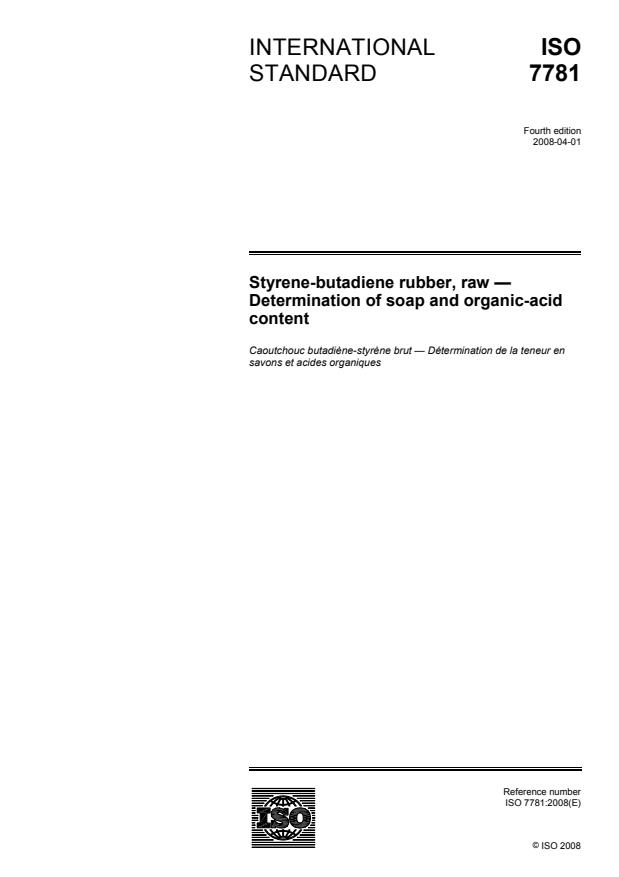
INTERNATIONAL ISO
STANDARD 7781
Fourth edition
2008-04-01
Styrene-butadiene rubber, raw —
Determination of soap and organic-acid
content
Caoutchouc butadiène-styrène brut — Détermination de la teneur en
savons et acides organiques
Reference number
©
ISO 2008
PDF disclaimer
This PDF file may contain embedded typefaces. In accordance with Adobe's licensing policy, this file may be printed or viewed but
shall not be edited unless the typefaces which are embedded are licensed to and installed on the computer performing the editing. In
downloading this file, parties accept therein the responsibility of not infringing Adobe's licensing policy. The ISO Central Secretariat
accepts no liability in this area.
Adobe is a trademark of Adobe Systems Incorporated.
Details of the software products used to create this PDF file can be found in the General Info relative to the file; the PDF-creation
parameters were optimized for printing. Every care has been taken to ensure that the file is suitable for use by ISO member bodies. In
the unlikely event that a problem relating to it is found, please inform the Central Secretariat at the address given below.
© ISO 2008
All rights reserved. Unless otherwise specified, no part of this publication may be reproduced or utilized in any form or by any means,
electronic or mechanical, including photocopying and microfilm, without permission in writing from either ISO at the address below or
ISO's member body in the country of the requester.
ISO copyright office
Case postale 56 • CH-1211 Geneva 20
Tel. + 41 22 749 01 11
Fax + 41 22 749 09 47
E-mail copyright@iso.org
Web www.iso.org
Published in Switzerland
ii © ISO 2008 – All rights reserved
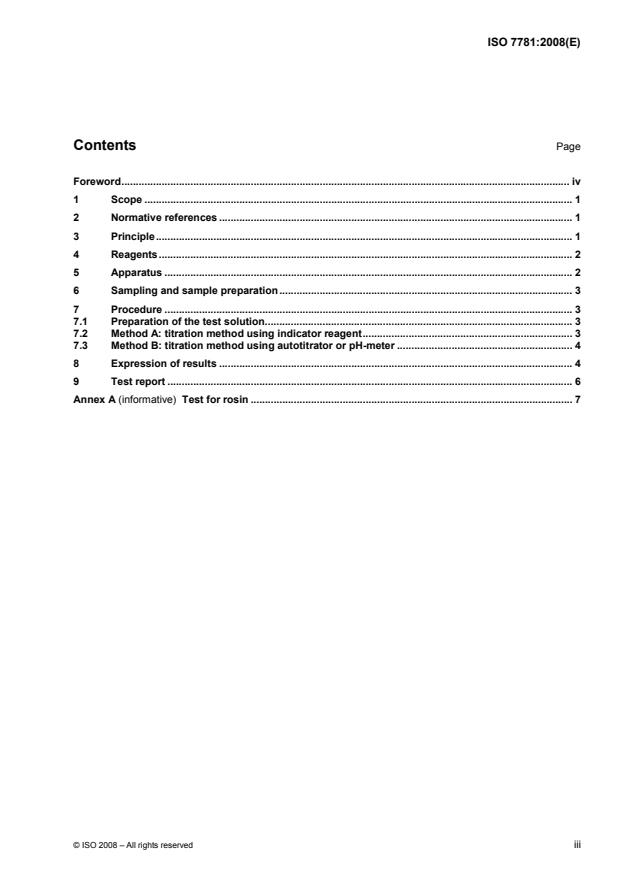
Contents Page
Foreword. iv
1 Scope . 1
2 Normative references . 1
3 Principle. 1
4 Reagents. 2
5 Apparatus . 2
6 Sampling and sample preparation. 3
7 Procedure . 3
7.1 Preparation of the test solution. 3
7.2 Method A: titration method using indicator reagent. 3
7.3 Method B: titration method using autotitrator or pH-meter . 4
8 Expression of results . 4
9 Test report . 6
Annex A (informative) Test for rosin . 7
Foreword
ISO (the International Organization for Standardization) is a worldwide federation of national standards bodies
(ISO member bodies). The work of preparing International Standards is normally carried out through ISO
technical committees. Each member body interested in a subject for which a technical committee has been
established has the right to be represented on that committee. International organizations, governmental and
non-governmental, in liaison with ISO, also take part in the work. ISO collaborates closely with the
International Electrotechnical Commission (IEC) on all matters of electrotechnical standardization.
International Standards are drafted in accordance with the rules given in the ISO/IEC Directives, Part 2.
The main task of technical committees is to prepare International Standards. Draft International Standards
adopted by the technical committees are circulated to the member bodies for voting. Publication as an
International Standard requires approval by at least 75 % of the member bodies casting a vote.
Attention is drawn to the possibility that some of the elements of this document may be the subject of patent
rights. ISO shall not be held responsible for identifying any or all such patent rights.
ISO 7781 was prepared by Technical Committee ISO/TC 45, Rubber and rubber products, Subcommittee
SC 2, Testing and analysis.
This fourth edition cancels and replaces the third edition (ISO 7781:2001), which has been technically revised.
iv © ISO 2008 – All rights reserved
INTERNATIONAL STANDARD ISO 7781:2008(E)
Styrene-butadiene rubber, raw — Determination of soap and
organic-acid content
WARNING — Persons using this International Standard should be familiar with normal laboratory
practice. This standard does not purport to address all of the safety problems, if any, associated with
its use. It is the responsibility of the user to establish appropriate safety and health practices and to
ensure compliance with any national regulatory conditions.
WARNING — Certain procedures specified in this International Standard may involve the use or
generation of substances, or the generation of waste, that could constitute a local environmental
hazard. Reference should be made to appropriate documentation on safe handling and disposal after
use.
1 Scope
This International Standard specifies methods for the determination of the soap and organic-acid content of
raw styrene-butadiene rubber (SBR). Method A is the titration method using indicator reagent. Method B is the
titration method using an autotitrator or pH-meter.
The methods depend on the extraction of the organic acids and soaps from the rubber by means of a
specified solvent. In practice, therefore, it is convenient to determine both organic-acid and soap contents on
separate portions of the same solvent extract. Since the soaps and organic acids present in the rubber are not
single chemical compounds, the method gives only an approximate value for the soap and organic-acid
content.
2 Normative references
The following referenced documents are indispensable for the application of this document. For dated
references, only the edition cited applies. For undated references, the latest edition of the referenced
document (including any amendments) applies.
ISO 385, Laboratory glassware — Burettes
ISO 648, Laboratory glassware — Single volume pipettes
ISO 1042, Laboratory glassware — One-mark volumetric flasks
ISO 1795, Rubber, raw natural and raw synthetic — Sampling and further preparative procedures
ISO 4799, Laboratory glassware — Condensers
3 Principle
A weighed test portion of the rubber, in the form of thin strips, is extracted using an ethanol-toluene azeotrope,
or, for alum-coagulated rubber, using an ethanol-toluene-water mixture. After making up to a standard volume,
an aliquot portion of the extract is withdrawn and titrated with standard acid for the determination of soap and
with standard alkali for the determination of organic acid.
4 Reagents
During the analysis, use only reagents of recognized analytical grade and only distilled water or water of
equivalent purity. Use commercially available analytical-grade buffer solutions of known pH or, in the absence
of commercial buffer solutions, prepare the solutions required (4.6, 4.7 and 4.8).
4.1 Ethanol-toluene azeotrope (ETA).
Mix seven volumes of absolute ethanol with three volumes of toluene. Alternatively, mix seven volumes of
commercial-grade ethanol with three volumes of toluene, and boil the mixture with anhydrous calcium oxide
(quicklime) under reflux for 4 h. Cool to room temperature and decant through No. 42 filter paper.
4.2 Ethanol-toluene-water mixture.
3 3
Mix 95 cm of ETA (4.1) and 5 cm of water.
4.3 Sodium hydroxide solution, c(NaOH) = 0,1 mol/dm , accurately standardized.
4.4 Thymol blue indicator.
3 3 3
Dissolve 0,06 g of thymol blue in 6,45 cm of 0,02 mol/dm sodium hydroxide solution and dilute to 50 cm
with water.
4.5 Hydrochloric acid, c(HCl) = 0,05 mol/dm , accurately standardized.
4.6 Buffer solution of nominal pH 7.
Dissolve 3,40 g of potassium dihydrogen phosphate (KH PO ) and 3,55 g of disodium hydrogen phosphate
2 4
(Na HPO ) in water and make up to 1 000 cm in a volumetric flask. The pH of this solution is 6,87 at 23 °C.
2 4
Store the solution in a glass or polyethylene vessel that is resistant to chemicals.
NOTE A pH 7 buffer solution already prepared is co
...
Questions, Comments and Discussion
Ask us and Technical Secretary will try to provide an answer. You can facilitate discussion about the standard in here.
Loading comments...