

ISO 11093-9:2019
(Main)Paper and board — Testing of cores — Part 9: Determination of flat crush resistance
General Information
- Abstract
This part of ISO 11093 specifies a method for the determination of the maximum flat crush resistance of wound paper and board cores. NOTE If the wall thickness of the core is less than 5 mm, the breaking point is not detectable.
- Status
- Published
- Publication Date
- 04-Mar-2019
- Technical Committee
- ISO/TC 6 - Paper, board and pulps
- Drafting Committee
- ISO/TC 6/WG 7 - Cores for reels of paper
- Current Stage
- 9092 - International Standard to be revised
- Start Date
- 29-Nov-2024
- Completion Date
- 29-Aug-2026
Buy Documents
ISO 11093-9:2019 - Paper and board -- Testing of cores
ISO 11093-9:2019 - Paper and board — Testing of cores — Part 9: Determination of flat crush resistance/5/2019
Overview
ISO 11093-9:2019 defines a standardized method to determine the maximum flat crush resistance of wound paper and board cores. The procedure measures the load acting at right angles to the core axis at the first maximum (or levelling off) of the crushing force. Results are reported in kilonewtons per metre (kN/m) and are intended to provide consistent core strength data for design, quality assurance and conversion processes.
Note: If the wall thickness of the core is less than 5 mm, the breaking point is not detectable and the note in the scope applies.
Key Topics
- Principle: A test piece is compressed between parallel pressure platens with its axis parallel to the platen plane until the first maximum or levelling of the load is exceeded.
- Apparatus:
- Compression testing machine calibrated per ISO 7500-1. Force measurement accuracy: ±1 % of the smallest crushing load measured.
- Flat, rigid, parallel upper and lower platens; platen travel limited to vertical motion only.
- Cutting device (recommended circular saw) producing 90° ± 1° cuts without feathering or deformation.
- Preparation:
- Sampling in accordance with ISO 11093-1.
- One test piece per specimen, taken at least 100 mm from core ends.
- Test piece length: (100 ± 1.5) mm for nominal internal diameter ≤ 300 mm; (300 ± 1.5) mm for > 300 mm.
- Conditioning per ISO 11093-2 and testing in the same standard atmosphere.
- Procedure details:
- Compression rate: constant relative platen rate between 50 mm/min and 65 mm/min.
- Switch-off limit for automatic break detection: 30 N or 3 % from the true value.
- Convert measured force to kN/m to ensure comparability across core diameters.
- Calculation & Reporting:
- Flat crush resistance is calculated from the measured force and expressed in kN/m.
- Test report must reference ISO 11093-9 and include specimen details, sampling/testing dates, individual values and mean (rounded to 1 %), and any departures from the procedure.
Applications
This standard is directly applicable to:
- Packaging designers assessing core performance under lateral load.
- Converters and manufacturers performing incoming inspection and process control.
- Quality assurance teams establishing acceptance criteria for cores used in winding, shipping or storage.
Practical benefits include reproducible strength data for product specification, reduced variability in acceptance testing, and improved compatibility between suppliers and users.
Related Standards
- ISO 11093-1 - Sampling of cores
- ISO 11093-2 - Conditioning of test samples
- ISO 7500-1 - Calibration and verification of static testing machines
For implementation, follow the procedures and reporting requirements in ISO 11093-9:2019 and consult the referenced parts for sampling, conditioning and machine calibration to ensure valid, comparable results.
Relations
- Effective Date
- 16-Jun-2018
Buy Documents
ISO 11093-9:2019 - Paper and board -- Testing of cores
ISO 11093-9:2019 - Paper and board — Testing of cores — Part 9: Determination of flat crush resistance/5/2019
Get Certified
Connect with accredited certification bodies for this standard

Control Union Certifications
Global certification for agriculture and sustainability.

Gozdarski inštitut Slovenije
Slovenian Forestry Institute. Forest management certification support, timber testing.
Sponsored listings
Frequently Asked Questions
ISO 11093-9:2019 is a standard published by the International Organization for Standardization (ISO). Its full title is "Paper and board — Testing of cores — Part 9: Determination of flat crush resistance". This standard covers: This part of ISO 11093 specifies a method for the determination of the maximum flat crush resistance of wound paper and board cores. NOTE If the wall thickness of the core is less than 5 mm, the breaking point is not detectable.
This part of ISO 11093 specifies a method for the determination of the maximum flat crush resistance of wound paper and board cores. NOTE If the wall thickness of the core is less than 5 mm, the breaking point is not detectable.
ISO 11093-9:2019 is classified under the following ICS (International Classification for Standards) categories: 85.060 - Paper and board. The ICS classification helps identify the subject area and facilitates finding related standards.
ISO 11093-9:2019 has the following relationships with other standards: It is inter standard links to ISO 11093-9:2006. Understanding these relationships helps ensure you are using the most current and applicable version of the standard.
ISO 11093-9:2019 is available in PDF format for immediate download after purchase. The document can be added to your cart and obtained through the secure checkout process. Digital delivery ensures instant access to the complete standard document.
Standards Content (Sample)
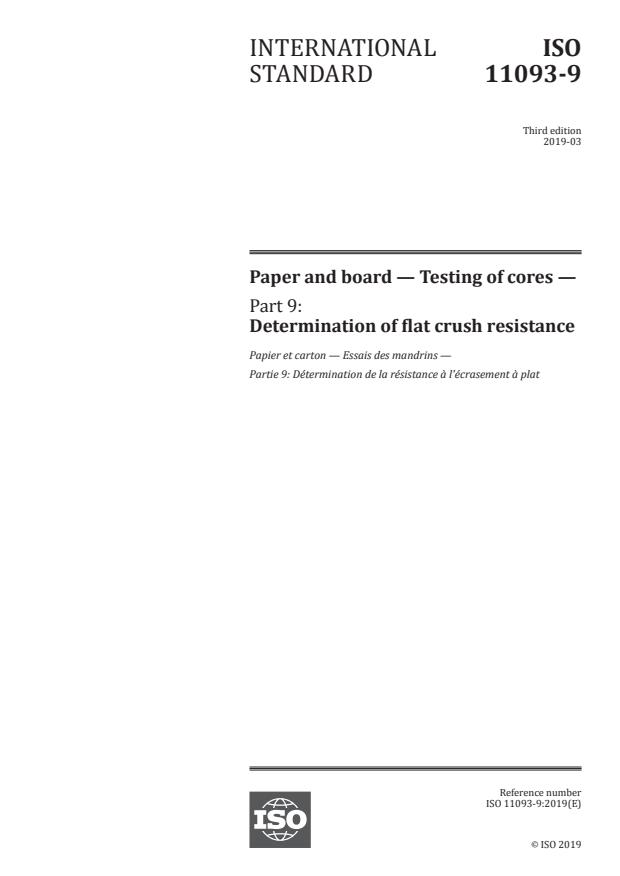
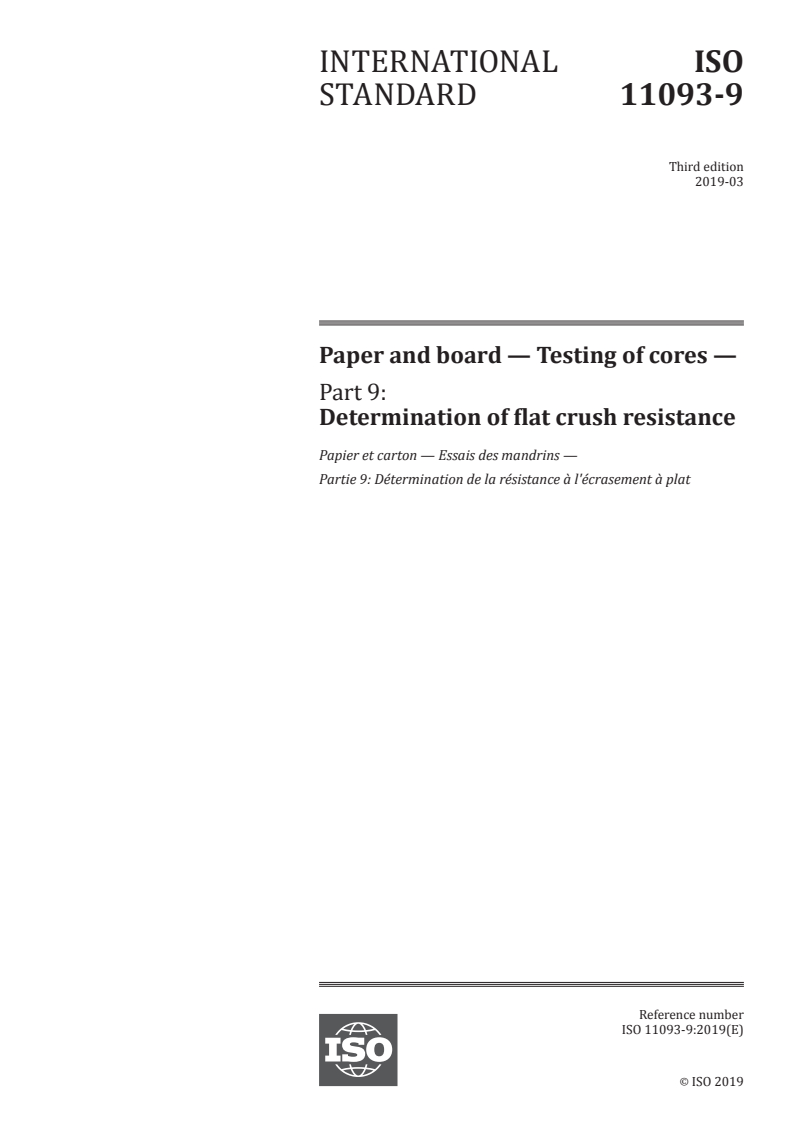
INTERNATIONAL ISO
STANDARD 11093-9
Third edition
2019-03
Paper and board — Testing of cores —
Part 9:
Determination of flat crush resistance
Papier et carton — Essais des mandrins —
Partie 9: Détermination de la résistance à l'écrasement à plat
Reference number
©
ISO 2019
© ISO 2019
All rights reserved. Unless otherwise specified, or required in the context of its implementation, no part of this publication may
be reproduced or utilized otherwise in any form or by any means, electronic or mechanical, including photocopying, or posting
on the internet or an intranet, without prior written permission. Permission can be requested from either ISO at the address
below or ISO’s member body in the country of the requester.
ISO copyright office
CP 401 • Ch. de Blandonnet 8
CH-1214 Vernier, Geneva
Phone: +41 22 749 01 11
Fax: +41 22 749 09 47
Email: copyright@iso.org
Website: www.iso.org
Published in Switzerland
ii © ISO 2019 – All rights reserved
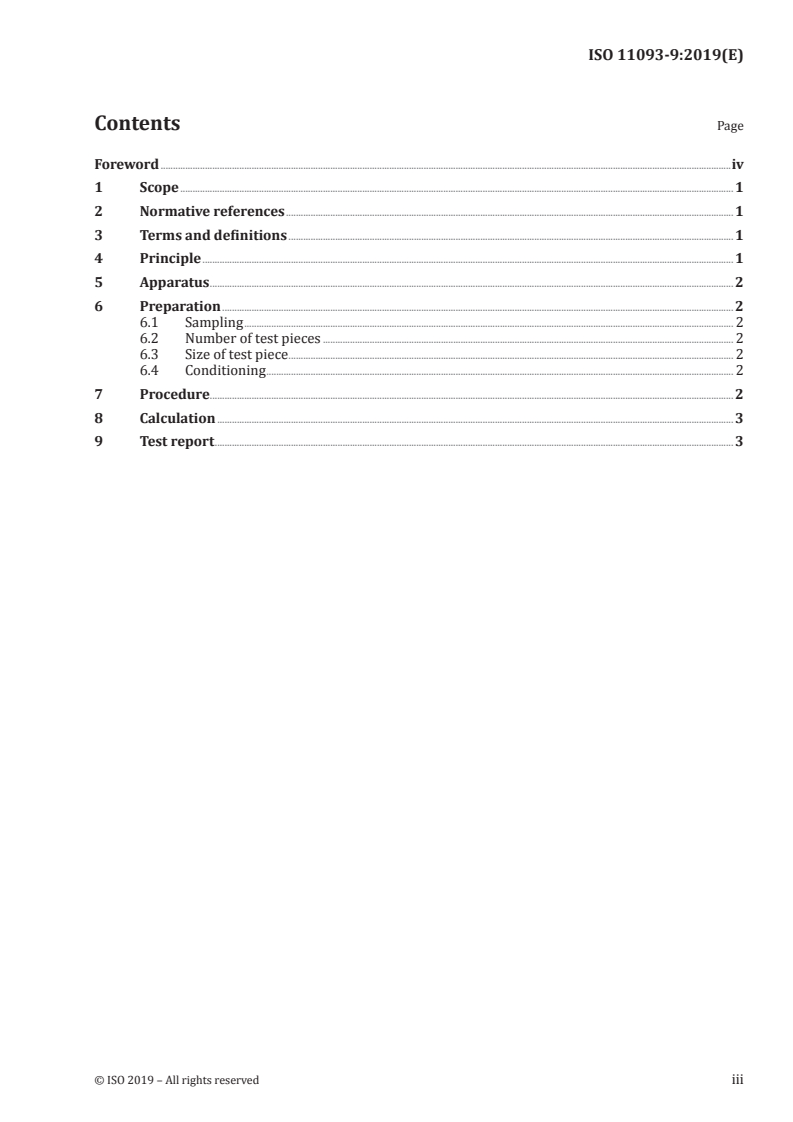
Contents Page
Foreword .iv
1 Scope . 1
2 Normative references . 1
3 Terms and definitions . 1
4 Principle . 1
5 Apparatus . 2
6 Preparation . 2
6.1 Sampling . 2
6.2 Number of test pieces . 2
6.3 Size of test piece . 2
6.4 Conditioning . 2
7 Procedure. 2
8 Calculation . 3
9 Test report . 3
Foreword
ISO (the International Organization for Standardization) is a worldwide federation of national standards
bodies (ISO member bodies). The work of preparing International Standards is normally carried out
through ISO technical committees. Each member body interested in a subject for which a technical
committee has been established has the right to be represented on that committee. International
organizations, governmental and non-governmental, in liaison with ISO, also take part in the work.
ISO collaborates closely with the International Electrotechnical Commission (IEC) on all matters of
electrotechnical standardization.
The procedures used to develop this document and those intended for its further maintenance are
described in the ISO/IEC Directives, Part 1. In particular, the different approval criteria needed for the
different types of ISO documents should be noted. This document was drafted in accordance with the
editorial rules of the ISO/IEC Directives, Part 2 (see www. iso. org/directives).
Attention is drawn to the possibility that some of the elements of this document may be the subject of
patent rights. ISO shall not be held responsible for identifying any or all such patent rights. Details of
any patent rights identified during the development of the document will be in the Introduction and/or
on the ISO list of patent declarations received (see www. iso.o rg/patents).
Any trade name used in this document is information given for the convenience of users and does not
constitute an endorsement.
For an explanation of the voluntary nature of standards, the meaning of ISO specific terms and
expressions related to conformity assessment, as well as information about ISO's adherence to the
World Trade Organization (WTO) principles in the Technical Barriers to Trade (TBT) see www. iso
.org/iso/foreword. html.
This document was prepared by Technical Committee ISO/TC 6, Paper, board and pulps.
This third edition cancels and replaces the second edition (ISO 11093-9:2006), of which it constitutes a
minor revision.
The changes compared to the previous edition are as follows:
— A note has been added to the scope, stating that if the wall thic
...
INTERNATIONAL ISO
STANDARD 11093-9
Third edition
2019-03
Paper and board — Testing of cores —
Part 9:
Determination of flat crush resistance
Papier et carton — Essais des mandrins —
Partie 9: Détermination de la résistance à l'écrasement à plat
Reference number
©
ISO 2019
© ISO 2019
All rights reserved. Unless otherwise specified, or required in the context of its implementation, no part of this publication may
be reproduced or utilized otherwise in any form or by any means, electronic or mechanical, including photocopying, or posting
on the internet or an intranet, without prior written permission. Permission can be requested from either ISO at the address
below or ISO’s member body in the country of the requester.
ISO copyright office
CP 401 • Ch. de Blandonnet 8
CH-1214 Vernier, Geneva
Phone: +41 22 749 01 11
Fax: +41 22 749 09 47
Email: copyright@iso.org
Website: www.iso.org
Published in Switzerland
ii © ISO 2019 – All rights reserved
Contents Page
Foreword .iv
1 Scope . 1
2 Normative references . 1
3 Terms and definitions . 1
4 Principle . 1
5 Apparatus . 2
6 Preparation . 2
6.1 Sampling . 2
6.2 Number of test pieces . 2
6.3 Size of test piece . 2
6.4 Conditioning . 2
7 Procedure. 2
8 Calculation . 3
9 Test report . 3
Foreword
ISO (the International Organization for Standardization) is a worldwide federation of national standards
bodies (ISO member bodies). The work of preparing International Standards is normally carried out
through ISO technical committees. Each member body interested in a subject for which a technical
committee has been established has the right to be represented on that committee. International
organizations, governmental and non-governmental, in liaison with ISO, also take part in the work.
ISO collaborates closely with the International Electrotechnical Commission (IEC) on all matters of
electrotechnical standardization.
The procedures used to develop this document and those intended for its further maintenance are
described in the ISO/IEC Directives, Part 1. In particular, the different approval criteria needed for the
different types of ISO documents should be noted. This document was drafted in accordance with the
editorial rules of the ISO/IEC Directives, Part 2 (see www. iso. org/directives).
Attention is drawn to the possibility that some of the elements of this document may be the subject of
patent rights. ISO shall not be held responsible for identifying any or all such patent rights. Details of
any patent rights identified during the development of the document will be in the Introduction and/or
on the ISO list of patent declarations received (see www. iso.o rg/patents).
Any trade name used in this document is information given for the convenience of users and does not
constitute an endorsement.
For an explanation of the voluntary nature of standards, the meaning of ISO specific terms and
expressions related to conformity assessment, as well as information about ISO's adherence to the
World Trade Organization (WTO) principles in the Technical Barriers to Trade (TBT) see www. iso
.org/iso/foreword. html.
This document was prepared by Technical Committee ISO/TC 6, Paper, board and pulps.
This third edition cancels and replaces the second edition (ISO 11093-9:2006), of which it constitutes a
minor revision.
The changes compared to the previous edition are as follows:
— A note has been added to the scope, stating that if the wall thic
...